neco model questions vol1 2019 geography | Objective

Prepare for your exams with neco model questions vol1 questions? Reviewing past/model questions is one of the most effective ways to guarantee a high score. This practice hub features authentic 2019 geography (Objective) questions designed to simulate the real exam environment.

Practice these randomly selected questions to test your readiness.
Question 1 View Details
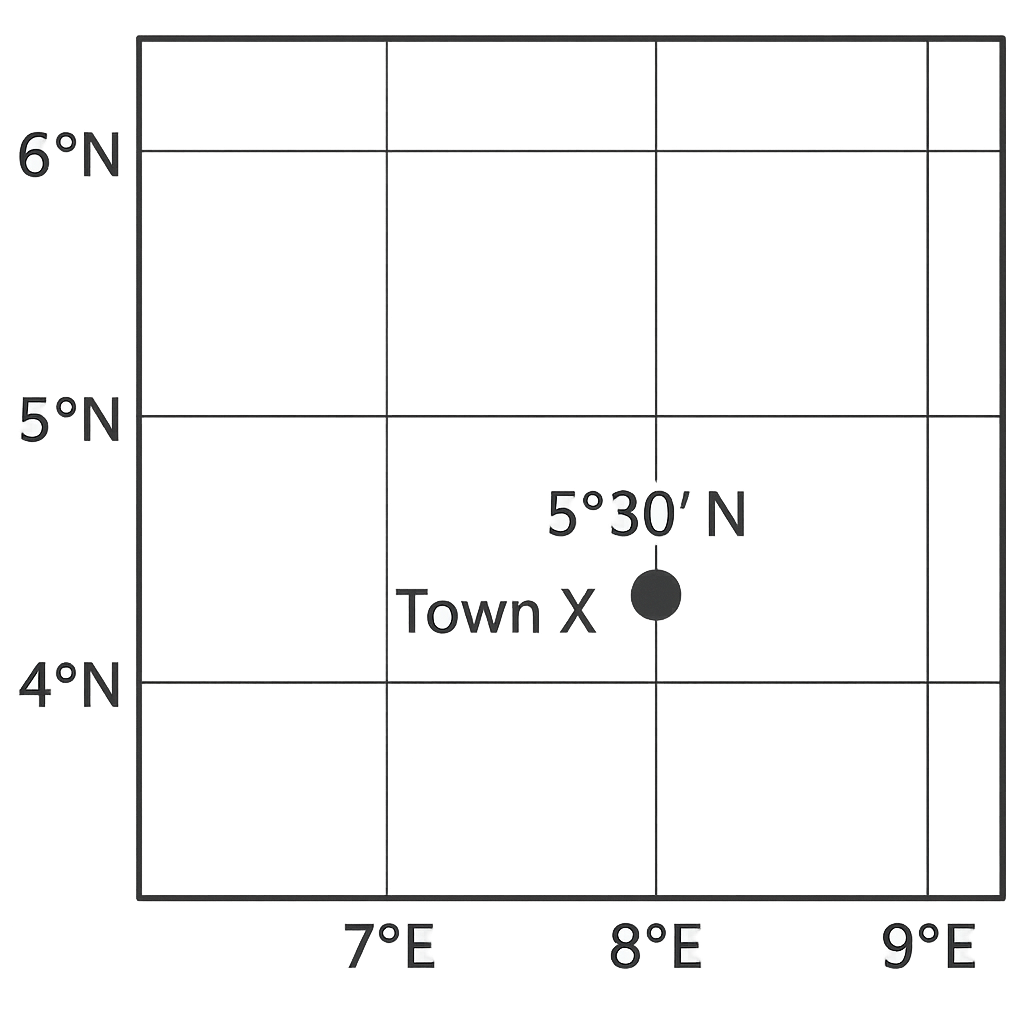
The map shows latitude lines from 4°N to 6°N and longitude lines from 7°E to 9°E. A town is marked at the intersection of the 5°30' N latitude line and the 8°15' E longitude line. State the coordinates of the town in degrees, minutes and cardinal directions.
A. 5°30' N, 8°15' W
B. 5°30' S, 8°15' E
Correct C. 5°30' N, 8°15' E
D. 5°31' N, 8°15' E

Correct Answer: C

Want to see the full step-by-step solution? Unlock AI Explanation & Analytics
Question 2 View Details
Two alternative routes connect City A to City B. Route 1: 120 km long, speed limit 80 km/h, and a compulsory 15‑minute traffic jam exactly halfway. Route 2: 150 km long, speed limit 100 km/h, but a 30‑km stretch has a 20 % speed reduction because of road condition. Fuel consumption rates are 8 L per 100 km at 80 km/h, 10 L per 100 km at 100 km/h, and 9 L per 100 km on the reduced‑speed stretch. (a) Which route gives the shortest travel time? (b) Which route uses the least fuel? State the answer in the form "Shortest time: …; Least fuel: …".
A. Shortest time: Route 1; Least fuel: Route 1
Correct B. Shortest time: Route 2; Least fuel: Route 1
C. Shortest time: Route 2; Least fuel: Route 2
D. Shortest time: Route 1; Least fuel: Route 2

Correct Answer: B

Want to see the full step-by-step solution? Unlock AI Explanation & Analytics
Question 3 View Details
A soil sample has the following properties: sand 40 %, silt 35 %, clay 25 %, organic matter 3 %, pH 6.5, bulk density 1.4 g cm⁻³, wilting point water content 12 % (by weight) and saturation water content 30 % (by weight).\n\n(a) Identify the soil texture class using the USDA triangle.\n(b) Estimate the field capacity, assuming it is approximately midway between wilting point and saturation.\n(c) Based on the texture and pH, state whether the soil is suitable for growing maize and give a brief justification.
A. a) Silt loam; b) 18 % (by weight); c) Not suitable for maize - silt loam, pH 6.5 and poor drainage.
B. a) Sandy loam; b) 19 % (by weight); c) Not suitable for maize - sandy texture, pH 6.5 and low field capacity.
C. a) Clay loam; b) 24 % (by weight); c) Not suitable for maize - clay loam texture, pH 6.5 and water‑logging risk.
Correct D. a) Loam; b) 21 % (by weight); c) Suitable for maize - loam texture, pH 6.5 and adequate field capacity.

Correct Answer: D

Want to see the full step-by-step solution? Unlock AI Explanation & Analytics
Question 4 View Details
A town had a population of 45 000 in the year 2000. From 2000 to 2009 the population grew at 2.5 % per year (compounded). Beginning in 2010 a net migration loss of 1 % per year reduced the effective growth rate to 1.5 % per year. In 2020 a new housing scheme added 5 000 houses, each intended for 5 persons. In 2000 the town possessed 8 000 houses; each year 2 % of the existing houses become uninhabitable and are removed.\n\n(a) Estimate the town's population in 2025.\n(b) Determine the number of houses available in 2025, taking into account the yearly 2 % loss and the 2020 addition.\n(c) Assuming each house can accommodate 5 persons, calculate the housing deficit (or surplus) in 2025 and state whether the town will have enough houses for its population.
A. Population ≈ 75 500; Houses available ≈ 9 500; Deficit ≈ 6 000 houses (insufficient)
Correct B. Population ≈ 73 100; Houses available ≈ 9 250; Deficit ≈ 5 370 houses (insufficient)
C. Population ≈ 71 200; Houses available ≈ 9 100; Deficit ≈ 5 100 houses (insufficient)
D. Population ≈ 68 000; Houses available ≈ 8 800; Deficit ≈ 4 900 houses (insufficient)

Correct Answer: B

Want to see the full step-by-step solution? Unlock AI Explanation & Analytics
Question 5 View Details
A river descends from an elevation of 800 m at its source to 200 m at its mouth over a straight‑line distance of 120 km. The river is divided into three consecutive sections: upper (first 40 km), middle (next 50 km) and lower (last 30 km). The gradient of the upper section is 5 m km⁻¹ and that of the lower section is 1 m km⁻¹.\n\n(a) Determine the gradient of the middle section.\n(b) Classify each section as "steep", "moderate" or "gentle" using the criteria: steep > 4 m km⁻¹, moderate 2-4 m km⁻¹, gentle < 2 m km⁻¹.\n(c) Identify the predominant landform associated with each section (e.g., V‑shaped valley, meander plain, floodplain).
Correct A. Middle gradient = 7.4 m km⁻¹; Upper - steep (V‑shaped valley); Middle - steep (V‑shaped valley/gorge); Lower - gentle (floodplain or meander plain).
B. Middle gradient = 8.2 m km⁻¹; Upper - moderate (V‑shaped valley); Middle - steep (V‑shaped valley/gorge); Lower - gentle (floodplain or meander plain).
C. Middle gradient = 7.4 m km⁻¹; Upper - steep (V‑shaped valley); Middle - steep (meander plain); Lower - moderate (floodplain or meander plain).
D. Middle gradient = 6.0 m km⁻¹; Upper - steep (V‑shaped valley); Middle - moderate (meander plain); Lower - gentle (floodplain).

Correct Answer: A

Want to see the full step-by-step solution? Unlock AI Explanation & Analytics
Question 6 View Details
City A lies at longitude (5^{\circ}\text{E}\). The local solar time in City A is 2 hours 30 minutes ahead of the local solar time in City B. Assuming the Earth rotates uniformly, determine the longitude of City B in degrees, minutes, and direction (E or W).
Correct A. 32°30' W
B. 32°30' E
C. 31°45' W
D. 33°00' W

Correct Answer: A

Want to see the full step-by-step solution? Unlock AI Explanation & Analytics
Question 7 View Details
A town had a population of 1,200,000 in the year 2020. Its annual birth rate was 28 per 1,000, the death rate 12 per 1,000 and net migration was -4 per 1,000 (more people left than arrived). Assuming these rates remain constant and that population changes compound yearly, estimate the population at the end of 2025.
Correct A. 1,273,800
B. 1,300,200
C. 1,285,400
D. 1,260,000

Correct Answer: A

Want to see the full step-by-step solution? Unlock AI Explanation & Analytics
Question 8 View Details
The temperature at a weather station is (5^{\circ}\text{C}\) and the wind speed is 30 km/h. Using the wind‑chill formula \(T_{wc}=13.12+0.6215T-11.37v^{0.16}+0.3965Tv^{0.16}\) (where \(T\) is in °C and \(v\) in km/h), calculate the wind‑chill temperature to the nearest whole degree Celsius.
A. -5°C
B. -2°C
Correct C. 0°C
D. 2°C

Correct Answer: C

Want to see the full step-by-step solution? Unlock AI Explanation & Analytics
Question 9 View Details
A rock sample consists of 40 % quartz (density 2.65 g/cm³), 35 % feldspar (2.55 g/cm³), 15 % mica (2.80 g/cm³) and 10 % amphibole (3.00 g/cm³). Assuming the minerals are packed without voids, calculate the bulk density of the rock and identify the most likely rock type among granite (2.65-2.75 g/cm³), gneiss (2.70-2.80 g/cm³) and basalt (2.90-3.00 g/cm³).
Correct A. Granite
B. Gneiss
C. Basalt
D. Diorite

Correct Answer: A

Want to see the full step-by-step solution? Unlock AI Explanation & Analytics
Question 10 View Details
A country has a total population of 8,500,000. The age distribution is: 0-14 years 30 %, 15-64 years 60 %, and 65 + years 10 %. Compute the dependency ratio (young + old dependents per 100 working‑age persons) and state whether it is classified as a high dependency ratio (greater than 55 per 100).
A. 78 per 100 (high dependency)
Correct B. 67 per 100 (high dependency)
C. 55 per 100 (low dependency)
D. 45 per 100 (low dependency)

Correct Answer: B

Want to see the full step-by-step solution? Unlock AI Explanation & Analytics
Question 11 View Details
An industrial region had two major sectors, A and B. In 2015 sector A's output was ₦1 200 million and sector B's output was ₦800 million. From 2015 up to and including 2020 sector A grew at \(5\%\) per year and sector B at \(3\%\) per year. Beginning in 2021 a policy changed the growth rates: sector A now grows at \(2\%\) per year while sector B grows at \(4\%\) per year. In which calendar year will sector B's output first become greater than sector A's output? Give the year as a four‑digit number.
A. 2044
B. 2052
C. 2038
Correct D. 2046

Correct Answer: D

Want to see the full step-by-step solution? Unlock AI Explanation & Analytics
Question 12 View Details
Town A lies 30 km east of a north‑south river. Town B lies 40 km west of the same river and 20 km north of Town A. A bridge of length 200 m spans the river at a point directly opposite on the two banks. A road runs from Town A to the east‑bank end of the bridge, and another road runs from the west‑bank end of the bridge to Town B. The roads are straight. A vehicle travels on the roads at \(60\) km h\(^{-1}\) and crosses the bridge at \(30\) km h\(^{-1}\). Assuming the bridge is placed at the altitude that minimises total travel distance, what is the total travel time in minutes, rounded to one decimal place?
A. 24.0
B. 23.6
Correct C. 22.8
D. 21.4

Correct Answer: C

Want to see the full step-by-step solution? Unlock AI Explanation & Analytics
Question 13 View Details
In a tropical region the mean annual rainfall at sea level is 1500 mm and the mean temperature is 28 °C. For every increase of 100 m in altitude, rainfall decreases by 50 mm and temperature falls by 0.6 °C. Tropical rainforest occurs where rainfall > 1200 mm and temperature > 26 °C; savanna occurs where rainfall is between 800 mm and 1200 mm inclusive and temperature is between 22 °C and 26 °C inclusive. Determine the minimum altitude (in metres) at which the vegetation changes from rainforest to savanna.
Correct A. 600
B. 500
C. 900
D. 700

Correct Answer: A

Want to see the full step-by-step solution? Unlock AI Explanation & Analytics
Question 14 View Details
A student must travel from City X to City Z for an exam that starts at 9:00 am. The journey consists of a train from X to Y followed by a bus from Y to Z. - The train departs X at a time to be chosen, travels 180 km at an average speed of 80 km h\(^{-1}\) and makes a 10‑minute stop at an intermediate station. - After the train arrives at Y the student must wait at least 15 minutes before boarding a bus. - Buses leave Y every half‑hour on the hour and half‑hour (e.g., 7:00, 7:30, 8:00 …). - The bus covers 120 km. For the first 40 km the speed is reduced by 10 % because of traffic; the remaining 80 km are travelled at the normal 60 km h\(^{-1}\). What is the latest possible departure time of the train (in 24‑hour format hh:mm) that still allows the student to reach City Z before 9:00 am?
A. 04:00
Correct B. 03:50
C. 03:40
D. 03:55

Correct Answer: B

Want to see the full step-by-step solution? Unlock AI Explanation & Analytics
Question 15 View Details
The following table gives the average monthly temperature (°C) and precipitation (mm) for a location: | Month | Temp (°C) | Precip (mm) | |-------|----------|-------------| | Jan | 28 | 12 | | Feb | 30 | 8 | | Mar | 32 | 5 | | Apr | 33 | 2 | | May | 31 | 1 | | Jun | 29 | 0 | | Jul | 27 | 0 | | Aug | 26 | 1 | | Sep | 27 | 3 | | Oct | 28 | 6 | | Nov | 29 | 9 | | Dec | 28 | 11 | According to the Köppen climate classification: - A tropical rainforest climate (Af) requires precipitation \(\ge 60\) mm in every month. - A tropical monsoon climate (Am) requires the driest month to have precipitation < 60 mm but \(\ge 100 - \frac{\text{annual precipitation}}{25}\) mm. - A tropical savanna climate (Aw) applies when the driest month has precipitation < 60 mm and is less than the value above. All months have mean temperature above 18 °C. Determine the Köppen climate type (Af, Am or Aw) for this location.
A. Am
Correct B. Aw
C. Af
D. Cw

Correct Answer: B

Want to see the full step-by-step solution? Unlock AI Explanation & Analytics
Question 16 View Details
Over a five‑day period a weather station recorded the following maximum and minimum temperatures (in \(^{\circ}\!C\)): Day 1: max 32, min 22; Day 2: max 30, min 20; Day 3: max 35, min 24; Day 4: max 31, min 21; Day 5: max 33, min 23. (a) Find the average daily temperature for the period (the mean of the max and min for each day, then averaged over the five days). (b) Using the average temperature obtained in (a), estimate the average saturation vapour pressure \(e_s\) (in hPa) with the approximation \(e_s = 6.11 \times 10^{\frac{7.5T}{237.3+T}}\). (c) If the actual vapour pressure measured during the period was 12 hPa, calculate the relative humidity (to the nearest whole percent).
Correct A. 34%
B. 32%
C. 36%
D. 30%

Correct Answer: A

Want to see the full step-by-step solution? Unlock AI Explanation & Analytics
Question 17 View Details
A manufacturing firm is choosing a location for a new factory. Three sites (A, B, C) are evaluated on three cost criteria: transport cost (₦ per ton·km), labour cost (₦ per worker per month) and power cost (₦ per kWh). The decision‑making weights are 0.5 for transport, 0.3 for labour and 0.2 for power (lower cost is preferred). The data are: - Site A: transport 0.08, labour 45 000, power 12\n- Site B: transport 0.06, labour 48 000, power 10\n- Site C: transport 0.07, labour 44 000, power 13 Using the factor‑rating method with normalisation (the lowest cost for each criterion receives a normalised value of 1, other sites receive lowest / their cost), compute the weighted score for each site and state which site should be selected.
Correct A. Site B
B. Site A
C. Site C
D. Site D

Correct Answer: A

Want to see the full step-by-step solution? Unlock AI Explanation & Analytics
Question 18 View Details
In 2010 a town had a population of 45 000. By 2015 the population had risen to 52 500. The town occupies an area of 30 km². (a) Assuming the population grew at a constant compound annual rate, determine that annual growth rate (as a percent, to one decimal place). (b) Calculate the population density (persons per km²) in 2015. (c) If the town wishes to keep its density below 2 000 persons per km², what is the maximum population it can sustain without expanding its area?
Correct A. 3.1%; 1750 persons/km²; 60000
B. 3.5%; 1700 persons/km²; 62000
C. 3.0%; 1750 persons/km²; 59000
D. 2.9%; 1800 persons/km²; 58000

Correct Answer: A

Want to see the full step-by-step solution? Unlock AI Explanation & Analytics
Question 19 View Details
A small catchment of 12 ha has a runoff coefficient of 0.45. For a 10‑year return‑period storm the design rainfall intensity is 45 mm h⁻¹. (a) Using the Rational method \(Q = C i A\) (with \(Q\) in m³ s⁻¹, \(i\) in mm h⁻¹ and \(A\) in ha), compute the peak discharge. (Use the conversion factor 0.00278.) (b) The engineer decides to convey the flow in a rectangular open channel whose width equals its depth (b = d). The channel slope is 0.001 and Manning's roughness coefficient is 0.015. Using Manning's equation, determine the required width (and depth) of the channel (in metres, to two decimal places).
Correct A. 0.68 m³/s; 0.86 m
B. 0.68 m³/s; 0.80 m
C. 0.55 m³/s; 0.78 m
D. 0.75 m³/s; 0.92 m

Correct Answer: A

Want to see the full step-by-step solution? Unlock AI Explanation & Analytics
Question 20 View Details
A community located near a river is exposed to flooding. The probability of a flood occurring in any given year is 0.02 (2 %). If a flood occurs, the estimated consequences are: - Economic loss: ₦150 million - Health impact: 2 000 person‑days of illness, valued at ₦5 000 per person‑day - Environmental damage: ₦30 million For a composite risk assessment the following weighting factors are applied: economic 0.5, health 0.3, environmental 0.2. (a) Calculate the expected annual loss for each component. (b) Compute the overall weighted risk value. (c) If the management threshold for action is a risk value of ₦5 million, should mitigation measures be implemented?
Correct A. ₦1.68 million; No mitigation required
B. ₦0.84 million; No mitigation required
C. ₦1.68 million; Mitigation required
D. ₦2.10 million; No mitigation required

Correct Answer: A

Want to see the full step-by-step solution? Unlock AI Explanation & Analytics
Question 21 View Details
Hazard A occurs (4) times per year with an average damage of \(\text{₦}250{,}000\) per incident. A mitigation measure reduces its frequency by (30\%\) and costs \(\text{₦}150{,}000\) per year. Hazard B occurs (2) times per year with an average damage of \(\text{₦}500{,}000\) per incident. A different mitigation reduces the damage per incident by (20\%\) (damage becomes (80\%\) of original) and costs \(\text{₦}200{,}000\) per year. Assuming the only benefit of each mitigation is the reduction in expected annual loss, which mitigation provides the greater net benefit (reduction in expected loss minus its annual cost)?
Correct A. Mitigation of Hazard A provides the greater net benefit.
B. Neither mitigation provides a net benefit.
C. Mitigation of Hazard B provides the greater net benefit.
D. Both mitigations provide equal net benefit.

Correct Answer: A

Want to see the full step-by-step solution? Unlock AI Explanation & Analytics
Question 22 View Details
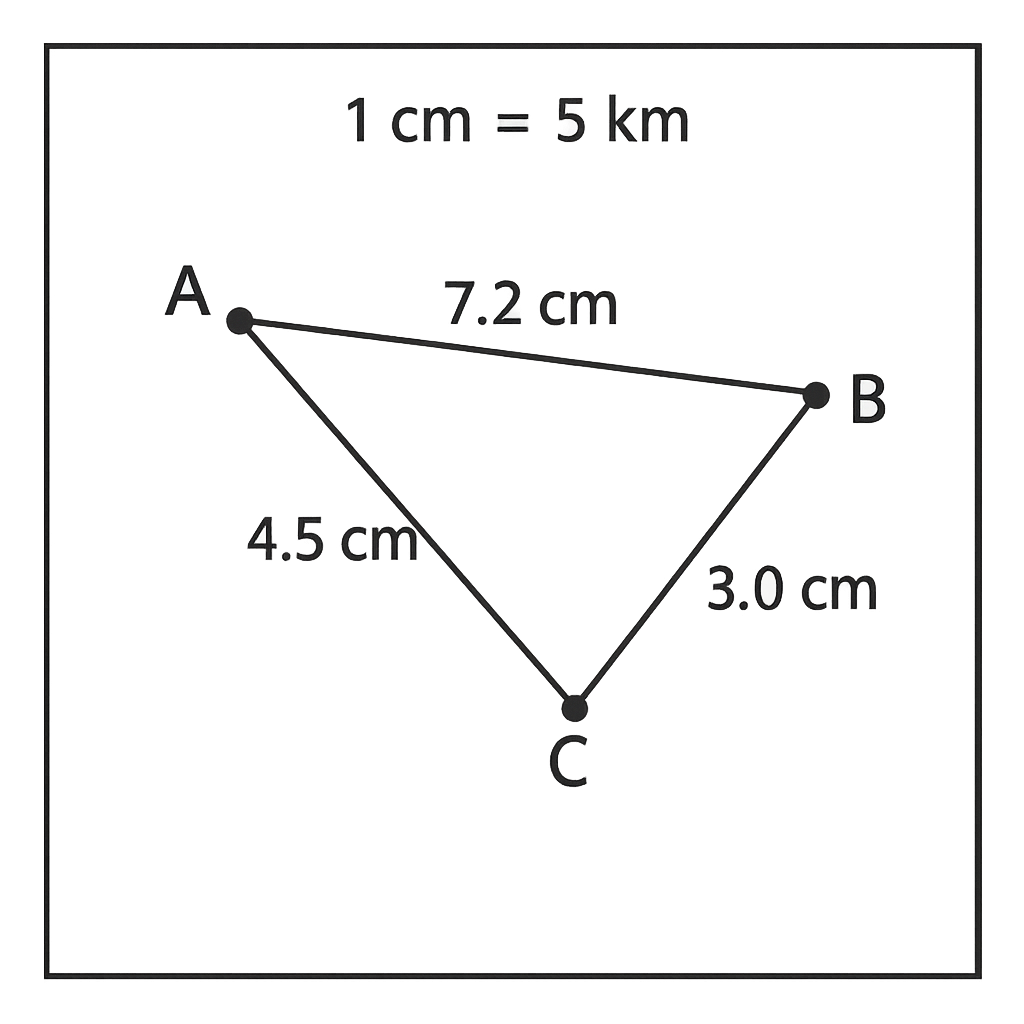
A schematic map shows three towns A, B and C. The straight‑line distance between A and B is marked as (7.2\) cm. A road from A to C is marked (4.5\) cm and from C to B (3.0\) cm. The map scale is (1\) cm : (5\) km. What is the additional distance in kilometres that a traveller would cover by using the road A‑C‑B instead of the straight line A‑B?
A. 1.0 km
B. 2.0 km
C. 0.8 km
Correct D. 1.5 km

Correct Answer: D

Want to see the full step-by-step solution? Unlock AI Explanation & Analytics
Question 23 View Details
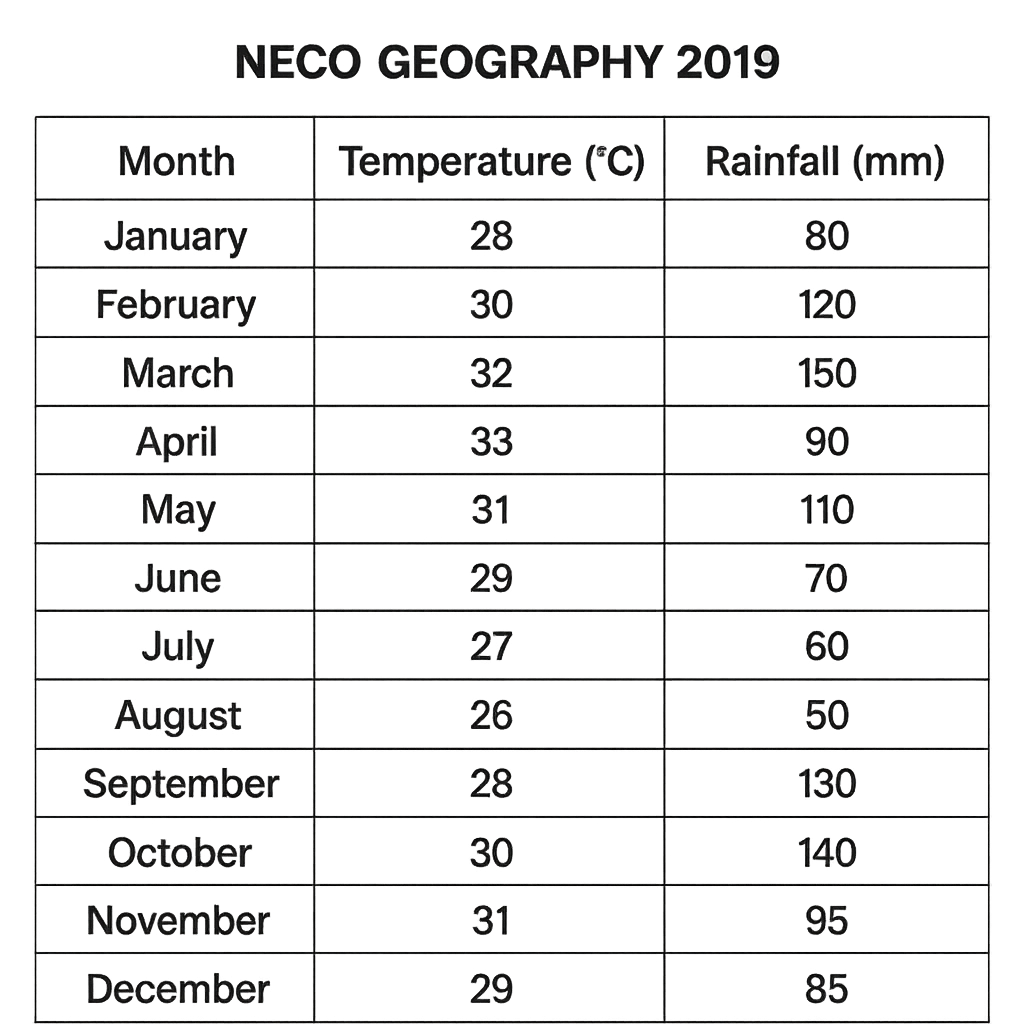
The diagram presents the average monthly temperature (°C) and rainfall (mm) for a region. The data are:\n\nJanuary: 28 °C, 80 mm\nFebruary: 30 °C, 120 mm\nMarch: 32 °C, 150 mm\nApril: 33 °C, 90 mm\nMay: 31 °C, 110 mm\nJune: 29 °C, 70 mm\nJuly: 27 °C, 60 mm\nAugust: 26 °C, 50 mm\nSeptember: 28 °C, 130 mm\nOctober: 30 °C, 140 mm\nNovember: 31 °C, 95 mm\nDecember: 29 °C, 85 mm\n\nIdentify the months in which rainfall exceeds 100 mm and calculate the average temperature of those months. Give your answer in °C to one decimal place.
A. 31.0 °C
Correct B. 30.2 °C
C. 28.6 °C
D. 29.8 °C

Correct Answer: B

Want to see the full step-by-step solution? Unlock AI Explanation & Analytics
Question 24 View Details
A settlement has a population of 12,500 people. It possesses a secondary school, a hospital and a central market. According to the NECO classification, a village has fewer than 5,000 inhabitants, a town has between 5,000 and 20,000 inhabitants and must have at least a secondary school and a market, while a city has more than 20,000 inhabitants and must have a university and a major hospital. Classify the settlement as a village, town or city.
A. village
B. city
Correct C. town
D. metropolis

Correct Answer: C

Want to see the full step-by-step solution? Unlock AI Explanation & Analytics
Question 25 View Details
A bus travels from point A to D via B and C. The distances are AB = 60 km, BC = 40 km, CD = 80 km. Speed limits are 60 km/h on AB, 40 km/h on BC and 80 km/h on CD. The bus stops for 5 minutes at B and 8 minutes at C. An alternative direct route from A to D is 150 km long with a speed limit of 70 km/h and no stops. Which route results in the shorter total travel time? State the route (A‑B‑C‑D or direct A‑D) and give the total travel time in hours (rounded to two decimal places).
A. A‑B‑C‑D route, 2.31 hours
B. Direct A‑D route, 2.05 hours
C. A‑B‑C‑D route, 2.14 hours
Correct D. Direct A‑D route, 2.14 hours

Correct Answer: D

Want to see the full step-by-step solution? Unlock AI Explanation & Analytics

Master the Exam!

You've seen a preview, but there are thousands more questions plus AI tutor to break down complex solutions.

Unlock Full Access Available for Android & Windows
Help others prepare! Share this practice hub:
Chat with Support