neco 2024 chemistry | Essay

Prepare for your exams with neco questions? Reviewing past/model questions is one of the most effective ways to guarantee a high score. This practice hub features authentic 2024 chemistry (Essay) questions designed to simulate the real exam environment.

Practice these randomly selected questions to test your readiness.
Question 1 View Details
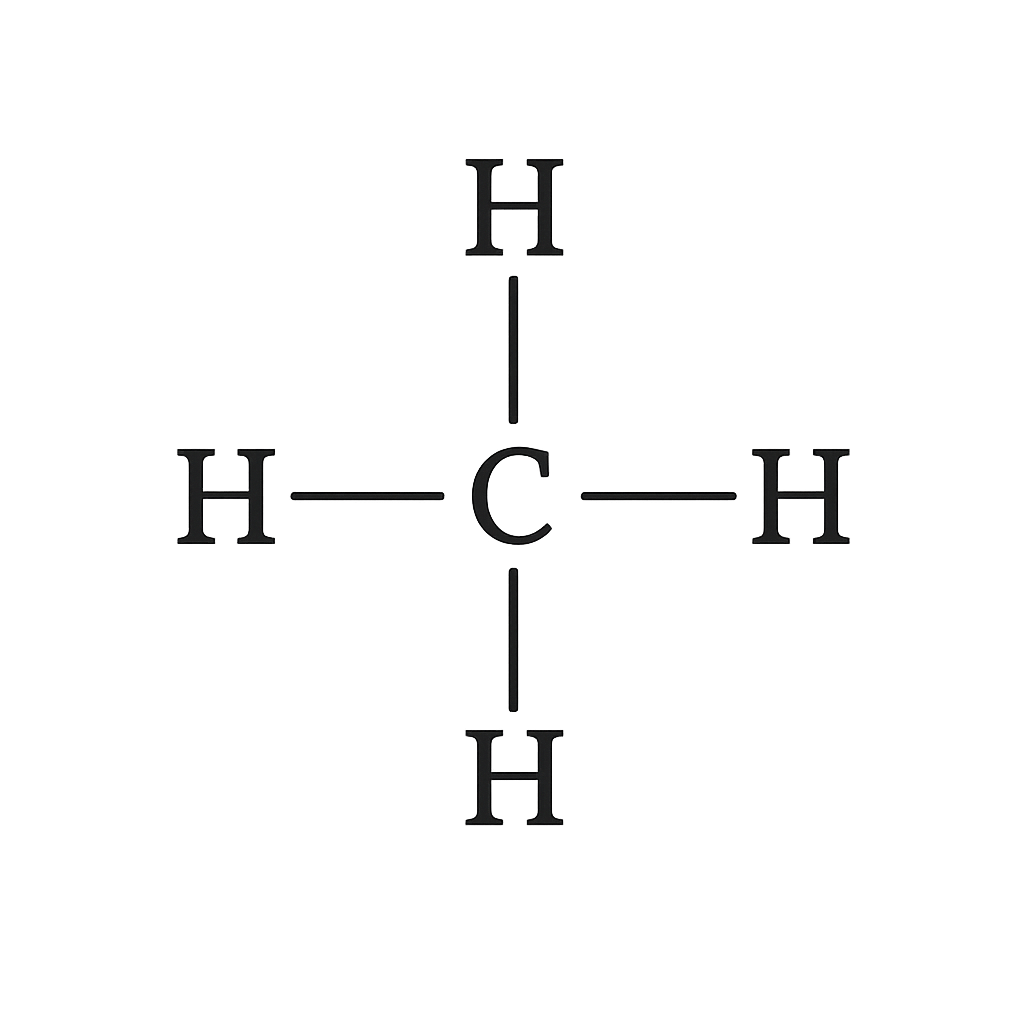
The diagram shows the Lewis structure of a simple covalent molecule.
Question Parts
(a)
Identify the central atom in the molecule and state its oxidation number.
(b)
Using VSEPR theory, describe the molecular geometry and give the approximate bond angle.
(c)
Write the balanced chemical equation for the complete combustion of this molecule in excess oxygen. Then calculate the mass of carbon dioxide produced when 16.0 g of the molecule is burnt. (Molar masses: C = 12.01 g mol⁻¹, H = 1.008 g mol⁻¹, O = 16.00 g mol⁻¹).
Detailed Essay Solution & Marking Scheme Available

Get the step-by-step mathematical proofs, key points required by examiners, and a comprehensive breakdown from our AI Tutor.
Question 2 View Details
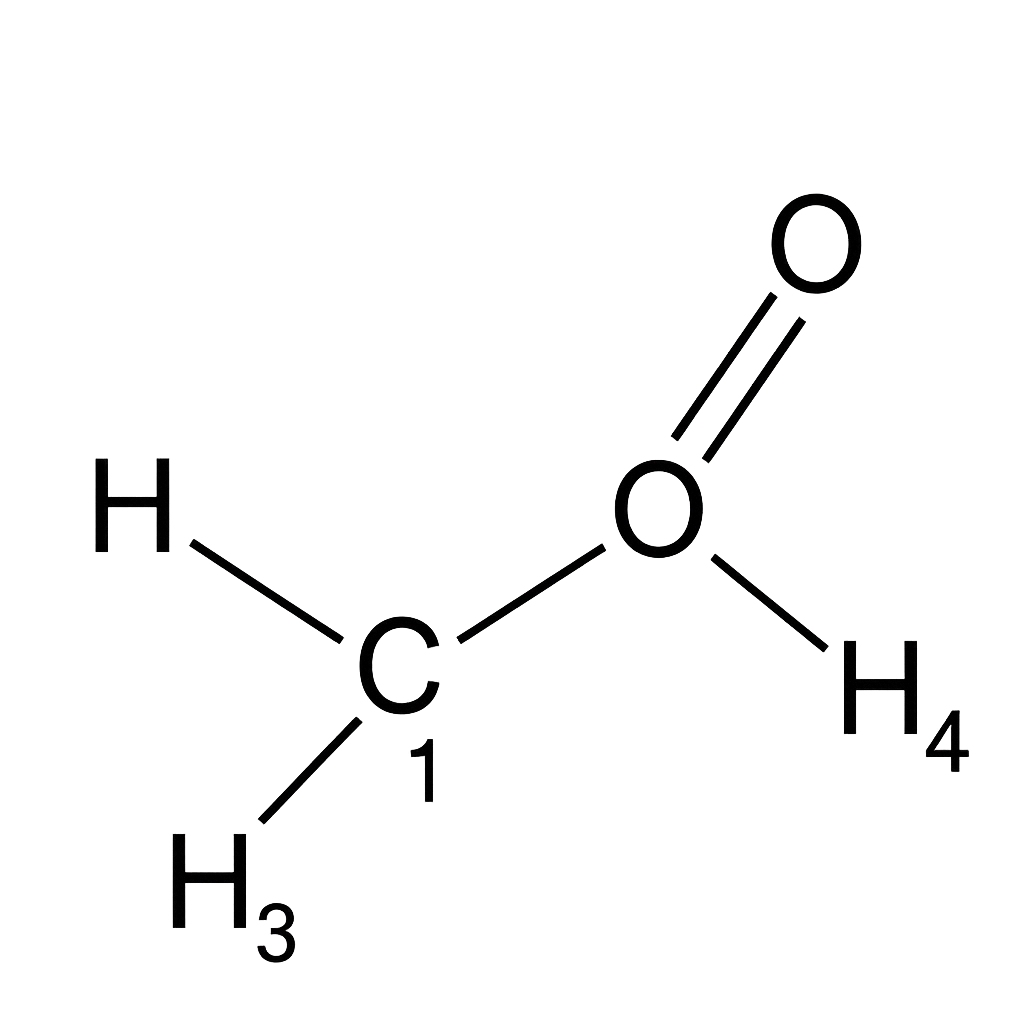
The diagram shows the Lewis structure of methanol, \(\text{CH}_{3}\text{OH}\).
Question Parts
(a)
Identify the central atom in the molecule and state its group number and period in the periodic table.
(b)
Discuss the type of bond formed between the central carbon atom and the attached oxygen atom. Justify your answer using electronegativity values.
(c)
Compare the acidity of methanol with that of water. Using periodic trends, explain which of the two is the stronger acid and why.
(d)
When methanol combusts completely in oxygen it forms carbon dioxide and water.\n(i) Write the balanced chemical equation for the combustion of methanol.\n(ii) Calculate the number of moles present in 1.00 g of methanol.\n(iii) Using the stoichiometry of the balanced equation, determine the mass of carbon dioxide produced from 1.00 g of methanol. (Molar masses: C = 12.01 g mol⁻¹, H = 1.008 g mol⁻¹, O = 16.00 g mol⁻¹).
() Balanced combustion equation.
() Moles of methanol in 1.00 g.
() Mass of CO₂ produced.
Detailed Essay Solution & Marking Scheme Available

Get the step-by-step mathematical proofs, key points required by examiners, and a comprehensive breakdown from our AI Tutor.
Question 3 View Details
Element A has an electronegativity of 2.1 and forms a compound AB₂ in which the central atom A is surrounded by two identical atoms B each having an electronegativity of 3.0. The compound adopts a trigonal planar arrangement around A. Using this information:
Question Parts
(a)
State the type of bond that exists between A and B and justify your answer.
(b)
Calculate the percent ionic character of the A–B bond using the formula \( \%IC = (1 - e^{-0.25(\Delta\chi)^2}) \times 100 \). Give your answer to one decimal place.
(c)
Explain why AB₂ is expected to have a higher boiling point than a comparable compound in which the electronegativity difference between the central atom and its ligands is only 0.4.
Detailed Essay Solution & Marking Scheme Available

Get the step-by-step mathematical proofs, key points required by examiners, and a comprehensive breakdown from our AI Tutor.

Question 4 View Details
The diagram shows the structural formula of a hypothetical organic compound X which contains only carbon (C), hydrogen (H) and oxygen (O). The molecular mass of X is given as 180 g·mol\^{-1}. Using the information from the diagram, answer the following questions.
Question Parts
(a)
Write the empirical formula of compound X based on the structural diagram.
(b)
Using the given molecular mass, determine the molecular formula of X and show that it agrees with the structure.
(c)
If 2.50 g of X is completely combusted, calculate the volume (in litres) of CO\(_2\) produced at STP (22.4 L·mol\^{-1}).
(d)
Compound X reacts according to the equation: C10H12O3 + 2 NaOH → products. If 0.025 mol of X is used and the reaction yield is 85 %, calculate the mass of NaOH that must be taken.
Detailed Essay Solution & Marking Scheme Available

Get the step-by-step mathematical proofs, key points required by examiners, and a comprehensive breakdown from our AI Tutor.

Question 5 View Details
A 2.00 L sample of hydrogen gas at 25\(^\circ\)C and 1.00 atm is mixed with an excess of copper(II) sulfate solution. The hydrogen reduces copper(II) sulfate according to the balanced equation: \(\text{CuSO}_4 (aq) + \text{H}_2 (g) \rightarrow \text{Cu} (s) + \text{H}_2\text{SO}_4 (aq)\). After the reaction, 1.20 g of copper are collected.
Question Parts
(a)
Calculate the number of moles of hydrogen gas present initially.
(b)
From the amount of hydrogen calculated, determine the theoretical mass of copper that could be produced.
(c)
Identify the limiting reagent and justify your choice.
(d)
Calculate the percent yield of copper obtained in the experiment.
Detailed Essay Solution & Marking Scheme Available

Get the step-by-step mathematical proofs, key points required by examiners, and a comprehensive breakdown from our AI Tutor.

Question 6 View Details
A 50.0 g sample of a pure substance is heated in a calorimeter. The substance has a specific heat capacity of 0.50 J·g⁻¹·K⁻¹ in the solid state and 0.80 J·g⁻¹·K⁻¹ in the liquid state. Its molar mass is irrelevant for this problem. The latent heat of fusion is 60 J·g⁻¹ and the melting point is 30\(^\circ\)C. The sample is initially at 20\(^\circ\)C and is heated until it reaches 120\(^\circ\)C.
Question Parts
(a)
Calculate the total amount of heat (in joules) absorbed by the sample to reach 120\(^\circ\)C.
(b)
Explain why the temperature of the substance remains constant at 30\(^\circ\)C during part of the heating process.
(c)
Briefly describe how the molecular arrangement of the substance changes from the initial state to the final state.
Detailed Essay Solution & Marking Scheme Available

Get the step-by-step mathematical proofs, key points required by examiners, and a comprehensive breakdown from our AI Tutor.

Question 7 View Details
A weak monoprotic acid HA has a dissociation constant Ka = 1.8 \times 10^{-5}. An aqueous solution is prepared by dissolving 0.250 mol dm\^{-3} of HA in 50.0 cm\^{3} of water. The solution is titrated at 25 \degree C with a strong base, NaOH, of concentration 0.200 mol dm\^{-3}. Answer the following:
Question Parts
(a)
Write the net ionic equation for the reaction between HA and OH\^{-}.
(b)
Calculate the pH of the solution at the half‑equivalence point.
(c)
Determine the volume of NaOH required to raise the pH of the solution to 8.00. Give your answer in millilitres (mL) to three significant figures.
(d)
Identify the salt formed at the equivalence point and explain whether the solution after the equivalence point will be acidic, neutral or basic, giving a clear reason.
Detailed Essay Solution & Marking Scheme Available

Get the step-by-step mathematical proofs, key points required by examiners, and a comprehensive breakdown from our AI Tutor.

Question 8 View Details
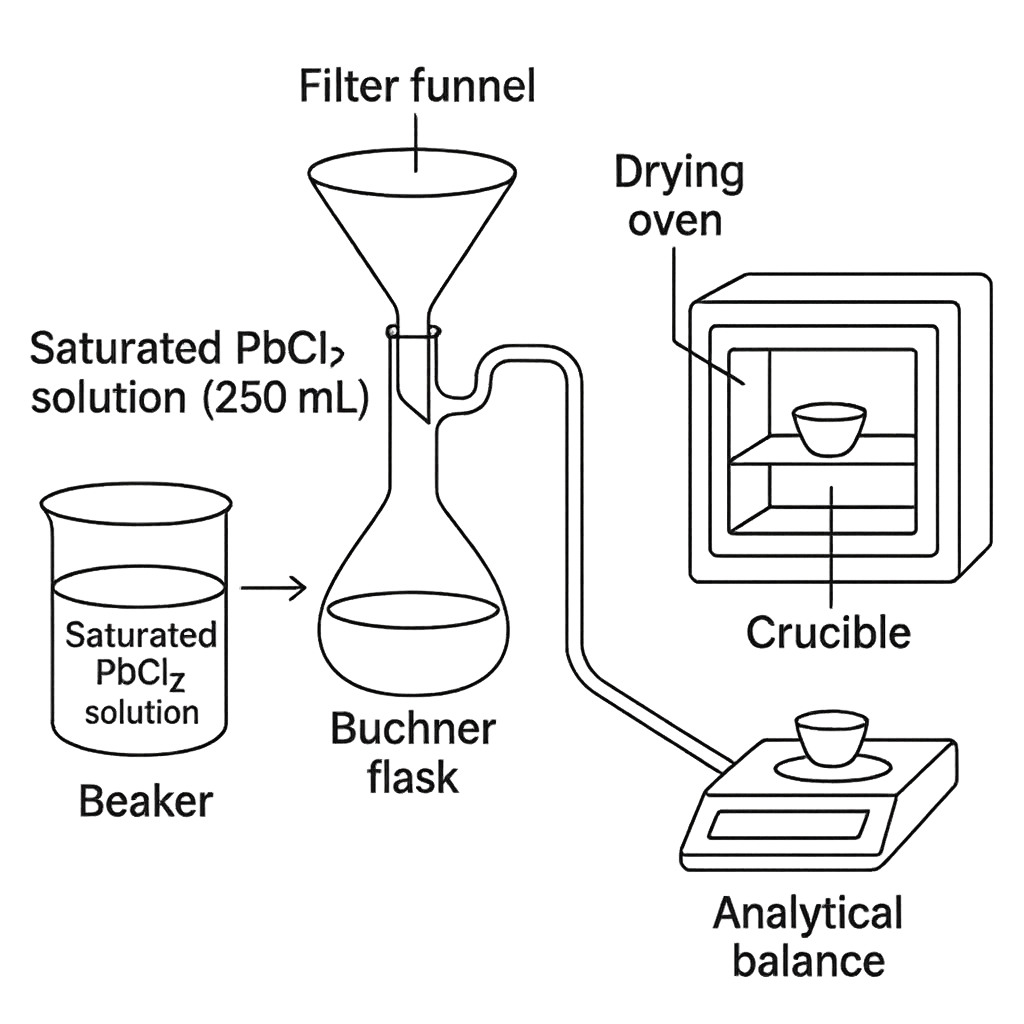
A student carried out a gravimetric determination of the solubility product (Ksp) of lead(II) chloride (PbCl2) at 25 °C using the laboratory apparatus shown.
Question Parts
(a)
Write the net ionic equation for the dissolution of PbCl2 in water.
(b)
The student filtered 250.0 mL of the saturated solution and obtained 0.452 g of dried PbCl2 precipitate. Calculate the molar solubility (mol L⁻¹) of PbCl2 at 25 °C.
(c)
Using the molar solubility obtained in part (b), calculate the Ksp of PbCl2 at 25 °C. Show all steps.
(d)
The student suspects that the temperature of the water bath may have risen to 30 °C during the experiment, which would increase solubility. Explain qualitatively how the Ksp value would be affected and why, referring to Le Chatelier’s principle.
Detailed Essay Solution & Marking Scheme Available

Get the step-by-step mathematical proofs, key points required by examiners, and a comprehensive breakdown from our AI Tutor.

Master the Exam!

You've seen a preview, but there are thousands more questions plus AI tutor to break down complex solutions.

Unlock Full Access Available for Android & Windows
Help others prepare! Share this practice hub:
Chat with Support