neco 2018 biology | Objective

Prepare for your exams with neco questions? Reviewing past/model questions is one of the most effective ways to guarantee a high score. This practice hub features authentic 2018 biology (Objective) questions designed to simulate the real exam environment.

Practice these randomly selected questions to test your readiness.

Question 1 View Details
A 25‑year‑old female weighing 60\,kg and 165\,cm tall wishes to lose 5\,kg in 10\,weeks. Her basal metabolic rate (BMR) can be estimated by the Harris‑Benedict equation \(BMR = 655 + 9.6W + 1.8H - 4.7A\) where \(W\) is weight in kg, \(H\) height in cm and \(A\) age in years. She is moderately active (activity factor 1.55). Assuming 7700\,kcal are stored per kilogram of fat, determine (a) the daily caloric intake she should adopt to achieve the weight loss, and (b) the number of grams of protein she must consume each day if 20\% of her calories are to come from protein (4\,kcal per gram).
A. Daily intake ≈ 1500 kcal; protein ≈ 75 g
B. Daily intake ≈ 1800 kcal; protein ≈ 90 g
Correct C. Daily intake ≈ 1636 kcal; protein ≈ 82 g
D. Daily intake ≈ 1700 kcal; protein ≈ 68 g

Correct Answer: C

Want to see the full step-by-step solution? Unlock AI Explanation & Analytics
Question 2 View Details
A bacterial strain has a spontaneous mutation rate to resistance against antibiotic X of \(2\times10^{-8}\) per cell division. After 12\,h of growth the culture contains \(5\times10^{9}\) cells. The minimum inhibitory concentration (MIC) for the wild‑type is 4\,\(\mu\)g\,mL\(^{-1}\) and for resistant mutants is 16\,\(\mu\)g\,mL\(^{-1}\). The clinician wants to use a single concentration of antibiotic X that will inhibit at least 99\% of the total population. What is the minimum concentration that should be administered, taking into account the probability that resistant mutants are present?
Correct A. 16 µg mL⁻¹
B. 4 µg mL⁻¹
C. 8 µg mL⁻¹
D. 12 µg mL⁻¹

Correct Answer: A

Want to see the full step-by-step solution? Unlock AI Explanation & Analytics
Question 3 View Details
A resting adult has a body surface area of 1.8\,m\(^2\) and a basal metabolic heat production of 80\,W\,m\(^{-2}\). She is in an environment at 10\,°C while wearing clothing with an insulation value of 0.5\,clo (1\,clo = 0.155\,m\(^2\)\,K\,W\(^{-1}\)). The overall heat transfer coefficient of the skin is 10\,W\,m\(^{-2}\)\,K\(^{-1}\). Assuming heat loss occurs by conduction/convection through the clothing and skin, calculate (a) the total heat loss from the body, (b) the additional metabolic heat (in watts) the body must generate to maintain core temperature of 37\,°C, and (c) the percentage increase in metabolic rate required.
A. Total loss ≈ 150 W; extra metabolic heat ≈ 10 W; increase ≈ 6.0 %
B. Total loss ≈ 165 W; extra metabolic heat ≈ 6 W; increase ≈ 4.2 %
C. Total loss ≈ 140 W; extra metabolic heat ≈ 12 W; increase ≈ 7.5 %
Correct D. Total loss ≈ 152 W; extra metabolic heat ≈ 8 W; increase ≈ 5.6 %

Correct Answer: D

Want to see the full step-by-step solution? Unlock AI Explanation & Analytics
Question 4 View Details
A halophytic plant growing in soil where the external NaCl concentration is 200\,mM accumulates the following solutes in its vacuoles: Na\(^+\) 150\,mM, K\(^+\) 50\,mM, and non‑ionic organic solutes 100\,mM. Assuming that the internal Cl\(^-\) concentration equals the internal Na\(^+\) concentration for electroneutrality, calculate the vacuolar osmotic potential \(\Psi_s\) using \(\Psi_s = -C_{\text{total}}RT\) (where \(C_{\text{total}}\) is the total molar concentration of solute particles, \(R = 0.0831\)\,L\,bar\,K\(^{-1}\)\,mol\(^{-1}\), \(T = 298\)\,K). The plant's pressure potential \(\Psi_p\) is -0.5\,MPa. Determine the plant's overall water potential \(\Psi_w\) and state whether it is lower (more negative) than the soil water potential of -0.8\,MPa, thus allowing water uptake.
A. \(\Psi_s \approx -0.95\,MPa\); \(\Psi_w \approx -1.45\,MPa\); water uptake possible (yes)
Correct B. \(\Psi_s \approx -1.11\,MPa\); \(\Psi_w \approx -1.61\,MPa\); water uptake possible (yes)
C. \(\Psi_s \approx -1.05\,MPa\); \(\Psi_w \approx -1.55\,MPa\); water uptake possible (yes)
D. \(\Psi_s \approx -1.20\,MPa\); \(\Psi_w \approx -1.70\,MPa\); water uptake possible (no)

Correct Answer: B

Want to see the full step-by-step solution? Unlock AI Explanation & Analytics
Question 5 View Details
A newly isolated virus has a double‑stranded RNA genome, an icosahedral capsid, replicates in the cytoplasm and carries its own RNA‑dependent RNA polymerase. It is inactivated by treatment with a dsRNA‑specific ribonuclease. Based on these characteristics, (a) assign the virus to the appropriate Baltimore classification group, and (b) suggest the most likely virus family.
Correct A. Baltimore group III; likely family Reoviridae
B. Baltimore group VI; likely family Retroviridae
C. Baltimore group IV; likely family Orthomyxoviridae
D. Baltimore group I; likely family Picornaviridae

Correct Answer: A

Want to see the full step-by-step solution? Unlock AI Explanation & Analytics
Question 6 View Details
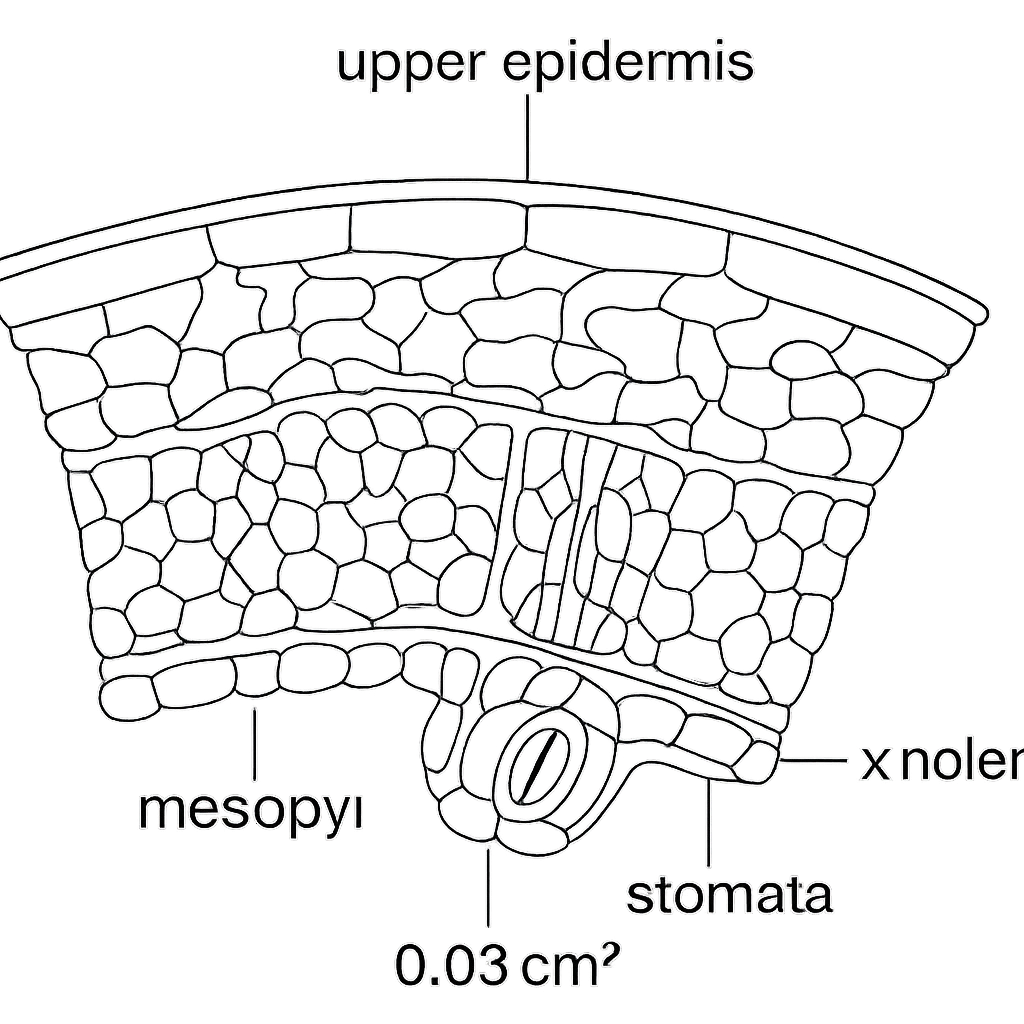
The diagram shows a cross‑section of a typical dicot leaf. The xylem is located 0.4 cm below the upper epidermis and the phloem is 0.2 cm below the xylem. The total stomatal opening area on the lower epidermis is 0.03 cm². The hydraulic conductivity of the xylem tissue is 0.8 cm·MPa⁻¹·s⁻¹ and the effective cross‑sectional area for water transport in the xylem is 0.05 cm². Soil water potential is -0.2 MPa while leaf water potential is -0.9 MPa. Assuming the distance from the soil water source to the leaf is 30 cm, calculate the volumetric flow rate of water through the xylem (in cm³·s⁻¹) using the relation \( \dfrac{K \; A \; \Delta\Psi}{L} \).
A. 0.00094
B. 0.00047
C. 0.00186
Correct D. 0.00093

Correct Answer: D

Want to see the full step-by-step solution? Unlock AI Explanation & Analytics
Question 7 View Details
A 70 kg adult has a blood volume of 5 L and a plasma osmolarity of 285 mOsm·L⁻¹. He drinks 0.5 L of isotonic saline (0.9 % NaCl) whose osmolarity is 308 mOsm·L⁻¹. Assuming instant and complete mixing, what is the new plasma osmolarity (in mOsm·L⁻¹) after ingestion?
A. 284.9
Correct B. 287.1
C. 288.4
D. 286.3

Correct Answer: B

Want to see the full step-by-step solution? Unlock AI Explanation & Analytics
Question 8 View Details
A labelled diagram of a neuron uses the letters A-F for its parts. The following statements are true: (i) Label A is the only structure that contains the nucleus. (ii) Label B is the only structure that receives synaptic inputs from other neurons. (iii) Label F is the only structure that releases neurotransmitter into the synaptic cleft. (iv) Label D is a long insulated segment that surrounds part of the axon. (v) Label E is a short gap within the insulated segment. (vi) The axon hillock lies directly between the structure that contains the nucleus and the start of the insulated segment. Using these clues, which label corresponds to the axon hillock?
A. D
B. B
C. A
Correct D. C

Correct Answer: D

Want to see the full step-by-step solution? Unlock AI Explanation & Analytics
Question 9 View Details
In a population of 10 000 individuals a trait shows incomplete dominance. The dominant phenotype (AA) occurs in 84 % of the population, the intermediate phenotype (Aa) in 12 %, and the recessive phenotype (aa) in the remainder. Assuming Hardy-Weinberg equilibrium, calculate the allele frequencies of A and a, and then give the expected number of individuals with genotype aa under equilibrium.
Correct A. 100
B. 120
C. 80
D. 70

Correct Answer: A

Want to see the full step-by-step solution? Unlock AI Explanation & Analytics
Question 10 View Details
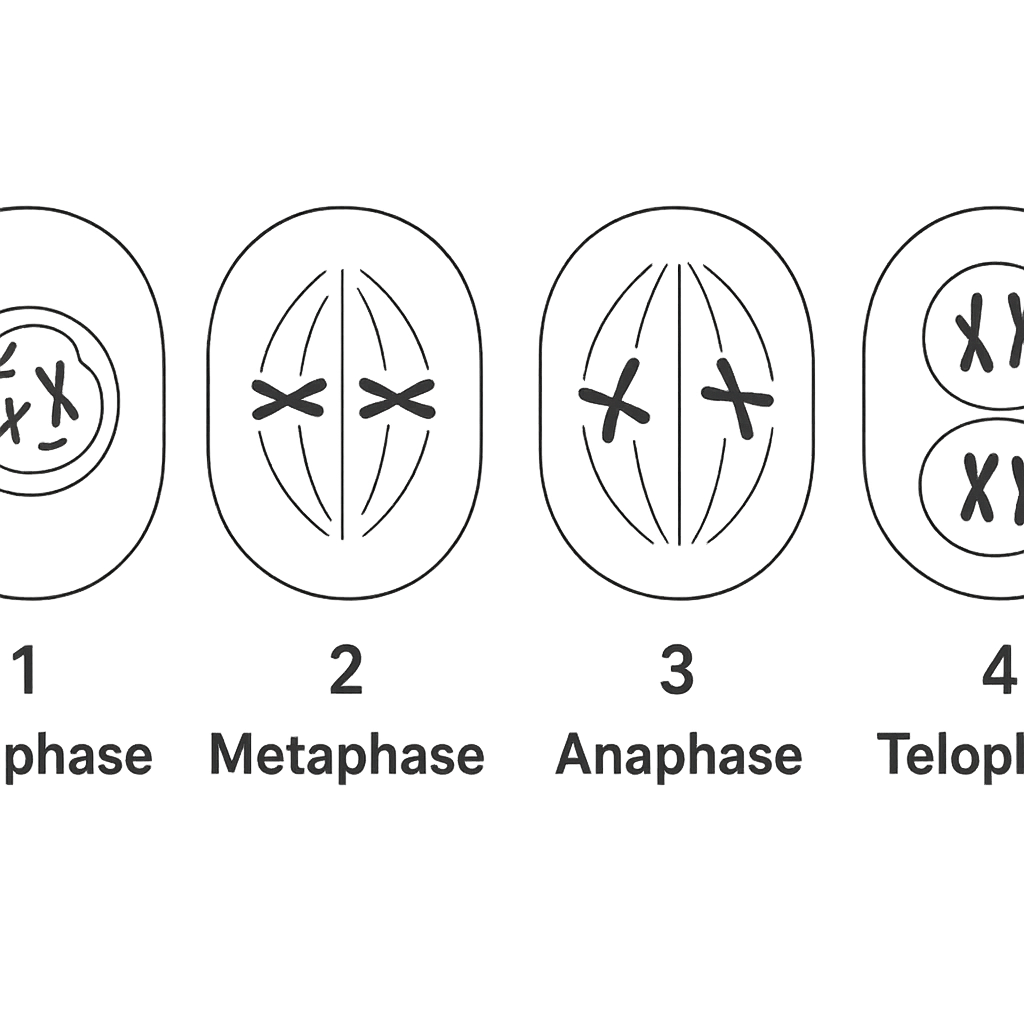
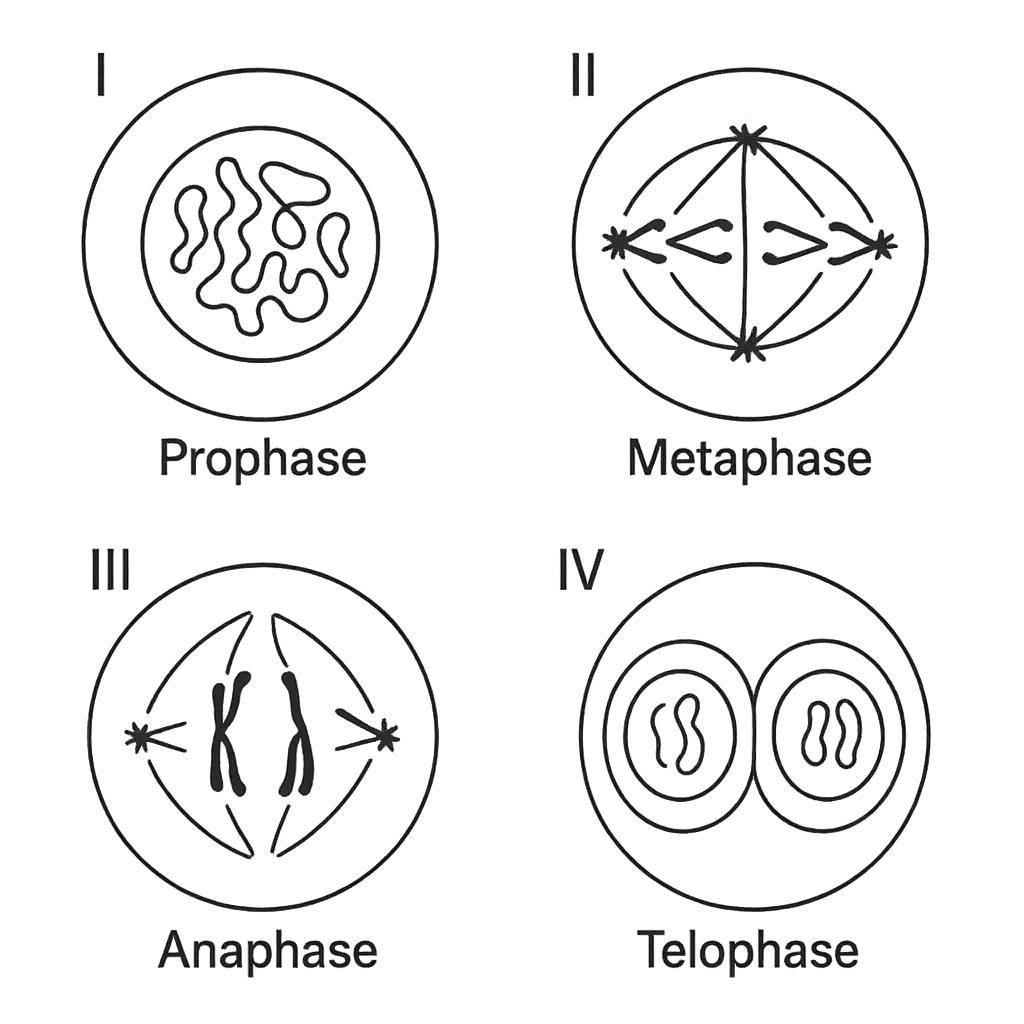
The diagram shows a typical animal cell undergoing mitosis, with the stages labelled 1-4. Which label corresponds to the stage in which chromosomes are aligned at the cell's equatorial plate?
A. 4
B. 1
Correct C. 2
D. 3

Correct Answer: C

Want to see the full step-by-step solution? Unlock AI Explanation & Analytics
Question 11 View Details
A flowering plant specimen shows the following characteristics: (i) leaves are compound, pinnate with stipules; (ii) flowers are actinomorphic, bisexual, with a superior ovary and five fused petals forming a tubular corolla; (iii) fruit is a legume that dehisces along two sutures; (iv) the plant contains alkaloids that are toxic to mammals. Based on these traits, determine the most probable family, then identify a genus within that family that commonly exhibits these features, and finally name a species native to West Africa that fits the description.
A. Family Fabaceae; Genus Mimosa; Species Mimosa pudica
B. Family Fabaceae; Genus Prosopis; Species Prosopis africana
Correct C. Family Fabaceae; Genus Acacia; Species Acacia nilotica
D. Family Euphorbiaceae; Genus Euphorbia; Species Euphorbia tirucalli

Correct Answer: C

Want to see the full step-by-step solution? Unlock AI Explanation & Analytics
Question 12 View Details
A labelled diagram of the human heart displays the four chambers, the tricuspid, pulmonary, mitral and aortic valves, and the major vessels: aorta, pulmonary artery, pulmonary veins, superior and inferior vena cava. Arrows indicate the direction of blood flow. List the complete sequence of blood flow through the heart and major vessels, naming each chamber, valve and vessel in order, and indicate which valve prevents backflow at each transition.
A. Superior/inferior vena cava → right atrium → tricuspid valve → right ventricle → pulmonary valve → pulmonary artery → lungs → pulmonary veins → left atrium → mitral valve → left ventricle → pulmonary valve → pulmonary artery → lungs → left atrium → mitral valve → left ventricle → aortic valve → aorta → systemic circulation → Superior/inferior vena cava
Correct B. Superior/inferior vena cava → right atrium → tricuspid valve → right ventricle → pulmonary valve → pulmonary artery → lungs → pulmonary veins → left atrium → mitral valve → left ventricle → aortic valve → aorta → systemic circulation → superior/inferior vena cava
C. Superior/inferior vena cava → right atrium → tricuspid valve → right ventricle → pulmonary valve → pulmonary artery → lungs → left atrium → mitral valve → left ventricle → aortic valve → aorta → systemic circulation → Superior/inferior vena cava
D. Superior/inferior vena cava → right atrium → tricuspid valve → right ventricle → aortic valve → aorta → systemic circulation → Superior/inferior vena cava

Correct Answer: B

Want to see the full step-by-step solution? Unlock AI Explanation & Analytics
Question 13 View Details
Which organelle is primarily responsible for the production of ATP through oxidative phosphorylation in eukaryotic cells?
Correct A. Mitochondrion
B. Chloroplast
C. Endoplasmic reticulum
D. Nucleus

Correct Answer: A

Want to see the full step-by-step solution? Unlock AI Explanation & Analytics
Question 14 View Details
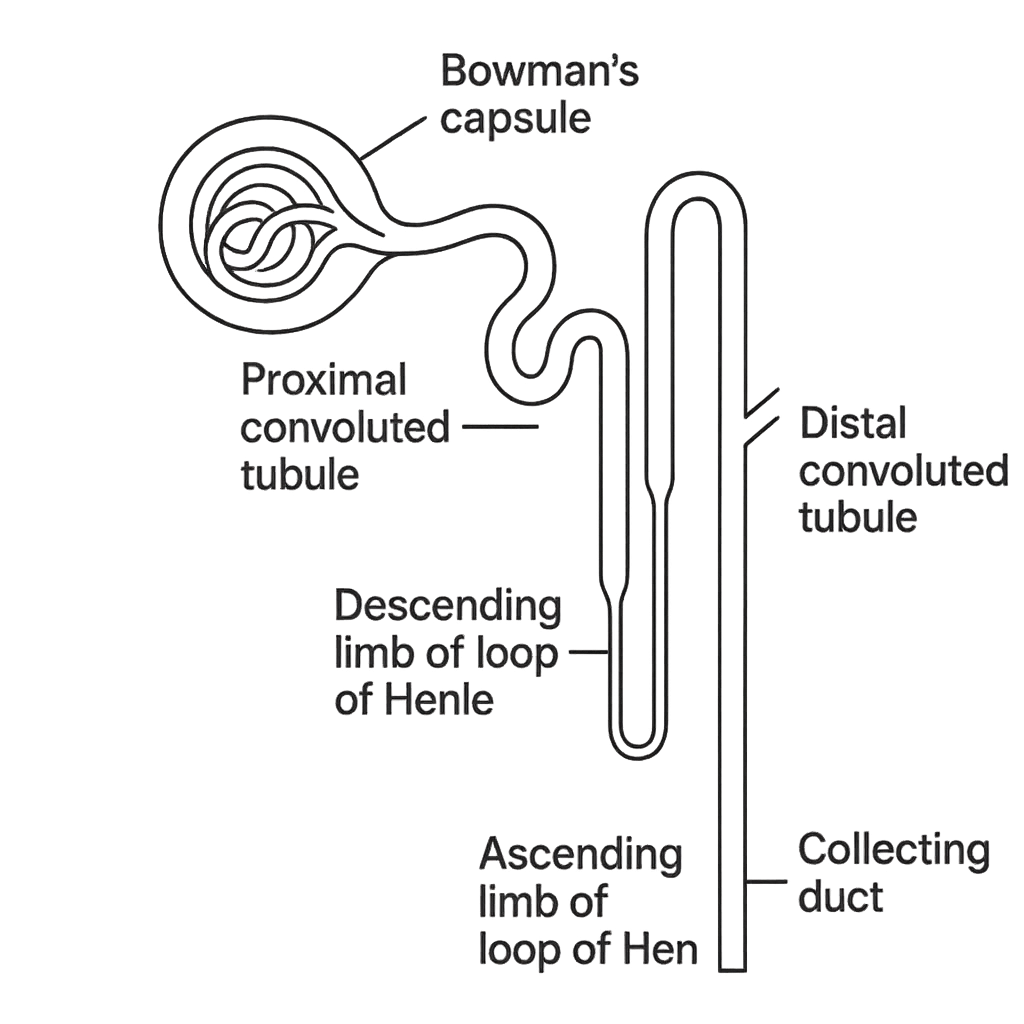
The diagram shows a labelled nephron of the human kidney, including Bowman's capsule, proximal convoluted tubule, descending limb of the loop of Henle, ascending limb of the loop of Henle, distal convoluted tubule and collecting duct. (a) Which segment is primarily responsible for the reabsorption of glucose from the filtrate? (b) Which part of the nephron creates the medullary osmotic gradient essential for urine concentration? (c) If the glomerular filtration rate is \(125\) mL min\(^{-1}\) and the plasma sodium concentration is \(140\) mmol L\(^{-1}\), and the proximal tubule reabsorbs \(65\)% of the filtered sodium, calculate the amount of sodium (in mmol min\(^{-1}\)) reabsorbed in the proximal tubule.
A. a) Proximal convoluted tubule; b) Descending limb of the loop of Henle; c) 9.75 mmol min⁻¹
Correct B. a) Proximal convoluted tubule; b) Thick ascending limb of the loop of Henle; c) 11.38 mmol min⁻¹
C. a) Proximal convoluted tubule; b) Thick ascending limb of the loop of Henle; c) 8.50 mmol min⁻¹
D. a) Distal convoluted tubule; b) Thick ascending limb of the loop of Henle; c) 13.20 mmol min⁻¹

Correct Answer: B

Want to see the full step-by-step solution? Unlock AI Explanation & Analytics
Question 15 View Details
An insect specimen exhibits these characteristics: (i) three pairs of legs attached to the thorax; (ii) two pairs of membranous wings, the forewings are hardened at the base forming a protective cover (elytra) over the hindwings; (iii) mouthparts are of the chewing type with strong mandibles; (iv) the insect undergoes complete metamorphosis (egg, larva, pupa, adult). Based on these traits, (a) identify the order, (b) name a family within that order that includes species with similar wing modification, and (c) give a genus that contains species known as agricultural pests in Nigeria.
Correct A. Order Coleoptera; Family Curculionidae; Genus Sitophilus
B. Order Hemiptera; Family Curculionidae; Genus Sitophilus
C. Order Coleoptera; Family Carabidae; Genus Sitophilus
D. Order Coleoptera; Family Curculionidae; Genus Tenebrio

Correct Answer: A

Want to see the full step-by-step solution? Unlock AI Explanation & Analytics
Question 16 View Details
A newly emerging infectious disease has a basic reproduction number \(R_{0}=2.5\). A vaccine available for the disease is 80% effective.\n\n(a) Calculate the minimum proportion of the total population that must be immunised (by vaccination) to achieve herd immunity.\n\n(b) In a community of 12,000 people, 10% are already immune because they recovered from a previous infection. How many additional individuals must be vaccinated to reach the herd‑immunity level calculated in part (a)?\n\n(c) If the same vaccine's effectiveness drops to 60%, what proportion of the whole population would now need to be vaccinated to obtain herd immunity?
Correct A. (a) 75 % of the population must be vaccinated. (b) 9,750 additional people need to be vaccinated. (c) With 60 % efficacy, 100 % of the population would have to be vaccinated.
B. (a) 70 % of the population must be vaccinated. (b) 9,000 additional people need to be vaccinated. (c) With 60 % efficacy, 95 % of the population would have to be vaccinated.
C. (a) 65 % of the population must be vaccinated. (b) 8,500 additional people need to be vaccinated. (c) With 60 % efficacy, 85 % of the population would have to be vaccinated.
D. (a) 80 % of the population must be vaccinated. (b) 10,200 additional people need to be vaccinated. (c) With 60 % efficacy, 110 % of the population would have to be vaccinated.

Correct Answer: A

Want to see the full step-by-step solution? Unlock AI Explanation & Analytics
Question 17 View Details
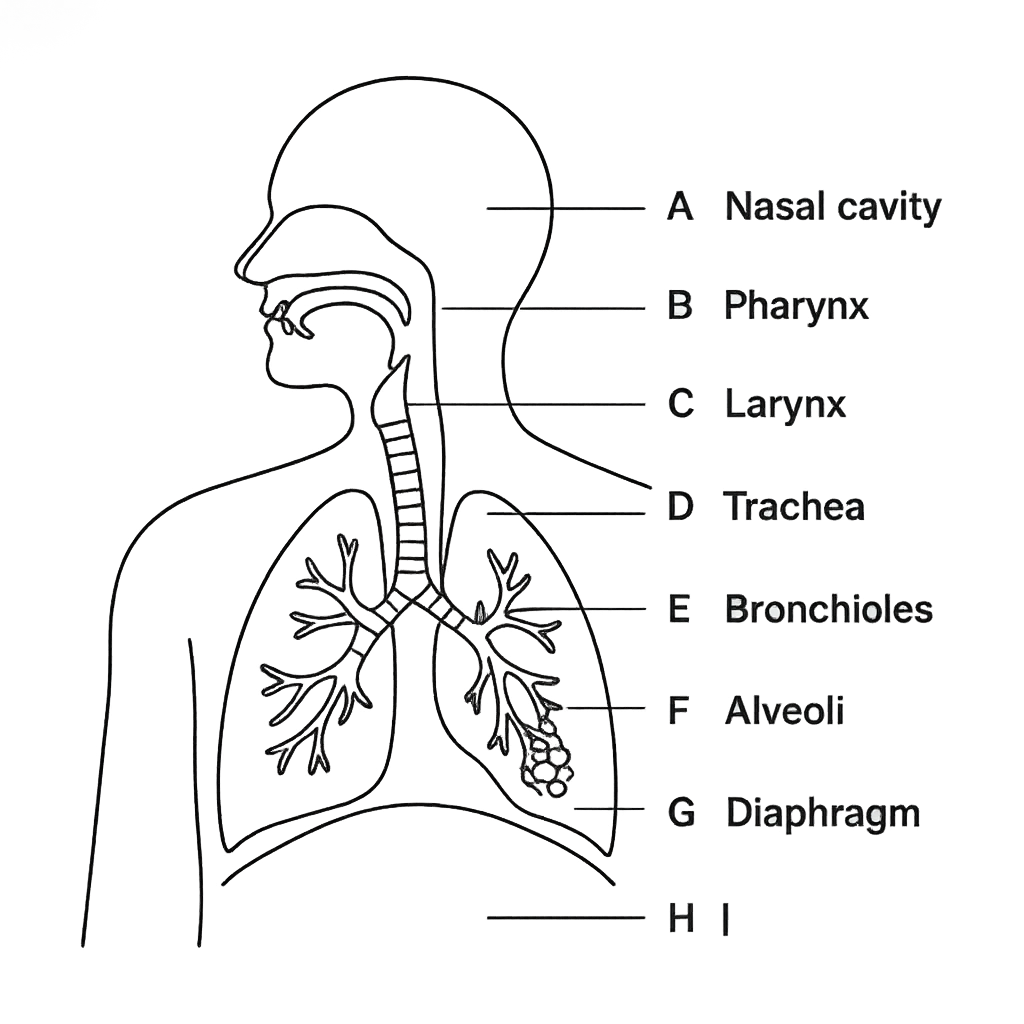
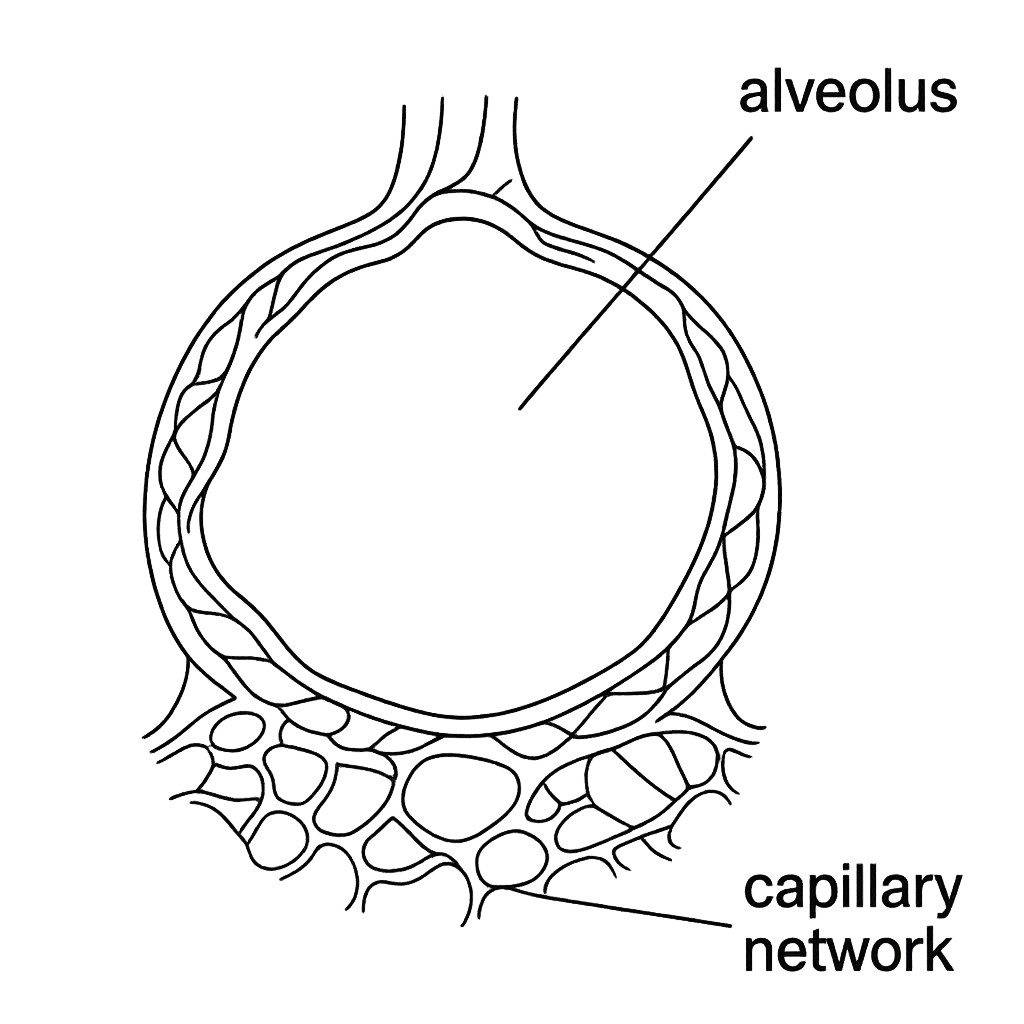
The diagram shows a labelled cross‑section of an alveolus surrounded by a dense capillary network. The diffusion coefficient for oxygen across the alveolar membrane is \(D=0.20\ \text{cm}^{3}\,\text{mmHg}^{-1}\,\text{min}^{-1}\).\n\nAt sea level the partial pressure of O\(_2\) in the alveolar air is \(P_{A}=100\ \text{mmHg}\) and in the pulmonary capillary blood it is \(P_{c}=40\ \text{mmHg}\).\n\n(a) Using Fick's law, calculate the rate of O\(_2\) diffusion (in cm\(^3\) per minute) from the alveolus into the blood.\n\n(b) If the individual ascends to a high altitude where the alveolar \(P_{A}\) falls to 70 mmHg while \(P_{c}\) remains 40 mmHg, what is the new diffusion rate?
A. Sea‑level diffusion rate = 10 cm³\/min; at high altitude = 5 cm³\/min.
B. Sea‑level diffusion rate = 8 cm³\/min; at high altitude = 4 cm³\/min.
Correct C. Sea‑level diffusion rate = 12 cm³/min; at high altitude = 6 cm³/min.
D. Sea‑level diffusion rate = 14 cm³\/min; at high altitude = 7 cm³\/min.

Correct Answer: C

Want to see the full step-by-step solution? Unlock AI Explanation & Analytics
Question 18 View Details
During a steady‑state exercise test a subject's measured gas exchange values are: \(V_{\text{CO}_{2}} = 180\ \text{mL\,min}^{-1}\) and \(V_{\text{O}_{2}} = 200\ \text{mL\,min}^{-1}\).\n\n(a) Calculate the respiratory quotient (RQ) and state which metabolic substrate(s) are predominantly being oxidised.\n\n(b) If the subject switches to a diet in which 70 % of the metabolised energy is derived from fat (RQ≈0.70) and the remaining 30 % from carbohydrate (RQ≈1.00), what RQ would you expect under the new diet?
A. (a) RQ = 0.85, indicating mixed carbohydrate‑fat oxidation with a predominance of fat. (b) Expected RQ ≈ 0.73.
Correct B. (a) RQ = 0.90, indicating mixed carbohydrate‑fat oxidation with a predominance of carbohydrate. (b) Expected RQ ≈ 0.79.
C. (a) RQ = 1.00, indicating pure carbohydrate oxidation. (b) Expected RQ ≈ 0.85.
D. (a) RQ = 0.80, indicating mixed oxidation with a predominance of fat. (b) Expected RQ ≈ 0.76.

Correct Answer: B

Want to see the full step-by-step solution? Unlock AI Explanation & Analytics
Question 19 View Details
A human somatic cell is diploid with a total of 46 chromosomes. After the completion of mitosis, how many chromosomes are present in each of the two daughter cells?
A. 23
Correct B. 46
C. 48
D. 92

Correct Answer: B

Want to see the full step-by-step solution? Unlock AI Explanation & Analytics
Question 20 View Details
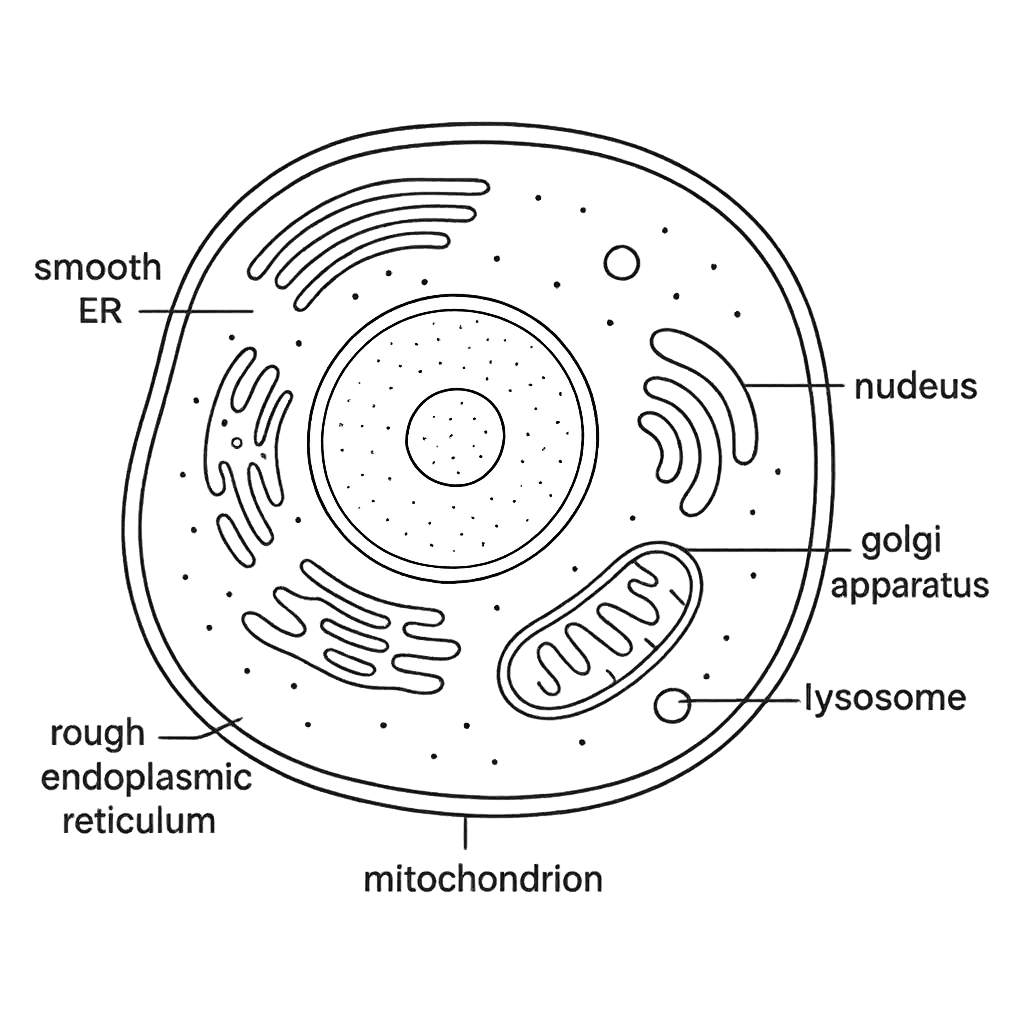
The labelled diagram of an animal cell shows that the total membrane surface area (including the plasma membrane and all internal membranes) is \(2000\ \mu\text{m}^{2}\). The plasma membrane accounts for 30 % of this total, while the rough endoplasmic reticulum (RER) accounts for 15 % of the total membrane area.\n\n(a) Calculate the surface area of the rough ER in square micrometres.\n\n(b) Which organelle is primarily responsible for the synthesis of secretory (export) proteins?
Correct A. (a) 300 µm² (b) Rough endoplasmic reticulum
B. (a) 400 µm² (b) Golgi apparatus
C. (a) 200 µm² (b) Smooth endoplasmic reticulum
D. (a) 500 µm² (b) Ribosome

Correct Answer: A

Want to see the full step-by-step solution? Unlock AI Explanation & Analytics
Question 21 View Details
If \( R_0 = 4.5 \) and vaccine efficacy is 80\%, the proportion of the population that must be immune to achieve herd immunity is \( 1 - \frac{1}{R_0} \). Calculate the minimum number of individuals that must be vaccinated in a community of 10,000 people, given that 2,500 are already immune through prior infection.
A. 9723
B. 6598
Correct C. 7222
D. 7778

Correct Answer: C

Want to see the full step-by-step solution? Unlock AI Explanation & Analytics
Question 22 View Details
In a 28‑day menstrual cycle the follicular phase lasts 12 days. Estrogen concentration rises linearly from \(50\) pg/mL on day \(1\) to \(400\) pg/mL on the day of the LH surge. The surge occurs when estrogen reaches \(350\) pg/mL. On which day of the cycle does the LH surge occur?
A. 12
B. 9
C. 11
Correct D. 10

Correct Answer: D

Want to see the full step-by-step solution? Unlock AI Explanation & Analytics
Question 23 View Details
At sea level atmospheric pressure is \(760\) mmHg, the fraction of inspired oxygen is \(0.21\) and water vapour pressure in the alveoli is \(47\) mmHg. Using the alveolar gas equation \( PAO_2 = F_{IO_2}(P_{atm}-P_{H_2O}) - \frac{PaCO_2}{R}\) with \(PaCO_2 = 40\) mmHg and respiratory quotient \(R = 0.8\), the alveolar \(O_2\) pressure is calculated. If a person ascends to an altitude where barometric pressure falls to \(560\) mmHg and their \(PaCO_2\) decreases to \(30\) mmHg due to hyperventilation, what is the new alveolar \(O_2\) pressure (in mmHg, one decimal place)?
A. 68.5
Correct B. 70.2
C. 73.1
D. 66.8

Correct Answer: B

Want to see the full step-by-step solution? Unlock AI Explanation & Analytics
Question 24 View Details
In a beetle population the initial allele frequencies are \(p = 0.6\) for allele \(A\) and \(q = 0.4\) for allele \(a\). The fitnesses of the genotypes are \(w_{AA}=1.0\), \(w_{Aa}=0.8\) and \(w_{aa}=0.6\). After one generation of selection, what is the new frequency of allele \(A\) (rounded to two decimal places)?
A. 0.58
B. 0.72
Correct C. 0.66
D. 0.64

Correct Answer: C

Want to see the full step-by-step solution? Unlock AI Explanation & Analytics
Question 25 View Details
Two genes \(A\) and \(B\) are linked on the same chromosome in fruit flies with a recombination frequency of 12\%. A fly heterozygous for the cis arrangement \(A^{+}B^{+}/ab\) is test‑crossed with a fly homozygous recessive \(ab/ab\). What percentage of the progeny are expected to display both dominant phenotypes \(A^{+}B^{+}\)?
A. 38
B. 50
Correct C. 44
D. 46

Correct Answer: C

Want to see the full step-by-step solution? Unlock AI Explanation & Analytics

Master the Exam!

You've seen a preview, but there are thousands more questions plus AI tutor to break down complex solutions.

Unlock Full Access Available for Android & Windows
Help others prepare! Share this practice hub:
Chat with Support