Neco 2018 Biology Question 17
Practice objective / multiple choice question 17 from the 2018 Neco Biology examination.
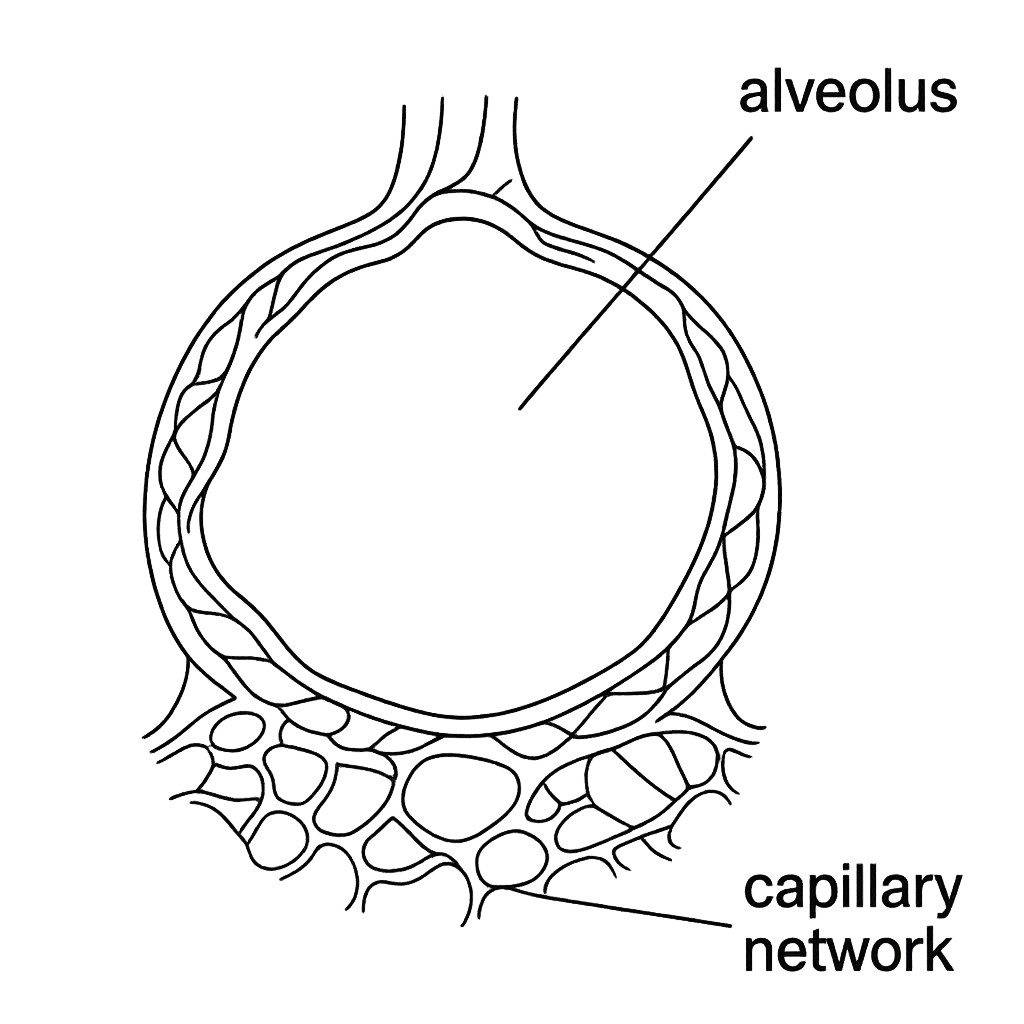
The diagram shows a labelled cross‑section of an alveolus surrounded by a dense capillary network. The diffusion coefficient for oxygen across the alveolar membrane is \(D=0.20\ \text{cm}^{3}\,\text{mmHg}^{-1}\,\text{min}^{-1}\).\n\nAt sea level the partial pressure of O\(_2\) in the alveolar air is \(P_{A}=100\ \text{mmHg}\) and in the pulmonary capillary blood it is \(P_{c}=40\ \text{mmHg}\).\n\n(a) Using Fick's law, calculate the rate of O\(_2\) diffusion (in cm\(^3\) per minute) from the alveolus into the blood.\n\n(b) If the individual ascends to a high altitude where the alveolar \(P_{A}\) falls to 70 mmHg while \(P_{c}\) remains 40 mmHg, what is the new diffusion rate?
Answer Options
About This Question
This is Neco 2018 Biology Question 17. It is one of the objective questions from the 2018 Neco Biology examination.
Difficulty level: Medium .
Master the Exam!
You've seen a preview, but there are thousands more questions plus AI tutor to break down complex solutions.