igcse model questions vol1 2025 chemistry | Objective

Prepare for your exams with igcse model questions vol1 questions? Reviewing past/model questions is one of the most effective ways to guarantee a high score. This practice hub features authentic 2025 chemistry (Objective) questions designed to simulate the real exam environment.

Practice these randomly selected questions to test your readiness.

Question 1 View Details
An element is located in period \(3\) and group \(16\) of the periodic table. Its atomic number is \(16\). What is the chemical symbol of this element?
Correct A. S
B. P
C. Cl
D. Se

Correct Answer: A

Want to see the full step-by-step solution? Unlock AI Explanation & Analytics
Question 2 View Details
An isotope of an element has an atomic number of \(12\) and a mass number of \(27\). How many neutrons are present in one atom of this isotope?
Correct A. 15
B. 12
C. 14
D. 16

Correct Answer: A

Want to see the full step-by-step solution? Unlock AI Explanation & Analytics
Question 3 View Details
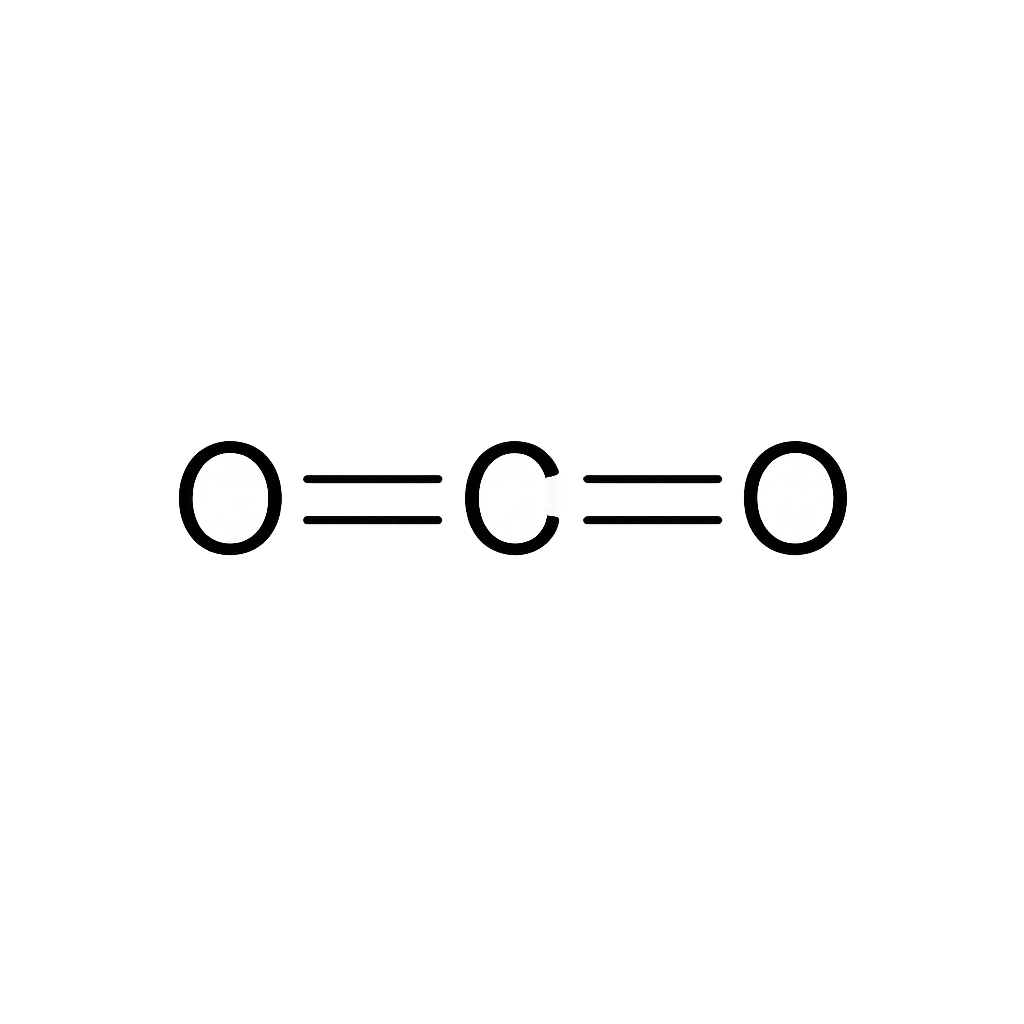
The diagram shows a molecule of carbon dioxide. Determine the oxidation number of the carbon atom in this molecule.
A. +2
Correct B. +4
C. 0
D. +3

Correct Answer: B

Want to see the full step-by-step solution? Unlock AI Explanation & Analytics
Question 4 View Details
A hydrocarbon with empirical formula \(C_{x}H_{y}\) is burnt completely in excess oxygen. The combustion produces \(44.8\ \text{g}\) of carbon dioxide and \(18.0\ \text{g}\) of water. Determine the empirical formula of the hydrocarbon.
A. C2H5
B. CH3
Correct C. CH2
D. C2H4

Correct Answer: C

Want to see the full step-by-step solution? Unlock AI Explanation & Analytics
Question 5 View Details
Consider a galvanic cell: Zn|Zn^{2+}(0.010\ \text{M})||Cu^{2+}(0.10\ \text{M})|Cu. The standard reduction potentials are \(E^{\circ}_{\text{Zn}^{2+}/\text{Zn}} = -0.76\ \text{V}\) and \(E^{\circ}_{\text{Cu}^{2+}/\text{Cu}} = +0.34\ \text{V}\). Calculate the cell potential at \(25^{\circ}\text{C}\).
A. 1.24 V
Correct B. 1.13 V
C. 1.00 V
D. 0.58 V

Correct Answer: B

Want to see the full step-by-step solution? Unlock AI Explanation & Analytics
Question 6 View Details
An industrial wastewater treatment plant processes water that initially contains (300\ \text{mg\ L}^{-1}\) biochemical oxygen demand (BOD) and (200\ \text{mg\ L}^{-1}\) suspended solids. The plant operates two stages: (1) Primary sedimentation removes 30 % of the suspended solids; (2) A biological treatment stage reduces the BOD by 80 % of the amount that remains after the first stage. The discharge limits are BOD \(\le\) (30\ \text{mg\ L}^{-1}\) and suspended solids \(\le\) (50\ \text{mg\ L}^{-1}\). (a) Identify which pollutant, if any, exceeds its limit after the two stages. (b) For each pollutant that exceeds its limit, calculate the minimum additional percentage removal that a tertiary filter must achieve to meet the limits.
A. Both pollutants exceed their limits. A tertiary filter must remove at least 40 % of the remaining BOD and about 55 % of the remaining suspended solids.
B. Only the BOD exceeds its limit. A tertiary filter must remove at least 45 % of the remaining BOD and about 60 % of the remaining suspended solids.
C. Both pollutants exceed their limits. A tertiary filter must remove at least 50 % of the remaining BOD and about 70 % of the remaining suspended solids.
Correct D. Both pollutants exceed their limits. A tertiary filter must remove at least 50 % of the remaining BOD and about 64 % of the remaining suspended solids.

Correct Answer: D

Want to see the full step-by-step solution? Unlock AI Explanation & Analytics
Question 7 View Details
In a region the atmospheric concentrations are 0.5 ppm SO\(_2\) and 0.2 ppm NO\(_2\) (by volume) at 25 °C and 1 atm. In the atmosphere, 0.5 % of the SO\(_2\) is converted to H\(_2\)SO\(_4\) and 0.3 % of the NO\(_2\) is converted to HNO\(_3\). Each mole of H\(_2\)SO\(_4\) yields two moles of H\(^+\) and each mole of HNO\(_3\) yields one mole of H\(^+\). Assuming the polluted air occupies a volume of 1 km\(^3\) (\(10^{12}\) m\(^3\)) and that all the H\(^+\) produced ends up in 1 L of rainwater collected from that volume, calculate the pH of the rainwater.
A. -4.12 (approximately)
B. -5.00 (approximately)
Correct C. -5.36 (approximately)
D. -6.78 (approximately)

Correct Answer: C

Want to see the full step-by-step solution? Unlock AI Explanation & Analytics
Question 8 View Details
The reaction \(2\,\text{Al} + 3\,\text{CuSO}_4 \rightarrow \text{Al}_2(\text{SO}_4)_3 + 3\,\text{Cu}\) is carried out using 15.0 g of aluminium and 30.0 g of copper(II) sulphate.\n(a) Determine the limiting reagent.\n(b) Calculate the theoretical mass of copper that can be produced.\n(c) If 4.5 g of copper are actually obtained, calculate the percent yield.
Correct A. Limiting reagent: CuSO₄; Theoretical Cu mass: 11.9 g; Percent yield: 38 %
B. Limiting reagent: CuSO₄; Theoretical Cu mass: 10.2 g; Percent yield: 55 %
C. Limiting reagent: CuSO₄; Theoretical Cu mass: 13.2 g; Percent yield: 45 %
D. Limiting reagent: Al; Theoretical Cu mass: 9.5 g; Percent yield: 30 %

Correct Answer: A

Want to see the full step-by-step solution? Unlock AI Explanation & Analytics
Question 9 View Details
Chlorine has atomic number 17. Write its ground‑state electron configuration and state how many electrons are present in the third principal energy level (n = 3).
A. 6
B. 9
C. 8
Correct D. 7

Correct Answer: D

Want to see the full step-by-step solution? Unlock AI Explanation & Analytics
Question 10 View Details
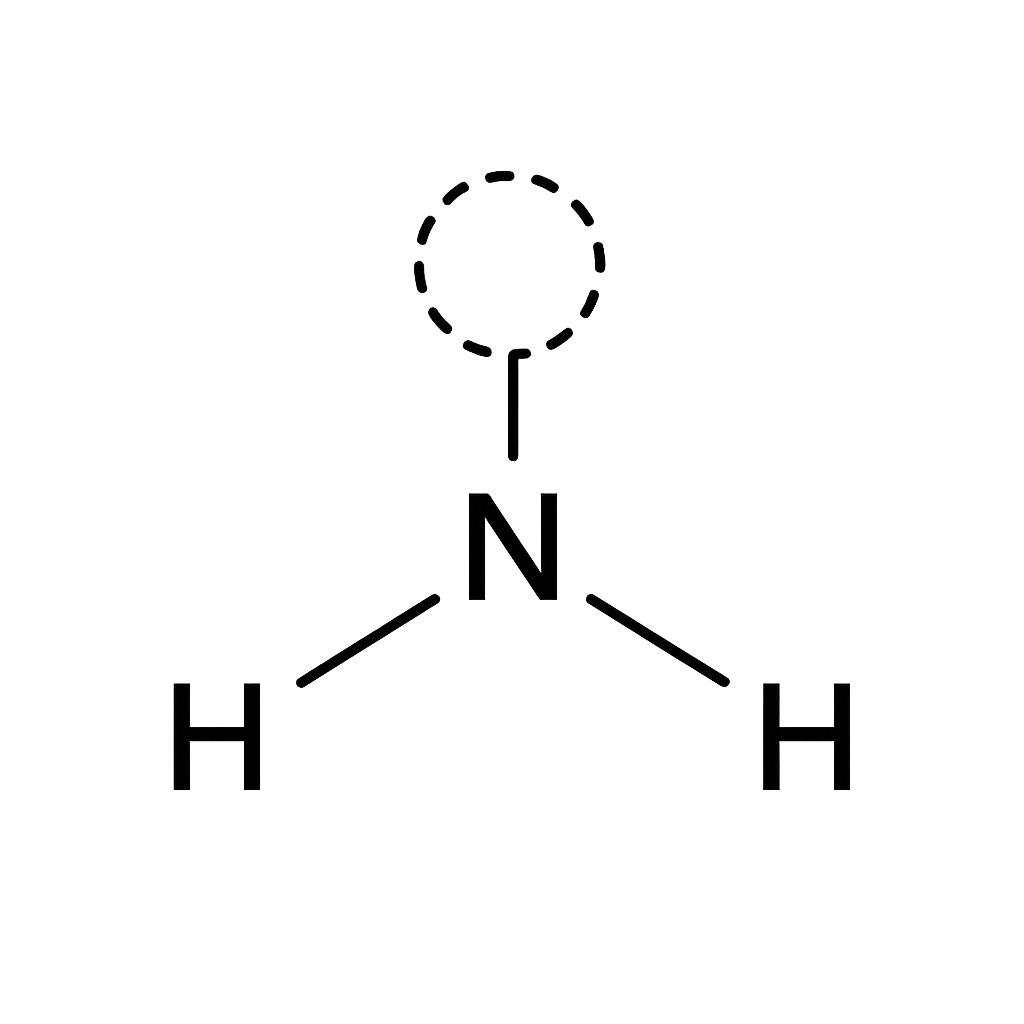
The diagram shows the Lewis structure of ammonia (NH\(_3\)). Using VSEPR theory, determine the approximate H-N-H bond angle and explain why it differs from the ideal tetrahedral angle.
A. Approximately 104°, because the lone pair on nitrogen repels the bonding pairs, widening the H-N-H angles above the ideal tetrahedral value.
Correct B. Approximately 107°, because the lone pair on nitrogen compresses the H-N-H angles below the ideal tetrahedral value.
C. Approximately 120°, because the molecule adopts a trigonal planar geometry due to sp2 hybridization.
D. Approximately 109.5°, because the lone pair on nitrogen expands the H-N-H angles to the ideal tetrahedral value.

Correct Answer: B

Want to see the full step-by-step solution? Unlock AI Explanation & Analytics
Question 11 View Details
A 25.0 mL sample of a monoprotic weak acid HA is titrated with 0.100 M NaOH. At the half‑equivalence point the measured pH is 4.75. After adding 30.0 mL of the NaOH solution the pH is 9.20. Assuming the solution volume changes only by the added titrant, calculate the initial concentration of the acid HA in mol L(^{-1}).
A. 0.135
B. 0.105
Correct C. 0.120
D. 0.150

Correct Answer: C

Want to see the full step-by-step solution? Unlock AI Explanation & Analytics
Question 12 View Details
A buffer prepared by mixing 0.250 M acetic acid (CH₃COOH) and 0.250 M sodium acetate (CH₃COONa) has a total volume of 500 mL. The pH of the buffer is 4.74. When a 0.100 M HCl solution is added, the pH falls to 4.44. Assuming the volume change on addition is negligible, calculate the volume of the HCl solution (in mL) that was added.
A. 420
B. 500
Correct C. 416
D. 350

Correct Answer: C

Want to see the full step-by-step solution? Unlock AI Explanation & Analytics
Question 13 View Details
A 0.500 L aqueous solution of Cu(NO₃)₂ is electrolysed using a constant current of 2.00 A for 30.0 min. At the cathode the reaction is \(\mathrm{Cu^{2+} + 2e^- \rightarrow Cu(s)}\). However, 10 % of the total charge is consumed by the side reaction \(\mathrm{2H_2O + 2e^- \rightarrow H_2 + 2OH^-}\). Calculate the mass of copper deposited on the cathode (in grams).
A. 1.19
Correct B. 1.07
C. 0.84
D. 0.96

Correct Answer: B

Want to see the full step-by-step solution? Unlock AI Explanation & Analytics
Question 14 View Details
Average bond enthalpies (kJ mol(^{-1})) are: C=C = 614, C-C = 348, C-H = 413, H-H = 436. Using these values, calculate the enthalpy change for the hydrogenation reaction \(\mathrm{C_2H_4(g) + H_2(g) \rightarrow C_2H_6(g)}\). The standard enthalpies of formation are: \(\Delta H_f^\circ(\mathrm{C_2H_4}) = +52\) kJ mol(^{-1}), \(\Delta H_f^\circ(\mathrm{C_2H_6}) = -84\) kJ mol(^{-1}), \(\Delta H_f^\circ(\mathrm{H_2}) = 0\). Using the formation data, calculate the enthalpy change for the same reaction. State both values and indicate which method predicts a more exothermic reaction, giving a brief explanation for any difference.
A. Bond method: -118 kJ/mol; Formation method: -130 kJ/mol; formation method more exothermic; difference due to experimental error.
B. Bond method: -130 kJ/mol; Formation method: -140 kJ/mol; formation method more exothermic; difference due to neglect of entropy.
C. Bond method: -124 kJ/mol; Formation method: -136 kJ/mol; bond method more exothermic; difference due to bond energy approximations.
Correct D. Bond method: -124 kJ/mol; Formation method: -136 kJ/mol; formation method more exothermic; difference due to approximations in average bond enthalpies.

Correct Answer: D

Want to see the full step-by-step solution? Unlock AI Explanation & Analytics
Question 15 View Details
The solubility product of AgCl at 25 °C is \(K_{sp}=1.8\times10^{-10}\). The enthalpy change for its dissolution is \(\Delta H^{\circ}=+71\) kJ mol(^{-1}). (a) Using the van't Hoff equation, calculate \(K_{sp}\) at 35 °C. (b) A solution is prepared by dissolving AgNO₃ to give an initial \([\mathrm{Ag}^+] = 0.010\) M. After adding NaCl until the solution becomes saturated at 35 °C, determine the equilibrium concentration of \([\mathrm{Cl}^-]\). Give your answers in scientific notation to two significant figures.
A. (a) 4.6×10⁻⁹; (b) 4.6×10⁻⁷ M
B. (a) 5.2×10⁻¹⁰; (b) 5.2×10⁻⁸ M
Correct C. (a) 4.6×10⁻¹⁰; (b) 4.6×10⁻⁸ M
D. (a) 2.3×10⁻¹⁰; (b) 2.3×10⁻⁸ M

Correct Answer: C

Want to see the full step-by-step solution? Unlock AI Explanation & Analytics
Question 16 View Details
Standard reduction potentials at 25 °C are given as follows: \(\mathrm{F_2 + 2e^- \rightarrow 2F^-}\) \(E^\circ = +2.87\ \text{V}\) \(\mathrm{Cl_2 + 2e^- \rightarrow 2Cl^-}\) \(E^\circ = +1.36\ \text{V}\) \(\mathrm{Br_2 + 2e^- \rightarrow 2Br^-}\) \(E^\circ = +1.07\ \text{V}\) \(\mathrm{O_2 + 4H^+ + 4e^- \rightarrow 2H_2O}\) \(E^\circ = +1.23\ \text{V}\) Using these data, determine which of the halogens (F₂, Cl₂, Br₂) will react spontaneously with water at 25 °C. For each halogen that does react, write the balanced overall chemical equation for its reaction with water.
A. Fluorine and bromine react spontaneously. Balanced equations: 2 F₂ + 2 H₂O → 4 HF + O₂ and 2 Br₂ + 2 H₂O → 4 HBr + O₂.
B. Chlorine and bromine react spontaneously. Balanced equations: 2 Cl₂ + 2 H₂O → 4 HCl + O₂ and 2 Br₂ + 2 H₂O → 4 HBr + O₂.
Correct C. Fluorine and chlorine react spontaneously. Balanced equations: 2 F₂ + 2 H₂O → 4 HF + O₂ and 2 Cl₂ + 2 H₂O → 4 HCl + O₂.
D. Only fluorine reacts spontaneously. Balanced equation: 2 F₂ + 2 H₂O → 4 HF + O₂.

Correct Answer: C

Want to see the full step-by-step solution? Unlock AI Explanation & Analytics
Question 17 View Details
A hydrocarbon is completely combusted, producing 44.0 g of carbon dioxide and 18.0 g of water. The molar mass of the hydrocarbon is 56.0 g mol⁻¹. Determine the molecular formula of the hydrocarbon and give its IUPAC name (assume the straight‑chain alkene with that formula).
A. Molecular formula C₄H₁₀; IUPAC name but‑2‑ane.
B. Molecular formula C₅H₁₀; IUPAC name pent‑1‑ene.
Correct C. Molecular formula C₄H₈; IUPAC name but‑1‑ene.
D. Molecular formula C₃H₆; IUPAC name prop‑1‑ene.

Correct Answer: C

Want to see the full step-by-step solution? Unlock AI Explanation & Analytics
Question 18 View Details
Propanoic acid (\(\mathrm{CH_3CH_2COOH}\)) reacts with ethanol (\(\mathrm{CH_3CH_2OH}\)) in an acid‑catalysed esterification: \(\mathrm{CH_3CH_2COOH + CH_3CH_2OH \rightleftharpoons CH_3CH_2COOCH_2CH_3 + H_2O}\). Initially, 0.050 mol of propanoic acid and 0.030 mol of ethanol are mixed, and the equilibrium constant at 25 °C is \(K = 4.0\) (based on concentrations). Calculate the amount (in moles, to three significant figures) of ethyl propanoate formed at equilibrium.
A. 0.0125 mol (≈1.3 g) of ethyl propanoate.
B. 0.0180 mol (≈1.9 g) of ethyl propanoate.
C. 0.0300 mol (≈3.1 g) of ethyl propanoate.
Correct D. 0.0243 mol (≈2.5 g) of ethyl propanoate.

Correct Answer: D

Want to see the full step-by-step solution? Unlock AI Explanation & Analytics
Question 19 View Details
In an electrolytic cell containing an aqueous solution of copper(II) sulfate, a constant current of 2.00 A is passed for 30 minutes. Assuming that copper ions are reduced at the cathode and water is oxidised at the anode, calculate (a) the mass of copper deposited on the cathode and (b) the volume of oxygen gas released at the anode at STP.
A. Copper deposited ≈ 1.35 g; oxygen evolved ≈ 0.18 L (at STP).
B. Copper deposited ≈ 0.95 g; oxygen evolved ≈ 0.30 L (at STP).
C. Copper deposited ≈ 0.80 g; oxygen evolved ≈ 0.25 L (at STP).
Correct D. Copper deposited ≈ 1.19 g; oxygen evolved ≈ 0.21 L (at STP).

Correct Answer: D

Want to see the full step-by-step solution? Unlock AI Explanation & Analytics
Question 20 View Details
The reaction between aluminium and copper(II) sulfate is: \(\mathrm{2Al + 3CuSO_4 \rightarrow Al_2(SO_4)_3 + 3Cu}\). If 5.0 g of aluminium are mixed with 10.0 g of copper(II) sulfate, (a) identify the limiting reagent, (b) calculate the mass of copper produced, and (c) calculate the mass of excess aluminium remaining after the reaction.
A. Limiting reagent: Al; copper produced ≈ 8.0 g; excess aluminium remaining ≈ 0.5 g.
B. Limiting reagent: CuSO₄; copper produced ≈ 9.5 g; excess aluminium remaining ≈ 4.5 g.
Correct C. Limiting reagent: CuSO₄; copper produced ≈ 12.0 g; excess aluminium remaining ≈ 3.9 g.
D. Limiting reagent: CuSO₄; copper produced ≈ 15.0 g; excess aluminium remaining ≈ 2.0 g.

Correct Answer: C

Want to see the full step-by-step solution? Unlock AI Explanation & Analytics
Question 21 View Details
Calcium fluoride has a solubility product \(K_{sp}=3.9\times10^{-11}\) at 25 °C. A solution is prepared by dissolving 0.20 mol of sodium fluoride in 1.0 L of water. Solid calcium chloride is then added in excess until the solution becomes saturated with respect to calcium fluoride. Calculate the mass of calcium chloride that remains undissolved (i.e., precipitated) after saturation is reached.
Correct A. 5.55 g
B. 3.87 g
C. 6.02 g
D. 4.31 g

Correct Answer: A

Want to see the full step-by-step solution? Unlock AI Explanation & Analytics
Question 22 View Details
A 0.60 g sample containing only ethanol (\(\mathrm{C_2H_5OH}\)) and 2‑propanol (\(\mathrm{(CH_3)_2CHOH}\)) is dissolved in 25.0 mL of acidified solution and oxidised completely by excess potassium dichromate. The reduction of dichromate produces 0.0125 mol of \(\mathrm{Cr^{3+}}\) ions, measured by complexation with 1,10‑phenanthroline. Assuming each mole of alcohol reduces one mole of dichromate, determine the mass percentage of ethanol in the original mixture.
Correct A. 82.7 %
B. 90.2 %
C. 75.4 %
D. 68.9 %

Correct Answer: A

Want to see the full step-by-step solution? Unlock AI Explanation & Analytics
Question 23 View Details
0.500 g of an unknown metal X reacts with excess dilute hydrochloric acid at STP, producing 0.200 L of hydrogen gas. The metal can form either a divalent chloride (\(\mathrm{XCl_2}\)) or a trivalent chloride (\(\mathrm{XCl_3}\)). Determine the equivalent weight of metal X and identify the metal from the list: magnesium, zinc, iron, aluminium.
Correct A. equivalent weight = 28 g/equiv; metal = iron
B. equivalent weight = 24 g/equiv; metal = zinc
C. equivalent weight = 26.7 g/equiv; metal = aluminium
D. equivalent weight = 35 g/equiv; metal = magnesium

Correct Answer: A

Want to see the full step-by-step solution? Unlock AI Explanation & Analytics
Question 24 View Details
0.500 g of an unknown hydrocarbon is burnt completely in excess oxygen. The combustion produces 1.52 g of carbon dioxide and 0.78 g of water. Given that the molar mass of the hydrocarbon is 58 g mol⁻¹, determine its molecular formula.
A. C3H8
Correct B. C4H10
C. C5H12
D. C2H6

Correct Answer: B

Want to see the full step-by-step solution? Unlock AI Explanation & Analytics
Question 25 View Details
A copolymer is prepared from monomer A (\(\mathrm{C_4H_6O_2}\), \(M_A = 86\) g mol⁻¹) and monomer B (\(\mathrm{C_3H_4O}\), \(M_B = 56\) g mol⁻¹). Analysis shows that the polymer contains 70 % by mass of monomer A and 30 % by mass of monomer B. The number‑average degree of polymerisation is 150. Calculate (a) the number‑average molecular weight of the copolymer, and (b) the weight fraction of repeat units derived from monomer B in the polymer chain.
A. M_n ≈ 9.8×10^3 g/mol; weight fraction of B = 0.40
Correct B. M_n ≈ 1.11×10^4 g/mol; weight fraction of B = 0.30
C. M_n ≈ 1.05×10^4 g/mol; weight fraction of B = 0.25
D. M_n ≈ 1.20×10^4 g/mol; weight fraction of B = 0.35

Correct Answer: B

Want to see the full step-by-step solution? Unlock AI Explanation & Analytics

Master the Exam!

You've seen a preview, but there are thousands more questions plus AI tutor to break down complex solutions.

Unlock Full Access Available for Android & Windows
Help others prepare! Share this practice hub:
Chat with Support