igcse model questions vol1 2020 biology | Objective

Prepare for your exams with igcse model questions vol1 questions? Reviewing past/model questions is one of the most effective ways to guarantee a high score. This practice hub features authentic 2020 biology (Objective) questions designed to simulate the real exam environment.

Practice these randomly selected questions to test your readiness.

Question 1 View Details
A person at rest consumes (250\,\text{mL}\) of O\(_2\) per minute and produces (200\,\text{mL}\) of CO\(_2\) per minute. During moderate exercise the O\(_2\) consumption rises to (1.2\,\text{L}\) per minute and CO\(_2\) production to (1.0\,\text{L}\) per minute. (a) Calculate the respiratory quotient (RQ) at rest and during exercise. (b) By how much does the RQ change when the person starts exercising? (c) Given that the RQ for pure carbohydrate metabolism is 1.0 and for pure fat metabolism is 0.7, what does the change in RQ suggest about the predominant substrate being used during exercise?
A. Rest RQ = 0.80; Exercise RQ = 0.78; the RQ decreases by 0.02, indicating a shift toward greater fat utilisation during exercise.
B. Rest RQ = 0.78; Exercise RQ = 0.85; the RQ increases by 0.07, indicating a shift toward greater carbohydrate utilisation during exercise.
C. Rest RQ = 0.85; Exercise RQ = 0.88; the RQ increases by 0.03, indicating a shift toward greater protein utilisation during exercise.
Correct D. Rest RQ = 0.80; Exercise RQ = 0.83; the RQ increases by 0.03, indicating a shift toward greater carbohydrate utilisation during exercise.

Correct Answer: D

Want to see the full step-by-step solution? Unlock AI Explanation & Analytics
Question 2 View Details
A renal function test uses inulin clearance. Over a 30‑minute collection period the patient produces 36 mL of urine. The inulin concentration in plasma is (0.9\,\text{mg\,mL}^{-1}\) and in the collected urine it is (2.7\,\text{mg\,mL}^{-1}\). (a) Determine the urine flow rate (in mL min\(^{-1}\)). (b) Calculate the glomerular filtration rate (GFR) using the clearance formula \(GFR = \frac{U_{\text{inulin}}\times V}{P_{\text{inulin}}}\). (c) Compare the calculated GFR with the normal adult value of about 125 mL min\(^{-1}\) and state what the result indicates about kidney function.
A. Urine flow rate = 2.0 mL min⁻¹; GFR = 6.0 mL min⁻¹, which is markedly below the normal ~125 mL min⁻¹, indicating severe renal impairment.
B. Urine flow rate = 0.8 mL min⁻¹; GFR = 2.4 mL min⁻¹, which is markedly above the normal ~125 mL min⁻¹, indicating hyperfiltration.
Correct C. Urine flow rate = 1.2 mL min⁻¹; GFR = 3.6 mL min⁻¹, which is markedly below the normal ~125 mL min⁻¹, indicating severe renal impairment.
D. Urine flow rate = 1.2 mL min⁻¹; GFR = 12.0 mL min⁻¹, which is moderately below the normal ~125 mL min⁻¹, indicating mild renal impairment.

Correct Answer: C

Want to see the full step-by-step solution? Unlock AI Explanation & Analytics
Question 3 View Details
A woman monitors her urinary luteinising hormone (LH) levels each day. The recorded values (IU L\(^{-1}\)) are: Day 10: 5 Day 11: 8 Day 12: 14 Day 13: 18 Day 14: 22 Day 15: 12 Day 16: 6 An LH surge is defined as a level ≥ 15 IU L\(^{-1}\) and ovulation occurs 24-36 hours after the first surge reading. (a) Identify the day on which the LH surge first begins. (b) Estimate the most likely day of ovulation. (c) State the five‑day fertile window (the five days ending on the day of ovulation).
A. The LH surge begins on Day 12; ovulation is most likely on Day 13; the five‑day fertile window is Days 9-13.
B. The LH surge begins on Day 13; ovulation is most likely on Day 15; the five‑day fertile window is Days 11-15.
C. The LH surge begins on Day 14; ovulation is most likely on Day 15; the five‑day fertile window is Days 12-16.
Correct D. The LH surge begins on Day 13; ovulation is most likely on Day 14; the five‑day fertile window is Days 10-14.

Correct Answer: D

Want to see the full step-by-step solution? Unlock AI Explanation & Analytics
Question 4 View Details
A student's lunch consists of the following foods: - 150 g of white rice (80 % carbohydrate by weight, 4 kcal g\(^{-1}\) for carbohydrate) - 100 g of chicken breast (30 % protein by weight, 4 kcal g\(^{-1}\) for protein) - 30 g of butter (100 % fat, 9 kcal g\(^{-1}\) for fat) (a) Calculate the total caloric intake from the meal. (b) Determine the percentage of the total calories that comes from carbohydrate, protein and fat respectively. (c) Compare these percentages with the recommended dietary distribution of 55 % carbohydrate, 15 % protein and 30 % fat, and comment on whether the meal meets the recommendations.
A. Total energy = 840 kcal; 54.0 % from carbohydrate, 14.5 % from protein, 31.5 % from fat. The meal meets the carbohydrate recommendation, meets protein recommendation, and slightly exceeds the fat recommendation.
B. Total energy = 870 kcal; 50.0 % from carbohydrate, 20.0 % from protein, 30.0 % from fat. The meal is low in carbohydrate, meets protein recommendation, and meets fat recommendation.
Correct C. Total energy = 870 kcal; 55.2 % from carbohydrate, 13.8 % from protein, 31.0 % from fat. The meal meets the carbohydrate recommendation, is slightly low in protein and slightly high in fat.
D. Total energy = 900 kcal; 56.0 % from carbohydrate, 12.0 % from protein, 32.0 % from fat. The meal exceeds the carbohydrate recommendation, is low in protein, and high in fat.

Correct Answer: C

Want to see the full step-by-step solution? Unlock AI Explanation & Analytics
Question 5 View Details
In a certain autosomal recessive disorder both parents are carriers (genotype Aa). They have three children: one is affected (aa), one is a carrier (Aa) and one is unaffected and not a carrier (AA). (a) What is the probability that their next child will be affected? (b) The affected child later marries a person who is known to be a non‑carrier (AA). What is the probability that their first child will be a carrier for the disorder?
A. (a) 0 % chance of an affected child. (b) 100 % chance that the first child will be a carrier for the disorder.
B. (a) 25 % chance of an affected child. (b) 0 % chance that the first child will be a carrier for the disorder.
Correct C. (a) 25 % chance of an affected child. (b) 100 % chance that the first child will be a carrier (Aa).
D. (a) 50 % chance of an affected child. (b) 50 % chance that the first child will be a carrier for the disorder.

Correct Answer: C

Want to see the full step-by-step solution? Unlock AI Explanation & Analytics
Question 6 View Details
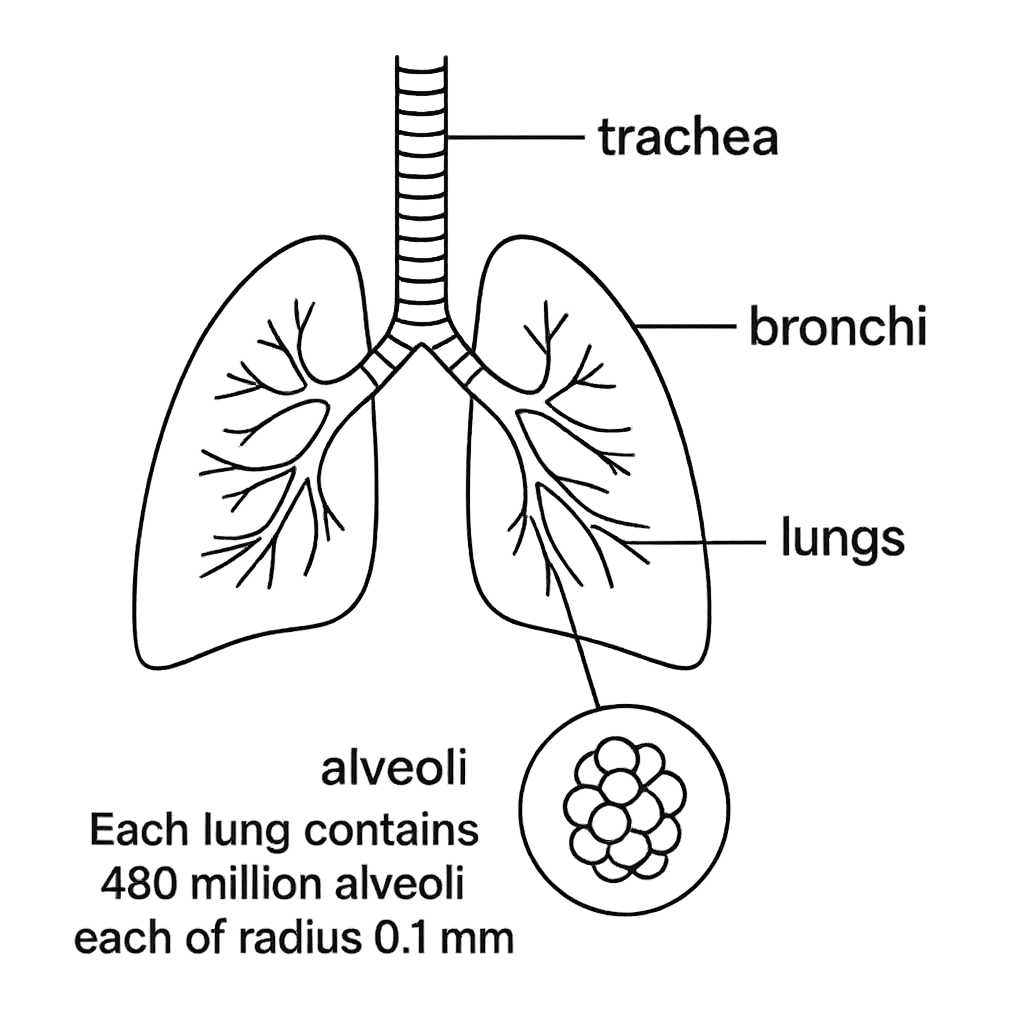
The diagram of the human respiratory system shows that the lungs contain about 480 million alveoli, each of which can be approximated as a sphere of radius \(0.1\) mm. Estimate the total internal surface area of all alveoli that is available for gas exchange. Give your answer in square metres, correct to two significant figures.
Correct A. 6.0×10^1 m^2
B. 4.8×10^1 m^2
C. 7.2×10^1 m^2
D. 5.0×10^1 m^2

Correct Answer: A

Want to see the full step-by-step solution? Unlock AI Explanation & Analytics
Question 7 View Details
In a simple reflex arc, a sensory receptor is located 0.5 m from the spinal cord, and the motor effector muscle is 0.3 m beyond the spinal cord. The sensory (afferent) nerve conducts impulses at \(50\) m s\(^{-1}\) and the motor (efferent) nerve at \(60\) m s\(^{-1}\). At each synapse there is a delay of \(0.5\) ms, and the central processing involves three interneurons, each adding a delay of \(2\) ms. After the motor impulse reaches the muscle, the muscle itself takes \(20\) ms to develop a measurable contraction. Calculate the total time, in milliseconds, from the initial stimulus at the receptor to the onset of muscle contraction.
Correct A. 42 ms
B. 40 ms
C. 48 ms
D. 44 ms

Correct Answer: A

Want to see the full step-by-step solution? Unlock AI Explanation & Analytics
Question 8 View Details
Two desert plant species, A and B, differ in two leaf adaptations that affect transpiration. Species A has a stomatal density of \(150\) stomata mm\(^{-2}\) and a cuticle thickness of \(5\) µm. Species B has a stomatal density of \(80\) stomata mm\(^{-2}\) and a cuticle thickness of \(12\) µm. Experimental data show that the transpiration rate \(W\) (in mg h\(^{-1}\) per unit leaf area) is directly proportional to stomatal density and inversely proportional to cuticle thickness, i.e. \(W = k \dfrac{D}{T}\), where \(D\) is density and \(T\) is thickness (in µm). If species A loses \(120\) mg h\(^{-1}\) under standard conditions, determine:\n\n(a) the constant \(k\);\n(b) the expected transpiration rate of species B;\n(c) the percentage reduction in water loss from A to B;\n(d) assuming only one adaptation changes at a time, calculate the individual percentage reductions due to (i) the lower stomatal density alone and (ii) the thicker cuticle alone, and state which adaptation contributes more to the overall reduction.
A. (a) k = 3; (b) 32.0 mg h⁻¹; (c) 73 %; (d) (i) 40 % reduction, (ii) 55 % reduction - the thicker cuticle contributes more.
Correct B. (a) k = 4; (b) 26.7 mg h⁻¹; (c) 78 %; (d) (i) 47 % reduction, (ii) 58 % reduction - the thicker cuticle contributes more.
C. (a) k = 5; (b) 22.5 mg h⁻¹; (c) 81 %; (d) (i) 50 % reduction, (ii) 60 % reduction - the lower stomatal density contributes more.
D. (a) k = 4; (b) 30.0 mg h⁻¹; (c) 75 %; (d) (i) 45 % reduction, (ii) 50 % reduction - the thicker cuticle contributes more.

Correct Answer: B

Want to see the full step-by-step solution? Unlock AI Explanation & Analytics
Question 9 View Details
During mitosis, which phase is characterised by the chromosomes lining up at the cell's equatorial plate?
A. telophase
B. anaphase
C. prophase
Correct D. metaphase

Correct Answer: D

Want to see the full step-by-step solution? Unlock AI Explanation & Analytics
Question 10 View Details
A semi‑permeable membrane separates two compartments. The membrane has an effective diffusion area of \(200\) mm\(^2\) and a thickness of \(10\) µm. The diffusion coefficient for the solute is \(1.5 \times 10^{-5}\) cm\(^2\) s\(^{-1}\), and the concentration difference across the membrane is \(0.8\) mol cm\(^{-3}\). Using Fick's first law, calculate the rate of diffusion of the solute in mol s\(^{-1}\). Give your answer in scientific notation to two significant figures.
A. 3.6×10⁻² mol s⁻¹
Correct B. 2.4×10⁻² mol s⁻¹
C. 2.4×10⁻³ mol s⁻¹
D. 1.2×10⁻² mol s⁻¹

Correct Answer: B

Want to see the full step-by-step solution? Unlock AI Explanation & Analytics
Question 11 View Details
During a 5‑minute period of moderate exercise, a student records that \(1.5\ \text{L}\) of O\(_2\) are taken in and \(1.2\ \text{L}\) of CO\(_2\) are expelled. At the same time the breathing rate rises to \(20\) breaths per minute and the tidal volume is \(600\ \text{mL}\). Assuming the fraction of each breath that is anatomical dead space remains constant, determine the volume of dead space per breath (in millilitres).
A. 350 mL
Correct B. 300 mL
C. 250 mL
D. 400 mL

Correct Answer: B

Want to see the full step-by-step solution? Unlock AI Explanation & Analytics
Question 12 View Details
A spherical plant cell has a diameter of \(40\ \mu\text{m}\). The central vacuole occupies \(80\%\) of the cell's total volume. Estimate the volume of the vacuole in cubic micrometres (\(\mu\text{m}^3\)).
A. 2.68×10³ µm³
Correct B. 2.68×10⁴ µm³
C. 2.5×10⁴ µm³
D. 3.0×10⁴ µm³

Correct Answer: B

Want to see the full step-by-step solution? Unlock AI Explanation & Analytics
Question 13 View Details
A newly emerging infectious disease has a basic reproduction number \(R_0 = 3\). To achieve herd immunity, a proportion \(p\) of the population must be immune, where \(p = 1 - \frac{1}{R_0}\). A vaccine available for this disease is only \(80\%\) effective at preventing infection. What minimum proportion of the total population must be vaccinated to achieve herd immunity? Express your answer as a decimal rounded to two decimal places.
A. 0.75
B. 0.90
C. 0.80
Correct D. 0.83

Correct Answer: D

Want to see the full step-by-step solution? Unlock AI Explanation & Analytics
Question 14 View Details
The kidneys filter \(180\ \text{L}\) of plasma each day. Of the filtered water, \(99\%\) is re‑absorbed, and \(65\%\) of the filtered glucose is re‑absorbed. If the plasma contains \(0.10\ \text{g\,L}^{-1}\) glucose, calculate (a) the volume of urine produced per day (in litres) and (b) the mass of glucose excreted per day (in grams).
A. a) 2.0 L, b) 5.0 g
Correct B. a) 1.8 L, b) 6.3 g
C. a) 3.6 L, b) 3.2 g
D. a) 1.5 L, b) 7.5 g

Correct Answer: B

Want to see the full step-by-step solution? Unlock AI Explanation & Analytics
Question 15 View Details
In a grassland ecosystem the total primary production is \(5000\ \text{MJ}\) per year. Only \(10\%\) of this energy is stored as biomass by the primary producers. Herbivores convert \(20\%\) of the biomass they consume into their own biomass, and carnivores convert \(10\%\) of the herbivore biomass they consume. Of the total carnivore biomass, top predators obtain \(60\%\) while secondary carnivores obtain the remaining \(40\%\). Calculate (a) the total energy available to all carnivores per year (in MJ) and (b) the energy obtained by top predators per year (in MJ).
A. a) 100 MJ, b) 60 MJ]
B. a) 10 MJ, b) 4 MJ]
Correct C. a) 10 MJ, b) 6 MJ
D. a) 8 MJ, b) 4.8 MJ]

Correct Answer: C

Want to see the full step-by-step solution? Unlock AI Explanation & Analytics
Question 16 View Details
A pea plant is heterozygous for two linked genes, A (round seed) and B (yellow seed), and the genes are in coupling phase (AB/ab). The recombination frequency between the genes is (12\%\). The plant is crossed with a plant that is homozygous recessive aabb. What proportion of the offspring will have round yellow seeds?
A. 36 %
B. 48 %
Correct C. 44 %
D. 52 %

Correct Answer: C

Want to see the full step-by-step solution? Unlock AI Explanation & Analytics
Question 17 View Details
A cell spends 8 h in G1, 6 h in S, 4 h in G2 and 2 h in M phase. What fraction of the total cell‑cycle time is spent in interphase?
A. 100 %
B. 70 %
C. 80 %
Correct D. 90 %

Correct Answer: D

Want to see the full step-by-step solution? Unlock AI Explanation & Analytics
Question 18 View Details
The volumetric flow rate of water through a plant's xylem can be approximated by \(R = k \frac{\Delta P}{L}\), where \(k = 5 \times 10^{-12}\,\text{m}^3\text{Pa}^{-1}\text{s}^{-1}\). In scenario A the pressure difference \(\Delta P\) is 0.3 MPa and the average vessel length \(L\) is 0.5 m. In scenario B the pressure difference is 0.4 MPa and the vessel length is 0.8 m. Assuming all other factors are equal, which scenario gives the higher flow rate and by what factor is it greater?
A. Scenario B, 1.2 times greater
B. Scenario A, 0.8 times greater
Correct C. Scenario A, 1.2 times greater
D. Scenario B, 0.9 times greater

Correct Answer: C

Want to see the full step-by-step solution? Unlock AI Explanation & Analytics
Question 19 View Details
Two desert shrubs differ in leaf morphology. Species X has a leaf area of 30 cm², stomatal density of 200 mm⁻² and each stomata opens to an area of 5 µm². Species Y has a leaf area of 20 cm², stomatal density of 150 mm⁻² and each stomata opens to an area of 8 µm². Transpiration rate is proportional to the total open stomatal area multiplied by the temperature difference between leaf interior and air. The temperature difference is 15 °C for species X and 10 °C for species Y. Which species loses more water per hour?
A. Both species equally
B. Species Z
C. Species Y
Correct D. Species X

Correct Answer: D

Want to see the full step-by-step solution? Unlock AI Explanation & Analytics
Question 20 View Details
A bacterial culture starts with \(2 \times 10^{5}\) cells. After 2 h the count is \(1.6 \times 10^{6}\) cells. Assuming exponential growth, (a) calculate the generation time in minutes; (b) if a bacteriostatic drug reduces the growth‑rate constant by 30 %, what will be the cell number after 6 h from the start?
Correct A. (a) 40 min; (b) ≈ 1.6 × 10⁷ cells
B. (a) 30 min; (b) ≈ 1.2 × 10⁷ cells
C. (a) 50 min; (b) ≈ 1.0 × 10⁷ cells
D. (a) 45 min; (b) ≈ 2.0 × 10⁷ cells

Correct Answer: A

Want to see the full step-by-step solution? Unlock AI Explanation & Analytics
Question 21 View Details
After a meal a student's blood glucose concentration rises to \(12\) mmol/L. For the first five minutes the pancreas secretes insulin at a constant rate of \(4\) units per minute; after five minutes insulin secretion stops. Each unit of insulin removes \(0.8\) mmol/L of glucose per minute, and cells use glucose at a basal rate of \(0.5\) mmol/L per minute regardless of insulin. Assuming no other processes, how many minutes (to one decimal place) are required for the glucose concentration to fall to the normal level of \(5\) mmol/L?
Correct A. 1.9
B. 2.5
C. 3.1
D. 0.9

Correct Answer: A

Want to see the full step-by-step solution? Unlock AI Explanation & Analytics
Question 22 View Details
A person's core body temperature is initially \(37^{\circ}\)C while the ambient temperature is \(5^{\circ}\)C. Heat loss occurs at a rate of \(0.05\times(T_{body}-T_{ambient})\) degrees Celsius per minute. When the body temperature falls below \(35^{\circ}\)C, shivering generates heat at a constant rate of \(0.3^{\circ}\)C per minute. Calculate the body temperature after \(20\) minutes, giving your answer to one decimal place.
A. 18.4
B. 15.0
C. 22.7
Correct D. 20.1

Correct Answer: D

Want to see the full step-by-step solution? Unlock AI Explanation & Analytics
Question 23 View Details
In a simple stretch reflex the sensory (afferent) neuron is \(0.8\) m long and conducts impulses at \(80\) m s⁻¹. The motor (efferent) neuron is \(0.6\) m long and conducts at \(60\) m s⁻¹. The synaptic delay in the spinal cord is \(0.5\) ms and the neuromuscular junction adds a further \(0.3\) ms. Muscle contraction occurs \(20\) ms after the motor impulse reaches the muscle. What is the total time from the initial stretch to the start of muscle contraction? Give your answer in milliseconds.
A. 38.5
B. 42.0
Correct C. 40.8
D. 45.2

Correct Answer: C

Want to see the full step-by-step solution? Unlock AI Explanation & Analytics
Question 24 View Details
A teenage athlete consumes \(2800\) kcal per day. His diet provides \(55\)% carbohydrate, \(15\)% protein and \(30\)% fat. Carbohydrate and protein supply \(4\) kcal g⁻¹, fat supplies \(9\) kcal g⁻¹. He wishes to gain \(1.5\) kg of muscle in six weeks (42 days). Assuming that gaining 1 kg of muscle requires a surplus of \(2500\) kcal stored as protein, calculate: (a) the extra kcal he must eat each day, and (b) the corresponding increase in protein intake (in grams per day) if the extra calories come only from protein. Give your answers to the nearest whole number.
A. 60 kcal per day, 15 g protein per day
Correct B. 89 kcal per day, 22 g protein per day
C. 75 kcal per day, 19 g protein per day
D. 100 kcal per day, 25 g protein per day

Correct Answer: B

Want to see the full step-by-step solution? Unlock AI Explanation & Analytics
Question 25 View Details
A bacterial culture starts with \(1\times10^{3}\) cells. Under optimal conditions the generation time is 20 minutes (the population doubles each generation). After exactly 2 hours an antibiotic is added that doubles the generation time to 40 minutes, and this effect is immediate. Assuming the culture continues to grow exponentially with the new generation time, how many cells are present after a total of 5 hours from the start of the culture? Give your answer in scientific notation to two significant figures.
Correct A. 1.5×10^6
B. 6.4×10^5
C. 1.3×10^6
D. 2.0×10^6

Correct Answer: A

Want to see the full step-by-step solution? Unlock AI Explanation & Analytics

Master the Exam!

You've seen a preview, but there are thousands more questions plus AI tutor to break down complex solutions.

Unlock Full Access Available for Android & Windows
Help others prepare! Share this practice hub:
Chat with Support