gce model questions vol1 2023 physics | Objective

Prepare for your exams with gce model questions vol1 questions? Reviewing past/model questions is one of the most effective ways to guarantee a high score. This practice hub features authentic 2023 physics (Objective) questions designed to simulate the real exam environment.

Practice these randomly selected questions to test your readiness.

Question 1 View Details
Two point charges +q and -q, each of magnitude \(5.0\ \mu\text{C}\), are fixed on the x‑axis at positions \(x=0\) and \(x=0.20\ \text{m}\) respectively. Determine the point on the x‑axis where the electric potential is zero and calculate the magnitude of the electric field at that point. Give the field magnitude in \(\text{N C}^{-1}\).
Correct A. 9.0×10⁶ N C⁻¹ (to the right)
B. 7.5×10⁶ N C⁻¹ (to the right)
C. 1.2×10⁶ N C⁻¹ (to the left)
D. 9.0×10⁶ N C⁻¹ (to the left)

Correct Answer: A

Want to see the full step-by-step solution? Unlock AI Explanation & Analytics
Question 2 View Details
A displacement vector \(\mathbf{A}\) has magnitude \(30\ \text{m}\) and is directed \(40^{\circ}\) north of east. A second displacement vector \(\mathbf{B}\) has magnitude \(40\ \text{m}\) and is directed \(30^{\circ}\) west of north. Find the magnitude of the resultant displacement and state its bearing as an angle east of north, to one decimal place.
A. Resultant magnitude ≈ 60.0 m, bearing ≈ 0.0° east of north
Correct B. Resultant magnitude ≈ 54.0 m, bearing ≈ 3.2° east of north
C. Resultant magnitude ≈ 54.0 m, bearing ≈ 15.0° east of north
D. Resultant magnitude ≈ 48.0 m, bearing ≈ 10.5° east of north

Correct Answer: B

Want to see the full step-by-step solution? Unlock AI Explanation & Analytics
Question 3 View Details
A 5.0 kg block is lifted at constant speed by a rope that passes over a movable pulley attached to the ceiling. The ideal mechanical advantage of the system is 2. Because of friction in the pulley axle, the tension in the rope on the load side is 10 % greater than the tension on the effort side. Determine (a) the magnitude of the input force required to lift the block, and (b) the overall efficiency of the system, expressed as a percentage.
A. Input force ≈ 44.5 N; efficiency ≈ 45 %
B. Input force ≈ 49.0 N; efficiency ≈ 60 %
C. Input force ≈ 40.0 N; efficiency ≈ 50 %
Correct D. Input force ≈ 44.5 N; efficiency ≈ 55 %

Correct Answer: D

Want to see the full step-by-step solution? Unlock AI Explanation & Analytics
Question 4 View Details
In the circuit shown, a 12 V ideal battery is connected in series with a 4 Ω resistor \(R_{1}\). The junction after \(R_{1}\) splits into a parallel network consisting of a 6 Ω resistor \(R_{2}\) and a load resistor \(R_{L}\). (i) Find the value of \(R_{L}\) that will receive maximum power and calculate that maximum power. (ii) If the battery has an internal resistance of 2 Ω (in series with the 12 V source), repeat the calculation: find the new value of \(R_{L}\) for maximum power transfer and the corresponding maximum power. Give all powers in watts to two decimal places.
A. (i) \(R_{L}=10\ \Omega\), \(P_{max}=1.00\ \text{W}\). (ii) With 2 Ω internal resistance: \(R_{L}=12\ \Omega\), \(P_{max}=0.60\ \text{W}\).
B. (i) \(R_{L}=8\ \Omega\), \(P_{max}=1.10\ \text{W}\). (ii) With 2 Ω internal resistance: \(R_{L}=10\ \Omega\), \(P_{max}=0.65\ \text{W}\).
Correct C. (i) \(R_{L}=10\ \Omega\), \(P_{max}=1.30\ \text{W}\). (ii) With 2 Ω internal resistance: \(R_{L}=12\ \Omega\), \(P_{max}=0.75\ \text{W}\).
D. (i) \(R_{L}=12\ \Omega\), \(P_{max}=1.50\ \text{W}\). (ii) With 2 Ω internal resistance: \(R_{L}=14\ \Omega\), \(P_{max}=0.80\ \text{W}\).

Correct Answer: C

Want to see the full step-by-step solution? Unlock AI Explanation & Analytics
Question 5 View Details
A block of mass \(8.0\ \text{kg}\) rests on a rough inclined plane that makes an angle of \(30^{\circ}\) with the horizontal. The coefficient of static friction is 0.40 and the coefficient of kinetic friction is 0.30. A horizontal force \(F\) is applied to the block, pushing it up the incline. (a) Determine the minimum magnitude of \(F\) required to start the block moving up the plane. (b) Using this value of \(F\), calculate the block's acceleration up the plane once it is moving, assuming kinetic friction. Give \(F\) in newtons (to one decimal place) and the acceleration in \(\text{m s}^{-2}\) (to two decimal places).
A. Minimum \(F\) ≈ 85.3 N; acceleration ≈ 0.92 m s⁻² up the plane
B. Minimum \(F\) ≈ 99.7 N; acceleration ≈ 2.30 m s⁻² up the plane
Correct C. Minimum \(F\) ≈ 99.7 N; acceleration ≈ 1.48 m s⁻² up the plane
D. Minimum \(F\) ≈ 112.5 N; acceleration ≈ 2.10 m s⁻² up the plane

Correct Answer: C

Want to see the full step-by-step solution? Unlock AI Explanation & Analytics
Question 6 View Details
A stretched string of length \(1.20\ \text{m}\) is fixed at both ends and has a linear mass density of \(0.025\ \text{kg\,m}^{-1}\). When the string is plucked, the second harmonic has a frequency of \(120\ \text{Hz}\). The tension in the string is then increased by \(20\%\). What is the new frequency of the fundamental (first harmonic) after the tension increase? Give your answer to the nearest hertz.
Correct A. 66
B. 60
C. 78
D. 72

Correct Answer: A

Want to see the full step-by-step solution? Unlock AI Explanation & Analytics
Question 7 View Details
A police siren emits a sound of frequency \(800\ \text{Hz}\). The siren is mounted on a car that approaches a stationary observer at a speed of \(30\ \text{m\,s}^{-1}\). After the car passes the observer, it continues moving away at the same speed. The speed of sound in air is \(340\ \text{m\,s}^{-1}\). At the instant when the car is \(60\ \text{m}\) beyond the observer, the observer also hears a second identical siren that is fixed at the observer's location and emits \(800\ \text{Hz}\). What beat frequency does the observer hear at that moment? Give your answer to the nearest hertz.
A. 70
B. 80
C. 55
Correct D. 65

Correct Answer: D

Want to see the full step-by-step solution? Unlock AI Explanation & Analytics
Question 8 View Details
Monochromatic water waves of frequency \(6\ \text{Hz}\) travel on the surface of a pond where the wave speed is \(0.30\ \text{m\,s}^{-1}\). Two narrow slits in a barrier are \(0.20\ \text{m}\) apart. A screen is placed \(2.00\ \text{m}\) behind the slits. Using the interference pattern formed on the screen, calculate the distance between the first two adjacent bright fringes. Give your answer in metres to two decimal places.
A. 0.45
B. 0.60
Correct C. 0.50
D. 0.55

Correct Answer: C

Want to see the full step-by-step solution? Unlock AI Explanation & Analytics
Question 9 View Details
A converging lens L1 has a focal length of \(10\ \text{cm}\). A candle is placed to the left of L1 such that a sharp real image is formed on a screen \(12\ \text{cm}\) to the right of L1. A second thin converging lens L2 is positioned \(20\ \text{cm}\) to the right of L1. When the screen is moved to a position \(40\ \text{cm}\) to the right of L2, a sharp image of the same candle is again obtained. Determine the focal length of L2 in centimetres, giving your answer to two decimal places.
A. 10.00
Correct B. 6.67
C. 8.33
D. 5.00

Correct Answer: B

Want to see the full step-by-step solution? Unlock AI Explanation & Analytics
Question 10 View Details
A car travels at a constant speed of \(72\ \text{km h}^{-1}\) for \(2\ \text{min}\ 30\ \text{s}\). How far does it travel in metres? Give your answer as an integer.
A. 3300
B. 2500
Correct C. 3000
D. 2700

Correct Answer: C

Want to see the full step-by-step solution? Unlock AI Explanation & Analytics
Question 11 View Details
An insulated container holds 2.0 kg of water at 20 °C and a steel container of mass 0.3 kg (specific heat capacity 450 J kg⁻¹ K⁻¹) also initially at 20 °C. A 0.5 kg copper block at 150 °C is placed into the water. After thermal equilibrium the final temperature of the system is 28 °C. Assuming no heat loss to the surroundings, determine the specific heat capacity of copper in J kg⁻¹ K⁻¹.
A. 9.8×10^2 J·kg⁻¹·K⁻¹
B. 1.30×10^3 J·kg⁻¹·K⁻¹
C. 8.5×10^2 J·kg⁻¹·K⁻¹
Correct D. 1.12×10^3 J·kg⁻¹·K⁻¹

Correct Answer: D

Want to see the full step-by-step solution? Unlock AI Explanation & Analytics
Question 12 View Details
Two loudspeakers S₁ and S₂ emit sound of the same original frequency \(f_0\) in still air where the speed of sound is \(v = 340\ \text{m s}^{-1}\). Speaker S₁ is stationary, while S₂ moves directly towards a point P at a speed of \(u = 10\ \text{m s}^{-1}\). At a particular instant the distances from S₁ and S₂ to P are \(d_1 = 2.0\ \text{m}\) and \(d_2 = 2.5\ \text{m}\) respectively. The waves arriving at P are observed to be in phase (constructive interference). Determine the original frequency \(f_0\) emitted by the speakers (in hertz).
Correct A. 590 Hz
B. 610 Hz
C. 560 Hz
D. 540 Hz

Correct Answer: A

Want to see the full step-by-step solution? Unlock AI Explanation & Analytics
Question 13 View Details
A rectangular solid has dimensions \(12.0\ \text{cm} \times 8.0\ \text{cm} \times 5.0\ \text{cm}\). Express its volume in cubic metres and then calculate its mass if the material density is \(2.70 \times 10^{3}\ \text{kg m}^{-3}\). Give the mass to three significant figures in kilograms.
A. 1.50 kg
B. 1.03 kg
C. 0.96 kg
Correct D. 1.30 kg

Correct Answer: D

Want to see the full step-by-step solution? Unlock AI Explanation & Analytics
Question 14 View Details
A car starts from rest and its acceleration varies with time according to \(a(t) = k t\) (in \(\text{m s}^{-2}\)), where \(k\) is a constant. After \(5\ \text{s}\) the car's speed is \(20\ \text{m s}^{-1}\). (a) Find the value of \(k\). (b) Determine the distance travelled by the car in the first \(5\ \text{s}\). (c) Find the speed of the car after \(8\ \text{s}\).
A. k = 1.6 m s⁻³; s = 28.0 m; v = 51.2 m s⁻¹
B. k = 2.0 m s⁻³; s = 30.0 m; v = 48.0 m s⁻¹
C. k = 1.6 m s⁻³; s = 33.3 m; v = 45.0 m s⁻¹
Correct D. k = 1.6 m s⁻³; s = 33.3 m; v = 51.2 m s⁻¹

Correct Answer: D

Want to see the full step-by-step solution? Unlock AI Explanation & Analytics
Question 15 View Details
A \(5.0\ \text{kg}\) block rests on a smooth incline that makes an angle of \(30^{\circ}\) with the horizontal. The block is attached by a light inextensible string over a frictionless pulley to a hanging mass \(M\). The system is released and the block accelerates up the incline with an acceleration of \(1.2\ \text{m s}^{-2}\). (a) Determine the mass \(M\) (in kilograms). (b) Find the tension in the string (in newtons).
A. M = 2.15 kg; T = 18.5 N
B. M = 3.52 kg; T = 31.0 N
C. M = 2.50 kg; T = 24.5 N
Correct D. M = 3.55 kg; T = 30.5 N

Correct Answer: D

Want to see the full step-by-step solution? Unlock AI Explanation & Analytics
Question 16 View Details
A thin film of oil (refractive index \(n=1.45\)) is lying in air and is illuminated at normal incidence by monochromatic light. For light of wavelength \(600\,\text{nm}\) the reflected light shows a bright fringe (constructive interference) and for light of wavelength \(500\,\text{nm}\) a dark fringe (destructive interference). Assuming the only phase change occurs at the air‑oil surface, determine the minimum possible thickness of the oil film. Give your answer in nanometres (nm).
A. 6.0×10^{2} nm (≈600 nm)
B. 5.8×10^{2} nm (≈580 nm)
Correct C. 5.2×10^{2} nm (≈517 nm)
D. 4.8×10^{2} nm (≈480 nm)

Correct Answer: C

Want to see the full step-by-step solution? Unlock AI Explanation & Analytics
Question 17 View Details
A sealed sample contains two radioactive isotopes, A and B, that both decay by \(\beta\) emission. Isotope A has a half‑life of \(30\) min and an initial activity of \(800\) Bq. Isotope B has a half‑life of \(2\) h and an unknown initial activity. After exactly \(1\) h the total measured activity of the sample is \(900\) Bq.\n\n(a) Determine the initial activity of isotope B.\n(b) If each decay of A releases \(0.5\) MeV and each decay of B releases \(1.2\) MeV, calculate the total energy released by the sample during the first hour. Give your answer in joules (J) in scientific notation to two significant figures.
A. Initial activity of B ≈ 1.1×10^{3} Bq; total energy released ≈ 7.5×10⁻⁷ J
B. Initial activity of B ≈ 8.5×10^{2} Bq; total energy released ≈ 6.2×10⁻⁷ J
Correct C. Initial activity of B ≈ 9.9×10^2 Bq; total energy released ≈ 7.0×10⁻⁷ J
D. Initial activity of B ≈ 9.0×10^{2} Bq; total energy released ≈ 8.0×10⁻⁷ J

Correct Answer: C

Want to see the full step-by-step solution? Unlock AI Explanation & Analytics
Question 18 View Details
A metal rod of unknown specific heat capacity \(c\) (J kg⁻¹ K⁻¹) has a rectangular cross‑section and a length of \(0.30\) m. Its density is \(7800\) kg m⁻³ and its volume is \(3.0\times10^{-5}\) m³. The rod is heated uniformly to \(120^{\circ}\text{C}\) and then placed into an insulated container holding \(200\) g of water initially at \(20^{\circ}\text{C}\). After thermal equilibrium the temperature of the water‑rod system is \(30^{\circ}\text{C}\). During the process the rod loses an additional \(5.0\) kJ of heat to the surroundings. Determine the specific heat capacity \(c\) of the metal, giving your answer to the nearest whole number (J kg⁻¹ K⁻¹).
A. 550 J kg⁻¹ K⁻¹
Correct B. 635 J kg⁻¹ K⁻¹
C. 720 J kg⁻¹ K⁻¹
D. 800 J kg⁻¹ K⁻¹

Correct Answer: B

Want to see the full step-by-step solution? Unlock AI Explanation & Analytics
Question 19 View Details
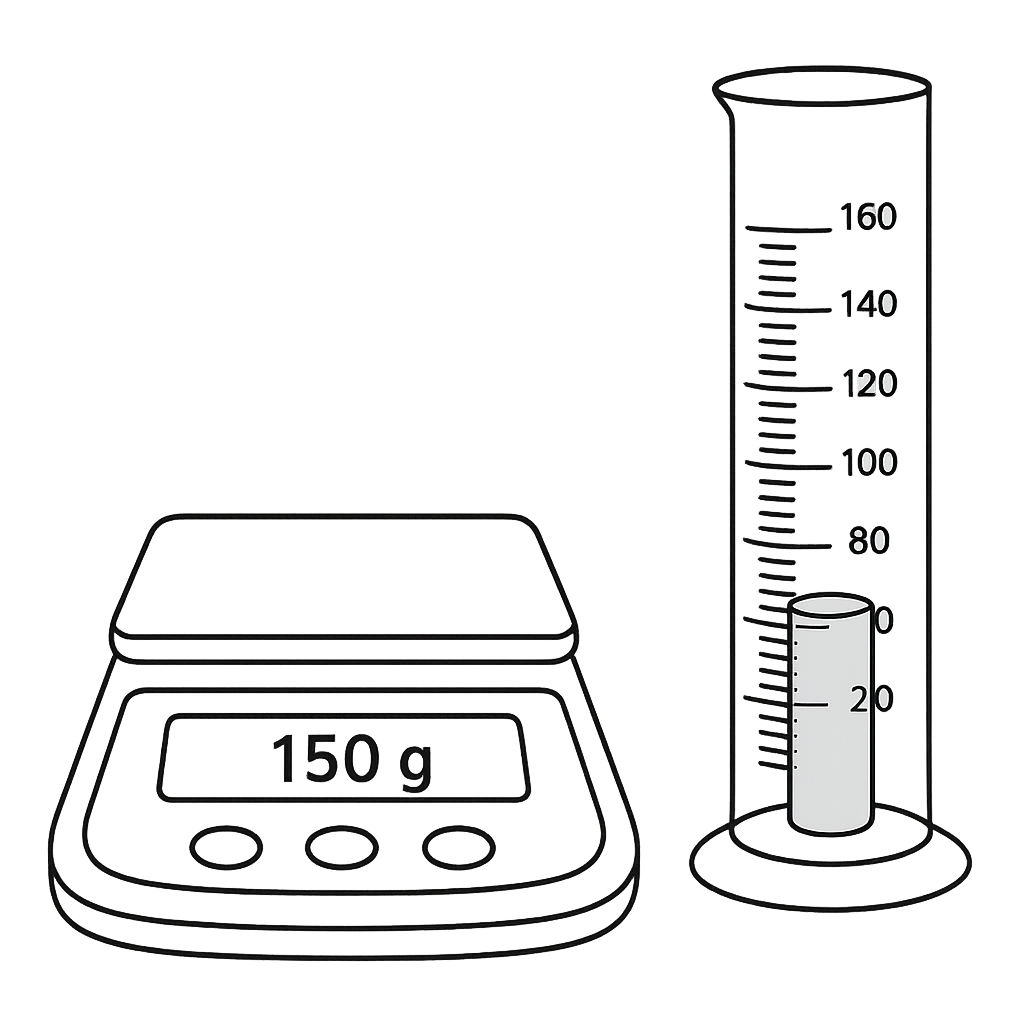
In the laboratory setup shown, a digital balance reads \(150\) g for a metal cylinder. The cylinder is then gently placed into a graduated cylinder containing water, causing the water level to rise from \(120\) mL to \(155\) mL. Using these measurements, calculate the density of the metal in kilograms per cubic metre (kg m⁻³). Give your answer to three significant figures.
A. 5.12×10³ kg m⁻³
Correct B. 4.29×10³ kg m⁻³
C. 3.85×10³ kg m⁻³
D. 4.80×10³ kg m⁻³

Correct Answer: B

Want to see the full step-by-step solution? Unlock AI Explanation & Analytics
Question 20 View Details
A sealed piston‑cylinder contains \(0.5\) mol of a monatomic ideal gas at \(300\) K and \(100\) kPa. The gas first expands isothermally until its volume doubles, and then it is compressed adiabatically back to its original volume.\n\n(a) Calculate the net work done on the gas over the complete cycle (in joules, to the nearest joule).\n(b) Determine the efficiency of the cycle, defined as \(\eta = \dfrac{|W_{\text{net}}|}{Q_{\text{in}}}\), where \(Q_{\text{in}}\) is the heat absorbed during the isothermal expansion. Express \(\eta\) as a percentage to the nearest whole percent.
Correct A. Net work on gas = 233 J; efficiency = 27 %
B. Net work on gas = 100 J; efficiency = 45 %
C. Net work on gas = 300 J; efficiency = 20 %
D. Net work on gas = 150 J; efficiency = 35 %

Correct Answer: A

Want to see the full step-by-step solution? Unlock AI Explanation & Analytics
Question 21 View Details
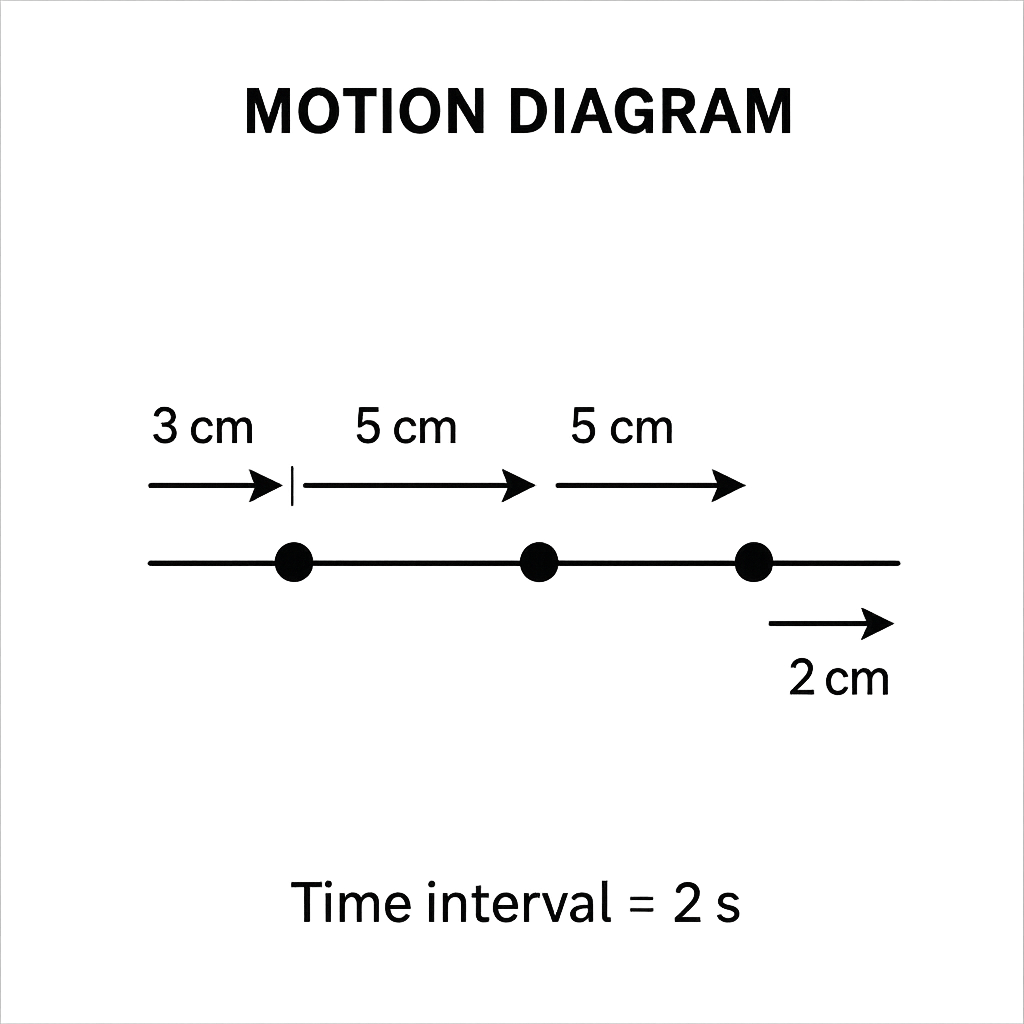
A motion diagram shows a particle moving in a straight line. Four equally spaced position markers are recorded at successive equal time intervals of \(2.0\) s. At each marker an arrow indicates the instantaneous speed, with arrow lengths of \(3\) cm, \(5\) cm, \(5\) cm and \(2\) cm respectively. Each centimetre of arrow length corresponds to \(1.0\) m s\(^{-1}\). Using the diagram, determine (a) the average speed of the particle over the whole \(8.0\) s, and (b) whether the particle is accelerating, decelerating or moving at constant speed during each interval.
Correct A. Average speed = 3.75 m s⁻¹. The particle accelerates in the first interval, moves at constant speed in the second, and decelerates in the third.
B. Average speed = 4.25 m s⁻¹. The particle accelerates in the first interval, moves at constant speed in the second, and decelerates in the third.
C. Average speed = 3.75 m s⁻¹. The particle accelerates in the first interval, decelerates in the second, and moves at constant speed in the third.
D. Average speed = 3.75 m s⁻¹. The particle moves at constant speed in the first interval, accelerates in the second, and decelerates in the third.

Correct Answer: A

Want to see the full step-by-step solution? Unlock AI Explanation & Analytics
Question 22 View Details
A \(5.0\) kg block is released from rest at the top of a \(30^{\circ}\) incline that is \(4.0\) m long. The coefficient of kinetic friction between the block and the incline is \(0.20\). At the bottom of the incline the block compresses a horizontal spring of force constant \(800\) N m\(^{-1}\). (a) Find the maximum compression of the spring. (b) Determine the average power delivered by gravity to the block during its descent.
A. (a) Maximum compression \(x = 0.30\) m. (b) Average power supplied by gravity \(\approx 80\) W.
B. (a) Maximum compression \(x = 0.40\) m. (b) Average power supplied by gravity \(\approx 45\) W.
Correct C. (a) Maximum compression \(x = 0.40\) m. (b) Average power supplied by gravity \(\approx 62\) W.
D. (a) Maximum compression \(x = 0.55\) m. (b) Average power supplied by gravity \(\approx 62\) W.

Correct Answer: C

Want to see the full step-by-step solution? Unlock AI Explanation & Analytics
Question 23 View Details
A circular coil of radius \(0.10\) m has \(200\) turns and rotates in a uniform magnetic field of magnitude \(0.5\) T. The axis of rotation is perpendicular to the field direction. The coil is connected to a \(10\) \(\Omega\) resistor. Starting from rest, the coil is given a constant angular acceleration of \(50\) rad s\(^{-2}\). Determine (a) the magnitude of the induced emf at the instant when the angular speed reaches \(100\) rad s\(^{-1}\), (b) the instantaneous current through the resistor at that instant, and (c) the rate at which electrical energy is being dissipated in the resistor at that instant.
A. (a) \(\mathcal{E} \approx 2.0\times10^{2}\) V (≈200 V). (b) \(I \approx 20.0\) A. (c) Power dissipated \(P \approx 4.0\times10^{3}\) W (≈4.0 kW).
B. (a) \(\mathcal{E} \approx 7.9\times10^{1}\) V (≈79 V). (b) \(I \approx 7.9\) A. (c) Power dissipated \(P \approx 6.3\times10^{2}\) W (≈630 W).
C. (a) \(\mathcal{E} \approx 3.16\times10^{2}\) V (≈316 V). (b) \(I \approx 31.6\) A. (c) Power dissipated \(P \approx 1.0\times10^{4}\) W (≈10 kW).
Correct D. (a) \(\mathcal{E} \approx 1.58\times10^{2}\) V (≈158 V). (b) \(I \approx 15.8\) A. (c) Power dissipated \(P \approx 2.5\times10^{3}\) W (≈2.5 kW).

Correct Answer: D

Want to see the full step-by-step solution? Unlock AI Explanation & Analytics
Question 24 View Details
A \(0.5\) kg copper block (specific heat \(c_{Cu}=385\) J kg\(^{-1}\)K\(^{-1}\)) initially at \(150^{\circ}\)C is placed into \(2.0\) kg of water (specific heat \(c_{w}=4186\) J kg\(^{-1}\)K\(^{-1}\)) at \(20^{\circ}\)C inside an insulated container. The container loses heat to the surroundings at a rate \(\dot Q = k\,(T-20^{\circ}{\rm C})\) with \(k = 2\) W K\(^{-1}\). Assuming thermal equilibrium is reached after \(5\) minutes, determine (a) the equilibrium temperature of the water‑copper system, and (b) the total heat lost to the surroundings during the \(5\) minute interval.
A. (a) Equilibrium temperature \(\approx 25^{\circ}{\rm C}\). (b) Heat lost to surroundings \(\approx 3.2\times10^{3}\) J.
B. (a) Equilibrium temperature \(\approx 18^{\circ}{\rm C}\). (b) Heat lost to surroundings \(\approx 1.0\times10^{3}\) J.
C. (a) Equilibrium temperature \(\approx 30^{\circ}{\rm C}\). (b) Heat lost to surroundings \(\approx 2.5\times10^{3}\) J.
Correct D. (a) Equilibrium temperature \(\approx 23^{\circ}{\rm C}\). (b) Heat lost to surroundings \(\approx 1.8\times10^{3}\) J.

Correct Answer: D

Want to see the full step-by-step solution? Unlock AI Explanation & Analytics
Question 25 View Details
A sample initially contains \(2.0\times10^{6}\) atoms of a radioactive isotope X. X decays to Y with a half‑life of \(30\) min, emitting a beta particle of kinetic energy \(0.5\) MeV. The daughter Y is itself radioactive, decaying to a stable nuclide Z with a half‑life of \(10\) min and emitting a gamma photon of energy \(1.2\) MeV. No other isotopes are present initially. Determine (a) the activity of X after \(45\) min, (b) the number of atoms of Y present at that time, and (c) the total energy (in joules) released by all decays (both beta and gamma) up to \(45\) min.
A. (a) Activity of X ≈ 1.8×10² Bq. (b) Number of Y atoms ≈ 2.0×10⁵. (c) Total energy released ≈ 1.5×10⁻⁷ J.
Correct B. (a) Activity of X ≈ 2.7×10² Bq. (b) Number of Y atoms ≈ 3.1×10⁵. (c) Total energy released ≈ 2.9×10⁻⁷ J.
C. (a) Activity of X ≈ 3.5×10² Bq. (b) Number of Y atoms ≈ 4.2×10⁵. (c) Total energy released ≈ 3.6×10⁻⁷ J.
D. (a) Activity of X ≈ 2.0×10² Bq. (b) Number of Y atoms ≈ 2.5×10⁵. (c) Total energy released ≈ 2.0×10⁻⁷ J.

Correct Answer: B

Want to see the full step-by-step solution? Unlock AI Explanation & Analytics

Master the Exam!

You've seen a preview, but there are thousands more questions plus AI tutor to break down complex solutions.

Unlock Full Access Available for Android & Windows
Help others prepare! Share this practice hub:
Chat with Support