gce model questions vol1 2021 geography | Objective

Prepare for your exams with gce model questions vol1 questions? Reviewing past/model questions is one of the most effective ways to guarantee a high score. This practice hub features authentic 2021 geography (Objective) questions designed to simulate the real exam environment.

Practice these randomly selected questions to test your readiness.

Question 1 View Details
A small urban catchment of 2.5 ha has a runoff coefficient of 0.6. During a design storm the rainfall intensity is 30 mm h⁻¹. Using the rational method, calculate the peak runoff discharge \(Q\). The drainage pipe must convey this flow on a slope of 0.001 (0.1 %) and is made of concrete (Manning \(n = 0.013\)). Determine the minimum internal diameter of a circular pipe that will convey the flow full‑pipe. Give your answer in metres to two decimal places.
A. 0.45 m
B. 0.60 m
Correct C. 0.51 m
D. 0.71 m

Correct Answer: C

Want to see the full step-by-step solution? Unlock AI Explanation & Analytics
Question 2 View Details
A topographic map has a scale of 1\!:\!50 000. The straight‑line distance between Town X and Town Y measured on the map is 3.2 cm. What is the actual ground distance between the two towns in kilometres? Give your answer to one decimal place.
A. 2.0 km
B. 0.8 km
C. 3.2 km
Correct D. 1.6 km

Correct Answer: D

Want to see the full step-by-step solution? Unlock AI Explanation & Analytics
Question 3 View Details
A river that is 12 km long in reality is drawn on a model at a scale of 1\!:\!2000. What is the length of the river on the model in centimetres? Give your answer as an integer.
A. 60 cm
B. 300 cm
Correct C. 600 cm
D. 1200 cm

Correct Answer: C

Want to see the full step-by-step solution? Unlock AI Explanation & Analytics
Question 4 View Details
A textile manufacturer is choosing between two possible sites for a new factory. **Site A**: distance to market 80 km, distance to raw‑material source 30 km, 120 workers, wage £12 h⁻¹. **Site B**: distance to market 120 km, distance to raw‑material source 20 km, 100 workers, wage £13 h⁻¹. Both sites use the same transport rates (finished product to market £0.05 t⁻¹ km⁻¹, raw material inbound £0.04 t⁻¹ km⁻¹). Annual production is 200 000 t of product. Each tonne of product requires 1.2 t of raw material. Workers work 8 h day⁻¹, 5 days week⁻¹, 48 weeks year⁻¹. Fixed overheads are £500 000 per year for either site. Calculate the total annual cost for each site and state which site is more economical. Give the total cost for each site in £ (rounded to the nearest thousand) and the preferred site.
A. Site A: £4 400 000; Site B: £4 350 000 - Site B is preferred
B. Site A: £4 353 000; Site B: £4 388 000 - Site B is preferred
Correct C. Site A: £4 353 000; Site B: £4 388 000 - Site A is preferred
D. Site A: £4 350 000; Site B: £4 390 000 - Site A is preferred

Correct Answer: C

Want to see the full step-by-step solution? Unlock AI Explanation & Analytics
Question 5 View Details
A country has a current population of 1.2 million and an annual compound growth rate of 2.5 %. The age‑structure today is 0-14 years 30 %, 15-64 years 60 %, and 65 years + 10 %.\n\n(a) Project the total population after 5 years.\n(b) Assuming the same age‑structure percentages apply to the projected population, calculate the number of people in each age group after 5 years.\n(c) Using these figures, compute the dependency ratio (\((young+old)/working\times100\)) after 5 years, expressed to one decimal place.
Correct A. 66.7 %
B. 58.3 %
C. 64.9 %
D. 72.5 %

Correct Answer: A

Want to see the full step-by-step solution? Unlock AI Explanation & Analytics
Question 6 View Details
A region is exposed to three environmental hazards: A, B and C. The probability of occurrence per year and the impact rating (on a scale of 1-10) are: Hazard A - probability 0.02, impact 8; Hazard B - probability 0.05, impact 6; Hazard C - probability 0.01, impact 9. Mitigation measures reduce the risk of Hazard A by 20 % and Hazard C by 30 %. If the total post‑mitigation risk (defined as \( \text{risk}=p \times \text{impact} \times (1-\text{mitigation})\)) must equal 0.40, what mitigation percentage (to the nearest whole percent) must be applied to Hazard B?
A. 35
B. 25
Correct C. 30
D. 45

Correct Answer: C

Want to see the full step-by-step solution? Unlock AI Explanation & Analytics
Question 7 View Details
In a region the manufacturing sector employs 120 000 workers directly. Indirect employment in services is estimated at 45 % of the direct manufacturing employment, but 20 % of those indirect jobs are also counted as direct employment in the construction sector, which itself employs 30 000 workers directly. After removing the double‑counted positions, what is the total number of unique jobs (direct and indirect) attributable to the manufacturing sector?
A. 150000
Correct B. 163200
C. 170000
D. 158000

Correct Answer: B

Want to see the full step-by-step solution? Unlock AI Explanation & Analytics
Question 8 View Details
A triangular catchment has an area of 2.5 km² and an average slope of 5 %. The length of the main watercourse (the longest flow path) is denoted by \(L\) metres, and the base of the triangle is twice this length. Using the Kirpich formula \( T_c = 0.0195\,L^{0.77}\,S^{-0.385}\) (where \(S\) is the slope expressed as a decimal), calculate the time of concentration \(T_c\) in minutes, rounded to the nearest minute.
Correct A. 57
B. 71
C. 62
D. 45

Correct Answer: A

Want to see the full step-by-step solution? Unlock AI Explanation & Analytics
Question 9 View Details
A river valley cross‑section shows the following elevations and horizontal distances: source at 350 m elevation, midpoint at 200 m after 12 km, and mouth at 50 m after a further 18 km. Calculate the average gradient (rise/run) for the upper reach (source to midpoint) and the lower reach (midpoint to mouth) to three decimal places, and state the corresponding landform stage for each reach using the criteria: youthful > 0.04, mature 0.01-0.04, old < 0.01.
Correct A. Upper gradient 0.013 (mature), Lower gradient 0.008 (old)
B. Upper gradient 0.020 (youthful), Lower gradient 0.005 (old)
C. Upper gradient 0.012 (mature), Lower gradient 0.007 (old)
D. Upper gradient 0.015 (mature), Lower gradient 0.009 (old)

Correct Answer: A

Want to see the full step-by-step solution? Unlock AI Explanation & Analytics
Question 10 View Details
Region X had a population of 2.5 million in 2010. The annual natural increase rate (births minus deaths) is 1.2 % per year. From 2010 to 2014 inclusive, net migration added 150 000 people each year. From 2015 onward, net migration was reduced to 80 000 people per year. Assuming natural increase is applied to the population at the start of each year before migration, what was the population in 2020 and what was the population density (persons per km²) given the region's area is 1 200 km²? Give the density rounded to the nearest whole person per km².
A. 3600
B. 3450
Correct C. 3370
D. 3320

Correct Answer: C

Want to see the full step-by-step solution? Unlock AI Explanation & Analytics
Question 11 View Details
Region A receives an average annual rainfall of \(900\) mm and has a mean annual temperature of \(22^{\circ}\)C. Region B receives \(300\) mm of rainfall and has a mean temperature of \(28^{\circ}\)C. Using the aridity index \(AI = \frac{P}{T \times 20}\) (where \(P\) is precipitation in mm and \(T\) is temperature in \(^{\circ}\)C), classify the likely natural vegetation of each region according to: \(AI > 0.65\) = forest, \(0.35 \le AI \le 0.65\) = savanna, \(AI < 0.35\) = desert. Which region is more likely to support savanna vegetation?
Correct A. Region B
B. Neither region
C. Region A
D. Both regions

Correct Answer: A

Want to see the full step-by-step solution? Unlock AI Explanation & Analytics
Question 12 View Details
Town X had a population of \(45{,}000\) in 2010 and \(58{,}500\) in 2020. Assuming exponential growth, calculate the average annual growth rate (as a percentage) and state whether the town meets the criteria for a ‘large town' (population > 50{,}000 and growth rate > 1.5% per year).
Correct A. 2.66% per year, qualifies as a large town
B. 2.00% per year, does not qualify as a large town
C. 3.20% per year, qualifies as a large town
D. 1.50% per year, does not qualify as a large town

Correct Answer: A

Want to see the full step-by-step solution? Unlock AI Explanation & Analytics
Question 13 View Details
Using the Universal Soil Loss Equation \(A = R \times K \times LS \times C \times P\), where the factors are: rainfall erosivity \(R = 300\), soil erodibility \(K = 0.04\), slope length‑steepness factor \(LS = 1.5\), cover‑management factor \(C = 0.2\) and support practice factor \(P = 0.9\), calculate the predicted annual soil loss \(A\) (in tonnes per hectare per year) and indicate the erosion class (low: \(A<2\), moderate: \(2\le A\le5\), high: \(A>5\)).
A. 4.10 t/ha/yr, moderate erosion
Correct B. 3.24 t/ha/yr, moderate erosion
C. 2.90 t/ha/yr, low erosion
D. 3.24 t/ha/yr, high erosion

Correct Answer: B

Want to see the full step-by-step solution? Unlock AI Explanation & Analytics
Question 14 View Details
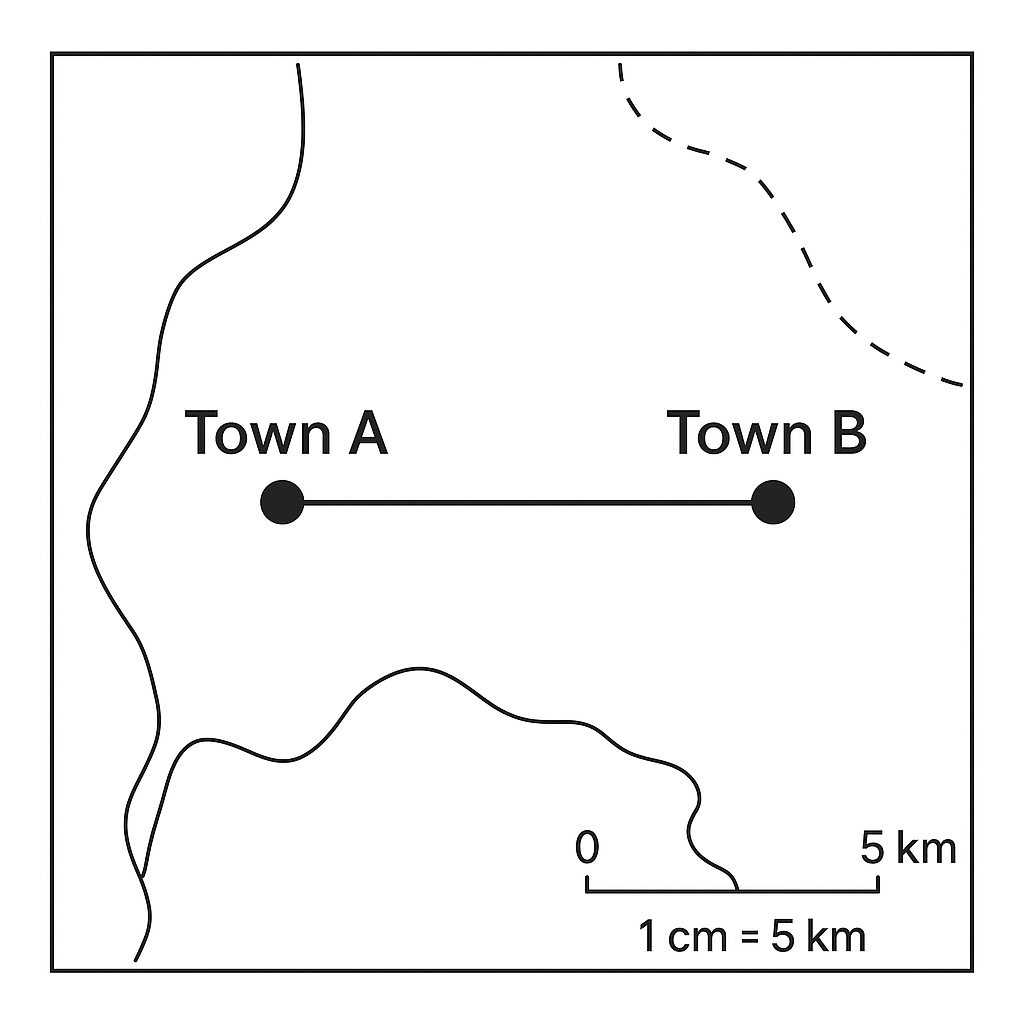
On the map, the scale is \(1\) cm : \(5\) km. The straight‑line distance between Town A and Town B measures \(7\) cm on the map. What is the actual distance between the two towns in kilometres?
A. 42 km
B. 30 km
C. 28 km
Correct D. 35 km

Correct Answer: D

Want to see the full step-by-step solution? Unlock AI Explanation & Analytics
Question 15 View Details
A farmer has \(10\) ha of land to allocate between wheat and maize. Wheat yields \(3.5\) t ha\(^{-1}\) and sells for £180 t\(^{-1}\); it requires \(120\) kg of nitrogen per ha. Maize yields \(5.0\) t ha\(^{-1}\) and sells for £150 t\(^{-1}\); it requires \(80\) kg of nitrogen per ha. The farmer possesses \(900\) kg of nitrogen fertilizer, costing £0.5 per kg, and must use all of it. Assuming linear relationships, determine how many hectares of each crop should be planted to maximise profit, and calculate the maximum profit (in £).
A. Wheat 2.5 ha, Maize 7.5 ha, profit £6,500
Correct B. Wheat 2.5 ha, Maize 7.5 ha, profit £6,750
C. Wheat 3.0 ha, Maize 7.0 ha, profit £6,300
D. Wheat 5.0 ha, Maize 5.0 ha, profit £6,000

Correct Answer: B

Want to see the full step-by-step solution? Unlock AI Explanation & Analytics
Question 16 View Details
A glacial valley has a characteristic U‑shaped cross‑section. The valley floor is 200 m wide and 100 m deep. The sides of the valley slope at an angle of \(30^{\circ}\) to the horizontal. Assuming the cross‑section consists of a rectangular floor plus two identical triangular side sections, calculate the total cross‑sectional area of the valley in square metres (rounded to the nearest whole number).
A. 36,800 m²
B. 35,500 m²
C. 38,000 m²
Correct D. 37,321 m²

Correct Answer: D

Want to see the full step-by-step solution? Unlock AI Explanation & Analytics
Question 17 View Details
At sea level the air temperature is \(30^{\circ}\text{C}\) and the relative humidity is 60 %. The air parcel rises adiabatically to an altitude of 1500 m. The dry‑adiabatic lapse rate is \(9.8^{\circ}\text{C km}^{-1}\) until the parcel becomes saturated, after which the moist‑adiabatic lapse rate of \(6^{\circ}\text{C km}^{-1}\) applies. Using the approximation \(T_{\text{dew}} = T - \frac{100 - \text{RH}}{5}\) to estimate the dew‑point temperature, determine the temperature of the parcel when it reaches 1500 m (give your answer to one decimal place).
Correct A. 17.9 °C
B. 19.8 °C
C. 22.3 °C
D. 15.4 °C

Correct Answer: A

Want to see the full step-by-step solution? Unlock AI Explanation & Analytics
Question 18 View Details
A field has a soil bulk density of \(1.4\ \text{g\,cm}^{-3}\) and a depth of \(0.60\ \text{m}\). The volumetric water content at field capacity is 0.30 and at the wilting point is 0.15. After a dry spell the soil moisture is at the wilting point. (a) How many millimetres of water must be applied to raise the soil moisture to field capacity? (b) What volume of water in cubic metres is required for a \(1\ \text{ha}\) (10 000 m²) field? Give answers to the nearest whole number.
A. 80 mm; 800 m³
Correct B. 90 mm; 900 m³
C. 110 mm; 1100 m³
D. 95 mm; 950 m³

Correct Answer: B

Want to see the full step-by-step solution? Unlock AI Explanation & Analytics
Question 19 View Details
The mean monthly temperatures (°C) of a location are: Jan 22, Feb 24, Mar 26, Apr 28, May 30, Jun 32, Jul 33, Aug 33, Sep 31, Oct 28, Nov 25, Dec 23. The corresponding mean monthly precipitation (mm) are: Jan 80, Feb 70, Mar 60, Apr 50, May 40, Jun 30, Jul 20, Aug 15, Sep 30, Oct 50, Nov 70, Dec 80. Using the Köppen climate classification criteria, determine the first two letters of the climate type for this location.
A. Cw
Correct B. Aw
C. Am
D. Af

Correct Answer: B

Want to see the full step-by-step solution? Unlock AI Explanation & Analytics
Question 20 View Details
A farmer intends to grow wheat on 5 ha. Without fertilizer the expected yield is 2.5 t ha⁻¹. Applying nitrogen fertilizer (N, in kg ha⁻¹) increases yield according to \[\Delta Y = 0.4N - 0.001N^{2}\ \text{(t ha}^{-1})\], but the total yield cannot exceed 5 t ha⁻¹. Nitrogen costs \$0.80 kg⁻¹ and wheat sells for \$200 t⁻¹. Ignoring all other costs, determine (a) the amount of nitrogen (kg ha⁻¹) that maximises profit, and (b) the maximum total profit for the whole 5 ha farm. Give N to one decimal place and profit to the nearest dollar.
A. 5.8 kg ha⁻¹; $4,500
B. 7.2 kg ha⁻¹; $5,200
C. 6.0 kg ha⁻¹; $4,800
Correct D. 6.4 kg ha⁻¹; $4,975

Correct Answer: D

Want to see the full step-by-step solution? Unlock AI Explanation & Analytics
Question 21 View Details
Three towns A, B and C lie in a region. Their populations are: A - 120 000, B - 80 000, C - 60 000. The road distances are: A-B = 30 km, A-C = 45 km, B-C = 20 km. A new supermarket requires a minimum market size of 150 000 people within a 40 km radius. Assuming people will travel to the nearest town that offers the supermarket, which towns could successfully host the supermarket? List all that satisfy the requirement.
A. A only
Correct B. A and B
C. B and C
D. A and C

Correct Answer: B

Want to see the full step-by-step solution? Unlock AI Explanation & Analytics
Question 22 View Details
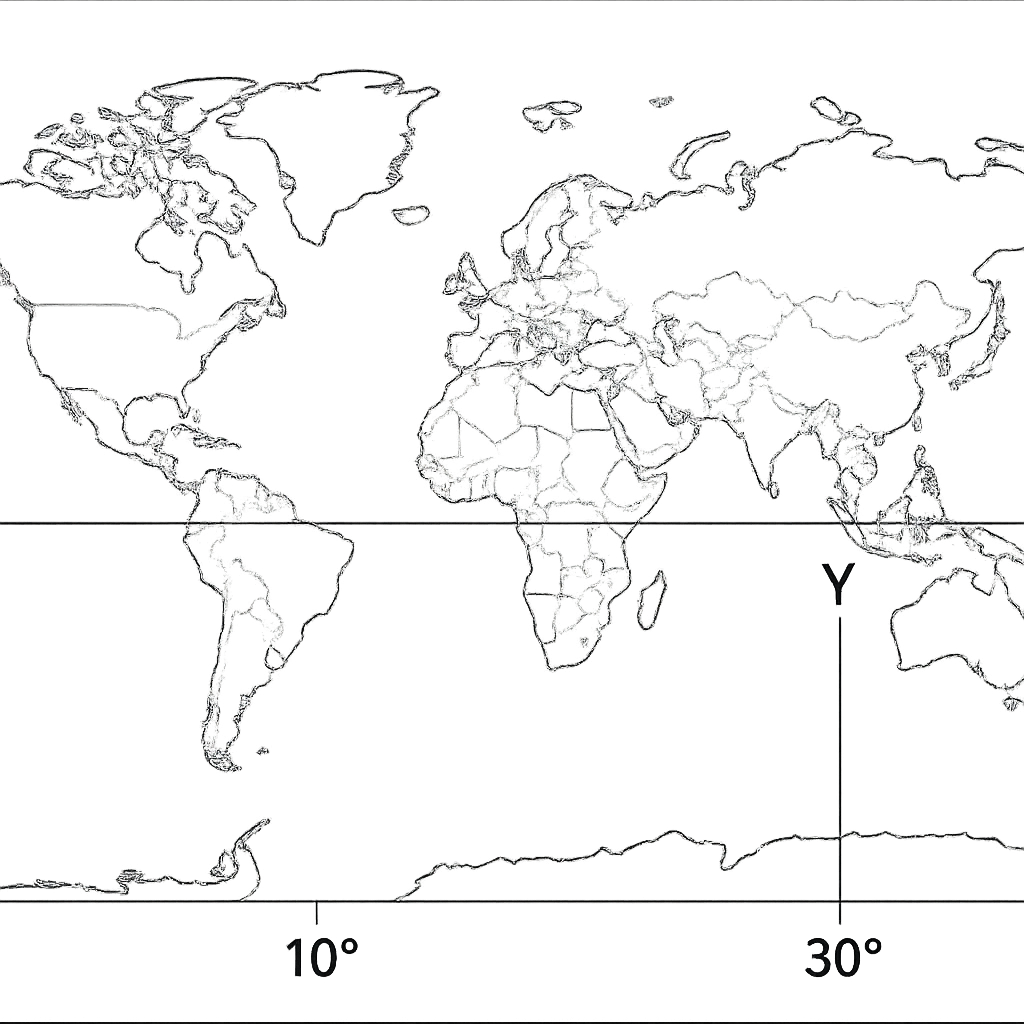
The map shows City X at latitude \(5^{\circ}\text{N}\) and longitude \(10^{\circ}\text{E}\), and City Y at latitude \(15^{\circ}\text{N}\) and longitude \(30^{\circ}\text{E}\). Estimate the straight‑line distance between the two cities. Use \(1^{\circ}\) of latitude = 111 km and assume the length of a degree of longitude equals \(111\cos\theta\) km, where \(\theta\) is the mean latitude of the two cities.
A. 2600 km
B. 2100 km
Correct C. 2450 km
D. 2300 km

Correct Answer: C

Want to see the full step-by-step solution? Unlock AI Explanation & Analytics
Question 23 View Details
A coastal region experiences two types of environmental hazard each year: floods and landslides. The probability of a flood in any given year is 0.12 with an average economic loss of £3 million per flood. The probability of a landslide is 0.05 with an average loss of £5 million per landslide. Two mitigation options are available: - A flood barrier that reduces flood loss by 40 % at a cost of £1 million. - Slope stabilisation that reduces landslide loss by 60 % at a cost of £2 million. If only one mitigation measure can be implemented, which option gives the greater reduction in expected annual loss per £ spent?
Correct A. Flood barrier
B. Do nothing
C. Slope stabilisation
D. Landslide mitigation

Correct Answer: A

Want to see the full step-by-step solution? Unlock AI Explanation & Analytics
Question 24 View Details
Three factories - A, B and C - supply a distribution centre. The road distances between the factories are: AB = 120 km, AC = 150 km, BC = 180 km. Their contributions to the total freight are 40 % from A, 35 % from B and 25 % from C. If the distribution centre must be located at one of the existing factories, which factory gives the minimum weighted total distance to the other two factories?
A. Factory B
B. Factory D
Correct C. Factory A
D. Factory C

Correct Answer: C

Want to see the full step-by-step solution? Unlock AI Explanation & Analytics
Question 25 View Details
The Horton infiltration model is given by \(f(t) = f_c + (f_0 - f_c) e^{-kt}\). For a particular soil, \(f_0 = 30\) mm h\(^{-1}\), \(f_c = 5\) mm h\(^{-1}\) and \(k = 0.4\) h\(^{-1}\). After how many hours will the infiltration rate fall to \(12\) mm h\(^{-1}\)? Give your answer to one decimal place.
A. 2.5
B. 4.0
C. 5.6
Correct D. 3.2

Correct Answer: D

Want to see the full step-by-step solution? Unlock AI Explanation & Analytics

Master the Exam!

You've seen a preview, but there are thousands more questions plus AI tutor to break down complex solutions.

Unlock Full Access Available for Android & Windows
Help others prepare! Share this practice hub:
Chat with Support