gce model questions vol1 2019 chemistry | Objective

Prepare for your exams with gce model questions vol1 questions? Reviewing past/model questions is one of the most effective ways to guarantee a high score. This practice hub features authentic 2019 chemistry (Objective) questions designed to simulate the real exam environment.

Practice these randomly selected questions to test your readiness.

Question 1 View Details
A 5.00 g sample of an unknown compound containing only C, H and O is combusted completely, producing 13.5 g \(\mathrm{CO_2}\) and 5.40 g \(\mathrm{H_2O}\). Determine the empirical formula of the compound.
A. C13H27O2
B. C14H27O3
C. C14H28O2
Correct D. C14H27O2

Correct Answer: D

Want to see the full step-by-step solution? Unlock AI Explanation & Analytics
Question 2 View Details
A galvanic cell is set up as \(\mathrm{Zn|Zn^{2+}(0.010\,M)||Cu^{2+}(0.10\,M)|Cu}\) at 25 °C. Standard reduction potentials are \(E^{\circ}(\mathrm{Cu^{2+}/Cu})=+0.34\,\text{V}\) and \(E^{\circ}(\mathrm{Zn^{2+}/Zn})=-0.76\,\text{V}\). (a) Calculate the cell potential under the given conditions. (b) If the cell runs until 0.025 mol of Zn is oxidised, what mass of Cu is deposited on the cathode?
A. E = 0.98 V; mass of Cu deposited = 1.30 g
Correct B. E = 1.13 V; mass of Cu deposited = 1.59 g
C. E = 1.20 V; mass of Cu deposited = 1.70 g
D. E = 1.05 V; mass of Cu deposited = 1.45 g

Correct Answer: B

Want to see the full step-by-step solution? Unlock AI Explanation & Analytics
Question 3 View Details
The molecule \(\mathrm{SF_2Cl_2}\) can exist as a cis isomer (the two F atoms adjacent) and a trans isomer (the two F atoms opposite). Both have a central S atom surrounded by four bonding pairs and two lone pairs. (a) State the hybridisation of the central S atom and give the approximate S-F bond angle in the cis isomer. (b) Which isomer possesses the larger dipole moment and why?
A. Hybridisation: sp³d²; S-F angle ≈ 180°. Trans isomer has the larger dipole moment.
B. Hybridisation: sp³d; S-F angle ≈ 120°. Trans isomer has the larger dipole moment.
Correct C. Hybridisation: sp³d²; S-F angle ≈ 90°. Cis isomer has the larger dipole moment.
D. Hybridisation: sp³; S-F angle ≈ 109.5°. Cis isomer has the larger dipole moment.

Correct Answer: C

Want to see the full step-by-step solution? Unlock AI Explanation & Analytics
Question 4 View Details
Calcium fluoride, \(\mathrm{CaF_2}\), has a solubility product \(K_{sp}=3.9\times10^{-11}\) at 25 °C. (a) Calculate its molar solubility in pure water. (b) If 0.10 M NaF is added, determine the new solubility of \(\mathrm{CaF_2}\). (c) Explain qualitatively how the solubility would change on heating, given that the dissolution is endothermic.
Correct A. a) 2.1×10⁻⁴ M; b) 3.9×10⁻⁹ M; c) Solubility increases with temperature (endothermic dissolution).
B. a) 1.0×10⁻⁴ M; b) 1.2×10⁻⁸ M; c) Solubility decreases with temperature (endothermic dissolution).
C. a) 2.1×10⁻⁴ M; b) 2.5×10⁻⁹ M; c) Solubility decreases with temperature (exothermic dissolution).
D. a) 3.9×10⁻⁴ M; b) 2.1×10⁻⁹ M; c) Solubility unchanged with temperature (endothermic dissolution).

Correct Answer: A

Want to see the full step-by-step solution? Unlock AI Explanation & Analytics
Question 5 View Details
A chemist wants to prepare 4‑bromo‑2‑methylacetophenone starting from commercially available toluene. Propose a three‑step synthetic route (including reagents) that introduces the carbonyl group, the para‑bromo substituent and the ortho‑methyl group in the correct positions. Briefly justify each transformation.
A. 1) NBS/benzoyl peroxide → p‑bromo‑toluene; 2) KMnO₄ → p‑bromo‑benzoic acid; 3) SOCl₂ then CH₃MgBr → 4‑bromo‑2‑methylacetophenone.
B. 1) Br₂/FeCl₃ → p‑bromo‑toluene; 2) COCl₂/PCl₅ → p‑bromo‑acetyl chloride; 3) n‑BuLi then CH₃I → 4‑bromo‑2‑methylacetophenone.
C. 1) Br₂/AlCl₃ → p‑bromo‑toluene; 2) CH₃COCl/AlCl₃ (Friedel‑Crafts acylation) → p‑bromo‑acetophenone; 3) n‑BuLi then CH₃I → 4‑bromo‑2‑methylacetophenone.
Correct D. 1) Br₂/FeBr₃ → p‑bromo‑toluene; 2) KMnO₄ (or CrO₃/H₂SO₄) → p‑bromoacetophenone; 3) n‑BuLi then CH₃I → 4‑bromo‑2‑methylacetophenone.

Correct Answer: D

Want to see the full step-by-step solution? Unlock AI Explanation & Analytics
Question 6 View Details
A sealed 1.0 L reaction vessel at 25 °C contains 0.050 mol of propanoic acid, 0.050 mol of ethanol and 0.050 mol of water. The esterification reaction \(\mathrm{CH_3CH_2COOH + CH_3CH_2OH \rightleftharpoons CH_3CH_2COOCH_2CH_3 + H_2O}\) has an equilibrium constant \(K_c = 4.0\) at this temperature. Assuming ideal behaviour, calculate the number of moles of ethyl propionate present at equilibrium.
A. 0.013 mol
Correct B. 0.027 mol
C. 0.040 mol
D. 0.050 mol

Correct Answer: B

Want to see the full step-by-step solution? Unlock AI Explanation & Analytics
Question 7 View Details
A 2.0 L sealed container at 25 °C holds a mixture of water vapour and nitrogen gas. The total pressure is 1.20 atm and the vapour pressure of water at 25 °C is 0.0313 atm. (a) Determine the partial pressure of nitrogen and the amount (in moles) of nitrogen present. (b) The temperature is then raised to 50 °C while the volume remains unchanged. The vapour pressure of water at 50 °C is 0.123 atm. Assuming nitrogen behaves ideally and the water vapour stays at its saturation pressure, calculate the new total pressure in the container.
A. 1.55 atm
B. 1.20 atm
C. 1.45 atm
Correct D. 1.39 atm

Correct Answer: D

Want to see the full step-by-step solution? Unlock AI Explanation & Analytics
Question 8 View Details
A 0.250 M solution of the diprotic acid H₂A (\(K_{a1}=1.0\times10^{-3}\), \(K_{a2}=1.0\times10^{-8}\)) is titrated with 0.100 M NaOH. If 12.5 mL of NaOH is added to 25.0 mL of the acid solution, calculate the pH of the resulting solution.
Correct A. 2.40
B. 2.70
C. 2.10
D. 3.00

Correct Answer: A

Want to see the full step-by-step solution? Unlock AI Explanation & Analytics
Question 9 View Details
A mixture containing 0.050 mol of 1‑butanol and 0.030 mol of 2‑butanol is treated with pyridinium chlorochromate (PCC), which oxidises primary alcohols to aldehydes but does not affect secondary alcohols. The gaseous butanal formed is collected over water at 25 °C and 1 atm, giving a measured volume of 1.20 L (corrected for water vapour). Assuming ideal gas behaviour, calculate the percentage yield of the oxidation of 1‑butanol.
A. 92 %
Correct B. 98 %
C. 105 %
D. 85 %

Correct Answer: B

Want to see the full step-by-step solution? Unlock AI Explanation & Analytics
Question 10 View Details
The rate constant for the acid‑catalysed dehydration of 2‑methyl‑2‑butanol follows the Arrhenius equation. At 25 °C the rate constant is \(k_{25}=2.0\times10^{-4}\,\text{s}^{-1}\) and the activation energy is \(E_a = 150\ \text{kJ mol}^{-1}\). Using the Arrhenius relationship, determine the rate constant at 80 °C.
A. 0.26 s^-1
Correct B. 2.6 s^-1
C. 2.0 s^-1
D. 26 s^-1

Correct Answer: B

Want to see the full step-by-step solution? Unlock AI Explanation & Analytics
Question 11 View Details
Potassium dichromate (\(\mathrm{K_2Cr_2O_7}\)) is used to oxidise ferrous ions in acidic solution according to the half‑reaction \(\mathrm{Cr_2O_7^{2-} + 6 Fe^{2+} + 14 H^{+} \rightarrow 2 Cr^{3+} + 6 Fe^{3+} + 7 H_2O}\). A sample of \(0.250\ \text{g}\) of anhydrous \(\mathrm{K_2Cr_2O_7}\) is dissolved in excess acid and mixed with an unknown concentration of \(\mathrm{Fe^{2+}}\) solution. After the reaction, \(10.0\ \text{cm}^3\) of the remaining \(\mathrm{Fe^{2+}}\) solution is titrated with \(0.0200\ \text{M}\) potassium permanganate (\(\mathrm{KMnO_4}\)). The titration requires \(15.0\ \text{cm}^3\) of the permanganate solution. The original volume of the \(\mathrm{Fe^{2+}}\) solution was \(100.0\ \text{cm}^3\). Calculate the initial molarity of the \(\mathrm{Fe^{2+}}\) solution.
A. 0.25
B. 0.30
C. 0.15
Correct D. 0.20

Correct Answer: D

Want to see the full step-by-step solution? Unlock AI Explanation & Analytics
Question 12 View Details
A 2.00 g sample of calcium carbonate (\(\mathrm{CaCO_3}\)) is heated strongly in a crucible. The carbon dioxide released is collected over water at \(25^{\circ}\mathrm{C}\) and a total pressure of \(750\ \text{mmHg}\). The vapour pressure of water at this temperature is \(23.8\ \text{mmHg}\). The volume of gas collected is \(45.0\ \text{cm}^3\). The collected \(\mathrm{CO_2}\) is then absorbed into excess sodium hydroxide solution, and the resulting sodium carbonate is isolated and weighed. The mass of dry \(\mathrm{Na_2CO_3}\) obtained is \(1.90\ \text{g}\). Determine the percent yield of \(\mathrm{Na_2CO_3}\) based on the original amount of \(\mathrm{CaCO_3}\). Give your answer as a percentage to the nearest whole number.
Correct A. 90
B. 85
C. 95
D. 75

Correct Answer: A

Want to see the full step-by-step solution? Unlock AI Explanation & Analytics
Question 13 View Details
The metal oxide \(\mathrm{MO}\) has a standard enthalpy of formation \(\Delta H_f^\circ = -350\ \text{kJ mol}^{-1}\) and a standard entropy of formation \(\Delta S_f^\circ = -120\ \text{J K}^{-1}\text{mol}^{-1}\). Carbon monoxide has \(\Delta H_f^\circ = -110.5\ \text{kJ mol}^{-1}\) and \(\Delta S_f^\circ = 197\ \text{J K}^{-1}\text{mol}^{-1}\). The metal is extracted by the reduction reaction \(\mathrm{MO(s) + C(s) \rightarrow M(s) + CO(g)}\) carried out at 1 atm. (a) Calculate the minimum temperature at which the reduction becomes spontaneous (\(\Delta G < 0\)). (b) At \(1200\ \text{K}\) the equilibrium constant for the reaction is \(K = 5.0 \times 10^{-4}\). Assuming activities of solids are unity, calculate the equilibrium partial pressure of \(\mathrm{CO}\) at this temperature.
A. 820 K, 2.5×10⁻⁴ atm
B. 680 K, 1.2×10⁻³ atm
C. 900 K, 5.0×10⁻⁵ atm
Correct D. 756 K, 5.0×10⁻⁴ atm

Correct Answer: D

Want to see the full step-by-step solution? Unlock AI Explanation & Analytics
Question 14 View Details
Adipic acid (\(\mathrm{C_6H_{10}O_4}\), \(M = 146.14\ \text{g mol}^{-1}\)) and hexamethylenediamine (\(\mathrm{C_6H_{16}N_2}\), \(M = 116.21\ \text{g mol}^{-1}\)) undergo step‑growth condensation polymerisation to give a polyamide, releasing one molecule of water (\(M_{\mathrm{H_2O}} = 18.02\ \text{g mol}^{-1}\)) per repeat unit. A sample containing \(10.0\ \text{g}\) of adipic acid also contains \(2.0\%\) by weight of a monofunctional impurity that can react at only one end of a chain. The diamine is present in large excess. The reaction proceeds to \(80\%\) conversion of the functional acid groups. (a) Calculate the number‑average degree of polymerisation (\(DP_n\)) taking the impurity into account. (b) Using the repeat‑unit mass \(M_{\text{repeat}} = M_{\text{acid}} + M_{\text{amine}} - M_{\mathrm{H_2O}}\), calculate the weight‑average molecular weight (\(M_w\)) of the polymer formed.
Correct A. DP_n = 4.9, Mw = 1.20×10³ g·mol⁻¹
B. DP_n = 5.5, Mw = 1.35×10³ g·mol⁻¹
C. DP_n = 6.0, Mw = 1.50×10³ g·mol⁻¹
D. DP_n = 4.2, Mw = 1.05×10³ g·mol⁻¹

Correct Answer: A

Want to see the full step-by-step solution? Unlock AI Explanation & Analytics
Question 15 View Details
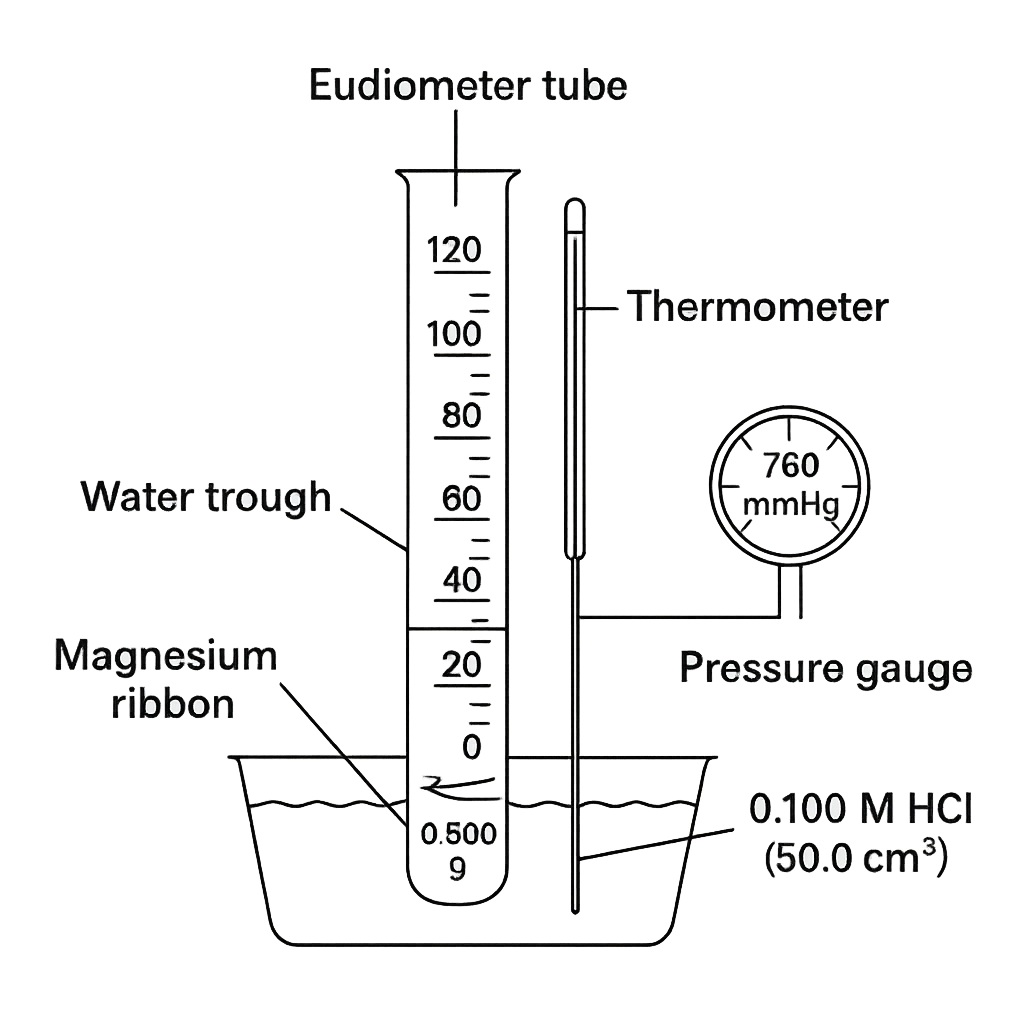
In the apparatus shown, a \(0.500\ \text{g}\) piece of magnesium ribbon is placed in a sealed eudiometer tube containing \(50.0\ \text{cm}^3\) of \(0.100\ \text{M}\) hydrochloric acid. The tube is inverted and immersed in a water trough at \(25^{\circ}\mathrm{C}\). Hydrogen gas produced displaces water, and the gas volume read on the eudiometer is \(120.0\ \text{cm}^3\) (including water). Atmospheric pressure is \(760\ \text{mmHg}\) and the vapour pressure of water at \(25^{\circ}\mathrm{C}\) is \(23.8\ \text{mmHg}\). Assuming the reaction goes to completion, (a) calculate the moles of dry hydrogen gas collected at atmospheric pressure, and (b) the percent yield of hydrogen based on the magnesium sample. Give the percent yield to the nearest whole percent.
A. 30
B. 21
Correct C. 23
D. 25

Correct Answer: C

Want to see the full step-by-step solution? Unlock AI Explanation & Analytics
Question 16 View Details
A buffer contains 0.250 mol of acetic acid (\(\mathrm{CH_3COOH}\)) and 0.150 mol of its conjugate base acetate (\(\mathrm{CH_3COO^-}\)) in 1.00 L of solution. The acid dissociation constant is \(K_a = 1.8\times10^{-5}\). How many millilitres of 0.10 M \(\mathrm{HCl}\) must be added to lower the pH of the solution by exactly 0.40 units?
Correct A. 732 mL
B. 790 mL
C. 845 mL
D. 680 mL

Correct Answer: A

Want to see the full step-by-step solution? Unlock AI Explanation & Analytics
Question 17 View Details
A 0.250‑L sample of a diprotic acid \(\mathrm{H_2A}\) contains 0.025 mol of the acid. The first and second dissociation constants are \(K_{a1}=1.0\times10^{-3}\) and \(K_{a2}=1.0\times10^{-8}\) respectively. The solution is titrated with 0.10 M \(\mathrm{NaOH}\). (a) What volume of \(\mathrm{NaOH}\) is required to reach the first equivalence point? (b) Calculate the pH of the solution at that point.
A. 250 mL; pH = 8.10
Correct B. 250 mL; pH = 7.85
C. 300 mL; pH = 7.85
D. 250 mL; pH = 7.20

Correct Answer: B

Want to see the full step-by-step solution? Unlock AI Explanation & Analytics
Question 18 View Details
The reaction \(2\,\mathrm{Al} + 3\,\mathrm{Cl_2} \rightarrow 2\,\mathrm{AlCl_3}\) is carried out at 25 °C and 1.00 atm. If 15.0 g of aluminium are used and chlorine is in excess, (a) calculate the volume of chlorine gas consumed, and (b) determine the mass of aluminium chloride obtained when the reaction gives an 85 % yield.
A. 18.7 L; 58.5 g
Correct B. 20.4 L; 63.0 g
C. 22.5 L; 70.2 g
D. 24.0 L; 55.0 g

Correct Answer: B

Want to see the full step-by-step solution? Unlock AI Explanation & Analytics
Question 19 View Details
Using the following bond‑dissociation energies (kJ mol⁻¹): D(H-H)=436, D(Cl-Cl)=243, D(Br-Br)=193, D(H-Cl)=431, D(H-Br)=366. Calculate the enthalpy change for the reactions (1) \(\mathrm{H_2 + Cl_2 \rightarrow 2\,HCl}\) and (2) \(\mathrm{H_2 + Br_2 \rightarrow 2\,HBr}\) by the bond‑energy method, then state which reaction is more exothermic and by how much.
A. ΔH₁ = -180 kJ·mol⁻¹; ΔH₂ = -120 kJ·mol⁻¹; reaction (1) is more exothermic by 60 kJ·mol⁻¹
Correct B. ΔH₁ = -183 kJ·mol⁻¹; ΔH₂ = -103 kJ·mol⁻¹; reaction (1) is more exothermic by 80 kJ·mol⁻¹
C. ΔH₁ = -190 kJ·mol⁻¹; ΔH₂ = -95 kJ·mol⁻¹; reaction (1) is more exothermic by 95 kJ·mol⁻¹
D. ΔH₁ = -170 kJ·mol⁻¹; ΔH₂ = -110 kJ·mol⁻¹; reaction (1) is more exothermic by 60 kJ·mol⁻¹

Correct Answer: B

Want to see the full step-by-step solution? Unlock AI Explanation & Analytics
Question 20 View Details
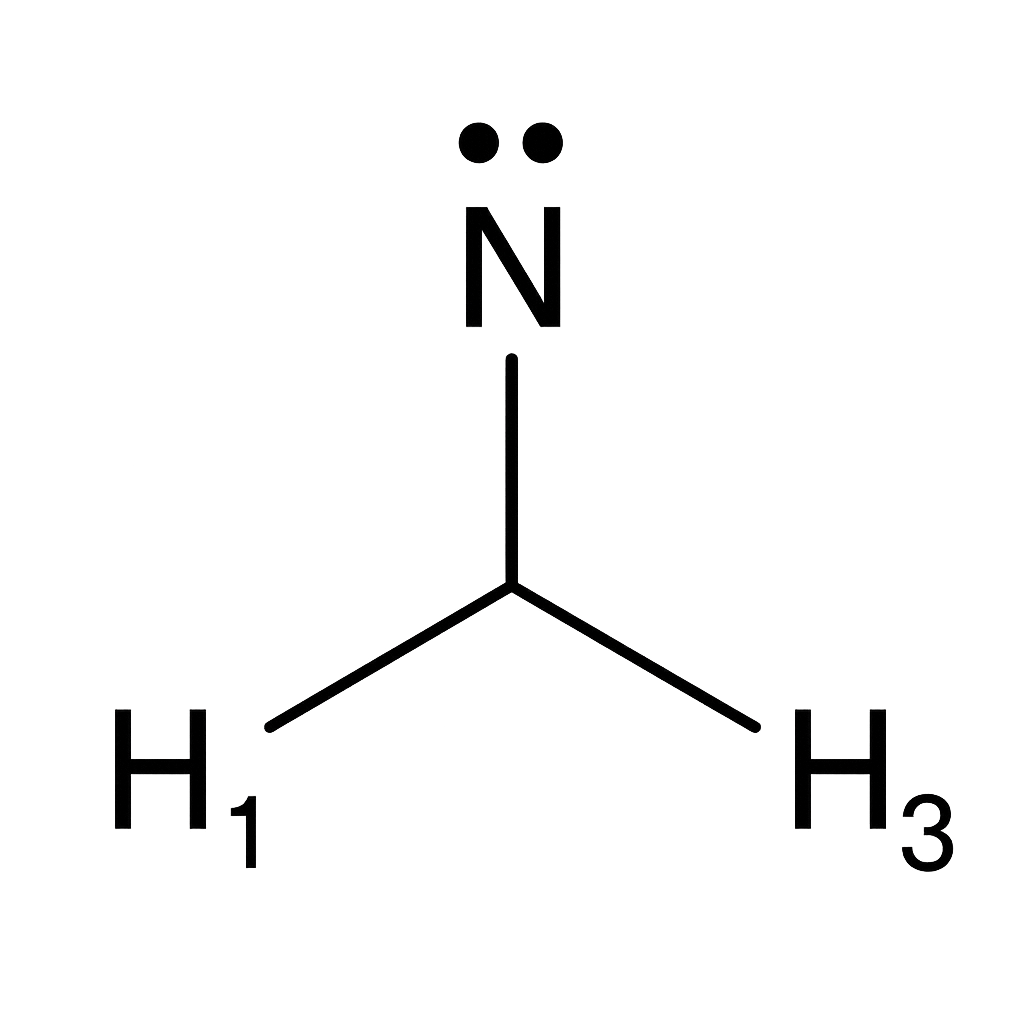
The diagram shows the Lewis structure of ammonia (NH₃). Based on this structure, state the hybridisation of the nitrogen atom and give the approximate H-N-H bond angle.
A. sp hybridisation; H-N-H ≈ 180°
B. sp³d hybridisation; H-N-H ≈ 109.5°
C. sp² hybridisation; H-N-H ≈ 120°
Correct D. sp³ hybridisation; H-N-H ≈ 107°

Correct Answer: D

Want to see the full step-by-step solution? Unlock AI Explanation & Analytics
Question 21 View Details
Which element has the greater first ionisation energy: sodium (\(\mathrm{Na}\)) or magnesium (\(\mathrm{Mg}\))?
A. Potassium
B. Sodium
C. Calcium
Correct D. Magnesium

Correct Answer: D

Want to see the full step-by-step solution? Unlock AI Explanation & Analytics
Question 22 View Details
The molecular formula \(\mathrm{C_5H_{10}O_2}\) can correspond either to a monocarboxylic acid or to an ester. Determine how many distinct structural isomers are possible for each functional group, and state which functional group gives the greater number of isomers.
A. Carboxylic acids: 3 isomers; Esters: 9 isomers; Esters give the greater number of isomers.
B. Carboxylic acids: 5 isomers; Esters: 9 isomers; Esters give the greater number of isomers.
C. Carboxylic acids: 4 isomers; Esters: 8 isomers; Carboxylic acids give the greater number of isomers.
Correct D. Carboxylic acids: 4 isomers; Esters: 9 isomers; Esters give the greater number of isomers.

Correct Answer: D

Want to see the full step-by-step solution? Unlock AI Explanation & Analytics
Question 23 View Details
Based on the electronegativity values \(\chi_{\mathrm{C}} = 2.55\) and \(\chi_{\mathrm{F}} = 3.98\), what type of bond is formed between carbon and fluorine in a C-F bond?
Correct A. Polar covalent
B. Ionic
C. Nonpolar covalent
D. Metallic

Correct Answer: A

Want to see the full step-by-step solution? Unlock AI Explanation & Analytics
Question 24 View Details
Using the ionic radii (pm): \(\mathrm{Na^+}=102\), \(\mathrm{F^-}=133\), \(\mathrm{Cl^-}=181\), \(\mathrm{I^-}=206\), estimate the relative lattice energies of the ionic compounds \(\mathrm{NaF}\), \(\mathrm{NaCl}\) and \(\mathrm{NaI}\) by assuming lattice energy is proportional to \(\frac{1}{r_{+}+r_{-}}\). Rank the compounds from highest to lowest lattice energy, and, applying Fajans' rules, indicate which compound is expected to exhibit the greatest covalent character.
A. NaF > NaI > NaCl; NaCl has the greatest covalent character.
B. NaCl > NaI > NaF; NaF has the greatest covalent character.
C. NaCl > NaF > NaI; NaCl has the greatest covalent character.
Correct D. NaF > NaCl > NaI; NaI has the greatest covalent character.

Correct Answer: D

Want to see the full step-by-step solution? Unlock AI Explanation & Analytics
Question 25 View Details
In acidic solution the redox reaction between permanganate ion and oxalate ion is: \(\mathrm{MnO_4^- + C_2O_4^{2-} \rightarrow Mn^{2+} + CO_2}\). (a) Write the balanced overall equation with the smallest whole‑number coefficients. (b) Calculate the volume (in mL) of 0.200 M \(\mathrm{KMnO_4}\) required to completely react with 25.0 mL of 0.150 M \(\mathrm{Na_2C_2O_4}\).
A. (a) \\(2\\mathrm{MnO_4^-} + 5\\mathrm{C_2O_4^{2-}} + 16\\mathrm{H^+} \\rightarrow 2\\mathrm{Mn^{2+}} + 8\\mathrm{CO_2} + 8\\mathrm{H_2O}\\). (b) 8.0 mL
B. (a) \\(2\\mathrm{MnO_4^-} + 5\\mathrm{C_2O_4^{2-}} + 14\\mathrm{H^+} \\rightarrow 2\\mathrm{Mn^{2+}} + 10\\mathrm{CO_2} + 7\\mathrm{H_2O}\\). (b) 6.0 mL
Correct C. (a) \(2\mathrm{MnO_4^-} + 5\mathrm{C_2O_4^{2-}} + 16\mathrm{H^+} \rightarrow 2\mathrm{Mn^{2+}} + 10\mathrm{CO_2} + 8\mathrm{H_2O}\). (b) 7.5 mL
D. (a) \\(2\\mathrm{MnO_4^-} + 5\\mathrm{C_2O_4^{2-}} + 16\\mathrm{H^+} \\rightarrow 2\\mathrm{Mn^{2+}} + 10\\mathrm{CO_2} + 8\\mathrm{H_2O}\\). (b) 5.0 mL

Correct Answer: C

Want to see the full step-by-step solution? Unlock AI Explanation & Analytics

Master the Exam!

You've seen a preview, but there are thousands more questions plus AI tutor to break down complex solutions.

Unlock Full Access Available for Android & Windows
Help others prepare! Share this practice hub:
Chat with Support