gce model questions vol1 2018 agricultural_science | Objective

Prepare for your exams with gce model questions vol1 questions? Reviewing past/model questions is one of the most effective ways to guarantee a high score. This practice hub features authentic 2018 agricultural_science (Objective) questions designed to simulate the real exam environment.

Practice these randomly selected questions to test your readiness.

Question 1 View Details
A tilapia farmer plans to stock a 2‑ha earthen pond. The survival rate (%) and average market weight (kg) per fish are related to the stocking density \(D\) (kg ha\(^{-1}\)) by \(S = 95 - 0.005D\) and \(W = 0.5 + 0.0002D\). The market price is ₦250 kg\(^{-1}\) and fingerlings cost ₦30 per kg of initial stocking weight. Fixed pond preparation costs are ₦20 000. Determine the stocking density that maximises net profit per hectare and calculate that maximum profit (round to the nearest thousand naira).
Correct A. Optimal density ≈ 11 987 kg ha⁻¹; maximum profit ≈ ₦2 665 000 per ha
B. Optimal density ≈ 13 200 kg ha⁻¹; maximum profit ≈ ₦2 800 000 per ha
C. Optimal density ≈ 12 750 kg ha⁻¹; maximum profit ≈ ₦2 500 000 per ha
D. Optimal density ≈ 10 500 kg ha⁻¹; maximum profit ≈ ₦2 300 000 per ha

Correct Answer: A

Want to see the full step-by-step solution? Unlock AI Explanation & Analytics
Question 2 View Details
In a mixed cropping system a legume crop fixes 30 kg N ha\(^{-1}\) annually and a cereal crop removes 120 kg N ha\(^{-1}\). An inoculant increases legume fixation by 20 %. Will the system meet the cereal's nitrogen requirement? State "Yes" or "No" and give the nitrogen deficit or surplus (kg ha\(^{-1}\)).
A. No, deficit = 72 kg N ha⁻¹
B. Yes, surplus = 6 kg N ha⁻¹
C. No, deficit = 96 kg N ha⁻¹
Correct D. No, deficit = 84 kg N ha⁻¹

Correct Answer: D

Want to see the full step-by-step solution? Unlock AI Explanation & Analytics
Question 3 View Details
A tractor must pull a moldboard plough 1.5 m wide at a speed of 5 km h\(^{-1}\). Soil resistance per metre width is \(R = 0.15v + 0.05\) kN m\(^{-1}\) where \(v\) is speed in km h\(^{-1}\). The tractor weighs 3 t and its rolling resistance is 0.02 times its weight (use \(g = 9.81\) m s\(^{-2}\)). Assuming an overall drivetrain efficiency of 0.85, calculate the minimum engine power required in kilowatts (round to the nearest whole kW).
A. 2 kW
B. 4 kW
Correct C. 3 kW
D. 5 kW

Correct Answer: C

Want to see the full step-by-step solution? Unlock AI Explanation & Analytics
Question 4 View Details
A dairy farmer compares two breeds. Breed A yields 6 000 kg milk per lactation, consumes 3 000 kg DM feed at ₦120 kg\(^{-1}\). Breed B yields 5 200 kg milk, consumes 2 500 kg DM feed at ₦130 kg\(^{-1}\). Milk sells for ₦150 kg\(^{-1}\) and fixed costs are ₦30 000 per animal. Which breed gives the higher net profit per animal? State the breed and the profit (₦).
Correct A. Breed A, profit = ₦510 000
B. Breed A, profit = ₦530 000
C. Breed A, profit = ₦480 000
D. Breed B, profit = ₦500 000

Correct Answer: A

Want to see the full step-by-step solution? Unlock AI Explanation & Analytics
Question 5 View Details
A farmer targets 8 t ha\(^{-1}\) of maize. Soil tests show available N = 60 kg ha\(^{-1}\), P = 20 kg ha\(^{-1}\), K = 30 kg ha\(^{-1}\). Crop removal rates are 20 kg N t\(^{-1}\), 5 kg P t\(^{-1}\), 15 kg K t\(^{-1}\). Fertiliser sources are urea (46 % N), DAP (18 % N, 46 % P\(_2\)O\(_5\)), and MOP (60 % K\(_2\)O). Convert P\(_2\)O\(_5\) to P (multiply by 0.44) and K\(_2\)O to K (multiply by 0.83). Calculate the required amounts of urea, DAP and MOP (kg ha\(^{-1}\)) to meet the nutrient deficits (round to the nearest kilogram).
Correct A. Urea ≈ 179 kg ha⁻¹, DAP ≈ 99 kg ha⁻¹, MOP ≈ 181 kg ha⁻¹
B. Urea ≈ 165 kg ha⁻¹, DAP ≈ 105 kg ha⁻¹, MOP ≈ 190 kg ha⁻¹
C. Urea ≈ 190 kg ha⁻¹, DAP ≈ 100 kg ha⁻¹, MOP ≈ 170 kg ha⁻¹
D. Urea ≈ 180 kg ha⁻¹, DAP ≈ 92 kg ha⁻¹, MOP ≈ 175 kg ha⁻¹

Correct Answer: A

Want to see the full step-by-step solution? Unlock AI Explanation & Analytics
Question 6 View Details
A tractor must pull a 5‑ton implement up a 5 % gradient at a speed of \(4\) km h⁻¹. The rolling‑resistance coefficient is \(0.02\). The tractor engine works at an efficiency of \(30\%\). Diesel has a calorific value of \(42\) MJ kg⁻¹ and a density of \(0.85\) kg L⁻¹. Assuming the only resistances are grade and rolling resistance, calculate the fuel consumption in litres per hour (to two decimal places).
A. 0.96 L per hour
B. 1.10 L per hour
C. 1.45 L per hour
Correct D. 1.28 L per hour

Correct Answer: D

Want to see the full step-by-step solution? Unlock AI Explanation & Analytics
Question 7 View Details
A farmer raises 50 rabbits. Each rabbit is expected to gain \(0.8\) kg over an 8‑week period. The feed conversion ratio (FCR) is \(3.5\) kg feed per kg live‑weight gain and feed costs \(\$0.25\) per kilogram. The market price of live rabbit is \(\$4\) per kilogram. Mortality during the period is 10 % and dead rabbits are assumed to have died halfway through the period, thus achieving only half of the expected weight gain and consuming half the feed. Calculate the expected total profit (in dollars, to two decimal places).
A. 105.25
Correct B. 118.75
C. 124.00
D. 112.50

Correct Answer: B

Want to see the full step-by-step solution? Unlock AI Explanation & Analytics
Question 8 View Details
A farmer harvests \(2\) tonnes of maize with an initial moisture content of \(25\)% (wet basis). The desired final moisture is \(14.5\)% (wet basis). The drying follows the exponential model \(M(t)=M_f+(M_0-M_f)e^{-kt}\) where \(M(t)\) is the moisture fraction at time \(t\) (hours), \(M_0=0.25\), \(M_f=0.145\) and \(k=0.05\) h⁻¹.\ (a) Determine the drying time required to reach the target moisture (to one decimal place of hour).\ (b) A conventional hot‑air dryer would use \(1.5\) MJ of energy per kilogram of water removed. Assuming the solar dryer uses negligible energy, calculate the energy saved (in megajoules, to the nearest whole number).
A. 48.0 hours; 400 MJ
B. 45.0 hours; 350 MJ
Correct C. 48.0 hours; 368 MJ
D. 52.3 hours; 410 MJ

Correct Answer: C

Want to see the full step-by-step solution? Unlock AI Explanation & Analytics
Question 9 View Details
A forest stand follows the Chapman‑Richards growth model \(V(t)=V_{\max}\bigl(1-e^{-kt}\bigr)^{p}\) where \(V(t)\) is the timber volume (m³ ha⁻¹) at age \(t\) years, \(V_{\max}=300\) m³ ha⁻¹, \(k=0.08\) yr⁻¹ and \(p=1.2\).\ (a) Find the age (in years, nearest whole year) at which the mean annual increment (MAI = \(V(t)/t\)) equals \(8\) m³ ha⁻¹ yr⁻¹.\ (b) Using that age, calculate the carbon stock in tonnes, assuming 1 m³ of wood contains 0.5 t of carbon. Give the carbon stock to one decimal place.
A. 40 years; 150.5 tonnes
B. 30 years; 120.0 tonnes
Correct C. 35 years; 138.9 tonnes
D. 35 years; 150.0 tonnes

Correct Answer: C

Want to see the full step-by-step solution? Unlock AI Explanation & Analytics
Question 10 View Details
A farmer harvests soybeans on 2 ha of land. The yield is \(2.5\) t ha⁻¹ of dry beans, and the nitrogen content of the beans is 6 % (dry weight). After harvest, 80 % of the nitrogen contained in the beans is returned to the soil through residues. Calculate the amount of nitrogen (in kilograms) added to the soil.
A. 300
Correct B. 240
C. 180
D. 200

Correct Answer: B

Want to see the full step-by-step solution? Unlock AI Explanation & Analytics
Question 11 View Details
Farmer A has three fields: Field A (\(2.4\) ha, light soil), Field B (\(1.8\) ha, heavy soil) and Field C (\(2.0\) ha, medium soil). A plough covers \(0.8\) ha h⁻¹ on light soil; on heavy soil its rate falls by 25 % and on medium soil it falls by 10 %. A disc‑harrow covers \(0.9\) ha h⁻¹ on heavy soil but only \(0.6\) ha h⁻¹ on light or medium soil.\n\n(i) Calculate the total time required to work all three fields if the plough is used on every field.\n(ii) Calculate the total time if the disc‑harrow is used on the heavy‑soil field while the plough is used on the other two fields.\n(iii) State which strategy is faster and by how much time.
A. Plough only: 9.12 h; disc‑harrow strategy: 8.05 h; disc‑harrow strategy is faster by 1.07 h.
Correct B. Plough only: 8.78 h; disc‑harrow strategy: 7.78 h; disc‑harrow strategy is faster by 1.00 h.
C. Plough only: 8.78 h; disc‑harrow strategy: 8.78 h; disc‑harrow strategy is faster by 0.00 h.
D. Plough only: 7.90 h; disc‑harrow strategy: 7.78 h; disc‑harrow strategy is faster by 0.12 h.

Correct Answer: B

Want to see the full step-by-step solution? Unlock AI Explanation & Analytics
Question 12 View Details
In a lake the fish population follows the logistic model\n\[\frac{dN}{dt}=rN\!\left(1-\frac{N}{K}\right)-hN,\]\nwhere the carrying capacity \(K=5000\) tonnes and the intrinsic growth rate \(r=0.4\;\text{yr}^{-1}\). The harvest rate is proportional to the stock, \(h=qE\). Currently the fishing effort gives \(qE=0.10\;\text{yr}^{-1}\).\nThe fishery wishes to increase effort by a percentage \(x\%\) but must keep the equilibrium stock at least \(60\%\) of \(K\).\nDetermine the greatest possible increase \(x\) (to the nearest whole percent) and the corresponding equilibrium stock (in tonnes).
A. Maximum increase = 55 %; equilibrium stock = 2800 t.
B. Maximum increase = 45 %; equilibrium stock = 3200 t.
Correct C. Maximum increase = 60 %; equilibrium stock = 3000 t.
D. Maximum increase = 70 %; equilibrium stock = 2500 t.

Correct Answer: C

Want to see the full step-by-step solution? Unlock AI Explanation & Analytics
Question 13 View Details
An agricultural extension programme introduces a high‑yield maize variety. The cost to each farmer is ₦12 000 (training and seed subsidy). The variety is expected to increase yield by \(1.5\) t ha⁻¹. The market price of maize is ₦2 500 t⁻¹ and each farmer cultivates \(2\) ha. Adoption among farmers follows the logistic curve\n\[p(t)=\frac{1}{1+e^{-0.8\,(t-3)}},\]\nwhere \(p(t)\) is the proportion of farmers that have adopted by year \(t\) (years 1-5). Benefits accrue only after adoption and are realised each year. The discount rate is \(10\%\) per annum.\nCalculate the net present value (NPV) per farmer of the programme over the five‑year horizon. State whether the NPV is positive or negative (round to the nearest naira).
A. NPV ≈ ₦800 (positive).
B. NPV ≈ ₦2 000 (positive).
Correct C. NPV ≈ ₦1 300 (positive).
D. NPV ≈ ₦‑500 (negative).

Correct Answer: C

Want to see the full step-by-step solution? Unlock AI Explanation & Analytics
Question 14 View Details
A farmer lifts a sack of grain weighing \(150\) kg onto a platform \(1.2\) m high using a first‑class lever. The effort arm is \(0.8\) m and the load arm is \(0.2\) m. The farmer pushes on the effort arm at an angle of \(30^{\circ}\) below the horizontal.\n\n(i) Determine the magnitude of the force the farmer must apply (in newtons).\n(ii) If the effort end moves vertically through a distance of \(0.30\) m during the lift, calculate the work done by the farmer's muscles (in joules).\nAssume \(g=9.81\;\text{m s}^{-2}\) and neglect friction.
A. Force ≈ 650 N; work ≈ 190 J.
B. Force ≈ 900 N; work ≈ 300 J.
C. Force ≈ 820 N; work ≈ 250 J.
Correct D. Force ≈ 736 N; work ≈ 221 J.

Correct Answer: D

Want to see the full step-by-step solution? Unlock AI Explanation & Analytics
Question 15 View Details
A forest stand grows according to the volume function\n\[V(t)=0.05t^{3}-0.6t^{2}+3t\quad(\text{m}^{3}\,\text{ha}^{-1}),\]\nwhere \(t\) is the age in years (\(0\le t\le30\)). Wood contains \(0.9\) t CO₂ per cubic metre. The stand is harvested at age \(T\) years, after which the site is replanted and the cycle repeats indefinitely.\nDetermine the integer rotation age \(T\) (in years) that maximises the average annual carbon sequestration (tonnes CO₂ ha⁻¹ yr⁻¹) over the infinite rotation, and give the corresponding maximum average sequestration value.
A. Optimal rotation age = 20 yr; maximum average sequestration = 22 t CO₂ ha⁻¹ yr⁻¹.
Correct B. Optimal rotation age = 30 yr; maximum average sequestration = 27 t CO₂ ha⁻¹ yr⁻¹.
C. Optimal rotation age = 15 yr; maximum average sequestration = 18 t CO₂ ha⁻¹ yr⁻¹.
D. Optimal rotation age = 25 yr; maximum average sequestration = 24 t CO₂ ha⁻¹ yr⁻¹.

Correct Answer: B

Want to see the full step-by-step solution? Unlock AI Explanation & Analytics
Question 16 View Details
A farmer grows maize and faces the following conditions: fixed costs are \(\text{₦}200{,}000\), variable cost is \(\text{₦}30{,}000\) per ton produced, and the market price per ton follows the linear demand function \(P = 150{,}000 - 5{,}000 Q\) where \(Q\) is the quantity in tons. The government provides a subsidy of \(\text{₦}10{,}000\) per ton for the first 10 tons sold, with no subsidy thereafter. Determine the quantity of maize (in tons) that maximises the farmer's profit.
Correct A. 12
B. 8
C. 10
D. 14

Correct Answer: A

Want to see the full step-by-step solution? Unlock AI Explanation & Analytics
Question 17 View Details
A farmer can cultivate a hectare of land using either a manual hoe or a motor‑powered rotavator. The manual hoe requires 8 labour hours per hectare, with labour costing \(\text{₦}500\) per hour. The rotavator works at 4 hours per hectare, consumes fuel costing \(\text{₦}200\) per hour, and must be rented at \(\text{₦}1{,}500\) per day. The rotavator can be operated for a maximum of 8 hours each day. The farmer needs to cultivate 30 hectares in a week (7 days). Which tool results in the lower total weekly cost?
A. manual hoe
B. hand plow
C. tractor
Correct D. rotavator

Correct Answer: D

Want to see the full step-by-step solution? Unlock AI Explanation & Analytics
Question 18 View Details
A maize farmer monitors the field for Fall Armyworm. The economic injury level (EIL) is given by \(\text{EIL}=\dfrac{C}{V\times I}\), where \(C\) is the cost of control per hectare (\(\text{₦}20{,}000\)), \(V\) is the market value per ton of maize (\(\text{₦}30{,}000\)), and \(I\) is the yield loss per larva per hectare (0.02 ton per larva). The observed pest density is 150 larvae per hectare. (a) Should the farmer apply control? (b) Assuming the control reduces the density to 20 larvae per hectare, calculate the expected profit per hectare with and without control. (Yield without pests is 5 tons ha⁻¹.)
Correct A. Apply control; profit with control = ₦118,000 per ha, profit without control = ₦60,000 per ha
B. Do not apply control; profit with control = ₦118,000 per ha, profit without control = ₦80,000 per ha
C. Apply control; profit with control = ₦100,000 per ha, profit without control = ₦60,000 per ha
D. Apply control; profit with control = ₦118,000 per ha, profit without control = ₦70,000 per ha

Correct Answer: A

Want to see the full step-by-step solution? Unlock AI Explanation & Analytics
Question 19 View Details
List the three principal processes by which nitrogen is returned to the soil from organic matter.
A. Mineralisation (ammonification), denitrification, nitrogen fixation
B. Mineralisation (ammonification), nitrification, ammonium leaching
C. Immobilisation, nitrification, nitrogen fixation
Correct D. Mineralisation (ammonification), nitrification, nitrogen fixation

Correct Answer: D

Want to see the full step-by-step solution? Unlock AI Explanation & Analytics
Question 20 View Details
Identify the farming practice that most effectively reduces soil erosion on sloping fields.
A. Cover cropping
B. Crop rotation
Correct C. Terracing
D. Mulching

Correct Answer: C

Want to see the full step-by-step solution? Unlock AI Explanation & Analytics
Question 21 View Details
A farm has 200 cattle. Without vaccination the disease incidence is 20% of the herd and mortality among infected animals is 12%. Treating an infected animal costs \(\text{₦}500\). A vaccine costs \(\text{₦}150\) per animal and reduces disease incidence to 5% and mortality to 2%. The market value of a dead animal is \(\text{₦}10{,}000\).\nCalculate the total expected cost for (a) treating only the infected animals (no vaccination) and (b) vaccinating all cattle and treating any infected animals. Which strategy gives the lower total cost?
A. Treatment only
Correct B. Vaccination
C. Both equally
D. Do nothing

Correct Answer: B

Want to see the full step-by-step solution? Unlock AI Explanation & Analytics
Question 22 View Details
In a 10 ha maize field the initial incidence of stalk rot is 25% of the plants. A farmer first adopts a resistant variety that reduces the incidence by 30% of the initial value and then sprays a fungicide that reduces the remaining incidence by 50%. The field has a plant density of 40 000 plants per ha. What is the final percentage incidence of the disease and how many plants are expected to be infected after both control measures?
A. 12.5% incidence, 40 000 plants
Correct B. 8.75% incidence, 35 000 plants
C. 6.25% incidence, 31 250 plants
D. 10% incidence, 40 000 plants

Correct Answer: B

Want to see the full step-by-step solution? Unlock AI Explanation & Analytics
Question 23 View Details
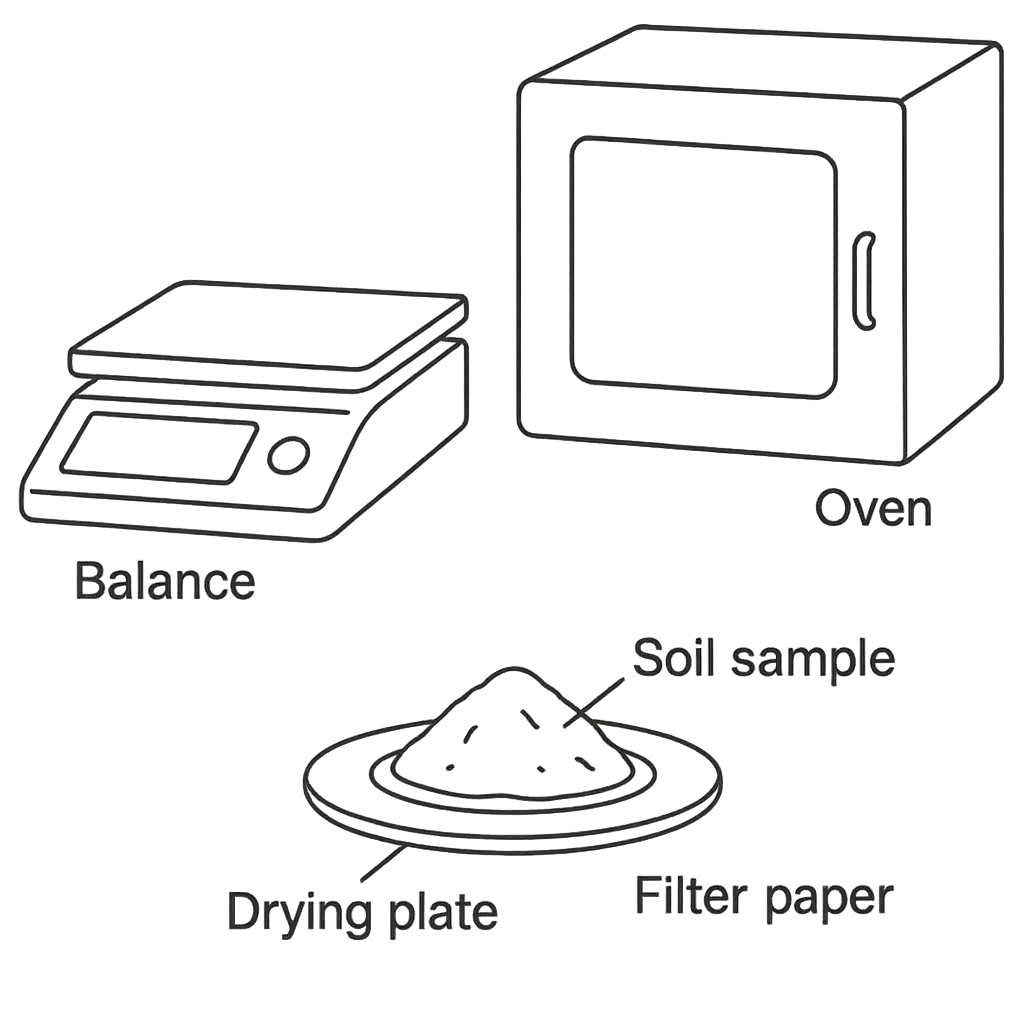
The diagram shows the gravimetric method for determining soil moisture (balance, oven, drying plate, labelled soil sample and filter paper). A soil sample weighed \(120\) g when freshly collected. After drying at \(105^{\circ}\)C for 24 h the dry weight is \(95\) g. Calculate the moisture content on a wet‑basis and express it as a percentage to one decimal place.
Correct A. 20.8
B. 19.5
C. 22.0
D. 21.7

Correct Answer: A

Want to see the full step-by-step solution? Unlock AI Explanation & Analytics
Question 24 View Details
In a poultry house a viral disease has a basic reproduction number \(R_{0}=2.5\) when the flock is fully susceptible. Introducing biosecurity measures reduces the contact rate by 40% and increases the recovery rate by 20%. Using the relationship \(R_{0}=\beta/\gamma\) (where \(\beta\) is the transmission rate and \(\gamma\) the recovery rate), calculate the effective reproduction number \(R_{e}\) after the measures are applied. Will the disease be expected to spread (\(R_{e}>1\)) or die out?
A. 0.75, disease will die out
B. 0.5, disease will die out
C. 1.5, disease will spread
Correct D. 1.25, disease will spread

Correct Answer: D

Want to see the full step-by-step solution? Unlock AI Explanation & Analytics
Question 25 View Details
Cassava chips are to be dried in a solar dryer. The chips start with a moisture content of 45% (wet basis) and a temperature of \(30^{\circ}\)C. The dryer maintains an ambient temperature of \(45^{\circ}\)C and provides a drying constant \(k = 0.08\ \text{h}^{-1}\) according to Newton's law for moisture ratio: \(MR = e^{-kt}\), where \(MR = \frac{M-M_{e}}{M_{0}-M_{e}}\). The equilibrium moisture content at \(45^{\circ}\)C is 10% (wet basis). The target moisture content is 12% (wet basis).\n(a) Calculate the drying time required to reach the target moisture content.\n(b) If each hour of drying evaporates 0.5 L of water, compute the total water loss.\n(c) The market price of dried chips is \(\text{₦}200\) per kg. Drying incurs a fixed energy cost of \(\text{₦}150\) per batch. Assuming the initial fresh weight is 1000 kg and the dry matter remains constant, determine the profit per kilogram of dried product.
Correct A. Drying time ≈ 35.8 h; water loss ≈ 17.9 kg; profit ≈ ₦199.8 per kg
B. Drying time ≈ 30.5 h; water loss ≈ 15.3 kg; profit ≈ ₦201.2 per kg
C. Drying time ≈ 42.0 h; water loss ≈ 21.0 kg; profit ≈ ₦197.0 per kg
D. Drying time ≈ 38.7 h; water loss ≈ 19.4 kg; profit ≈ ₦199.0 per kg

Correct Answer: A

Want to see the full step-by-step solution? Unlock AI Explanation & Analytics

Master the Exam!

You've seen a preview, but there are thousands more questions plus AI tutor to break down complex solutions.

Unlock Full Access Available for Android & Windows
Help others prepare! Share this practice hub:
Chat with Support