waec model questions vol1 2021 physics | Essay

Prepare for your exams with waec model questions vol1 questions? Reviewing past/model questions is one of the most effective ways to guarantee a high score. This practice hub features authentic 2021 physics (Essay) questions designed to simulate the real exam environment.

Practice these randomly selected questions to test your readiness.
Question 1 View Details
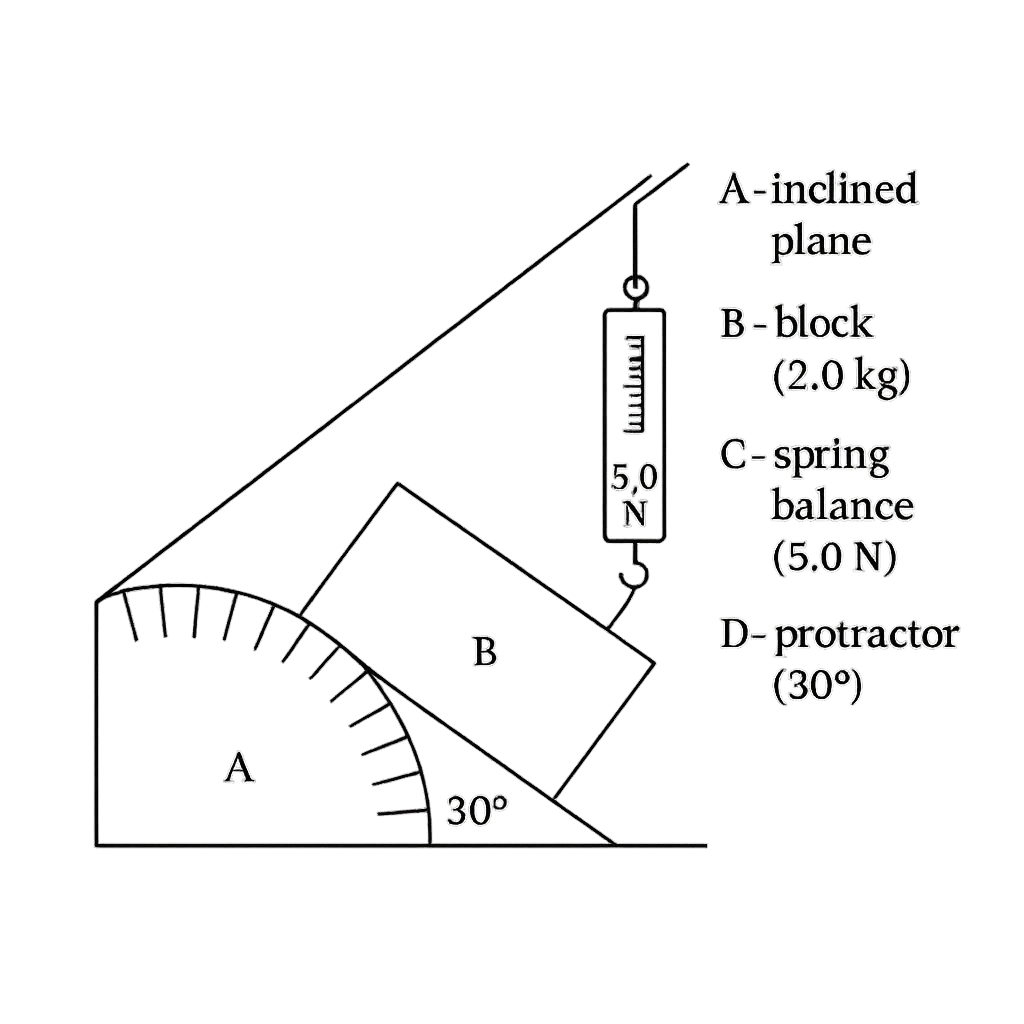
A laboratory set‑up consists of an inclined plane that can be fixed at any required angle, a smooth block of mass 2.0 kg placed on the plane, a spring balance attached to the block and pulling it up the plane, and a protractor indicating the angle of inclination. The plane is set at 30° to the horizontal and, when the block moves down the plane at constant speed, the spring balance reads 5.0 N.
Question Parts
(a)
Calculate the component of the block’s weight acting parallel to the inclined plane.
(b)
Using the information that the block moves at constant speed, determine the kinetic friction force acting on the block.
(c)
Calculate the coefficient of kinetic friction (μ_k) between the block and the plane.
(d)
Based on the value obtained, comment briefly on the nature of the surface of the plane (rough, smooth, very smooth, etc.).
Detailed Essay Solution & Marking Scheme Available

Get the step-by-step mathematical proofs, key points required by examiners, and a comprehensive breakdown from our AI Tutor.
Question 2 View Details
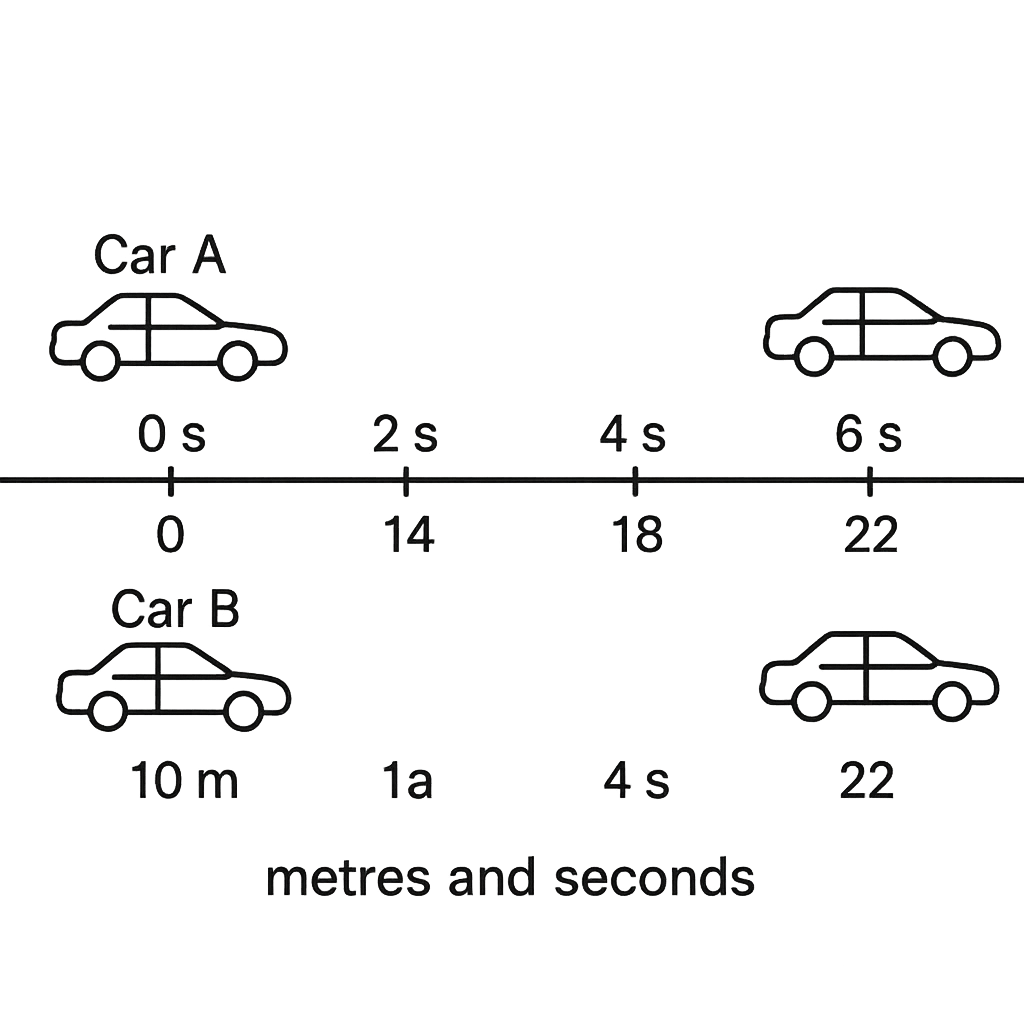
Two cars, A and B, move along a straight road as shown in the motion diagram.
Question Parts
(a)
Determine the uniform acceleration of Car A.
(b)
State the constant speed of Car B.
(c)
Car A eventually overtakes Car B.
() Find the time (in seconds) at which Car A overtakes Car B.
() State the distance (in metres) from the start point at the instant of overtaking.
(d)
If Car A continues to accelerate uniformly for a further 4 s after overtaking, calculate its speed at that moment.
Detailed Essay Solution & Marking Scheme Available

Get the step-by-step mathematical proofs, key points required by examiners, and a comprehensive breakdown from our AI Tutor.
Question 3 View Details
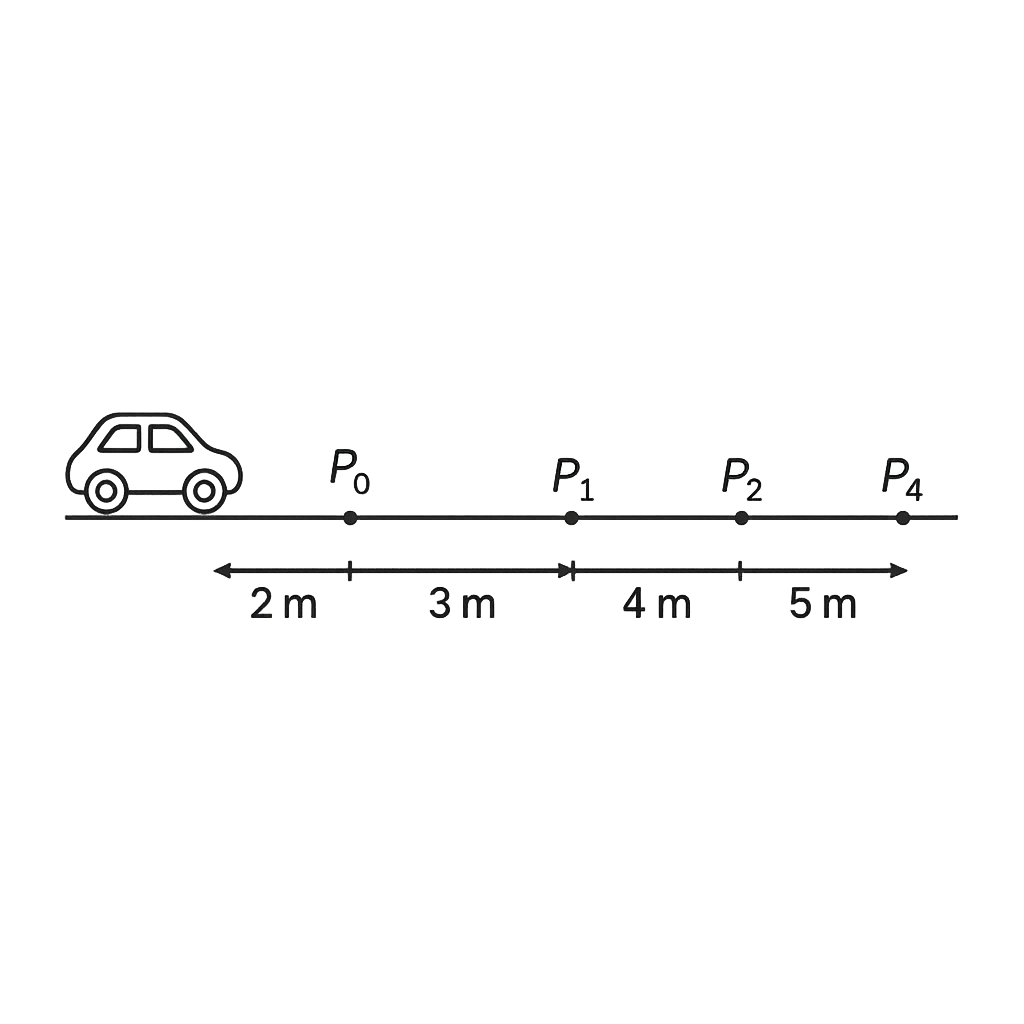
A motion diagram for a toy car moving along a straight horizontal track is shown. The diagram records the position of the car at successive 1‑second intervals. The distances between successive positions are: 2 m, 3 m, 4 m and 5 m.
Question Parts
(a)
Determine the initial speed of the car at the instant the first position is recorded.
(b)
Calculate the magnitude of the car’s constant acceleration.
(c)
Find the total distance travelled by the car in the first 5 seconds of motion.
Detailed Essay Solution & Marking Scheme Available

Get the step-by-step mathematical proofs, key points required by examiners, and a comprehensive breakdown from our AI Tutor.

Question 4 View Details
A block of mass 5 kg rests on a rough inclined plane that makes an angle of 30° with the horizontal. The coefficient of static friction between the block and the plane is 0.30. A horizontal force of magnitude F is applied to the block as shown (the force acts horizontally to the right).
Question Parts
(a)
Determine the greatest value of the horizontal force F that can be applied without causing the block to move up the plane.
(b)
If a horizontal force of 20 N is applied, state whether the block will move up the plane, down the plane, or remain at rest. Justify your answer.
(c)
Assuming the block does move, find the magnitude and direction of the kinetic frictional force acting on the block.
Detailed Essay Solution & Marking Scheme Available

Get the step-by-step mathematical proofs, key points required by examiners, and a comprehensive breakdown from our AI Tutor.

Question 5 View Details
A 12.0 kg crate is pulled up a smooth inclined plane that makes an angle of 30° with the horizontal. The pulling force is applied parallel to the plane and varies with the distance s (in metres) from the bottom according to \(F = (50 + 5s)\) N. The crate starts from rest at the bottom and reaches the top after moving 8.0 m.
Question Parts
(a)
Calculate the total work done by the pulling force during the ascent.
(b)
Determine the kinetic energy of the crate at the top of the incline. (Assume no friction.)
(c)
The crate is then released from rest at the top and allowed to slide down the same incline under the action of gravity alone. It reaches the bottom in 4.0 s. Find the average power delivered by gravity during this descent.
Detailed Essay Solution & Marking Scheme Available

Get the step-by-step mathematical proofs, key points required by examiners, and a comprehensive breakdown from our AI Tutor.

Question 6 View Details
A lifting system consists of a fixed pulley attached to the ceiling and a movable pulley attached to a load of 15.0 kg. The rope passes over the fixed pulley, under the movable pulley, and is pulled vertically upward with a constant effort of 120 N. The pulleys are assumed to be massless and frictionless.
Question Parts
(a)
Determine the mechanical advantage (MA) of the system based on the actual load and the applied effort.
(b)
For an ideal (frictionless) movable‑pulley arrangement the theoretical MA is 2. Using the given effort, calculate the ideal load that could be lifted and then state the efficiency of the actual system.
(c)
If the rope stretches uniformly by 0.05 m when the load is raised 2.0 m, estimate the work lost in stretching the rope and discuss its effect on the overall efficiency of the system.
Detailed Essay Solution & Marking Scheme Available

Get the step-by-step mathematical proofs, key points required by examiners, and a comprehensive breakdown from our AI Tutor.

Question 7 View Details
A vertical cylindrical tank of internal cross‑sectional area 0.50 m² has a total height of 10.0 m. The tank is closed at the top by a frictionless piston that initially locks the air inside at atmospheric pressure (101.3 kPa) and temperature 300 K. Water fills the lower part of the tank to a depth of 6.0 m. A valve at the bottom of the tank is opened, allowing water to flow out until the water level falls to 4.0 m, after which the valve is closed. The process is carried out slowly so that the trapped air behaves isothermally. Assume the density of water is 1000 kg·m⁻³ and the air behaves as an ideal gas. Answer the following:
Question Parts
(a)
Determine the final pressure of the trapped air after the water level has fallen to 4.0 m.
(b)
Calculate the work done on the trapped air by the water during the outflow.
(c)
A pressure gauge is connected to the trapped air. Explain how the gauge reading compares with atmospheric pressure and why.
Detailed Essay Solution & Marking Scheme Available

Get the step-by-step mathematical proofs, key points required by examiners, and a comprehensive breakdown from our AI Tutor.

Question 8 View Details
A metal cylinder (mass = 0.80 kg, specific heat = 0.45 kJ kg⁻¹ K⁻¹) contains 2.00 kg of water at 20.0 °C. The cylinder‑water system is placed in a large water bath maintained initially at 80.0 °C. After 10.0 min the temperature of the cylinder‑water system rises uniformly to 45.0 °C. Assume that during this interval no heat is lost to the surrounding laboratory. Answer the following:
Question Parts
(a)
Calculate the total heat absorbed by the cylinder‑water system during the 10 min.
(b)
Determine the average rate of heat transfer (in watts) from the bath to the system over the 10 min period.
Detailed Essay Solution & Marking Scheme Available

Get the step-by-step mathematical proofs, key points required by examiners, and a comprehensive breakdown from our AI Tutor.

Master the Exam!

You've seen a preview, but there are thousands more questions plus AI tutor to break down complex solutions.

Unlock Full Access Available for Android & Windows
Help others prepare! Share this practice hub:
Chat with Support