waec model questions vol1 2020 physics | Essay

Prepare for your exams with waec model questions vol1 questions? Reviewing past/model questions is one of the most effective ways to guarantee a high score. This practice hub features authentic 2020 physics (Essay) questions designed to simulate the real exam environment.

Practice these randomly selected questions to test your readiness.
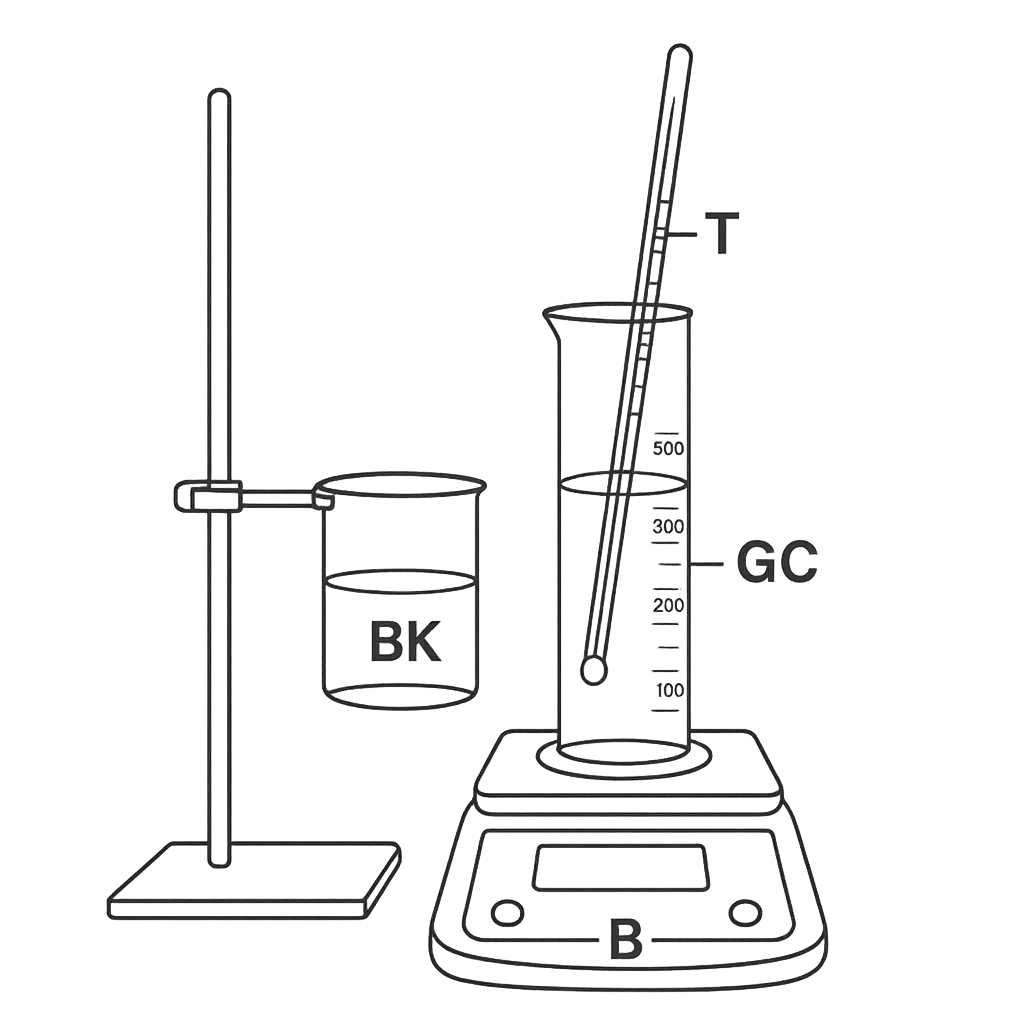
Question 1 View Details
A laboratory set‑up is provided for measuring the density of an unknown liquid. The set‑up consists of a digital balance, a clean dry graduated cylinder (capacity 500 mL), a beaker, a thermometer and a stand with a clamp. The graduated cylinder is placed on the balance and the mass is recorded. The cylinder is then filled with the liquid and the new mass is recorded. The volume of liquid is read from the scale on the cylinder. The temperature of the liquid is also noted. Using this set‑up, answer the following:
Question Parts
(a)
Outline the step‑by‑step procedure required to determine the density of the liquid, including how you would record the necessary data.
(b)
The mass of the empty graduated cylinder is 150.0 g. After filling it with the liquid, the balance reads 420.5 g. The volume reading on the cylinder is 250.0 mL. Calculate the density of the liquid in kg m⁻³. Show all steps.
(c)
Identify two systematic errors and two random errors that could affect the density determination.
(d)
For each type of error listed in part (c), suggest one practical way to reduce its effect.
Detailed Essay Solution & Marking Scheme Available

Get the step-by-step mathematical proofs, key points required by examiners, and a comprehensive breakdown from our AI Tutor.
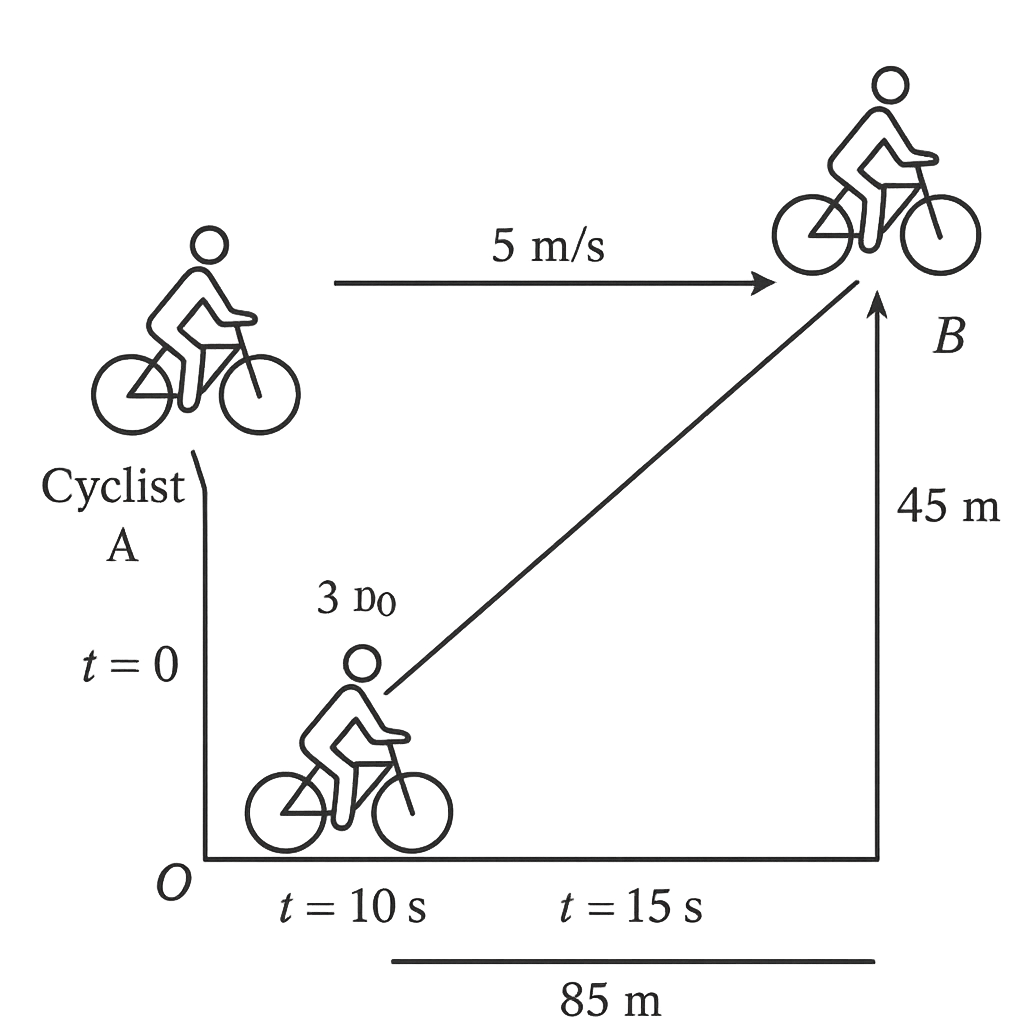
Question 2 View Details
Two cyclists, A and B, start from the same point O at the same instant. Cyclist A moves eastward. For the first 10 s A travels with a constant speed of 5 m s⁻¹ and then accelerates uniformly to reach 9 m s⁻¹ at the end of the next 5 s. Cyclist B moves northward with a constant speed of 3 m s⁻¹ throughout. The motion diagram shown in the illustration records the positions of A and B at t = 0 s, t = 10 s and t = 15 s and includes a straight line joining the positions of A and B at t = 15 s.
Question Parts
(a)
Determine the magnitude of the relative velocity of B with respect to A at t = 15 s.
(b)
Using the diagram, find the straight‑line distance between A and B at t = 15 s.
(c)
A third cyclist, C, starts from O at t = 0 s and moves directly toward the point where A and B are at t = 15 s. If C must reach that point exactly at t = 20 s, calculate the minimum constant speed required for C.
(d)
Explain how the concept of relative motion simplifies the calculation in part (c) and comment on the importance of choosing an appropriate reference frame in relative‑motion problems.
Detailed Essay Solution & Marking Scheme Available

Get the step-by-step mathematical proofs, key points required by examiners, and a comprehensive breakdown from our AI Tutor.
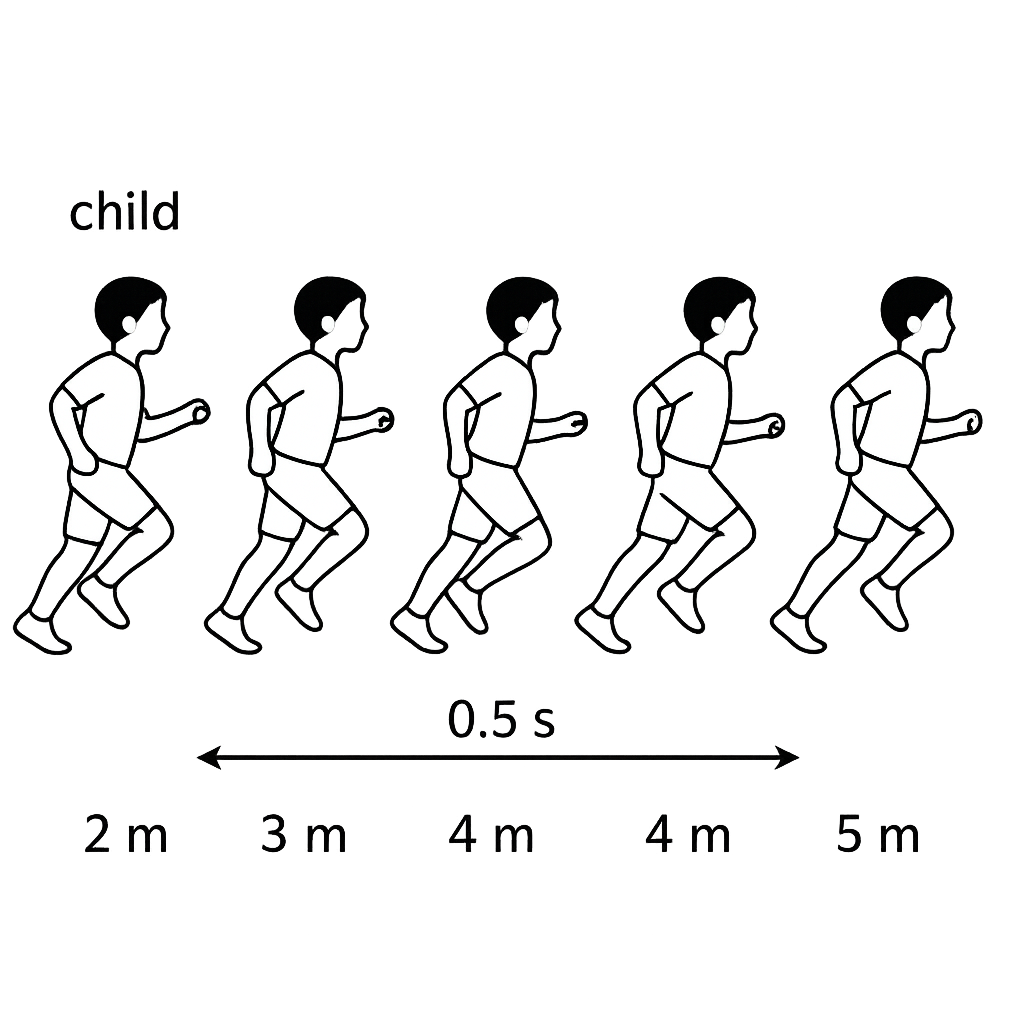
Question 3 View Details
A child runs in a straight line and a motion diagram of the motion is drawn. The diagram shows the positions of the child at successive equal time intervals of 0.5 s. The distances between successive positions are 2 m, 3 m, 4 m and 5 m respectively.
Question Parts
(a)
Determine the magnitude of the child's constant acceleration and the initial speed at the start of the first interval.
(b)
Calculate the speed of the child after 2.0 s from the start.
(c)
Find the total distance travelled by the child in the first 2.0 s.
(d)
Sketch a velocity‑time graph for the motion from t = 0 to t = 2.0 s. State the gradient of the graph and explain what the area under the graph represents.
Detailed Essay Solution & Marking Scheme Available

Get the step-by-step mathematical proofs, key points required by examiners, and a comprehensive breakdown from our AI Tutor.
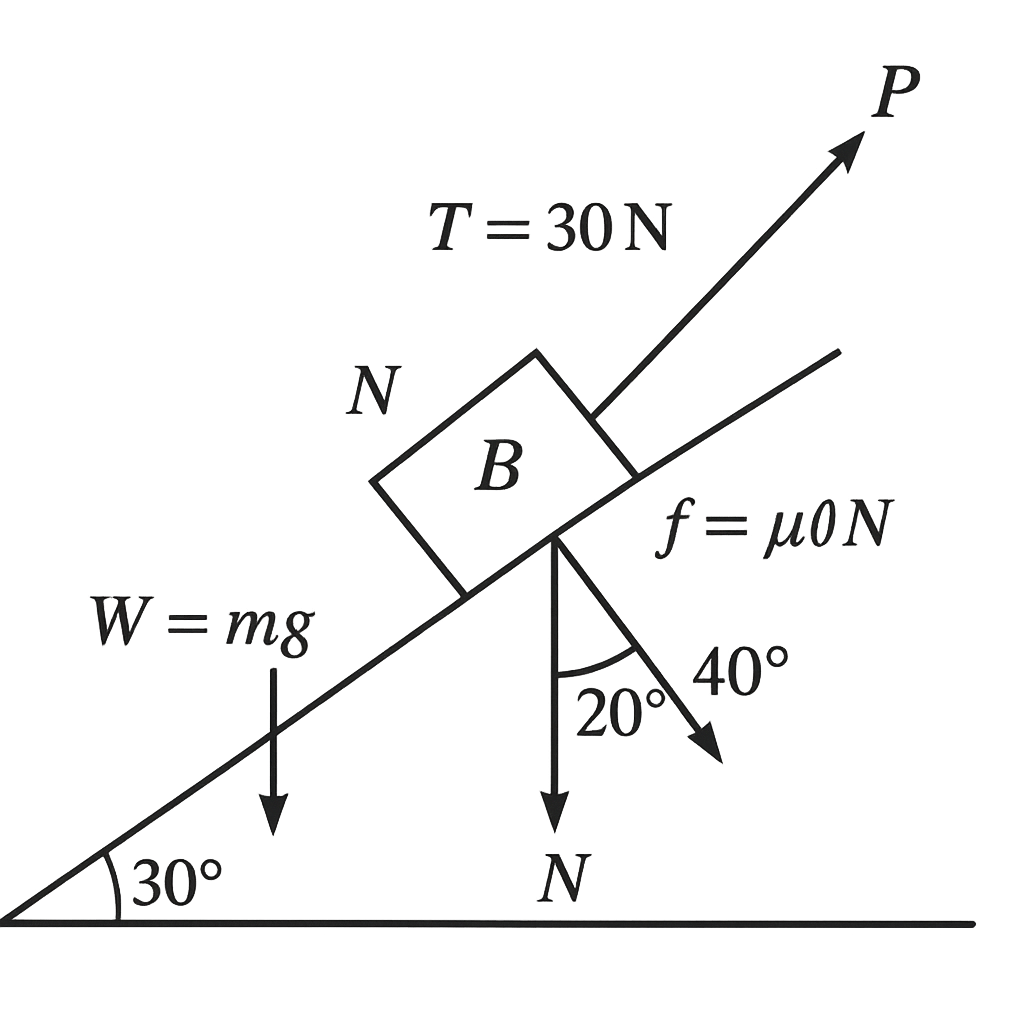
Question 4 View Details
A 5.0 kg block rests on a rough inclined plane that makes an angle of 30° with the horizontal. The coefficient of static friction between the block and the plane is 0.20. The block is acted upon by the following forces: - Its weight \(W = mg\). - A normal reaction \(N\) from the plane. - A tension \(T = 30 N\) in a light rope that pulls the block up the plane at an angle of 20° above the plane. - A horizontal push \(P\) applied to the block at an angle of 40° above the horizontal. - A frictional force \(f\) that opposes any tendency of motion. The force diagram for the situation is shown in the accompanying diagram. Answer the following questions:
Question Parts
(a)
Resolve the tension \(T\) into components parallel and perpendicular to the inclined plane. State the magnitude and direction of each component.
(b)
Write the two equilibrium equations (parallel to the plane and perpendicular to the plane) for the block, showing all forces involved.
(c)
Using \(\mu_s = 0.20\) and \(T = 30 N\), determine the magnitude of the horizontal push \(P\) required to keep the block in equilibrium. State clearly the direction of \(P\) with respect to the assumed positive direction.
(d)
Briefly discuss how increasing the inclination of the plane to 45° would affect the magnitude of the required horizontal push \(P\).
Detailed Essay Solution & Marking Scheme Available

Get the step-by-step mathematical proofs, key points required by examiners, and a comprehensive breakdown from our AI Tutor.

Question 5 View Details
A smooth inclined plane makes an angle of 30° with the horizontal. A 2.0 kg block is released from rest at the top of the plane and slides down a distance of 5.0 m along the plane. The coefficient of kinetic friction between the block and the plane is 0.20. At the bottom of the incline the block contacts a horizontal spring of force constant 400 N m⁻¹ and compresses it. Neglect air resistance.
Question Parts
(a)
Calculate the work done by gravity on the block during its descent.
(b)
Calculate the work done by friction during the descent.
(c)
Find the speed of the block just before it contacts the spring.
(d)
Determine the maximum compression of the spring.
Detailed Essay Solution & Marking Scheme Available

Get the step-by-step mathematical proofs, key points required by examiners, and a comprehensive breakdown from our AI Tutor.

Question 6 View Details
A block‑and‑tackle system consists of one fixed pulley and one movable pulley. A load of 80 N is lifted vertically. An effort of 30 N is applied to the free end of the rope, which is pulled downwards at a speed of 0.60 m s⁻¹. The load rises at a speed of 0.20 m s⁻¹. Assume the rope and pulleys are mass‑less.
Question Parts
(a)
Calculate the mechanical advantage (MA) of the system.
(b)
State the ideal velocity ratio (VR_ideal) for this arrangement.
(c)
Determine the actual velocity ratio (VR_actual) and the efficiency of the system (expressed as a percentage).
(d)
Calculate the power input and the useful power output of the system.
Detailed Essay Solution & Marking Scheme Available

Get the step-by-step mathematical proofs, key points required by examiners, and a comprehensive breakdown from our AI Tutor.

Question 7 View Details
A rigid, sealed container of internal volume 2.0 L initially contains a mixture of nitrogen and oxygen gases at 27°C and a total pressure of 1.0 atm. The mole fraction of nitrogen in the mixture is 0.70. The container is then heated to 127°C, causing the pressure to increase. To bring the pressure back to 1.0 atm at the new temperature, a valve is opened and some gas is allowed to escape until the pressure stabilises at 1.0 atm while the temperature is maintained at 127°C.
Question Parts
(a)
Calculate the initial total number of moles of gas in the container.
(b)
Determine the total number of moles of gas remaining in the container after the valve is closed.
(c)
Find the mass of nitrogen that has escaped from the container (give your answer to two significant figures).
(d)
Explain why no work is done on or by the gas during the heating and venting processes.
Detailed Essay Solution & Marking Scheme Available

Get the step-by-step mathematical proofs, key points required by examiners, and a comprehensive breakdown from our AI Tutor.

Question 8 View Details
A 150 g block of copper at 80°C is placed into a well‑insulated calorimeter that initially contains 200 g of water at 20°C. The specific heat capacities are: copper c₍Cu₎ = 0.385 J·g⁻¹·K⁻¹, water c₍w₎ = 4.18 J·g⁻¹·K⁻¹. After the system reaches thermal equilibrium the temperature recorded (ignoring the calorimeter’s heat capacity) is 25.0°C. The calorimeter itself has a heat capacity of 12.0 J·K⁻¹ which was not taken into account in the first reading.
Question Parts
(a)
Re‑calculate the final equilibrium temperature of the whole system when the calorimeter’s heat capacity is correctly included.
Detailed Essay Solution & Marking Scheme Available

Get the step-by-step mathematical proofs, key points required by examiners, and a comprehensive breakdown from our AI Tutor.

Master the Exam!

You've seen a preview, but there are thousands more questions plus AI tutor to break down complex solutions.

Unlock Full Access Available for Android & Windows
Help others prepare! Share this practice hub:
Chat with Support