waec model questions vol1 2019 biology | Objective

Are you preparing for waec model questions vol1 exams? Reviewing past questions is one of the most effective ways to guarantee a high score. This practice hub features authentic 2019 biology (Objective) questions designed to simulate the real exam environment.

Practice these randomly selected questions to test your readiness.

Question 1 View Details
Fossil species A, which lived 5 million years ago, had an average molar length of 12 mm. Its descendant species B, living today, has an average molar length of 18 mm. Assuming a linear increase in size, (a) calculate the average increase in molar length per million years, and (b) if another lineage C shows an increase of 0.8 mm per million years, how many million years would be required for lineage C to achieve the same total increase observed from A to B?
Correct A. 7.5
B. 6.0
C. 10.0
D. 8.0

Correct Answer: A

Want to see the full step-by-step solution? Unlock AI Explanation & Analytics
Question 2 View Details
A bacterial culture at 30°C has a generation time of 20 minutes. When the temperature is raised to 40°C, the generation time shortens by 25% but a lag phase of 30 minutes precedes exponential growth. Starting with 1,000 cells, a bacteriophage infection occurs exactly 2 hours after inoculation, killing 90% of the cells instantly. The culture is then allowed to continue growing for a total of 3 hours at 40°C. Assuming first‑order growth after the lag phase, how many viable cells are present at the end of the 3‑hour period?
A. 204800
Correct B. 102400
C. 10240
D. 51200

Correct Answer: B

Want to see the full step-by-step solution? Unlock AI Explanation & Analytics
Question 3 View Details
In a community of 2,000 individuals, 800 received vaccine X and 1,200 did not. Among the vaccinated, 20 developed disease Y, while among the unvaccinated, 180 developed the disease. (a) Determine the incidence of disease Y in each group. (b) Compute the relative risk (RR) and the vaccine efficacy expressed as a percentage. (c) If a new strain reduces the vaccine's efficacy by 30% relative to the original efficacy, how many cases of disease Y would be expected among the vaccinated group under the same exposure conditions?
A. 60
B. 70
Correct C. 50
D. 45

Correct Answer: C

Want to see the full step-by-step solution? Unlock AI Explanation & Analytics
Question 4 View Details
A lake covering 5 km² has a primary productivity of 1,200 kcal·m⁻²·day⁻¹. Only 10% of this energy is transferred to herbivorous zooplankton, and 20% of the energy they ingest is assimilated into their biomass. A fish species feeds on this zooplankton with a consumption efficiency of 15% and an assimilation efficiency of 25%. (a) Calculate the total amount of energy (in kcal) available to the fish per day under these conditions. (b) If a pollutant reduces primary productivity by 25% and lowers zooplankton assimilation efficiency by 5 percentage points, what is the new daily energy available to the fish?
Correct A. 2531250
B. 2250000
C. 3000000
D. 2000000

Correct Answer: A

Want to see the full step-by-step solution? Unlock AI Explanation & Analytics
Question 5 View Details
Drug Z has an oral bioavailability of 0.6, a volume of distribution of 40 L, and an elimination half‑life of 8 h. It is administered every 12 h. (a) What loading dose (in mg) is required to instantly achieve a plasma concentration of 5 µg·mL⁻¹? (b) What maintenance dose (in mg) should be given each interval to maintain a steady‑state peak concentration of 5 µg·mL⁻¹, assuming first‑order kinetics? (c) If a patient's renal clearance falls by 30%, how should the maintenance dose be adjusted to keep the same steady‑state concentration?
A. 360 mg loading; 400 mg maintenance; 280 mg adjusted maintenance
B. 350 mg loading; 380 mg maintenance; 266 mg adjusted maintenance
Correct C. 333 mg loading; 347 mg maintenance; 243 mg adjusted maintenance
D. 300 mg loading; 320 mg maintenance; 224 mg adjusted maintenance

Correct Answer: C

Want to see the full step-by-step solution? Unlock AI Explanation & Analytics
Question 6 View Details
A freshwater fish maintains an internal Na⁺ concentration of 150 mM. In freshwater the ambient Na⁺ concentration is 0.5 mM. Na⁺ diffuses across the gill surface (area = 2 cm²) with a permeability coefficient of 1×10⁻⁵ cm·s⁻¹. (a) Calculate the rate of Na⁺ loss (in mmol·s⁻¹) by diffusion. (b) The fish can actively pump Na⁺ at a rate of 2×10⁻⁶ mol·cm⁻²·s⁻¹ across the same gill area. Can the active transport fully compensate for the diffusive loss? Answer "Yes" or "No".
Correct A. Yes
B. Partially
C. Maybe
D. No

Correct Answer: A

Want to see the full step-by-step solution? Unlock AI Explanation & Analytics
Question 7 View Details
During which phase of mitosis does the nuclear envelope break down?
Correct A. prophase
B. anaphase
C. metaphase
D. telophase

Correct Answer: A

Want to see the full step-by-step solution? Unlock AI Explanation & Analytics
Question 8 View Details
A female dog can become pregnant again one month after giving birth. The gestation period is 2 months and the estrous cycle repeats every 6 months. Starting at age 1 year, how many litters can she produce in the next 4 years?
A. 14
B. 12
Correct C. 16
D. 18

Correct Answer: C

Want to see the full step-by-step solution? Unlock AI Explanation & Analytics
Question 9 View Details
A frog inhabiting a 35 °C environment can dissipate excess heat by evaporative cooling. Its skin surface area is 0.02 m² and the latent heat of vaporisation of water is 2.4×10⁶ J·kg⁻¹. Heat loss by radiation and convection is 5 W per °C above the frog's optimum body temperature of 25 °C. Calculate the minimum rate of water loss (in kg·s⁻¹) required for the frog to maintain its body temperature.
Correct A. 2.1×10⁻⁵ kg·s⁻¹
B. 2.5×10⁻⁵ kg·s⁻¹
C. 3.0×10⁻⁵ kg·s⁻¹
D. 1.8×10⁻⁵ kg·s⁻¹

Correct Answer: A

Want to see the full step-by-step solution? Unlock AI Explanation & Analytics
Question 10 View Details
A resting student has a tidal volume of 500 mL, a respiratory rate of 12 breaths·min⁻¹ and an anatomical dead space of 150 mL. (a) Calculate the alveolar ventilation in L·min⁻¹. (b) If the fraction of inspired O₂ (FIO₂) is 0.21 and the fraction of expired O₂ (FEO₂) is 0.16, determine the rate of O₂ uptake in mL·min⁻¹.
A. 180 mL·min⁻¹
B. 240 mL·min⁻¹
C. 300 mL·min⁻¹
Correct D. 210 mL·min⁻¹

Correct Answer: D

Want to see the full step-by-step solution? Unlock AI Explanation & Analytics
Question 11 View Details
A small mammal exhibits the following characteristics: (i) dental formula I 3/3, C 1/1, P 3/3, M 1/1; (ii) plantigrade foot pads; (iii) a well‑developed auditory bulla formed mainly by the tympanic bone; (iv) retractile claws. Using these traits, determine the taxonomic family to which this animal belongs.
A. Canidae
B. Viverridae
C. Mustelidae
Correct D. Felidae

Correct Answer: D

Want to see the full step-by-step solution? Unlock AI Explanation & Analytics
Question 12 View Details
Two species of fruit fly differ by 0.012 substitutions per nucleotide site in a mitochondrial gene. The mutation rate for this gene is estimated at 2.5 \times 10^{-8} substitutions per site per year. Assuming a molecular clock, estimate the time since the two species diverged, expressing your answer in million years (to two decimal places).
A. 0.12
B. 0.48
C. 0.30
Correct D. 0.24

Correct Answer: D

Want to see the full step-by-step solution? Unlock AI Explanation & Analytics
Question 13 View Details
A daily diet consists of 150 g of rice (80% carbohydrate, 7% protein, 1% fat), 100 g of chicken breast (31% protein, 3.6% fat) and 50 g of almonds (21% protein, 49% fat, 22% carbohydrate). Digestibility coefficients are 95% for carbohydrates, 90% for proteins and 98% for fats. Using Atwater factors (carbohydrate 4 kcal·g⁻¹, protein 4 kcal·g⁻¹, fat 9 kcal·g⁻¹), calculate the percentage of the total metabolizable energy that is supplied by protein. Give your answer as a whole number percentage.
Correct A. 20
B. 15
C. 25
D. 30

Correct Answer: A

Want to see the full step-by-step solution? Unlock AI Explanation & Analytics
Question 14 View Details
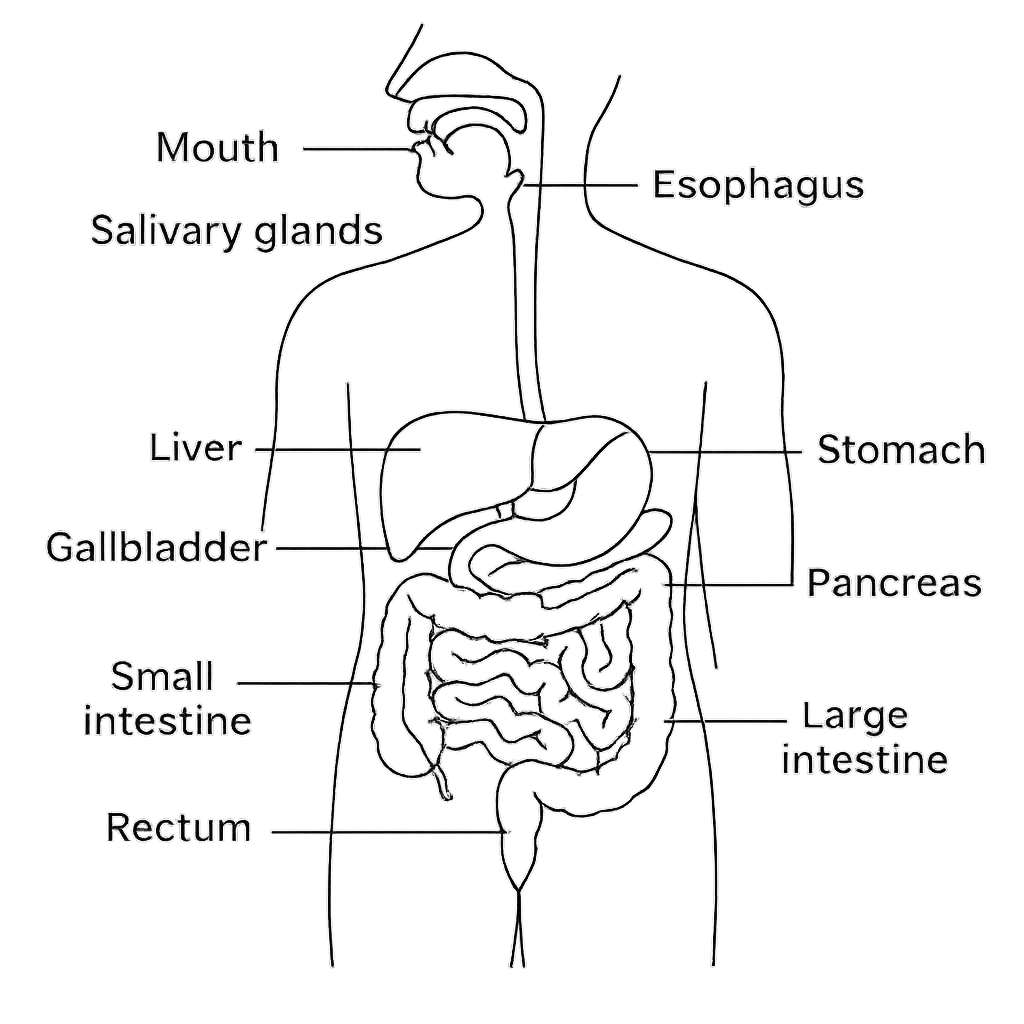
The labelled diagram shows the major organs of the human digestive system. According to the diagram, which organ secretes the enzyme that initiates the digestion of carbohydrates by breaking down starch into maltose?
A. Small intestine (in the abdomen)
B. Pancreas (in the abdomen)
Correct C. Salivary glands (in the mouth)
D. Stomach (in the abdomen)

Correct Answer: C

Want to see the full step-by-step solution? Unlock AI Explanation & Analytics
Question 15 View Details
A clinical specimen yields Gram‑positive cocci that occur in clusters. The isolate is catalase‑positive, coagulase‑negative, grows on Mannitol Salt Agar producing yellow colonies, does not ferment sucrose, is resistant to penicillin but sensitive to oxacillin. Identify the organism.
A. Staphylococcus aureus
B. Staphylococcus haemolyticus
Correct C. Staphylococcus saprophyticus
D. Staphylococcus epidermidis

Correct Answer: C

Want to see the full step-by-step solution? Unlock AI Explanation & Analytics
Question 16 View Details
In corn, kernel colour is controlled by two genes: C (colour) is dominant over c (colourless), and W (white) is dominant over w (yellow). The presence of at least one C allele gives colour, but if the genotype is cc the kernels are colourless regardless of the W gene. A plant heterozygous for both genes (CcWw) is crossed with a plant homozygous recessive for colour (ccww). What proportion of the offspring will have white coloured kernels?
A. 1\/8
B. 3\/4
Correct C. 1/4
D. 1\/2

Correct Answer: C

Want to see the full step-by-step solution? Unlock AI Explanation & Analytics
Question 17 View Details
An animal exhibits the following characteristics: (i) it is warm‑blooded, (ii) it has hair, (iii) females possess mammary glands, (iv) it lays eggs, and (v) it has a cloaca. Using the standard taxonomic hierarchy, state the class and order to which this animal belongs.
A. Class Reptilia, Order Monotremata
B. Class Mammalia, Order Carnivora
C. Class Aves, Order Monotremata
Correct D. Class Mammalia, Order Monotremata

Correct Answer: D

Want to see the full step-by-step solution? Unlock AI Explanation & Analytics
Question 18 View Details
A lake ecosystem has an annual primary productivity of 800 g C m⁻² yr⁻¹. Thirty percent of this primary production is lost directly to detritus and is not available to consumers. Of the remaining primary production, 10 % is consumed by herbivorous zooplankton. Of the herbivore biomass, 25 % is transferred to secondary consumers, and 15 % of the secondary‑consumer biomass is transferred to tertiary consumers. How many grams of carbon per square metre per year are present in the tertiary‑consumer level?
A. 4.2
B. 1.5
C. 3.0
Correct D. 2.1

Correct Answer: D

Want to see the full step-by-step solution? Unlock AI Explanation & Analytics
Question 19 View Details
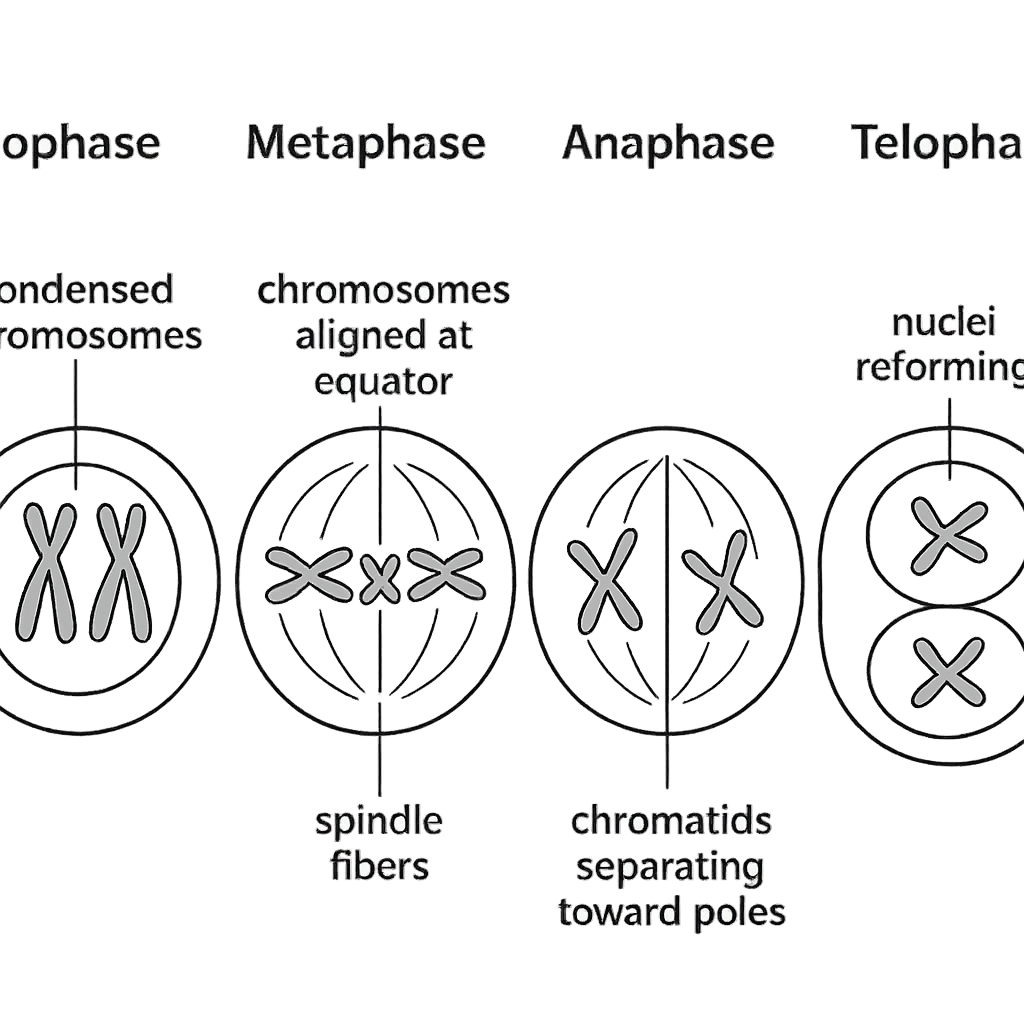
The diagram shows the four main stages of mitosis in a typical animal cell. Identify the stage in which sister chromatids separate and move toward opposite poles.
A. Telophase
B. Metaphase
Correct C. Anaphase
D. Prophase

Correct Answer: C

Want to see the full step-by-step solution? Unlock AI Explanation & Analytics
Question 20 View Details
A person experiences a sudden fall in blood glucose concentration. Describe the immediate hormonal response that restores glucose levels, specifying (i) the hormone released first, (ii) the gland that secretes it, and (iii) its direct effect on liver glycogen.
A. Insulin; secreted by pancreatic β‑cells; it stimulates glycogenolysis (breakdown of liver glycogen).
Correct B. Glucagon; secreted by pancreatic α‑cells; it stimulates glycogenolysis (breakdown of liver glycogen).
C. Glucagon; secreted by pancreatic α‑cells; it stimulates glycogenesis (formation of liver glycogen).
D. Epinephrine; secreted by adrenal medulla; it stimulates glycogenolysis (breakdown of liver glycogen).

Correct Answer: B

Want to see the full step-by-step solution? Unlock AI Explanation & Analytics
Question 21 View Details
In peas, the genes for plant height (T = tall, t = dwarf) and seed colour (Y = yellow, y = green) are linked on the same chromosome with a recombination frequency of 10%. A plant heterozygous for both traits (genotype TtYy) has the coupling arrangement (TY/ty). It is crossed with a homozygous recessive plant (ttyy). What percentage of the progeny are expected to be tall and have green seeds?
Correct A. 5%
B. 0%
C. 15%
D. 10%

Correct Answer: A

Want to see the full step-by-step solution? Unlock AI Explanation & Analytics
Question 22 View Details
In the estrous cycle of a rabbit, estrogen peaks at 08:00 h on day 2. The luteinising hormone (LH) surge occurs 6 h after the estrogen peak, and ovulation takes place 10 h after the LH surge. On which day and at what time does ovulation occur?
Correct A. 00:00 h on day 3
B. 14:00 h on day 2
C. 06:00 h on day 3
D. 20:00 h on day 3

Correct Answer: A

Want to see the full step-by-step solution? Unlock AI Explanation & Analytics
Question 23 View Details
A community health survey followed 2,000 individuals for five years. Among 500 smokers, 40 developed lung cancer. Among 1,500 non‑smokers, 30 developed lung cancer.\n(a) Calculate the incidence of lung cancer in smokers and in non‑smokers.\n(b) Determine the relative risk (RR) of lung cancer for smokers compared with non‑smokers.\n(c) If a smoking‑cessation programme reduces the number of smokers by 20% (the quitters adopt the non‑smoker risk), estimate how many cases of lung cancer would be prevented over the five‑year period.
A. 12 cases prevented
B. 10 cases prevented
Correct C. 8 cases prevented
D. 5 cases prevented

Correct Answer: C

Want to see the full step-by-step solution? Unlock AI Explanation & Analytics
Question 24 View Details
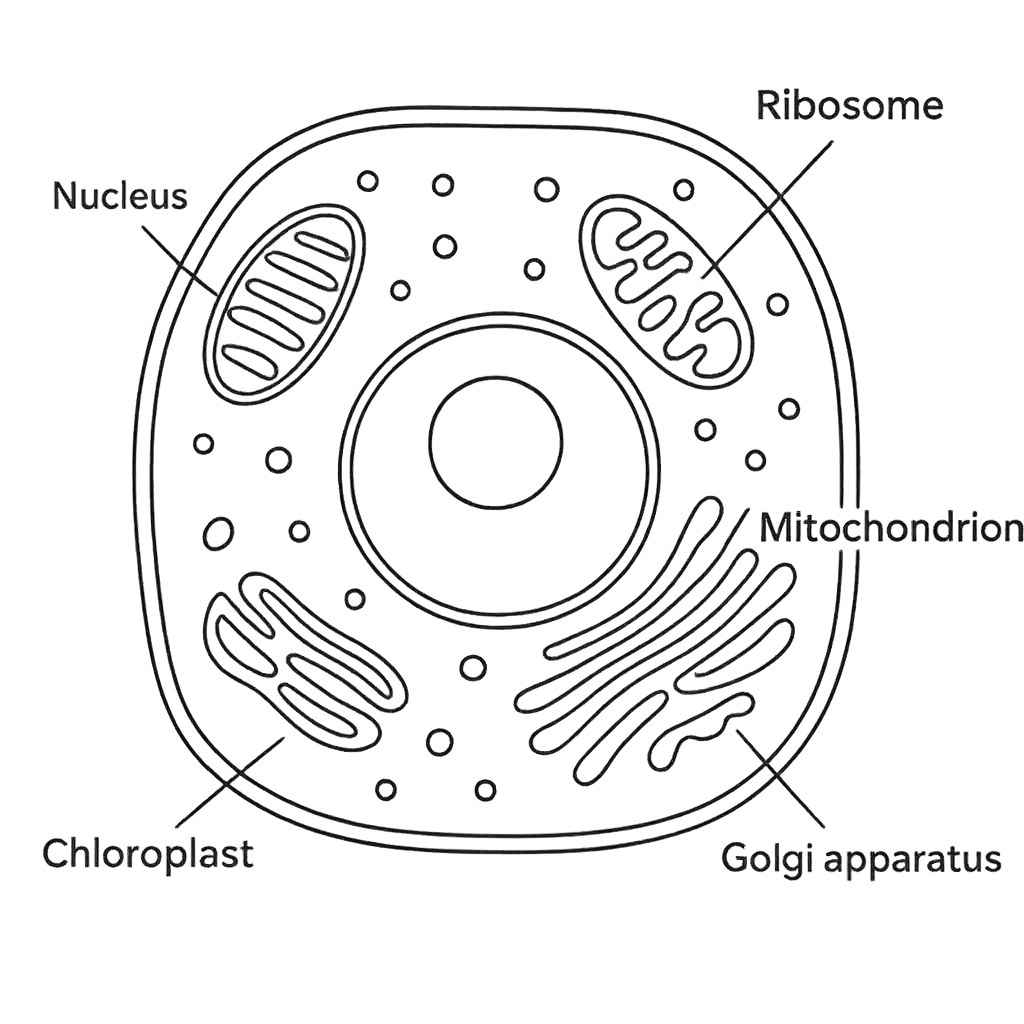
The diagram shows a typical plant cell with its major organelles labelled. Which labelled structure is the primary site of aerobic respiration and ATP production?
A. Golgi apparatus
Correct B. Mitochondrion
C. Nucleus
D. Chloroplast

Correct Answer: B

Want to see the full step-by-step solution? Unlock AI Explanation & Analytics
Question 25 View Details
An unknown multicellular organism displays the following characteristics:\n- Eukaryotic cells with a cellulose cell wall\n- Chloroplasts containing thylakoids\n- Stores starch as the main food reserve\n- Possesses true roots, stems and leaves with vascular tissue\n- Reproduces via spores rather than seeds\nBased on these traits, state the appropriate taxonomic group at the (a) kingdom level, (b) phylum level, and (c) class level.
Correct A. Kingdom Plantae; Phylum Pteridophyta; Class Polypodiopsida
B. Kingdom Fungi; Phylum Basidiomycota; Class Agaricomycetes
C. Kingdom Plantae; Phylum Bryophyta; Class Bryopsida
D. Kingdom Plantae; Phylum Pteridophyta; Class Lycopodiopsida

Correct Answer: A

Want to see the full step-by-step solution? Unlock AI Explanation & Analytics

Master the Exam!

You've seen a preview, but there are thousands more questions plus AI tutor to break down complex solutions.

Unlock Full Access Available for Android & Windows
Help others prepare! Share this practice hub:
Chat with Support