waec model questions vol1 2018 mathematics | Essay

Prepare for your exams with waec model questions vol1 questions? Reviewing past/model questions is one of the most effective ways to guarantee a high score. This practice hub features authentic 2018 mathematics (Essay) questions designed to simulate the real exam environment.

Practice these randomly selected questions to test your readiness.

Question 1 View Details
Determine the least common multiple (LCM) of 12, 15 and 20. Using this LCM, calculate how many three‑digit integers are multiples of the LCM.
Detailed Essay Solution & Marking Scheme Available

Get the step-by-step mathematical proofs, key points required by examiners, and a comprehensive breakdown from our AI Tutor.
Question 2 View Details
A shirt is priced at ₦12,500. The shop first offers a 20 % discount on the price. After the discount, a sales tax of 7.5 % is added to the discounted price. Finally, the buyer applies a voucher that deducts ₦500 from the total amount payable. Determine the final amount the buyer pays and express this final amount as a percentage of the original price.
Detailed Essay Solution & Marking Scheme Available

Get the step-by-step mathematical proofs, key points required by examiners, and a comprehensive breakdown from our AI Tutor.

Question 3 View Details
Let a and b be positive real numbers such that \(a^{\log_{2}16}=b^{\log_{3}9}\) and \((a/b)^{1/2}=3\).
Question Parts
(a)
Show that the condition \(a^{\log_{2}16}=b^{\log_{3}9}\) leads to the algebraic relation \(a^{2}=b\).
(b)
Using the relation \(a^{2}=b\) together with \((a/b)^{1/2}=3\), determine the numerical values of \(a\) and \(b\).
(c)
Evaluate the expression \(\sqrt{a}+\sqrt{b}\) and give your answer as a fraction in lowest terms.
Detailed Essay Solution & Marking Scheme Available

Get the step-by-step mathematical proofs, key points required by examiners, and a comprehensive breakdown from our AI Tutor.

Question 4 View Details
The Venn diagram below represents the distribution of 150 students according to the three optional subjects they may study: Mathematics (M), Physics (P) and Chemistry (C). The numbers in each region are:
Question Parts
(a)
How many students study at least one of the three subjects?
(b)
How many students study exactly one of the subjects?
(c)
How many students study exactly two of the subjects?
(d)
How many students study none of the three subjects?
Detailed Essay Solution & Marking Scheme Available

Get the step-by-step mathematical proofs, key points required by examiners, and a comprehensive breakdown from our AI Tutor.

Question 5 View Details
A rectangular garden has its length expressed as 3x + 2 metres and its width expressed as x – 1 metres, where x is a positive integer. The area of the garden is represented by the algebraic expression 3x² + a x + b square metres.
Question Parts
(a)
Obtain the algebraic expression for the area by multiplying the length and width.
() Show the expanded form.
() Hence determine the values of a and b.
(b)
If the perimeter of the garden is 48 metres, find the value of x and then compute the numerical area of the garden.
(c)
The garden is to be fenced using wire that costs ₦150 per metre. Write an expression for the total cost in terms of x and then calculate the cost using the value of x obtained in part (b).
Detailed Essay Solution & Marking Scheme Available

Get the step-by-step mathematical proofs, key points required by examiners, and a comprehensive breakdown from our AI Tutor.

Question 6 View Details
A school is purchasing two types of textbooks for a new class. Type A costs ₦250 each and Type B costs ₦340 each. The school spends a total of ₦31,500 on the books and buys exactly 90 books in total.
Question Parts
(a)
Let the number of Type A books be a and the number of Type B books be b. Form a system of linear equations that represents the situation.
(b)
Solve the system to find the number of each type of book purchased.
(c)
After the purchase the school receives a discount of 5 % on the total amount spent. Calculate the amount saved and the final amount paid.
(d)
The school decides to sell any remaining Type B books at a profit of 20 % per book. If they sell 10 of the Type B books, what is the total profit earned?
Detailed Essay Solution & Marking Scheme Available

Get the step-by-step mathematical proofs, key points required by examiners, and a comprehensive breakdown from our AI Tutor.

Question 7 View Details
A farmer wishes to fence a rectangular field that is bounded on one side by a river, so that the river forms one side of the rectangle and no fence is needed there. The farmer has 120 metres of fencing to use for the other three sides.
Question Parts
(a)
Let x be the length of the side of the rectangle that is parallel to the river (in metres). Express the area A of the field, in square metres, as a quadratic function of x.
(b)
Using the quadratic expression obtained in part (a), determine the dimensions of the rectangle that give the maximum possible area. State the maximum area.
(c)
Form the quadratic equation whose roots represent the possible values of x that would give an area of exactly 1800 m².
(d)
Solve the quadratic equation from part (c) and interpret the meaning of the solution(s) in the context of the problem.
Detailed Essay Solution & Marking Scheme Available

Get the step-by-step mathematical proofs, key points required by examiners, and a comprehensive breakdown from our AI Tutor.

Question 8 View Details
A manufacturing company produces widgets. The cost (in Naira) of producing each widget when n widgets are made per day is given by the formula C = 3000/n + n.
Question Parts
(a)
Write the inequality that expresses the requirement that the cost per widget does not exceed 150 Naira.
(b)
Transform the inequality in part (a) into a quadratic inequality in n (assume n > 0).
(c)
Solve the quadratic inequality obtained in part (b) and give the interval of real values of n that satisfy it.
(d)
If the production must be an integer number of widgets and at least 20 widgets per day, list all feasible values of n that satisfy the cost requirement.
Detailed Essay Solution & Marking Scheme Available

Get the step-by-step mathematical proofs, key points required by examiners, and a comprehensive breakdown from our AI Tutor.

Question 9 View Details
A sequence is defined as follows: the first term is 5, the second term is 8 and the difference between consecutive terms increases by 3 each time. Using this information:
Question Parts
(a)
Find the 10th term of the sequence.
(b)
Find the sum of the first 10 terms.
(c)
State the smallest integer n for which the sum of the first n terms exceeds 500.
Detailed Essay Solution & Marking Scheme Available

Get the step-by-step mathematical proofs, key points required by examiners, and a comprehensive breakdown from our AI Tutor.

Question 10 View Details
The time t (in seconds) taken for a certain chemical reaction to complete varies directly with the square of the concentration c (in mol L⁻¹) of a catalyst and inversely with the absolute temperature T (in K). When c = 0.20 mol L⁻¹ and T = 300 K the reaction requires 120 s.
Question Parts
(a)
Find the constant of variation k.
(b)
If the temperature is raised to 350 K and the catalyst concentration is increased to 0.25 mol L⁻¹, determine the new reaction time (to the nearest second).
(c)
The laboratory wishes the reaction to finish in under 90 s while keeping the temperature at 350 K. Determine the minimum catalyst concentration required, giving your answer to two decimal places.
(d)
Discuss qualitatively how the reaction time would change if both the temperature and the catalyst concentration were doubled from the values in part (b).
Detailed Essay Solution & Marking Scheme Available

Get the step-by-step mathematical proofs, key points required by examiners, and a comprehensive breakdown from our AI Tutor.

Question 11 View Details
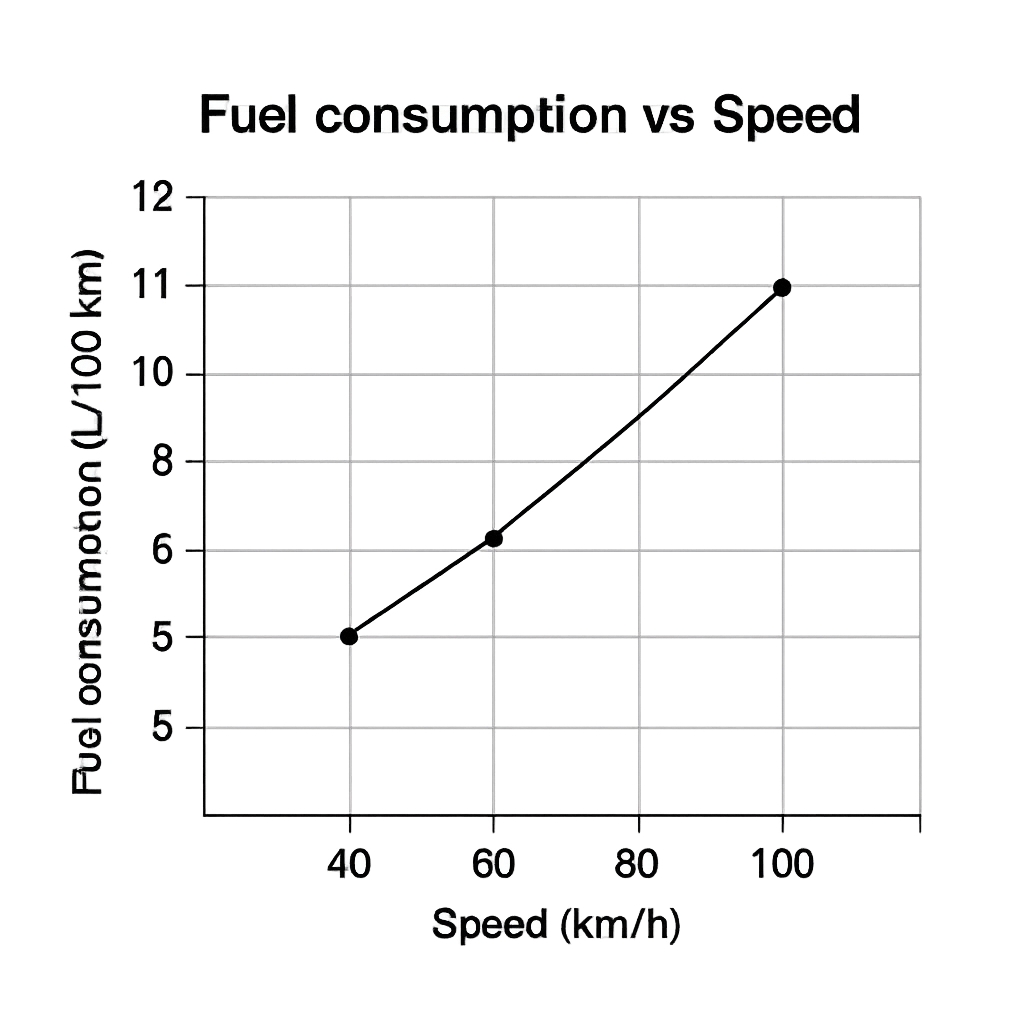
The graph below shows the fuel consumption (in litres per 100 km) of a car when it travels at various constant speeds (in km/h).
Question Parts
(a)
Calculate the average rate of change of fuel consumption with respect to speed between 60 km/h and 100 km/h. Express your answer in litres per kilometre per hour.
(b)
Using linear interpolation, estimate the fuel consumption of the car when it travels at 90 km/h.
(c)
Determine the speed at which the car would consume exactly 9 litres per 100 km, assuming the same linear relationship between 80 km/h and 100 km/h.
(d)
Explain, in brief, what the graph reveals about the effect of speed on the car’s fuel consumption.
Detailed Essay Solution & Marking Scheme Available

Get the step-by-step mathematical proofs, key points required by examiners, and a comprehensive breakdown from our AI Tutor.

Question 12 View Details
In the diagram, triangle ABC is drawn such that \(\angle A = 40^{\circ}\) and \(\angle B = 70^{\circ}\). The side \(AB\) measures 12 cm. A point D lies on side \(BC\) dividing it internally in the ratio \(BD : DC = 1 : 2\).
Question Parts
(a)
Determine the length of side \(BC\) (in cm).
(b)
Find the lengths of \(BD\) and \(DC\) (in cm) to two decimal places.
(c)
Compute the area of triangle \(ABC\) (in cm\(^2\)) to two decimal places.
(d)
Determine the length of segment \(AD\) (in cm) to two decimal places.
Detailed Essay Solution & Marking Scheme Available

Get the step-by-step mathematical proofs, key points required by examiners, and a comprehensive breakdown from our AI Tutor.

Question 13 View Details
In triangle ABC, \(\angle A = 40^{\circ}\) and \(\angle B = 70^{\circ}\). The side \(AB = 12\) cm. Point D lies on side BC such that \(BD:DC = 1:2\). The altitude from A meets BC at H.
Question Parts
(a)
Determine the length of side BC and the length of side AC.
(b)
Find the lengths of BD and DC.
(c)
Calculate the area of triangle ABC.
(d)
Determine the length of the altitude AH.
Detailed Essay Solution & Marking Scheme Available

Get the step-by-step mathematical proofs, key points required by examiners, and a comprehensive breakdown from our AI Tutor.

Master the Exam!

You've seen a preview, but there are thousands more questions plus AI tutor to break down complex solutions.

Unlock Full Access Available for Android & Windows
Help others prepare! Share this practice hub:
Chat with Support