waec model questions vol1 2018 chemistry | Objective

Prepare for your exams with waec model questions vol1 questions? Reviewing past/model questions is one of the most effective ways to guarantee a high score. This practice hub features authentic 2018 chemistry (Objective) questions designed to simulate the real exam environment.

Practice these randomly selected questions to test your readiness.

Question 1 View Details
An isotope of an element has an atomic number of 15 and an atomic mass of 31. How many neutrons are present in one atom of this isotope?
A. 15
Correct B. 16
C. 14
D. 17

Correct Answer: B

Want to see the full step-by-step solution? Unlock AI Explanation & Analytics
Question 2 View Details
A pure primary alcohol with the general formula CₙH₂ₙ₊₂O is completely oxidised to a carboxylic acid. The mass of the acid obtained is 74 g while the mass of the original alcohol was 60 g. Determine the value of n and write the molecular formula of the alcohol.
Correct A. n = 3; molecular formula C₃H₈O
B. n = 5; molecular formula C₅H₁₂O
C. n = 4; molecular formula C₄H₁₀O
D. n = 2; molecular formula C₂H₆O

Correct Answer: A

Want to see the full step-by-step solution? Unlock AI Explanation & Analytics
Question 3 View Details
2.00 g of a compound A (molar mass = 60 g·mol⁻¹) reacts with excess of compound B according to the equation: 2 A + 3 B → C + 4 D. The reaction produces 1.20 L of gaseous product D measured at STP. Calculate the theoretical mass of D (in grams) that should be obtained and the percent yield of the reaction. (Assume D is N₂, M(D) = 28 g·mol⁻¹.)
Correct A. Theoretical mass = 1.87 g; percent yield = 80.4%
B. Theoretical mass = 1.50 g; percent yield = 92.0%
C. Theoretical mass = 1.87 g; percent yield = 70.0%
D. Theoretical mass = 2.10 g; percent yield = 68.0%

Correct Answer: A

Want to see the full step-by-step solution? Unlock AI Explanation & Analytics
Question 4 View Details
A galvanic cell is assembled with the half‑cells Cu²⁺/Cu(s) (E° = +0.34 V) and Fe²⁺/Fe(s) (E° = -0.44 V). The concentrations are [Cu²⁺] = 0.010 M and [Fe²⁺] = 0.10 M at 25 °C. Calculate the cell potential (Ecell) and indicate which electrode functions as the cathode.
A. Ecell = 0.880 V; cathode = Cu²⁺\/Cu electrode
B. Ecell = 0.750 V; cathode = Fe²⁺\/Fe electrode
C. Ecell = 0.620 V; cathode = Fe²⁺\/Fe electrode
Correct D. Ecell = 0.750 V; cathode = Cu²⁺/Cu electrode

Correct Answer: D

Want to see the full step-by-step solution? Unlock AI Explanation & Analytics
Question 5 View Details
When 44 g of an alkane is completely combusted in excess oxygen, 67.2 L of carbon dioxide are produced at STP. Identify the alkane and give its molecular formula.
A. Butane, C₄H₁₀
B. Ethane, C₂H₆
C. Pentane, C₅H₁₂
Correct D. Propane, C₃H₈

Correct Answer: D

Want to see the full step-by-step solution? Unlock AI Explanation & Analytics
Question 6 View Details
A wastewater sample contains 120 mg L⁻¹ of phenol. It is treated in two successive steps: (i) aerobic biodegradation removes 40 % of the phenol present, (ii) an advanced oxidation process (Fenton's reagent) removes 75 % of the phenol remaining after step (i). The treated water is then mixed with clean water in a ratio of 1 part treated water to 3 parts clean water before discharge. What is the final phenol concentration in the discharged water (in mg L⁻¹)? Give your answer to two decimal places.
A. 5.40 mg/L
B. 3.75 mg/L
C. 6.00 mg/L
Correct D. 4.50 mg/L

Correct Answer: D

Want to see the full step-by-step solution? Unlock AI Explanation & Analytics
Question 7 View Details
In acidic solution the following half‑reactions are given: MnO₄⁻ + 8 H⁺ + 5 e⁻ → Mn²⁺ + 4 H₂O  E° = +1.51 V; Fe³⁺ + e⁻ → Fe²⁺  E° = +0.77 V. (a) Write the balanced overall redox equation for the reaction between potassium permanganate and ferrous ion. (b) Calculate the equilibrium constant K for this reaction at 25 °C. Express K in scientific notation with two significant figures.
A. 2.8×10^63
Correct B. 3.4×10^62
C. 5.6×10^61
D. 1.2×10^62

Correct Answer: B

Want to see the full step-by-step solution? Unlock AI Explanation & Analytics
Question 8 View Details
The compound 1‑phenyl‑1‑butene (C₁₀H₁₂) is reacted with bromine (Br₂) in carbon tetrachloride at 0 °C. (a) Write the IUPAC name of the major product formed by anti‑addition of Br₂ across the double bond. (b) If 5.00 g of the alkene is used with excess Br₂ and the reaction proceeds with 100 % yield, calculate the mass of the product obtained (in grams). Use molar masses: C₁₀H₁₂ = 132.20 g mol⁻¹, Br₂ = 159.80 g mol⁻¹, C₁₀H₁₂Br₂ = 231.00 g mol⁻¹. Give the mass to two decimal places.
A. 1,1-dibromo-1-phenylbutane; 8.74 g
Correct B. 1,2-dibromo-1-phenylbutane; 8.74 g
C. 1,2-dibromo-2-phenylbutane; 9.12 g
D. 1,2-dibromo-1-phenylbutane; 7.85 g

Correct Answer: B

Want to see the full step-by-step solution? Unlock AI Explanation & Analytics
Question 9 View Details
A buffer is prepared by dissolving 0.250 mol of acetic acid (CH₃COOH, Ka = 1.8 × 10⁻⁵) and 0.150 mol of sodium acetate (CH₃COONa) in 1.00 L of water. (a) Calculate the initial pH of the buffer. (b) After adding 0.050 mol of HCl to the solution (volume change negligible), what is the new pH? Give both pH values to two decimal places.
A. Initial pH = 4.68; Final pH = 4.41
Correct B. Initial pH = 4.52; Final pH = 4.27
C. Initial pH = 4.30; Final pH = 4.27
D. Initial pH = 4.52; Final pH = 4.10

Correct Answer: B

Want to see the full step-by-step solution? Unlock AI Explanation & Analytics
Question 10 View Details
Write the ground‑state electron configuration of the element zirconium (Z = 40). State the block of the periodic table to which it belongs and its most common oxidation state in compounds.
A. [Kr]4d¹5s²; d-block; +2
B. [Kr]4d³5s¹; d-block; +4
C. [Kr]4d²5s²; s-block; +4
Correct D. [Kr]4d²5s²; d-block; +4

Correct Answer: D

Want to see the full step-by-step solution? Unlock AI Explanation & Analytics
Question 11 View Details
A mixture contains 500 g of water at 20 °C and 300 g of ice at -5 °C. The mixture is heated by a heater that supplies 2.0 kJ per minute for 30 minutes. Assuming no heat loss to the surroundings, determine the mass of ice that remains unmelted after the heating period.
Correct A. 130
B. 90
C. 150
D. 200

Correct Answer: A

Want to see the full step-by-step solution? Unlock AI Explanation & Analytics
Question 12 View Details
A hydrocarbon has a molecular mass of 114 g mol⁻¹ and its molecular formula follows that of an alkane (CₙH₂ₙ₊₂). (a) Determine the value of n and write the molecular formula. (b) Write the balanced equation for its complete combustion in oxygen. (c) If the standard enthalpy of combustion is -6580 kJ mol⁻¹, calculate the heat released per gram of the hydrocarbon.
Correct A. 57.7
B. 48.3
C. 52.1
D. 65.8

Correct Answer: A

Want to see the full step-by-step solution? Unlock AI Explanation & Analytics
Question 13 View Details
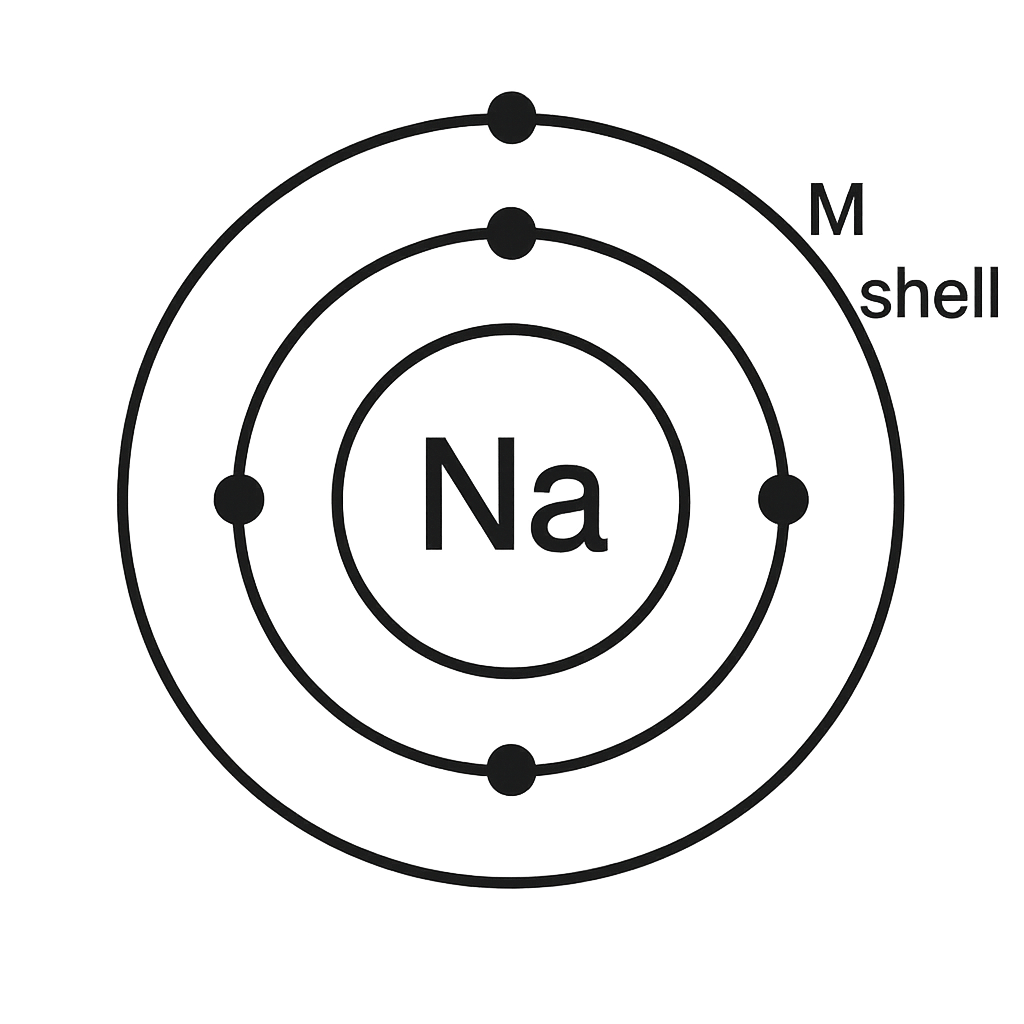
The diagram shows a Bohr model of a sodium atom. How many electrons are present in its outermost (third) shell?
A. 3
B. 0
Correct C. 1
D. 2

Correct Answer: C

Want to see the full step-by-step solution? Unlock AI Explanation & Analytics
Question 14 View Details
In acidic solution the following half‑reactions have standard potentials:\n\nMnO₄⁻ + 8 H⁺ + 5 e⁻ → Mn²⁺ + 4 H₂O  E° = +1.51 V\nFe³⁺ + e⁻ → Fe²⁺  E° = +0.77 V\n\n(a) Write the balanced overall redox equation for the reaction between MnO₄⁻ and Fe²⁺.\n(b) Calculate the standard cell potential (E°cell).\n(c) Identify the oxidising agent and the reducing agent.
A. MnO4- + 8H+ + 5Fe2+ -> Mn2+ + 4H2O + 5Fe3+; E°cell = -0.74 V; oxidising agent = MnO4-; reducing agent = Fe2+
Correct B. MnO4- + 8H+ + 5Fe2+ -> Mn2+ + 4H2O + 5Fe3+; E°cell = +0.74 V; oxidising agent = MnO4-; reducing agent = Fe2+
C. MnO4- + 8H+ + 5Fe2+ -> Mn2+ + 4H2O + 5Fe3+; E°cell = +0.68 V; oxidising agent = MnO4-; reducing agent = Fe2+
D. MnO4- + 8H+ + 5Fe2+ -> Mn2+ + 4H2O + 5Fe3+; E°cell = +0.74 V; oxidising agent = Fe2+; reducing agent = MnO4-

Correct Answer: B

Want to see the full step-by-step solution? Unlock AI Explanation & Analytics
Question 15 View Details
The solubility product of AgCl at 25 °C is Ksp = 1.8 × 10⁻¹⁰. Calculate the mass of AgCl (in milligrams) that can dissolve in 250 mL of a 0.10 M NaCl solution at the same temperature.
A. 9.0e-5
B. 3.2e-5
Correct C. 6.5e-5
D. 1.8e-4

Correct Answer: C

Want to see the full step-by-step solution? Unlock AI Explanation & Analytics
Question 16 View Details
A galvanic cell is constructed as follows: Zn(s) | Zn2+(0.010 M) || Cu2+(c M) | Cu(s) at 25 °C. The standard reduction potentials are E°(Cu2+/Cu) = +0.34 V and E°(Zn2+/Zn) = -0.76 V. The measured cell potential is 1.05 V. Calculate the concentration c of Cu2+ in the cell solution (in mol L⁻¹).
A. 0.73 M
B. 1.02 M
Correct C. 0.49 M
D. 0.24 M

Correct Answer: C

Want to see the full step-by-step solution? Unlock AI Explanation & Analytics
Question 17 View Details
A 0.500 g sample of an unknown monohydric alcohol (formula CₙH₂ₙ₊₂O) is completely combusted. The combustion produces 1.10 g of CO₂. Determine the molecular formula of the alcohol.
Correct A. C3H8O
B. C2H6O
C. C4H10O
D. C5H12O

Correct Answer: A

Want to see the full step-by-step solution? Unlock AI Explanation & Analytics
Question 18 View Details
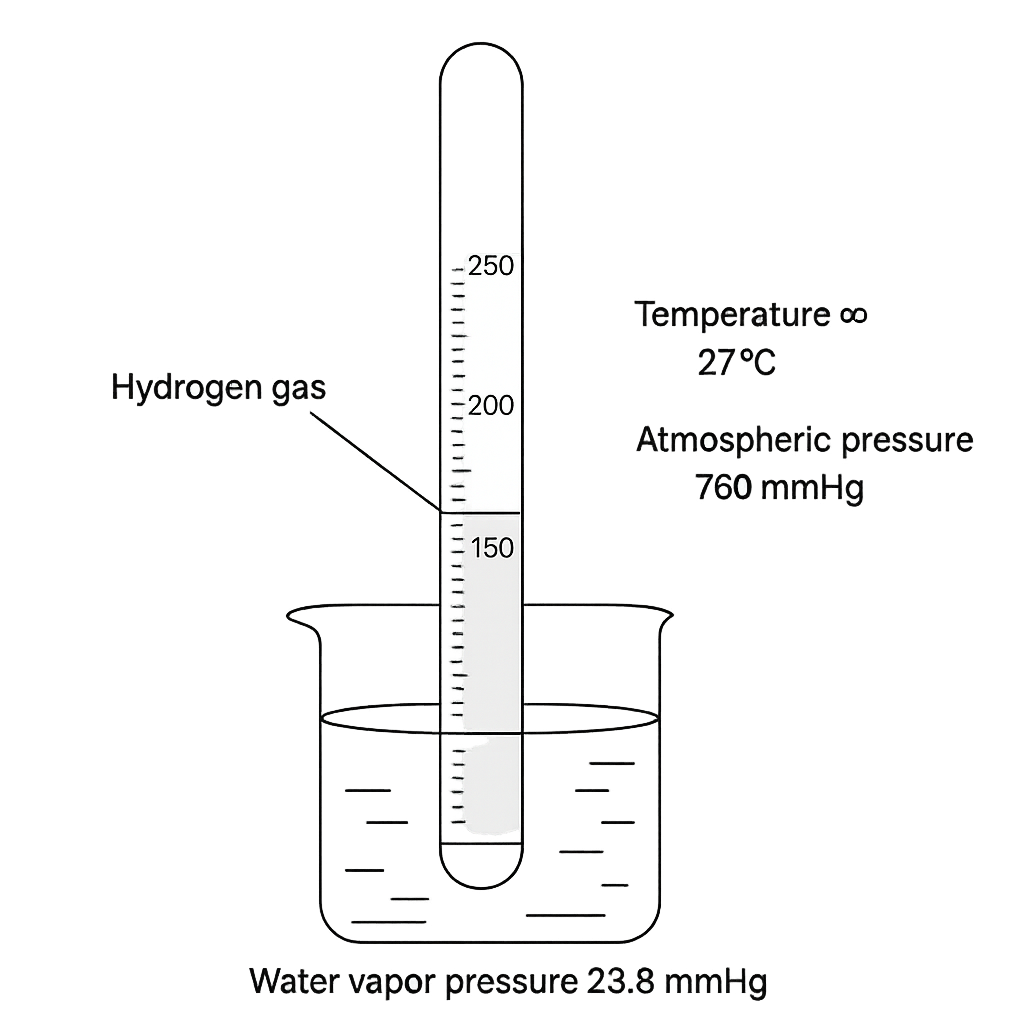
In the laboratory apparatus shown, hydrogen gas is collected over water. The gas syringe reads a volume of 250 mL at 27 °C. The atmospheric pressure is 760 mmHg and the water‑vapour pressure at 27 °C is 23.8 mmHg. Calculate the amount (in moles) of hydrogen gas collected.
A. 0.0120 mol
Correct B. 0.0098 mol
C. 0.0085 mol
D. 0.0102 mol

Correct Answer: B

Want to see the full step-by-step solution? Unlock AI Explanation & Analytics
Question 19 View Details
Compound A is 2‑methyl‑3‑pentanol. When heated with concentrated H₂SO₄, it undergoes dehydration to give two possible alkenes. Identify the major alkene product according to Zaitsev's rule.
A. 3-methyl-2-pentene
Correct B. 2-methyl-2-pentene
C. 2-methyl-3-pentene
D. 2-methyl-1-pentene

Correct Answer: B

Want to see the full step-by-step solution? Unlock AI Explanation & Analytics
Question 20 View Details
In a batch polymerisation, 1500 g of ethylene glycol (M = 62 g mol⁻¹) reacts with 2000 g of terephthalic acid (M = 166 g mol⁻¹) to form poly(ethylene terephthalate) (PET). The repeat unit of PET has a molar mass of 192 g mol⁻¹ (loss of one water molecule per ester link).\n(a) Determine the degree of polymerisation (DP).\n(b) Calculate the number‑average molecular weight (Mₙ).\n(c) Using the Mark-Houwink equation η = K·Mₙ^{a} with K = 1.2×10⁻⁴ Pa·s·(g mol⁻¹)^{‑a} and a = 0.7, compute the viscosity η of the polymer melt.
A. 0.020 Pa·s
B. 0.054 Pa·s
Correct C. 0.027 Pa·s
D. 0.013 Pa·s

Correct Answer: C

Want to see the full step-by-step solution? Unlock AI Explanation & Analytics
Question 21 View Details
An ore contains 68% iron by mass. The ore is processed as follows: (i) magnetic separation removes 15% of the ore mass, and the removed portion contains 90% iron; (ii) the remaining ore is roasted, losing 5% of its mass (iron content remains unchanged); (iii) the roasted ore is reduced to obtain pure iron with a 98% recovery. What percentage of iron is obtained relative to the original ore mass?
A. 55.2
B. 48.6
Correct C. 53.4
D. 60.0

Correct Answer: C

Want to see the full step-by-step solution? Unlock AI Explanation & Analytics
Question 22 View Details
A 0.250 M solution of acetic acid (Ka = 1.8×10⁻⁵) is prepared in a 2.00 L flask. 0.100 mol of NaOH is added, and the solution is then diluted to a total volume of 2.00 L. Calculate the pH of the resulting buffer solution.
A. 4.00
B. 3.95
Correct C. 4.14
D. 4.30

Correct Answer: C

Want to see the full step-by-step solution? Unlock AI Explanation & Analytics
Question 23 View Details
A wastewater sample contains 120 mg/L phenol. It undergoes two consecutive treatments: (1) adsorption onto activated carbon removes 85% of phenol but adds 20 mg/L dissolved organic carbon (DOC); (2) a biological oxidation step lasting 30 min degrades phenol following first‑order kinetics with k = 0.15 min⁻¹ and consumes DOC at 0.4 mg DOC per mg phenol degraded. Assuming DOC is sufficiently available, what is the phenol concentration (mg/L) in the final effluent?
A. 0.30
Correct B. 0.20
C. 0.25
D. 0.15

Correct Answer: B

Want to see the full step-by-step solution? Unlock AI Explanation & Analytics
Question 24 View Details
In a galvanic cell the half‑reactions are:\nAnode (oxidation): Fe²⁺ → Fe³⁺ + e⁻ (E° = +0.77 V for Fe³⁺/Fe²⁺ reduction)\nCathode (reduction): MnO₄⁻ + 8 H⁺ + 5 e⁻ → Mn²⁺ + 4 H₂O (E° = +1.51 V)\nThe cell operates at 25 °C with [Fe²⁺]=0.010 M, [Fe³⁺]=0.10 M, [MnO₄⁻]=0.0010 M, [Mn²⁺]=0.10 M and [H⁺]=0.10 M. Calculate the cell potential E_cell under these conditions.
A. 0.62 V
Correct B. 0.56 V
C. 0.71 V
D. 0.48 V

Correct Answer: B

Want to see the full step-by-step solution? Unlock AI Explanation & Analytics
Question 25 View Details
Write the ground‑state electron configuration of the element with atomic number 31 using the noble‑gas core notation.
A. [Ar] 3d^10 4s^2 4p^2
B. [Ar] 3d^9 4s^2 4p^1
Correct C. [Ar] 3d^10 4s^2 4p^1
D. [Ar] 3d^10 4s^1 4p^1

Correct Answer: C

Want to see the full step-by-step solution? Unlock AI Explanation & Analytics

Master the Exam!

You've seen a preview, but there are thousands more questions plus AI tutor to break down complex solutions.

Unlock Full Access Available for Android & Windows
Help others prepare! Share this practice hub:
Chat with Support