WAEC 2023 Physics | Essay

Prepare for your exams with WAEC questions? Reviewing past/model questions is one of the most effective ways to guarantee a high score. This practice hub features authentic 2023 Physics (Essay) questions designed to simulate the real exam environment.

Practice these randomly selected questions to test your readiness.

Question 1 View Details
The force, \( F \), acting on the wings of an aircraft moving through air of velocity, \( v \), and density, \( p \), is given by the equation \( F=k \nu^{x} p^{y} A^{z} \), where \( k \) is a dimensionless constant and \( A \) is the surface area of the wings of the aircraft. Use dimensional analysis to determine the values of \( x, y \) and \( z \).
Detailed Essay Solution & Marking Scheme Available

Get the step-by-step mathematical proofs, key points required by examiners, and a comprehensive breakdown from our AI Tutor.
Question 2 View Details
Question Parts
(a)
Define strain energy.
(b)
Write an expression for the energy stored, \( E \), in a stretched wire of original length, \( l \), cross-sectional area, \( A \), extension, \( e \), and Young's modulus, \( Y \), of the material of the wire.
Detailed Essay Solution & Marking Scheme Available

Get the step-by-step mathematical proofs, key points required by examiners, and a comprehensive breakdown from our AI Tutor.
Question 3 View Details
Question Parts
(a)
A projectile is fired at an angle, \( \theta \), to the horizontal with velocity, \( u \). Show that at any time, \( t \), during the motion, the;
(b)
State the assumption on which projectile motion is based.
Detailed Essay Solution & Marking Scheme Available

Get the step-by-step mathematical proofs, key points required by examiners, and a comprehensive breakdown from our AI Tutor.
Question 4 View Details
State three differences between geostationary satellites and polar satellites.
Detailed Essay Solution & Marking Scheme Available

Get the step-by-step mathematical proofs, key points required by examiners, and a comprehensive breakdown from our AI Tutor.

Question 5 View Details
Question Parts
(a)
Using the kinetic theory, explain the term diffusion of fluid molecules.
(b)
Name one phenomenon that demonstrates that light behaves as a:
Detailed Essay Solution & Marking Scheme Available

Get the step-by-step mathematical proofs, key points required by examiners, and a comprehensive breakdown from our AI Tutor.

Question 6 View Details
Question Parts
(a)
State one difference between an intrinsic and an extrinsic semiconductor.
(b)
Draw a circuit diagram to illustrate full-wave smoothing rectification.
Detailed Essay Solution & Marking Scheme Available

Get the step-by-step mathematical proofs, key points required by examiners, and a comprehensive breakdown from our AI Tutor.

Question 7 View Details
Question Parts
(a)
What is fibre optics?
(b)
State two reasons why optical fibres are preferred to copper cables in the telecommunication industry.
Detailed Essay Solution & Marking Scheme Available

Get the step-by-step mathematical proofs, key points required by examiners, and a comprehensive breakdown from our AI Tutor.

Question 8 View Details
Question Parts
(a)
(i) State the reason why simple harmonic motion is periodic.
(a)
(ii) State two factors that affect the period of oscillation of a simple pendulum.
(a)
(iii) Sketch a graph of the total mechanical energy, \( \mathbf{E} \), against displacement, \( y \), for the motion of a simple pendulum from one extreme position to the other.
(b)
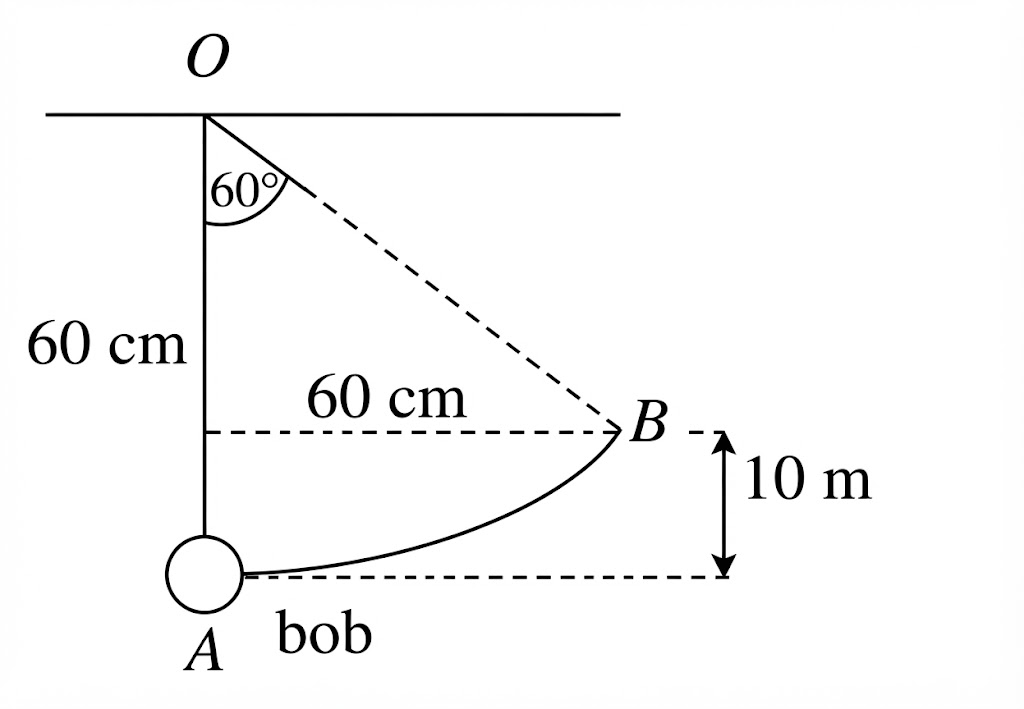
The diagram below illustrates an oscillatory pendulum. Calculate the work done in raising the pendulum to point B, if the mass of the bob is \( 50 \mathrm{~g} .\left[g=10 m s^{-2}\right] \).
(c)
A spiral spring of spring constant, \( k \), and natural length, \( l \), has a scale pan of mass \( 0.04 k g \) hanging on its lower end while the upper end is firmly fixed to a support. When an object of mass 0.20 kg is placed on the scale pan, the length of the spring becomes \( 0.055 m \) and when the object is replaced with another object of mass 0.28 kg, the length of the spring becomes 0.6 m. Calculate the values of \( k \) and \( l \). \( [g=10 \left.m s^{-2}\right] \).
Detailed Essay Solution & Marking Scheme Available

Get the step-by-step mathematical proofs, key points required by examiners, and a comprehensive breakdown from our AI Tutor.

Question 9 View Details
Question Parts
(a)
Define each of the following terms used with simple machines; pivot; load; efficiency.
(b)
A truck of mass \( 1.2 \times 10^{3} \mathrm{~kg} \) is pulled from rest by a constant horizontal force of \( 25.2 N \) on a levelled road. If the maximum speed attainable in the process is \( 60 \mathrm{~km} \mathrm{~h}^{-1} \). Calculate the; (i) work done by the force; (ii) distance travelled by the truck in reaching the maximum speed.
(c)
State two differences between absolute zero temperature and ice point.
(d)
An uncalibrated liquid-in-gas thermometer was used in determining a Celsius temperature. The readings are tabulated below. \( \begin{array}{|l|c|c|c|} \hline \text{Temperature }^\circ\text{C} & -6 & 0 & 100 \\ \hline \text{Length of column/cm} & L & 2.0 & 15.0 \\ \hline \end{array} \) Determine the value of \( L \).
Detailed Essay Solution & Marking Scheme Available

Get the step-by-step mathematical proofs, key points required by examiners, and a comprehensive breakdown from our AI Tutor.

Question 10 View Details
Question Parts
(a)
(i) Why are parabolic mirrors suitable for use in headlamps of vehicles?
(a)
(ii) Draw a ray diagram to illustrate the answer in 10a(i).
(b)
(i) State two applications of echoes.
(b)
(ii) An observer standing at a point, P, on the same horizontal ground as the foot, H, of a tower shouts and \( 1.20 s \) later, he hears the echo. He then moved to another point, \( \mathbf{Q}, 40 m \) from \( \mathbf{P} \), and shouts again but the echo was heard after \( 1.45 s \). Calculate the: I. distance between P and H; II. speed of sound in air.
Detailed Essay Solution & Marking Scheme Available

Get the step-by-step mathematical proofs, key points required by examiners, and a comprehensive breakdown from our AI Tutor.

Question 11 View Details
Question Parts
(a(i))
Define the electric potential at a point in an electric field.
(a(ii))
An uncharged body, A, was charged electrostatically by a test charge, B, using the method of induction and the method of contact. State two differences between the two methods.
(b)
An important precaution during an electricity experiment is to open the circuit when no leadings are being taken. Give two reasons for the stated precaution.
(c)
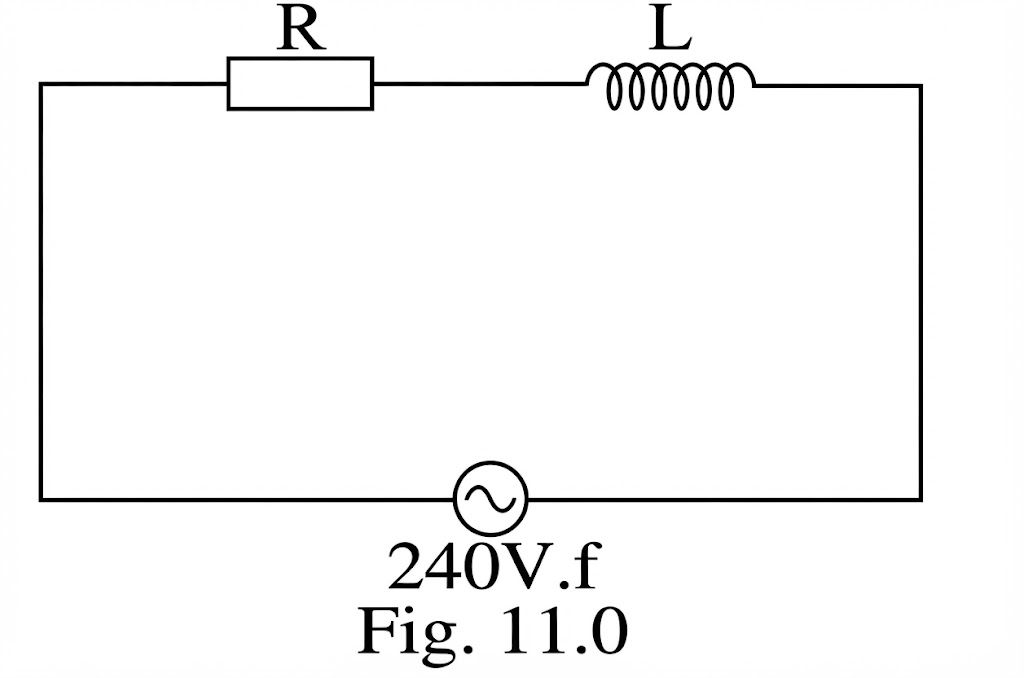
Fig. 11.0 is a circuit diagram in which a coil of inductance, \( L \), and a resistor of resistance, \( R \), are connected to a variable alternating source of frequency, \( f \). The table shows the square of the impedance, \( Z^2 \), corresponding to each value of \( f^2 \). \( \begin{array}{|l|c|c|c|c|c|} \hline f^2/\text{Hz}^2 & 198.8 & 400.0 & 600.3 & 800.9 & 900.0 \\ \hline Z^2/\Omega^2 & 249.6 & 400.0 & 552.3 & 702.3 & 800.0 \\ \hline \end{array} \)
(ii)
Write down the equation for Z in terms of f², R² and L². Plot a graph of Z² against f² and use it to deduce (I) L (II) R.
Detailed Essay Solution & Marking Scheme Available

Get the step-by-step mathematical proofs, key points required by examiners, and a comprehensive breakdown from our AI Tutor.

Question 12 View Details
State the function of each of the following parts of a modern X-ray tube:
Question Parts
(a)
(i) heater; (ii) high tension source; (iii) cooling fins.
(b)
State one for each of the following design features of a modern X-ray tube: (i) the glass envelope is highly evacuated; (ii) the target is a metal of very high melting point; (iii) the cooling fins are located outside the glass envelope.
(c)
In a nuclear fission reaction, a nuclide \( { }_{92}^{215} U \) is bombarded with a neutron to \( { }_{36}^{93} \mathrm{Kr} \) and \( { }_{56}^{141} \mathrm{Ba} \) with additional neutrons, the energy involved in the process is Q. [mass of \( { }_{92}^{235} U=235.044 u \), mass of \( { }_{36}^{93} \mathrm{Kr}=91.898 u \), mass of \( { }_{56}^{141} \mathrm{Ba}= 140.914 u \), mass of neutron \( =1.009 u \), \( \left.1 u=1.66 \times 10^{-27} \mathrm{~kg}, c=3.0 \times 10^{8} \mathrm{~ms}^{-1}\right] \). (i) write down the balanced nuclear reaction equation for the process. (ii) State with reason whether \( \mathbf{Q} \) is absorbed or released in the process. (iii) Calculate the value of \( \mathbf{Q} \) in joules.
(d)
State three differences between nuclear fusion and nuclear fission.
Detailed Essay Solution & Marking Scheme Available

Get the step-by-step mathematical proofs, key points required by examiners, and a comprehensive breakdown from our AI Tutor.

Master the Exam!

You've seen a preview, but there are thousands more questions plus AI tutor to break down complex solutions.

Unlock Full Access Available for Android & Windows
Help others prepare! Share this practice hub:
Chat with Support