neco model questions vol1 2024 geography | Objective

Prepare for your exams with neco model questions vol1 questions? Reviewing past/model questions is one of the most effective ways to guarantee a high score. This practice hub features authentic 2024 geography (Objective) questions designed to simulate the real exam environment.

Practice these randomly selected questions to test your readiness.

Question 1 View Details
In 2020 the urban population of Country X was 12 million and the rural population was 28 million. The urban natural increase rate is 2.5% per year and the rural natural increase rate is 1.8% per year. Additionally, each year 3% of the rural population migrates to urban areas (taken from the rural population at the start of the year). Assuming these rates remain constant, what is the urban population after 5 years? Give your answer to one decimal place (million).
A. 19.2 million
Correct B. 17.9 million
C. 18.5 million
D. 16.8 million

Correct Answer: B

Want to see the full step-by-step solution? Unlock AI Explanation & Analytics
Question 2 View Details
A farmer has 10 hectares of land to allocate between maize and soybeans. Maize yields 4 tonnes per hectare and sells for \(\text{₦}150\) per kg; its other variable cost is \(\text{₦}30\) per kg. Soybeans yield 2.5 tonnes per hectare, sell for \(\text{₦}200\) per kg and have other variable costs of \(\text{₦}80\) per kg. Fixed overheads are \(\text{₦}500,000\) per year.\n\nFertiliser requirements are 150 kg/ha for maize and 100 kg/ha for soybeans. The first 800 kg of fertiliser cost \(\text{₦}200\) per kg; any amount above 800 kg costs \(\text{₦}150\) per kg.\n\nMarket constraints: at most 30 tonnes of maize can be sold each year and soybeans cannot exceed 6 hectares. At least 3 hectares must be planted to maize for food‑security reasons. Determine the optimal hectares for maize and soybeans that maximise annual profit and state the maximum profit (in naira).
A. Maize: 7.5 ha, Soybeans: 2.5 ha; Maximum profit: ₦3,500,000
B. Maize: 6.0 ha, Soybeans: 4.0 ha; Maximum profit: ₦3,250,000
C. Maize: 8.0 ha, Soybeans: 2.0 ha; Maximum profit: ₦3,800,000
Correct D. Maize: 7.5 ha, Soybeans: 2.5 ha; Maximum profit: ₦3,603,750

Correct Answer: D

Want to see the full step-by-step solution? Unlock AI Explanation & Analytics
Question 3 View Details
A factory produces widgets. Its total‑cost function (in thousand naira) is \(C(q)=0.02q^{3}-0.3q^{2}+150q+500\), where \(q\) is output in thousands of units. The demand price per thousand units is \(P(q)=200-0.05q\). Determine the output level (in thousands of units) that maximises profit, compute the maximum profit (in thousand naira), and state whether marginal cost is increasing at that output.
A. Output: 30.00 thousand units; Maximum profit: ₦650,000; MC increasing: Yes
B. Output: 35.00 thousand units; Maximum profit: ₦703,704; MC increasing: Yes
Correct C. Output: 33.33 thousand units; Maximum profit: ₦703,704; MC increasing: Yes
D. Output: 33.33 thousand units; Maximum profit: ₦800,000; MC increasing: No

Correct Answer: C

Want to see the full step-by-step solution? Unlock AI Explanation & Analytics
Question 4 View Details
In a certain region the probability of a flood in any given year is 0.12. The probability of a landslide depends on whether a flood occurs: if a flood occurs, the probability of a landslide that year is 0.25; if no flood occurs, the probability of a landslide is 0.05. Compute (a) the probability that in a randomly selected year the region experiences at least one of the two hazards, and (b) the expected number of years in a 20‑year period in which both hazards occur in the same year.
Correct A. a) 0.164 (16.4%); b) 0.6 years
B. a) 0.180 (18.0%); b) 0.8 years
C. a) 0.164 (16.4%); b) 1.0 years
D. a) 0.150 (15.0%); b) 0.5 years

Correct Answer: A

Want to see the full step-by-step solution? Unlock AI Explanation & Analytics
Question 5 View Details
A country has three major regions with the following characteristics:\n\n- Coastal: elevation 0-200 m, mean annual rainfall 2,200 mm, mean temperature 27 °C.\n- Highland: elevation 1,200-2,500 m, rainfall 1,200 mm, temperature 18 °C.\n- Savannah: elevation 300-800 m, rainfall 900 mm, temperature 24 °C.\n\nA particular crop requires at least 1,500 mm of rainfall, a temperature between 20 °C and 30 °C, and cannot be grown above 1,000 m elevation. Which region(s) are suitable for this crop? If the total arable land in the country is 1.2 million hectares, distributed proportionally to the area of each region (Coastal 30 %, Highland 25 %, Savannah 45 %), and the government wants 40 % of the total arable land to be devoted to the crop, calculate how many hectares in each suitable region should be allocated to meet the target, assuming the crop can only be grown in suitable regions.
A. Only the Savannah region is suitable; required area = 480,000 ha but only 540,000 ha are available, so the 40% target can be met.
B. Coastal and Savannah regions are suitable; required area = 480,000 ha and 216,000 ha respectively, total available = 576,000 ha, meeting the 40% target.
Correct C. Only the Coastal region is suitable; required area = 480,000 ha but only 360,000 ha are available, so the 40% target cannot be met.
D. Only the Coastal region is suitable; required area = 480,000 ha and the region has 480,000 ha available, so the 40% target is exactly met.

Correct Answer: C

Want to see the full step-by-step solution? Unlock AI Explanation & Analytics
Question 6 View Details
A region has \(500\) workers available for employment. Three possible industries could be established, each with the following data per unit of product: - Industry A: selling price ₦\(1500\), raw material cost ₦\(600\), transport cost ₦\(100\), labour requirement \(2\) workers per unit. - Industry B: selling price ₦\(1800\), raw material cost ₦\(800\), transport cost ₦\(150\), labour requirement \(1.5\) workers per unit. - Industry C: selling price ₦\(2100\), raw material cost ₦\(1200\), transport cost ₦\(80\), labour requirement \(2.5\) workers per unit. Assuming the region can allocate all its workers to only one industry, which industry will generate the greatest total monthly profit? Show your calculations.
Correct A. Industry B
B. Industry D
C. Industry A
D. Industry C

Correct Answer: A

Want to see the full step-by-step solution? Unlock AI Explanation & Analytics
Question 7 View Details
The following maximum and minimum temperatures (in \(^{\circ}\)C) were recorded for a city over seven consecutive days: Day 1: max \(34\), min \(24\); Day 2: max \(36\), min \(26\); Day 3: max \(33\), min \(23\); Day 4: max \(31\), min \(22\); Day 5: max \(35\), min \(25\); Day 6: max \(32\), min \(21\); Day 7: max \(30\), min \(20\). A heat wave is defined as a period of at least five days in which the daily mean temperature exceeds \(30^{\circ}\)C. Does this week qualify as a heat wave? Explain.
A. Yes, the week qualifies as a heat wave.
Correct B. No, the week does not qualify as a heat wave.
C. Yes, the week does not qualify as a heat wave.
D. No, the week qualifies as a heat wave.

Correct Answer: B

Want to see the full step-by-step solution? Unlock AI Explanation & Analytics
Question 8 View Details
A topographic map uses a scale of \(1\text{ cm} : 250\text{ km}\). The distance between Town A and Town B on the map measures \(3.6\) cm. What is the actual distance between the towns in kilometres?
Correct A. 900 km
B. 720 km
C. 1080 km
D. 850 km

Correct Answer: A

Want to see the full step-by-step solution? Unlock AI Explanation & Analytics
Question 9 View Details
A soil profile has sand \(40\%\), silt \(35\%\) and clay \(25\%\) by weight, with a bulk density of \(1.4\) g cm\(^{-3}\). Its field capacity is \(0.30\) cm\(^3\) cm\(^{-3}\) and wilting point is \(0.15\) cm\(^3\) cm\(^{-3}\). Assuming a root‑zone depth of \(30\) cm, calculate the soil's available water holding capacity (AWC) in millimetres. A crop requires \(5\) mm of water per day for \(10\) days. Is the soil's AWC sufficient to meet the crop's water demand without irrigation? Show your work.
Correct A. No, the soil's AWC is insufficient (deficit of 5 mm).
B. Yes, the soil's AWC is sufficient (exactly meets demand).
C. No, the soil's AWC is insufficient (deficit of 10 mm).
D. Yes, the soil's AWC is sufficient (surplus of 5 mm).

Correct Answer: A

Want to see the full step-by-step solution? Unlock AI Explanation & Analytics
Question 10 View Details
A region receives an annual rainfall of \(800\) mm and has \(120\) kg ha\(^{-1}\) of nitrogen fertilizer available. Three crops are considered: - Crop X: potential yield \(4\) t ha\(^{-1}\), nitrogen requirement \(100\) kg ha\(^{-1}\), optimum rainfall \(600\)-\(900\) mm, pest loss \(10\%\) of yield. - Crop Y: potential yield \(5\) t ha\(^{-1}\), nitrogen requirement \(150\) kg ha\(^{-1}\), optimum rainfall \(700\)-\(1000\) mm, pest loss \(15\%\). - Crop Z: potential yield \(3.5\) t ha\(^{-1}\), nitrogen requirement \(80\) kg ha\(^{-1}\), optimum rainfall \(500\)-\(800\) mm, pest loss \(5\%\). Assuming rainfall is adequate for all crops, determine which crop will give the highest net yield after accounting for the fertilizer limitation and pest losses. Show all calculations.
A. Crop X (ignoring pest loss)
B. Crop Z
C. Crop Y
Correct D. Crop X

Correct Answer: D

Want to see the full step-by-step solution? Unlock AI Explanation & Analytics
Question 11 View Details
Region A receives an average annual rainfall of 1200 mm, has an average temperature of 28 °C, covers an area of 2500 km² and a population of 5 million. Region B receives 900 mm rainfall, an average temperature of 22 °C, covers an area of 1800 km² and a population of 3 million. The potential agricultural yield per unit area is assumed to be proportional to \( \text{rainfall}\times\left(1-\frac{\text{temperature}}{40}\right) \). Yield per capita is obtained by dividing this yield by the population density (people per km²). Which region has the higher potential agricultural yield per capita?
Correct A. Region B
B. Region A
C. Region C
D. Region D

Correct Answer: A

Want to see the full step-by-step solution? Unlock AI Explanation & Analytics
Question 12 View Details
City X is located at latitude \(5^{\circ}\text{N}\) and City Y at latitude \(12^{\circ}\text{S}\). Which city is nearer to the equator?
A. City W
Correct B. City X
C. City Z
D. City Y

Correct Answer: B

Want to see the full step-by-step solution? Unlock AI Explanation & Analytics
Question 13 View Details
Stream A has a gradient of 0.0015 and a length of 80 km. Stream B has a gradient of 0.001 and a length of 120 km. Both streams have the same cross‑sectional area and Manning's roughness coefficient \(n = 0.035\). Using Manning's equation \( V = \frac{1}{n} R^{2/3} S^{1/2} \) (where \(R\) is the hydraulic radius, the same for both streams), which stream is expected to have the higher average flow velocity?
Correct A. Stream A
B. Stream B
C. Neither stream; velocities are identical due to the same hydraulic radius
D. Both streams have equal average flow velocity

Correct Answer: A

Want to see the full step-by-step solution? Unlock AI Explanation & Analytics
Question 14 View Details
Soil X contains 30 % sand, 40 % silt and 30 % clay. Soil Y contains 45 % sand, 35 % silt and 20 % clay. The field capacity (percentage water content) can be estimated by \( \text{FC}=0.2(\%\text{clay})+0.1(\%\text{silt}) \). Which soil has the higher field capacity?
A. Soil Y
Correct B. Soil X
C. Both soils have equal field capacity
D. Neither; field capacity cannot be determined from the given percentages

Correct Answer: B

Want to see the full step-by-step solution? Unlock AI Explanation & Analytics
Question 15 View Details
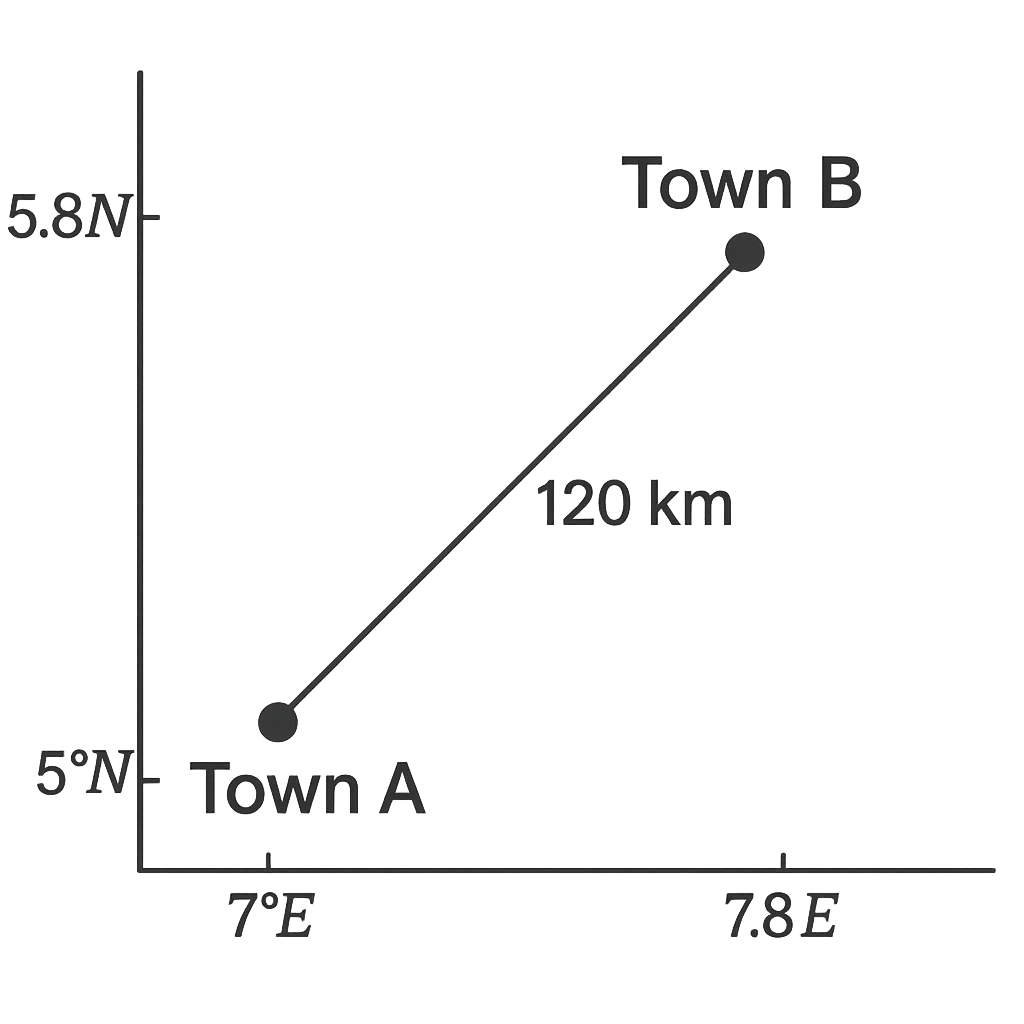
The map shows Town A at latitude \(5^{\circ}\text{N}\), longitude \(7^{\circ}\text{E}\) and Town B at latitude \(5.5^{\circ}\text{N}\), longitude \(7.8^{\circ}\text{E}\). Using the approximations \(1^{\circ}\) latitude ≈ 111 km and \(1^{\circ}\) longitude ≈ 111 km × cos average latitude, calculate the straight‑line distance between the two towns (to the nearest kilometre).
A. 98 km
B. 121 km
C. 112 km
Correct D. 104 km

Correct Answer: D

Want to see the full step-by-step solution? Unlock AI Explanation & Analytics
Question 16 View Details
A bus company operates a (120\) km route. Fuel consumption is (30\) L per 100 km when the bus is empty and increases by (0.2\) L per 100 km for each passenger above 20 (up to a capacity of 50). The ticket price per passenger is \(\text{₦}500\). Fuel costs \(\text{₦}180\) per litre. The driver's salary per trip is \(\text{₦}8{,}000\) and other fixed costs are \(\text{₦}4{,}000\). What is the minimum number of passengers required for the trip to be profitable (revenue greater than total cost)?
Correct A. 39
B. 42
C. 38
D. 40

Correct Answer: A

Want to see the full step-by-step solution? Unlock AI Explanation & Analytics
Question 17 View Details
In 2020 a town had a total population of \(120{,}000\). Forty percent of the population were in Group A, which grows at \(2.5\%\) per year. The remaining sixty percent were in Group B, which grows at \(1.2\%\) per year. In addition, the town receives a net migration of \(1{,}200\) people each year, uniformly added to the whole population. What is the projected total population at the end of 2025 (after five years)?
A. 135000
Correct B. 136736
C. 137500
D. 138000

Correct Answer: B

Want to see the full step-by-step solution? Unlock AI Explanation & Analytics
Question 18 View Details
In a tropical region the temperature at sea level is \(30^{\circ}\text{C}\) and decreases by \(0.6^{\circ}\text{C}\) for every 100 m of altitude. Rainfall decreases linearly from 2000 mm at sea level to 1400 mm at 1500 m. A particular forest type requires a temperature between \(22^{\circ}\text{C}\) and \(24^{\circ}\text{C}\) and an annual rainfall of at least 1500 mm. Determine the altitude range (in metres) where this forest can occur.
Correct A. 1000 m to 1250 m
B. 950 m to 1200 m
C. 1050 m to 1300 m
D. 900 m to 1150 m

Correct Answer: A

Want to see the full step-by-step solution? Unlock AI Explanation & Analytics
Question 19 View Details
A national park covers \(800\) km\(^2\) and is divided into three vegetation zones: savanna, woodland and forest. Savanna occupies 35 % of the park. The woodland area is twice the forest area. What is the area (in km\(^2\)) of each zone?
A. Savanna: 280 km²; Woodland: 350 km²; Forest: 170 km²
B. Savanna: 280 km²; Woodland: 360 km²; Forest: 160 km²
C. Savanna: 280 km²; Woodland: 333.33 km²; Forest: 186.67 km²
Correct D. Savanna: 280 km²; Woodland: 346.67 km²; Forest: 173.33 km²

Correct Answer: D

Want to see the full step-by-step solution? Unlock AI Explanation & Analytics
Question 20 View Details
A river segment is \(45\) km long and has a gradient of \(0.0015\) (i.e., a drop of 1.5 m per kilometre). The average flow velocity (in m s\(^{-1}\)) can be approximated by \(V = 5\sqrt{\text{gradient}}\). Determine the average travel time of a water particle from the upstream to the downstream end of the segment, expressed in hours (rounded to two decimal places).
A. 68.00
B. 62.50
Correct C. 64.55
D. 66.43

Correct Answer: C

Want to see the full step-by-step solution? Unlock AI Explanation & Analytics
Question 21 View Details
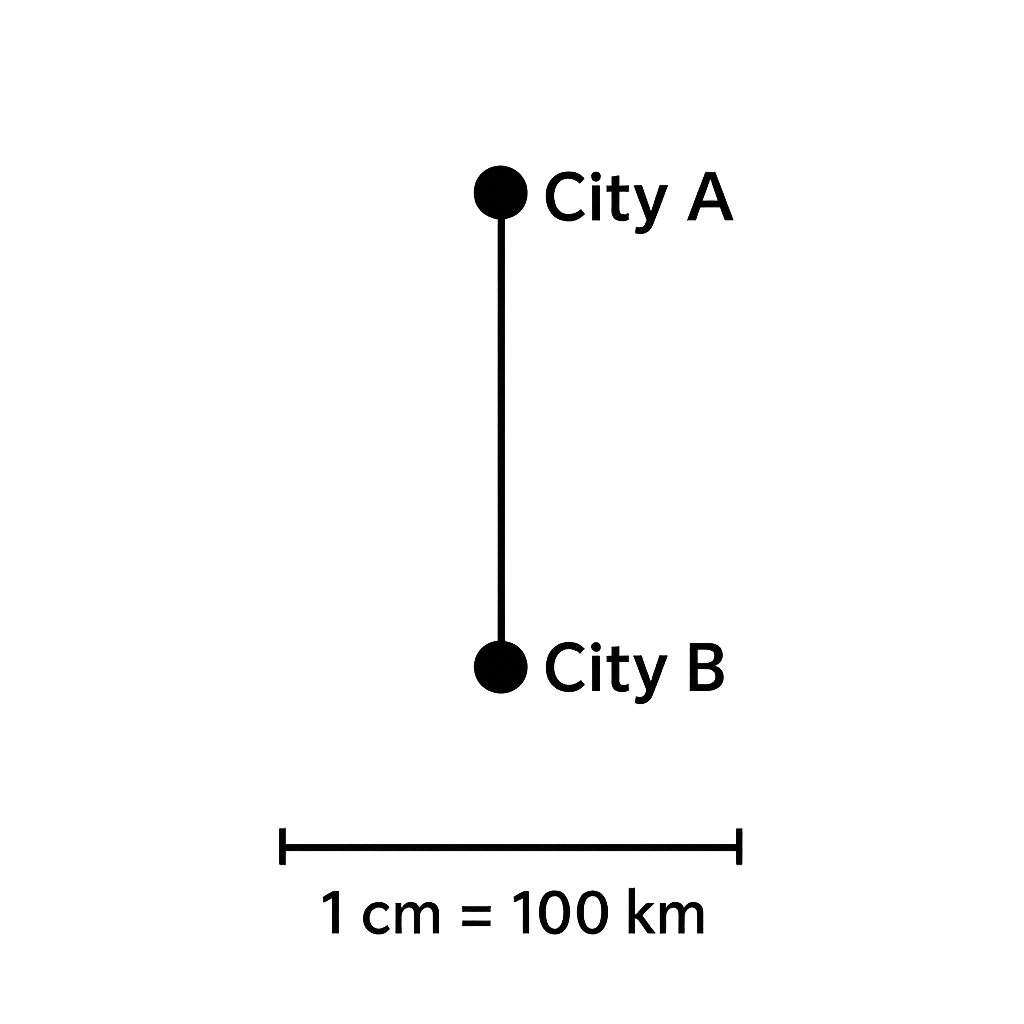
A schematic map shows City A at the top and City B directly south of it. The distance between the two cities on the map measures \(3\) cm. The map scale is \(1\text{ cm}=100\text{ km}\) (north‑south). Assuming \(1^{\circ}\) of latitude corresponds to \(111\text{ km}\), calculate the difference in latitude between City A and City B in degrees, rounded to one decimal place.
A. 2.8
B. 2.5
Correct C. 2.7
D. 3.0

Correct Answer: C

Want to see the full step-by-step solution? Unlock AI Explanation & Analytics
Question 22 View Details
A plateau has an average elevation of 1200 m above sea level and receives an average annual rainfall of 1500 mm. For every 100 mm of rainfall, the plateau erodes vertically by 0.01 mm. How many years will it take for the plateau's elevation to decrease by 10 % of its present height? Give your answer in whole years.
A. 200000
Correct B. 800000
C. 400000
D. 1600000

Correct Answer: B

Want to see the full step-by-step solution? Unlock AI Explanation & Analytics
Question 23 View Details
City X is located at latitude \(5^{\circ}\text{N}\) and longitude \(10^{\circ}\text{E}\). City Y lies due east of City X on the same latitude, and the distance along the parallel between them is \(560\) km. Determine the difference in longitude between the two cities, expressed in degrees to one decimal place. (Use \(111.32\) km as the length of one degree of latitude and assume the length of a degree of longitude equals \(111.32\cos\phi\) km, where \(\phi\) is the latitude.)
A. 6.0
Correct B. 5.1
C. 4.8
D. 5.6

Correct Answer: B

Want to see the full step-by-step solution? Unlock AI Explanation & Analytics
Question 24 View Details
In 2010 the population of a town was 45 000. The annual birth rate was 28 per 1 000, the death rate 12 per 1 000, and net migration was -3 per 1 000. Assuming these rates remain constant, calculate the projected population in 2020. Round your answer to the nearest whole number.
Correct A. 51204
B. 52015
C. 50800
D. 49530

Correct Answer: A

Want to see the full step-by-step solution? Unlock AI Explanation & Analytics
Question 25 View Details
On a map the scale is \(1\text{ cm}=5\text{ km}\). The straight‑line distance between Town C and Town D measures \(7.2\) cm on the map. The actual road connecting the towns is 15 % longer than the straight‑line distance. What is the length of the road in kilometres? Give your answer to one decimal place.
A. 39.6
Correct B. 41.4
C. 36.0
D. 43.2

Correct Answer: B

Want to see the full step-by-step solution? Unlock AI Explanation & Analytics

Master the Exam!

You've seen a preview, but there are thousands more questions plus AI tutor to break down complex solutions.

Unlock Full Access Available for Android & Windows
Help others prepare! Share this practice hub:
Chat with Support