neco model questions vol1 2023 biology | Objective

Prepare for your exams with neco model questions vol1 questions? Reviewing past/model questions is one of the most effective ways to guarantee a high score. This practice hub features authentic 2023 biology (Objective) questions designed to simulate the real exam environment.

Practice these randomly selected questions to test your readiness.

Question 1 View Details
During an inulin clearance test, \(180\ \text{mL}\) of urine is collected over \(30\ \text{minutes}\). The urine inulin concentration is \(0.45\ \text{g/dL}\) and the plasma inulin concentration is \(0.015\ \text{g/dL}\). Calculate the glomerular filtration rate (GFR) in \(\text{mL/min}\) and indicate whether it is below, within, or above the normal adult range (\(90\text{-}120\ \text{mL/min}\)).
A. normal
B. within
C. below
Correct D. above

Correct Answer: D

Want to see the full step-by-step solution? Unlock AI Explanation & Analytics
Question 2 View Details
A human somatic cell contains \(46\) chromosomes. After it undergoes mitosis and cytokinesis, how many chromosomes are present in each daughter cell?
A. 48
Correct B. 46
C. 92
D. 23

Correct Answer: B

Want to see the full step-by-step solution? Unlock AI Explanation & Analytics
Question 3 View Details
Both parents are carriers (heterozygous) for an autosomal recessive disorder. What is the probability, expressed as a percentage to one decimal place, that at least one of their three children will be affected by the disorder?
Correct A. 57.8%
B. 43.8%
C. 25.0%
D. 75.0%

Correct Answer: A

Want to see the full step-by-step solution? Unlock AI Explanation & Analytics
Question 4 View Details
According to Fick's law, the rate of diffusion is proportional to the surface area \(A\) and inversely proportional to the thickness \(T\) of the membrane. In a certain lung disease the alveolar surface area decreases by 25 % while the membrane thickness doubles. By what percentage of the original rate does oxygen diffusion occur under these new conditions? Express your answer as a percentage to one decimal place.
Correct A. 37.5%
B. 50.0%
C. 25.0%
D. 75.0%

Correct Answer: A

Want to see the full step-by-step solution? Unlock AI Explanation & Analytics
Question 5 View Details
A patient's fasting plasma glucose (FPG) is \(7.2\ \text{mmol/L}\), the 2‑hour post‑prandial glucose is \(11.5\ \text{mmol/L}\), and the HbA1c level is \(7.8\%\). According to WHO diagnostic criteria, state the glycaemic status (Normal, Impaired Glucose Tolerance, or Diabetes). Then, using the formula Estimated Average Glucose (mg/dL) = \((28.7\times\text{HbA1c})-46.7\), calculate the estimated average glucose and indicate whether this value exceeds \(180\ \text{mg/dL}\). Provide your answer in the format: "Diagnosis; X mg/dL; Yes/No".
A. Impaired Glucose Tolerance; 177 mg/dL; No
Correct B. Diabetes; 177 mg/dL; No
C. Diabetes; 185 mg/dL; Yes
D. Diabetes; 177 mg/dL; Yes

Correct Answer: B

Want to see the full step-by-step solution? Unlock AI Explanation & Analytics
Question 6 View Details
In a lake ecosystem the gross primary productivity (GPP) is \(1500\ \text{g C m}^{-2}\text{yr}^{-1}\). Autotrophic respiration equals 20 % of GPP. Of the net primary production, 15 % is exported to an adjacent water body. The remaining net primary production is partly consumed by heterotrophic respiration, which accounts for 40 % of the production that stays in the lake. Calculate the net ecosystem productivity (NEP) remaining in the lake in \(\text{g C m}^{-2}\text{yr}^{-1}\).
A. 1020
B. 720
C. 585
Correct D. 612

Correct Answer: D

Want to see the full step-by-step solution? Unlock AI Explanation & Analytics
Question 7 View Details
Two genes, A and B, are linked on the same chromosome with a recombination frequency of 12 %. A plant heterozygous in coupling phase (genotype \(AB/ab\)) is crossed with a plant homozygous recessive (\(ab/ab\)). What proportion of the offspring will be recombinant (i.e., have genotype \(Ab\) or \(aB\))?
A. 0.06
B. 0.88
C. 0.24
Correct D. 0.12

Correct Answer: D

Want to see the full step-by-step solution? Unlock AI Explanation & Analytics
Question 8 View Details
In a subject the renal plasma flow (RPF) is \(600\ \text{mL min}^{-1}\) and the filtration fraction (FF) is 20 %. The urine flow rate is \(1.5\ \text{mL min}^{-1}\). If the plasma concentration of creatinine is \(0.10\ \text{mg dL}^{-1}\), calculate the concentration of creatinine in the urine (in mg dL\(^{-1}\)). Assume creatinine clearance equals the glomerular filtration rate (GFR).
A. 6
Correct B. 8
C. 12
D. 10

Correct Answer: B

Want to see the full step-by-step solution? Unlock AI Explanation & Analytics
Question 9 View Details
Which organelle is the primary site of ATP synthesis through oxidative phosphorylation in eukaryotic cells?
A. nucleus
B. chloroplast
C. ribosome
Correct D. mitochondrion

Correct Answer: D

Want to see the full step-by-step solution? Unlock AI Explanation & Analytics
Question 10 View Details
In a bacterial culture of \(10^{8}\) cells, 2 % initially carry a plasmid conferring antibiotic resistance. During each hour, conjugation causes 5 % of the non‑resistant cells to acquire the plasmid, and no loss of the plasmid occurs. Assuming the population size remains constant, what percentage of the total population will be resistant after 2 hours? Give your answer to one decimal place.
A. 10.5
B. 12.3
Correct C. 11.6
D. 9.8

Correct Answer: C

Want to see the full step-by-step solution? Unlock AI Explanation & Analytics
Question 11 View Details
A desert rodent has a cylindrical body of length \(12\ \text{cm}\) and radius \(2\ \text{cm}\). Its thin fur reduces heat loss by \(30\%\). A desert jackrabbit has a spherical body of radius \(8\ \text{cm}\) and its large ears increase heat loss by \(20\%\) per unit ear surface area. Both animals experience the same ambient temperature difference of \(15^{\circ}\text{C}\). The basic heat loss per unit surface area is \(k = 0.5\ \text{J s}^{-1}\text{cm}^{-2}\,^{\circ}\text{C}^{-1}\). Assuming heat loss is given by \(Q = k \times \text{SA} \times \Delta T\) and adjusting for the fur or ear effects, which animal loses more heat per second? Show all calculations.
A. Neither
B. Both
C. Rodent
Correct D. Jackrabbit

Correct Answer: D

Want to see the full step-by-step solution? Unlock AI Explanation & Analytics
Question 12 View Details
A fish species X lives in water where the dissolved oxygen concentration is \(6\ \text{mg L}^{-1}\). Its gill surface area is \(2.5\ \text{cm}^{2}\) and the diffusion distance across the gill epithelium is \(0.02\ \text{mm}\). Oxygen diffusion follows Fick's law \(J = D \times A \times (C_{\text{out}} - C_{\text{in}}) / d\), where the diffusion coefficient \(D = 2.0 \times 10^{-5}\ \text{cm}^{2}\text{s}^{-1}\). The fish maintains an internal oxygen concentration of \(2\ \text{mg L}^{-1}\). (a) Calculate the rate of oxygen uptake \(J\) in \(\text{mg s}^{-1}\). (b) If the fish's metabolic demand is \(0.15\ \text{mg s}^{-1}\), state whether the gill supply is sufficient.
A. (a) 0.10 mg s^{-1}; (b) sufficient
B. (a) 0.08 mg s^{-1}; (b) insufficient
Correct C. (a) 0.10 mg s^{-1}; (b) insufficient
D. (a) 0.12 mg s^{-1}; (b) sufficient

Correct Answer: C

Want to see the full step-by-step solution? Unlock AI Explanation & Analytics
Question 13 View Details
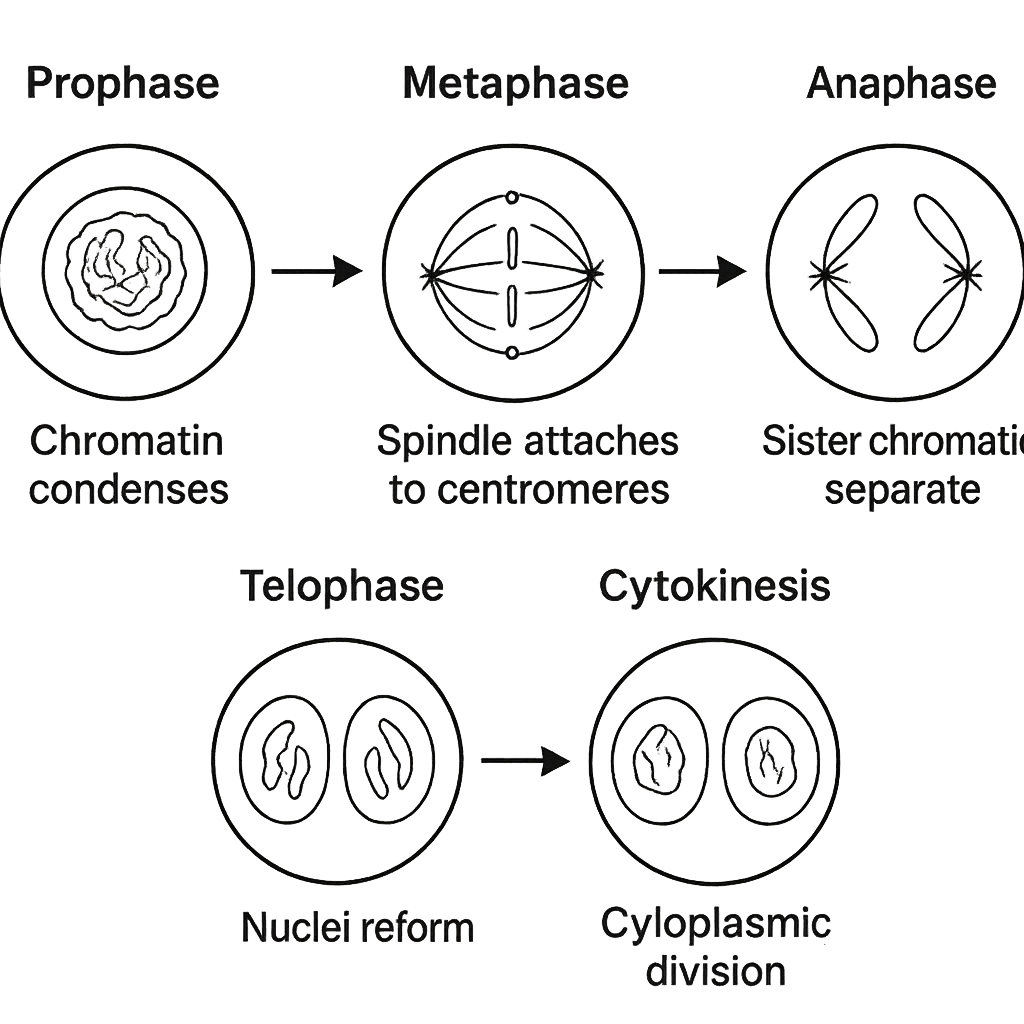
The diagram shows the stages of mitosis in a typical animal cell. (a) List the stages in their correct chronological order. (b) Identify the stage at which sister chromatids separate.
A. a) Interphase, Prophase, Metaphase, Anaphase, Telophase; b) Anaphase
B. a) Prophase, Metaphase, Anaphase, Cytokinesis, Telophase; b) Cytokinesis
C. a) Prophase, Metaphase, Telophase, Anaphase, Cytokinesis; b) Telophase
Correct D. a) Prophase, Metaphase, Anaphase, Telophase, Cytokinesis; b) Anaphase

Correct Answer: D

Want to see the full step-by-step solution? Unlock AI Explanation & Analytics
Question 14 View Details
An organelle is bounded by a double membrane, contains its own circular DNA, and is the site of oxidative phosphorylation. (a) Name this organelle. (b) Give one human disease that results from its dysfunction.
A. a) Chloroplast; b) Phenylketonuria
B. a) Endoplasmic reticulum; b) Huntington's disease
C. a) Nucleus; b) Cystic fibrosis
Correct D. a) Mitochondrion; b) Mitochondrial myopathy (e.g., Leigh disease)

Correct Answer: D

Want to see the full step-by-step solution? Unlock AI Explanation & Analytics
Question 15 View Details
A newly emerging viral disease has a basic reproduction number \(R_{0}=2.5\). A vaccine available for the disease has an efficacy of \(85\%\). (a) Calculate the herd‑immunity threshold \(H\) (the proportion of the population that must be immune to stop transmission). (b) Determine the minimum vaccination coverage \(V_{\text{min}}\) required to achieve herd immunity, taking vaccine efficacy into account. (c) If the current vaccination coverage in the community is \(70\%\), assess whether herd immunity has been attained.
A. (a) 0.60; (b) 0.706 (≈70.6%); (c) Attained - herd immunity achieved
B. (a) 0.55; (b) 0.706 (≈70.6%); (c) Not attained - herd immunity not achieved
Correct C. (a) 0.60; (b) 0.706 (≈70.6%); (c) Not attained - herd immunity not achieved
D. (a) 0.60; (b) 0.65 (≈65%); (c) Not attained - herd immunity not achieved

Correct Answer: C

Want to see the full step-by-step solution? Unlock AI Explanation & Analytics
Question 16 View Details
A diploid human somatic cell contains \(46\) chromosomes. After DNA replication in the S phase, each chromosome consists of two sister chromatids. How many chromatids are present in the cell?
A. 48
B. 46
C. 184
Correct D. 92

Correct Answer: D

Want to see the full step-by-step solution? Unlock AI Explanation & Analytics
Question 17 View Details
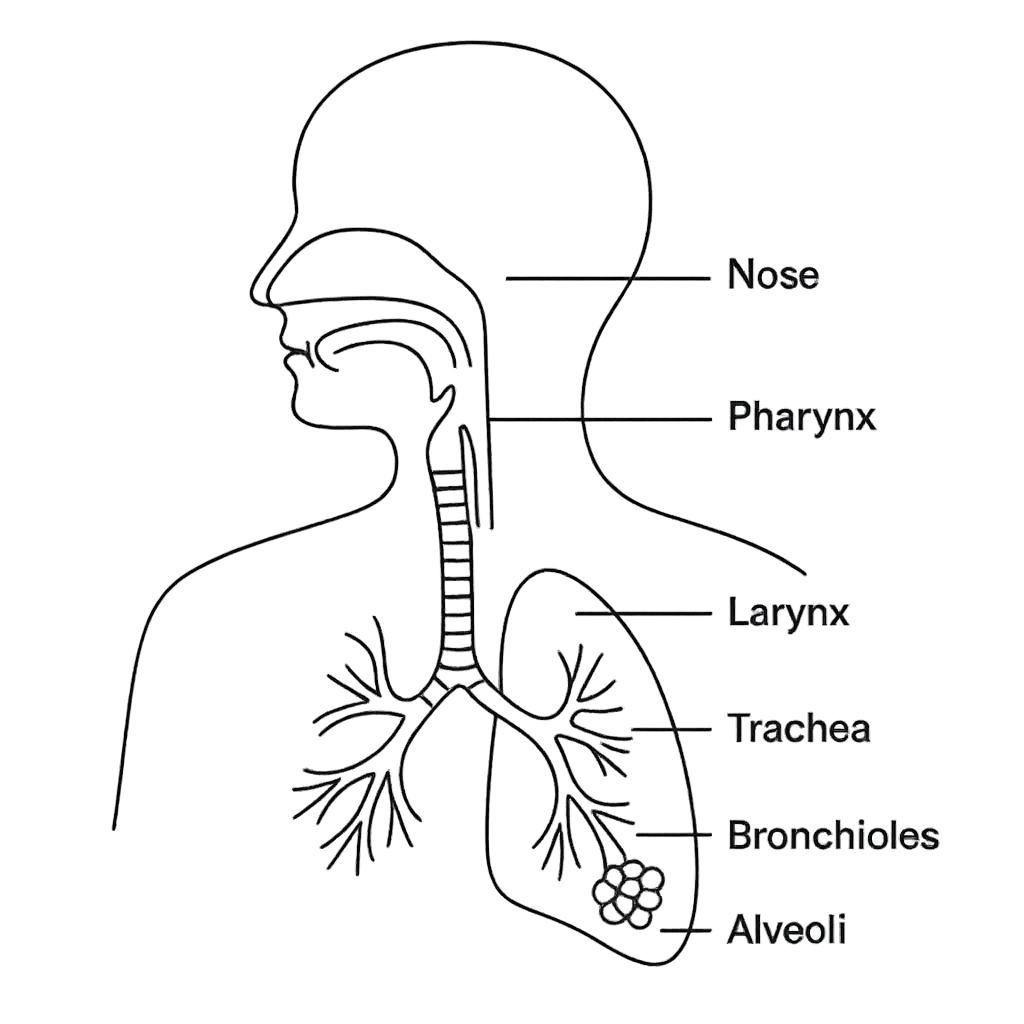
The diagram shows the major parts of the human respiratory system. Each alveolus is approximated as a sphere with a diameter of \(0.2\) mm. The lungs contain about \(3.0\times10^{8}\) alveoli. Estimate the total internal surface area of all alveoli in square metres. Use \(\pi \approx 3.14\).
A. 9.42 m^2
Correct B. 37.68 m^2
C. 36.00 m^2
D. 150.72 m^2

Correct Answer: B

Want to see the full step-by-step solution? Unlock AI Explanation & Analytics
Question 18 View Details
In a simple reflex arc, the sensory neuron carries the impulse from a skin receptor to the spinal cord over a distance of \(0.8\) m at a conduction speed of \(50\) m s\(^{-1}\). The motor neuron then carries the impulse from the spinal cord to the effector muscle over a distance of \(0.6\) m at \(60\) m s\(^{-1}\). Synaptic transmission adds a delay of \(0.5\) ms, and the muscle requires \(20\) ms to develop a visible contraction after the motor impulse arrives. Calculate the total reaction time from the initial stimulus to the onset of muscle contraction, in milliseconds.
A. 48 ms
B. 50 ms
C. 45 ms
Correct D. 46.5 ms

Correct Answer: D

Want to see the full step-by-step solution? Unlock AI Explanation & Analytics
Question 19 View Details
A diploid human germ cell undergoes meiosis. How many haploid gametes are produced at the end of meiosis II?
A. 3
Correct B. 4
C. 6
D. 2

Correct Answer: B

Want to see the full step-by-step solution? Unlock AI Explanation & Analytics
Question 20 View Details
A drug follows first‑order elimination with a half‑life of \(8\) h and a volume of distribution of \(40\) L. To achieve a target plasma concentration of \(15\) mg L\(^{-1}\), a loading dose is given, followed by equal maintenance doses every \(8\) h to maintain steady‑state. Calculate (a) the required loading dose in milligrams, and (b) the maintenance dose in milligrams (rounded to the nearest milligram). Use \(\ln 2 = 0.693\).
Correct A. Loading dose: 600 mg; Maintenance dose: 416 mg
B. Loading dose: 600 mg; Maintenance dose: 450 mg
C. Loading dose: 640 mg; Maintenance dose: 384 mg
D. Loading dose: 560 mg; Maintenance dose: 416 mg

Correct Answer: A

Want to see the full step-by-step solution? Unlock AI Explanation & Analytics
Question 21 View Details
A woman has a regular \(30\)-day menstrual cycle. She records a sustained rise in basal body temperature on the morning of day \(18\). Assuming the temperature rise occurs the morning after ovulation and that the luteinising hormone (LH) surge peaks exactly \(36\) hours before ovulation, on which day of the cycle did the LH surge peak?
A. day 12
B. day 14
Correct C. day 15
D. day 16

Correct Answer: C

Want to see the full step-by-step solution? Unlock AI Explanation & Analytics
Question 22 View Details
In a plant, two genes A/a (seed shape) and B/b (seed colour) are located on the same chromosome with a recombination frequency of \(10\)% . The heterozygous parent has the cis configuration AB/ab, while the other parent is homozygous recessive ab/ab. If \(200\) offspring are produced, how many are expected to display the recombinant phenotype aB (recessive shape, dominant colour)?
A. 5
Correct B. 10
C. 20
D. 15

Correct Answer: B

Want to see the full step-by-step solution? Unlock AI Explanation & Analytics
Question 23 View Details
In a reflex arc, the impulse travels through \(0.5\) m of myelinated nerve fibre that conducts at \(80\) m s\(^{-1}\) and then through \(0.2\) m of unmyelinated fibre that conducts at \(2\) m s\(^{-1}\). Calculate the total time taken for the impulse to travel the whole distance, and state which segment (myelinated or unmyelinated) contributes the greater proportion of the total time.
A. 0.106 s; myelinated segment
B. 0.112 s; myelinated segment
C. 0.102 s; unmyelinated segment
Correct D. 0.106 s; unmyelinated segment

Correct Answer: D

Want to see the full step-by-step solution? Unlock AI Explanation & Analytics
Question 24 View Details
A specific drug blocks the modification and packaging of proteins in the Golgi apparatus. After treatment, the cell continues to synthesise proteins, but none are secreted into the extracellular medium. Which organelle's normal function is being inhibited?
A. Endoplasmic reticulum
Correct B. Golgi apparatus
C. Mitochondrion
D. Lysosome

Correct Answer: B

Want to see the full step-by-step solution? Unlock AI Explanation & Analytics
Question 25 View Details
During intense exercise a muscle cell requires a total of \(1200\) µmol of ATP per minute. If \(60\)% of the ATP is supplied by anaerobic glycolysis and the remaining ATP is supplied by aerobic respiration, (i) how many µmol of ATP are produced per minute by oxidative phosphorylation, and (ii) assuming complete oxidation of one glucose molecule yields \(30\) ATP, what is the minimum number of glucose molecules that must be oxidised per minute to meet the aerobic ATP demand?
A. 600 µmol aerobic ATP; 20 µmol glucose
B. 480 µmol aerobic ATP; 15 µmol glucose
C. 720 µmol aerobic ATP; 24 µmol glucose
Correct D. 480 µmol aerobic ATP; 16 µmol glucose

Correct Answer: D

Want to see the full step-by-step solution? Unlock AI Explanation & Analytics

Master the Exam!

You've seen a preview, but there are thousands more questions plus AI tutor to break down complex solutions.

Unlock Full Access Available for Android & Windows
Help others prepare! Share this practice hub:
Chat with Support