neco model questions vol1 2023 agricultural_science | Essay

Prepare for your exams with neco model questions vol1 questions? Reviewing past/model questions is one of the most effective ways to guarantee a high score. This practice hub features authentic 2023 agricultural_science (Essay) questions designed to simulate the real exam environment.

Practice these randomly selected questions to test your readiness.

Question 1 View Details
A farmer intends to convert a portion of his farm to a mixed farming system to improve sustainability.
Question Parts
(a)
Explain two ecological advantages of mixed farming over monoculture.
(b)
The farmer plans to allocate 2 ha for a legume crop that fixes 50 kg N per ha per season and 3 ha for a cereal crop that requires 120 kg N per ha per season. Assuming no other nitrogen inputs, calculate the nitrogen deficit or surplus for the combined area.
(c)
Suggest one management practice to reduce the nitrogen deficit identified in part (b) and explain how it works.
Detailed Essay Solution & Marking Scheme Available

Get the step-by-step mathematical proofs, key points required by examiners, and a comprehensive breakdown from our AI Tutor.
Question 2 View Details
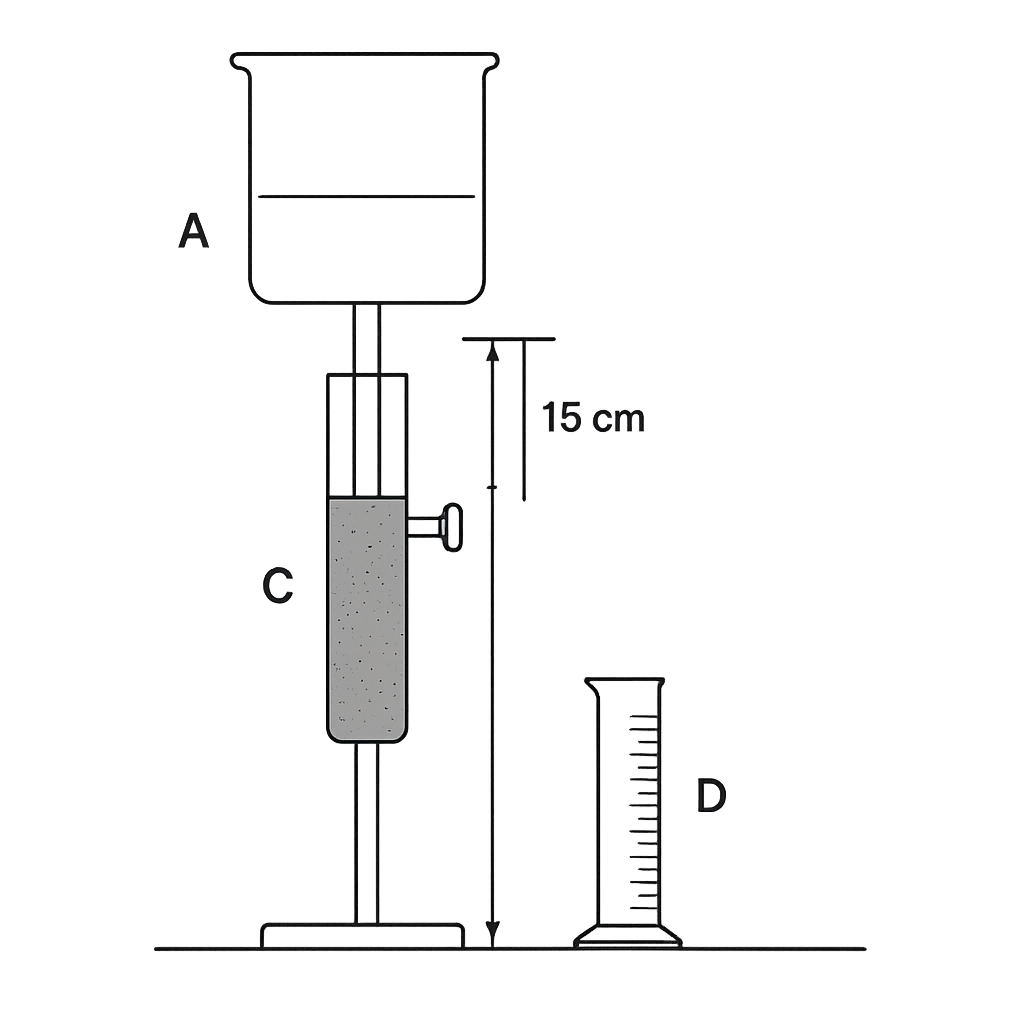
The diagram shows a laboratory setup used to determine the infiltration rate of a soil sample using a constant head permeameter.
Question Parts
(a)
Identify the purpose of each component labelled A, B, C and D in the setup.
(b)
If the water level in the reservoir (A) is maintained at a constant head of 15 cm above the soil surface, and the volume of water collected in the graduated cylinder (D) after 5 minutes is 120 mL, calculate the infiltration rate in cm³ min⁻¹ cm⁻², given that the soil column has a cross‑sectional area of 25 cm².
(c)
Based on the infiltration rate obtained, discuss whether the soil is likely to be sandy, loamy or clayey, citing typical infiltration rate ranges for each texture class.
Detailed Essay Solution & Marking Scheme Available

Get the step-by-step mathematical proofs, key points required by examiners, and a comprehensive breakdown from our AI Tutor.
Question 3 View Details
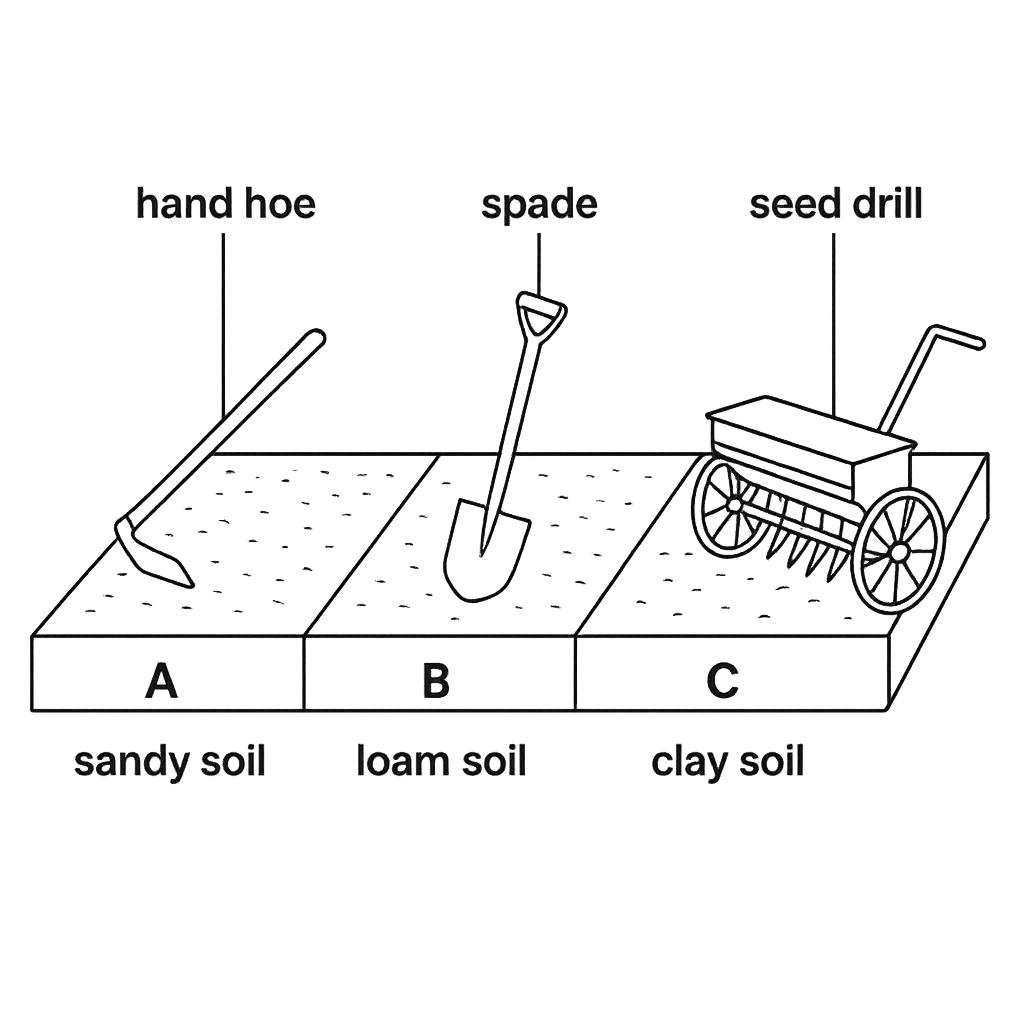
A smallholder farmer intends to cultivate three adjacent 0.5‑hectare plots that differ in soil texture. The farmer has the following hand tools available: a spade, a hand hoe, and a seed drill. The diagram shows the three plots labelled A, B and C with their respective soil types and the tool positioned over each plot.
Question Parts
(a)
Identify the most suitable tool for each plot (A, B and C) and give a brief justification based on the soil texture and the function of the tool.
(b)
The farmer works 8 hours per day. The average tillage rates are: spade 0.5 ha h⁻¹, hand hoe 0.8 ha h⁻¹, seed drill 1.2 ha h⁻¹. Calculate the total time saved (in hours) for the three plots when the most suitable tool identified in part (a) is used instead of the spade on all plots.
(c)
Discuss two environmental advantages of using the appropriate hand tools identified in part (a) over the exclusive use of a motorised tillage machine for these plots.
Detailed Essay Solution & Marking Scheme Available

Get the step-by-step mathematical proofs, key points required by examiners, and a comprehensive breakdown from our AI Tutor.

Question 4 View Details
A farmer is considering the acquisition of a tractor for land preparation on a 5‑hectare farm. The farmer evaluates both a new 45 kW tractor and a second‑hand 40 kW tractor, as well as the option of renting a tractor.
Question Parts
(a)
The new 45 kW tractor consumes 8 L of diesel per hour at full load. If diesel costs ₦200 per litre, calculate the operating cost per hour at full load.
(b)
The tractor can plough at 1.5 ha per hour when operated at 75 % of its rated power. Estimate the total fuel used and the total fuel cost to plough the whole 5 ha farm.
(c)
The second‑hand 40 kW tractor consumes 7 L of diesel per hour at full load. Its purchase price is ₦1,200,000. Renting a tractor costs ₦15,000 per day. Assuming the farmer works 30 days per year for three years, determine which option (buying the second‑hand tractor or renting) is more economical. Show all calculations.
(d)
Briefly discuss two advantages and two disadvantages of using a combine harvester for rice harvesting compared with manual threshing.
Detailed Essay Solution & Marking Scheme Available

Get the step-by-step mathematical proofs, key points required by examiners, and a comprehensive breakdown from our AI Tutor.

Question 5 View Details
A farmer intends to increase the yield of maize on a 2‑hectare field. The current soil test indicates an available phosphorus level of 12 mg kg⁻¹, while the target level for optimum maize production is 30 mg kg⁻¹. The recommended phosphorus (P₂O₅) application rate is 20 kg ha⁻¹ for every 10 mg kg⁻¹ increase in soil phosphorus. The farmer also wishes to adjust the planting arrangement, apply nitrogen fertilizer, manage insect pests, and develop an overall management plan to achieve a target yield of 6 t ha⁻¹.
Question Parts
(a)
Calculate the amount of P₂O₅ fertilizer required (in kilograms) for the whole 2‑ha field to raise the soil phosphorus from 12 mg kg⁻¹ to the target 30 mg kg⁻¹.
(b)
The recommended seed rate for maize at a row spacing of 75 cm is 25 kg ha⁻¹. If the farmer decides to use a narrower row spacing of 60 cm, calculate the new seed rate per hectare, assuming plant population is inversely proportional to row spacing.
(c)
The farmer will use urea (46 % N) to supply the required nitrogen. The recommended nitrogen application is 120 kg ha⁻¹. Determine the quantity of urea needed per hectare and the total cost for the 2‑ha field if urea costs ₦45 per kilogram.
(d)
Identify two major insect pests of maize that are prevalent in the region and outline an integrated pest management (IPM) strategy for each pest.
(e)
Based on the calculations above, prepare a concise management plan (max 150 words) that integrates soil fertility, seed rate, nitrogen application, and pest control to achieve the target yield of 6 t ha⁻¹.
Detailed Essay Solution & Marking Scheme Available

Get the step-by-step mathematical proofs, key points required by examiners, and a comprehensive breakdown from our AI Tutor.

Question 6 View Details
A smallholder keeps a flock of 40 laying hens. Each bird requires 120 g of concentrate feed per day containing 18 % crude protein and 4 500 kcal kg⁻¹ metabolizable energy. The farmer wishes to partially replace the concentrate with locally available maize grain (86 % carbohydrate, 9 % protein, 3 600 kcal kg⁻¹). The flock produces an average of 55 eggs per bird per month and each egg sells for ₦30. Concentrate costs ₦150 per kilogram and maize costs ₦120 per kilogram.
Question Parts
(a)
Calculate the total daily feed requirement for the flock in kilograms, and determine the total amount of crude protein (in grams) and metabolizable energy (in kilocalories) supplied by the concentrate each day.
(b)
If the farmer replaces 30 % of the concentrate with maize grain, recalculate the daily total protein and energy supplied to the flock. Comment on whether the new ration meets the birds’ requirement of at least 16 % protein and 2 800 kcal per bird per day.
Detailed Essay Solution & Marking Scheme Available

Get the step-by-step mathematical proofs, key points required by examiners, and a comprehensive breakdown from our AI Tutor.

Question 7 View Details
A farmer cultivates 5 ha of maize. During a scouting visit, 12% of the plants show typical symptoms of the stem borer (Chilo partellus). The average yield loss per infested plant is estimated at 0.15 kg of grain. The market price of maize is ₦120 per kg. The cost of applying the recommended dose of the insecticide (0.5 L of formulation per ha at ₦250 per litre) is ₦125 per ha (including labour). The economic injury level (EIL) for this pest is given by EIL = C / (V × I), where C is the cost of control per ha, V is the market value per kg, and I is the yield loss per infested plant (kg).
Question Parts
(a)
Calculate the EIL expressed as the percentage of plants that must be infested for control to be justified.
(b)
Based on the observed 12% infestation, should the farmer apply the insecticide? Justify your answer with calculations.
(c)
List two cultural control methods and two biological control agents for stem borer, and briefly explain how each reduces pest damage.
Detailed Essay Solution & Marking Scheme Available

Get the step-by-step mathematical proofs, key points required by examiners, and a comprehensive breakdown from our AI Tutor.

Question 8 View Details
A farmer observes wilting and yellowing of leaves on 30% of cassava plants in a 2 ha field. Laboratory analysis identifies the causal agent as Fusarium oxysporum f. sp. cubense (Fusarium wilt). The pathogen produces spores that can survive in soil for up to 5 years. Disease spread follows the model: proportion infected in the next season = p + r × (current proportion infected), where p is the primary infection rate from soil inoculum (0.02) and r is the secondary spread rate (1.2).
Question Parts
(a)
Calculate the expected proportion of infected plants in the next cropping season.
(b)
Assuming the yield loss is 0.8 t/ha when 30% of plants are infected and loss scales linearly with proportion infected, estimate the expected yield loss per hectare for the next season.
(c)
Propose an integrated disease management plan comprising (i) a cultural practice, (ii) a chemical control, and (iii) a resistant variety, explaining the role of each component.
Detailed Essay Solution & Marking Scheme Available

Get the step-by-step mathematical proofs, key points required by examiners, and a comprehensive breakdown from our AI Tutor.

Master the Exam!

You've seen a preview, but there are thousands more questions plus AI tutor to break down complex solutions.

Unlock Full Access Available for Android & Windows
Help others prepare! Share this practice hub:
Chat with Support