neco model questions vol1 2021 agricultural_science | Objective

Prepare for your exams with neco model questions vol1 questions? Reviewing past/model questions is one of the most effective ways to guarantee a high score. This practice hub features authentic 2021 agricultural_science (Objective) questions designed to simulate the real exam environment.

Practice these randomly selected questions to test your readiness.

Question 1 View Details
A farmer uses a disc plough that is 0.75 m wide. To ensure complete tillage each pass must overlap the previous one by 10 % of the plough width. The field to be tilled is a rectangle 120 m long and 45 m wide. The farmer can operate the plough at a constant speed of 5 km h\(^{-1}\).\n\n(a) How many hours (to two decimal places) will be required to till the whole field with this disc plough?\n\n(b) If the farmer replaces the disc plough with a mouldboard plough that is 0.50 m wide, can increase his speed by 20 % but must still maintain the same 10 % overlap, how many hours (to two decimal places) will be required with the mouldboard plough?
Correct A. 1.61 hours (disc plough); 2.00 hours (mouldboard plough)
B. 1.90 hours (disc plough); 2.10 hours (mouldboard plough)
C. 1.75 hours (disc plough); 2.20 hours (mouldboard plough)
D. 1.45 hours (disc plough); 1.80 hours (mouldboard plough)

Correct Answer: A

Want to see the full step-by-step solution? Unlock AI Explanation & Analytics
Question 2 View Details
A farmer applies 120 kg of NPK fertilizer that contains 12 % nitrogen. The fertilizer is applied in two equal splits. After the first split, 30 % of the nitrogen is lost by volatilisation, while the second split suffers no loss. How many kilograms of nitrogen remain in the soil after both applications?
A. 13.20 kg
B. 11.40 kg
Correct C. 12.24 kg
D. 10.80 kg

Correct Answer: C

Want to see the full step-by-step solution? Unlock AI Explanation & Analytics
Question 3 View Details
A 150‑ha forest can be planted with species A and species B. Species A grows 2.5 m yr\(^{-1}\) from an initial height of 1.5 m and is harvested after 10 years, yielding 0.8 m³ of timber per hectare for each metre of height above 1.5 m. Species B grows 1.8 m yr\(^{-1}\) from an initial height of 0.8 m and is harvested after 15 years, yielding 0.6 m³ ha\(^{-1}\) per metre of height above 0.8 m. Timber prices are ₦250 m\(^{-3}\) for species A and ₦300 m\(^{-3}\) for species B. Soil suitability limits the area planted to species A to at most 70 % of the total forest. Assuming successive rotations over a 30‑year planning horizon (i.e., after each harvest the same species is replanted on the same area), determine the proportion of the forest that should be allocated to each species to maximise total revenue, and compute that maximum total revenue (in ₦).
A. 55 % species A, 45 % species B; maximum total revenue = ₦1,880,000
Correct B. 70 % species A, 30 % species B; maximum total revenue = ₦2,012,400
C. 65 % species A, 35 % species B; maximum total revenue = ₦1,950,000
D. 70 % species A, 30 % species B; maximum total revenue = ₦2,050,000

Correct Answer: B

Want to see the full step-by-step solution? Unlock AI Explanation & Analytics
Question 4 View Details
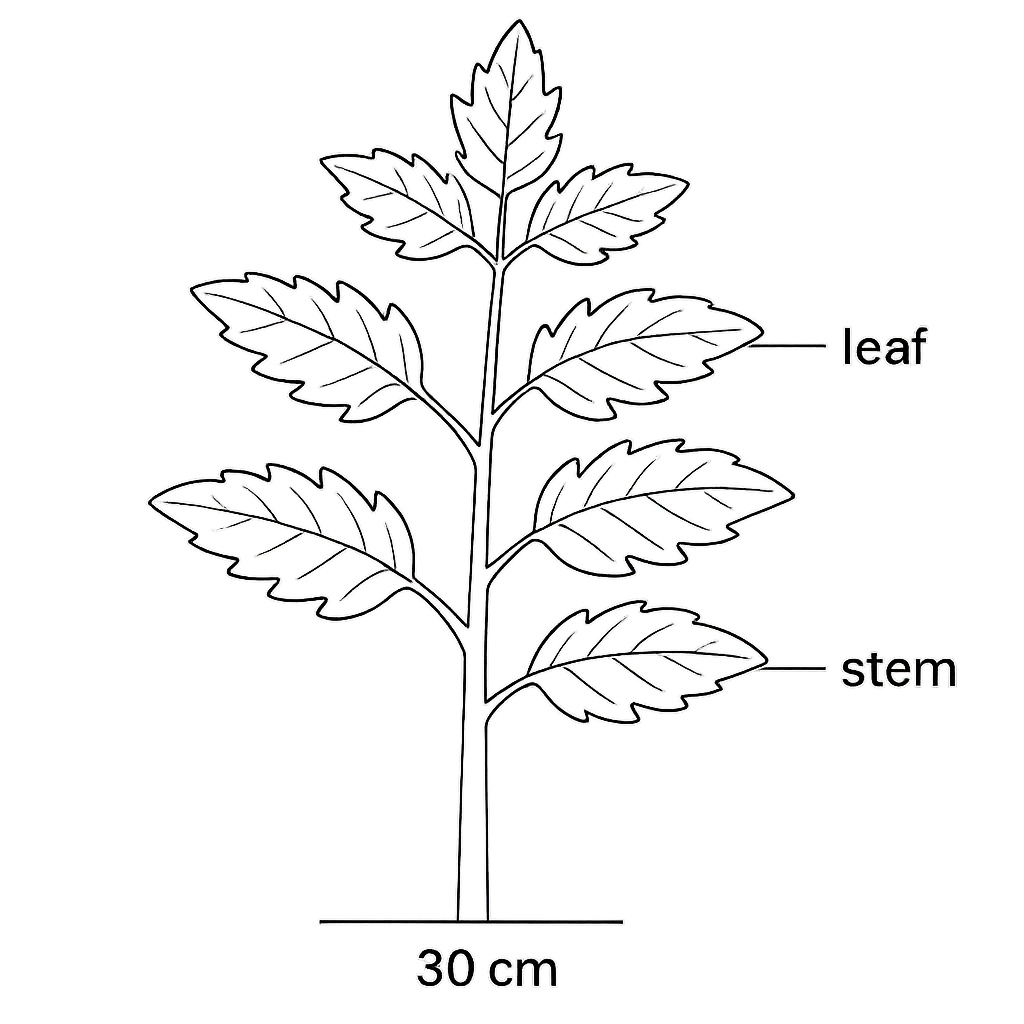
Using the labelled diagram of the tomato plant, calculate the ratio of the total leaf area to the lateral surface area of the stem. Express the ratio to two decimal places.
Correct A. 2.55
B. 2.78
C. 2.35
D. 3.02

Correct Answer: A

Want to see the full step-by-step solution? Unlock AI Explanation & Analytics
Question 5 View Details
A 200‑ha forest is to be managed for timber and carbon credits. Two species are available:\n\n- Species C: initial stock 50 m³ ha\(^{-1}\), annual growth 4 % (compounded), harvested after 20 years. 30 % of the harvested volume remains as residues for carbon credits.\n- Species D: initial stock 30 m³ ha\(^{-1}\), annual growth 6 % (compounded), harvested after 12 years. 20 % of the harvested volume remains as residues for carbon credits.\n\nTimber prices are $150 m\(^{-3}\) for species C and $180 m\(^{-3}\) for species D. Carbon credits are $12 per tonne of carbon, and 1 m³ of wood contains 0.5 tonne of carbon (so $6 per m³ of wood). The processing plant can handle at most 5 000 m³ of timber per year. Biodiversity regulations require that at least 30 % of the forest area be planted with species C.\n\nAssuming the manager can allocate any proportion of the 200 ha to each species and that each species is replanted immediately after harvest, determine the optimal allocation (percentage of area to species C and to species D) that maximises the total annual net revenue (timber plus carbon credits) over a 24‑year horizon, while respecting the processing capacity and biodiversity constraint. State the optimal percentages (to the nearest whole percent) and the corresponding maximum annual net revenue (in $).
A. 35 % species C, 65 % species D; maximum annual net revenue = $182,300
Correct B. 30 % species C, 70 % species D; maximum annual net revenue = $177,490
C. 25 % species C, 75 % species D; maximum annual net revenue = $179,800
D. 30 % species C, 70 % species D; maximum annual net revenue = $170,000

Correct Answer: B

Want to see the full step-by-step solution? Unlock AI Explanation & Analytics
Question 6 View Details
A farmer intends to grow maize on 2 ha. Soil test shows available nitrogen (N) = 30 kg ha⁻¹, phosphorus (P) = 15 kg ha⁻¹ and potassium (K) = 20 kg ha⁻¹. The optimum nutrient requirement for maximum yield is N = 120 kg ha⁻¹, P = 60 kg ha⁻¹ and K = 80 kg ha⁻¹. The farmer can use diammonium phosphate (DAP) which contains 18 % N and 46 % P₂O₅, and muriate of potash (MOP) which contains 60 % K₂O. Prices are ₦45 000 per tonne for DAP and ₦38 000 per tonne for MOP (1 tonne = 1000 kg). Assuming nutrients supplied by the fertilizers are additive and that the farmer will meet the nutrient deficits exactly, calculate the minimum total cost (in Naira) required to satisfy the nutrient requirements.
A. 54800
B. 53156
Correct C. 54156
D. 56000

Correct Answer: C

Want to see the full step-by-step solution? Unlock AI Explanation & Analytics
Question 7 View Details
A 0.5 ha pond (average depth 1.2 m) is stocked with catfish fingerlings at a density of 5 000 fingerlings per ha. Thus 2 500 fingerlings are introduced. Survival after six months is given by \(S = 0.9 - 0.02\,(FCR - 1.5)\), where \(FCR\) is the feed conversion ratio. The farmer can choose between Feed A (\(FCR = 1.6\), cost \(\text{₦}150\) per kg) and Feed B (\(FCR = 1.4\), cost \(\text{₦}200\) per kg). Each surviving fish receives 0.02 kg feed per day. The culture period is 180 days and the market price of live fish at harvest is \(\text{₦}500\) per kg. Fish reach an average weight of 0.8 kg at harvest if survival exceeds 70 %; otherwise the average weight falls proportionally to the survival percentage. Determine which feed gives the higher profit and state that profit (in Naira).
Correct A. -314300
B. -322000
C. -300000
D. -280500

Correct Answer: A

Want to see the full step-by-step solution? Unlock AI Explanation & Analytics
Question 8 View Details
A farmer must clear 2 ha of land. Two options are available: (i) manual hoe work, where one person can clear 0.05 ha per day; (ii) a powered rotavator that clears 0.4 ha per hour. Labour cost is ₦2 500 per person per day. The rotavator can be hired for ₦12 000 per day and requires ₦1 500 per day for fuel (operator's wage is included in the hire charge). Assuming an 8‑hour workday for the rotavator, which option results in the lower total cost for clearing the whole area, and what is that cost (in Naira)?
A. 12500
Correct B. 13500
C. 10000
D. 15000

Correct Answer: B

Want to see the full step-by-step solution? Unlock AI Explanation & Analytics
Question 9 View Details
In a wheat field the following symptoms are observed: yellowing of lower leaves, stunted growth and white powdery pustules on stems. The most likely disease is powdery mildew. The recommended control is a 0.5 % (w/v) copper oxychloride solution applied at 2 L per hectare. The farmer has 25 L of concentrate that contains 250 g of active ingredient per litre. Determine how many hectares can be treated with the 25 L of concentrate and the total volume of spray solution required.
A. 750
B. 1000
C. 500
Correct D. 625

Correct Answer: D

Want to see the full step-by-step solution? Unlock AI Explanation & Analytics
Question 10 View Details
A batch of 500 kg of cassava roots is harvested with a moisture content of 65 % (wet basis). To store safely the moisture must be reduced to 20 % (wet basis). The drying kiln follows the moisture‑removal law \(\frac{dM}{dt} = -k\,(M - M_{eq})\) where \(M\) is moisture (% wet basis), \(M_{eq}=15\%\) and \(k = 0.03\,\text{h}^{-1}\).\n(a) How many hours are required to reach 20 % moisture?\n(b) After drying, the cassava is packed in 25 kg bags. The respiration rate at 20 % moisture causes a weight loss of 0.1 % per day. Assuming this loss is continuous, calculate the total weight loss (in kg) after 30 days of storage and the net weight of cassava remaining.
A. 80.2 hours, 8.2 kg loss, 210.5 kg remaining
Correct B. 76.8 hours, 6.6 kg loss, 212.2 kg remaining
C. 78.5 hours, 7.0 kg loss, 211.8 kg remaining
D. 70.0 hours, 5.5 kg loss, 213.2 kg remaining

Correct Answer: B

Want to see the full step-by-step solution? Unlock AI Explanation & Analytics
Question 11 View Details
The extension agency plans to train 120 smallholder maize farmers. The program costs are: trainer fees ₦150,000, training materials ₦45,000, transport ₦30,000, and a per‑farmer stipend of ₦2,500. Each trained farmer is expected to increase his maize yield by (1.8\) tonnes per season. The current market price of maize is ₦1,200 per tonne, but (10\%\) of the increased yield is lost to post‑harvest pests. Calculate the net monetary benefit per farmer after accounting for the loss, and state whether the program yields a positive net benefit per farmer.
Correct A. -2,431 ₦ (negative, programme not viable)
B. -3,200 ₦ (negative, programme not viable)
C. -1,800 ₦ (negative, programme not viable)
D. 1,200 ₦ (positive, programme viable)

Correct Answer: A

Want to see the full step-by-step solution? Unlock AI Explanation & Analytics
Question 12 View Details
In a 2‑ha wheat field, (15\%\) of the plants show leaf‑rust symptoms. A field survey counted 12,000 plants per hectare. The recommended fungicide dosage is 0.75 L ha(^{-1}\) for each 5 % increase in disease incidence above a 5 % threshold. Determine the total volume of fungicide (in litres) required for the whole field.
A. 2.5 L
B. 1.8 L
Correct C. 3.0 L
D. 4.5 L

Correct Answer: C

Want to see the full step-by-step solution? Unlock AI Explanation & Analytics
Question 13 View Details
A teak plantation has an initial standing volume of 80,000 m³. The annual natural growth rate is 4 % of the standing volume. Management policy permits a harvest that never reduces the standing volume below 70 % of the initial stock. What is the maximum constant annual harvest volume (in m³) that can be sustained indefinitely under these conditions?
A. 1,800 m³ per year
B. 2,500 m³ per year
Correct C. 2,240 m³ per year
D. 2,100 m³ per year

Correct Answer: C

Want to see the full step-by-step solution? Unlock AI Explanation & Analytics
Question 14 View Details
A dairy farm has 40 lactating cows, each producing 22 L of milk per day. Milk contains 3.2 % protein by weight, i.e., each litre requires 0.032 kg of protein. The cows are fed a concentrate containing 18 % crude protein costing ₦250 kg(^{-1}) and a roughage containing 8 % crude protein costing ₦120 kg(^{-1}). The farmer decides to mix concentrate and roughage in a weight ratio of 3 : 5. Determine the total daily feed cost for the herd (in naira).
A. ₦38,200 per day (approx.)
B. ₦45,000 per day (approx.)
C. ₦42,500 per day (approx.)
Correct D. ₦40,437 per day (approx.)

Correct Answer: D

Want to see the full step-by-step solution? Unlock AI Explanation & Analytics
Question 15 View Details
A poultry farm keeps 250 laying hens, each laying an average of 280 eggs per year. Fixed overheads amount to ₦180,000 per year. Variable cost is ₦12 per dozen eggs produced. The market price is ₦150 per dozen. What is the minimum number of dozens of eggs that must be sold each year to achieve a profit of at least ₦50,000?
A. 1,800 dozens
Correct B. 1,667 dozens
C. 1,500 dozens
D. 2,000 dozens

Correct Answer: B

Want to see the full step-by-step solution? Unlock AI Explanation & Analytics
Question 16 View Details
A tractor must pull a plough that requires a draw‑bar pull of \(12\ \text{kN}\) while moving at a speed of \(5\ \text{km h}^{-1}\). The transmission efficiency is \(85\%\) and the final‑drive efficiency is \(80\%\). What minimum engine power in horsepower should the tractor have? (Use \(1\ \text{hp}=0.7457\ \text{kW}\) and round up to the nearest whole horsepower.)
A. 30 hp
B. 35 hp
Correct C. 33 hp
D. 40 hp

Correct Answer: C

Want to see the full step-by-step solution? Unlock AI Explanation & Analytics
Question 17 View Details
A farmer needs to harvest \(45\) hectares of maize. Harvester A can harvest \(2.5\) ha h\(^{-1}\) and consumes \(12\) L of diesel per hour. Harvester B can harvest \(3.0\) ha h\(^{-1}\) and consumes \(15\) L of diesel per hour. Diesel costs \(\₦210\) per litre. Which harvester will result in the lower total fuel cost for the whole operation?
A. Harvester B
Correct B. Harvester A
C. Both harvesters cost the same
D. Neither, a third harvester would be cheaper

Correct Answer: B

Want to see the full step-by-step solution? Unlock AI Explanation & Analytics
Question 18 View Details
A farmer incurs fixed costs of \(\₦120{,}000\) for a season and variable costs of \(\₦25{,}000\) per hectare. The farm size is \(8\) ha. The crop is sold at \(\₦45{,}000\) per tonne. A government subsidy pays \(\₦5{,}000\) for each tonne produced above \(2.5\) t ha\(^{-1}\). The farmer expects a yield of \(3.0\) t ha\(^{-1}\).\n\n(a) Calculate the net profit for the season.\n\n(b) If the farmer wants a net profit of at least \(\₦800{,}000\), what is the minimum yield per hectare required (assume the price and subsidy rates remain unchanged)?
Correct A. (a) \(\₦780{,}000\) profit; (b) minimum yield \(3.05\) t ha\(^{-1}\) (approximately)
B. (a) \(\₦800{,}000\) profit; (b) minimum yield \(3.00\) t ha\(^{-1}\) (approximately)
C. (a) \(\₦720{,}000\) profit; (b) minimum yield \(2.95\) t ha\(^{-1}\) (approximately)
D. (a) \(\₦750{,}000\) profit; (b) minimum yield \(3.10\) t ha\(^{-1}\) (approximately)

Correct Answer: A

Want to see the full step-by-step solution? Unlock AI Explanation & Analytics
Question 19 View Details
A goat weighing \(45\) kg shows fever, nasal discharge and coughing, suggesting contagious caprine pleuropneumonia. The recommended treatment is oxytetracycline injection at a dose of \(20\) mg kg\(^{-1}\) body weight, administered once daily for \(5\) days. The available preparation contains \(100\) mg ml\(^{-1}\). Determine the total volume of oxytetracycline solution that must be administered over the whole treatment course.
A. 55 ml
B. 40 ml
C. 50 ml
Correct D. 45 ml

Correct Answer: D

Want to see the full step-by-step solution? Unlock AI Explanation & Analytics
Question 20 View Details
A farmer intends to sow maize with a row spacing of \(75\) cm and an intra‑row spacing of \(25\) cm. Each seed weighs \(0.25\) g. Assuming a seed loss of \(5\%\) during sowing, calculate the total amount of seed (in kilograms) that should be purchased for one hectare.
A. approximately 13.3 kg
B. approximately 15.2 kg
Correct C. approximately 14.0 kg
D. approximately 12.5 kg

Correct Answer: C

Want to see the full step-by-step solution? Unlock AI Explanation & Analytics
Question 21 View Details
A farmer applies 100 kg of agricultural lime that is 30\% calcium carbonate equivalent. Each kilogram of calcium carbonate equivalent raises the soil pH by 0.02 units. By how many pH units will the soil pH increase?
Correct A. 0.6
B. 1.0
C. 0.8
D. 0.4

Correct Answer: A

Want to see the full step-by-step solution? Unlock AI Explanation & Analytics
Question 22 View Details
A pond is stocked with 10,000 fingerlings. After the first month the survival rate is 80\%; after each subsequent month the survival rate is 90\% of the survivors from the previous month. At the end of every month (starting after the first) the farmer harvests 30\% of the surviving fish. How many fish are harvested in total over the first four months? (Round the final answer to the nearest whole fish.)
A. 5,800
Correct B. 5,465
C. 4,800
D. 5,200

Correct Answer: B

Want to see the full step-by-step solution? Unlock AI Explanation & Analytics
Question 23 View Details
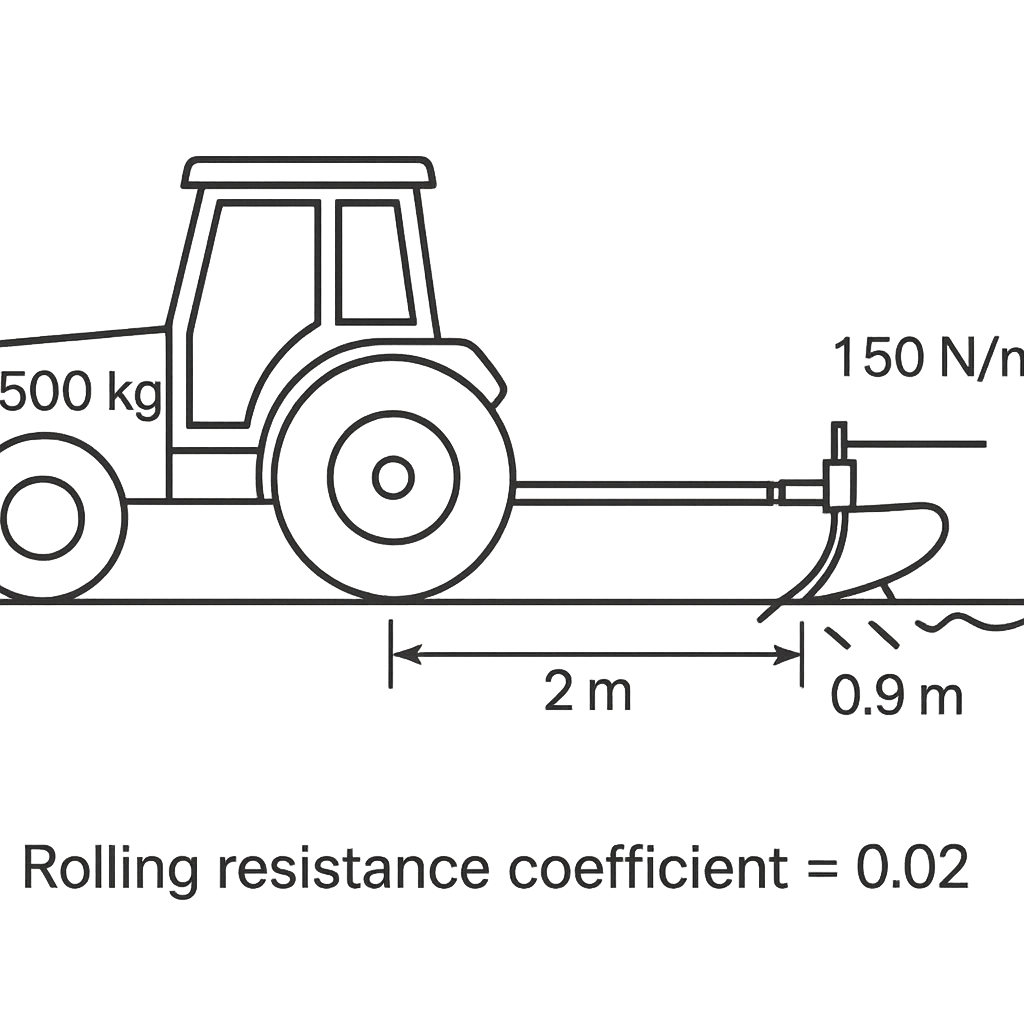
The diagram shows a tractor pulling a plough via a drawbar that is 2 m long. The plough has a working width of 0.9 m and each metre of width requires a soil resistance of 150 N. The tractor weighs 1500 kg and the coefficient of rolling resistance of its wheels is 0.02. The tractor can deliver a pulling force of 12 kN at the drawbar. Ignoring aerodynamic drag, determine the minimum pulling force required to overcome both soil resistance and rolling resistance, and state whether the tractor's available force is sufficient.
Correct A. The minimum required pulling force is about 430 N; the tractor's available 12 kN is sufficient.
B. The minimum required pulling force is about 5 800 N; the tractor's available 12 kN is sufficient.
C. The minimum required pulling force is about 430 N; the tractor's available 12 kN is insufficient.
D. The minimum required pulling force is about 1 200 N; the tractor's available 12 kN is sufficient.

Correct Answer: A

Want to see the full step-by-step solution? Unlock AI Explanation & Analytics
Question 24 View Details
An extension officer has a budget of ₦500,000 to run two programmes: a radio campaign costing ₦120,000 per month and a farmer field school costing ₦80,000 per session. The radio campaign reaches 2,500 farmers each month, while each field‑school session reaches 150 farmers. At least 30\% of the total expenditure must be on field schools. Determine the number of months of radio campaigning and the number of field‑school sessions that maximise the total number of farmers reached, and give that maximum reach.
A. 2 months of radio and 4 field‑school sessions, reaching a maximum of 5,800 farmers.
Correct B. 2 months of radio and 3 field‑school sessions, reaching a maximum of 5,450 farmers.
C. 3 months of radio and 2 field‑school sessions, reaching a maximum of 5,100 farmers.
D. 1 month of radio and 3 field‑school sessions, reaching a maximum of 4,950 farmers.

Correct Answer: B

Want to see the full step-by-step solution? Unlock AI Explanation & Analytics
Question 25 View Details
A fish farmer must produce 100 kg of feed that contains at least 30\% protein and 5\% lipid. Two raw ingredients are available:\n- Ingredient A: 40\% protein, 2\% lipid, costing ₦200 per kg.\n- Ingredient B: 20\% protein, 8\% lipid, costing ₦150 per kg.\nDetermine the kilograms of each ingredient required to meet the nutrient specifications at minimum cost, and state that minimum total cost.
Correct A. 50 kg of Ingredient A and 50 kg of Ingredient B; minimum cost = ₦17,500
B. 40 kg of Ingredient A and 60 kg of Ingredient B; minimum cost = ₦17,000
C. 70 kg of Ingredient A and 30 kg of Ingredient B; minimum cost = ₦18,500
D. 60 kg of Ingredient A and 40 kg of Ingredient B; minimum cost = ₦18,000

Correct Answer: A

Want to see the full step-by-step solution? Unlock AI Explanation & Analytics

Master the Exam!

You've seen a preview, but there are thousands more questions plus AI tutor to break down complex solutions.

Unlock Full Access Available for Android & Windows
Help others prepare! Share this practice hub:
Chat with Support