neco model questions vol1 2020 agricultural_science | Objective

Prepare for your exams with neco model questions vol1 questions? Reviewing past/model questions is one of the most effective ways to guarantee a high score. This practice hub features authentic 2020 agricultural_science (Objective) questions designed to simulate the real exam environment.

Practice these randomly selected questions to test your readiness.

Question 1 View Details
A tractor is required to pull a plough across a level field. The plough has a drawbar pull requirement of \(5\text{ kN}\) and a weight of \(2.0\text{ kN}\). The coefficient of rolling resistance between the plough and the soil is \(0.04\). The tractor moves at a constant speed of \(4\text{ km h}^{-1}\). If the overall drivetrain efficiency is \(85\%\), what is the minimum engine power in kilowatts that the tractor must develop? Give your answer to one decimal place.
A. 7.2
Correct B. 6.6
C. 8.0
D. 5.9

Correct Answer: B

Want to see the full step-by-step solution? Unlock AI Explanation & Analytics
Question 2 View Details
A farmer cultivates \(2\) hectares of maize. Fixed costs (land rent, depreciation) amount to \(\₦150{,}000\) per hectare. The variable cost is \(\₦30\) per kilogram of maize produced. The expected yield is \(2.5\) tonnes per hectare. The farmer wishes to earn a profit equal to \(20\%\) of the total cost. Determine the minimum selling price per kilogram of maize (in naira) that will achieve this profit target. Give your answer as a whole number.
A. 102
B. 124
C. 115
Correct D. 108

Correct Answer: D

Want to see the full step-by-step solution? Unlock AI Explanation & Analytics
Question 3 View Details
In a poultry farm, a contagious disease spreads with a transmission coefficient of \(\beta = 0.8\) day\(^{-1}\) per infected bird. The average infectious period is \(5\) days. (i) Calculate the basic reproduction number \(R_{0}\). (ii) Assuming a perfect vaccine, what minimum proportion of the flock must be vaccinated to reduce the effective reproduction number below \(1\)? Express your answer as a percentage.
A. 60
B. 90
C. 50
Correct D. 75

Correct Answer: D

Want to see the full step-by-step solution? Unlock AI Explanation & Analytics
Question 4 View Details
A field of \(10{,}000\) tomato plants is surveyed for early blight. Initially, \(1{,}200\) plants show symptoms. After applying a new fungicide, a follow‑up survey records only \(300\) symptomatic plants. (a) Calculate the percentage reduction in disease incidence achieved by the fungicide. (b) Does the fungicide meet the efficacy threshold of \(80\%\) control? Answer with the percentage reduction and a yes/no.
A. 75, yes
B. 85, no
C. 70, no
Correct D. 75, no

Correct Answer: D

Want to see the full step-by-step solution? Unlock AI Explanation & Analytics
Question 5 View Details
The agricultural extension service plans a training programme for \(150\) smallholder farmers on integrated pest management (IPM). The programme includes a two‑day workshop costing \(\₦5{,}000\) per participant for materials, plus a venue cost of \(\₦200{,}000\). Each farmer also receives a starter kit valued at \(\₦8{,}000\). It is expected that each farmer will increase maize yield by \(1.5\) tonnes per hectare on a one‑hectare farm, and the market price of maize is \(\₦45\) per kilogram. (i) Compute the total cost of the programme. (ii) Compute the total additional revenue generated by the farmers. (iii) Determine the benefit‑cost ratio (BCR). (iv) Based on a required BCR of at least \(1.5\) for approval, state whether the programme should be approved.
A. 4.71, reject
Correct B. 4.71, approve
C. 1.23, reject
D. 3.92, approve

Correct Answer: B

Want to see the full step-by-step solution? Unlock AI Explanation & Analytics
Question 6 View Details
A farmer has 2,500 cassava plants. Initially 12% show symptoms of mosaic disease. After applying a fungicide the disease incidence falls to 40% of its original value. Each healthy plant yields \(\text{₦}250\) while a diseased plant yields only 30% of that. The fungicide costs \(\text{₦}150\) per litre and one litre covers 0.8 ha; the farm area is 5 ha. Calculate the net increase in profit after treatment (in Naira, rounded to the nearest Naira).
A. 20062
B. 51562
Correct C. 30563
D. 31500

Correct Answer: C

Want to see the full step-by-step solution? Unlock AI Explanation & Analytics
Question 7 View Details
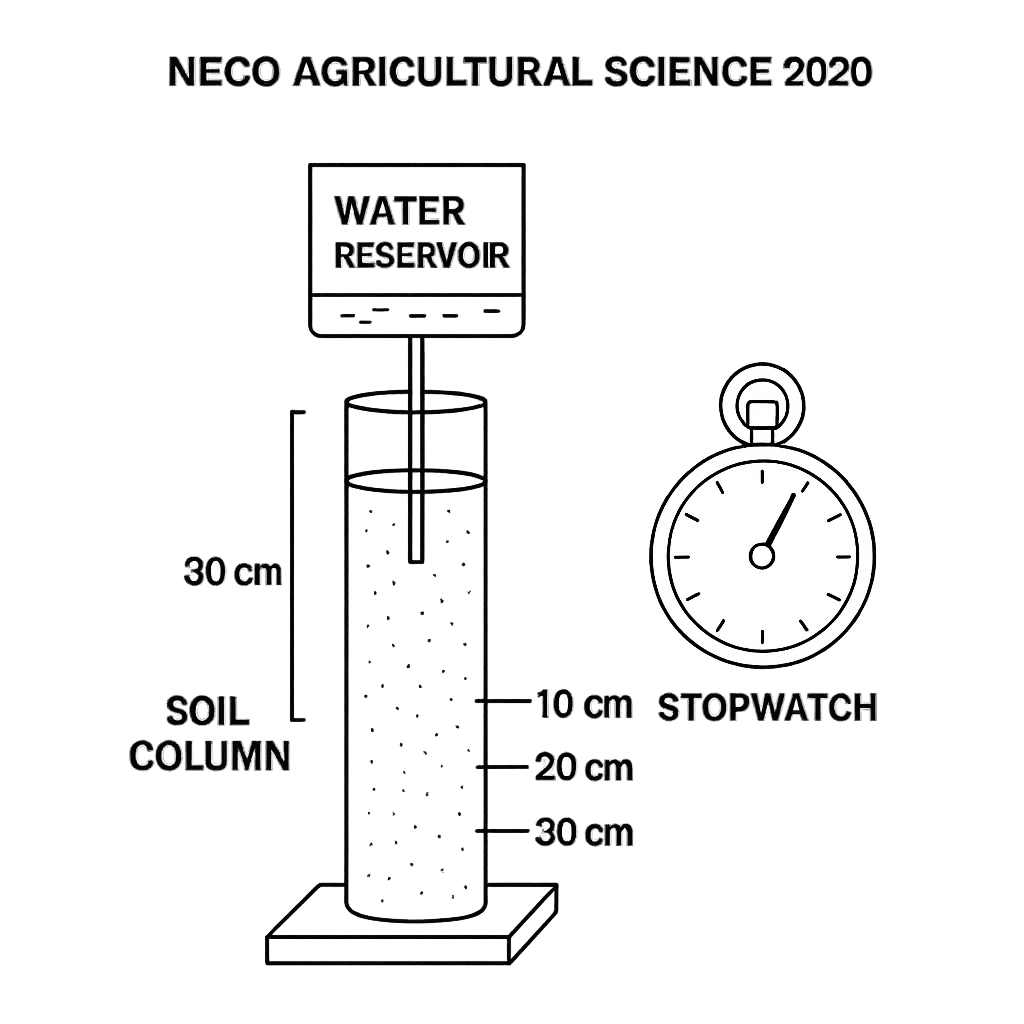
In a laboratory soil infiltration test, water is released at the top of a 30 cm tall soil column. It takes 45 s to travel the first 10 cm, 30 s for the next 10 cm and 20 s for the final 10 cm. What is the average infiltration rate in cm min⁻¹ for the whole column?
Correct A. 19.0
B. 18.0
C. 21.1
D. 0.32

Correct Answer: A

Want to see the full step-by-step solution? Unlock AI Explanation & Analytics
Question 8 View Details
A rabbit farm has 120 does. Each doe produces 5 kits per litter and has two litters per year. The survival rate to weaning is 85%. Each weaned kit weighs 1.2 kg and is sold at \(\text{₦}1200\) per kg. Each kit consumes 0.2 kg feed per day for 8 weeks (56 days). Feed costs \(\text{₦}100\) per kg. Calculate the annual net profit from rabbit production (in Naira).
Correct A. 326400
B. 307200
C. 554880
D. 384000

Correct Answer: A

Want to see the full step-by-step solution? Unlock AI Explanation & Analytics
Question 9 View Details
A 1 ha field contains four plant species with the following individual counts: 40, 30, 20 and 10. Using Simpson's Diversity Index \(D = \frac{\sum n_i (n_i-1)}{N(N-1)}\), where \(n_i\) is the count of species \(i\) and \(N\) is the total number of individuals, calculate \(D\) to three decimal places.
A. 0.250
Correct B. 0.293
C. 0.300
D. 0.292

Correct Answer: B

Want to see the full step-by-step solution? Unlock AI Explanation & Analytics
Question 10 View Details
A farmer harvests 500 kg of mangoes with an initial moisture content of 85 % (wet basis). He intends to dry them in a solar dryer that follows the moisture‑removal kinetics \(M(t) = M_{eq} + (M_0 - M_{eq})e^{-kt}\), where \(M\) is the water mass per kg dry matter, \(M_{eq}=0.2\) kg kg⁻¹, \(k=0.05\) h⁻¹, and \(M_0\) is the initial moisture ratio. The target moisture is 15 % (wet basis). Determine whether this target can be reached with the dryer. If not, state the lowest moisture percentage (wet basis) attainable and compute the total energy required to reach that moisture, assuming the latent heat of vaporisation is 2,430 kJ kg⁻¹ of water removed.
Correct A. Not achievable; minimum moisture 16.7% w.b.; energy required 9.96×10^5 kJ
B. Not achievable; minimum moisture 17.2% w.b.; energy required 9.80×10^5 kJ
C. Achievable; final moisture 15% w.b.; energy required 9.50×10^5 kJ
D. Not achievable; minimum moisture 15.5% w.b.; energy required 1.02×10^5 kJ

Correct Answer: A

Want to see the full step-by-step solution? Unlock AI Explanation & Analytics
Question 11 View Details
A farmer practices a 3‑year crop rotation of maize - soybean - maize on a 1 ha field. Soil nitrogen supplies 30 kg N ha⁻¹. Maize yield (t ha⁻¹) follows the relation \(Y = 2 + 0.02\times N_{total}\) where \(N_{total}\) is total nitrogen (soil + fertiliser) in kg ha⁻¹. In year 1 the farmer applies 120 kg N ha⁻¹ as fertiliser and harvests maize. In year 2 soybean is grown, fixes 50 kg N ha⁻¹ and receives no fertiliser. In year 3 maize is planted again, but the fertiliser amount is reduced by 30 % of the year 1 rate. Calculate the total grain yield (t ha⁻¹) obtained over the three‑year cycle.
A. 11.90
B. 12.00
C. 13.45
Correct D. 12.78

Correct Answer: D

Want to see the full step-by-step solution? Unlock AI Explanation & Analytics
Question 12 View Details
A tomato farmer cultivates 10 ha with 1 000 plants per ha. Initially 20 % of the plants are infected with a disease that reduces each infected plant's yield by 0.05 kg compared with a healthy plant that yields 0.20 kg. The farmer can apply a fungicide costing ₦150 per ha; the treatment eliminates 60 % of the infected plants, and the remaining infected plants are destroyed. The market price of tomatoes is ₦200 per kg and the production cost (excluding fungicide) is ₦30 per kg. Determine the change in net profit (in ₦) if the farmer uses the fungicide compared with doing nothing.
A. -10500
B. -13000
Correct C. -11700
D. -9000

Correct Answer: C

Want to see the full step-by-step solution? Unlock AI Explanation & Analytics
Question 13 View Details
A farmer is deciding when to plant a cash crop. Fixed costs are ₦500 000 and variable costs are ₦120 000 per hectare. Expected yield is 8 tonnes per hectare. The current market price is ₦80 000 per tonne and is projected to rise by 5 % each year for the next three years. The discount rate is 10 % per annum.\n\nOption A: Plant now (year 0) and harvest at the end of year 1.\nOption B: Wait one year, plant at the start of year 1 and harvest at the end of year 2.\n\nCalculate the net present value (NPV) of each option and state which option gives the higher NPV.
A. Wait one year; NPV = 25000 (higher than planting now)
B. Plant now; NPV = 20000 (higher than waiting)
Correct C. Wait one year; NPV = 20000 (higher than planting now)
D. Plant now; NPV = 15000 (lower than waiting)

Correct Answer: C

Want to see the full step-by-step solution? Unlock AI Explanation & Analytics
Question 14 View Details
In a herd of 200 cattle a contagious disease has a basic reproduction number \(R_0 = 2.5\). A vaccine reduces susceptibility by 80 % and costs ₦5 000 per animal. To achieve herd immunity the proportion vaccinated \(p\) must satisfy \((1 - e\,p)\,R_0 < 1\) where \(e = 0.80\).\n\n(a) Determine the minimum number of cattle that must be vaccinated and the total vaccination cost.\n(b) If an outbreak would cause a loss of 30 % of the unvaccinated cattle, each valued at ₦150 000, decide whether vaccination is cost‑effective.
Correct A. Vaccinate at least 150 cattle; cost ₦750000; vaccination is cost‑effective
B. Vaccinate at least 150 cattle; cost ₦750000; vaccination is not cost‑effective
C. Vaccinate at least 180 cattle; cost ₦900000; vaccination is cost‑effective
D. Vaccinate at least 120 cattle; cost ₦600000; vaccination is not cost‑effective

Correct Answer: A

Want to see the full step-by-step solution? Unlock AI Explanation & Analytics
Question 15 View Details
A rotary tiller requires a torque of 250 Nm at 250 rpm to operate efficiently. The farmer has a diesel engine that delivers 12 kW at 1800 rpm. The engine power is transmitted to the tiller through a two‑stage belt drive: the first stage has a reduction ratio of 3 : 1 and the second stage a reduction ratio of 2 : 1 (both ideal, i.e., no losses). Determine the output speed and torque after the two reductions and state whether the tiller can be driven satisfactorily.
A. Yes; after reductions the tiller would run at 300 rpm with torque 382 Nm, meeting both speed and torque requirements.
B. No; after reductions the tiller would run at 250 rpm with torque 300 Nm, which meets the speed but not the torque requirement.
Correct C. No; after reductions the tiller would run at 300 rpm with torque 382 Nm, which exceeds the required speed of 250 rpm, so the speed requirement is not met.
D. Yes; after reductions the tiller would run at 200 rpm with torque 500 Nm, satisfying both requirements.

Correct Answer: C

Want to see the full step-by-step solution? Unlock AI Explanation & Analytics
Question 16 View Details
Species Y in a plantation follows the volume growth function \(V(t)=0.6t^{2}-4t+20\) (m³ per hectare), where \(t\) is the age in years (\(t\ge 5\)). For a sustainable yield the average annual increment (AAI) must be at least \(5\) m³ ha\(^{-1}\) yr\(^{-1}\). The AAI is defined as \(\dfrac{V(t)}{t}\). Determine the minimum integer rotation age \(t\) (in years) that satisfies this condition.
Correct A. 13 years
B. 14 years
C. 15 years
D. 12 years

Correct Answer: A

Want to see the full step-by-step solution? Unlock AI Explanation & Analytics
Question 17 View Details
A farmer intends to raise 50 goats, each to gain 15 kg over 120 days. The daily weight gain per goat is therefore \(0.125\) kg. For each kilogram of gain the goats require \(2.5\) MJ of metabolizable energy and \(0.5\) kg of crude protein. The feed mixture consists of Ingredient A (crude protein 20 %, metabolizable energy 6 MJ kg\(^{-1}\), cost ₦200 kg\(^{-1}\)) and Ingredient B (crude protein 12 %, metabolizable energy 10 MJ kg\(^{-1}\), cost ₦120 kg\(^{-1}\)). Each goat is offered exactly \(0.5\) kg of feed per day, the remainder being Ingredient B. Determine the minimum amount (in kg, to three decimal places) of Ingredient A that must be included per goat per day to satisfy both the energy and protein requirements, and compute the daily feed cost per goat at this minimum.
A. 0.035 kg of Ingredient A per goat per day; cost = ₦70.0 per goat per day
B. 0.025 kg of Ingredient A per goat per day; cost = ₦55.0 per goat per day
C. 0.040 kg of Ingredient A per goat per day; cost = ₦80.0 per goat per day
Correct D. 0.031 kg of Ingredient A per goat per day; cost = ₦62.5 per goat per day

Correct Answer: D

Want to see the full step-by-step solution? Unlock AI Explanation & Analytics
Question 18 View Details
Organic matter in a soil has a half‑life of 5 years. What fraction of the original organic matter remains after 15 years? Express your answer as a decimal.
A. 0.20
B. 0.25
C. 0.0625
Correct D. 0.125

Correct Answer: D

Want to see the full step-by-step solution? Unlock AI Explanation & Analytics
Question 19 View Details
A soil has a bulk density of 1.4 g cm\(^{-3}\) and a total porosity of 45 %. Assuming field capacity equals 75 % of total porosity, calculate the field‑capacity water content expressed as cm\(^{3}\) water per cm\(^{3}\) soil (i.e., as a decimal).
Correct A. 0.3375
B. 0.2700
C. 0.3600
D. 0.2250

Correct Answer: A

Want to see the full step-by-step solution? Unlock AI Explanation & Analytics
Question 20 View Details
An agricultural extension programme aims to train 1 200 farmers in a district within 6 months. Each extension agent can conduct at most 4 training sessions per week, and each session can accommodate up to 15 farmers. An agent may work for a maximum of 3 months (12 weeks) because of other duties. Determine the minimum number of extension agents required to achieve the target, and the minimum total time (in weeks) needed to complete the training if the agents work simultaneously at their maximum capacity.
Correct A. Minimum 2 agents; training can be completed in 10 weeks
B. Minimum 2 agents; training can be completed in 12 weeks
C. Minimum 3 agents; training can be completed in 8 weeks
D. Minimum 1 agents; training can be completed in 15 weeks

Correct Answer: A

Want to see the full step-by-step solution? Unlock AI Explanation & Analytics
Question 21 View Details
A farm has 12 ha of land. One\-third is planted with wheat. Half of the remaining area is planted with a legume crop, and the rest is left fallow. How many hectares are under the legume crop?
Correct A. 4
B. 3
C. 2
D. 6

Correct Answer: A

Want to see the full step-by-step solution? Unlock AI Explanation & Analytics
Question 22 View Details
A farmer must till 10 ha of land. A manual plough tills \(0.5\) ha per hour and the labour cost is \(\N{₦}80\) per hour. A tractor‑mounted plough tills \(2.5\) ha per hour, uses \(\N{₦}150\) of fuel per hour and the driver is paid the same labour rate (\(\N{₦}80\) per hour). The farmer wants the minimum total cost. Determine how many hours the tractor should be used, how many hours the manual plough should be used, and the minimum total cost.
A. Use the tractor for 2 hours, manual plough 10 hours; minimum total cost = \N{₦}1260
Correct B. Use the tractor for 4 hours, manual plough 0 hours; minimum total cost = \N{₦}920
C. Use the tractor for 3 hours, manual plough 5 hours; minimum total cost = \N{₦}1090
D. Use the tractor for 1 hour, manual plough 15 hours; minimum total cost = \N{₦}1430

Correct Answer: B

Want to see the full step-by-step solution? Unlock AI Explanation & Analytics
Question 23 View Details
In a maize field the yield loss caused by a particular pest is \(0.02\) tonnes per pest per hectare. The market price of maize is \(\N{₦}150\) per tonne and the cost of control is \(\N{₦}30\) per hectare. The economic injury level (EIL) is given by \(\text{EIL}=\dfrac{C}{V\times I}\) where \(C\) is the control cost per hectare, \(V\) the market price per tonne and \(I\) the yield loss per pest per hectare (in tonnes).\n(a) Calculate the pest density (pests per hectare) at which control should be applied.\n(b) If the observed pest density is 40% above this threshold, compute the expected monetary loss per hectare if no control is taken.
A. EIL = 10 pests/ha; expected loss = \N{₦}50 per hectare
Correct B. EIL = 10 pests/ha; expected loss = \N{₦}42 per hectare
C. EIL = 8 pests/ha; expected loss = \N{₦}48 per hectare
D. EIL = 12 pests/ha; expected loss = \N{₦}36 per hectare

Correct Answer: B

Want to see the full step-by-step solution? Unlock AI Explanation & Analytics
Question 24 View Details
A disease‑causing pathogen persists in soil for 2 years after a susceptible crop (Crop A) is grown. Crop B is a non‑host and reduces the pathogen inoculum by 30% each year it is grown. Crop C is a partial host and cuts the inoculum by 50% each year it is grown. Initially the inoculum level is 100 units and the economic threshold is 20 units. Design a 6‑year rotation using Crops A, B and C (any crop may be repeated) that keeps the inoculum at or below the threshold after the sixth year. State the yearly sequence and the final inoculum level.
Correct A. Sequence: B, C, B, C, B, C; final inoculum ≈ 4.3 units (≤20)
B. Sequence: B, B, C, B, C, B; final inoculum ≈ 7.2 units (≤20)
C. Sequence: B, C, B, C, B, B; final inoculum ≈ 9.8 units (≤20)
D. Sequence: C, B, C, B, C, B; final inoculum ≈ 5.1 units (≤20)

Correct Answer: A

Want to see the full step-by-step solution? Unlock AI Explanation & Analytics
Question 25 View Details
A farmer harvests 5 000 kg of fresh cassava roots with an initial moisture content of 65 % (wet basis). The roots must be dried to a final moisture content of 20 % (wet basis) for safe storage. The dryer removes water at a constant rate of \(0.8\) kg per hour for every 100 kg of fresh cassava, but the rate falls by 10 % after each 5 % absolute reduction in moisture content above the target. After drying, the stored cassava loses moisture equal to 0.5 % of its dry weight each month because of respiration.\n(a) Estimate the total drying time (in hours) required to reach the target moisture.\n(b) Calculate the total electrical energy consumed if the dryer uses 5 kWh per hour.\n(c) Determine the net weight of cassava after 3 months of storage.
A. (a) ≈ 95 h, (b) ≈ 475 kWh, (c) ≈ 2150 kg
B. (a) ≈ 85 h, (b) ≈ 425 kWh, (c) ≈ 2190 kg
C. (a) ≈ 110 h, (b) ≈ 550 kWh, (c) ≈ 2100 kg
Correct D. (a) ≈ 98 h, (b) ≈ 489 kWh, (c) ≈ 2161 kg

Correct Answer: D

Want to see the full step-by-step solution? Unlock AI Explanation & Analytics

Master the Exam!

You've seen a preview, but there are thousands more questions plus AI tutor to break down complex solutions.

Unlock Full Access Available for Android & Windows
Help others prepare! Share this practice hub:
Chat with Support