neco model questions vol1 2019 biology | Objective

Prepare for your exams with neco model questions vol1 questions? Reviewing past/model questions is one of the most effective ways to guarantee a high score. This practice hub features authentic 2019 biology (Objective) questions designed to simulate the real exam environment.

Practice these randomly selected questions to test your readiness.

Question 1 View Details
In aerobic respiration of one molecule of glucose, each \(\text{NADH}\) yields 3 ATP and each \(\text{FADH}_{2}\) yields 2 ATP. Glycolysis produces a net 2 ATP and 2 \(\text{NADH}\); each pyruvate oxidation yields 1 \(\text{NADH}\); the Krebs cycle yields per glucose 6 \(\text{NADH}\), 2 \(\text{FADH}_{2}\) and 2 GTP (equivalent to ATP). Calculate the total number of ATP molecules produced per glucose under aerobic conditions, and state how many fewer ATP molecules are produced when the glucose is metabolised anaerobically (fermentation).
A. 40 ATP; 38 fewer ATP
B. 36 ATP; 38 fewer ATP
C. 38 ATP; 34 fewer ATP
Correct D. 38 ATP; 36 fewer ATP

Correct Answer: D

Want to see the full step-by-step solution? Unlock AI Explanation & Analytics
Question 2 View Details
In a certain ecosystem, the five mammalian classes are numbered 1 to 5. Class 1 contains 2 families, and each subsequent class contains twice as many families as the previous one. Each family comprises exactly 3 genera, and each genus contains 4 species. A newly discovered mammal belongs to class 3. How many species are there in class 3, and what is the total number of mammalian species across all five classes in the ecosystem?
A. 96 species in class 3; 720 species in total
B. 84 species in class 3; 744 species in total
Correct C. 96 species in class 3; 744 species in total
D. 108 species in class 3; 864 species in total

Correct Answer: C

Want to see the full step-by-step solution? Unlock AI Explanation & Analytics
Question 3 View Details
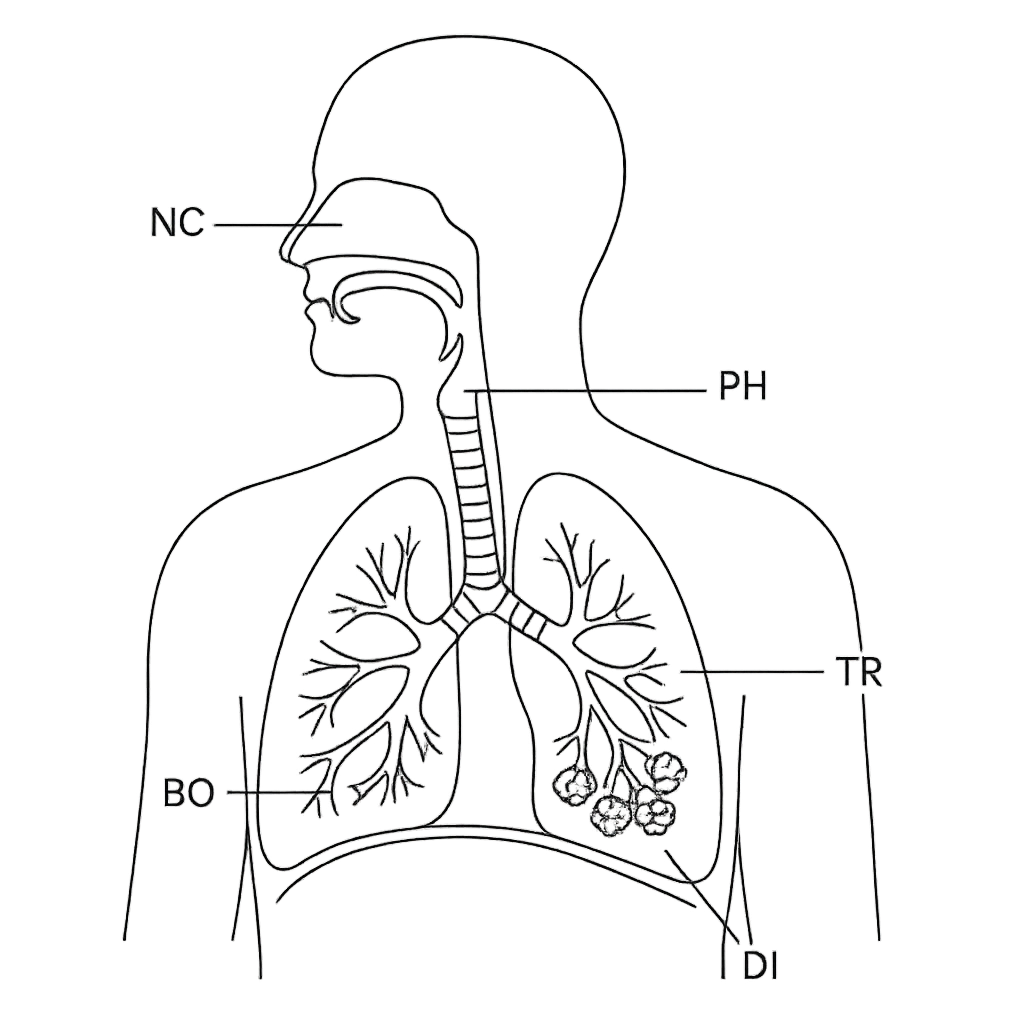
The diagram shows the human respiratory system with labelled parts: nasal cavity (NC), pharynx (PH), larynx (LA), trachea (TR), bronchi (BR), bronchioles (BO), alveoli (AL) and diaphragm (DI). Identify the structure that is the primary site of gas exchange. Assuming the total lung volume is 6 L and alveoli occupy 74 % of this volume, and that the lung contains approximately \(4.8 \times 10^{8}\) alveoli of equal size, calculate the total internal surface area of the alveoli (in square metres) available for diffusion. (Treat each alveolus as a sphere.)
A. Alveoli; approximately 150 m²
B. Bronchioles; approximately 102 m²
C. Alveoli; approximately 80 m²
Correct D. Alveoli; approximately 102 m²

Correct Answer: D

Want to see the full step-by-step solution? Unlock AI Explanation & Analytics
Question 4 View Details
In a lake, net primary productivity (NPP) is \(800\ \text{g C m}^{-2}\text{yr}^{-1}\). Of this primary production, 60 % is consumed by herbivorous zooplankton. Of the herbivore biomass, 20 % is transferred to small fish (secondary consumers), and 10 % of the small‑fish biomass is transferred to large predatory fish (tertiary consumers). Given that 1 g of carbon releases 9 kcal of energy, calculate:\n\na) the energy (kcal) available to herbivores per m² per year;\nb) the energy available to small fish;\nc) the energy available to large predatory fish.
Correct A. Herbivores: 4320 kcal; Small fish: 864 kcal; Large predatory fish: 86.4 kcal
B. Herbivores: 3840 kcal; Small fish: 768 kcal; Large predatory fish: 76.8 kcal
C. Herbivores: 4800 kcal; Small fish: 960 kcal; Large predatory fish: 96 kcal
D. Herbivores: 4320 kcal; Small fish: 720 kcal; Large predatory fish: 72 kcal

Correct Answer: A

Want to see the full step-by-step solution? Unlock AI Explanation & Analytics
Question 5 View Details
A desert plant reduces its stomatal density from \(300\ \text{stomata mm}^{-2}\) to \(150\ \text{stomata mm}^{-2}\) compared with a related mesic species. Each stomata transpires water at a rate of \(0.05\ \mu\text{mol H}_{2}\text{O s}^{-1}\) under the given conditions. If the leaf area is \(50\ \text{cm}^{2}\), determine:\n1) the reduction in total water loss (in mmol h\(^{-1}\)) due to the lower stomatal density alone;\n2) if the desert plant also increases leaf thickness, reducing the transpiration rate per stomata by 30 %, calculate the total water loss (in mmol h\(^{-1}\)) after both adaptations.
A. Reduction: 150,000 mmol h⁻¹; Total after both adaptations: 105,000 mmol h⁻¹
B. Reduction: 135,000 mmol h⁻¹; Total after both adaptations: 175,500 mmol h⁻¹
Correct C. Reduction: 135,000 mmol h⁻¹; Total after both adaptations: 94,500 mmol h⁻¹
D. Reduction: 1,350 mmol h⁻¹; Total after both adaptations: 945 mmol h⁻¹

Correct Answer: C

Want to see the full step-by-step solution? Unlock AI Explanation & Analytics
Question 6 View Details
Organism A is multicellular, eukaryotic, has cell walls made of cellulose, contains chloroplasts and reproduces via spores. Organism B is multicellular, eukaryotic, has cell walls made of chitin, forms hyphae and reproduces via spores. What is the highest taxonomic rank (most inclusive) that both organisms belong to?
Correct A. Domain Eukarya
B. Domain Bacteria
C. Domain Prokarya
D. Domain Archaea

Correct Answer: A

Want to see the full step-by-step solution? Unlock AI Explanation & Analytics
Question 7 View Details
In a study of 2000 individuals, 800 are smokers and 1200 are non‑smokers. Among smokers, 96 develop disease X; among non‑smokers, 48 develop disease X. Calculate the relative risk of disease X for smokers compared with non‑smokers, and determine the attributable risk percent among the exposed group.
Correct A. Relative risk = 3; Attributable risk percent ≈ 66.7 %
B. Relative risk = 4; Attributable risk percent ≈ 75 %
C. Relative risk = 3; Attributable risk percent ≈ 60 %
D. Relative risk = 2; Attributable risk percent ≈ 50 %

Correct Answer: A

Want to see the full step-by-step solution? Unlock AI Explanation & Analytics
Question 8 View Details
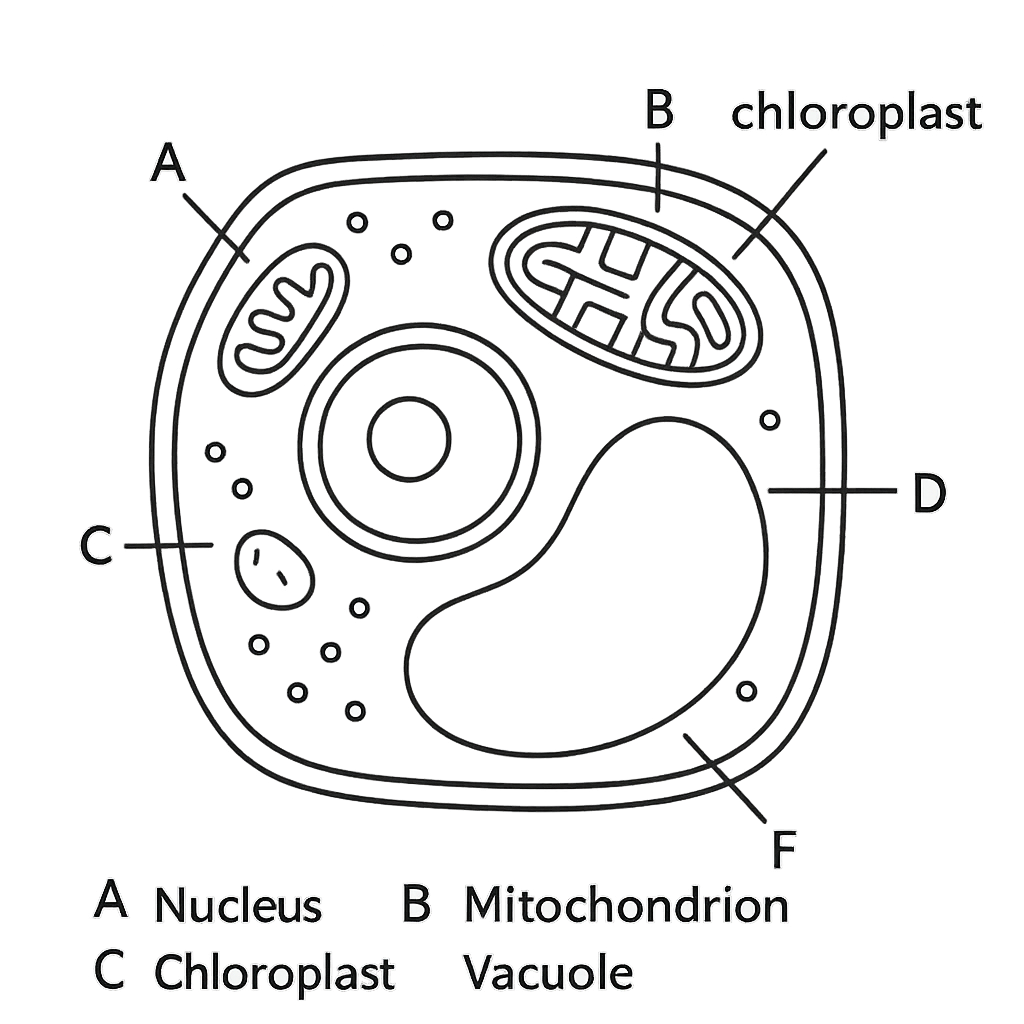
In the diagram of a plant cell, the organelle labelled 'C' is shown. Identify this organelle and state its primary function.
A. Golgi apparatus; protein modification
B. Vacuole; storage of nutrients
Correct C. Chloroplast; photosynthesis
D. Mitochondrion; cellular respiration

Correct Answer: C

Want to see the full step-by-step solution? Unlock AI Explanation & Analytics
Question 9 View Details
A subject produces 1.5 L of urine per day containing urea at a concentration of 30 g L^{-1}. The subject's daily protein intake is 80 g, and protein is on average 16 % nitrogen by weight. Assume that 90 % of the absorbed nitrogen is excreted as urea (molar mass of urea = 60 g mol^{-1}; atomic mass of nitrogen = 14 g mol^{-1}). Calculate the expected mass of urea excreted per day and compare it with the measured urinary urea mass. State the difference.
A. Expected ≈ 35 g; measured 35 g; excess ≈ 0 g
B. Expected ≈ 20 g; measured 50 g; excess ≈ 30 g
Correct C. Expected ≈ 25 g; measured 45 g; excess ≈ 20 g
D. Expected ≈ 30 g; measured 40 g; excess ≈ 10 g

Correct Answer: C

Want to see the full step-by-step solution? Unlock AI Explanation & Analytics
Question 10 View Details
During mitosis, at which phase do sister chromatids separate and move toward opposite poles?
Correct A. Anaphase
B. Prophase
C. Telophase
D. Metaphase

Correct Answer: A

Want to see the full step-by-step solution? Unlock AI Explanation & Analytics
Question 11 View Details
A newly emerging viral disease has a basic reproduction number \(R_0 = 3.5\). A vaccine available for this disease is 80 % effective in preventing infection. (a) What is the minimum proportion of the total population that must be immunised with this vaccine to achieve herd immunity? Express your answer as a percentage to one decimal place. (b) If only 60 % of the population can be reached by the vaccination programme, what is the effective reproduction number \(R_{\text{eff}}\) that would result?
A. 85.7 % ; 1.50
Correct B. 89.3 % ; 1.82
C. 90.0 % ; 2.00
D. 78.6 % ; 2.10

Correct Answer: B

Want to see the full step-by-step solution? Unlock AI Explanation & Analytics
Question 12 View Details
Plant cells contain a large central vacuole that stores solutes. A leaf cell is placed in an external solution containing 0.5 M sucrose, while the vacuole initially contains 0.8 M sucrose. (a) Predict the direction of water movement between the vacuole and the external solution. (b) State which cellular structure primarily maintains the cell's rigidity after the water movement.
Correct A. Water moves out of the vacuole; cell wall
B. Water moves into the vacuole; plasma membrane
C. Water moves out of the vacuole; cytoskeleton
D. Water moves into the vacuole; cell wall

Correct Answer: A

Want to see the full step-by-step solution? Unlock AI Explanation & Analytics
Question 13 View Details
An unknown microorganism shows the following characteristics: - Cells lack a true nucleus and other membrane‑bound organelles. - The organism reproduces by binary fission. - Its cell wall contains peptidoglycan. - It requires oxygen for growth. Based on these traits, determine (a) the kingdom to which the organism belongs and (b) the most probable phylum within that kingdom.
A. Kingdom Monera (Bacteria); Phylum Firmicutes
B. Kingdom Protista (Protozoa); Phylum Proteobacteria
C. Kingdom Monera (Archaea); Phylum Proteobacteria
Correct D. Kingdom Monera (Bacteria); Phylum Proteobacteria

Correct Answer: D

Want to see the full step-by-step solution? Unlock AI Explanation & Analytics
Question 14 View Details
In pea plants, the allele for tall stems (A) is dominant over short (a), and the allele for purple flowers (B) is dominant over white (b). The two genes are linked on the same chromosome with a recombination frequency of 10 %. A plant heterozygous for both traits (genotype AB/ab) is crossed with a plant homozygous recessive (ab/ab). Calculate the expected phenotypic ratio of the offspring.
A. 3:3:1:9 (tall‑purple : short‑white : tall‑white : short‑purple)
B. 1:9:9:1 (tall‑purple : short‑white : tall‑white : short‑purple)
Correct C. 9:9:1:1 (tall‑purple : short‑white : tall‑white : short‑purple)
D. 9:3:3:1 (tall‑purple : short‑purple : tall‑white : short‑white)

Correct Answer: C

Want to see the full step-by-step solution? Unlock AI Explanation & Analytics
Question 15 View Details
Blood calcium concentration falls to 1.0 mmol L\(^{-1}\) (normal range 1.2-1.3 mmol L\(^{-1}\)). (a) Identify the organ that detects this change and initiates the hormonal response. (b) List, in order, the three main physiological actions triggered by the released hormone that restore calcium to the normal range.
A. Pituitary gland; (1) bone resorption, (2) increased renal reabsorption + calcitonin release, (3) increased intestinal absorption
B. Thyroid gland; (1) increased bone formation, (2) decreased renal reabsorption + vitamin D inhibition, (3) decreased intestinal absorption
Correct C. Parathyroid glands; (1) bone resorption, (2) increased renal reabsorption + vitamin D activation, (3) increased intestinal absorption
D. Parathyroid glands; (1) bone formation, (2) increased renal excretion + vitamin D activation, (3) increased intestinal secretion

Correct Answer: C

Want to see the full step-by-step solution? Unlock AI Explanation & Analytics
Question 16 View Details
In a simple three‑trophic‑level ecosystem, grass produces (5,000\,\text{kg}\) of biomass per year. Herbivores (rabbits) convert \(10\%\) of the grass biomass into their own biomass. A disease reduces the rabbit biomass by \(20\%\) each year before they are consumed by carnivores (foxes). Foxes convert \(15\%\) of the surviving rabbit biomass into fox biomass. Additionally, foxes suffer a natural mortality loss of \(10\%\) of their biomass each year; the lost biomass is recycled to the rabbit level with a conversion efficiency of \(10\%\) and the resulting rabbit biomass is again available to foxes with the same \(15\%\) efficiency. Assuming no other inputs or losses, what is the net fox biomass (in kg) present after one year?
A. 45.09 kg
B. 60.12 kg
Correct C. 54.09 kg
D. 49.99 kg

Correct Answer: C

Want to see the full step-by-step solution? Unlock AI Explanation & Analytics
Question 17 View Details
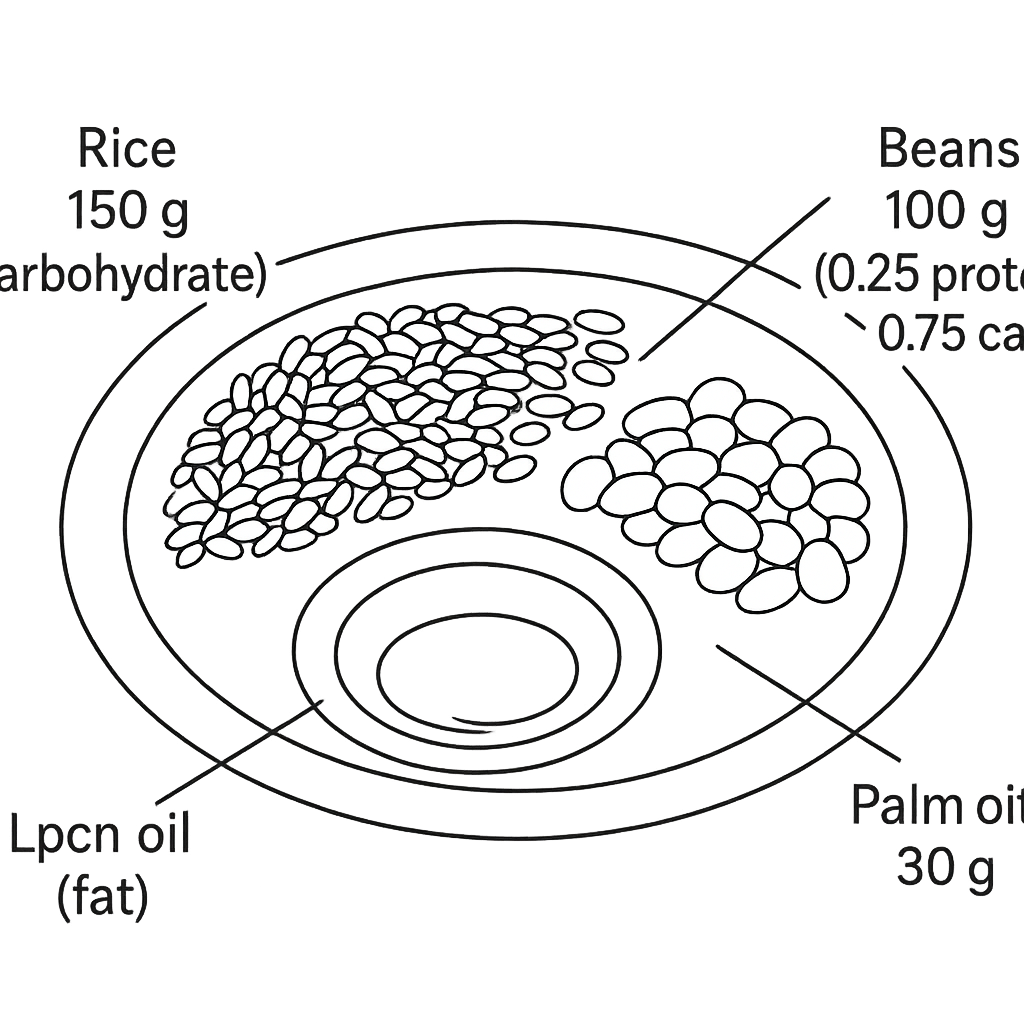
The diagram shows a plate containing three food items with their masses: 150 g of cooked white rice (pure carbohydrate), 100 g of boiled beans (25 % protein, 75 % carbohydrate by mass) and 30 g of palm oil (pure fat). Using the energy values 4 kcal g⁻¹ for carbohydrate and protein and 9 kcal g⁻¹ for fat, calculate (a) the total caloric content of the meal, (b) the caloric contribution of each macronutrient, and (c) which macronutrient supplies the greatest proportion of the total calories, giving the percentage to the nearest whole number.
A. Carbohydrates, approximately 65 % of total calories
B. Proteins, approximately 71 % of total calories
C. Fats, approximately 71 % of total calories
Correct D. Carbohydrates, approximately 71 % of total calories

Correct Answer: D

Want to see the full step-by-step solution? Unlock AI Explanation & Analytics
Question 18 View Details
A sprinter reacts to the starting gun with a reaction time of 0.12 s. He then accelerates uniformly from rest to a speed of 10 m s⁻¹ in 0.30 s and maintains this speed for the remainder of a 40 m race. Determine the total time taken to complete the race, giving your answer to two decimal places.
A. 4.12 s
B. 4.80 s
C. 4.55 s
Correct D. 4.27 s

Correct Answer: D

Want to see the full step-by-step solution? Unlock AI Explanation & Analytics
Question 19 View Details
Glucose homeostasis can be described by the equation \(\text{Rate}_{\text{entry}} = k \times [G]\), where \([G]\) is the plasma glucose concentration (mmol L⁻¹) and \(k\) is the removal constant (min⁻¹). In the fasting state, basal glucose production supplies 2 mmol min⁻¹ and the removal constant is \(k = 0.8\ \text{min}^{-1}\). (a) Calculate the fasting steady‑state glucose concentration. (b) After a meal, an additional 12 mmol min⁻¹ of glucose enters the bloodstream. Assuming the removal constant remains unchanged, what is the new steady‑state concentration? (c) If insulin resistance reduces the removal constant to \(k = 0.5\ \text{min}^{-1}\) while the post‑meal entry rate stays at 12 mmol min⁻¹, what is the resulting steady‑state concentration?
A. 3.0 mmol L⁻¹; 18.5 mmol L⁻¹; 30 mmol L⁻¹
B. 2.0 mmol L⁻¹; 15.0 mmol L⁻¹; 24 mmol L⁻¹
C. 2.8 mmol L⁻¹; 16.0 mmol L⁻¹; 26 mmol L⁻¹
Correct D. 2.5 mmol L⁻¹; 17.5 mmol L⁻¹; 28 mmol L⁻¹

Correct Answer: D

Want to see the full step-by-step solution? Unlock AI Explanation & Analytics
Question 20 View Details
A typical animal cell contains about 2 000 mitochondria. Each mitochondrion can synthesize approximately \(2.5 \times 10^{-9}\) J of ATP per second. Estimate the total amount of ATP‑derived energy (in joules) produced by the cell each second. Express your answer in scientific notation to two significant figures.
Correct A. 5.0 × 10⁻⁶ J s⁻¹
B. 5.0 × 10⁻⁵ J s⁻¹
C. 2.5 × 10⁻⁶ J s⁻¹
D. 1.0 × 10⁻⁵ J s⁻¹

Correct Answer: A

Want to see the full step-by-step solution? Unlock AI Explanation & Analytics
Question 21 View Details
A student's daily diet provides a total of \(2500\ \text{kJ}\) of energy. The macronutrients are present in the weight ratio carbohydrate\ :\ protein\ :\ fat = \(3\!:\!2\!:\!1\). The energy yields are \(17\ \text{kJ\ g}^{-1}\) for carbohydrate and protein, and \(37\ \text{kJ\ g}^{-1}\) for fat. Calculate the percentage of the total energy that is supplied by each macronutrient, giving your answers to one decimal place.
A. Carbohydrate ≈ 38.5 %, Protein ≈ 31.0 %, Fat ≈ 30.5 %
B. Carbohydrate ≈ 45.0 %, Protein ≈ 25.0 %, Fat ≈ 30.0 %
Correct C. Carbohydrate ≈ 41.8 %, Protein ≈ 27.9 %, Fat ≈ 30.3 %
D. Carbohydrate ≈ 42.0 %, Protein ≈ 28.0 %, Fat ≈ 30.0 %

Correct Answer: C

Want to see the full step-by-step solution? Unlock AI Explanation & Analytics
Question 22 View Details
The glomerular filtration rate (GFR) in a kidney is \(120\ \text{mL\ min}^{-1}\). Plasma urea concentration is \(0.5\ \text{g\ L}^{-1}\), and \(85\%\) of the filtered urea is re‑absorbed. Determine the rate of urea excretion in grams per minute.
Correct A. 0.009 g min⁻¹ (or 9 mg min⁻¹)
B. 0.012 g min⁻¹ (or 12 mg min⁻¹)
C. 0.010 g min⁻¹ (or 10 mg min⁻¹)
D. 0.008 g min⁻¹ (or 8 mg min⁻¹)

Correct Answer: A

Want to see the full step-by-step solution? Unlock AI Explanation & Analytics
Question 23 View Details
In *Drosophila*, genes \(A\) and \(B\) are linked on the same chromosome with a recombination frequency of \(10\%\). A heterozygote with the cis arrangement \(AB/ab\) is test‑crossed with a homozygous recessive \(aabb\). (i) What phenotypic ratio is expected among the progeny? (ii) If 200 progeny are obtained, how many are expected to be recombinants?
A. Phenotypic ratio 9:9:2:2; 30 recombinant offspring out of 200
Correct B. Phenotypic ratio 9:9:1:1; 20 recombinant offspring out of 200
C. Phenotypic ratio 9:9:1:1; 10 recombinant offspring out of 200
D. Phenotypic ratio 8:8:1:1; 15 recombinant offspring out of 200

Correct Answer: B

Want to see the full step-by-step solution? Unlock AI Explanation & Analytics
Question 24 View Details
A spherical animal cell has a radius of \(10\ \mu\text{m}\). Its plasma‑membrane permeability to glucose is \(P = 1.2 \times 10^{-5}\ \text{cm\ s}^{-1}\). External glucose concentration is \(5\ \text{mM}\) and internal concentration is \(1\ \text{mM}\). Using the equation \(\text{Rate}=P\times A\times\Delta C\) (where \(A\) is the membrane surface area and \(\Delta C\) the concentration difference in \(\text{mol\ cm}^{-3}\)), calculate the rate of glucose entry into the cell in \(\text{mol\ s}^{-1}\). Express your answer in scientific notation to two significant figures.
A. 5.5×10⁻¹⁶ mol s⁻¹
B. 6.0×10⁻¹⁵ mol s⁻¹
C. 4.8×10⁻¹⁶ mol s⁻¹
Correct D. 6.0×10⁻¹⁶ mol s⁻¹

Correct Answer: D

Want to see the full step-by-step solution? Unlock AI Explanation & Analytics
Question 25 View Details
A simple reflex arc consists of a sensory neuron \(0.8\ \text{m}\) long, an interneuron that adds a central‑processing delay of \(2\ \text{ms}\), and a motor neuron \(0.6\ \text{m}\) long. Conduction velocities are \(80\ \text{m\ s}^{-1}\) for the sensory fibre and \(60\ \text{m\ s}^{-1}\) for the motor fibre. Each synapse introduces a delay of \(0.5\ \text{ms}\). Determine the total time from the moment a stimulus is applied to the muscle contraction, in milliseconds.
A. 30 ms
Correct B. 23 ms
C. 27 ms
D. 21 ms

Correct Answer: B

Want to see the full step-by-step solution? Unlock AI Explanation & Analytics

Master the Exam!

You've seen a preview, but there are thousands more questions plus AI tutor to break down complex solutions.

Unlock Full Access Available for Android & Windows
Help others prepare! Share this practice hub:
Chat with Support