neco model questions vol1 2018 physics | Essay

Prepare for your exams with neco model questions vol1 questions? Reviewing past/model questions is one of the most effective ways to guarantee a high score. This practice hub features authentic 2018 physics (Essay) questions designed to simulate the real exam environment.

Practice these randomly selected questions to test your readiness.
Question 1 View Details
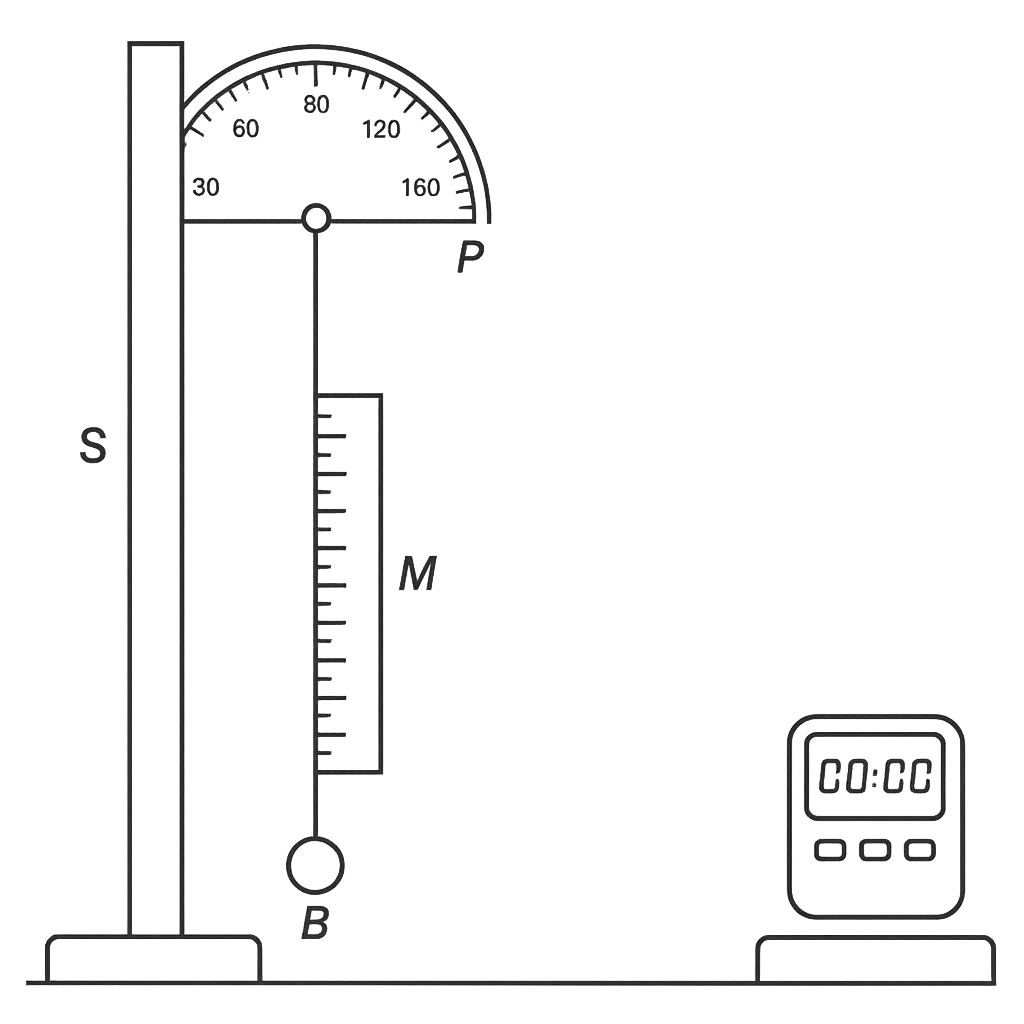
A laboratory is set up to determine the acceleration due to gravity (g) using a simple pendulum. The apparatus consists of a thin, non‑elastic string attached to a small spherical bob, a fixed support, a metre‑scale for measuring the length of the pendulum, a digital stopwatch, and a protractor for measuring the swing angle. The length of the string is measured from the point of suspension to the centre of the bob.
Question Parts
(a)
State the theoretical expression that relates the period of a simple pendulum to its length and g, and explain briefly the assumptions involved in deriving this expression.
(b)
Describe a step‑by‑step procedure to measure the period of the pendulum accurately, including how you would obtain a reliable average period.
(c)
The length of the pendulum is measured as L = 0.500 m (±0.001 m). After performing the procedure, the average period obtained from 20 oscillations is 1.42 s (±0.02 s). Calculate the experimental value of g and its percentage uncertainty.
(d)
Identify two possible sources of systematic error in this experiment and suggest a method to reduce each error.
Detailed Essay Solution & Marking Scheme Available

Get the step-by-step mathematical proofs, key points required by examiners, and a comprehensive breakdown from our AI Tutor.
Question 2 View Details
A boat can travel at a speed of 5.0 m s⁻¹ in still water. It attempts to cross a river that flows uniformly at 3.0 m s⁻¹ from west to east. The river is 200 m wide.
Question Parts
(a)
If the boat points directly north (perpendicular to the bank) and maintains its speed relative to the water, determine the magnitude and direction of the boat's resultant velocity relative to the ground.
(b)
To land at a point directly opposite its starting point on the far bank, the boat must aim upstream at an angle θ to the north‑west direction. Determine the required heading angle (relative to the north) and the time taken to cross the river.
(c)
If the river speed were to double while the boat's speed in still water remains unchanged, discuss qualitatively how the required heading angle and crossing time would be affected.
Detailed Essay Solution & Marking Scheme Available

Get the step-by-step mathematical proofs, key points required by examiners, and a comprehensive breakdown from our AI Tutor.

Question 3 View Details
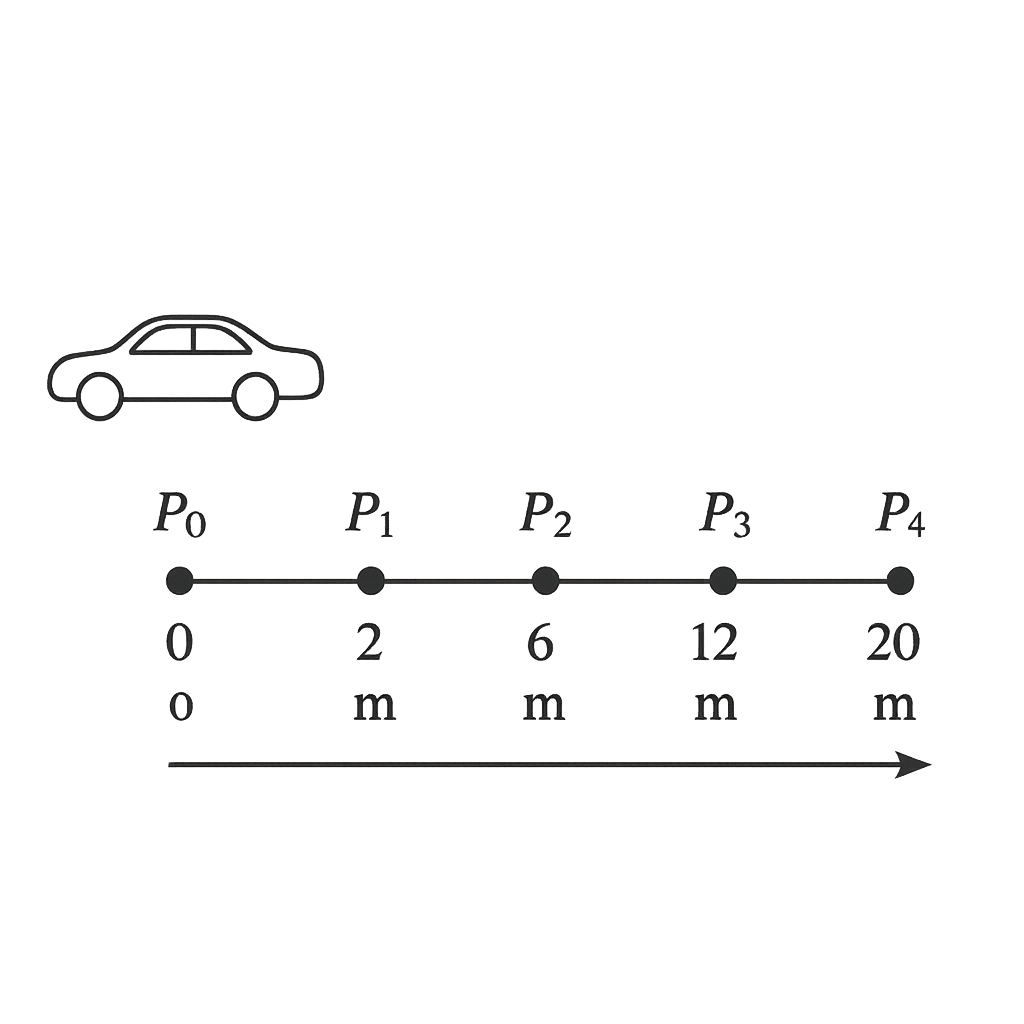
A car moves in a straight line. The motion diagram for the first five seconds of its travel is shown in the illustration. The diagram represents equal time intervals of 1 s. The successive positions of the car from the start are labelled P0, P1, P2, P3 and P4 and are spaced as follows: P0 is the starting point, P1 is 2 m from P0, P2 is 6 m from P0, P3 is 12 m from P0 and P4 is 20 m from P0.
Question Parts
(a)
State the type of motion exhibited by the car during the first five seconds and justify your answer using the diagram.
(b)
Calculate the instantaneous speed of the car at t = 5 s.
(c)
Determine the magnitude of the constant acceleration of the car.
(d)
If the car continues to move with the same constant acceleration, find the total distance it will travel in the next 3 seconds (from t =5 s to t =8 s).
Detailed Essay Solution & Marking Scheme Available

Get the step-by-step mathematical proofs, key points required by examiners, and a comprehensive breakdown from our AI Tutor.

Question 4 View Details
A uniform block of mass 2.0 kg rests on a smooth inclined plane that makes an angle of 30° with the horizontal. The coefficient of static friction between the block and the plane is μ_s.
Question Parts
(a)
If the block remains at rest on the incline, calculate the minimum value of μ_s required to prevent sliding.
(b)
A horizontal force of 20 N is now applied to the block (directed up the incline). Determine the magnitude of the block’s acceleration up the plane.
(c)
The block is released from rest at the top of a 5.0‑m long incline (same 30°) while the 20 N horizontal force continues to act. Find the speed of the block when it reaches the bottom of the incline.
Detailed Essay Solution & Marking Scheme Available

Get the step-by-step mathematical proofs, key points required by examiners, and a comprehensive breakdown from our AI Tutor.

Question 5 View Details
A block of mass 5.0 kg is released from rest at the top of a 4.0 m long smooth incline that makes an angle of 30° with the horizontal. The block slides down the incline and reaches the bottom with a speed of 3.0 m s⁻¹. The coefficient of kinetic friction between the block and the incline is not given. (a) Determine the coefficient of kinetic friction (μ) between the block and the incline. (b) Calculate the total work done by the frictional force during the descent. (c) The block is then attached to a motor that pulls it up the same incline at a constant speed of 2.0 m s⁻¹. The motor supplies a constant pulling force equal to the component of the block’s weight parallel to the incline plus the frictional force opposing the motion. Calculate the power output of the motor.
Question Parts
(a)
Determine the coefficient of kinetic friction (μ) between the block and the incline.
(b)
Calculate the total work done by the frictional force during the descent.
(c)
The block is now pulled up the same incline at a constant speed of 2.0 m s⁻¹ by a motor that supplies a force equal to the component of the block’s weight parallel to the incline plus the frictional force. Calculate the power output of the motor.
Detailed Essay Solution & Marking Scheme Available

Get the step-by-step mathematical proofs, key points required by examiners, and a comprehensive breakdown from our AI Tutor.

Question 6 View Details
The diagram shows a simple compound machine consisting of a uniform rigid beam AB of total length 2.0 m pivoted at point O. The fulcrum O is located 0.6 m from the left end A and therefore 1.4 m from the right end B. A load of weight W = 500 N hangs vertically from end A. The right end B is attached to a mass‑less rope that passes over a fixed frictionless pulley C fixed to the ceiling; the other end of the rope is pulled vertically upward by an effort force F applied at B. The pivot at O experiences a resisting (frictional) torque of 10 N·m opposing the rotation caused by the effort. The system is in static equilibrium.
Question Parts
(a)
Determine the magnitude of the effort force F required to keep the system in equilibrium, taking the frictional torque of 10 N·m at the fulcrum into account.
(b)
Calculate:
() the ideal mechanical advantage (IMA) of the lever,
() the actual mechanical advantage (AMA),
() the efficiency of the machine (in %).
(c)
Explain why the efficiency is less than 100 % and describe how it would change if the frictional torque were eliminated.
Detailed Essay Solution & Marking Scheme Available

Get the step-by-step mathematical proofs, key points required by examiners, and a comprehensive breakdown from our AI Tutor.

Question 7 View Details
A vertical cylindrical tank 10.0 m high has a constant cross‑sectional area of 2.00 m². The tank is closed at the top and initially contains dry air at 1.00 atm and 27 °C. Water is slowly pumped into the tank until the water level reaches 6.0 m above the bottom. Because of heat exchange with the surroundings the temperature of the trapped air rises to 37 °C. Assume the air behaves as an ideal gas and the water is incompressible.
Question Parts
(a)
Calculate the final absolute pressure of the trapped air (in kPa).
(b)
Determine the magnitude of the force exerted by the water on the bottom of the tank (in newtons).
(c)
A pressure gauge connected to the bottom of the tank reads the total pressure (air + water). Calculate the gauge reading (in kPa).
(d)
Briefly discuss two practical reasons why the measured gauge pressure might differ from the calculated value.
Detailed Essay Solution & Marking Scheme Available

Get the step-by-step mathematical proofs, key points required by examiners, and a comprehensive breakdown from our AI Tutor.

Question 8 View Details
A 150 g block of copper initially at 150 °C is gently placed into a well‑insulated calorimeter that contains 200 g of water at 25 °C. The calorimeter itself has a heat capacity of 0.50 kJ °C⁻¹. After the system reaches thermal equilibrium the final temperature is 30 °C. It is known that 5 % of the heat released by the copper is lost to the surroundings during the process.
Question Parts
(a)
Determine the specific heat capacity of copper (in J kg⁻¹ °C⁻¹) taking the 5 % heat loss into account.
(b)
If the copper block is replaced by an unknown metal of the same mass and the same initial temperature, and the calorimeter now records a final temperature of 45 °C with **no** heat loss, determine the specific heat capacity of the unknown metal (in J kg⁻¹ °C⁻¹).
Detailed Essay Solution & Marking Scheme Available

Get the step-by-step mathematical proofs, key points required by examiners, and a comprehensive breakdown from our AI Tutor.

Master the Exam!

You've seen a preview, but there are thousands more questions plus AI tutor to break down complex solutions.

Unlock Full Access Available for Android & Windows
Help others prepare! Share this practice hub:
Chat with Support