neco model questions vol1 2018 biology | Objective

Prepare for your exams with neco model questions vol1 questions? Reviewing past/model questions is one of the most effective ways to guarantee a high score. This practice hub features authentic 2018 biology (Objective) questions designed to simulate the real exam environment.

Practice these randomly selected questions to test your readiness.

Question 1 View Details
A desert insect experiences a 40 % increase in cuticle thickness and a 20 % decrease in its metabolic rate relative to a closely related species living in a humid environment. Under the humid conditions the insect loses \(100\ \text{mg}\) of water per day. Water loss is directly proportional to metabolic rate and inversely proportional to cuticle thickness. (i) Calculate the water loss of the desert insect per day. (ii) Considering each change separately (i.e., first only the thickness change, then only the metabolic change), determine which adaptation contributes more to the reduction in water loss.
Correct A. Water loss ≈ 57.14 mg day⁻¹; the increased cuticle thickness contributes more to the reduction.
B. Water loss ≈ 71.43 mg day⁻¹; the decreased metabolic rate contributes more to the reduction.
C. Water loss ≈ 57.14 mg day⁻¹; the decreased metabolic rate contributes more to the reduction.
D. Water loss ≈ 45.00 mg day⁻¹; the increased cuticle thickness contributes more to the reduction.

Correct Answer: A

Want to see the full step-by-step solution? Unlock AI Explanation & Analytics
Question 2 View Details
In a reflex pathway a sensory neuron conducts an impulse over \(0.40\ \text{m}\) at \(80\ \text{m s}^{-1}\), an interneuron over \(0.20\ \text{m}\) at \(60\ \text{m s}^{-1}\), and a motor neuron over \(0.50\ \text{m}\) at \(70\ \text{m s}^{-1}\). Each synapse introduces a delay of \(0.5\ \text{ms}\). The adrenal medulla releases epinephrine that reaches its target tissue through the bloodstream travelling \(2.0\ \text{m}\) at \(0.5\ \text{m s}^{-1}\). (i) Calculate the total time from stimulus to muscle contraction via the neural reflex. (ii) Calculate the time for the hormonal response to reach the target tissue. (iii) Which response is faster and by how many milliseconds?
Correct A. Neural reflex ≈ 16.5 ms; hormonal response ≈ 4000 ms; the neural response is faster by about 3983 ms.
B. Neural reflex ≈ 16.5 ms; hormonal response ≈ 3500 ms; the neural response is faster by about 3483 ms.
C. Neural reflex ≈ 16.5 ms; hormonal response ≈ 4000 ms; the hormonal response is faster by about 3983 ms.
D. Neural reflex ≈ 20.0 ms; hormonal response ≈ 4000 ms; the neural response is faster by about 3980 ms.

Correct Answer: A

Want to see the full step-by-step solution? Unlock AI Explanation & Analytics
Question 3 View Details
In a beetle population the frequency of allele \(A\) (green colour) is \(p=0.6\) and allele \(a\) (brown colour) is \(q=0.4\). The green phenotype (genotypes \(AA\) and \(Aa\)) has a 20 % survival advantage over the brown phenotype (\(aa\)). Assuming random mating and that selection acts only on survival, (i) calculate the allele frequencies after one generation of selection, and (ii) determine the change in heterozygosity \(H=2pq\) caused by this selection.
A. After selection \(p'≈0.590\), \(q'≈0.410\); heterozygosity falls from 0.480 to ≈0.466 (decrease ≈0.014).
Correct B. After selection \(p'≈0.617\), \(q'≈0.383\); heterozygosity falls from 0.480 to ≈0.473 (decrease ≈0.007).
C. After selection \(p'≈0.600\), \(q'≈0.400\); heterozygosity unchanged at 0.480 (no change).
D. After selection \(p'≈0.650\), \(q'≈0.350\); heterozygosity rises to ≈0.455 (increase ≈0.025).

Correct Answer: B

Want to see the full step-by-step solution? Unlock AI Explanation & Analytics
Question 4 View Details
A 70 kg adult has a basal metabolic heat production of \(80\ \text{W}\). In a cold environment (\(5^{\circ}\text{C}\)) the body loses heat by convection according to \(Q = hA(T_{\text{body}}-T_{\text{env}})\) where the heat‑transfer coefficient \(h = 10\ \text{W m}^{-2}\,^{\circ}\text{C}^{-1}\) and the effective body surface area \(A = 1.8\ \text{m}^2\). The sympathetic nervous system can increase metabolic heat production up to 300 % of the basal rate (i.e., a maximum of \(4 \times 80 = 320\ \text{W}\)). (i) Determine the heat loss that would occur if the core temperature remained at the normal \(37^{\circ}\text{C}\). (ii) Is the maximum metabolic heat production sufficient to maintain \(37^{\circ}\text{C}\)? (iii) If the body produces the maximum metabolic heat, calculate the new steady‑state core temperature.
A. Heat loss at 37 °C = 576 W; the maximum metabolic heat (320 W) is sufficient; the steady‑state temperature remains at 37 °C.
B. Heat loss at 37 °C = 504 W; the maximum metabolic heat (320 W) is insufficient; with maximal metabolism the steady‑state temperature falls to ≈30.2 °C.
C. Heat loss at 37 °C = 648 W; the maximum metabolic heat (320 W) is insufficient; with maximal metabolism the steady‑state temperature falls to ≈18.5 °C.
Correct D. Heat loss at 37 °C = 576 W; the maximum metabolic heat (320 W) is insufficient; with maximal metabolism the steady‑state temperature falls to ≈22.8 °C.

Correct Answer: D

Want to see the full step-by-step solution? Unlock AI Explanation & Analytics
Question 5 View Details
A student at sea level (barometric pressure \(P_B = 760\ \text{mmHg}\)) inhales dry air containing 21 % oxygen (\(F_{iO_2}=0.21\)). The water vapour pressure in the alveoli is \(P_{H_2O}=47\ \text{mmHg}\) and the respiratory quotient is \(R=0.8\). Alveolar ventilation is \(4\ \text{L min}^{-1}\) and carbon dioxide production is \(200\ \text{mL min}^{-1}\). (i) Using the alveolar gas equation \(P_{A O_2}=F_{iO_2}(P_B-P_{H_2O})-\frac{P_{aCO_2}}{R}\) and the relationship \(P_{aCO_2}= \frac{V_{CO_2}\times 0.863}{\dot V_A}\), calculate the alveolar partial pressure of oxygen \(P_{A O_2}\) at sea level. (ii) If the student ascends to an altitude where \(P_B = 600\ \text{mmHg}\), with all other variables unchanged, calculate the new \(P_{A O_2}\). (iii) What is the percentage decrease in alveolar \(P_{O_2}\) caused by the ascent?
A. Sea‑level \(P_{A O_2}\) ≈ 100.0 mmHg; at 600 mmHg barometric pressure ≈ 65.0 mmHg; the ascent reduces alveolar \(P_{O_2}\) by about 30 %.
B. Sea‑level \(P_{A O_2}\) ≈ 92.5 mmHg; at 600 mmHg barometric pressure ≈ 60.0 mmHg; the ascent reduces alveolar \(P_{O_2}\) by about 33 %.
Correct C. Sea‑level \(P_{A O_2}\) ≈ 95.8 mmHg; at 600 mmHg barometric pressure ≈ 62.2 mmHg; the ascent reduces alveolar \(P_{O_2}\) by about 35 %.
D. Sea‑level \(P_{A O_2}\) ≈ 90.0 mmHg; at 600 mmHg barometric pressure ≈ 58.0 mmHg; the ascent reduces alveolar \(P_{O_2}\) by about 38 %.

Correct Answer: C

Want to see the full step-by-step solution? Unlock AI Explanation & Analytics
Question 6 View Details
A plant cell contains a chloroplast with internal thylakoid membranes arranged in stacks called grana. If each granum consists of \(3\) thylakoid discs and a chloroplast has \(12\) grana, how many thylakoid discs are present? Additionally, state the primary role of thylakoid membranes in photosynthesis.
A. 48 discs; they are the site of the light‑dependent reactions of photosynthesis.
B. 30 discs; they are the site of the Calvin cycle.
Correct C. 36 discs; they are the site of the light‑dependent reactions of photosynthesis.
D. 36 discs; they are the site of the Calvin cycle.

Correct Answer: C

Want to see the full step-by-step solution? Unlock AI Explanation & Analytics
Question 7 View Details
A new viral disease has a basic reproduction number \(R_0 = 3.5\). The available vaccine is \(80\%\) effective. (i) What is the minimum proportion of the total population that must be vaccinated to achieve herd immunity? (ii) If the disease incubation period is \(5\) days and an infected individual becomes infectious \(2\) days after infection, how many days after the onset of symptoms will the individual have been infectious?
A. Approximately 85% (about 0.85) of the population must be vaccinated; the individual has been infectious for 5 days by the time symptoms appear.
B. Approximately 92% (about 0.92) of the population must be vaccinated; the individual has been infectious for 4 days by the time symptoms appear.
C. Approximately 78% (about 0.78) of the population must be vaccinated; the individual has been infectious for 2 days by the time symptoms appear.
Correct D. Approximately 89% (about 0.89) of the population must be vaccinated; the individual has been infectious for 3 days by the time symptoms appear.

Correct Answer: D

Want to see the full step-by-step solution? Unlock AI Explanation & Analytics
Question 8 View Details
A person at rest has a basal metabolic rate (BMR) of \(80\ \text{kcal h}^{-1}\), producing heat that must be dissipated to keep the core temperature at \(37^{\circ}\text{C}\). In a cold environment of \(5^{\circ}\text{C}\), the person wears a jacket with thermal resistance \(R = 0.3\ ^{\circ}\text{C h kcal}^{-1}\). Heat loss to the environment follows \( Q = \frac{\Delta T}{R}\), where \(\Delta T\) is the temperature difference between the skin (assumed equal to core) and the ambient. (i) Determine the rate of heat loss \(Q\) (kcal h\(^{-1}\)). (ii) Calculate the additional metabolic heat (kcal h\(^{-1}\)) the person must generate to maintain core temperature.
A. Heat loss ≈ 120 kcal h⁻¹; an additional 40 kcal h⁻¹ of metabolic heat is required.
B. Heat loss ≈ 95 kcal h⁻¹; an additional 15 kcal h⁻¹ of metabolic heat is required.
C. Heat loss ≈ 80 kcal h⁻¹; an additional 0 kcal h⁻¹ of metabolic heat is required.
Correct D. Heat loss ≈ 107 kcal h⁻¹; an additional 27 kcal h⁻¹ of metabolic heat is required.

Correct Answer: D

Want to see the full step-by-step solution? Unlock AI Explanation & Analytics
Question 9 View Details
A desert shrub has leaves with a total surface area of \(150\ \text{cm}^2\). The stomatal conductance of a typical leaf is \(g_s = 0.2\ \text{mol m}^{-2}\text{s}^{-1}\), and the vapor pressure deficit (VPD) between the leaf interior and the air is \(1.5\ \text{kPa}\). Transpiration rate \(E\) (mol H\(_2\)O s\(^{-1}\)) is given by \(E = g_s \times \text{VPD} \times A\), where \(A\) is leaf area in \(\text{m}^2\). The shrub has evolved (i) a waxy cuticle that reduces effective stomatal conductance by \(40\%\) and (ii) a leaf orientation that reduces the effective leaf area exposed to sunlight by \(30\%\). Determine the new transpiration rate after both adaptations and the percentage reduction in water loss compared to the original rate.
Correct A. New transpiration rate ≈ 1.9 × 10⁻³ mol s⁻¹; water loss is reduced by about 58%.
B. New transpiration rate ≈ 2.5 × 10⁻³ mol s⁻¹; water loss is reduced by about 45%.
C. New transpiration rate ≈ 1.2 × 10⁻³ mol s⁻¹; water loss is reduced by about 70%.
D. New transpiration rate ≈ 3.0 × 10⁻³ mol s⁻¹; water loss is reduced by about 30%.

Correct Answer: A

Want to see the full step-by-step solution? Unlock AI Explanation & Analytics
Question 10 View Details
A diploid human somatic cell undergoing mitosis starts with \(46\) chromosomes, each consisting of two sister chromatids. At the end of anaphase, how many chromosomes and how many chromatids are present in each of the two daughter nuclei?
A. Each daughter nucleus contains 23 chromosomes and 46 chromatids.
B. Each daughter nucleus contains 92 chromosomes and 92 chromatids.
Correct C. Each daughter nucleus contains 46 chromosomes and 46 chromatids.
D. Each daughter nucleus contains 46 chromosomes and 92 chromatids.

Correct Answer: C

Want to see the full step-by-step solution? Unlock AI Explanation & Analytics
Question 11 View Details
Fossil records show that Species A lived \(150\) million years ago and had a femur length of \(5\) cm and \(30\) teeth. Species B, appearing \(120\) million years ago, had a femur length of \(7\) cm and \(45\) teeth. Assuming linear change over time for each trait, which trait exhibited the higher rate of evolutionary change per million years? Provide the trait name.
A. Number of vertebrae
B. Femur length
Correct C. Number of teeth
D. Skull width

Correct Answer: C

Want to see the full step-by-step solution? Unlock AI Explanation & Analytics
Question 12 View Details
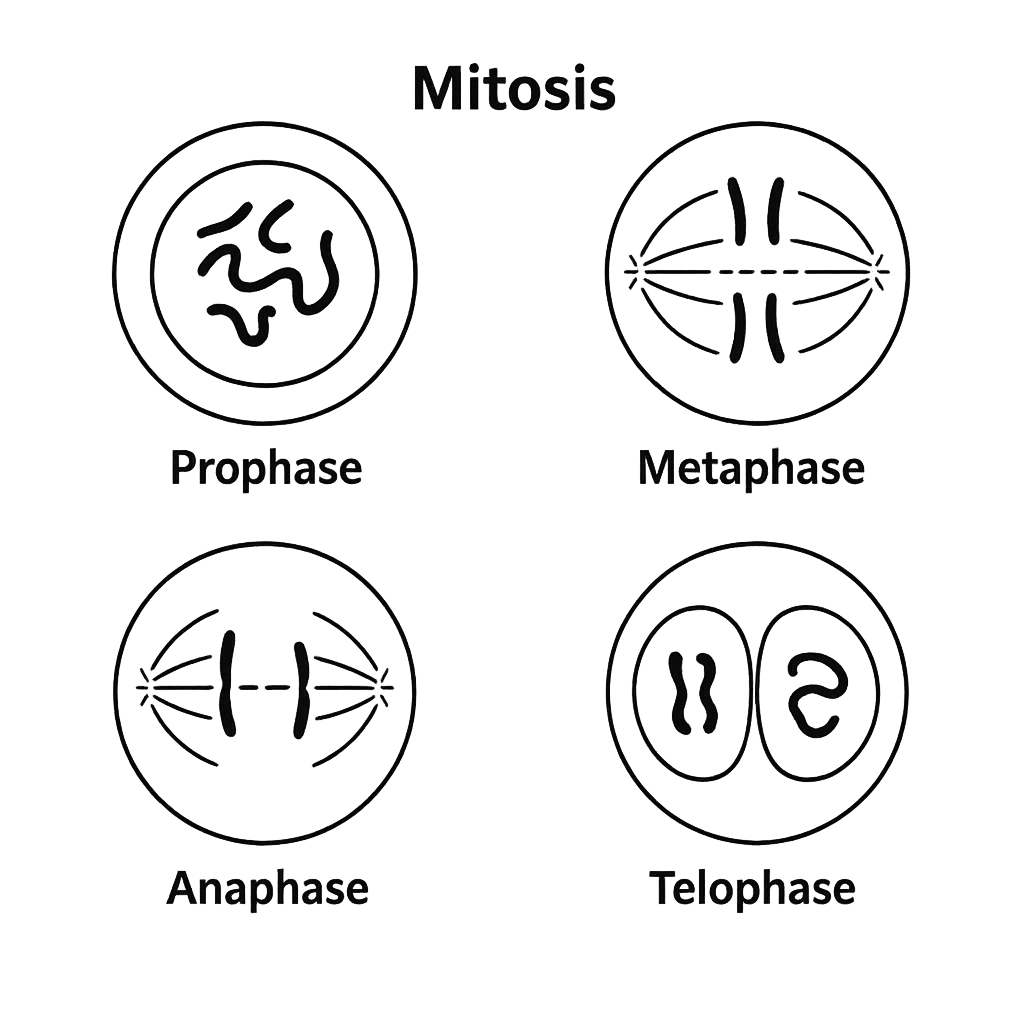
Refer to the labelled diagram of mitosis showing the four stages. Which stage is characterized by chromosomes aligning at the cell's equatorial plate?
A. Anaphase
B. Telophase
C. Prophase
Correct D. Metaphase

Correct Answer: D

Want to see the full step-by-step solution? Unlock AI Explanation & Analytics
Question 13 View Details
An animal maintains a core temperature of \(38^{\circ}\text{C}\). Heat loss occurs by conduction with coefficient \(k_{1}=0.2\ \text{kcal}/(\text{°C·h})\) and by convection with coefficient \(k_{2}=0.1\ \text{kcal}/(\text{°C·h})\). In an environment at \(20^{\circ}\text{C}\), total heat loss is given by \(Q = k_{1}\Delta T + k_{2}(\Delta T)^{2}\) where \(\Delta T\) is the temperature difference. If the basal metabolic heat production is \(80\ \text{kcal/h}\), calculate the amount of heat that must be dissipated by evaporation.
A. 52 kcal/h
Correct B. 44 kcal/h
C. 48 kcal/h
D. 40 kcal/h

Correct Answer: B

Want to see the full step-by-step solution? Unlock AI Explanation & Analytics
Question 14 View Details
In a population of 200 individuals, the frequency of allele \(A\) was \(0.50\) five generations ago and is \(0.55\) in the present generation. Assuming random mating, the expected standard deviation of allele‑frequency change due to genetic drift in one generation is \(\sigma = \sqrt{\dfrac{p(1-p)}{2N}}\), where \(p\) is the allele frequency and \(N\) the effective population size. Determine whether the observed change could be attributed to genetic drift alone (choose "drift" or "selection").
A. migration
Correct B. drift
C. mutation
D. selection

Correct Answer: B

Want to see the full step-by-step solution? Unlock AI Explanation & Analytics
Question 15 View Details
During a renal clearance test, the plasma concentration of inulin is \(0.12\ \text{g/L}\) and its urine concentration is also \(0.12\ \text{g/L}\). The urine flow rate is \(1.2\ \text{mL/min}\). (a) Calculate the glomerular filtration rate (GFR) using the clearance formula \(C = \dfrac{U \times V}{P}\). (b) Given a plasma glucose concentration of \(5\ \text{mmol/L}\) and a urine glucose concentration of \(0.5\ \text{mmol/L}\), determine the percentage of filtered glucose that is reabsorbed.
A. GFR = 12 mL/min; 90% reabsorbed
Correct B. GFR = 1.2 mL/min; 90% reabsorbed
C. GFR = 1.2 mL/min; 80% reabsorbed
D. GFR = 1.5 mL/min; 90% reabsorbed

Correct Answer: B

Want to see the full step-by-step solution? Unlock AI Explanation & Analytics
Question 16 View Details
In a lake ecosystem the net primary productivity (NPP) is 1200 g C m⁻² yr⁻¹. Herbivorous fish directly consume 15 % of the primary production, and the remaining primary production is decomposed and recycled with 30 % efficiency into detritus that is then consumed by detritivores. The overall transfer efficiency from primary producers to primary consumers (herbivores) is 10 %, and from detritus to primary consumers (detritivores) is 5 %. Calculate the total biomass of primary consumers (herbivores + detritivores) that can be supported (in g C m⁻²).
A. 18 g C m⁻²
B. 36 g C m⁻²
Correct C. 33.3 g C m⁻²
D. 120 g C m⁻²

Correct Answer: C

Want to see the full step-by-step solution? Unlock AI Explanation & Analytics
Question 17 View Details
A bacterial culture is inoculated with 10³ cells in a nutrient broth. The lag phase lasts 2 h, during which the population does not increase. After the lag phase the bacteria enter exponential growth with a generation time of 30 min until the population reaches 90 % of the carrying capacity, which is 10⁹ cells. The culture then enters stationary phase. Determine the total time (in hours) from inoculation until the culture reaches stationary phase.
A. 14
B. 8
Correct C. 12
D. 10

Correct Answer: C

Want to see the full step-by-step solution? Unlock AI Explanation & Analytics
Question 18 View Details
In a disc diffusion test a researcher measures zones of inhibition of 14 mm, 22 mm and 18 mm for antibiotics A, B and C respectively against a bacterial strain. The standard interpretive criteria for this organism are: susceptible if zone ≥ 20 mm, intermediate if 15 mm ≤ zone ≤ 19 mm, resistant if zone ≤ 14 mm. The agar depth used was 4 mm instead of the standard 5 mm, which increases zone diameters by approximately 10 % compared with the standard depth. Adjust the measured zones to the standard depth and state the susceptibility category for each antibiotic.
A. A: Intermediate; B: Resistant; C: Susceptible
B. A: Susceptible; B: Resistant; C: Intermediate
C. A: Resistant; B: Intermediate; C: Susceptible
Correct D. A: Resistant; B: Susceptible; C: Intermediate

Correct Answer: D

Want to see the full step-by-step solution? Unlock AI Explanation & Analytics
Question 19 View Details
A fish population in a lake follows the logistic growth model \( \frac{dN}{dt}=rN\left(1-\frac{N}{K}\right) \) where the intrinsic rate \(r = 0.8\ \text{yr}^{-1}\) and the carrying capacity \(K = 500{,}000\) fish. The fishery removes fish at a constant rate \(H\) (fish per year). Determine the maximum constant harvest \(H_{\text{max}}\) that allows the population to persist (i.e., a non‑zero equilibrium). Give \(H_{\text{max}}\) rounded to the nearest whole number (fish per year).
Correct A. 100000
B. 80000
C. 150000
D. 120000

Correct Answer: A

Want to see the full step-by-step solution? Unlock AI Explanation & Analytics
Question 20 View Details
In a plant the water potential in the leaf (\(\Psi_{\text{leaf}}\)) is -0.85 MPa and in the root (\(\Psi_{\text{root}}\)) is -0.15 MPa. The plant transpires water at a rate of \(5 \times 10^{-6}\ \text{m}^{3}\,\text{s}^{-1}\). The hydraulic conductivity of the xylem (\(L\)) is \(1.2 \times 10^{-7}\ \text{m}^{3}\,\text{s}^{-1}\,\text{MPa}^{-1}\). (i) Calculate the pressure gradient \(\Delta\Psi = \Psi_{\text{root}} - \Psi_{\text{leaf}}\) required to sustain the observed transpiration rate. (ii) State whether the given conductivity is sufficient to provide this gradient (yes/no). Provide the required gradient in MPa (to one decimal place) and the adequacy answer.
Correct A. 41.7 MPa; No
B. 41.7 MPa; Yes
C. 38.0 MPa; No
D. 42.5 MPa; No

Correct Answer: A

Want to see the full step-by-step solution? Unlock AI Explanation & Analytics
Question 21 View Details
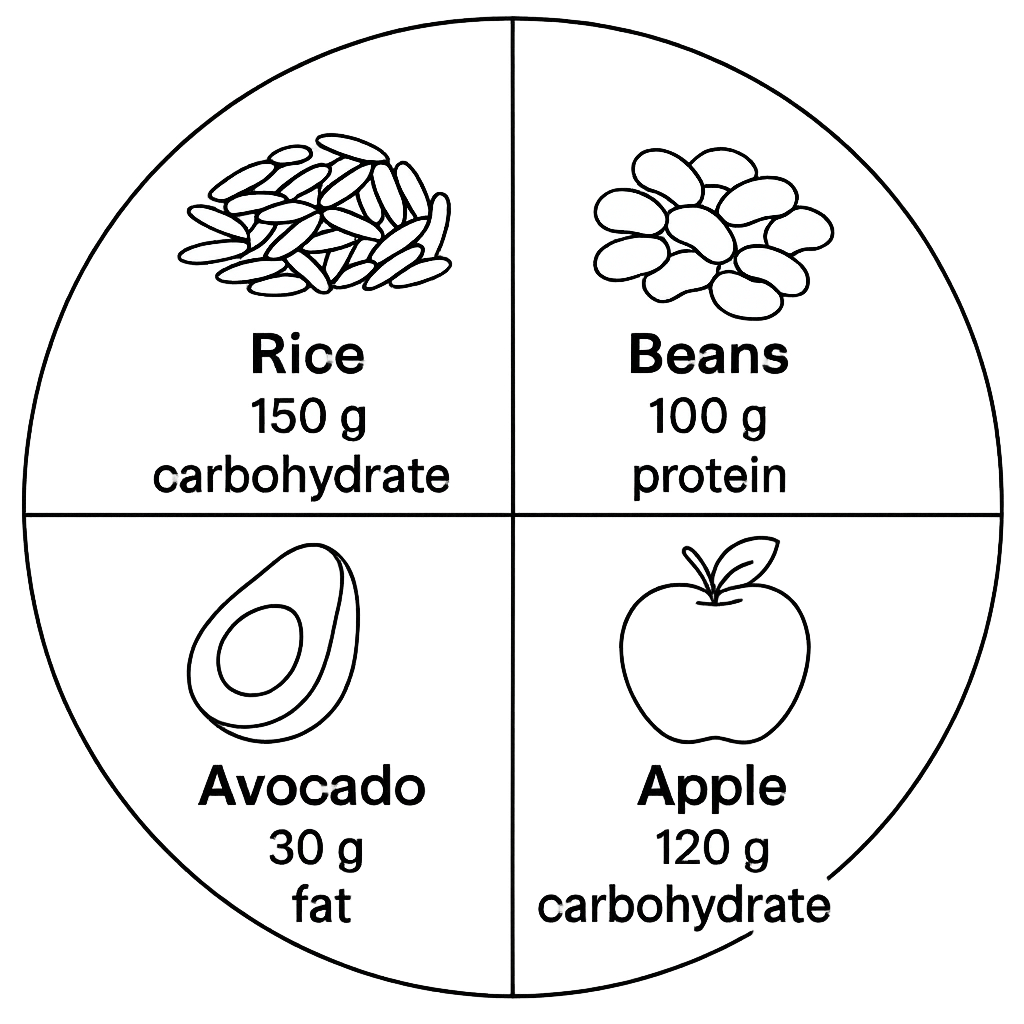
The diagram shows a plate divided into four labelled sections with the following amounts: Rice (carbohydrate) - 150 g, Beans (protein) - 100 g, Avocado (fat) - 30 g, Apple (carbohydrate) - 120 g. Using the standard caloric values (carbohydrate = \(4\ \text{kcal g}^{-1}\), protein = \(4\ \text{kcal g}^{-1}\), fat = \(9\ \text{kcal g}^{-1}\)), calculate the total caloric content of the meal and state which macronutrient contributes the greatest proportion of the calories.
A. Carbohydrate (approximately 55 % of total calories)
Correct B. Carbohydrate (approximately 62 % of total calories)
C. Protein (approximately 28 % of total calories)
D. Fat (approximately 10 % of total calories)

Correct Answer: B

Want to see the full step-by-step solution? Unlock AI Explanation & Analytics
Question 22 View Details
The small intestine is a cylindrical tube 6 m long with an internal diameter of 2 cm. Its inner surface area is increased 600‑fold by villi and microvilli. If the rate of glucose absorption per cm² of plain intestinal wall is \(0.5\ \mu\text{mol min}^{-1}\) when the concentration gradient is 10 mM, calculate the total amount of glucose absorbed per minute by the whole small intestine.
A. ≈8.2×10⁵ µmol min⁻¹
B. ≈9.5×10⁵ µmol min⁻¹
C. ≈1.45×10⁶ µmol min⁻¹
Correct D. ≈1.13×10⁶ µmol min⁻¹

Correct Answer: D

Want to see the full step-by-step solution? Unlock AI Explanation & Analytics
Question 23 View Details
A single cell undergoes three successive rounds of mitotic division. How many cells are present after the third division?
A. 9
B. 12
C. 6
Correct D. 8

Correct Answer: D

Want to see the full step-by-step solution? Unlock AI Explanation & Analytics
Question 24 View Details
A bacterial culture starts with \(5\times10^{3}\) cells. After 4 h the count is \(8\times10^{5}\) cells. Assuming exponential growth, (a) determine the generation time in minutes, and (b) estimate the population after 10 h.
A. ≈1.0×10⁹ cells
Correct B. ≈1.6×10⁹ cells
C. ≈2.5×10⁸ cells
D. ≈3.2×10⁹ cells

Correct Answer: B

Want to see the full step-by-step solution? Unlock AI Explanation & Analytics
Question 25 View Details
A 12‑year‑old girl weighing 45 kg is diagnosed with iron‑deficiency anaemia. The therapeutic recommendation is elemental iron at 3 mg kg⁻¹ day⁻¹ for 3 months. Each tablet of ferrous sulfate (325 mg) supplies 65 mg elemental iron. Determine (a) the minimum whole tablets she should take each day, and (b) the total number of tablets required for the entire treatment period.
A. 2 tablets per day, total 180 tablets
B. 4 tablets per day, total 360 tablets
Correct C. 3 tablets per day, total 270 tablets
D. 3 tablets per day, total 300 tablets

Correct Answer: C

Want to see the full step-by-step solution? Unlock AI Explanation & Analytics

Master the Exam!

You've seen a preview, but there are thousands more questions plus AI tutor to break down complex solutions.

Unlock Full Access Available for Android & Windows
Help others prepare! Share this practice hub:
Chat with Support