neco 2025 physics | Objective

Prepare for your exams with neco questions? Reviewing past/model questions is one of the most effective ways to guarantee a high score. This practice hub features authentic 2025 physics (Objective) questions designed to simulate the real exam environment.

Practice these randomly selected questions to test your readiness.

Question 1 View Details
A block of mass \(5\,\text{kg}\) rests on a rough inclined plane that makes an angle of \(30^{\circ}\) with the horizontal. The coefficient of static friction between the block and the plane is \(\mu_{s}=0.40\). A horizontal force \(P\) is applied to the block, pushing it up the plane. Determine the minimum magnitude of \(P\) (in newtons) required to start moving the block up the plane.
A. 55.0 N
B. 70.5 N
Correct C. 62.3 N
D. 48.2 N

Correct Answer: C

Want to see the full step-by-step solution? Unlock AI Explanation & Analytics
Question 2 View Details
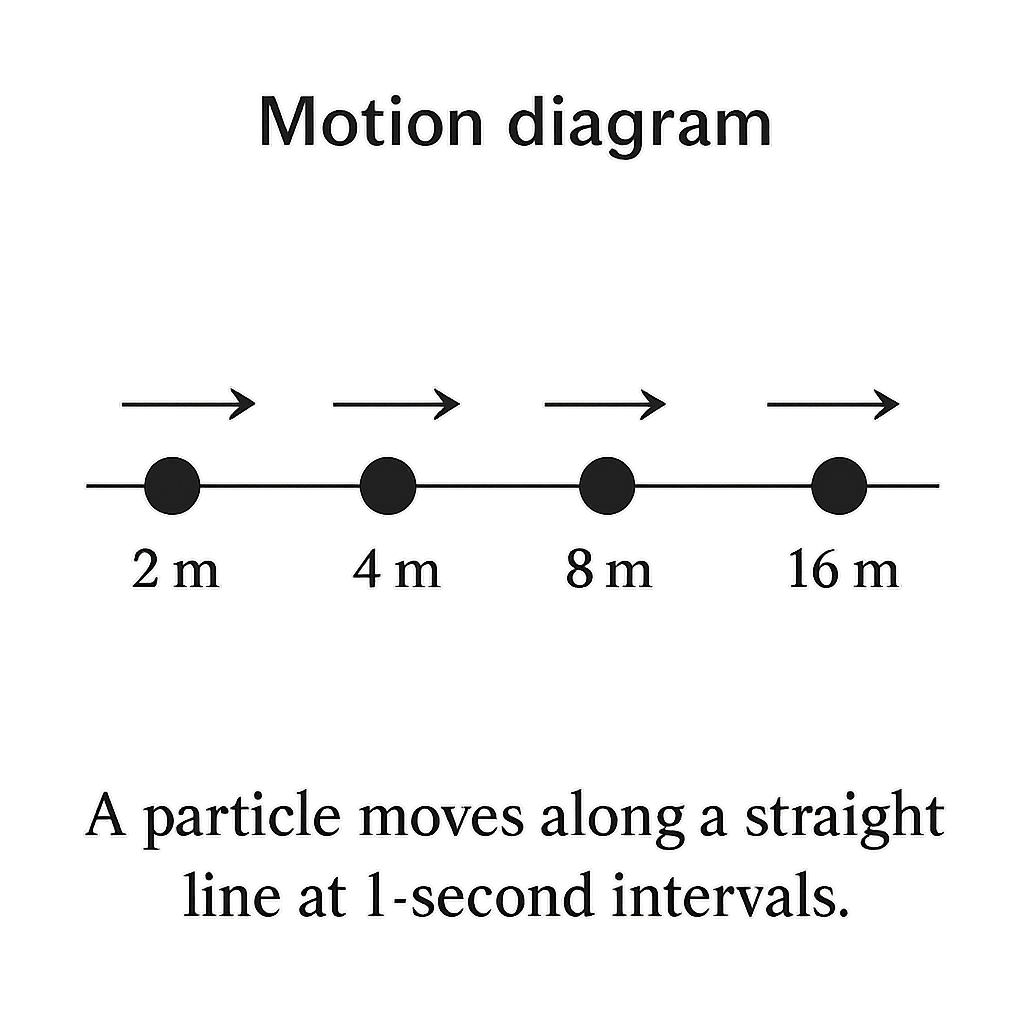
A motion diagram shows a particle moving in a straight line with equal time intervals of 1 s. The successive distances covered in the four intervals are 2 m, 4 m, 8 m and 16 m. From the diagram, determine the instantaneous speed during the third interval and the average speed of the particle over the whole motion.
Correct A. 8 m/s, 7.5 m/s
B. 8 m\/s, 8 m\/s
C. 10 m\/s, 6 m\/s
D. 4 m\/s, 7.5 m\/s

Correct Answer: A

Want to see the full step-by-step solution? Unlock AI Explanation & Analytics
Question 3 View Details
An aquarium has internal dimensions \(120\,\text{cm}\) (length) \(\times\) \(45\,\text{cm}\) (width) \(\times\) \(50\,\text{cm}\) (height). It is filled with water to \(80\%\) of its height. Find (a) the volume of water in litres, and (b) the mass of the water in kilograms (density of water \(=1000\,\text{kg\,m}^{-3}\)).
Correct A. 216 L and 216 kg
B. 216 L and 200 kg
C. 240 L and 240 kg
D. 180 L and 180 kg

Correct Answer: A

Want to see the full step-by-step solution? Unlock AI Explanation & Analytics
Question 4 View Details
A long solenoid 0.5 m in length has 800 turns and carries a current \(I\).\n(a) Derive an expression for the magnetic field \(B\) at the centre of the solenoid in terms of \(I\).\n(b) If \(I = 5\,\text{A}\) and a small magnetic dipole with moment \(\mu = 2.0\times10^{-3}\,\text{A\,m}^2\) is placed at the centre, find the magnitude of the torque on the dipole when its axis makes an angle of \(30^{\circ}\) with the field direction.\n(c) The current is increased until the field at the centre becomes \(1.2\,\text{T}\). Assuming the field varies linearly along the length, estimate the magnitude of the force on the dipole (use \(F \approx \mu\,\frac{dB}{dx}\) with \(\frac{dB}{dx}\approx \frac{B}{L}\)).
A. B = 2.50\times10^{-3} I\,T; \tau \approx 1.2\times10^{-5}\,N\,m; F \approx 5.5\times10^{-3}\,N
B. B = 1.60\times10^{-3} I\,T; \tau \approx 8.0\times10^{-6}\,N\,m; F \approx 3.5\times10^{-3}\,N
C. B = 2.01\times10^{-3} I\,T; \tau \approx 9.0\times10^{-6}\,N\,m; F \approx 6.0\times10^{-3}\,N
Correct D. B = 2.01\times10^{-3} I\,T; \tau \approx 1.0\times10^{-5}\,N\,m; F \approx 4.8\times10^{-3}\,N

Correct Answer: D

Want to see the full step-by-step solution? Unlock AI Explanation & Analytics
Question 5 View Details
A \(150\,\text{g}\) copper block (specific heat \(c_{\text{Cu}} = 0.385\,\text{J\,g}^{-1}\,\text{K}^{-1}\)) initially at \(80^{\circ}\text{C}\) is placed into \(200\,\text{g}\) of water (specific heat \(c_{\text{w}} = 4.18\,\text{J\,g}^{-1}\,\text{K}^{-1}\)) initially at \(20^{\circ}\text{C}\) inside an insulated container. The system reaches equilibrium at \(70^{\circ}\text{C}\) after \(300\) s. During this time the container loses heat to the surroundings (ambient temperature \(15^{\circ}\text{C}\)) at a rate \(\dot Q = k\,(T_{\text{avg}}-T_{\text{amb}})\) with \(k = 0.02\,\text{J\,s}^{-1}\,\text{K}^{-1}\).\n(a) What would the final temperature be if there were no heat loss?\n(b) How much total heat was lost to the surroundings during the 300 s?
Correct A. a) \(\approx 76^{\circ}\text{C}\); b) \(5.47\times10^{3}\,\text{J}\) (about 5.5 kJ)
B. a) \\(\\approx 80^{\\circ}\\text{C}\\); b) \\(6.20\\times10^{3}\\,\\text{J}\\) (about 6.2 kJ)
C. a) \\(\\approx 72^{\\circ}\\text{C}\\); b) \\(4.80\\times10^{3}\\,\\text{J}\\) (about 4.8 kJ)
D. a) \\(\\approx 68^{\\circ}\\text{C}\\); b) \\(5.00\\times10^{3}\\,\\text{J}\\) (about 5.0 kJ)

Correct Answer: A

Want to see the full step-by-step solution? Unlock AI Explanation & Analytics
Question 6 View Details
An open-ended tube is connected to a sealed chamber containing air. The tube is filled with mercury so that the mercury column stands 0.30 m above the opening of the chamber. Atmospheric pressure is 101.3 kPa and the density of mercury is \(13\,600 \ \text{kg m}^{-3}\). (a) Determine the pressure of the air in the sealed chamber. (b) The temperature of the air in the chamber is then raised from \(20^{\circ}\text{C}\) to \(40^{\circ}\text{C}\) while the tube remains open to the atmosphere. Assuming the volume of the chamber does not change, calculate the new height of the mercury column.
A. 0.33 m
Correct B. 0.27 m
C. 0.25 m
D. 0.30 m

Correct Answer: B

Want to see the full step-by-step solution? Unlock AI Explanation & Analytics
Question 7 View Details
A sample contains \(1.0\times10^{6}\) atoms of a radioactive isotope A that decays to isotope B with a half‑life of 8 min. Isotope B is itself radioactive and decays to a stable nucleus with a half‑life of 2 min. Initially only A is present. (a) At what time after the start does the activity of isotope B reach its maximum? (b) What is that maximum activity in decays per second? (Assume the decay constants are \(\lambda_{A}=\ln2/8\) min\(^{-1}\) and \(\lambda_{B}=\ln2/2\) min\(^{-1}\).)
A. 5.33 min, 1.0×10^3 s^{-1}
Correct B. 5.33 min, 9.1×10^2 s^{-1}
C. 6.00 min, 1.2×10^3 s^{-1}
D. 4.00 min, 7.5×10^2 s^{-1}

Correct Answer: B

Want to see the full step-by-step solution? Unlock AI Explanation & Analytics
Question 8 View Details
A source emits sound of frequency \(800\ \text{Hz}\) in air where the speed of sound is \(340\ \text{m s}^{-1}\). The source moves directly towards a stationary observer with a speed of \(30\ \text{m s}^{-1}\) while the observer simultaneously moves directly away from the source with a speed of \(20\ \text{m s}^{-1}\). (a) What frequency does the observer hear? (b) The observer also hears a second stationary source emitting a frequency of \(795\ \text{Hz}\). Determine the beat frequency heard by the observer.
A. 820 Hz, 30 Hz
B. 830 Hz, 32 Hz
C. 825 Hz, 29 Hz
Correct D. 826 Hz, 31 Hz

Correct Answer: D

Want to see the full step-by-step solution? Unlock AI Explanation & Analytics
Question 9 View Details
Two point charges are placed on the vertical \(y\)-axis. A charge \(+8\ \mu\text{C}\) is at the origin \(A(0,0)\) and a charge \(-2\ \mu\text{C}\) is at point \(B(0,0.12\ \text{m})\). (a) Find the point on the line joining the charges where the net electric field is zero. (b) Calculate the electric potential at that point due to the two charges. (Take \(k=9.0\times10^{9}\ \text{N m}^{2}\text{C}^{-2}\).)
A. 0.24 m, -1.5×10^5 V
B. 0.12 m, 2.0×10^5 V
C. 0.48 m, 1.0×10^5 V
Correct D. 0.24 m, 1.5×10^5 V

Correct Answer: D

Want to see the full step-by-step solution? Unlock AI Explanation & Analytics
Question 10 View Details
A piston‑cylinder contains \(0.050\ \text{mol}\) of an ideal gas at \(300\ \text{K}\) and a pressure of \(150\ \text{kPa}\). The gas is compressed adiabatically until the pressure reaches \(600\ \text{kPa}\). The heat capacity ratio of the gas is \(\gamma = 1.4\). (a) Determine the final temperature of the gas. (b) Calculate the work done on the gas during the compression (in kJ).
A. 410 K, 0.130 kJ
B. 470 K, 0.165 kJ
Correct C. 445 K, 0.151 kJ
D. 522 K, 0.231 kJ

Correct Answer: C

Want to see the full step-by-step solution? Unlock AI Explanation & Analytics
Question 11 View Details
An ideal block‑and‑tackle system has 4 supporting rope segments. It is used to lift a load of \(480\text{N}\). The operator applies a constant input force of \(150\text{N}\) and pulls the rope through a distance of \(2.5\text{m}\) in \(5.0\text{s}\). The system works with an overall efficiency of \(80\%\). (a) Calculate the vertical distance through which the load is raised. (b) Determine the power output of the system in watts.
A. a) \(1.0\text{m}\); b) \(90\text{W}\)
B. a) \(0.75\text{m}\); b) \(75\text{W}\)
Correct C. a) \(0.625\text{m}\); b) \(60\text{W}\)
D. a) \(0.5\text{m}\); b) \(48\text{W}\)

Correct Answer: C

Want to see the full step-by-step solution? Unlock AI Explanation & Analytics
Question 12 View Details
The rod has length \(2.35\text{m}\), cross‑sectional area \(3.2\text{cm}^2\) and mass \(5.6\text{kg}\). Determine its density in \(\text{kg}\,\text{m}^{-3}\).
A. \(7.45\times10^{4}\ \text{kg\ m}^{-3}\)
B. \(6.45\times10^{3}\ \text{kg\ m}^{-3}\)
Correct C. \(7.45\times10^{3}\ \text{kg\ m}^{-3}\)
D. \(7.45\times10^{2}\ \text{kg\ m}^{-3}\)

Correct Answer: C

Want to see the full step-by-step solution? Unlock AI Explanation & Analytics
Question 13 View Details
A tuning fork of frequency \(256\text{Hz}\) produces a standing wave in a string fixed at both ends. The string length is \(0.80\text{m}\). (a) Find the speed of the transverse wave for the fundamental mode. (b) If the tension is increased so that the wave speed becomes 20\% larger, what is the new fundamental frequency?
A. a) \\(400\\text{m s}^{-1}\\); b) \\(300\\text{Hz}\\)
B. a) \\(380\\text{m s}^{-1}\\); b) \\(295\\text{Hz}\\)
C. a) \\(420\\text{m s}^{-1}\\); b) \\(315\\text{Hz}\\)
Correct D. a) \(410\text{m s}^{-1}\); b) \(307\text{Hz}\)

Correct Answer: D

Want to see the full step-by-step solution? Unlock AI Explanation & Analytics
Question 14 View Details
A motor drives gear A (diameter \(0.20\text{m}\)) at \(1500\text{rpm}\). Gear A meshes with gear B (diameter \(0.40\text{m}\)). Gear B shares its shaft with gear C (diameter \(0.10\text{m}\)), which drives gear D (diameter \(0.30\text{m}\)) attached to a load requiring torque \(12\text{N·m}\). Assuming an overall efficiency of \(90\%\), calculate the minimum torque the motor must supply.
A. \(3.33\text{N·m}\)
B. \(1.80\text{N·m}\)
Correct C. \(2.22\text{N·m}\)
D. \(4.44\text{N·m}\)

Correct Answer: C

Want to see the full step-by-step solution? Unlock AI Explanation & Analytics
Question 15 View Details
A river flows due east at \(3\text{m s}^{-1}\). A boat can move through still water at \(4\text{m s}^{-1}\) directed due north. Determine the magnitude and direction of the boat's resultant velocity relative to the ground.
A. \(5\text{m s}^{-1}\) at \(45^{\circ}\) east of north
B. \(5\text{m s}^{-1}\) at \(36.9^{\circ}\) west of north
Correct C. \(5\text{m s}^{-1}\) at \(36.9^{\circ}\) east of north
D. \(3\text{m s}^{-1}\) at \(36.9^{\circ}\) east of north

Correct Answer: C

Want to see the full step-by-step solution? Unlock AI Explanation & Analytics
Question 16 View Details
A U‑tube manometer contains mercury (density \(\rho_{\text{Hg}} = 13\,600\ \text{kg m}^{-3}\)) and water (density \(\rho_{\text{w}} = 1\,000\ \text{kg m}^{-3}\)). The left leg is open to the atmosphere (\(P_{\text{atm}} = 1.00\times10^{5}\ \text{Pa}\)). In the right leg a column of water 0.30 m high rests on the mercury, and the mercury levels differ by 0.15 m, the right‑hand level being higher. Determine the pressure of the sealed gas in the right leg.
A. 9.8e4 Pa
B. 1.30e5 Pa
C. 1.05e5 Pa
Correct D. 1.17e5 Pa

Correct Answer: D

Want to see the full step-by-step solution? Unlock AI Explanation & Analytics
Question 17 View Details
A mixture of two ideal gases A and B is confined in a 10.0 L container at 300 K and total pressure 1.00 atm. Gas A effuses through a small hole twice as fast as gas B. The partial pressure of gas A is 0.30 atm. The molar mass of gas B is 32 g mol\(^{-1}\). (a) Find the molar mass of gas A. (b) Determine the mole fraction of gas B in the mixture.
Correct A. M_A = 8 g/mol; mole fraction of B = 0.70
B. M_A = 12 g\/mol; mole fraction of B = 0.60
C. M_A = 8 g\/mol; mole fraction of B = 0.30
D. M_A = 16 g\/mol; mole fraction of B = 0.70

Correct Answer: A

Want to see the full step-by-step solution? Unlock AI Explanation & Analytics
Question 18 View Details
A rectangular coil of 50 turns has dimensions 0.20 m by 0.10 m and rotates with constant angular speed \(\omega\) in a uniform magnetic field of magnitude 0.5 T, the axis of rotation being perpendicular to the field. The coil is connected to an external resistor \(R\) (its own resistance is negligible). The maximum induced emf observed is 12 V. (a) Calculate the angular speed \(\omega\). (b) Find the value of \(R\) that makes the average power dissipated in the resistor equal to 6 W.
Correct A. ω = 24 rad/s; R = 12 Ω
B. ω = 24 rad\/s; R = 8 Ω
C. ω = 20 rad\/s; R = 15 Ω
D. ω = 30 rad\/s; R = 10 Ω

Correct Answer: A

Want to see the full step-by-step solution? Unlock AI Explanation & Analytics
Question 19 View Details
A car starts from rest and accelerates uniformly to a speed of 20 m s\(^{-1}\) in 5.0 s. What distance does it travel during this time?
A. 20 m
B. 75 m
C. 100 m
Correct D. 50 m

Correct Answer: D

Want to see the full step-by-step solution? Unlock AI Explanation & Analytics
Question 20 View Details
Two point charges are placed on the y‑axis: a charge \(+8\,\mu\text{C}\) at the origin O and a charge \(-2\,\mu\text{C}\) at point B (0, 0.12 m). (a) Find the point on the y‑axis between the charges where the net electric field is zero. (b) Calculate the electric potential at that point. (Take \(k = 9.0\times10^{9}\ \text{N m}^{2}\text{C}^{-2}\).)
A. y = 0.04 m; V = 2.8×10^5 V
B. y = 0.10 m; V = 5.0×10^5 V
Correct C. y = 0.08 m; V = 4.5×10^5 V
D. y = 0.06 m; V = 3.6×10^5 V

Correct Answer: C

Want to see the full step-by-step solution? Unlock AI Explanation & Analytics
Question 21 View Details
A 1.0 kg metal block is initially at \(200^{\circ}\text{C}\). It is placed into an insulated container that holds \(0.4\ \text{kg}\) of water at \(25^{\circ}\text{C}\) and \(0.3\ \text{kg}\) of ice at \(0^{\circ}\text{C}\). After equilibrium the temperature of the system is \(10^{\circ}\text{C}\) and all the ice has melted. Given the specific heat capacity of water \(c_{w}=4.18\ \text{J g}^{-1}\text{K}^{-1}\) and the latent heat of fusion of ice \(L_{f}=334\ \text{J g}^{-1}\), determine the specific heat capacity of the metal in \(\text{J kg}^{-1}\text{K}^{-1}\).
A. 7.25×10^3 J·kg^{-1}·K^{-1}
B. 6.80×10^2 J·kg^{-1}·K^{-1}
C. 8.10×10^2 J·kg^{-1}·K^{-1}
Correct D. 7.25×10^2 J·kg^{-1}·K^{-1}

Correct Answer: D

Want to see the full step-by-step solution? Unlock AI Explanation & Analytics
Question 22 View Details
In a circuit a 12 V ideal battery with internal resistance \(r\) supplies two resistors \(R_{1}=6\ \Omega\) and an unknown resistor \(R_{2}\) connected in parallel. The total current drawn from the battery is \(3\ \text{A}\) and the power dissipated in \(R_{2}\) is \(12\ \text{W}\). Determine the internal resistance \(r\) of the battery and the value of \(R_{2}\) (in ohms).
A. r = 1 Ω, R₂ = 4 Ω
B. r = 3 Ω, R₂ = 2 Ω
C. r = 2 Ω, R₂ = 4 Ω
Correct D. r = 2 Ω, R₂ = 3 Ω

Correct Answer: D

Want to see the full step-by-step solution? Unlock AI Explanation & Analytics
Question 23 View Details
In a photoelectric experiment a metal surface of unknown work function \(\phi\) is illuminated with monochromatic light of wavelength \(500\ \text{nm}\), producing a stopping potential of \(0.80\ \text{V}\). When the wavelength is changed to \(400\ \text{nm}\) the stopping potential increases by \(0.62\ \text{V}\). (i) Determine the work function \(\phi\) in electron‑volts. (ii) Find the threshold wavelength \(\lambda_{0}\) (in nanometres) for this metal. (Use \(h c = 1240\ \text{eV·nm}\).)
A. φ = 1.20 eV, λ₀ ≈ 1030 nm
B. φ = 1.68 eV, λ₀ ≈ 800 nm
C. φ = 2.10 eV, λ₀ ≈ 590 nm
Correct D. φ = 1.68 eV, λ₀ ≈ 738 nm

Correct Answer: D

Want to see the full step-by-step solution? Unlock AI Explanation & Analytics
Question 24 View Details
A block of mass \(5\ \text{kg}\) rests on a rough inclined plane that makes an angle \(\theta\) with the horizontal. The coefficient of static friction between the block and the plane is \(\mu_{s}=0.4\). A horizontal force of magnitude \(20\ \text{N}\) is applied to the block, directed up the incline. The block is on the verge of sliding down. Determine the angle \(\theta\) (in degrees) of the incline.
A. 52°
B. 38°
C. 60°
Correct D. 44°

Correct Answer: D

Want to see the full step-by-step solution? Unlock AI Explanation & Analytics
Question 25 View Details
A block of mass \(800\ \text{kg}\) is pulled up a \(30^{\circ}\) incline by a constant horizontal force of magnitude \(8000\ \text{N}\). The coefficient of kinetic friction between the block and the plane is \(\mu_{k}=0.2\). The block starts from rest at the bottom and moves \(10\ \text{m}\) along the incline. (a) Calculate the work done by the horizontal force. (b) Determine the increase in kinetic energy of the block. (c) Find the speed of the block after moving the \(10\ \text{m}\). (Take \(g=9.8\ \text{m s}^{-2}\).)
A. a) 62 400 J, b) 7 200 J, c) 4.2 m\/s
Correct B. a) 69 280 J, b) 8 500 J, c) 4.6 m/s
C. a) 68 000 J, b) 8 000 J, c) 4.8 m\/s
D. a) 75 000 J, b) 9 500 J, c) 5.0 m\/s

Correct Answer: B

Want to see the full step-by-step solution? Unlock AI Explanation & Analytics

Master the Exam!

You've seen a preview, but there are thousands more questions plus AI tutor to break down complex solutions.

Unlock Full Access Available for Android & Windows
Help others prepare! Share this practice hub:
Chat with Support