neco 2025 chemistry | Objective

Prepare for your exams with neco questions? Reviewing past/model questions is one of the most effective ways to guarantee a high score. This practice hub features authentic 2025 chemistry (Objective) questions designed to simulate the real exam environment.

Practice these randomly selected questions to test your readiness.
Question 1 View Details
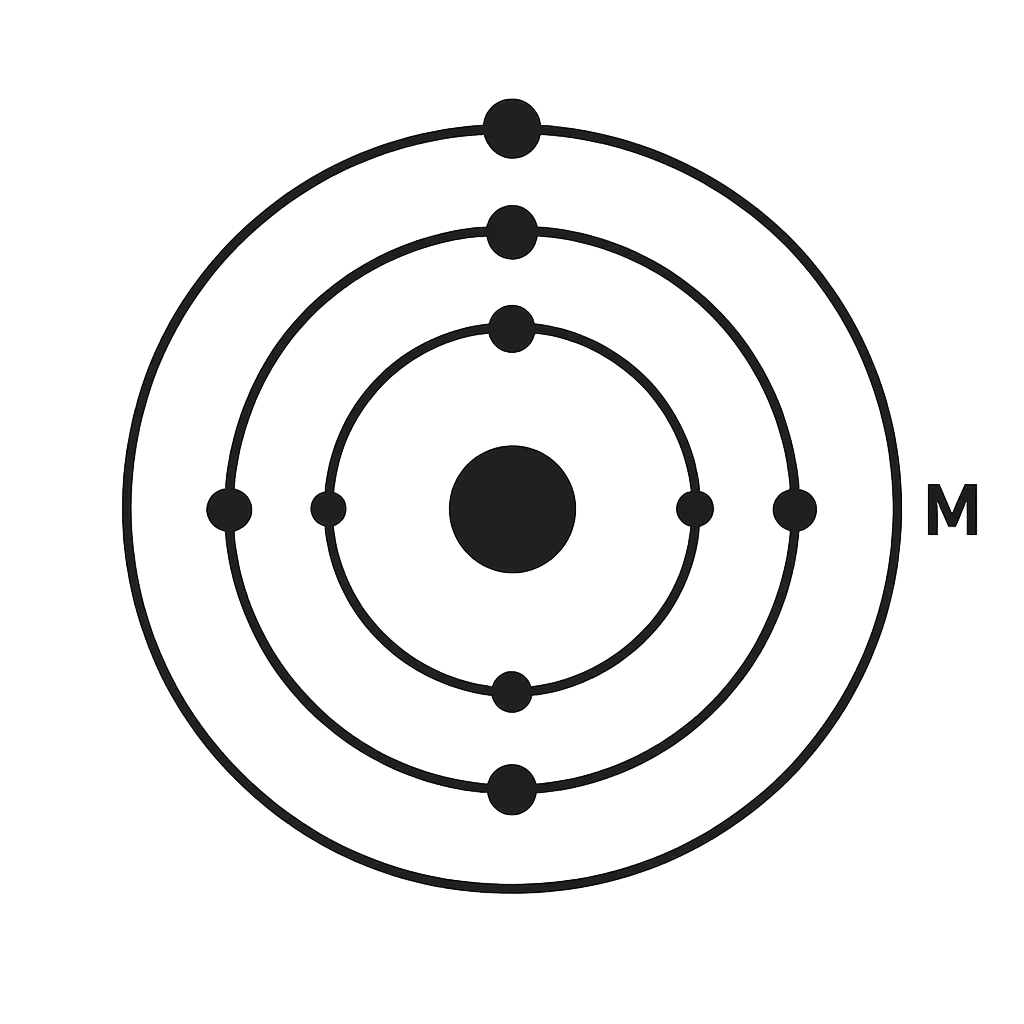
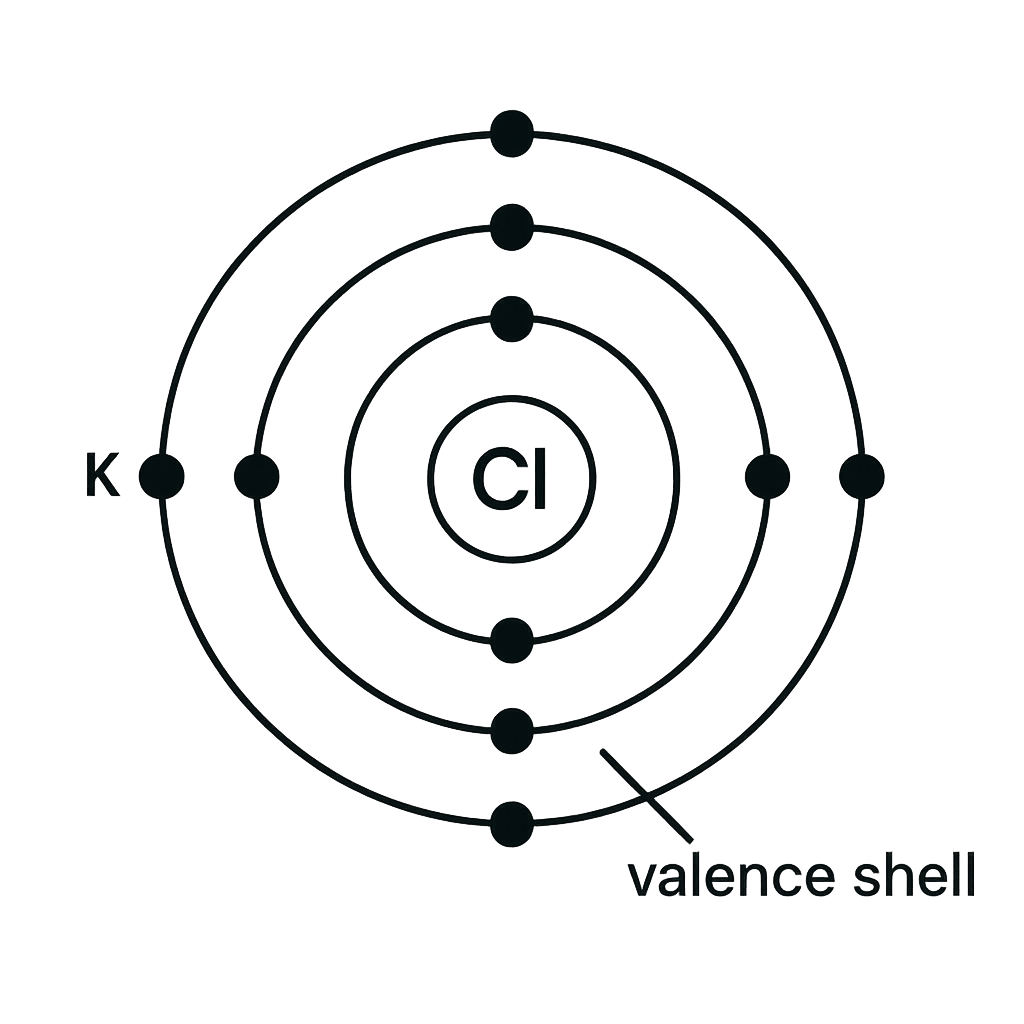
The diagram shows a chlorine atom with two electrons in the K shell, eight electrons in the L shell, and seven electrons in the M shell. Based on this electron arrangement, what is the oxidation state of chlorine in its most common ionic form?
Correct A. -1
B. +5
C. +1
D. 0

Correct Answer: A

Want to see the full step-by-step solution? Unlock AI Explanation & Analytics
Question 2 View Details
A neutral atom of sodium has atomic number 11 and mass number 23. How many neutrons are present in this atom?
A. 23
B. 11
Correct C. 12
D. 13

Correct Answer: C

Want to see the full step-by-step solution? Unlock AI Explanation & Analytics
Question 3 View Details
A polymer is prepared by addition polymerisation of monomer M (molar mass \(M = 100 \; \text{g mol}^{-1}\)). Each polymer chain has two identical end groups, each with a molar mass of \(10 \; \text{g mol}^{-1}\). End‑group analysis shows that the polymer sample contains \(0.020\) mol of end groups. The total mass of the polymer sample is \(5.00\) g. (a) Determine the average degree of polymerisation (\(DP_n\)). (b) Calculate the number‑average molecular weight (\(M_n\)). (c) If the polymer has a polydispersity index of 1.20, find the weight‑average degree of polymerisation (\(DP_w\)).
A. DP_n = 4.80; M_n = 600 g·mol^{-1}; DP_w = 5.76
B. DP_n = 5.00; M_n = 500 g·mol^{-1}; DP_w = 5.76
Correct C. DP_n = 4.80; M_n = 500 g·mol^{-1}; DP_w = 5.76
D. DP_n = 4.80; M_n = 500 g·mol^{-1}; DP_w = 6.00

Correct Answer: C

Want to see the full step-by-step solution? Unlock AI Explanation & Analytics
Question 4 View Details
Consider a galvanic cell constructed as follows: Zn|Zn^{2+}(0.010 \; \text{M})||Cu^{2+}(0.10 \; \text{M})|Cu at 25^{\circ}\text{C}. The standard reduction potentials are \(E^{\circ}_{\text{Cu}^{2+}/\text{Cu}} = +0.34 \; \text{V}\) and \(E^{\circ}_{\text{Zn}^{2+}/\text{Zn}} = -0.76 \; \text{V}\). (a) Calculate the cell potential under the given conditions. (b) Determine the maximum electrical work obtainable from the transfer of 1.00 mol of electrons.
A. E_cell = 1.13 V; W_max = 9.5×10^4 J
B. E_cell = 1.25 V; W_max = 1.09×10^5 J
Correct C. E_cell = 1.13 V; W_max = 1.09×10^5 J
D. E_cell = 0.94 V; W_max = 9.1×10^4 J

Correct Answer: C

Want to see the full step-by-step solution? Unlock AI Explanation & Analytics
Question 5 View Details
In the synthesis of ammonium nitrate, the reaction is \(\mathrm{NH_3(g) + HNO_3(aq) -> NH_4NO_3(aq)}\). A student mixes 2.00 g of \(\mathrm{NH_3}\) (M = 17.03 g mol^{-1}) with 3.00 g of \(\mathrm{HNO_3}\) (M = 63.01 g mol^{-1}). After the reaction, 3.20 g of solid \(\mathrm{NH_4NO_3}\) is obtained. (a) Identify the limiting reagent. (b) Calculate the theoretical yield of \(\mathrm{NH_4NO_3}\). (c) Determine the percent yield.
A. Limiting reagent: HNO₃; Theoretical yield: 3.81 g; Percent yield: 75.0%
B. Limiting reagent: HNO₃; Theoretical yield: 4.20 g; Percent yield: 84.0%
C. Limiting reagent: NH₃; Theoretical yield: 3.81 g; Percent yield: 84.0%
Correct D. Limiting reagent: HNO₃; Theoretical yield: 3.81 g; Percent yield: 84.0%

Correct Answer: D

Want to see the full step-by-step solution? Unlock AI Explanation & Analytics
Question 6 View Details
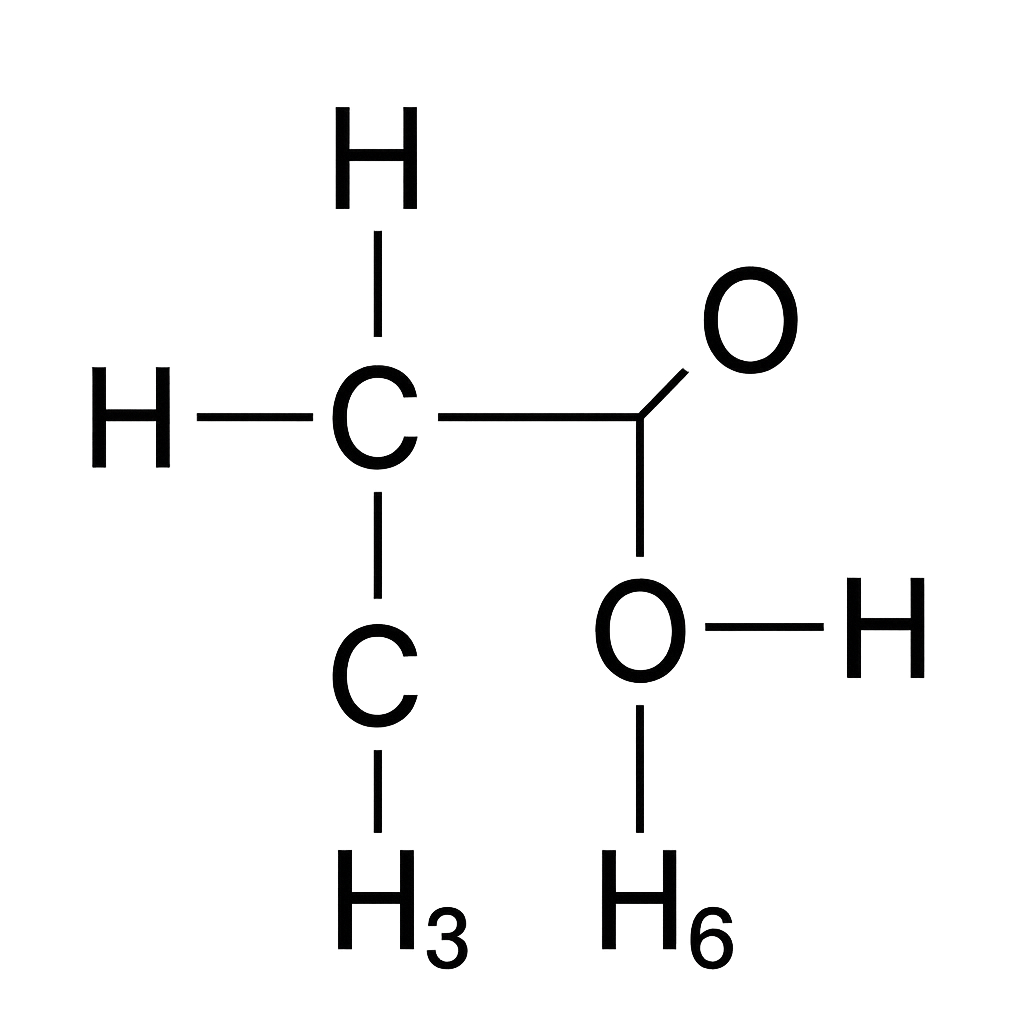
The diagram shows the structural formula of ethanol (CH\_{3}\!-\!CH\_{2}\!-\!OH). Using the diagram, calculate the total number of \( \sigma \) bonds present in the molecule.
A. 9
B. 10
Correct C. 8
D. 7

Correct Answer: C

Want to see the full step-by-step solution? Unlock AI Explanation & Analytics
Question 7 View Details
An unknown non‑metal element X satisfies the following conditions: (i) X is in the same period as the element with atomic number 7; (ii) The Pauling electronegativity of X is 0.54 less than that of fluorine (which has \( \chi = 3.98 \)); (iii) The bond length of the diatomic molecule X\_2 is 21 pm shorter than that of F\_2, whose bond length is 142 pm. Identify element X.
A. N
B. C
Correct C. O
D. F

Correct Answer: C

Want to see the full step-by-step solution? Unlock AI Explanation & Analytics
Question 8 View Details
A 2.00 g sample of a substance is heated from 25\,\(^\circ\)C to 150\,\(^\circ\)C. The substance melts at 80\,\(^\circ\)C with a latent heat of fusion of 60\,J\,g\( ^{-1} \), boils at 120\,\(^\circ\)C with a latent heat of vaporisation of 200\,J\,g\( ^{-1} \), and has specific heat capacities of 1.0\,J\,g\( ^{-1} \)K\( ^{-1} \) (solid), 0.8\,J\,g\( ^{-1} \)K\( ^{-1} \) (liquid) and 0.6\,J\,g\( ^{-1} \)K\( ^{-1} \) (gas). Calculate the total heat absorbed by the sample.
A. 330
B. 754
C. 694
Correct D. 730

Correct Answer: D

Want to see the full step-by-step solution? Unlock AI Explanation & Analytics
Question 9 View Details
In the Lewis structure of carbon dioxide (\( \mathrm{CO}_{2} \)), how many total lone pairs are present on the oxygen atoms?
A. 2
B. 8
C. 6
Correct D. 4

Correct Answer: D

Want to see the full step-by-step solution? Unlock AI Explanation & Analytics
Question 10 View Details
A lake contains 5000\,L of water with a nitrate concentration of 10\,mg\,L\( ^{-1} \). A treatment plant adds 200\,L of a solution that contains 0.5\,g of nitrate per litre. After thorough mixing, nitrate is removed by a first‑order process with rate constant \( k = 0.02 \ \text{day}^{-1} \). Determine the nitrate concentration (in mg\,L\( ^{-1} \)) remaining in the lake after 5 days. Assume the lake volume remains 5000\,L.
Correct A. 27.1
B. 22.5
C. 31.4
D. 24.0

Correct Answer: A

Want to see the full step-by-step solution? Unlock AI Explanation & Analytics
Question 11 View Details
A 10.0 g sample of aluminium metal reacts with 15.0 g of \(\mathrm{H_2SO_4}\). The reaction is \(2\,\mathrm{Al} + 3\,\mathrm{H_2SO_4} \rightarrow \mathrm{Al_2(SO_4)_3} + 3\,\mathrm{H_2}\). The resulting \(\mathrm{Al_2(SO_4)_3}\) solution is then treated with excess calcium hydroxide according to \(\mathrm{Al_2(SO_4)_3} + 3\,\mathrm{Ca(OH)_2} \rightarrow 3\,\mathrm{CaSO_4} + 2\,\mathrm{Al(OH)_3}\). If the precipitation of \(\mathrm{CaSO_4}\) occurs with an 80 % yield, calculate the mass of calcium sulphate actually obtained (in grams, to three significant figures).
Correct A. 16.6 g
B. 14.2 g
C. 18.5 g
D. 12.0 g

Correct Answer: A

Want to see the full step-by-step solution? Unlock AI Explanation & Analytics
Question 12 View Details
A 12.0 g alloy of zinc and copper is treated with excess dilute \(\mathrm{H_2SO_4}\). Only the zinc reacts, liberating hydrogen gas that is collected over water. The volume of gas measured at 25 °C and 1.00 atm (water vapour pressure 23.8 mm Hg) is 0.85 L. After the reaction, the solution is evaporated to dryness, leaving zinc sulphate crystals weighing 5.00 g. Determine the mass percent of zinc in the original alloy (to three significant figures).
Correct A. 18.3 %
B. 22.1 %
C. 20.5 %
D. 15.2 %

Correct Answer: A

Want to see the full step-by-step solution? Unlock AI Explanation & Analytics
Question 13 View Details
An unknown ester has the molecular formula \(\mathrm{C_5H_{10}O_2}\). Complete hydrolysis with aqueous NaOH gives an alcohol that boils at 78 °C and a carboxylic acid that boils at 118 °C. Identify the ester and give its IUPAC name.
A. butyl ethanoate
B. methyl propanoate
C. propyl methanoate
Correct D. ethyl ethanoate

Correct Answer: D

Want to see the full step-by-step solution? Unlock AI Explanation & Analytics
Question 14 View Details
A colourless liquid with formula \(\mathrm{C_3H_6O}\) is reduced with sodium borohydride (NaBH\(_4\)) followed by acid work‑up to give a product that boils at 97 °C. Identify the starting compound and give its IUPAC name.
A. prop-2-ene
Correct B. propanal
C. acetaldehyde
D. propanone

Correct Answer: B

Want to see the full step-by-step solution? Unlock AI Explanation & Analytics
Question 15 View Details
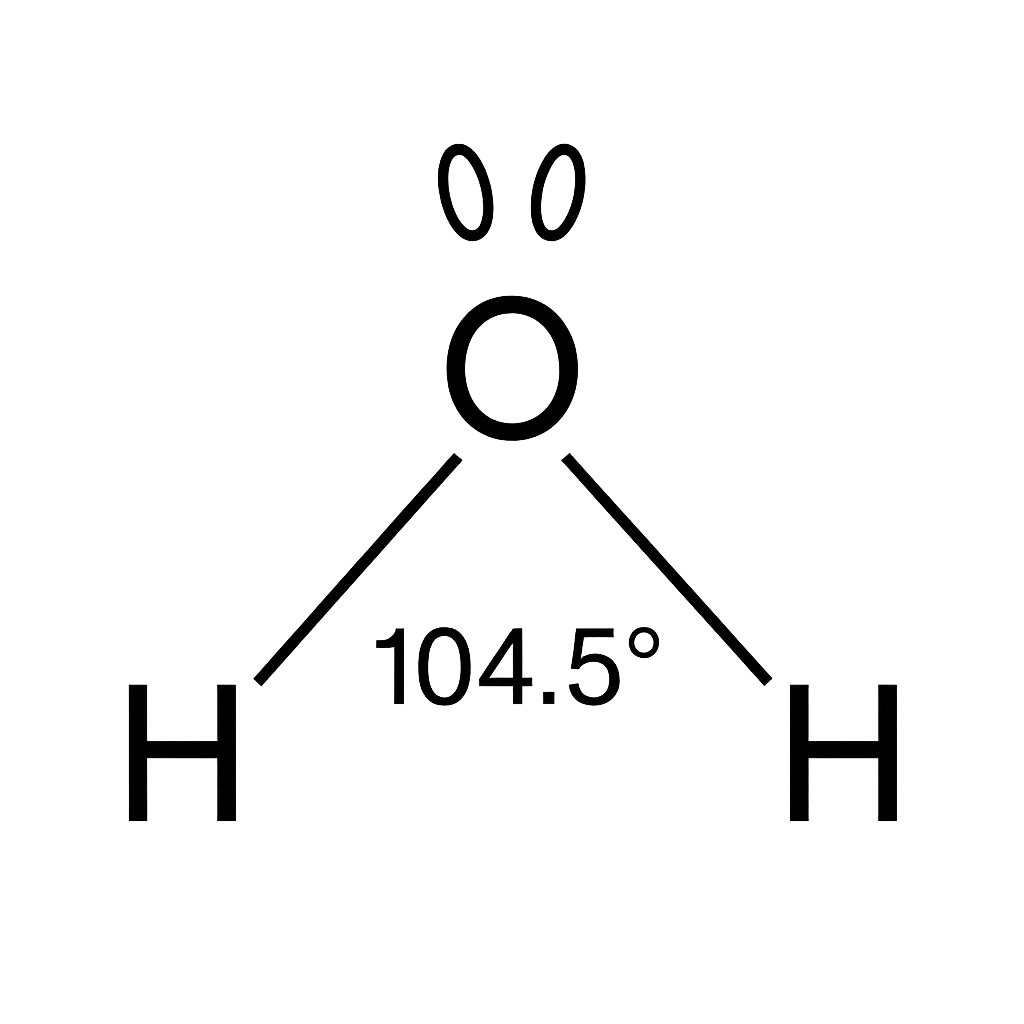
The diagram shows a water molecule. State the hybridisation of the oxygen atom and give the approximate H-O-H bond angle (in degrees).
Correct A. sp3 hybridisation, 104.5°
B. sp3 hybridisation, 109.5°
C. sp hybridisation, 180°
D. sp2 hybridisation, 120°

Correct Answer: A

Want to see the full step-by-step solution? Unlock AI Explanation & Analytics
Question 16 View Details
A 25.0 g sample of a hydrated copper(II) sulfate is heated until constant mass and yields 15.0 g of anhydrous \(\mathrm{CuSO_4}\). Determine (i) the number of water molecules \(x\) in the formula \(\mathrm{CuSO_4\cdot xH_2O}\) and (ii) the percentage by mass of water in the hydrate.
A. x = 7; % water = 46%
B. x = 5; % water = 33%
C. x = 8; % water = 50%
Correct D. x = 6; % water = 40%

Correct Answer: D

Want to see the full step-by-step solution? Unlock AI Explanation & Analytics
Question 17 View Details
A step‑growth polymer is formed from equimolar amounts of monomers A (molar mass \(M_A = 120\ \text{g mol}^{-1}\)) and B (\(M_B = 180\ \text{g mol}^{-1}\)). After polymerization the number‑average degree of polymerization is 50. The polymer is then partially depolymerized so that the number‑average molecular weight decreases by 20 % while the weight‑average molecular weight decreases by 10 %. Calculate the new polydispersity index (PDI) of the polymer.
Correct A. 1.15
B. 1.05
C. 1.30
D. 1.25

Correct Answer: A

Want to see the full step-by-step solution? Unlock AI Explanation & Analytics
Question 18 View Details
In acidic solution the reaction between potassium dichromate and iron(II) sulfate is: \(\ce{K2Cr2O7 + 6 FeSO4 + 7 H2SO4 -> Cr2(SO4)3 + 3 Fe2(SO4)3 + K2SO4 + 7 H2O}\). If 5.00 g of \(\ce{K2Cr2O7}\) are reacted with excess \(\ce{FeSO4}\), what mass of \(\ce{Fe2(SO4)3}\) is formed?
Correct A. 20.4 g
B. 30.6 g
C. 10.2 g
D. 24.5 g

Correct Answer: A

Want to see the full step-by-step solution? Unlock AI Explanation & Analytics
Question 19 View Details
A white crystalline solid is dissolved in distilled water to give a clear solution. The following observations are made:\n\n1. A copper‑green flame is observed when a small portion of the solution is heated with a copper wire.\n2. Adding a few drops of 0.10 M NaOH produces a pale blue precipitate which dissolves on addition of excess NaOH, giving a deep blue solution.\n3. Adding dilute HCl followed by \(\mathrm{H_2S}\) gas yields a black precipitate that does not dissolve on heating with dilute acid.\n4. Adding ammonium chloride solution and then excess NH\(_4\)OH gives a deep blue solution.\n\nA 25.0 mL aliquot of the solution is treated with excess 0.10 M NaOH, the precipitate is filtered, washed and dried to give 0.215 g of copper(II) hydroxide. Identify the cation present and determine its concentration (mol L\(^{-1}\)) in the original solution.
A. Cu^{+}; 0.088 M
Correct B. Cu^{2+}; 0.088 M
C. Ni^{2+}; 0.088 M
D. Cu^{2+}; 0.044 M

Correct Answer: B

Want to see the full step-by-step solution? Unlock AI Explanation & Analytics
Question 20 View Details
A 0.741 g sample of an unknown hydrocarbon containing only C, H and O is combusted completely, producing 1.32 g of \(\mathrm{CO_2}\) and 0.540 g of \(\mathrm{H_2O}\). The compound is known to contain exactly two oxygen atoms per molecule. Determine its molecular formula.
A. C4H8O2
B. C2H4O2
C. C3H8O2
Correct D. C3H6O2

Correct Answer: D

Want to see the full step-by-step solution? Unlock AI Explanation & Analytics
Question 21 View Details
An aqueous solution contains a metal cation M^{2+} and an anion X^{-}. The following observations are recorded:\n1. Adding dilute HCl produces no precipitate.\n2. Adding NaOH yields a white precipitate that dissolves on addition of excess NaOH.\n3. Adding NH_{4}OH gives a white gelatinous precipitate that does not dissolve on excess.\n4. Adding AgNO_{3} produces a white precipitate which dissolves in dilute NH_{3}.\n5. The flame test shows no characteristic colour. Identify the metal cation and the anion present.
A. Cation: Zn^{2+}; Anion: Cl^{-}
B. Cation: Fe^{3+}; Anion: Cl^{-}
C. Cation: Al^{3+}; Anion: SO_{4}^{2-}
Correct D. Cation: Al^{3+}; Anion: Cl^{-}

Correct Answer: D

Want to see the full step-by-step solution? Unlock AI Explanation & Analytics
Question 22 View Details
A 0.350 g sample of a mixture of benzoic acid (C_{6}H_{5}COOH, M = 122.12 g·mol^{-1}) and acetic acid (CH_{3}COOH, M = 60.05 g·mol^{-1}) is dissolved in 50.0 mL of water and titrated with 0.100 M NaOH. The first equivalence point is reached after 12.5 mL of NaOH, and the second equivalence point after a total of 45.0 mL. Given pK_{a} values of benzoic acid = 4.20 and acetic acid = 4.76, determine the mass of benzoic acid in the sample (to three significant figures).
A. 0.180 g
Correct B. 0.153 g
C. 0.120 g
D. 0.210 g

Correct Answer: B

Want to see the full step-by-step solution? Unlock AI Explanation & Analytics
Question 23 View Details
Consider a molecule AB_{3}C in which the central atom A is bonded to three identical atoms B and possesses one lone pair. The measured bond angle between the A-B bonds is 107^{\circ}. (i) State the electron‑pair geometry and the molecular geometry of AB_{3}C. (ii) Indicate the hybridisation of the central atom A. (iii) Explain why the observed bond angle is smaller than the ideal tetrahedral angle.
A. Electron‑pair geometry: tetrahedral; Molecular geometry: tetrahedral; Hybridisation: sp^{3}; The lone pair exerts greater repulsion, compressing the bond angles to about 107^{\\circ}.
B. Electron‑pair geometry: tetrahedral; Molecular geometry: trigonal pyramidal; Hybridisation: sp^{2}; The lone pair exerts greater repulsion, compressing the bond angles to about 107^{\\circ}.
Correct C. Electron‑pair geometry: tetrahedral; Molecular geometry: trigonal pyramidal; Hybridisation: sp^{3}; The lone pair exerts greater repulsion, compressing the bond angles to about 107^{\circ}.
D. Electron‑pair geometry: trigonal planar; Molecular geometry: trigonal pyramidal; Hybridisation: sp^{2}; The lone pair exerts greater repulsion, compressing the bond angles to about 107^{\\circ}.

Correct Answer: C

Want to see the full step-by-step solution? Unlock AI Explanation & Analytics
Question 24 View Details
Write the ground‑state electron configuration of the element whose atomic number is 35.
A. [Ar] 4s^{2} 3d^{10} 4p^{4}
Correct B. [Ar] 4s^{2} 3d^{10} 4p^{5}
C. [Ar] 4s^{1} 3d^{10} 4p^{5}
D. [Ar] 4s^{2} 3d^{9} 4p^{5}

Correct Answer: B

Want to see the full step-by-step solution? Unlock AI Explanation & Analytics
Question 25 View Details
At 25^{\circ}C the solubility product of CaSO_{4} is K_{sp}=2.4\times10^{-5}. The solubility of CaSO_{4} in pure water at this temperature is 0.067 g per 100 mL. A 1.00 L sample of this saturated solution is then mixed with 0.10 mol of Na_{2}SO_{4}. Assuming the temperature remains at 25^{\circ}C and the volume change is negligible, calculate the final concentration of Ca^{2+} ions in the solution (in mol·L^{-1}, give your answer to two significant figures).
A. 3.5\times10^{-4} mol·L^{-1}
B. 1.2\times10^{-4} mol·L^{-1}
C. 2.3\times10^{-3} mol·L^{-1}
Correct D. 2.3\times10^{-4} mol·L^{-1}

Correct Answer: D

Want to see the full step-by-step solution? Unlock AI Explanation & Analytics

Master the Exam!

You've seen a preview, but there are thousands more questions plus AI tutor to break down complex solutions.

Unlock Full Access Available for Android & Windows
Help others prepare! Share this practice hub:
Chat with Support