neco 2025 agricultural_science | Essay

Prepare for your exams with neco questions? Reviewing past/model questions is one of the most effective ways to guarantee a high score. This practice hub features authentic 2025 agricultural_science (Essay) questions designed to simulate the real exam environment.

Practice these randomly selected questions to test your readiness.

Question 1 View Details
Biodiversity is a key component of sustainable agricultural ecosystems. Discuss the role of biodiversity by addressing the following points:
Question Parts
(a)
Explain how species diversity in a field helps to regulate pest populations.
(b)
Describe the importance of soil microbial diversity for nutrient cycling and soil fertility.
(c)
Analyse the impact of monoculture on ecosystem resilience and long‑term productivity.
Detailed Essay Solution & Marking Scheme Available

Get the step-by-step mathematical proofs, key points required by examiners, and a comprehensive breakdown from our AI Tutor.
Question 2 View Details
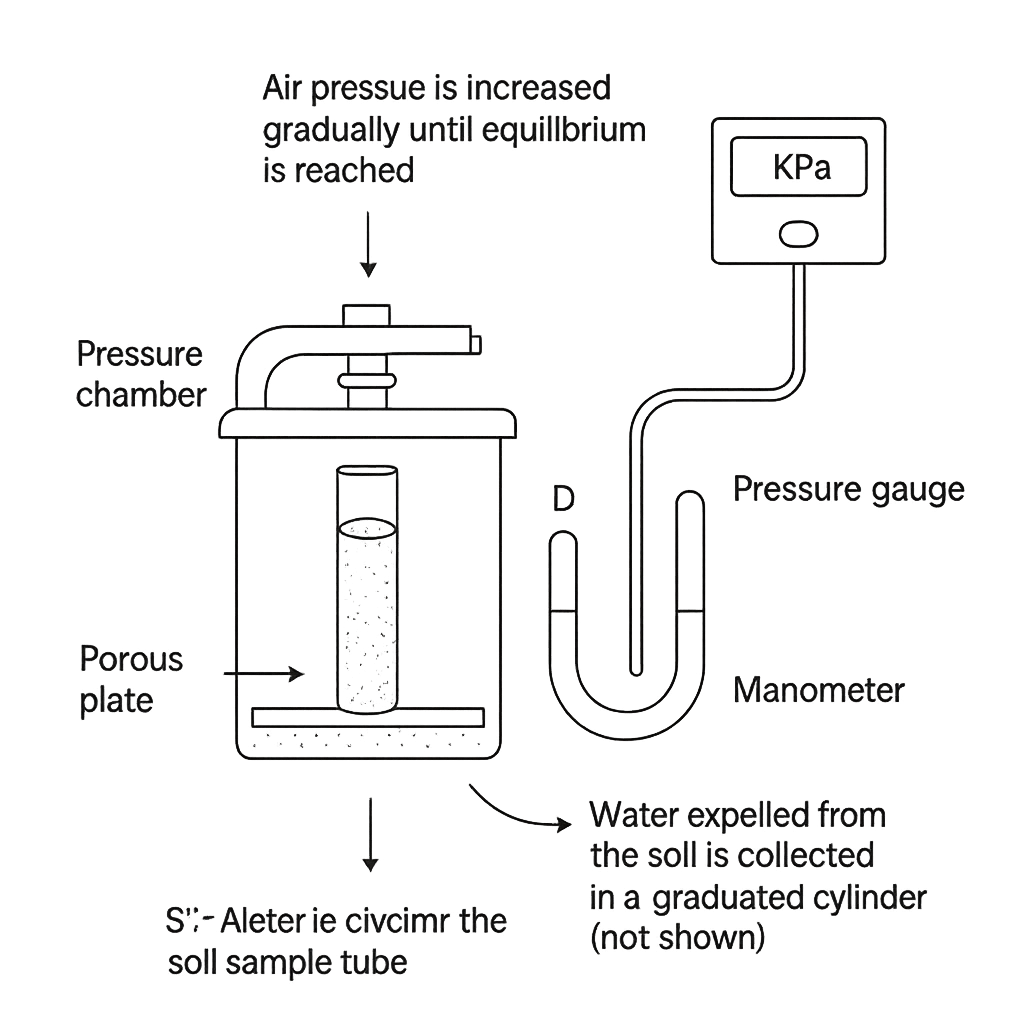
A soil moisture retention experiment is set up using a pressure plate apparatus as shown in the illustration. The apparatus consists of a sealed pressure chamber, a porous plate, a soil sample tube, a manometer and a pressure gauge. The soil sample is a 5 cm thick undisturbed core taken from a loamy field. The following data were recorded during the test: | Water potential (kPa) | Gravimetric water content (g g⁻¹) | |-----------------------|-----------------------------------| | -10 | 0.32 | | -33 | 0.24 | | -100 | 0.18 | | -300 | 0.12 | | -1500 | 0.07 | Answer the questions below:
Question Parts
(a)
Explain the principle of the pressure plate method for determining the soil water retention curve.
(b)
Using the data provided, determine the field capacity of the soil (water content at –33 kPa). Show any calculation or interpolation used.
(c)
Discuss how the texture of the loamy soil influences the shape of its moisture retention curve compared with a sandy soil.
Detailed Essay Solution & Marking Scheme Available

Get the step-by-step mathematical proofs, key points required by examiners, and a comprehensive breakdown from our AI Tutor.
Question 3 View Details
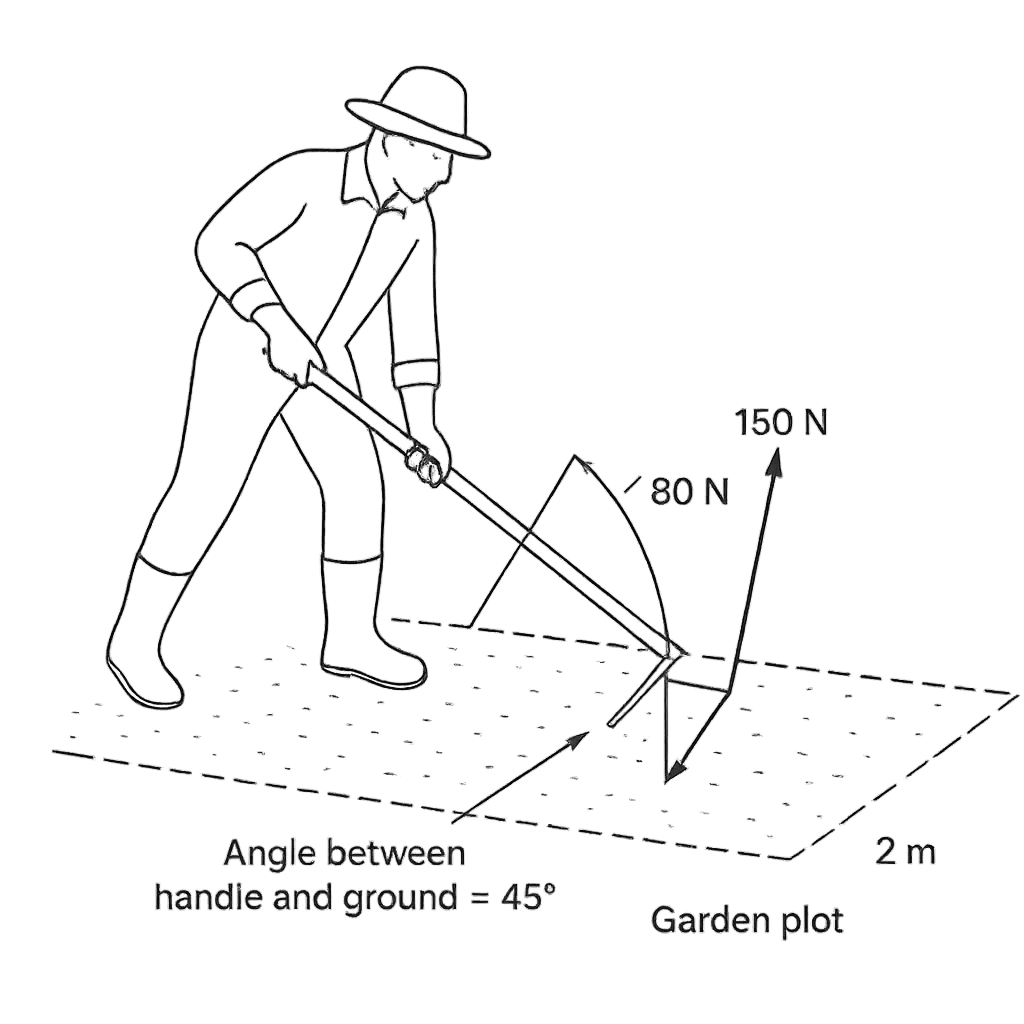
The diagram shows a practical setup for using a hand hoe to loosen soil in a rectangular garden plot. The hoe blade is 30 cm long and is inserted into the soil at an angle of 45° to the horizontal. The farmer applies a constant force of 150 N along the 1.2‑m long handle. The soil offers a resistance of 80 N opposite to the direction of motion. The farmer makes 20 strokes, each moving the blade through a vertical distance equal to the blade length projected onto the vertical direction.
Question Parts
(a)
Calculate the total work done by the farmer in joules after the 20 strokes.
(b)
State two advantages of using a hand hoe rather than a spade for preparing a garden bed, considering ergonomics and soil disturbance.
(c)
If the farmer wishes to increase the total work output by 50 % without changing the applied force, suggest one modification to the setup and justify how it achieves the increase.
Detailed Essay Solution & Marking Scheme Available

Get the step-by-step mathematical proofs, key points required by examiners, and a comprehensive breakdown from our AI Tutor.

Question 4 View Details
A small farm uses a 20‑horsepower (hp) diesel tractor to plough a 10‑hectare field. The tractor’s fuel consumption at full load is 5 L per hour and diesel costs ₦200 per litre. The tractor can plough at a rate of 1.5 ha per hour. Manual ploughing requires 8 labourers working 8 hours per day, each earning a daily wage of ₦1,200, and the manual ploughing speed is 0.5 ha per day.
Question Parts
(a)
Calculate the total fuel cost incurred to plough the whole 10 ha field with the tractor.
Detailed Essay Solution & Marking Scheme Available

Get the step-by-step mathematical proofs, key points required by examiners, and a comprehensive breakdown from our AI Tutor.

Question 5 View Details
A farmer owns three fields: Field A (5 ha), Field B (3 ha) and Field C (2 ha). He intends to practice a three‑year crop rotation using maize, soybean and cassava, each crop to be grown on each field once during the rotation.
Question Parts
(a)
Prepare a rotation schedule showing which crop is grown on each field in Year 1, Year 2 and Year 3.
(b)
Given average yields of maize = 3.5 t ha⁻¹, soybean = 2.8 t ha⁻¹ and cassava = 15 t ha⁻¹, calculate the total quantity (in tonnes) of each crop produced over the three‑year rotation and the aggregate production.
(c)
State and briefly explain three agronomic benefits of adopting this rotation system.
Detailed Essay Solution & Marking Scheme Available

Get the step-by-step mathematical proofs, key points required by examiners, and a comprehensive breakdown from our AI Tutor.

Question 6 View Details
A smallholder dairy farmer keeps 20 lactating cows. Each cow requires 12 kg of dry matter (DM) per day. The farm has the following feed resources for a 30‑day month: - Maize silage: 2,000 kg fresh weight, 30 % DM - Groundnut cake: 300 kg fresh weight, 50 % DM - Napier grass: 1,500 kg fresh weight, 15 % DM
Question Parts
(a)
Calculate the total DM required by the herd for the month.
(b)
Determine the total DM supplied by the available feeds and state whether there is a deficit or surplus. If there is a deficit, compute the shortfall in kg DM.
(c)
Assuming the farmer can purchase a concentrate containing 90 % DM to fill any deficit, calculate the minimum amount (in kg fresh weight) of this concentrate needed.
(d)
If each cow yields an average of 20 L of milk per day, estimate the total milk production for the month. Additionally, suggest two management practices that could increase milk yield.
Detailed Essay Solution & Marking Scheme Available

Get the step-by-step mathematical proofs, key points required by examiners, and a comprehensive breakdown from our AI Tutor.

Question 7 View Details
A farmer cultivates maize on a total area of 5 hectares. During the growing season he observes an outbreak of fall armyworm (Spodoptera frugiperda) on his crop. He wishes to adopt an integrated pest management (IPM) approach that combines cultural, biological and chemical control methods.
Question Parts
(a)
Identify three biological control agents that are effective against fall armyworm and briefly describe the mode of action of each agent.
(b)
The farmer decides to use a synthetic insecticide that is supplied as a 200 g L⁻¹ formulation. The recommended field rate is 0.75 L per hectare. After the first application he has used 1.2 L of the formulation. Calculate the maximum additional area (in hectares) that can be treated with the remaining insecticide. Show all steps of your calculation.
(c)
Weekly monitoring of larval density (number of larvae per 10 plants) gave the following counts: Week 1 = 15, Week 2 = 9, Week 3 = 4, Week 4 = 2. Determine the percentage reduction in larval population from Week 1 to Week 4 and comment on the effectiveness of the control measures applied.
(d)
Discuss two cultural practices that can be incorporated into the farmer’s IPM programme to lower the incidence of fall armyworm and explain how these practices complement the chemical and biological controls mentioned earlier.
Detailed Essay Solution & Marking Scheme Available

Get the step-by-step mathematical proofs, key points required by examiners, and a comprehensive breakdown from our AI Tutor.

Question 8 View Details
A cassava farmer has noticed the appearance of circular brown lesions surrounded by a yellow halo on the older leaves of his crop. The lesions have gradually spread to younger leaves, and the disease appears to be worsening during the rainy season.
Question Parts
(a)
Identify the most likely causal pathogen of the described symptoms and state its taxonomic group (e.g., genus and species).
(b)
The pathogen produces conidia that are dispersed by wind. If an average infected leaf releases 2.5 × 10⁵ conidia per day and the farmer currently has 120 infected leaves, estimate the total number of conidia released over a period of one week. Show your working.
(c)
The farmer intends to apply a copper‑based fungicide at a rate of 0.5 kg of copper per hectare. He possesses 12.5 kg of a commercial product that contains 20 % copper sulphate (by weight). Determine how many hectares can be treated with the available product. Include all calculation steps.
(d)
Explain how rotating cassava with a non‑host crop can interrupt the disease cycle, mentioning the specific survival structures of the pathogen and the typical period they can persist in the soil.
Detailed Essay Solution & Marking Scheme Available

Get the step-by-step mathematical proofs, key points required by examiners, and a comprehensive breakdown from our AI Tutor.

Master the Exam!

You've seen a preview, but there are thousands more questions plus AI tutor to break down complex solutions.

Unlock Full Access Available for Android & Windows
Help others prepare! Share this practice hub:
Chat with Support