neco 2024 physics | Objective

Prepare for your exams with neco questions? Reviewing past/model questions is one of the most effective ways to guarantee a high score. This practice hub features authentic 2024 physics (Objective) questions designed to simulate the real exam environment.

Practice these randomly selected questions to test your readiness.

Question 1 View Details
Two forces of magnitudes 8 N and 6 N act on a point object with an angle of \(60^{\circ}\) between them. Find the magnitude of the resultant force.
A. 2\sqrt{36} N
Correct B. 2\sqrt{37} N
C. \sqrt{144} N
D. 10 N

Correct Answer: B

Want to see the full step-by-step solution? Unlock AI Explanation & Analytics
Question 2 View Details
A 120 g sample of water at \(80^{\circ}C\) is mixed with 80 g of ice at \(-10^{\circ}C\). Assuming the specific heat capacities are \(c_{water}=4.18\,\text{J g}^{-1}\text{K}^{-1}\) and \(c_{ice}=2.09\,\text{J g}^{-1}\text{K}^{-1}\), and the latent heat of fusion of water is \(L_f=334\,\text{J g}^{-1}\), the mixture reaches a uniform temperature above \(0^{\circ}C\). Determine the final equilibrium temperature.
Correct A. 14.0 ^{\circ}C
B. 8.0 ^{\circ}C
C. 20.0 ^{\circ}C
D. 2.5 ^{\circ}C

Correct Answer: A

Want to see the full step-by-step solution? Unlock AI Explanation & Analytics
Question 3 View Details
An automobile starts from rest, accelerates uniformly at \(2\,\text{m s}^{-2}\) for 5 s, then moves at constant speed for 10 s, and finally decelerates uniformly to rest in 4 s. Calculate the total distance travelled during the whole motion.
A. 135 m
Correct B. 145 m
C. 150 m
D. 165 m

Correct Answer: B

Want to see the full step-by-step solution? Unlock AI Explanation & Analytics
Question 4 View Details
A sealed 10.0 L vessel initially contains 0.80 mol of an ideal gas at \(25^{\circ}C\) and pressure 2.0 atm. The temperature is raised to \(75^{\circ}C\) and the pressure is measured to be 2.5 atm. Assuming the volume of the vessel remains constant, determine how many moles of gas were added to the vessel during the heating process. Use \(R = 0.0821\,\text{L atm K}^{-1}\text{mol}^{-1}\).
A. 0.080 mol
B. 0.090 mol
C. 0.065 mol
Correct D. 0.0755 mol

Correct Answer: D

Want to see the full step-by-step solution? Unlock AI Explanation & Analytics
Question 5 View Details
In an experiment to determine the acceleration due to gravity using a simple pendulum, a student measures the length as \(L = 0.500\) m with a meter rule whose least count is 1 mm, and records the time for 20 oscillations as \(t = 40.2\) s using a stopwatch with a least count of 0.01 s. The student repeats the timing three times, obtaining \(t_1 = 40.2\) s, \(t_2 = 40.4\) s, and \(t_3 = 40.1\) s. Assuming the period is given by \(T = 2\pi\sqrt{L/g}\):\n(a) Find the best estimate of \(g\) using the average period.\n(b) Calculate the percentage random error in the period due to the spread of the three measurements.\n(c) Calculate the percentage systematic error in \(g\) due to the length measurement uncertainty (take the least count as \(\pm0.5\) mm).\n(d) Identify two possible sources of systematic error not accounted for, and suggest a precaution to minimise each.
A. a) g ≈ 4.70 m s^{-2} b) Random error ≈ 0.60 % c) Systematic error ≈ 0.05 % d) (i) Air currents - shield the pendulum; (ii) Non‑rigid string - use a stiff rod.
Correct B. a) g ≈ 4.88 m s^{-2}\n b) Random error ≈ 0.38 %\n c) Systematic error ≈ 0.10 %\n d) (i) Air resistance - use small amplitude or conduct in still air; (ii) Large swing angle - keep angle ≤5°.
C. a) g ≈ 9.80 m s^{-2} b) Random error ≈ 1.20 % c) Systematic error ≈ 0.30 % d) (i) Magnetic field interference - use non‑magnetic materials; (ii) Incorrect timing - use electronic timer.
D. a) g ≈ 5.10 m s^{-2} b) Random error ≈ 0.45 % c) Systematic error ≈ 0.15 % d) (i) Friction at the pivot - lubricate the hinge; (ii) Temperature variation - perform experiment at constant temperature.

Correct Answer: B

Want to see the full step-by-step solution? Unlock AI Explanation & Analytics
Question 6 View Details
The force acting on a \(4.0\ \text{kg}\) cart along a straight line is given by the graph: from \(t = 0\ \text{s}\) to \(t = 2\ \text{s}\) the force increases uniformly from \(0\ \text{N}\) to \(8\ \text{N}\); from \(t = 2\ \text{s}\) to \(t = 5\ \text{s}\) the force remains constant at \(8\ \text{N}\); from \(t = 5\ \text{s}\) to \(t = 7\ \text{s}\) the force decreases uniformly to \(0\ \text{N}\). Assuming the cart starts from rest, determine the speed of the cart at \(t = 7\ \text{s}\).
A. 12 \text{ m s}^{-1}
B. 8 \text{ m s}^{-1}
Correct C. 10 \text{ m s}^{-1}
D. 6 \text{ m s}^{-1}

Correct Answer: C

Want to see the full step-by-step solution? Unlock AI Explanation & Analytics
Question 7 View Details
A force of \(30\ \text{N}\) acts at \(40^{\circ}\) north of east. Another force of \(20\ \text{N}\) acts due east. Find the magnitude (in newtons) and direction (angle north of east) of the resultant force.
A. 52 \\text{ N}, \\; 20^{\\circ} \\text{ north of east}
B. 43 \\text{ N}, \\; 28^{\\circ} \\text{ north of east}
Correct C. 47 \text{ N}, \; 24^{\circ} \text{ north of east}
D. 39 \\text{ N}, \\; 35^{\\circ} \\text{ north of east}

Correct Answer: C

Want to see the full step-by-step solution? Unlock AI Explanation & Analytics
Question 8 View Details
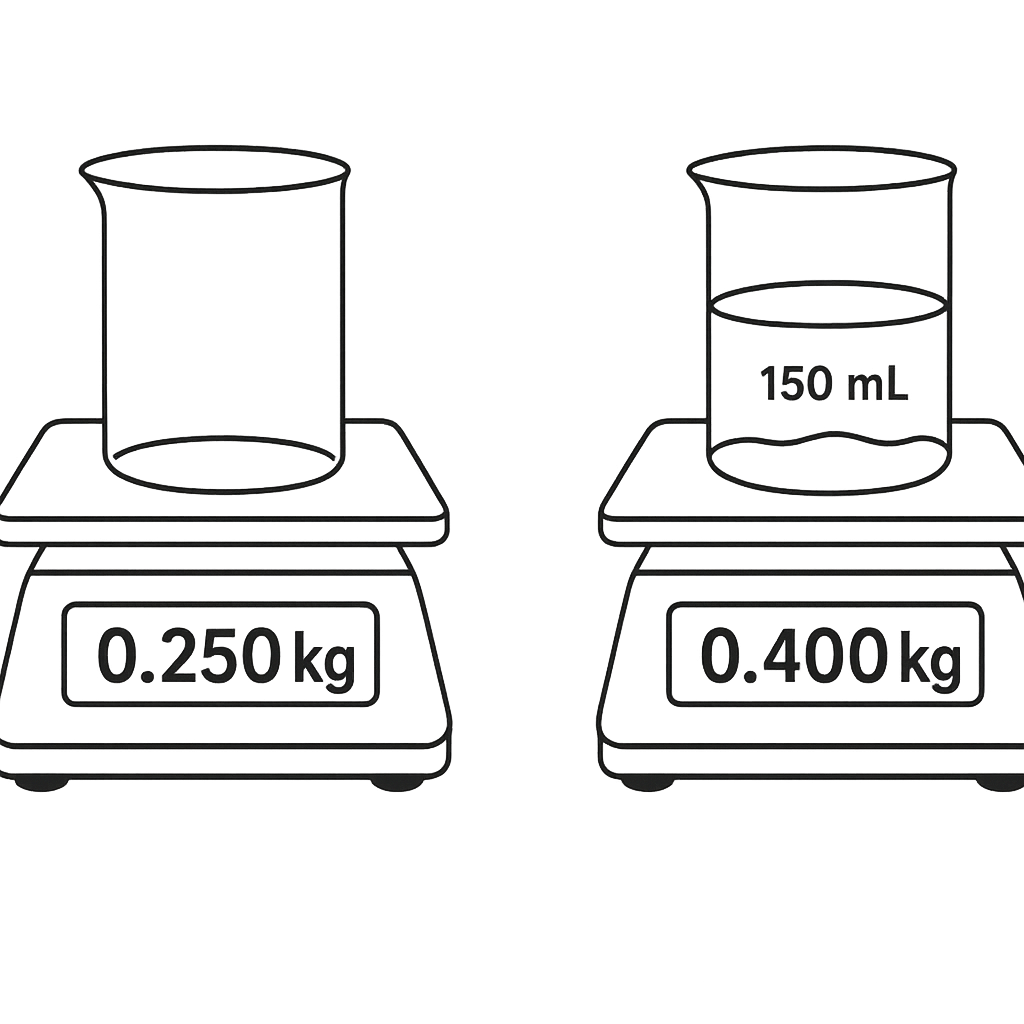
The diagram shows a balance with a beaker. The balance reads \(0.250\ \text{kg}\) when the empty beaker is placed on it, and \(0.400\ \text{kg}\) when the beaker contains \(150\ \text{mL}\) of water. Determine the density of water in \(\text{kg}\,\text{m}^{-3}\).
A. 0.8\times10^{3}\ \text{kg m}^{-3}
B. 1.0\times10^{2}\ \text{kg m}^{-3}
C. 1.2\times10^{3}\ \text{kg m}^{-3}
Correct D. 1.0\times10^{3}\ \text{kg m}^{-3}

Correct Answer: D

Want to see the full step-by-step solution? Unlock AI Explanation & Analytics
Question 9 View Details
A block of mass \(5\ \text{kg}\) is lifted by a system of two ideal pulleys: a fixed pulley attached to the ceiling and a movable pulley attached to the block. The rope passes over the fixed pulley, under the movable pulley, and the free end is pulled upward with a force \(F\). (a) Find the magnitude of \(F\) required to lift the block at constant speed. (b) If the pulling force is increased so that the block accelerates upward at \(2.0\ \text{m s}^{-2}\), find the new required pulling force.
A. (a) 49.0 \text{ N}, \; (b) 59.0 \text{ N}
B. (a) 24.5 \text{ N}, \; (b) 34.3 \text{ N}
Correct C. (a) 24.5 \text{ N}, \; (b) 29.5 \text{ N}
D. (a) 20.0 \text{ N}, \; (b) 25.0 \text{ N}

Correct Answer: C

Want to see the full step-by-step solution? Unlock AI Explanation & Analytics
Question 10 View Details
A block of mass \(10\ \text{kg}\) rests on a rough inclined plane that makes an angle of \(30^{\circ}\) with the horizontal. The coefficients of static and kinetic friction are \(\mu_s = 0.20\) and \(\mu_k = 0.15\) respectively. A horizontal force \(F\) is applied to the block (the force is parallel to the horizontal, not along the plane). (a) Determine the minimum magnitude of \(F\) required to start moving the block up the incline. (b) Once the block is moving, compute the work done by this horizontal force in moving the block \(5.0\ \text{m}\) up the incline.
A. (a) 78 \\text{ N}, \\; (b) 3.2\\times10^{2} \\text{ J}
B. (a) 80 \\text{ N}, \\; (b) 4.0\\times10^{2} \\text{ J}
Correct C. (a) 86 \text{ N}, \; (b) 3.7\times10^{2} \text{ J}
D. (a) 92 \\text{ N}, \\; (b) 4.1\\times10^{2} \\text{ J}

Correct Answer: C

Want to see the full step-by-step solution? Unlock AI Explanation & Analytics
Question 11 View Details
A mixture contains two radioactive isotopes, A and B. Isotope A has a half‑life of \(10\ \text{min}\) and isotope B has a half‑life of \(30\ \text{min}\). At time \(t = 0\) the total activity of the mixture is \(5.0 \times 10^{5}\ \text{Bq}\). After \(20\ \text{min}\) the total activity has decreased to \(2.0 \times 10^{5}\ \text{Bq}\). Assuming both isotopes decay independently and that the activity of each isotope is given by \(A = \lambda N\) where \(\lambda = \frac{\ln 2}{T_{1/2}}\), determine the initial number of atoms of isotope A and of isotope B in the sample.
A. Initial atoms of A \\(\\approx 3.90\\times10^{6}\\) atoms; initial atoms of B \\(\\approx 9.20\\times10^{6}\\) atoms.
B. Initial atoms of A \\(\\approx 5.12\\times10^{6}\\) atoms; initial atoms of B \\(\\approx 7.84\\times10^{6}\\) atoms.
C. Initial atoms of A \\(\\approx 4.36\\times10^{5}\\) atoms; initial atoms of B \\(\\approx 8.57\\times10^{7}\\) atoms.
Correct D. Initial atoms of A \(\approx 4.36\times10^{6}\) atoms; initial atoms of B \(\approx 8.57\times10^{6}\) atoms.

Correct Answer: D

Want to see the full step-by-step solution? Unlock AI Explanation & Analytics
Question 12 View Details
The speed of sound in air varies with temperature according to \(v = 331 + 0.6T\) where \(v\) is in \(\text{m s}^{-1}\) and \(T\) in \(^\circ\text{C}\). A source emits a tone of frequency \(f_s = 800\ \text{Hz}\) while moving away from a stationary observer at \(5\ \text{m s}^{-1}\). At the same time the observer moves toward the source at \(10\ \text{m s}^{-1}\). If the air temperature is \(25\ ^\circ\text{C}\), determine the frequency heard by the observer and the wavelength of the sound in the air. Give the frequency to the nearest hertz and the wavelength to three significant figures.
Correct A. Observed frequency \(\approx 811\ \text{Hz}\); wavelength \(\approx 0.433\ \text{m}\).
B. Observed frequency \(\approx 800\ \text{Hz}\); wavelength \(\approx 0.433\ \text{m}\).
C. Observed frequency \(\approx 811\ \text{Hz}\); wavelength \(\approx 0.427\ \text{m}\).
D. Observed frequency \(\approx 789\ \text{Hz}\); wavelength \(\approx 0.439\ \text{m}\).

Correct Answer: A

Want to see the full step-by-step solution? Unlock AI Explanation & Analytics
Question 13 View Details
A metal block of mass \(2.0\ \text{kg}\) and specific heat \(c_m = 0.45\ \text{kJ kg}^{-1}\text{K}^{-1}\) is initially at \(20\ ^\circ\text{C}\). It is placed in a well‑insulated water bath containing \(5.0\ \text{kg}\) of water (specific heat \(c_w = 4.18\ \text{kJ kg}^{-1}\text{K}^{-1}\)) at \(80\ ^\circ\text{C}\). The system loses heat to the surroundings at \(25\ ^\circ\text{C}\) according to Newton's law of cooling with a cooling constant \(k = 0.02\ \text{min}^{-1}\). (a) Assuming no heat loss, find the equilibrium temperature after mixing. (b) Using the equilibrium temperature as the initial temperature of the combined system, determine the temperature after \(10\) minutes of cooling. Give answers to one decimal place.
Correct A. Equilibrium temperature \(77.5\ ^\circ\text{C}\); temperature after 10 min \(68.0\ ^\circ\text{C}\).
B. Equilibrium temperature \\(76.0\\ ^\\circ\\text{C}\\); temperature after 10 min \\(69.3\\ ^\\circ\\text{C}\\).
C. Equilibrium temperature \\(78.2\\ ^\\circ\\text{C}\\); temperature after 10 min \\(66.5\\ ^\\circ\\text{C}\\).
D. Equilibrium temperature \\(80.0\\ ^\\circ\\text{C}\\); temperature after 10 min \\(70.0\\ ^\\circ\\text{C}\\).

Correct Answer: A

Want to see the full step-by-step solution? Unlock AI Explanation & Analytics
Question 14 View Details
A battery of emf \(E = 12\ \text{V}\) has an internal resistance of \(0.5\ \Omega\). It is connected in series with an unknown resistor \(R\) and a parallel network consisting of a \(4\ \Omega\) resistor and another unknown resistor \(R_2\). The total current measured in the circuit is \(2.0\ \text{A}\). It is also known that the voltage across the parallel network is \(6.0\ \text{V}\) under this condition. (a) Determine the values of \(R\) and \(R_2\). (b) If the resistor \(R\) heats up and its resistance increases by 10 % while the battery emf and internal resistance remain unchanged, calculate the new total current flowing in the circuit. Give the current to two decimal places.
Correct A. R = 2.5 \Omega, R_2 = 12 \Omega; new total current \(\approx 1.92\ \text{A}\).
B. R = 2.0 \\Omega, R_2 = 15 \\Omega; new total current \\(\\approx 2.05\\ \\text{A}\\).
C. R = 3.0 \\Omega, R_2 = 10 \\Omega; new total current \\(\\approx 1.85\\ \\text{A}\\).
D. R = 4.0 \\Omega, R_2 = 8 \\Omega; new total current \\(\\approx 1.70\\ \\text{A}\\).

Correct Answer: A

Want to see the full step-by-step solution? Unlock AI Explanation & Analytics
Question 15 View Details
A smooth horizontal surface supports a block that is pulled by a rope attached to a fixed point above the block, forming a simple pulley system. The rope passes over a single fixed pulley and then down to the block, so that three equal lengths of rope support the block (an ideal block‑and‑tackle with mechanical advantage 3). The load weight is \(500\ \text{N}\). The operator pulls the rope a distance of \(1.8\ \text{m}\) in \(4.0\ \text{s}\) while the load rises \(0.6\ \text{m}\). The system operates with an overall efficiency of \(80\%\). Determine (a) the tension in the input rope and (b) the useful power output delivered to the load. Give the tension to two significant figures and the power to the nearest watt.
A. Tension \\(\\approx 2.1\\times10^{2}\\ \text{N}\\); power output = 85 W
B. Tension \\(\\approx 1.8\\times10^{2}\\ \text{N}\\); power output = 60 W
Correct C. Tension \(\approx 2.1\times10^{2}\ \text{N}\); power output = 75 W
D. Tension \\(\\approx 2.4\\times10^{2}\\ \text{N}\\); power output = 90 W

Correct Answer: C

Want to see the full step-by-step solution? Unlock AI Explanation & Analytics
Question 16 View Details
A long solenoid of length \(L=0.50\) m and radius \(r=2.0\) cm is wound with \(N\) turns. It carries a sinusoidal current \(I(t)=I_{0}\sin(\omega t)\) where \(I_{0}=5\) A and \(\omega =200\pi\) rad s\(^{-1}\). The solenoid is placed in series with a resistor \(R=10\ \Omega\). The magnetic field at the centre of the solenoid must be \(0.02\) T when the current is at its peak. A secondary coil of \(N_{2}=200\) turns is wound over the same length and is connected across a resistor \(R_{L}=10\ \Omega\). Determine the maximum instantaneous power dissipated in the load resistor.
A. 2.0 W
B. 0.25 W
Correct C. 1.0 W
D. 0.5 W

Correct Answer: C

Want to see the full step-by-step solution? Unlock AI Explanation & Analytics
Question 17 View Details
A sealed container holds 2.0 mol of an ideal gas initially at \(27^{\circ}\text{C}\) and \(1.0\) atm. The gas first undergoes a constant‑volume process raising the pressure to \(2.5\) atm. It then expands isothermally until the pressure returns to \(1.0\) atm. What is the final temperature of the gas in \(^{\circ}\text{C}\)?
A. 600 \(^\circ\)C
Correct B. 477 \(^\circ\)C
C. 250 \(^\circ\)C
D. 350 \(^\circ\)C

Correct Answer: B

Want to see the full step-by-step solution? Unlock AI Explanation & Analytics
Question 18 View Details
A \(5\) kg block rests on a \(30^{\circ}\) incline. The coefficients of static and kinetic friction are \(\mu_{s}=0.25\) and \(\mu_{k}=0.20\) respectively. The block is attached to a light string that passes over a frictionless pulley at the top of the incline and is connected to a hanging mass \(M\). What is the minimum mass \(M\) (in kg) required to start moving the block up the incline?
A. 2.9 kg
Correct B. 3.6 kg
C. 5.0 kg
D. 4.2 kg

Correct Answer: B

Want to see the full step-by-step solution? Unlock AI Explanation & Analytics
Question 19 View Details
In the circuit shown, a battery of emf \(\varepsilon\) and internal resistance \(r\) supplies a network consisting of a \(12\ \Omega\) resistor in series with a parallel combination of a \(6\ \Omega\) resistor and a \(4\ \Omega\) resistor. The current through the \(6\ \Omega\) resistor is measured to be \(2.0\) A and the total current supplied by the battery is \(5.0\) A. The power dissipated in the internal resistance of the battery is \(20.0\) W. Determine the emf \(\varepsilon\) of the battery and its internal resistance \(r\).
A. \(\varepsilon = 80\ \text{V},\; r = 0.50\ \Omega\)
B. \(\varepsilon = 70\ \text{V},\; r = 1.0\ \Omega\)
C. \(\varepsilon = 76\ \text{V},\; r = 1.20\ \Omega\)
Correct D. \(\varepsilon = 76\ \text{V},\; r = 0.80\ \Omega\)

Correct Answer: D

Want to see the full step-by-step solution? Unlock AI Explanation & Analytics
Question 20 View Details
A student measures the period of a simple pendulum of length \(L=0.50\) m using a stopwatch. Ten successive readings (in seconds) are: 1.42, 1.44, 1.41, 1.43, 1.45, 1.40, 1.44, 1.42, 1.43, 1.41. The stopwatch has a systematic error of +0.02 s per reading, and the length measurement has an uncertainty of \(\pm0.001\) m. After correcting for the systematic error, determine the best estimate of the acceleration due to gravity \(g\) (in m·s\(^{-2}\)) and the combined standard uncertainty (expressed as a single standard uncertainty). Give \(g\) to two decimal places.
A. \\(g = 9.95 \\pm 0.07\\ \\text{m·s}^{-2}\\)
Correct B. \(g = 10.00 \pm 0.07\ \text{m·s}^{-2}\)
C. \\(g = 10.00 \\pm 0.09\\ \\text{m·s}^{-2}\\)
D. \\(g = 10.05 \\pm 0.07\\ \\text{m·s}^{-2}\\)

Correct Answer: B

Want to see the full step-by-step solution? Unlock AI Explanation & Analytics
Question 21 View Details
A block of mass \(2.0\ \text{kg}\) starts from rest at the top of a frictionless incline that is \(5.0\ \text{m}\) high. It slides down, then immediately enters a horizontal rough surface of length \(3.0\ \text{m}\) with coefficient of kinetic friction \(\mu = 0.30\), and finally contacts a horizontal spring of force constant \(k = 200\ \text{N m}^{-1}\) fixed to a wall. Assuming the block comes to rest after compressing the spring, find (a) the speed of the block just before it reaches the spring, and (b) the maximum compression of the spring.
A. a) \\(9.06\\ \text{m s}^{-1}\\), b) \\(0.91\\ \text{m}\\)
Correct B. a) \(8.97\ \text{m s}^{-1}\), b) \(0.90\ \text{m}\)
C. a) \\(9.90\\ \text{m s}^{-1}\\), b) \\(0.99\\ \text{m}\\)
D. a) \\(9.29\\ \text{m s}^{-1}\\), b) \\(0.93\\ \text{m}\\)

Correct Answer: B

Want to see the full step-by-step solution? Unlock AI Explanation & Analytics
Question 22 View Details
A system consists of a movable pulley of radius \(0.15\ \text{m}\) attached to a load of weight \(120\ \text{N}\). The rope passes over a fixed pulley and the effort is applied to the free end of the rope. The axle of the movable pulley has a friction torque of \(0.5\ \text{N m}\). (a) Determine the magnitude of the effort force required to lift the load at constant speed. (b) Calculate the efficiency of the system as a percentage.
A. Effort \(= 55.55\ \text{N}\); Efficiency \(\approx 90.0\%\)
Correct B. Effort \(= 63.33\ \text{N}\); Efficiency \(\approx 94.8\%\)
C. Effort \(= 70.00\ \text{N}\); Efficiency \(\approx 85.0\%\)
D. Effort \(= 60.00\ \text{N}\); Efficiency \(\approx 80.0\%\)

Correct Answer: B

Want to see the full step-by-step solution? Unlock AI Explanation & Analytics
Question 23 View Details
A length is measured as \(12.35\ \text{cm}\) using a ruler whose smallest division is \(0.01\ \text{cm}\). Express this length in metres with the appropriate number of significant figures.
A. 0.01235 m
Correct B. 0.1235 m
C. 0.124 m
D. 12.35 m

Correct Answer: B

Want to see the full step-by-step solution? Unlock AI Explanation & Analytics
Question 24 View Details
A point charge \(q_1 = +5.0\ \mu\text{C}\) is fixed at the origin. A uniform electric field of magnitude \(E = 2.0 \times 10^{4}\ \text{N C}^{-1}\) directed along the positive \(x\)-axis is present. At what position \(x\) (in metres) along the \(x\)-axis should a test charge \(q_2 = -2.0\ \mu\text{C}\) be placed so that the net electrostatic force on it is zero?
A. -0.75 m
B. 1.5 m
C. -3.0 m
Correct D. -1.5 m

Correct Answer: D

Want to see the full step-by-step solution? Unlock AI Explanation & Analytics
Question 25 View Details
A motor of rated power \(P_{\text{max}} = 1500\ \text{W}\) is used to lift a load of mass \(m = 120\ \text{kg}\). The load is first accelerated from rest with a constant acceleration for \(t_1 = 5\ \text{s}\), after which it moves upward at the constant speed attained. Determine (a) the greatest possible constant acceleration \(a\) that does not cause the motor power to exceed its rating at any time, (b) the speed of the load at the end of the acceleration phase, and (c) the total distance the load rises in a total time of \(20\ \text{s}\).
A. a) \(0.30\ \text{m s}^{-2}\), b) \(1.50\ \text{m s}^{-1}\), c) \(24.0\ \text{m}\)
Correct B. a) \(0.25\ \text{m s}^{-2}\), b) \(1.25\ \text{m s}^{-1}\), c) \(21.9\ \text{m}\)
C. a) \(0.22\ \text{m s}^{-2}\), b) \(1.10\ \text{m s}^{-1}\), c) \(22.0\ \text{m}\)
D. a) \(0.20\ \text{m s}^{-2}\), b) \(1.00\ \text{m s}^{-1}\), c) \(20.0\ \text{m}\)

Correct Answer: B

Want to see the full step-by-step solution? Unlock AI Explanation & Analytics

Master the Exam!

You've seen a preview, but there are thousands more questions plus AI tutor to break down complex solutions.

Unlock Full Access Available for Android & Windows
Help others prepare! Share this practice hub:
Chat with Support