neco 2022 chemistry | Objective

Prepare for your exams with neco questions? Reviewing past/model questions is one of the most effective ways to guarantee a high score. This practice hub features authentic 2022 chemistry (Objective) questions designed to simulate the real exam environment.

Practice these randomly selected questions to test your readiness.

Question 1 View Details
When 2-methyl-1-butene (\( \mathrm{CH_2=C(CH_3)CH_2CH_3} \)) is treated with aqueous \(\mathrm{H_2SO_4}\) under reflux, the major product is formed after carbocation rearrangement. Identify the IUPAC name of the major product.
Correct A. 2-methyl-2-butanol
B. 3-methyl-2-butanol
C. 2-methyl-1-butanol
D. 2-ethyl-2-butanol

Correct Answer: A

Want to see the full step-by-step solution? Unlock AI Explanation & Analytics
Question 2 View Details
A solid oxide of a non‑metal contains 52.14% sulfur by mass. Determine (i) its empirical formula, (ii) the oxidation state of sulfur in the oxide, and (iii) the formula of the acid formed when the oxide reacts with water.
A. Empirical formula SO; oxidation state of S = +2; acid formed is H₂SO₂ (sulfurous acid).
Correct B. Empirical formula SO₂; oxidation state of S = +4; acid formed is H₂SO₃ (sulfurous acid).
C. Empirical formula S₂O₅; oxidation state of S = +5; acid formed is H₂S₂O₅ (disulfurous acid).
D. Empirical formula SO₃; oxidation state of S = +6; acid formed is H₂SO₄ (sulfuric acid).

Correct Answer: B

Want to see the full step-by-step solution? Unlock AI Explanation & Analytics
Question 3 View Details
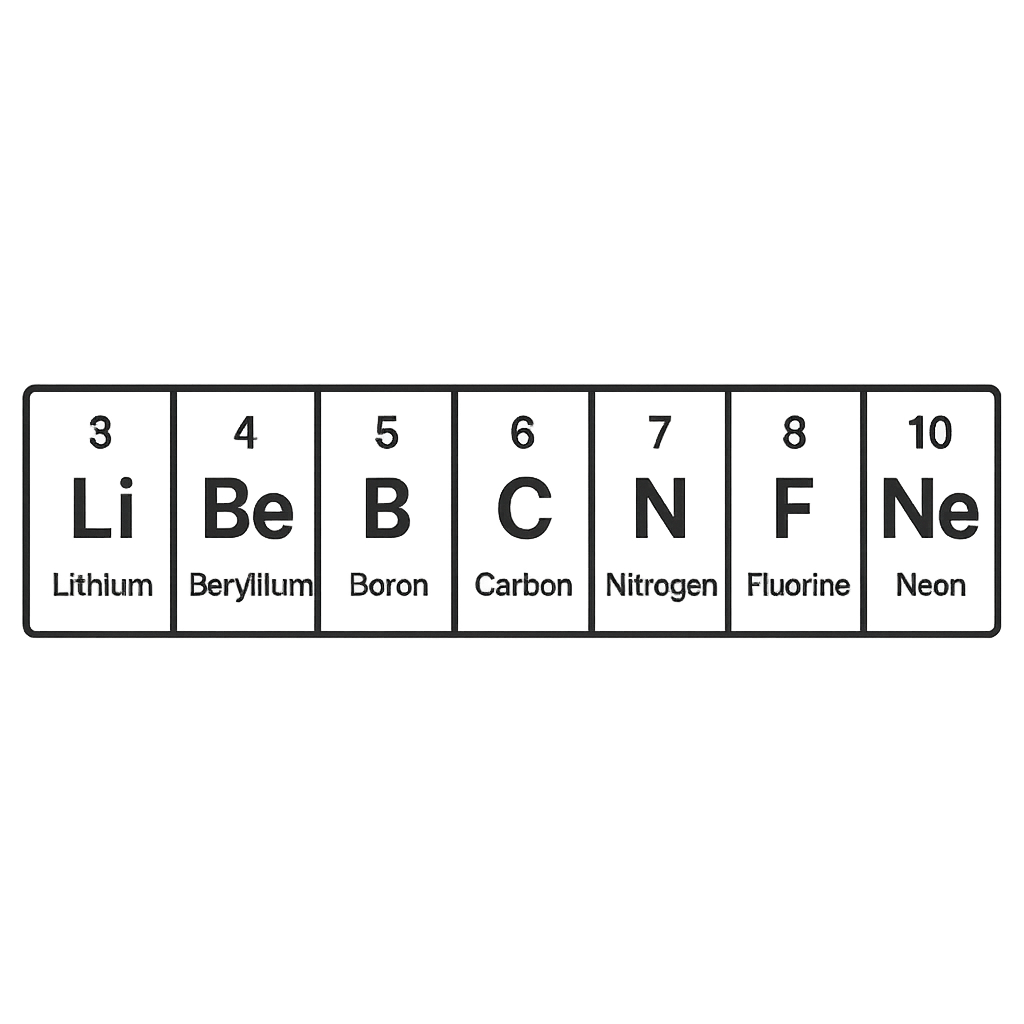
The diagram shows the elements of period 2 of the periodic table (Li, Be, B, C, N, O, F, Ne). Which element in this period has the highest first ionisation energy?
A. Oxygen (O)
B. Fluorine (F)
C. Nitrogen (N)
Correct D. Neon (Ne)

Correct Answer: D

Want to see the full step-by-step solution? Unlock AI Explanation & Analytics
Question 4 View Details
A metal M forms a nitrate solution that reacts spontaneously with solid copper metal, producing a blue solution and depositing copper metal. Given the standard reduction potentials: \(\mathrm{M^{2+}+2e^- \rightarrow M}\)  E° = -0.13 V, \(\mathrm{Cu^{2+}+2e^- \rightarrow Cu}\)  E° = +0.34 V. Identify the metal M and write the balanced redox equation for the reaction.
A. Metal M is zinc (Zn); balanced equation: Zn^{2+}(aq) + Cu(s) → Zn(s) + Cu^{2+}(aq)
Correct B. Metal M is lead (Pb); balanced equation: Pb^{2+}(aq) + Cu(s) → Pb(s) + Cu^{2+}(aq)
C. Metal M is nickel (Ni); balanced equation: Ni^{2+}(aq) + Cu(s) → Ni(s) + Cu^{2+}(aq)
D. Metal M is iron (Fe); balanced equation: Fe^{2+}(aq) + Cu(s) → Fe(s) + Cu^{2+}(aq)

Correct Answer: B

Want to see the full step-by-step solution? Unlock AI Explanation & Analytics
Question 5 View Details
A 2.00 g sample of a non‑volatile solute is dissolved in 100.0 g of water. The freezing point of the solution is lowered by 0.74 °C. (i) Calculate the molar mass of the solute. (ii) Using the same solute, predict the freezing‑point depression when it is dissolved in 50.0 g of benzene (freezing point -5.5 °C, \(K_f\) = 5.12 °C·kg mol⁻¹). Give the new freezing point of the benzene solution.
Correct A. Molar mass ≈ 50.3 g mol⁻¹; freezing point of the benzene solution ≈ -9.6 °C.
B. Molar mass ≈ 55.0 g mol⁻¹; freezing point of the benzene solution ≈ -10.8 °C.
C. Molar mass ≈ 60.1 g mol⁻¹; freezing point of the benzene solution ≈ -7.5 °C.
D. Molar mass ≈ 45.2 g mol⁻¹; freezing point of the benzene solution ≈ -8.3 °C.

Correct Answer: A

Want to see the full step-by-step solution? Unlock AI Explanation & Analytics
Question 6 View Details
An electrochemical cell is constructed as follows: Zn(s) | Zn^{2+}(0.010\,M) || Cu^{2+}(x\,M) | Cu(s) at 25\,°C. The standard electrode potentials are E°(Zn^{2+}/Zn) = -0.76\,V and E°(Cu^{2+}/Cu) = +0.34\,V. The cell emf measured under these conditions is 1.05\,V. (a) Calculate the concentration \(x\) of Cu^{2+} in the cell. (b) If a charge of 0.500\,C passes through the cell, how many grams of copper are deposited on the copper electrode?
Correct A. Cu^{2+} concentration = 9.7\times10^{-5}\,M; mass of Cu deposited = 1.65\times10^{-4}\,g
B. Cu^{2+} concentration = 9.7\times10^{-5}\,M; mass of Cu deposited = 1.65\times10^{-5}\,g
C. Cu^{2+} concentration = 1.0\times10^{-4}\,M; mass of Cu deposited = 1.70\times10^{-4}\,g
D. Cu^{2+} concentration = 9.7\times10^{-4}\,M; mass of Cu deposited = 1.65\times10^{-3}\,g

Correct Answer: A

Want to see the full step-by-step solution? Unlock AI Explanation & Analytics
Question 7 View Details
Benzaldehyde (C_{6}H_{5}CHO) is converted into p‑nitroacetophenone (C_{8}H_{7}NO_{3}) in three successive steps: (1) addition of methylmagnesium bromide followed by acidic work‑up, (2) oxidation of the resulting secondary alcohol to a ketone, and (3) electrophilic nitration that installs a nitro group para to the carbonyl. If 5.00\,g of benzaldehyde is used and each step gives an 80\% isolated yield, calculate (a) the overall theoretical mass of p‑nitroacetophenone obtainable and (b) write the overall balanced equation for the transformation (showing the stoichiometric relationship between benzaldehyde and p‑nitroacetophenone).
A. Mass of p‑nitroacetophenone ≈ 3.2\\,g; overall stoichiometry: 1 mol C_{6}H_{5}CHO → 1 mol C_{8}H_{7}NO_{3}
B. Mass of p‑nitroacetophenone ≈ 4.8\\,g; overall stoichiometry: 1 mol C_{6}H_{5}CHO → 1.2 mol C_{8}H_{7}NO_{3}
Correct C. Mass of p‑nitroacetophenone ≈ 4.0\,g; overall stoichiometry: 1 mol C_{6}H_{5}CHO → 1 mol C_{8}H_{7}NO_{3}
D. Mass of p‑nitroacetophenone ≈ 5.0\\,g; overall stoichiometry: 1 mol C_{6}H_{5}CHO → 0.8 mol C_{8}H_{7}NO_{3}

Correct Answer: C

Want to see the full step-by-step solution? Unlock AI Explanation & Analytics
Question 8 View Details
2.00\,g of aluminium metal is placed in excess hydrochloric acid. The reaction is 2 Al + 6 HCl \rightarrow 2 AlCl_{3} + 3 H_{2}. (a) Calculate the volume of hydrogen gas produced at STP if the reaction went to completion. (b) In practice only 75\% of the aluminium reacts because of surface passivation. Re‑calculate the volume of hydrogen actually evolved. (c) Determine the mass of aluminium chloride formed under the same 75\% conversion condition.
A. Theoretical H_{2} volume = 2.55\,L; actual H_{2} volume = 1.90\,L; mass of AlCl_{3} formed = 7.20\,g
Correct B. Theoretical H_{2} volume = 2.49\,L; actual H_{2} volume = 1.87\,L; mass of AlCl_{3} formed = 7.41\,g
C. Theoretical H_{2} volume = 2.60\,L; actual H_{2} volume = 1.95\,L; mass of AlCl_{3} formed = 7.80\,g
D. Theoretical H_{2} volume = 2.30\,L; actual H_{2} volume = 1.73\,L; mass of AlCl_{3} formed = 6.95\,g

Correct Answer: B

Want to see the full step-by-step solution? Unlock AI Explanation & Analytics
Question 9 View Details
The solubility product of calcium fluoride at 25\,°C is K_{sp}=3.9\times10^{-11}. (a) Calculate the molar solubility \(s\) of CaF_{2} in pure water. (b) If 0.10\,M NaF is added to the solution, determine the new solubility of CaF_{2}. (c) Assuming the fluoride concentration after addition is essentially 0.10\,M, estimate the pH of the solution arising from the hydrolysis of F^{-} (K_{a} of HF = 6.6\times10^{-4}).
A. s = 2.1\\times10^{-4}\\,M; s' (with 0.10\\,M NaF) = 3.9\\times10^{-9}\\,M; pH ≈ 6.8
Correct B. s = 2.1\times10^{-4}\,M; s' (with 0.10\,M NaF) = 3.9\times10^{-9}\,M; pH ≈ 8.1
C. s = 2.1\\times10^{-3}\\,M; s' (with 0.10\\,M NaF) = 3.9\\times10^{-7}\\,M; pH ≈ 9.2
D. s = 1.3\\times10^{-4}\\,M; s' (with 0.10\\,M NaF) = 1.2\\times10^{-8}\\,M; pH ≈ 7.5

Correct Answer: B

Want to see the full step-by-step solution? Unlock AI Explanation & Analytics
Question 10 View Details
A 5.00\,g sample of a solid mixture containing calcium carbonate (CaCO_{3}) and magnesium carbonate (MgCO_{3}) is heated until complete decomposition: CaCO_{3} \rightarrow CaO + CO_{2} and MgCO_{3} \rightarrow MgO + CO_{2}. The volume of CO_{2} collected over the solid at 298\,K and 1\,atm is 1.30\,L. Determine the mass percent of CaCO_{3} in the original mixture.
A. Mass percent of CaCO_{3} ≈ 55\\%
B. Mass percent of CaCO_{3} ≈ 72\\%
C. Mass percent of CaCO_{3} ≈ 48\\%
Correct D. Mass percent of CaCO_{3} ≈ 66\%

Correct Answer: D

Want to see the full step-by-step solution? Unlock AI Explanation & Analytics
Question 11 View Details
An unknown copolymer is prepared from monomer A (C4H6, \(M = 54\ \text{g·mol}^{-1}\)) and monomer B (C2H4, \(M = 28\ \text{g·mol}^{-1}\)). Elemental analysis shows that the polymer contains 62\% by mass of monomer A and 38\% by mass of monomer B. The number‑average molecular weight of the polymer sample is \(24\,000\ \text{g·mol}^{-1}\). Assuming the polymer consists of a single repeat unit that contains integer numbers of monomer A and monomer B units, determine (i) the smallest whole‑number ratio of monomer A to monomer B in the repeat unit, and (ii) the degree of polymerisation (DP) of the sample (rounded to the nearest integer).
A. Ratio A : B = 11 : 12; DP ≈ 26
Correct B. Ratio A : B = 11 : 13; DP ≈ 25
C. Ratio A : B = 10 : 13; DP ≈ 24
D. Ratio A : B = 12 : 13; DP ≈ 25

Correct Answer: B

Want to see the full step-by-step solution? Unlock AI Explanation & Analytics
Question 12 View Details
A galvanic cell is constructed as follows: \(\text{Cu(s)}\ |\ \text{Cu}^{2+}(0.050\ \text{M})\ ||\ \text{Fe}^{2+}(x\ \text{M})\ |\ \text{Fe(s)}\). The standard reduction potentials are \(E^{\circ}_{\text{Cu}^{2+}/\text{Cu}} = +0.337\ \text{V}\) and \(E^{\circ}_{\text{Fe}^{2+}/\text{Fe}} = -0.447\ \text{V}\). At 298 K the measured cell emf is 0.78 V. Calculate the concentration \(x\) of the \(\text{Fe}^{2+}\) solution (in mol·L⁻¹, three significant figures).
Correct A. 0.0368 M
B. 0.0123 M
C. 0.0589 M
D. 0.0250 M

Correct Answer: A

Want to see the full step-by-step solution? Unlock AI Explanation & Analytics
Question 13 View Details
Ethyl acetate (\(\text{CH}_3\text{COOCH}_2\text{CH}_3\)) hydrolyses in water according to\n\[\n\text{CH}_3\text{COOCH}_2\text{CH}_3 + \text{H}_2\text{O} \rightleftharpoons \text{CH}_3\text{COOH} + \text{CH}_3\text{CH}_2\text{OH}\n\]\nAt 25 °C the equilibrium constant \(K_c\) is \(1.0 \times 10^{-5}\). A 1.00 L solution is prepared by mixing 0.10 mol of ethyl acetate with 0.20 mol of water. (i) Calculate the equilibrium concentrations of all four species and the percentage of ethyl acetate that has hydrolysed. (ii) Using the acetic acid dissociation constant \(K_a = 1.8 \times 10^{-5}\), estimate the pH of the equilibrium solution (neglect the effect of ethanol).
A. Equilibrium: [EA]=0.09900 M, [H₂O]=0.19900 M, [AcOH]=[EtOH]=2.00×10⁻⁴ M; hydrolysis = 0.20 %; pH ≈ 4.30
B. Equilibrium: [EA]=0.0980 M, [H₂O]=0.1980 M, [AcOH]=[EtOH]=9.00×10⁻⁴ M; hydrolysis = 0.90 %; pH ≈ 3.80
C. Equilibrium: [EA]=0.10000 M, [H₂O]=0.20000 M, [AcOH]=[EtOH]=0 M; hydrolysis = 0 %; pH ≈ 7.00
Correct D. Equilibrium: [EA]=0.09955 M, [H₂O]=0.19955 M, [AcOH]=[EtOH]=4.47×10⁻⁴ M; hydrolysis = 0.447 %; pH ≈ 4.05

Correct Answer: D

Want to see the full step-by-step solution? Unlock AI Explanation & Analytics
Question 14 View Details
A sample solution contains an unknown mixture of the metal ions Fe³⁺, Cu²⁺, Ni²⁺ and Zn²⁺. The following qualitative tests are carried out sequentially:\n\n1. Addition of dilute HCl produces a white precipitate that dissolves on heating.\n2. To the filtrate, excess aqueous NH₃ is added, giving a deep‑blue solution.\n3. After adjusting the solution to pH 9, dimethylglyoxime reagent is added, producing a bright‑red precipitate.\n4. In a separate experiment, the original solution is first treated with excess KCN; the solution becomes colourless and no precipitate forms when H₂S is subsequently added in acidic medium.\n\nBased on these observations, identify all metal ions present in the original mixture.
A. Fe³⁺, Cu²⁺ and Zn²⁺
B. Fe³⁺, Ni²⁺ and Zn²⁺
Correct C. Fe³⁺, Cu²⁺ and Ni²⁺
D. Cu²⁺, Ni²⁺ and Zn²⁺

Correct Answer: C

Want to see the full step-by-step solution? Unlock AI Explanation & Analytics
Question 15 View Details
5.00 g of a pure secondary alcohol with molecular formula \(\text{C}_5\text{H}_{12}\text{O}\) (M = 88 g·mol⁻¹) is oxidised with excess \(\text{K}_2\text{Cr}_2\text{O}_7^{2-}\) in acidic medium to give the corresponding ketone. The ketone is then reacted with 2,4‑dinitrophenylhydrazine (DNPH) to form the hydrazone, which is isolated and weighed. The isolated hydrazone mass is 6.20 g and its molecular formula is \(\text{C}_{11}\text{H}_{12}\text{N}_4\text{O}_5\) (M = 252 g·mol⁻¹). Assuming the oxidation step proceeds with 100 % yield and that the only loss of material occurs in the DNPH step, (i) state the IUPAC name of the alcohol (assuming a straight‑chain structure), and (ii) calculate the percentage yield of the DNPH reaction.
Correct A. Alcohol: 2‑pentanol; DNPH yield ≈ 43.3 %
B. Alcohol: 2‑pentanol; DNPH yield ≈ 60.0 %
C. Alcohol: 1‑pentanol; DNPH yield ≈ 55.0 %
D. Alcohol: 3‑pentanol; DNPH yield ≈ 43.3 %

Correct Answer: A

Want to see the full step-by-step solution? Unlock AI Explanation & Analytics
Question 16 View Details
A buffer solution is prepared by mixing a weak acid HA (\( \mathrm{p}K_a = 4.75 \)) with its sodium salt NaA. To obtain a buffer of \( \mathrm{pH}=5.75 \), \(0.500\ \text{L}\) of solution is required with a total concentration of HA plus A⁻ equal to \(0.200\ \text{M}\). Determine the mass of NaA (molar mass \(82\ \text{g mol}^{-1}\)) that must be added.
A. 8.12 g
Correct B. 7.46 g
C. 6.23 g
D. 5.00 g

Correct Answer: B

Want to see the full step-by-step solution? Unlock AI Explanation & Analytics
Question 17 View Details
2.00 g of magnesium reacts with excess hydrochloric acid according to \( \mathrm{Mg} + 2\mathrm{HCl} \rightarrow \mathrm{MgCl_2} + \mathrm{H_2} \). The hydrogen gas collected over water at 25 °C and 750 mmHg occupies \(0.845\ \text{L}\). Determine the percent yield of hydrogen, taking the water vapour pressure at 25 °C as 23.8 mmHg.
A. 35.8 %
Correct B. 40.1 %
C. 45.3 %
D. 52.0 %

Correct Answer: B

Want to see the full step-by-step solution? Unlock AI Explanation & Analytics
Question 18 View Details
A wastewater treatment plant reduces the concentration of a biodegradable pollutant following first‑order kinetics \( C = C_0 e^{-kt}\). The plant operates with a hydraulic retention time of 6 h. Influent concentration \(C_0 = 120\ \text{mg L}^{-1}\). Discharge standard requires \(C \le 30\ \text{mg L}^{-1}\). (a) Find the minimum rate constant \(k\) (h^{-1}) needed. (b) If the plant can achieve \(k = 0.45\ \text{h}^{-1}\), calculate the percentage by which the effluent concentration is lower than the standard.
A. 0.183 h^{-1}, 68.5 %
B. 0.277 h^{-1}, 73.1 %
Correct C. 0.231 h^{-1}, 73.1 %
D. 0.231 h^{-1}, 93.4 %

Correct Answer: C

Want to see the full step-by-step solution? Unlock AI Explanation & Analytics
Question 19 View Details
A sealed container of volume \(2.00\ \text{m}^3\) at 25 °C contains a gas mixture in which carbon dioxide occupies 0.045 % by volume. (a) Calculate the mass of CO₂ (g) present. (b) If the container is opened to the atmosphere where CO₂ concentration is 0.041 % by volume (temperature and total pressure remain 1 atm), determine the net mass of CO₂ that will be released to the atmosphere.
A. 0.154 g
B. 0.124 g
C. 0.164 g
Correct D. 0.144 g

Correct Answer: D

Want to see the full step-by-step solution? Unlock AI Explanation & Analytics
Question 20 View Details
The solubility of silver chloride (AgCl) in water at 25 °C is \(1.33\times10^{-5}\ \text{mol L}^{-1}\). 250.0 mL of 0.0100 M NaCl solution is mixed with 250.0 mL of a saturated AgCl solution at the same temperature. Will a precipitate form? If so, calculate the mass of AgCl (mg) that precipitates.
A. 4.76 mg
Correct B. 0.476 mg
C. 0.238 mg
D. 0.952 mg

Correct Answer: B

Want to see the full step-by-step solution? Unlock AI Explanation & Analytics
Question 21 View Details
The solubility of AgCl in pure water at 25 °C is \(1.33 \times 10^{-5}\ \text{mol\ L}^{-1}\). When the temperature is raised to 35 °C the solubility increases by 20 %. If 0.010\ mol\ L\(^{-1}\) NaCl is added to the solution at 25 °C, calculate the new solubility of AgCl at this temperature.
A. 2.0 \\times 10^{-8} mol L^{-1}
B. 1.5 \\times 10^{-8} mol L^{-1}
C. 1.8 \\times 10^{-7} mol L^{-1}
Correct D. 1.8 \times 10^{-8} mol L^{-1}

Correct Answer: D

Want to see the full step-by-step solution? Unlock AI Explanation & Analytics
Question 22 View Details
A 0.50‑mol mixture of the two structural isomers of C\(_5\)H\(_{12}\) (n‑pentane and isopentane) is completely combusted in excess O\(_2\). The combustion of pure n‑pentane releases 3500 kJ mol\(^{-1}\) and that of pure isopentane releases 3400 kJ mol\(^{-1}\). The mixture releases a total of 1725 kJ on combustion. Determine the mole fraction of n‑pentane in the mixture.
A. 0.45
Correct B. 0.50
C. 0.60
D. 0.55

Correct Answer: B

Want to see the full step-by-step solution? Unlock AI Explanation & Analytics
Question 23 View Details
Write the ground‑state electron configuration of iron (atomic number 26) and state the number of unpaired electrons present.
A. 5
Correct B. 4
C. 2
D. 3

Correct Answer: B

Want to see the full step-by-step solution? Unlock AI Explanation & Analytics
Question 24 View Details
Ethene (\(C_{2}H_{4}\)) contains carbon-carbon and carbon-hydrogen bonds. How many sigma (\(\sigma\)) bonds are present in one molecule of ethene?
Correct A. 5
B. 6
C. 7
D. 4

Correct Answer: A

Want to see the full step-by-step solution? Unlock AI Explanation & Analytics
Question 25 View Details
A galvanic cell is set up with a zinc electrode immersed in 0.10 M ZnSO\(_4\) solution and a copper electrode immersed in an unknown concentration of CuSO\(_4\) solution. The standard reduction potentials are \(E^{\circ}_{\text{Zn}^{2+}/\text{Zn}} = -0.76\ \text{V}\) and \(E^{\circ}_{\text{Cu}^{2+}/\text{Cu}} = +0.34\ \text{V}\). At 25 °C the cell emf is measured to be 1.05 V. Calculate the concentration of Cu\(^{2+}\) ions in the copper half‑cell. (Use \(n = 2\) for the overall reaction and \(0.0592\ \text{V}\) for \(\frac{RT}{F}\) at 25 °C.)
A. 4.0 \\times 10^{-3} M
B. 2.0 \\times 10^{-2} M
C. 1.0 \\times 10^{-3} M
Correct D. 2.0 \times 10^{-3} M

Correct Answer: D

Want to see the full step-by-step solution? Unlock AI Explanation & Analytics

Master the Exam!

You've seen a preview, but there are thousands more questions plus AI tutor to break down complex solutions.

Unlock Full Access Available for Android & Windows
Help others prepare! Share this practice hub:
Chat with Support