neco 2022 chemistry | Essay

Prepare for your exams with neco questions? Reviewing past/model questions is one of the most effective ways to guarantee a high score. This practice hub features authentic 2022 chemistry (Essay) questions designed to simulate the real exam environment.

Practice these randomly selected questions to test your readiness.
Question 1 View Details
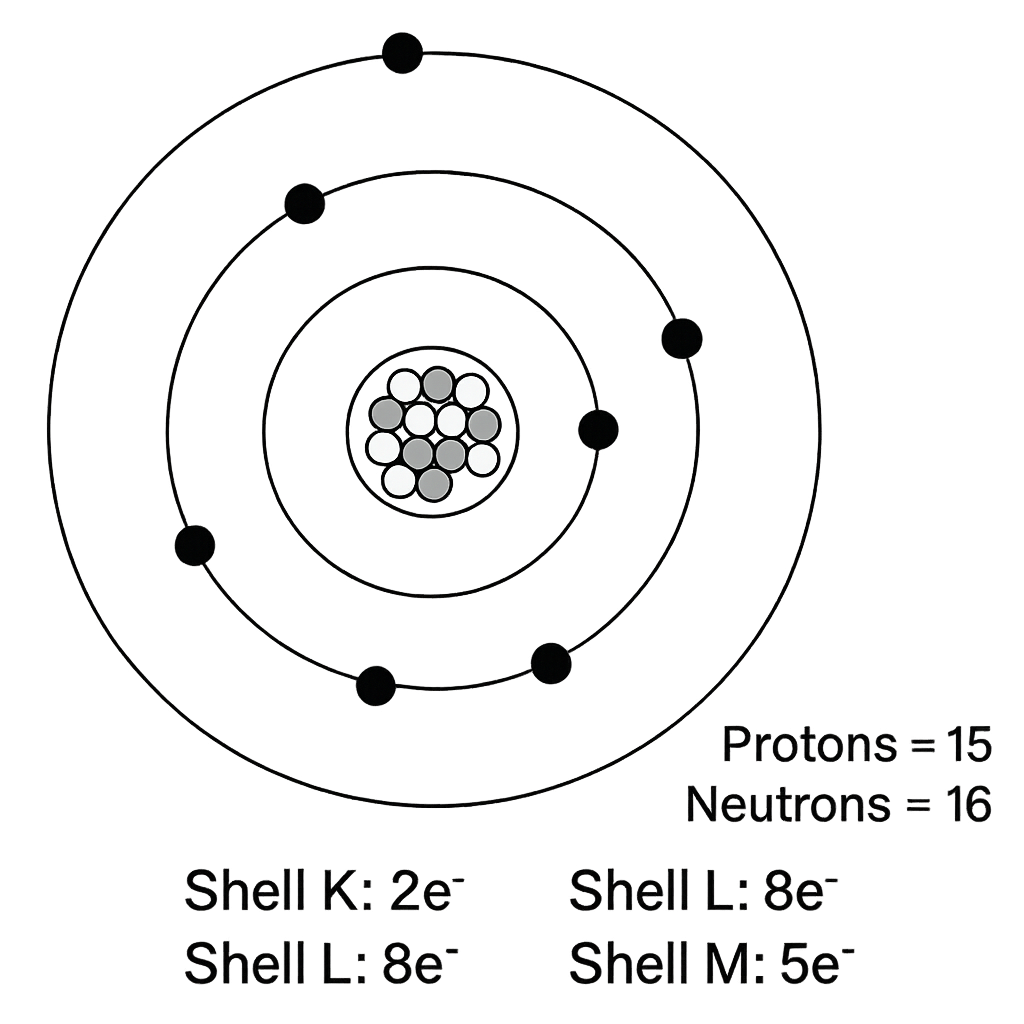
The diagram shows a simplified Bohr model of an unknown element X. The nucleus contains 15 protons and 16 neutrons. The electron shells are labelled K, L and M and contain 2, 8 and 5 electrons respectively.
Question Parts
(a)
Identify the element and write its chemical symbol.
(b)
State the atomic number, mass number and the number of neutrons of the element.
(c)
Write the ground‑state electron configuration of the neutral atom using the notation 1s² 2s² 2p⁶ 3s² 3pⁿ.
(d)
If the atom loses two electrons to form a cation, write the new electron configuration and state the charge of the ion.
(e)
Calculate the percentage by mass of neutrons in the nucleus of the element (use 1 u for the mass of a proton and a neutron, neglect electron mass).
Detailed Essay Solution & Marking Scheme Available

Get the step-by-step mathematical proofs, key points required by examiners, and a comprehensive breakdown from our AI Tutor.
Question 2 View Details
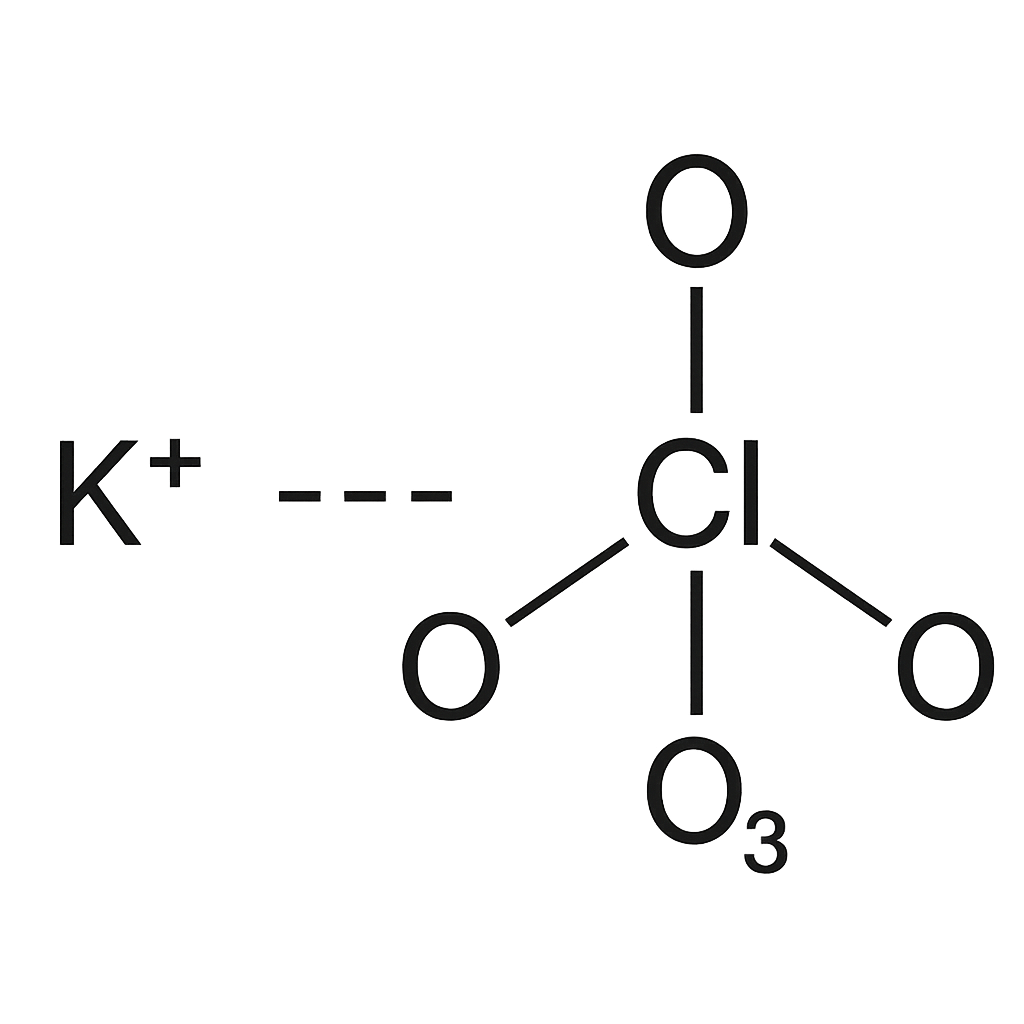
The diagram shows the structure of potassium chlorate, KClO₃, with a potassium ion (K⁺) and a chlorate ion (ClO₃⁻). The chlorine atom is central and is bonded to three oxygen atoms. Using the information from the diagram and the periodic table:
Question Parts
(a)
Assign the oxidation number of each element (K, Cl and O) in KClO₃.
(b)
Write the ground‑state electron configuration for each element present in the compound.
(c)
Among K, Cl and O, which element has the highest first ionisation energy? State the element and give a concise explanation based on periodic trends.
(d)
Calculate the mass percent of chlorine in pure KClO₃. (Atomic masses: K = 39.10 g mol⁻¹, Cl = 35.45 g mol⁻¹, O = 16.00 g mol⁻¹.) Give your answer to one decimal place.
Detailed Essay Solution & Marking Scheme Available

Get the step-by-step mathematical proofs, key points required by examiners, and a comprehensive breakdown from our AI Tutor.
Question 3 View Details
Answer the following questions on chemical bonding.
Question Parts
(a)
Explain, with reference to electron configuration, why sodium chloride (NaCl) forms an ionic bond. Include in your answer the processes that occur when the solid lattice is formed and relate these processes to the physical properties of NaCl.
(b)
Carbon dioxide (CO₂) is a common molecular compound. State the type of bond(s) present, describe its molecular geometry and explain why CO₂ is a non‑polar molecule despite containing polar C=O bonds.
(c)
Using the average bond enthalpies given below, calculate the enthalpy change (ΔH) for the reaction: \(\mathrm{H_2(g) + Cl_2(g) \rightarrow 2\,HCl(g)}\). Show all steps. Average bond enthalpies (kJ mol⁻¹): - H–H : 436 - Cl–Cl : 243 - H–Cl : 431
Detailed Essay Solution & Marking Scheme Available

Get the step-by-step mathematical proofs, key points required by examiners, and a comprehensive breakdown from our AI Tutor.

Question 4 View Details
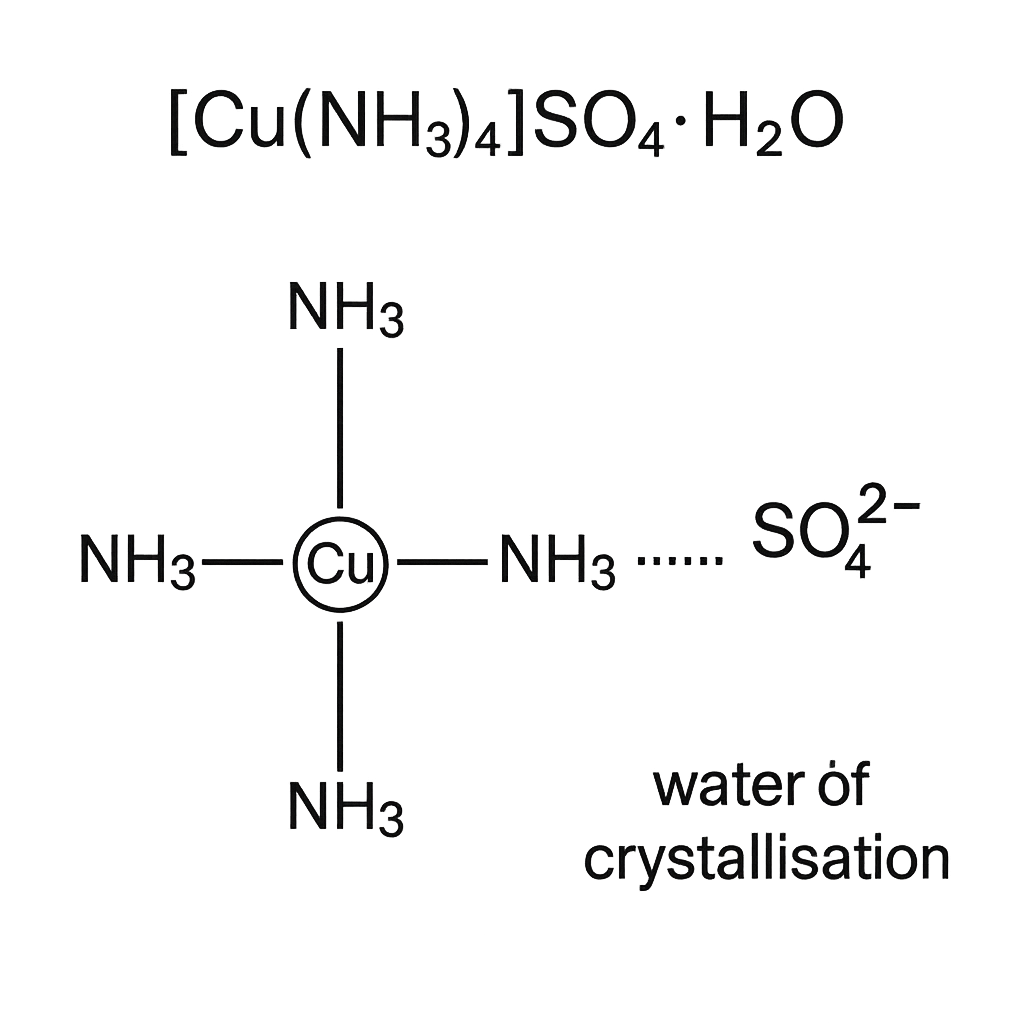
The diagram shows the structure of the hydrated copper(II) tetraammine sulfate complex, [Cu(NH3)4]SO4·H2O.
Question Parts
(a)
Write the empirical formula of the compound and calculate its molar mass (in g·mol\(^{-1}\)).
(b)
A 2.50 g sample of the compound is dissolved in water. Calculate the number of moles of copper present in the sample. Give your answer to three significant figures.
(c)
When excess sodium hydroxide is added, copper(II) hydroxide precipitates according to: [Cu(NH3)4]SO4·H2O + 2 NaOH → Cu(OH)2(s) + 4 NH3 + Na2SO4 + H2O. Calculate the mass of Cu(OH)2 formed from the 2.50 g sample. (Molar mass of Cu(OH)2 = 97.6 g·mol\(^{-1}\)). Give your answer to two decimal places.
(d)
If the same solution is instead treated with excess silver nitrate, the sulfate ion precipitates as silver sulfate: SO4^{2-} + 2 AgNO3 → Ag2SO4(s) + 2 NO3^{-}. Calculate the mass of Ag2SO4 obtained from the original 2.50 g sample. (Molar mass of Ag2SO4 = 311.8 g·mol\(^{-1}\)). Give your answer to two decimal places.
Detailed Essay Solution & Marking Scheme Available

Get the step-by-step mathematical proofs, key points required by examiners, and a comprehensive breakdown from our AI Tutor.

Question 5 View Details
A student carries out the reaction between aluminium metal and copper(II) sulfate solution as shown below: \[ \text{Al (s)} + CuSO_{4} (aq) \rightarrow Al_{2}(SO_{4})_{3} (aq) + Cu (s) \] The student weighs 4.50 g of aluminium and adds it to 150.0 mL of 0.250 mol dm\(^{-3}\) copper(II) sulfate solution. After the reaction is complete, the copper metal is filtered, dried and weighed. The mass of copper obtained is 3.12 g. Answer the following questions: (a) Write the balanced chemical equation for the reaction. (b) Determine which reactant is the limiting reagent and calculate the theoretical mass of copper that could be formed. (c) Calculate the percentage yield of copper obtained in the experiment. (d) Calculate the mass of the excess reagent that remains unreacted after the reaction is complete.
Question Parts
(a)
Write the balanced chemical equation for the reaction.
(b)
Determine which reactant is the limiting reagent and calculate the theoretical mass of copper that could be formed.
(c)
Calculate the percentage yield of copper obtained in the experiment.
(d)
Calculate the mass of the excess reagent that remains unreacted after the reaction is complete.
Detailed Essay Solution & Marking Scheme Available

Get the step-by-step mathematical proofs, key points required by examiners, and a comprehensive breakdown from our AI Tutor.

Question 6 View Details
A 0.500 g sample of an unknown non‑volatile solute is dissolved in 100.0 cm³ of water at 25 °C. The freezing point of the solution is observed to be –0.465 °C. Answer the following: (a) Calculate the molar mass of the unknown solute. (b) Explain qualitatively how an increase in external pressure would affect the boiling point of pure water. (c) Discuss why most solid substances expand on heating, relating your answer to the nature of intermolecular forces.
Question Parts
(a)
Calculate the molar mass of the unknown solute.
(b)
Explain qualitatively how an increase in external pressure would affect the boiling point of pure water.
(c)
Discuss why most solid substances expand on heating, relating your answer to the nature of intermolecular forces.
Detailed Essay Solution & Marking Scheme Available

Get the step-by-step mathematical proofs, key points required by examiners, and a comprehensive breakdown from our AI Tutor.

Question 7 View Details
A 1.00 L solution is prepared by mixing 0.20 mol of acetic acid (CH₃COOH) with 0.30 mol of sodium acetate (CH₃COONa). The temperature of the solution is 25 °C and the acid dissociation constant of acetic acid is K_a = 1.74×10⁻⁵.
Question Parts
(a)
Define a buffer solution and give one practical example of a buffer system used in industry.
(b)
Derive the Henderson–Hasselbalch equation for the above buffer system starting from the expression of the acid dissociation constant.
(c)
Calculate the pH of the prepared buffer solution.
(d)
If 0.010 mol of a strong acid (HCl) is added to the 1.00 L buffer, calculate the new pH of the solution.
Detailed Essay Solution & Marking Scheme Available

Get the step-by-step mathematical proofs, key points required by examiners, and a comprehensive breakdown from our AI Tutor.

Question 8 View Details
The laboratory set‑up shown in the diagram is used to determine the solubility of calcium hydroxide, Ca(OH)₂, at 25 °C. The apparatus consists of a 250 mL beaker containing 200 mL of distilled water, a thermometer, a magnetic stirrer, a filter funnel fitted with filter paper, and a graduated cylinder. In the experiment, excess solid Ca(OH)₂ is added to the water and the mixture is stirred until no more solid dissolves (saturation). The suspension is filtered, and the filtrate is collected in the graduated cylinder. The following data are recorded: - Initial mass of Ca(OH)₂ added: 1.00 g - Mass of undissolved Ca(OH)₂ after filtration: 0.65 g - Volume of filtrate collected: 180 mL - Temperature of the solution: 25 °C Answer the questions below.
Question Parts
(a)
Calculate the solubility of Ca(OH)₂ in grams per 100 mL of water at 25 °C.
(b)
Using the solubility obtained in part (a), calculate the solubility product constant (Ksp) of Ca(OH)₂ at 25 °C. (Assume the dissolution equilibrium: Ca(OH)₂ \(\rightleftharpoons\) Ca²⁺ + 2 OH⁻.)
(c)
Discuss two experimental factors shown in the apparatus that could cause the calculated Ksp to differ from the literature value.
(d)
A 0.10 M NaOH solution is added to 50.0 mL of the saturated Ca(OH)₂ solution obtained above. (i) Predict qualitatively how the solubility of Ca(OH)₂ will change and explain using the common‑ion effect. (ii) Assuming the added NaOH does not change the total volume appreciably, calculate the new equilibrium concentration of Ca²⁺ ions.
() Predict qualitatively how the solubility of Ca(OH)₂ will change and explain using the common‑ion effect.
() Calculate the new equilibrium concentration of Ca²⁺ ions.
Detailed Essay Solution & Marking Scheme Available

Get the step-by-step mathematical proofs, key points required by examiners, and a comprehensive breakdown from our AI Tutor.

Master the Exam!

You've seen a preview, but there are thousands more questions plus AI tutor to break down complex solutions.

Unlock Full Access Available for Android & Windows
Help others prepare! Share this practice hub:
Chat with Support