neco 2022 biology | Objective

Prepare for your exams with neco questions? Reviewing past/model questions is one of the most effective ways to guarantee a high score. This practice hub features authentic 2022 biology (Objective) questions designed to simulate the real exam environment.

Practice these randomly selected questions to test your readiness.

Question 1 View Details
A frog's heart rate was recorded at two different temperatures: at \(20^{\circ}\text{C}\) the rate was \(30\) beats per minute and at \(30^{\circ}\text{C}\) it was \(45\) beats per minute. Assuming the temperature coefficient \(Q_{10}\) remains constant, what heart rate would you expect at \(40^{\circ}\text{C}\)?
A. 75
Correct B. 67.5
C. 60
D. 55.5

Correct Answer: B

Want to see the full step-by-step solution? Unlock AI Explanation & Analytics
Question 2 View Details
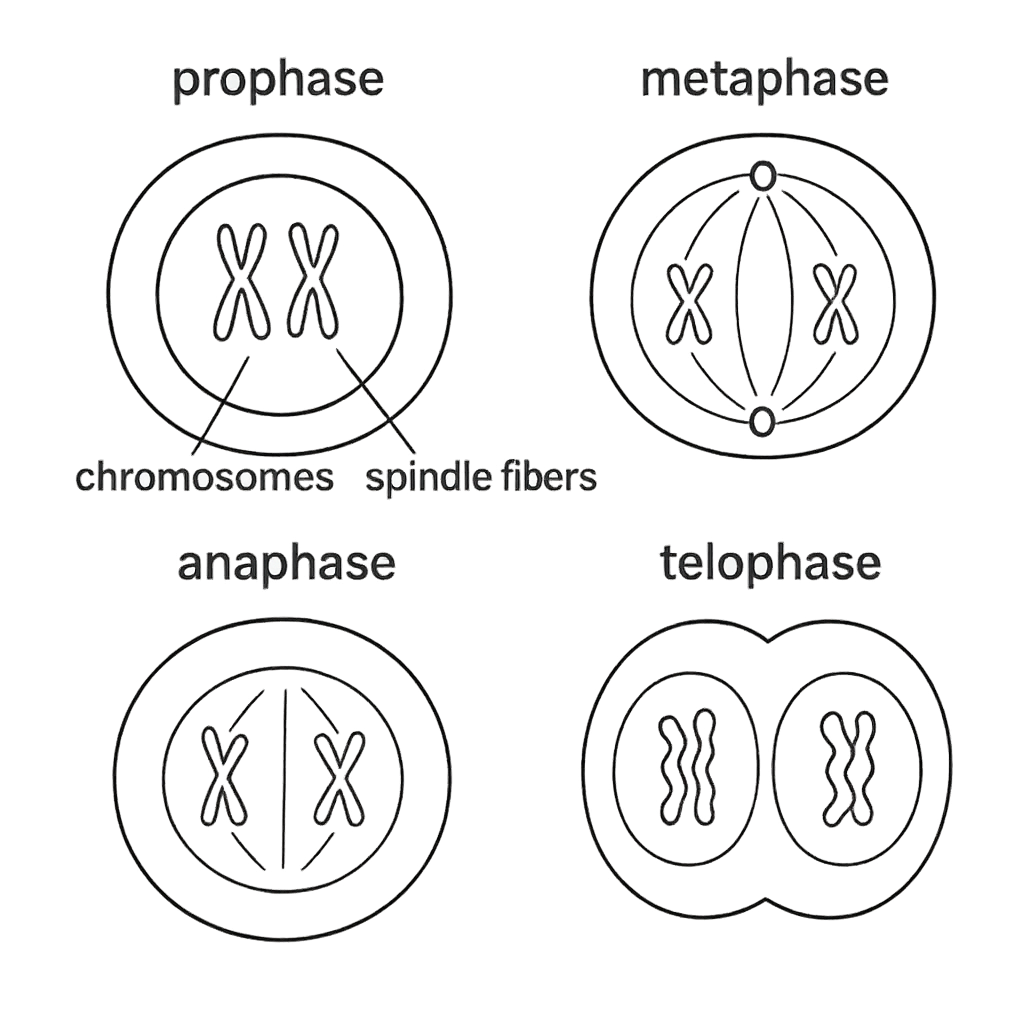
The diagram shows the stages of mitosis with the structures labelled: prophase, metaphase, anaphase and telophase. Which stage is characterised by the chromosomes lining up at the cell equator?
A. Prophase
Correct B. Metaphase
C. Anaphase
D. Telophase

Correct Answer: B

Want to see the full step-by-step solution? Unlock AI Explanation & Analytics
Question 3 View Details
An unknown flowering plant shows the following characteristics: leaves opposite, flowers with five distinct petals, fruit a dry capsule, and the plant is herbaceous. Using the dichotomous key below, identify the family of the plant. Dichotomous Key: 1a. Leaves opposite ........ go to 2 1b. Leaves alternate ........ go to 3 2a. Flowers with five petals ........ go to 4 2b. Flowers with more than five petals ........ go to 5 4a. Fruit a dry capsule ........ Genus *A* 4b. Fruit a berry ........ Genus *B* Genus *A* belongs to the family Lamiaceae. Genus *B* belongs to the family Rosaceae. What is the family of the plant?
A. Rosaceae
B. Asteraceae
Correct C. Lamiaceae
D. Fabaceae

Correct Answer: C

Want to see the full step-by-step solution? Unlock AI Explanation & Analytics
Question 4 View Details
The plasma of a freshwater fish is isotonic at 300 mOsm kg⁻¹. It is transferred to water that is 0.5 % NaCl (approximately 85 mOsm kg⁻¹). Assuming the temperature is 25 °C (298 K) and using the van't Hoff equation \(\pi = iMRT\) (with \(i=1\) for NaCl), calculate the osmotic pressure difference (in atmospheres) between the fish's internal fluids and the external medium.
A. 6.31
B. 4.26
Correct C. 5.26
D. 5.86

Correct Answer: C

Want to see the full step-by-step solution? Unlock AI Explanation & Analytics
Question 5 View Details
In a pedigree, the mother is a carrier of an X‑linked recessive disorder (genotype \(X^{A}X^{a}\)) and the father is unaffected (genotype \(X^{A}Y\)). They have four children. What is the probability that exactly two of the children are affected males?
A. 27/256
Correct B. 27/128
C. 3/128
D. 9/256

Correct Answer: B

Want to see the full step-by-step solution? Unlock AI Explanation & Analytics
Question 6 View Details
Fossil evidence shows that species A (dated \(200\) Ma) gave rise to species B (dated \(150\) Ma) with 40 morphological character changes, and species B gave rise to species C (dated \(120\) Ma) with 30 further changes. Assuming a constant rate of change within each interval, at what age (in million years ago) would a descendant D that exhibits a total of 100 character changes from species A be expected to appear?
A. 83
Correct B. 90
C. 150
D. 86

Correct Answer: B

Want to see the full step-by-step solution? Unlock AI Explanation & Analytics
Question 7 View Details
During a batch culture, viable cell counts were recorded at several times: at 0\,h the culture contained \(1.0\times10^{5}\) CFU\,mL^{-1}; at 2\,h it contained \(8.0\times10^{5}\) CFU\,mL^{-1}; at 5\,h it contained \(6.4\times10^{6}\) CFU\,mL^{-1}; and at 8\,h it contained \(5.1\times10^{7}\) CFU\,mL^{-1}. Assuming the culture experiences an initial lag phase followed by exponential growth, determine the generation time (in minutes) during the exponential phase.
A. 90
B. 120
Correct C. 60
D. 45

Correct Answer: C

Want to see the full step-by-step solution? Unlock AI Explanation & Analytics
Question 8 View Details
An unknown flowering plant has opposite leaves, a tubular corolla, fruit that is a capsule, seeds containing endosperm and produces alkaloids. Using these characters, identify its family. The family is divided into two subfamilies: Subfamily\,A comprises 60 genera with an average of 10 species per genus, while Subfamily\,B comprises 35 genera with an average of 15 species per genus. Estimate the total number of species in the entire family.
A. 1150
Correct B. 1125
C. 525
D. 600

Correct Answer: B

Want to see the full step-by-step solution? Unlock AI Explanation & Analytics
Question 9 View Details
In a plant, two genes R (round seed) and Y (yellow seed) are linked on the same chromosome with a recombination frequency of 15\%. A true‑breeding round‑yellow plant (RRYY) is crossed with a true‑breeding wrinkled‑green plant (rryy) to produce F\(_1\) plants. The F\(_1\) plants are then self‑fertilized. What percentage of the F\(_2\) seeds are expected to have the round‑green phenotype (genotype R\_yy)?
A. 8.25
B. 5.00
C. 12.50
Correct D. 6.94

Correct Answer: D

Want to see the full step-by-step solution? Unlock AI Explanation & Analytics
Question 10 View Details
In an experiment, the plasma concentration of hormone X after a single intravenous injection follows first‑order decay described by \(C(t)=C_{0}e^{-kt}+C_{b}\), where \(C_{b}=5\) ng mL^{-1} is a constant basal level. The observed concentration is 85 ng mL^{-1} immediately after injection (t=0) and 25 ng mL^{-1} after 2 h. Determine the half‑life of the decaying component of hormone X in minutes.
Correct A. 60
B. 45
C. 90
D. 120

Correct Answer: A

Want to see the full step-by-step solution? Unlock AI Explanation & Analytics
Question 11 View Details
A human somatic cell is diploid with \(46\) chromosomes. After DNA replication in the S‑phase, how many chromatids are present in the cell?
Correct A. 92
B. 184
C. 23
D. 46

Correct Answer: A

Want to see the full step-by-step solution? Unlock AI Explanation & Analytics
Question 12 View Details
A bacterial culture is inoculated with \(1\times10^{3}\) cells. It exhibits a lag phase of 2\,h, after which it grows exponentially with a generation time of 30\,min. (a) How many cells are present after a total incubation time of 8\,h? (b) To obtain at least \(1\times10^{9}\) cells, what is the minimum total incubation time required under the same conditions?
A. a) 8.2\times10^{6} cells; b) 11 h
B. a) 2.0\times10^{6} cells; b) 10 h
Correct C. a) 4.1\times10^{6} cells; b) 12 h
D. a) 5.0\times10^{6} cells; b) 14 h

Correct Answer: C

Want to see the full step-by-step solution? Unlock AI Explanation & Analytics
Question 13 View Details
A labelled diagram of the human digestive tract shows the following lengths: esophagus\,=\,25\,cm, stomach\,=\,15\,cm, small intestine\,=\,6\,m, large intestine\,=\,1.5\,m. (a) What is the total distance food travels from the mouth to the end of the large intestine? (b) What percentage of this total distance is contributed by the small intestine? (c) Which organ is the principal site for nutrient absorption?
Correct A. a) 7.9 m; b) 76 %; c) small intestine
B. a) 7.5 m; b) 70 %; c) large intestine
C. a) 7.9 m; b) 85 %; c) esophagus
D. a) 8.0 m; b) 80 %; c) stomach

Correct Answer: A

Want to see the full step-by-step solution? Unlock AI Explanation & Analytics
Question 14 View Details
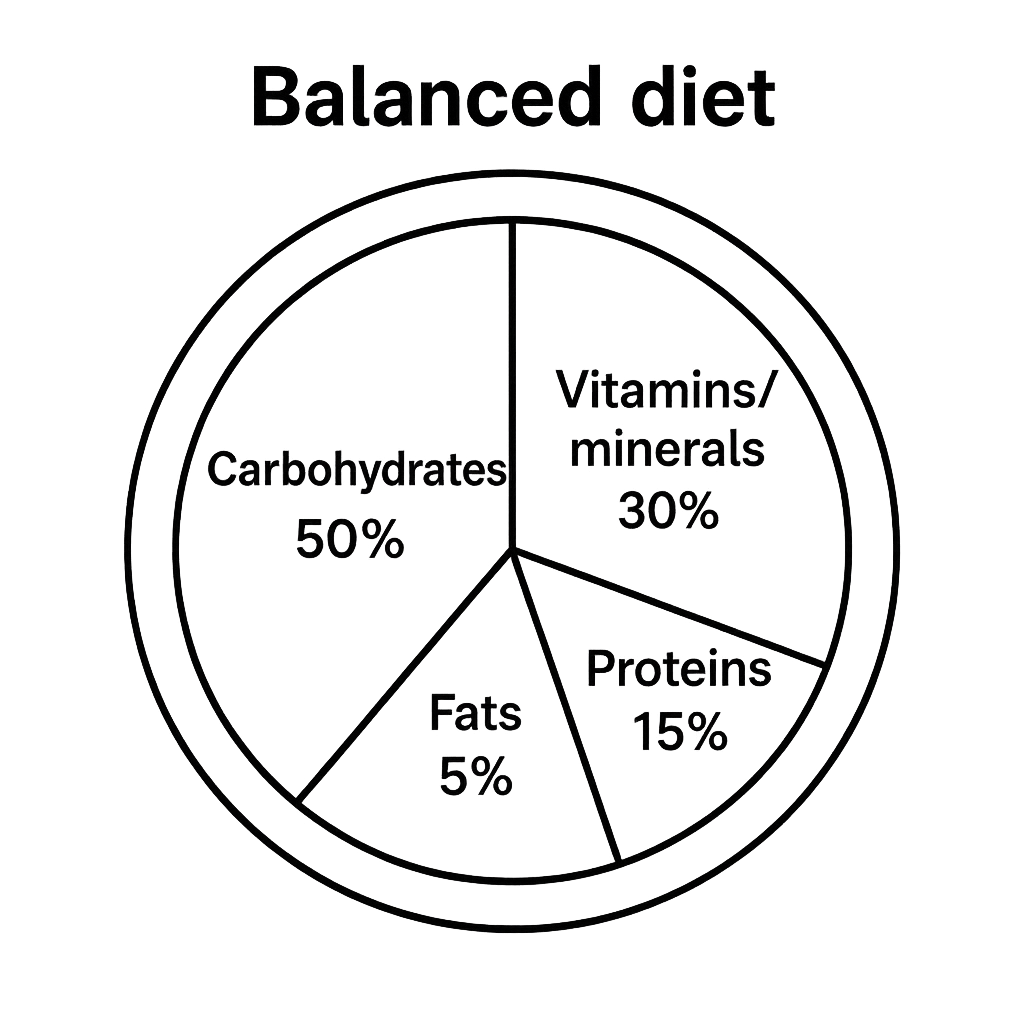
A student's 1‑day diet consists of 250\,g of rice (80\% carbohydrate, 4\,kcal\,g\(^{-1}\)), 100\,g of beans (20\% protein, 1\% fat, 4\,kcal\,g\(^{-1}\) for protein, 9\,kcal\,g\(^{-1}\) for fat) and 30\,g of oil (100\% fat, 9\,kcal\,g\(^{-1}\)). (a) Calculate the total caloric intake. (b) What percentage of the total calories is supplied by protein? (c) For a 55\,kg student whose recommended protein intake is 0.8\,g\,kg\(^{-1}\)\,day\(^{-1}\), does the diet meet the protein requirement?
Correct A. a) 1159 kcal; b) 6.9 %; c) No (20 g < 44 g)
B. a) 1159 kcal; b) 6.9 %; c) Yes (20 g > 44 g)
C. a) 1159 kcal; b) 5.5 %; c) No (20 g < 44 g)
D. a) 1190 kcal; b) 7.2 %; c) No (20 g < 44 g)

Correct Answer: A

Want to see the full step-by-step solution? Unlock AI Explanation & Analytics
Question 15 View Details
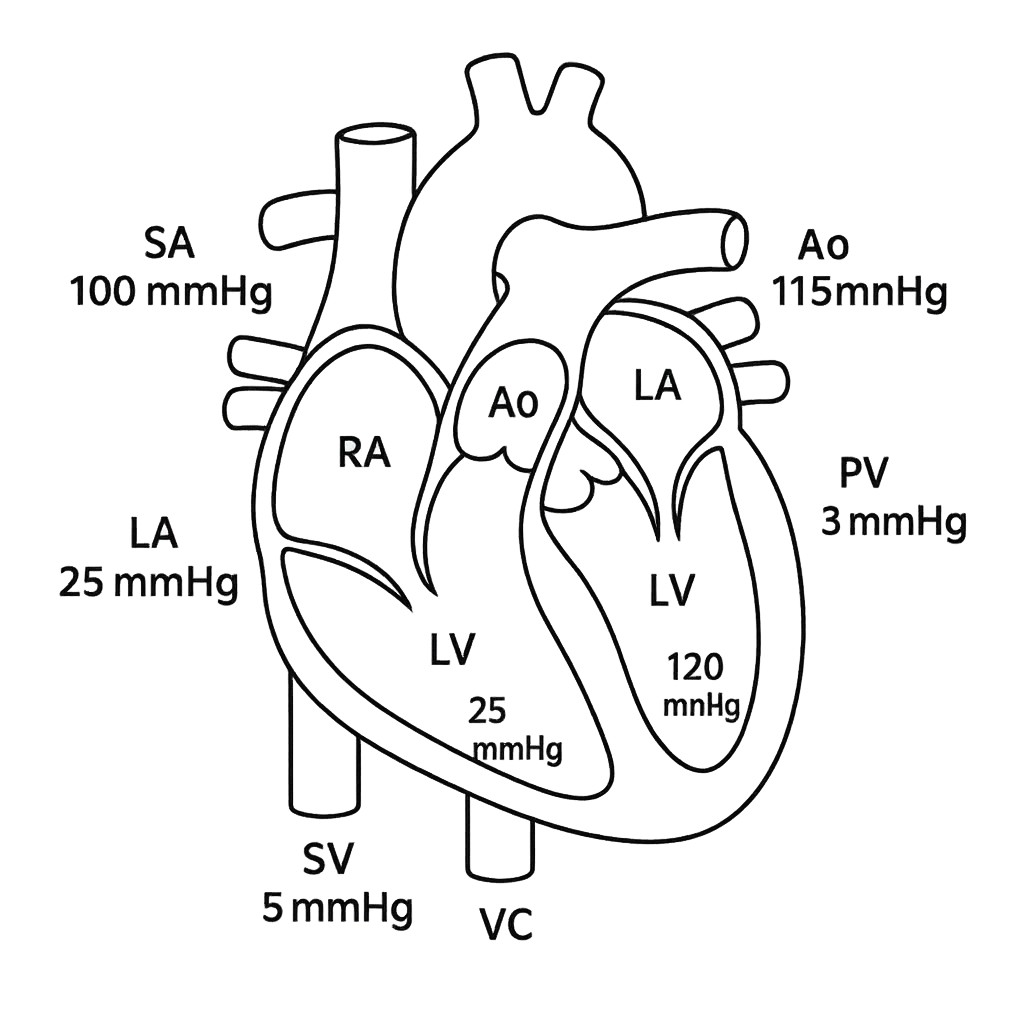
In a labelled diagram of the human heart, the left ventricle is shown to have a stroke volume of 70\,mL and the resting heart rate is 75\,beats\,min\(^{-1}\). (a) Calculate the resting cardiac output in L\,min\(^{-1}\). (b) During vigorous exercise the heart rate rises to 150\,beats\,min\(^{-1}\) and the stroke volume increases by 15\%. What is the cardiac output then? (c) What is the percentage increase in cardiac output from rest to exercise?
Correct A. a) 5.25 L/min; b) 12.08 L/min; c) 130 %
B. a) 5.75 L\/min; b) 13.00 L\/min; c) 125 %
C. a) 5.00 L\/min; b) 11.00 L\/min; c) 110 %
D. a) 4.90 L\/min; b) 10.50 L\/min; c) 115 %

Correct Answer: A

Want to see the full step-by-step solution? Unlock AI Explanation & Analytics
Question 16 View Details
An arid‑adapted shrub reduces its leaf surface area by \(40\%\) compared with a related mesic species. The mesic species has a leaf area of \(250\ \text{cm}^2\) and a stomatal density of \(120\ \text{stomata}\,\text{mm}^{-2}\). Each stomata loses \(0.02\ \text{mg}\) of water per hour. The desert shrub's stomatal density is \(30\%\) lower than that of the mesic species and its leaf area is \(150\ \text{cm}^2\). Assuming water loss is proportional to the total number of stomata, calculate the total water loss of the desert shrub per hour in milligrams.
A. 36000
B. 10800
Correct C. 25200
D. 252

Correct Answer: C

Want to see the full step-by-step solution? Unlock AI Explanation & Analytics
Question 17 View Details
The diagram shows a labelled human heart with the left ventricle (LV), aorta (Ao), systemic arteries (SA) and systemic veins (SV) together with the pressures: LV = \(120\ \text{mmHg}\), Ao = \(115\ \text{mmHg}\), SA = \(100\ \text{mmHg}\), SV = \(5\ \text{mmHg}\). The stroke volume is \(70\ \text{mL}\). Assuming the mean arterial pressure is approximated by the pressure in the systemic arteries and the venous pressure by that in the systemic veins, calculate the mechanical work done by the left ventricle in one cardiac cycle. (Use \(1\ \text{mmHg}=133.322\ \text{Pa}\) and \(1\ \text{mL}=1\times10^{-6}\ \text{m}^3\).)
A. 0.67
B. 1.07
C. 1.03
Correct D. 0.89

Correct Answer: D

Want to see the full step-by-step solution? Unlock AI Explanation & Analytics
Question 18 View Details
A snack contains \(25\ \text{g}\) of protein, \(30\ \text{g}\) of carbohydrate and \(10\ \text{g}\) of fat. Using the Atwater factors (protein = \(4\ \text{kcal}\,\text{g}^{-1}\), carbohydrate = \(4\ \text{kcal}\,\text{g}^{-1}\), fat = \(9\ \text{kcal}\,\text{g}^{-1}\)), calculate the total caloric value of the snack in kilocalories.
Correct A. 310
B. 320
C. 300
D. 330

Correct Answer: A

Want to see the full step-by-step solution? Unlock AI Explanation & Analytics
Question 19 View Details
In a terrestrial ecosystem the following energy values are recorded per day: primary producers capture \(12\,000\ \text{kJ}\) of solar energy; herbivores obtain \(2\,400\ \text{kJ}\) from the producers; carnivores obtain \(360\ \text{kJ}\) from the herbivores. Calculate the overall percentage of energy transferred from primary producers to tertiary consumers (carnivores).
A. 4
Correct B. 3
C. 5
D. 2

Correct Answer: B

Want to see the full step-by-step solution? Unlock AI Explanation & Analytics
Question 20 View Details
A motor neuron that innervates a skeletal muscle fibre has a myelinated axon \(0.8\ \text{m}\) long. The conduction velocity in myelinated fibres is \(80\ \text{m}\,\text{s}^{-1}\). After the impulse reaches the terminal, a synaptic delay of \(0.5\ \text{ms}\) occurs before the muscle fibre contracts. Calculate the total time from the initiation of the action potential at the neuron's soma to the onset of muscle contraction, expressed in milliseconds.
A. 11.0
B. 10.0
C. 9.5
Correct D. 10.5

Correct Answer: D

Want to see the full step-by-step solution? Unlock AI Explanation & Analytics
Question 21 View Details
A researcher incubates 200 amphibian eggs, 100 at \(25^{\circ}\text{C}\) where \(70\%\) develop as females and 100 at \(30^{\circ}\text{C}\) where \(40\%\) develop as females. After hatching, 10 individuals are randomly selected without replacement. What is the probability that exactly \(6\) of the selected are females? Express your answer as a decimal to four significant figures.
A. 0.2719
B. 0.3124
Correct C. 0.2438
D. 0.2156

Correct Answer: C

Want to see the full step-by-step solution? Unlock AI Explanation & Analytics
Question 22 View Details
Plasma urea concentration is \(0.25\ \text{g L}^{-1}\). The kidneys filter plasma at a rate of \(120\ \text{mL min}^{-1}\). If \(95\%\) of the filtered urea is reabsorbed, calculate the rate of urea excretion in milligrams per hour.
A. 150
B. 45
C. 30
Correct D. 90

Correct Answer: D

Want to see the full step-by-step solution? Unlock AI Explanation & Analytics
Question 23 View Details
An experiment measured the rate of CO\(_2\) production by isolated rat liver mitochondria at four substrate concentrations. The data are:\\ Substrate (mM): 0.5, 1.0, 2.0, 4.0\\ Rate (µmol CO\(_2\) min⁻¹ mg⁻¹ protein): 12, 20, 28, 32.\nAssuming Michaelis-Menten kinetics \(v = \frac{V_{\max}[S]}{K_m+[S]}\), use the two extreme data points (0.5 mM and 4.0 mM) to construct a Lineweaver-Burk plot and estimate \(V_{\max}\) and \(K_m\). Give \(V_{\max}\) to the nearest whole µmol min⁻¹ mg⁻¹ and \(K_m\) to two decimal places (mM).
A. Vmax = 40 µmol min⁻¹ mg⁻¹; Km = 0.90 mM
B. Vmax = 38 µmol min⁻¹ mg⁻¹; Km = 1.10 mM
Correct C. Vmax = 42 µmol min⁻¹ mg⁻¹; Km = 1.25 mM
D. Vmax = 45 µmol min⁻¹ mg⁻¹; Km = 1.50 mM

Correct Answer: C

Want to see the full step-by-step solution? Unlock AI Explanation & Analytics
Question 24 View Details
During a resting metabolic measurement, a student records an oxygen consumption of \(0.80\ \text{L min}^{-1}\) and a carbon dioxide production of \(0.60\ \text{L min}^{-1}\). Calculate the respiratory quotient (RQ) and state the predominant metabolic substrate being oxidised.
A. RQ = 0.70; predominant substrate = protein
B. RQ = 0.85; predominant substrate = fat
Correct C. RQ = 0.75; predominant substrate = fat
D. RQ = 0.80; predominant substrate = carbohydrate

Correct Answer: C

Want to see the full step-by-step solution? Unlock AI Explanation & Analytics
Question 25 View Details
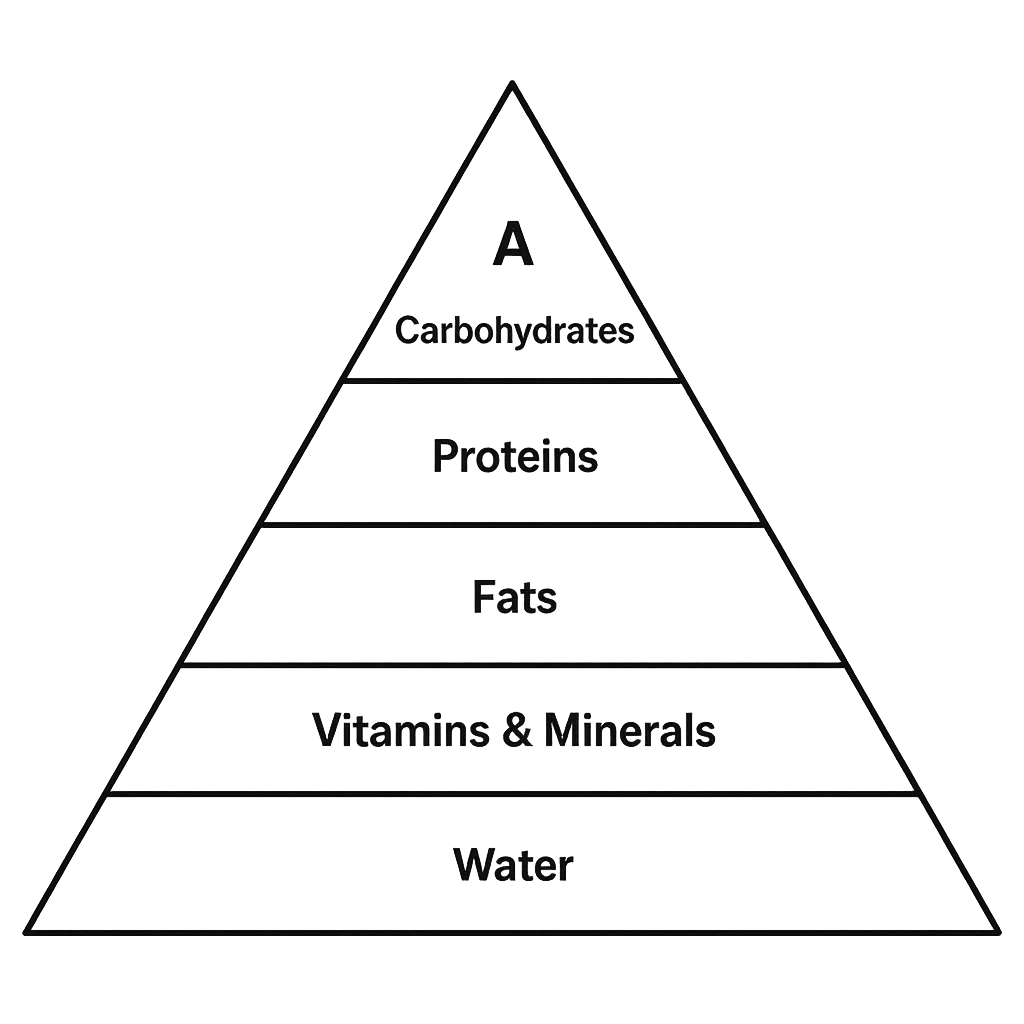
The diagram shows a simplified food pyramid with five horizontal layers labelled A, B, C, D and E. The layers correspond to the following nutrient groups: A - Carbohydrates B - Proteins C - Fats D - Vitamins & Minerals E - Water. Which layer supplies the greatest amount of energy per gram of nutrient?
A. A
B. B
C. D
Correct D. C

Correct Answer: D

Want to see the full step-by-step solution? Unlock AI Explanation & Analytics

Master the Exam!

You've seen a preview, but there are thousands more questions plus AI tutor to break down complex solutions.

Unlock Full Access Available for Android & Windows
Help others prepare! Share this practice hub:
Chat with Support