neco 2021 chemistry | Objective

Prepare for your exams with neco questions? Reviewing past/model questions is one of the most effective ways to guarantee a high score. This practice hub features authentic 2021 chemistry (Objective) questions designed to simulate the real exam environment.

Practice these randomly selected questions to test your readiness.

Question 1 View Details
A 0.250 mol sample of sodium acetate (CH₃COONa) is dissolved in 1.00 L of water. The solution is then titrated with 0.100 M HCl. Given that \(K_{a}=1.8\\times10^{-5}\), calculate the volume of HCl required to lower the pH of the solution to 5.00.
Correct A. 0.89 L
B. 0.12 L
C. 1.23 L
D. 0.45 L

Correct Answer: A

Want to see the full step-by-step solution? Unlock AI Explanation & Analytics
Question 2 View Details
Five hundred grams of water is used as a solvent for a non‑electrolyte solute. The solution's boiling point is raised by \(0.512^{\circ}\text{C}\) and its freezing point is lowered by \(1.86^{\circ}\text{C}\). Given \(K_{b}=0.512^{\circ}\text{C·kg·mol}^{-1}\) and \(K_{f}=1.86^{\circ}\text{C·kg·mol}^{-1}\), and that 5.00 g of the solute were dissolved, determine the molar mass of the solute.
A. 20 g\/mol
Correct B. 10 g/mol
C. 15 g\/mol
D. 5 g\/mol

Correct Answer: B

Want to see the full step-by-step solution? Unlock AI Explanation & Analytics
Question 3 View Details
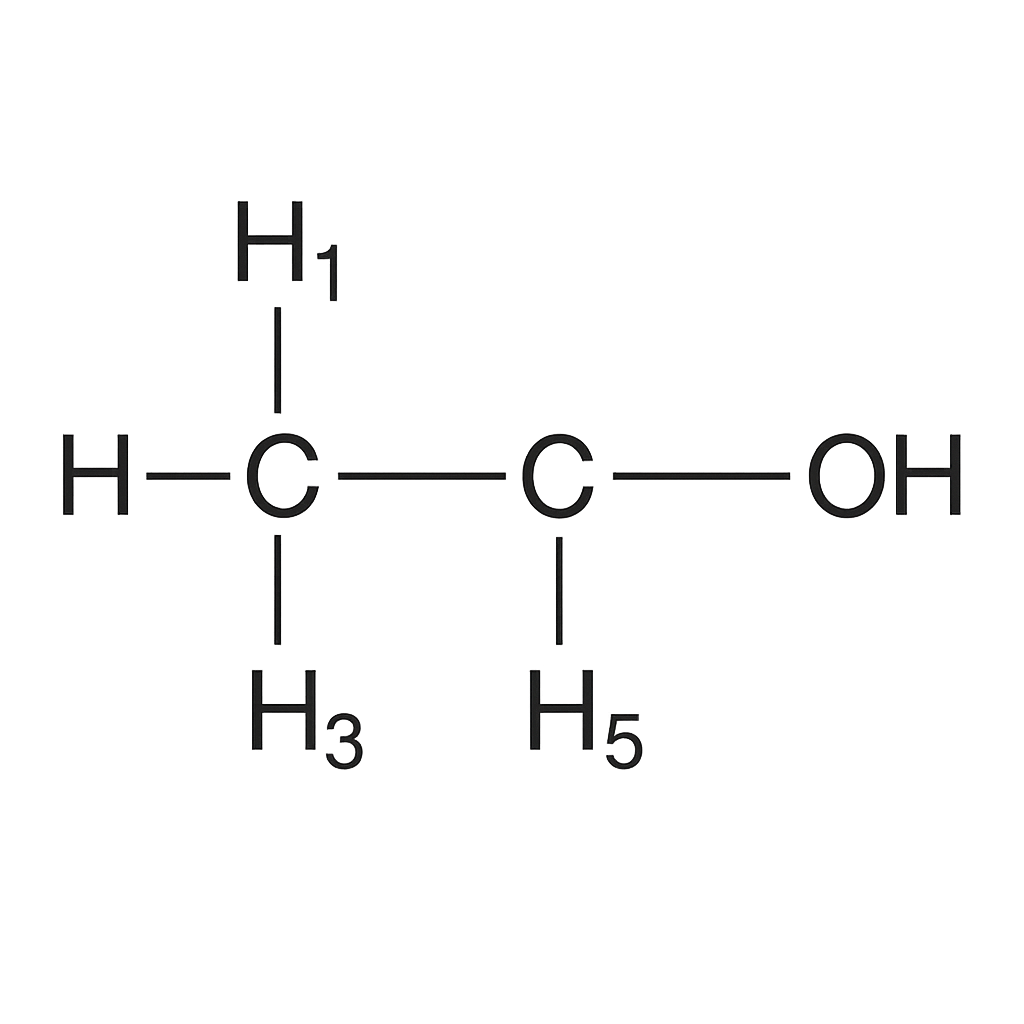
The structural diagram of ethanol is shown. Identify the hybridisation state of the carbon atom directly bonded to the hydroxyl group.
A. sp
Correct B. sp³
C. sp²
D. sp⁴

Correct Answer: B

Want to see the full step-by-step solution? Unlock AI Explanation & Analytics
Question 4 View Details
Two point zero grams of magnesium metal reacts with excess hydrochloric acid according to \(\text{Mg} + 2\text{HCl} \rightarrow \text{MgCl}_{2} + \text{H}_{2}\). If the reaction yields 78% of the theoretical amount of hydrogen gas, what volume of hydrogen (at STP) is collected? Give your answer in litres to two decimal places.
Correct A. 1.44 L
B. 1.20 L
C. 2.00 L
D. 1.84 L

Correct Answer: A

Want to see the full step-by-step solution? Unlock AI Explanation & Analytics
Question 5 View Details
Starting with 5.00 g of cyclohexanone, a three‑step synthesis is carried out: (i) reduction with NaBH₄ to cyclohexanol, (ii) oxidation with Jones reagent to cyclohexanecarboxylic acid, and (iii) esterification with methanol to give methyl cyclohexanecarboxylate. Assuming an overall yield of 85% for the three steps combined, calculate the mass of methyl cyclohexanecarboxylate obtained. Molar masses: cyclohexanone 100.16 g·mol⁻¹, cyclohexanol 100.16 g·mol⁻¹, cyclohexanecarboxylic acid 114.14 g·mol⁻¹, methyl cyclohexanecarboxylate 128.16 g·mol⁻¹.
Correct A. 5.44 g
B. 4.84 g
C. 6.39 g
D. 5.75 g

Correct Answer: A

Want to see the full step-by-step solution? Unlock AI Explanation & Analytics
Question 6 View Details
A 10.0 g sample of 2‑butanol (\( \mathrm{C}_4\mathrm{H}_{10}\mathrm{O} \)) is mixed with 8.0 g of 1‑butanol (\( \mathrm{C}_4\mathrm{H}_{10}\mathrm{O} \)). The mixture is treated with excess acidic potassium dichromate under conditions that oxidise only the secondary alcohol (2‑butanol) to butanone (\( \mathrm{C}_4\mathrm{H}_{8}\mathrm{O} \)). After the reaction the distillate contains 5.0 g of pure butanone. Assuming quantitative conversion of the reacted 2‑butanol, calculate the percentage of the original 2‑butanol that was actually oxidised.
A. 45.2%
Correct B. 51.4%
C. 58.3%
D. 62.5%

Correct Answer: B

Want to see the full step-by-step solution? Unlock AI Explanation & Analytics
Question 7 View Details
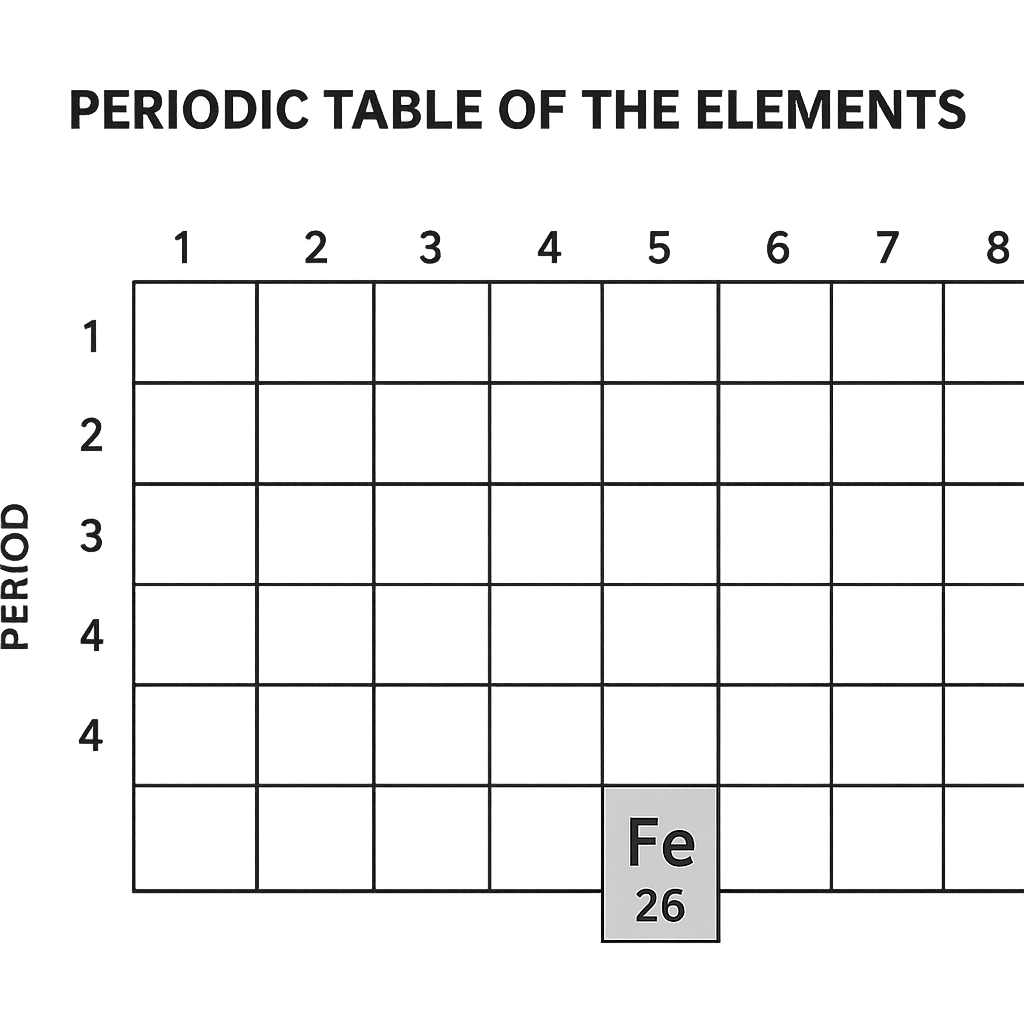
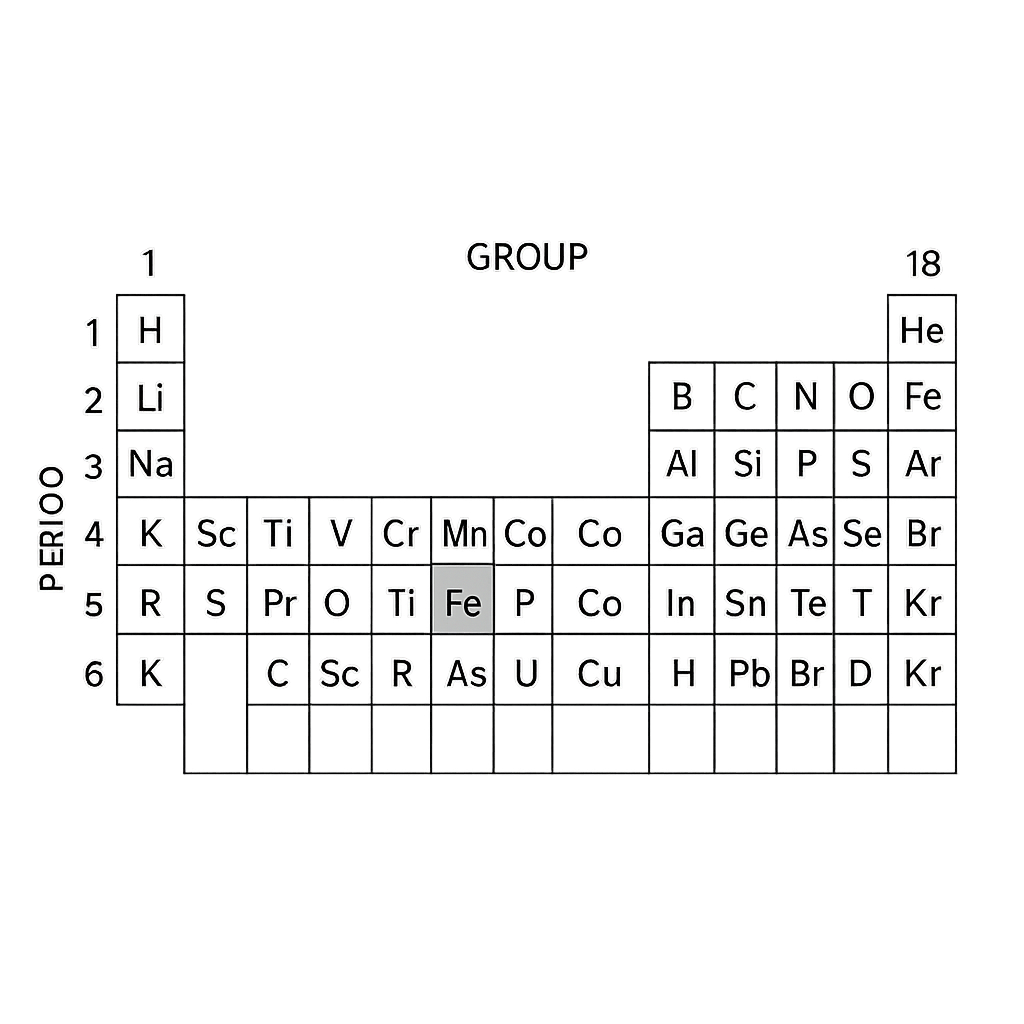
The diagram shows a highlighted element in the periodic table. Identify the element and state its atomic number and the two most common oxidation states of this element.
A. Cu, 29, +1 and +2
B. Mn, 25, +2 and +4
Correct C. Fe, 26, +2 and +3
D. Zn, 30, +1 and +2

Correct Answer: C

Want to see the full step-by-step solution? Unlock AI Explanation & Analytics
Question 8 View Details
An impure sample of sodium carbonate weighing 0.250 g is dissolved in water. To the solution 25.0 mL of 0.100 M HCl is added in excess. The excess acid is then back‑titrated with 0.080 M NaOH, requiring 12.5 mL to reach the endpoint. Calculate the percent purity of Na₂CO₃ in the original sample.
A. 15.9%
Correct B. 31.8%
C. 63.6%
D. 25.0%

Correct Answer: B

Want to see the full step-by-step solution? Unlock AI Explanation & Analytics
Question 9 View Details
State the hybridisation of the carbon atom in methane (CH₄) and give the approximate H‑C‑H bond angle.
A. sp hybridisation, 180°
B. sp³ hybridisation, 90°
Correct C. sp³ hybridisation, 109.5°
D. sp² hybridisation, 120°

Correct Answer: C

Want to see the full step-by-step solution? Unlock AI Explanation & Analytics
Question 10 View Details
A copper strip of area 10 cm² is immersed in a 0.5 M NaCl solution. After 48 h the strip has lost 0.012 g of mass due to oxidation to Cu²⁺. Assuming the corrosion follows the reaction Cu → Cu²⁺ + 2 e⁻, calculate the corrosion current density i_corr in µA cm⁻². (Use Faraday constant F = 96485 C mol⁻¹.)
Correct A. 21.1 µA cm⁻²
B. 10.6 µA cm⁻²
C. 211 µA cm⁻²
D. 42.2 µA cm⁻²

Correct Answer: A

Want to see the full step-by-step solution? Unlock AI Explanation & Analytics
Question 11 View Details
A 2.00 g mixture of the two isomers of pentane, n‑pentane and isopentane, is completely combusted in excess oxygen. The heat of combustion is 48.0 kJ\,g\(^{-1}\) for n‑pentane and 46.0 kJ\,g\(^{-1}\) for isopentane. The total heat released is 93.0 kJ. Determine the mass of each isomer present in the mixture.
Correct A. 0.50 g of n‑pentane and 1.50 g of isopentane
B. 0.75 g of n‑pentane and 1.25 g of isopentane
C. 0.30 g of n‑pentane and 1.70 g of isopentane
D. 1.00 g of n‑pentane and 1.00 g of isopentane

Correct Answer: A

Want to see the full step-by-step solution? Unlock AI Explanation & Analytics
Question 12 View Details
A buffer solution is prepared by mixing 0.250 mol of the weak acid HA ( \(K_a = 1.8\times10^{-5}\) ) with 0.150 mol of its sodium salt NaA in a total volume of 1.00 L. Then 0.050 mol of HCl is added. Calculate the pH of the solution after the addition.
A. 4.02
B. 4.57
Correct C. 4.27
D. 3.97

Correct Answer: C

Want to see the full step-by-step solution? Unlock AI Explanation & Analytics
Question 13 View Details
In a catalytic cracking process, 150 g of octane ( \(C_8H_{18}\) ) is cracked according to the equation \(C_8H_{18} \rightarrow C_2H_4 + C_6H_{14}\). Only 80 % of the theoretical amount of ethene is obtained. Determine the mass of ethene actually produced (in grams, three significant figures).
A. 27.5 g
Correct B. 29.5 g
C. 30.5 g
D. 33.2 g

Correct Answer: B

Want to see the full step-by-step solution? Unlock AI Explanation & Analytics
Question 14 View Details
A 0.10 M aqueous solution of ethyl acetate ( \(CH_3COOCH_2CH_3\) ) has a measured pH of 8.72 at 25 °C due to its hydrolysis:\n\(CH_3COOCH_2CH_3 + H_2O \rightleftharpoons CH_3COOH + CH_3CH_2OH\)\nGiven that the acid dissociation constant of acetic acid is \(K_a = 1.8\times10^{-5}\), calculate the equilibrium constant \(K\) for the ester hydrolysis reaction.
A. 2\\times10^{-25}
Correct B. 4\times10^{-25}
C. 1\\times10^{-25}
D. 4\\times10^{-24}

Correct Answer: B

Want to see the full step-by-step solution? Unlock AI Explanation & Analytics
Question 15 View Details
In acidic solution the redox reaction\n\(MnO_4^- + C_2O_4^{2-} \rightarrow Mn^{2+} + CO_2\)\noccurs. Balance the equation and then determine the mass of potassium permanganate (KMnO\(_4\)) required to completely react with 0.050 mol of oxalate ion (\(C_2O_4^{2-}\)). Give your answer in grams to three significant figures.
Correct A. 3.16 g
B. 3.80 g
C. 2.48 g
D. 4.12 g

Correct Answer: A

Want to see the full step-by-step solution? Unlock AI Explanation & Analytics
Question 16 View Details
A metal X is extracted from its ore by the reduction reaction \( \text{X}_2\text{O}_3 + 3C \rightarrow 2X + 3CO \). A 150.0 g sample of the ore contains 68.0 % \( \text{X}_2\text{O}_3 \) by mass; the remainder is inert impurity. The atomic mass of X is 55.8 g mol\(^{-1}\). After reduction, 12.5 g of metal X is obtained.\n(a) Calculate the percent efficiency of the reduction process.\n(b) The metal X is to be alloyed with metal Y in a mass ratio X : Y = 3 : 2. If 20.0 g of X is available, determine the mass of Y required and the total mass of the alloy produced.
Correct A. Percent efficiency = 17.5 %; mass of Y = 13.3 g; mass of alloy = 33.3 g
B. Percent efficiency = 8.3 %; mass of Y = 10.0 g; mass of alloy = 30.0 g
C. Percent efficiency = 17.5 %; mass of Y = 8.3 g; mass of alloy = 28.3 g
D. Percent efficiency = 12.3 %; mass of Y = 13.3 g; mass of alloy = 25.6 g

Correct Answer: A

Want to see the full step-by-step solution? Unlock AI Explanation & Analytics
Question 17 View Details
A step‑growth polymer is formed from the monomer A (molar mass 86 g mol\(^{-1}\)). The extent of reaction is \(p = 0.85\).\n(a) Calculate the number‑average degree of polymerisation \( \bar{X}_n \).\n(b) If the polymer is used to prepare a 0.250 M solution in 500 mL of water, determine the mass of polymer required.\n(c) During storage the polymer undergoes 10 % chain scission, reducing its average molecular weight proportionally. Re‑calculate the mass of polymer needed to obtain the same 0.250 M solution of the original polymer.
A. Xn = 6.00; mass = 64.5 g; adjusted mass = 71.5 g
B. Xn = 7.14; mass = 76.8 g; adjusted mass = 84.5 g
C. Xn = 5.88; mass = 63.5 g; adjusted mass = 70.4 g
Correct D. Xn = 6.67; mass = 71.7 g; adjusted mass = 79.6 g

Correct Answer: D

Want to see the full step-by-step solution? Unlock AI Explanation & Analytics
Question 18 View Details
In acidic solution the redox reaction between permanganate ion and oxalate ion occurs.\n(a) Balance the overall equation.\n(b) If 0.0250 mol of \( \text{C}_2\text{O}_4^{2-} \) reacts completely with excess \( \text{MnO}_4^- \) in 1.00 L of solution, calculate the concentration of \( \text{Mn}^{2+} \) formed.\n(c) If instead the same amount of oxalate were oxidised by molecular oxygen according to \( \text{C}_2\text{O}_4^{2-} + \text{O}_2 + 2H^+ \rightarrow 2CO_2 + 2H_2O \), determine the volume of \( \text{O}_2 \) gas (at STP) that would be consumed.
Correct A. Balanced: 2MnO4^- + 5C2O4^{2-} + 16H^+ → 2Mn^{2+} + 10CO2 + 8H2O; [Mn^{2+}] = 0.0100 M; O2 volume = 0.560 L
B. Balanced: 2MnO4^- + 5C2O4^{2-} + 16H^+ → 2Mn^{2+} + 12CO2 + 8H2O; [Mn^{2+}] = 0.0100 M; O2 volume = 0.560 L
C. Balanced: 2MnO4^- + 5C2O4^{2-} + 16H^+ → 2Mn^{2+} + 10CO2 + 8H2O; [Mn^{2+}] = 0.0125 M; O2 volume = 0.560 L
D. Balanced: 2MnO4^- + 5C2O4^{2-} + 16H^+ → 2Mn^{2+} + 10CO2 + 8H2O; [Mn^{2+}] = 0.0100 M; O2 volume = 0.700 L

Correct Answer: A

Want to see the full step-by-step solution? Unlock AI Explanation & Analytics
Question 19 View Details
A buffer is prepared by dissolving 0.200 mol of acetic acid (Ka = 1.8 × 10^{-5}) and 0.150 mol of sodium acetate in 1.00 L of water.\n(a) Calculate the initial pH of the buffer.\n(b) After adding 0.0200 mol of HCl, calculate the new pH.\n(c) How many millilitres of 0.100 M NaOH are required to raise the pH back to its original value?
A. Initial pH = 4.70; pH after HCl = 4.60; NaOH volume = 210 mL
Correct B. Initial pH = 4.62; pH after HCl = 4.52; NaOH volume = 200 mL
C. Initial pH = 4.62; pH after HCl = 4.40; NaOH volume = 200 mL
D. Initial pH = 4.55; pH after HCl = 4.45; NaOH volume = 190 mL

Correct Answer: B

Want to see the full step-by-step solution? Unlock AI Explanation & Analytics
Question 20 View Details
An electrochemical cell consists of a Zn electrode in 1.0 M ZnSO4 and a Cu electrode in a Cu^{2+} solution of unknown concentration. Standard potentials: \(E^\circ_{\text{Cu}^{2+}/\text{Cu}} = +0.34\ \text{V}\), \(E^\circ_{\text{Zn}^{2+}/\text{Zn}} = -0.76\ \text{V}\).\n(a) If the measured cell potential at 25 °C is 1.05 V, calculate the concentration of Cu^{2+} in the solution.\n(b) Using this concentration, determine the mass of copper deposited when a current of 0.500 A is passed for 30.0 min (100 % current efficiency).
A. [Cu^{2+}] = 1.0×10^{-2}\\ \text{M}; mass of Cu = 0.15\\ \text{g}
B. [Cu^{2+}] = 2.0×10^{-3}\\ \text{M}; mass of Cu = 0.03\\ \text{g}
C. [Cu^{2+}] = 5.0×10^{-2}\\ \text{M}; mass of Cu = 0.75\\ \text{g}
Correct D. [Cu^{2+}] = 2.0×10^{-2}\ \text{M}; mass of Cu = 0.30\ \text{g}

Correct Answer: D

Want to see the full step-by-step solution? Unlock AI Explanation & Analytics
Question 21 View Details
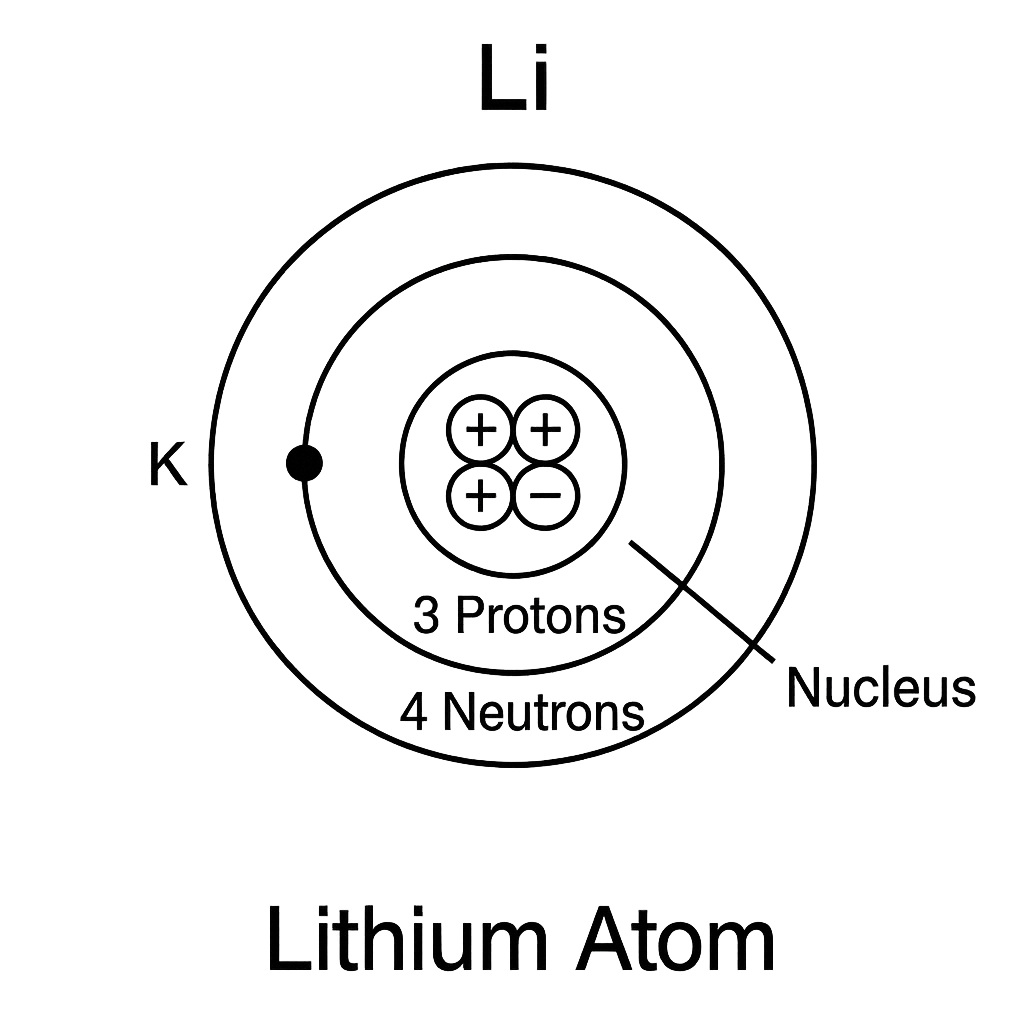
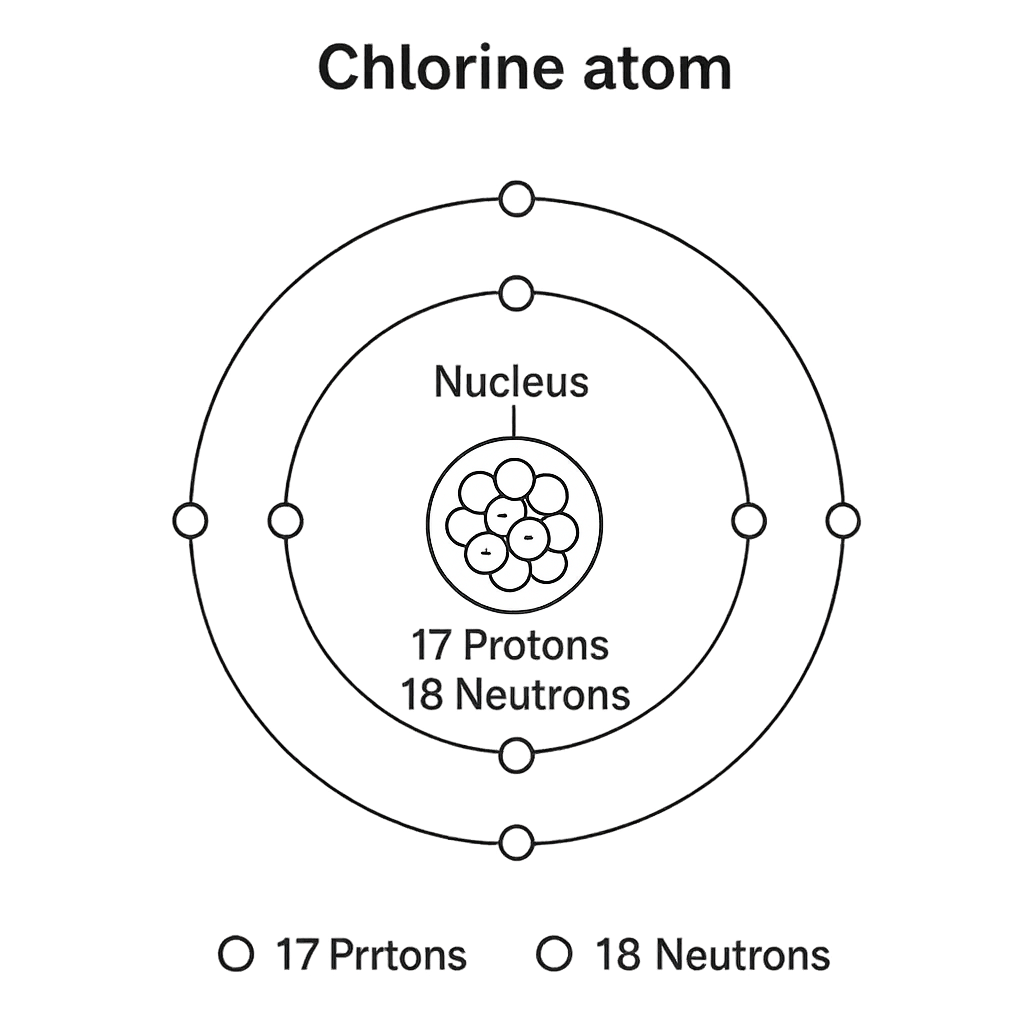
The diagram shows a lithium atom with a nucleus containing 3 protons and 4 neutrons, and electron shells containing 2 electrons in the first shell and 1 electron in the second shell. Based on the diagram, state the atomic number (\(Z\)), mass number (\(A\)), and identify the element.
A. Atomic number Z = 3; mass number A = 8; element = Lithium (Li).
B. Atomic number Z = 2; mass number A = 7; element = Helium (He).
C. Atomic number Z = 4; mass number A = 8; element = Beryllium (Be).
Correct D. Atomic number Z = 3; mass number A = 7; element = Lithium (Li).

Correct Answer: D

Want to see the full step-by-step solution? Unlock AI Explanation & Analytics
Question 22 View Details
An element X has the electron configuration \( [Ar] 4s^{2} 3d^{10} 4p^{2} \). Identify the element and state its group number in the periodic table.
Correct A. Germanium (Ge); group 14.
B. Tin (Sn); group 14.
C. Gallium (Ga); group 13.
D. Arsenic (As); group 15.

Correct Answer: A

Want to see the full step-by-step solution? Unlock AI Explanation & Analytics
Question 23 View Details
A 2.00 mol sample of an ideal gas is at 300 K and 1.00 atm. It is heated at constant pressure to 450 K, then compressed isothermally at 450 K to half its volume, after which the pressure is measured to be 1.50 atm. Assuming the gas behaves ideally, calculate the mass of gas that has condensed during the isothermal compression. The molar mass of the gas is 44 g·mol\(^{-1}\).
A. 30 g
B. 20 g
C. 24 g
Correct D. 22 g

Correct Answer: D

Want to see the full step-by-step solution? Unlock AI Explanation & Analytics
Question 24 View Details
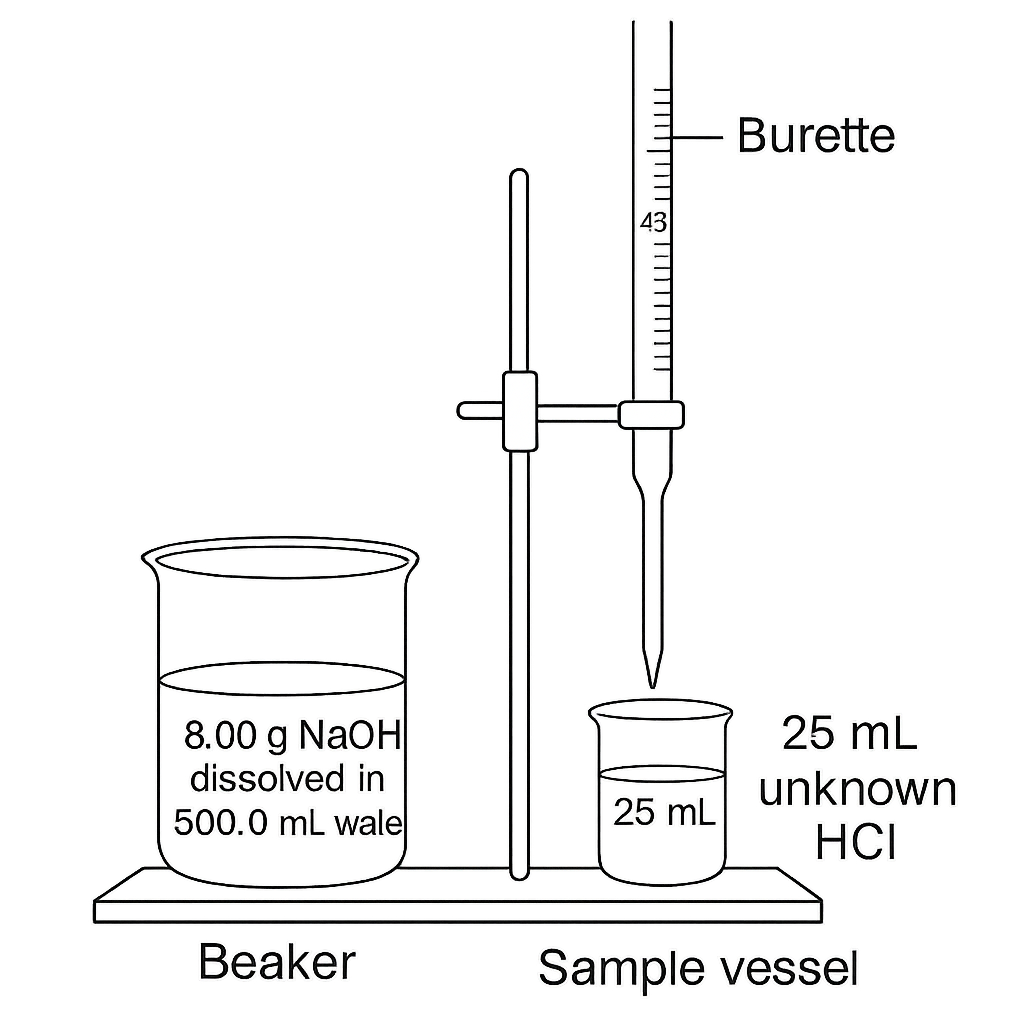
A laboratory set‑up is shown in the diagram. 8.00 g of solid NaOH is dissolved in 500.0 mL of water to prepare a solution. A burette filled with this NaOH solution delivers exactly 45.0 mL into a 25.0 mL sample of an unknown HCl solution, completely neutralising it. The reaction is \(\mathrm{NaOH + HCl \rightarrow NaCl + H_{2}O}\) (1:1 mole ratio). Determine the molarity of the HCl solution.
A. 0.400 M
B. 0.360 M
C. 0.900 M
Correct D. 0.720 M

Correct Answer: D

Want to see the full step-by-step solution? Unlock AI Explanation & Analytics
Question 25 View Details
A 0.500 g sample of a compound containing only carbon, hydrogen and sulfur is combusted completely. The combustion produces 1.00 g of \(\mathrm{CO_{2}}\) and 0.410 g of \(\mathrm{H_{2}O}\). (a) Determine the empirical formula of the compound. (b) If the molar mass of the compound is approximately 176 g·mol\(^{-1}\), determine its molecular formula.
A. Empirical formula: C4H8S; Molecular formula: C12H24S3.
B. Empirical formula: C5H10S; Molecular formula: C10H20S2.
Correct C. Empirical formula: C4H8S; Molecular formula: C8H16S2.
D. Empirical formula: C3H6S; Molecular formula: C6H12S2.

Correct Answer: C

Want to see the full step-by-step solution? Unlock AI Explanation & Analytics

Master the Exam!

You've seen a preview, but there are thousands more questions plus AI tutor to break down complex solutions.

Unlock Full Access Available for Android & Windows
Help others prepare! Share this practice hub:
Chat with Support