neco 2021 chemistry | Essay

Prepare for your exams with neco questions? Reviewing past/model questions is one of the most effective ways to guarantee a high score. This practice hub features authentic 2021 chemistry (Essay) questions designed to simulate the real exam environment.

Practice these randomly selected questions to test your readiness.
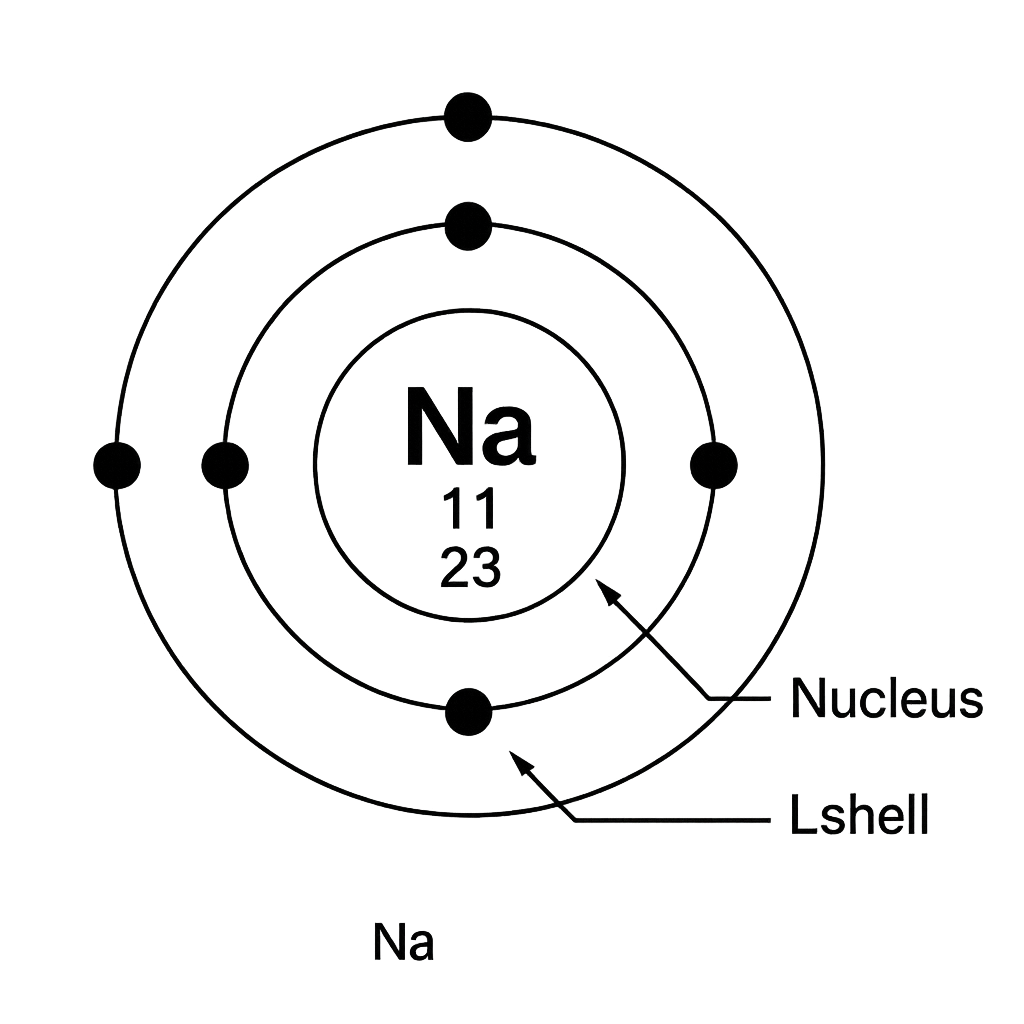
Question 1 View Details
The diagram shows a neutral atom of an element with atomic number 11. The nucleus is labelled, and the electron shells are drawn with the number of electrons in each shell indicated by arrows.
Question Parts
(a)
State the number of protons, neutrons and electrons present in the atom shown.
(b)
Write the ground‑state electron configuration of the element using the Aufbau principle.
(c)
Explain why this element is placed in Group 1 of the periodic table and describe one characteristic chemical property that results from this position.
Detailed Essay Solution & Marking Scheme Available

Get the step-by-step mathematical proofs, key points required by examiners, and a comprehensive breakdown from our AI Tutor.
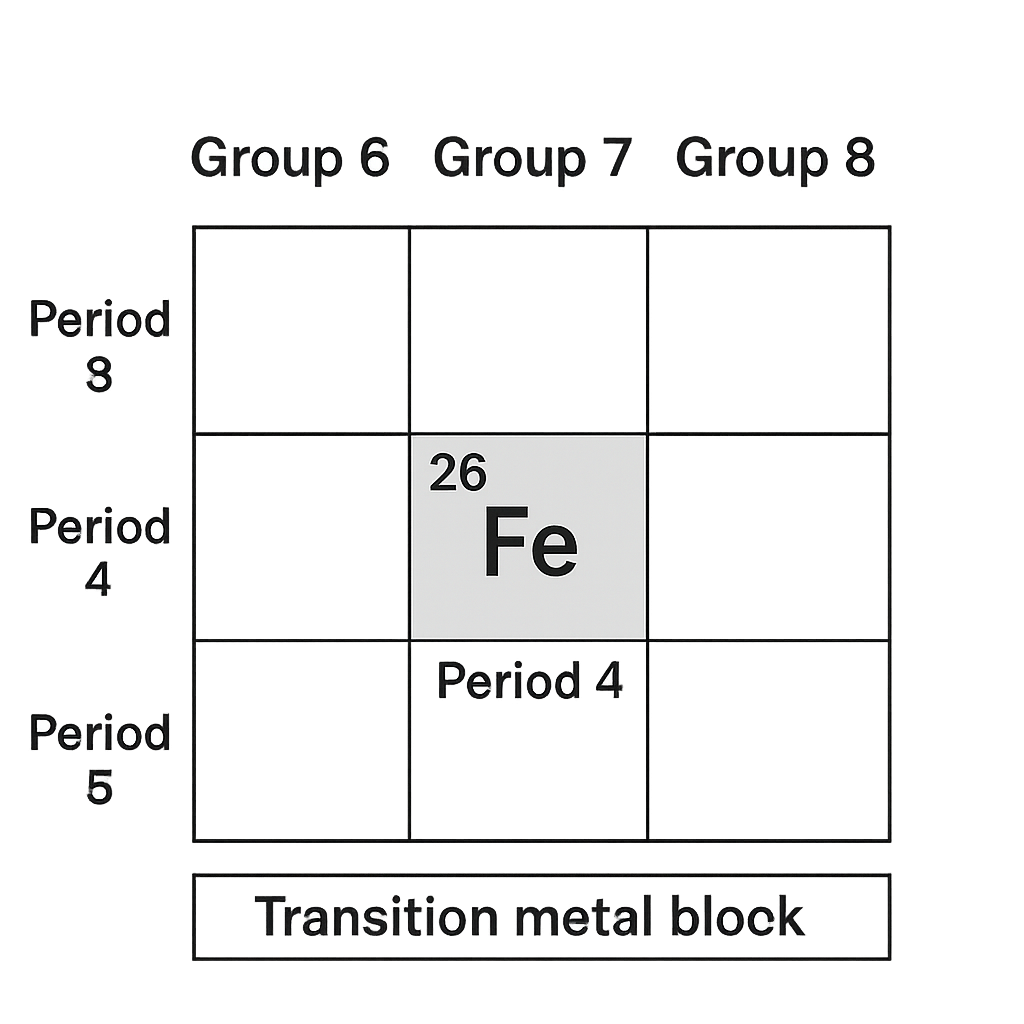
Question 2 View Details
The diagram is a portion of the periodic table highlighting the transition metal block. The element highlighted is situated in period 4, group 8, and its atomic number is shown as 26.
Question Parts
(a)
State the chemical symbol, atomic number and standard atomic mass of the highlighted element.
(b)
List two common oxidation states exhibited by this element and give one example compound for each oxidation state.
(c)
Using periodic trends, explain why this element is classified as a transition metal and discuss one physical property that results from its d‑electron configuration.
Detailed Essay Solution & Marking Scheme Available

Get the step-by-step mathematical proofs, key points required by examiners, and a comprehensive breakdown from our AI Tutor.
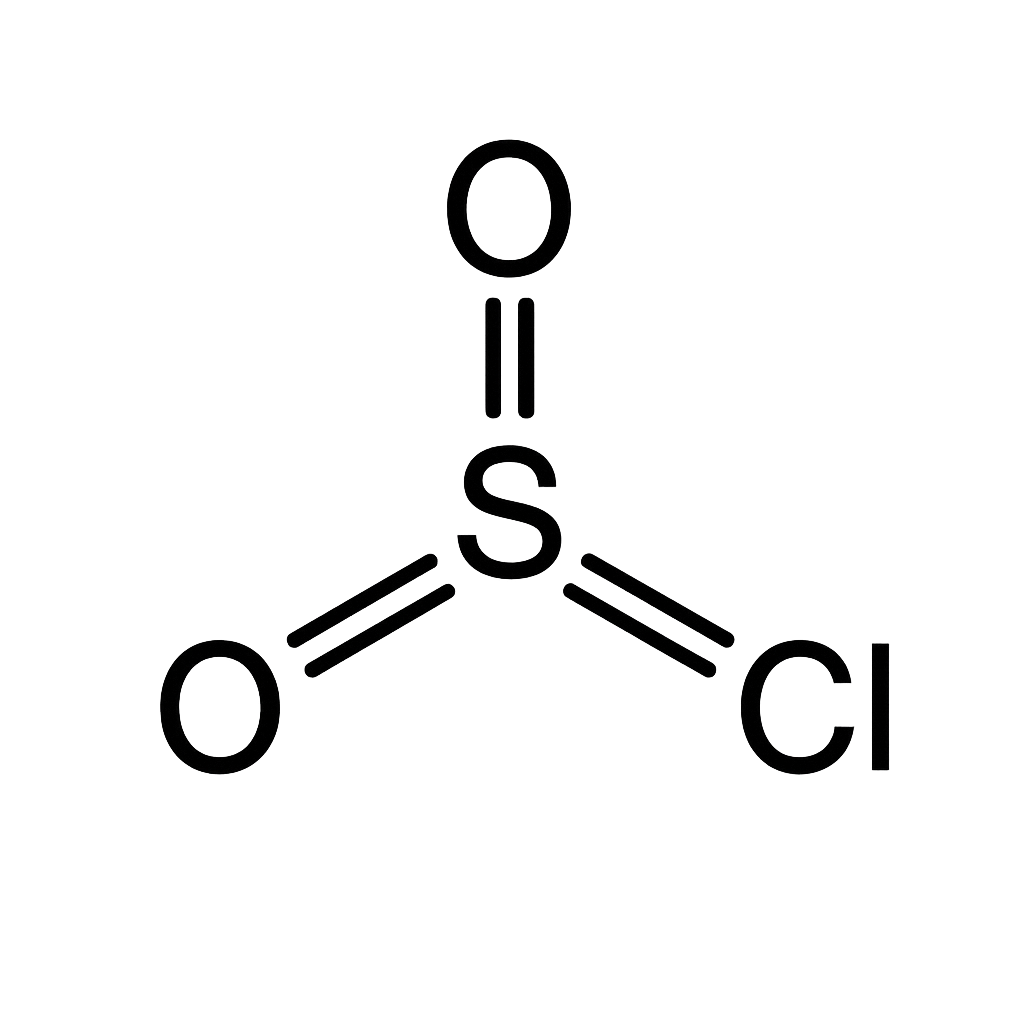
Question 3 View Details
The diagram shows the Lewis structure of sulfuryl chloride (SO\(_2\)Cl\(_2\)).
Question Parts
(a)
Calculate the total number of valence electrons present in a molecule of SO\(_2\)Cl\(_2\).
(b)
Outline the step‑by‑step procedure used to draw the correct Lewis structure of SO\(_2\)Cl\(_2\), including any formal‑charge considerations.
(c)
Using VSEPR theory, determine the molecular geometry, approximate bond angles and the hybridisation of the central sulphur atom in SO\(_2\)Cl\(_2\).
(d)
Discuss the overall polarity of SO\(_2\)Cl\(_2\) and identify the type(s) of intermolecular forces it is expected to exhibit.
Detailed Essay Solution & Marking Scheme Available

Get the step-by-step mathematical proofs, key points required by examiners, and a comprehensive breakdown from our AI Tutor.
Question 4 View Details
A 1.80 g sample of an unknown compound containing only carbon, hydrogen and oxygen is completely combusted. The combustion yields 4.44 g of carbon dioxide and 1.80 g of water. The molar mass of the compound is known to be 144 g mol⁻¹. A hydrate of this compound loses 0.45 g of water when 1.80 g of the hydrate is heated to a constant mass.
Question Parts
(a)
Determine the empirical formula of the compound from the combustion data.
(b)
Using the empirical formula and the given molar mass, calculate the molecular formula of the compound.
(c)
From the heating data of the hydrate, determine the number of water molecules of crystallisation per formula unit of the compound.
Detailed Essay Solution & Marking Scheme Available

Get the step-by-step mathematical proofs, key points required by examiners, and a comprehensive breakdown from our AI Tutor.

Question 5 View Details
A 5.00 g alloy contains magnesium and calcium. The alloy is 90 % Mg by mass and the remaining 10 % is Ca. The alloy is placed in excess hydrochloric acid. The reactions are: \(\text{Mg} + 2\text{HCl} \rightarrow \text{MgCl}_2 + \text{H}_2\) \(\text{Ca} + 2\text{HCl} \rightarrow \text{CaCl}_2 + \text{H}_2\) Assume the acid is in large excess. (a) Calculate the total number of moles of hydrogen gas that can be produced theoretically from the alloy. (b) Determine the mass of magnesium chloride that would be formed. (c) In the experiment, 0.75 L of hydrogen gas is collected at 298 K and 1.00 atm. Calculate the percent yield of hydrogen gas based on the theoretical amount obtained in part (a).
Detailed Essay Solution & Marking Scheme Available

Get the step-by-step mathematical proofs, key points required by examiners, and a comprehensive breakdown from our AI Tutor.

Question 6 View Details
A 2.00 g sample of a pure substance X has the following thermal data: - Melting point: 120 °C - Boiling point: 300 °C - Specific heat capacity (solid): 0.50 J g⁻¹ K⁻¹ - Specific heat capacity (liquid): 0.80 J g⁻¹ K⁻¹ - Latent heat of fusion: 60 J g⁻¹ - Latent heat of vaporisation: 200 J g⁻¹ The sample is initially at 25 °C. (a) Calculate the total amount of heat (in kJ) required to convert the sample completely into vapour at 350 °C. (b) If only 150 kJ of heat is supplied, determine the final state of the sample and its temperature after the heat is absorbed. (c) Briefly explain how an increase in external pressure would affect the boiling point of substance X, citing the relevant principle.
Detailed Essay Solution & Marking Scheme Available

Get the step-by-step mathematical proofs, key points required by examiners, and a comprehensive breakdown from our AI Tutor.

Question 7 View Details
A student prepares 50.0 mL of 0.10 M acetic acid (CH₃COOH, Ka = 1.8×10⁻⁵ at 25 °C) in a beaker. She then titrates the solution with 0.10 M NaOH and records that after adding 5.0 mL of the base the solution becomes a buffer.
Question Parts
(a)
Calculate the pH of the solution after the addition of 5.0 mL of NaOH.
(b)
Write the net ionic equation for the reaction that occurs at the equivalence point and identify the salt formed. State whether the salt solution will be acidic, basic or neutral and justify your answer.
(c)
Calculate the pH of a 0.20 M aqueous solution of sodium acetate at 25 °C. (Use Kw = 1.0×10⁻¹⁴).
Detailed Essay Solution & Marking Scheme Available

Get the step-by-step mathematical proofs, key points required by examiners, and a comprehensive breakdown from our AI Tutor.

Question 8 View Details
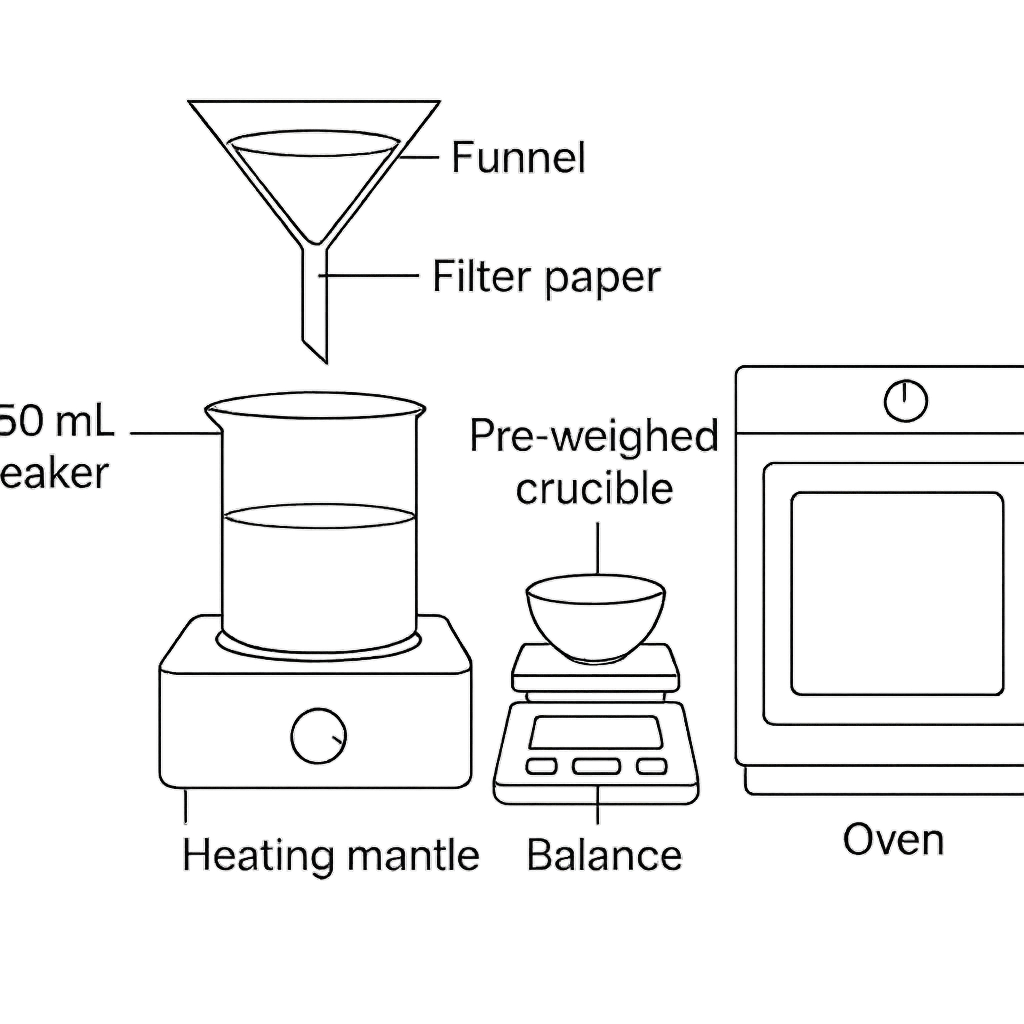
A student is required to determine the solubility of lead(II) chloride (PbCl\(_2\)) in water at 25 °C using the experimental setup shown in the diagram. The apparatus consists of a 250 mL beaker containing distilled water, a clean funnel fitted with filter paper, a pre‑weighed dry crucible, a balance accurate to 0.01 g, and a heating mantle. The student adds excess solid PbCl\(_2\) (5.00 g) to the beaker, gently heats the mixture to maintain a constant temperature of 25 °C, and stirs until no more solid dissolves. The mixture is then filtered, and the filtrate is transferred to the pre‑weighed crucible, which is subsequently dried in an oven at 105 °C to constant mass. The mass of the empty crucible is 12.34 g and the mass of the crucible containing the dried residue is 13.19 g.
Question Parts
(a)
Calculate the solubility of PbCl\(_2\) in water at 25 °C expressed as grams of PbCl\(_2\) dissolved per 100 mL of solution. Show all steps.
(b)
Given that the standard enthalpy change for the dissolution of PbCl\(_2\) is \(\Delta H^{\circ}_{\text{sol}} = +45\) kJ mol\(^{-1}\) (endothermic), predict qualitatively how the solubility will change if the temperature is raised to 40 °C. Use the van’t Hoff relation to estimate the ratio \(K_{40}/K_{25}\).
(c)
Explain the common‑ion effect that would occur if 0.10 M NaCl were added to the saturated PbCl\(_2\) solution. Indicate how the solubility expression and the concentration of dissolved Pb\(^{2+}\) would be affected.
(d)
Determine the percentage of the initially added PbCl\(_2\) that remained undissolved after the experiment.
Detailed Essay Solution & Marking Scheme Available

Get the step-by-step mathematical proofs, key points required by examiners, and a comprehensive breakdown from our AI Tutor.

Master the Exam!

You've seen a preview, but there are thousands more questions plus AI tutor to break down complex solutions.

Unlock Full Access Available for Android & Windows
Help others prepare! Share this practice hub:
Chat with Support