neco 2021 agricultural_science | Essay

Prepare for your exams with neco questions? Reviewing past/model questions is one of the most effective ways to guarantee a high score. This practice hub features authentic 2021 agricultural_science (Essay) questions designed to simulate the real exam environment.

Practice these randomly selected questions to test your readiness.

Question 1 View Details
A mixed farming system is being practiced on a 10‑hectare farm in the savanna zone of Nigeria.
Question Parts
(a)
Identify and explain three ecological factors that influence the productivity of the farm.
(b)
Discuss two sustainable agricultural practices that can be adopted to improve soil fertility while conserving biodiversity on the farm.
(c)
Given that the farm currently yields 2.5 tonnes of maize per hectare, calculate the expected total maize production after adopting the practices in part (b) if they are projected to increase yield by 20 %.
Detailed Essay Solution & Marking Scheme Available

Get the step-by-step mathematical proofs, key points required by examiners, and a comprehensive breakdown from our AI Tutor.
Question 2 View Details
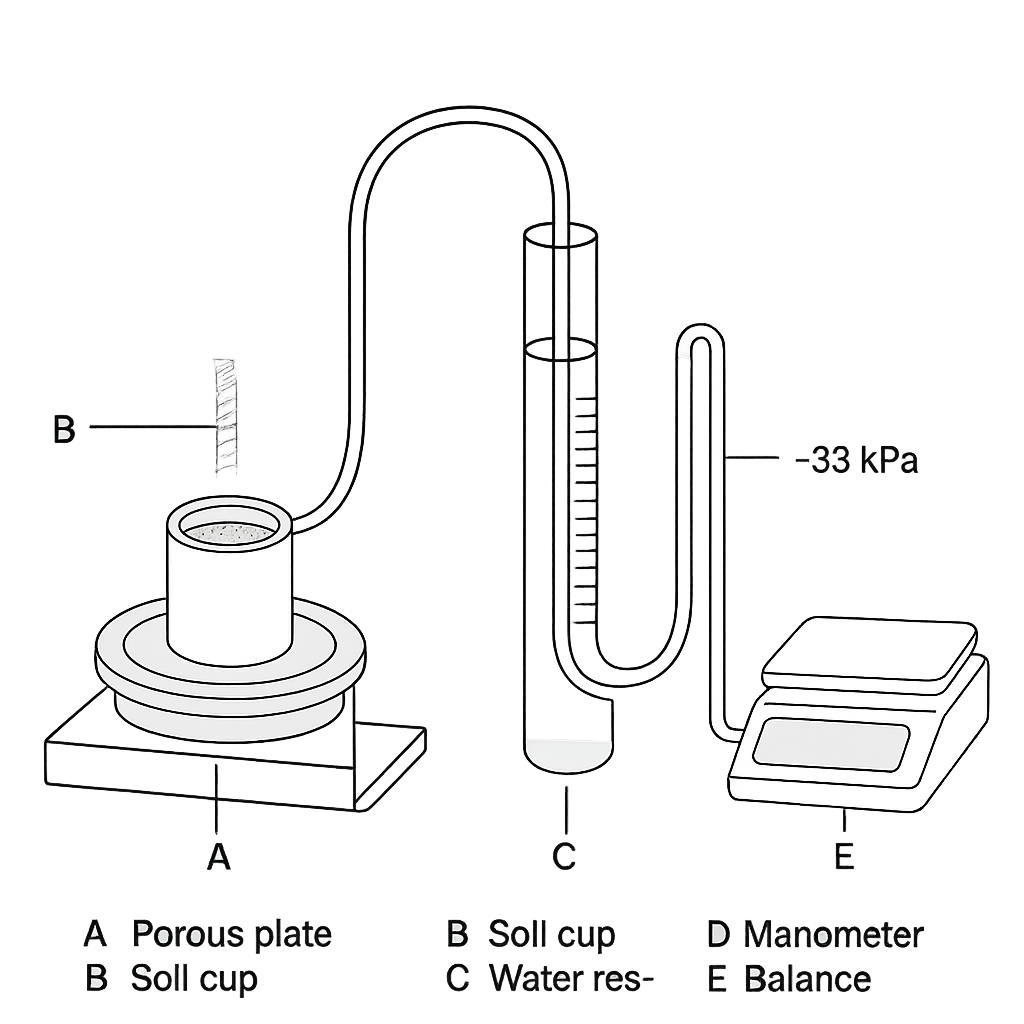
A soil scientist is conducting a laboratory experiment to determine the field capacity (FC) of a soil sample using the pressure plate apparatus shown in the diagram.
Question Parts
(a)
Explain the principle behind the pressure plate method for determining field capacity.
(b)
The apparatus is set to a matric potential of –33 kPa. A 100 g oven‑dry soil sample is placed in the plate and after equilibrium the water retained is measured as 45 g. Calculate the field capacity of the soil (i) as gravimetric water content (g water g⁻¹ dry soil) and (ii) as volumetric water content (cm³ water cm⁻³ soil), given the bulk density of the soil is 1.35 g cm⁻³.
(c)
Based on the result, recommend one management practice to improve the soil's water‑holding capacity and justify your choice.
Detailed Essay Solution & Marking Scheme Available

Get the step-by-step mathematical proofs, key points required by examiners, and a comprehensive breakdown from our AI Tutor.
Question 3 View Details
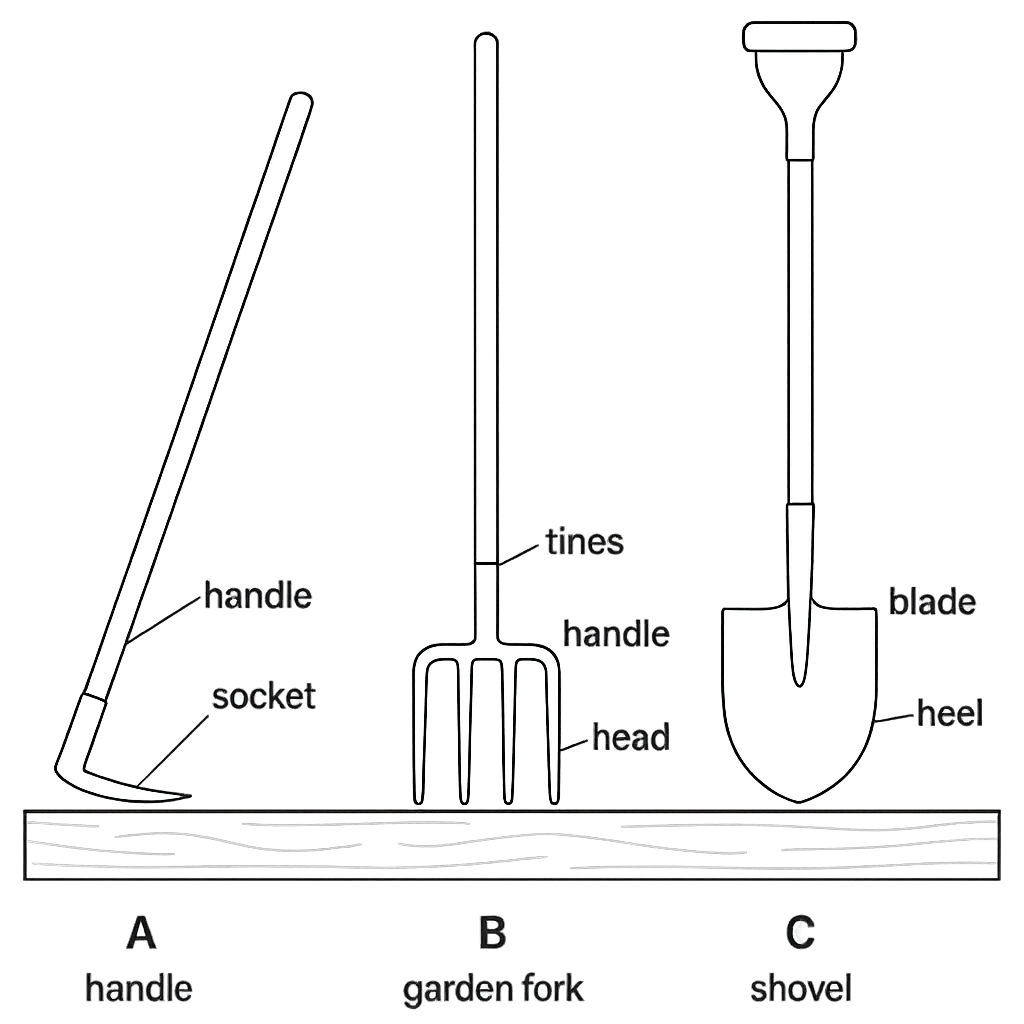
The diagram shows three commonly used farm hand tools arranged on a wooden board. Tool A is a hand hoe, Tool B is a garden fork, and Tool C is a shovel. The dimensions of the handles and the angles between the handle and the blade are indicated.
Question Parts
(a)
List the three main parts of each tool as labelled in the diagram.
(b)
For each tool, describe a farming operation where it is most effective and justify why its design is suitable for that operation.
(c)
The farmer records that using the hand hoe (Tool A) reduces the time required to break up a 0.5 ha plot from 8 hours (when using a simple spade) to 5 hours. Assuming labour cost is ₦150 per hour, calculate the monetary saving per hectare when the hand hoe is used instead of the spade. Also, if the hand hoe costs ₦12,000 and has a useful life of 4 years with 150 working days per year, determine the daily depreciation cost and state whether the saving per day justifies the purchase.
Detailed Essay Solution & Marking Scheme Available

Get the step-by-step mathematical proofs, key points required by examiners, and a comprehensive breakdown from our AI Tutor.

Question 4 View Details
A smallholder farmer intends to mechanise the preparation of his 2 ha field using a power tiller. The power tiller has a rated power of 12 kW and a fuel consumption rate of 3.5 L per hour at full load. The farmer plans to operate the tiller for 6 hours per day during the rainy season.
Question Parts
(a)
Calculate the total fuel required for tilling the whole field in one day.
(b)
If diesel costs ₦165 per litre, compute the daily fuel cost and the cost per hectare.
(c)
The farmer compares the power tiller with a traditional animal‑drawn plough which requires 2 oxen, each fed 5 kg of concentrate feed per day at ₦250 per kg. Determine the daily feed cost for the oxen and compare it with the fuel cost of the power tiller. Which option is more economical?
(d)
Discuss two non‑economic advantages of using the power tiller over animal draught power in the context of smallholder farming.
Detailed Essay Solution & Marking Scheme Available

Get the step-by-step mathematical proofs, key points required by examiners, and a comprehensive breakdown from our AI Tutor.

Question 5 View Details
A farmer intends to increase the yield of maize on a 2‑hectare field. The soil test results are: pH = 5.5, organic matter = 1.2 %, available nitrogen (N) = 40 kg ha⁻¹, available phosphorus (P) = 12 kg ha⁻¹, and available potassium (K) = 80 kg ha⁻¹. The recommended fertilizer rates for maize are 120 kg N ha⁻¹ and 60 kg P₂O₅ ha⁻¹. The farmer plans to use urea (46 % N) and single superphosphate (16 % P₂O₅). The expected yield response to nitrogen is 0.8 t per 100 kg N applied. Answer the following:
Question Parts
(a)
Interpret the soil test results and identify the nutrients that are limiting for maize production.
(b)
Propose a three‑season crop rotation sequence that would improve soil fertility for the next three years, giving a brief justification for each crop.
(c)
Calculate the quantities of urea and single superphosphate required per hectare to meet the recommended fertilizer rates of 120 kg N ha⁻¹ and 60 kg P₂O₅ ha⁻¹.
(d)
Using the yield response factor, estimate the increase in maize yield (t ha⁻¹) that can be expected from the nitrogen application alone.
Detailed Essay Solution & Marking Scheme Available

Get the step-by-step mathematical proofs, key points required by examiners, and a comprehensive breakdown from our AI Tutor.

Question 6 View Details
A smallholder keeps a flock of 80 laying hens. Each bird requires a daily intake of 110 g of a concentrate that contains 16 % crude protein and 2800 kcal kg⁻¹ metabolizable energy. The farmer wishes to improve the diet to 20 % crude protein by partially replacing the concentrate with soybean meal (44 % protein, 0 % protein filler). The concentrate costs ₦250 kg⁻¹ and soybean meal costs ₦500 kg⁻¹. Answer the following:
Question Parts
(a)
Calculate the total daily feed requirement (kg) for the whole flock.
(b)
Determine the proportion (by weight) of soybean meal that must be mixed with the concentrate to obtain an overall diet of 20 % crude protein. Show your calculation.
(c)
Using the proportion from (b), estimate the annual feed cost for the flock (assume 365 days of production).
(d)
Discuss two major health challenges affecting layer birds in tropical Nigeria and outline preventive measures for each.
Detailed Essay Solution & Marking Scheme Available

Get the step-by-step mathematical proofs, key points required by examiners, and a comprehensive breakdown from our AI Tutor.

Question 7 View Details
A farmer in the Sudan savanna zone of Nigeria cultivates maize on a 2.5‑hectare field.
Question Parts
(a)
Identify the most economically important insect pest of maize in this region and describe its complete life cycle, highlighting the stage that causes the greatest damage.
(b)
The recommended spray rate for the insecticide lambda‑cyhalothrin is 0.025 g of active ingredient per litre of water, and the recommended spray volume is 200 L per hectare. Calculate the total amount of active ingredient (in grams) the farmer must purchase for the whole 2.5‑hectare field.
(c)
Discuss an integrated pest management (IPM) programme for this pest, including at least three control tactics and the scientific rationale for each.
Detailed Essay Solution & Marking Scheme Available

Get the step-by-step mathematical proofs, key points required by examiners, and a comprehensive breakdown from our AI Tutor.

Question 8 View Details
A smallholder tomato farmer in the rainforest zone observes wilting and yellowing of lower leaves on his 1‑hectare farm.
Question Parts
(a)
Identify the disease affecting the tomatoes and name the causal pathogen.
(b)
Explain the disease cycle, emphasizing the role of temperature and humidity in disease development.
(c)
A field survey shows that infected plants yield on average 1.8 t ha⁻¹, whereas healthy plants yield 4.5 t ha⁻¹. If the market price of tomatoes is ₦150 per kilogram, calculate the monetary loss per hectare caused by the disease.
(d)
Recommend a comprehensive disease management plan that integrates cultural, biological and chemical measures, and justify each recommendation.
Detailed Essay Solution & Marking Scheme Available

Get the step-by-step mathematical proofs, key points required by examiners, and a comprehensive breakdown from our AI Tutor.

Master the Exam!

You've seen a preview, but there are thousands more questions plus AI tutor to break down complex solutions.

Unlock Full Access Available for Android & Windows
Help others prepare! Share this practice hub:
Chat with Support