neco 2020 physics | Objective

Prepare for your exams with neco questions? Reviewing past/model questions is one of the most effective ways to guarantee a high score. This practice hub features authentic 2020 physics (Objective) questions designed to simulate the real exam environment.

Practice these randomly selected questions to test your readiness.

Question 1 View Details
Two sinusoidal waves travel in the same direction along a stretched string. The first wave has wavelength \(0.68\ \text{m}\) and the wave speed in the string is \(340\ \text{m\ s}^{-1}\). The second wave has the same amplitude but an unknown frequency. When the two waves interfere, the resultant amplitude reaches a maximum (a beat) \(12\) times in \(5\ \text{s}\). Assuming the second wave's frequency is higher than the first, determine the frequency of the second wave in hertz.
A. 497.6 Hz
B. 1200 Hz
Correct C. 502.4 Hz
D. 502 Hz

Correct Answer: C

Want to see the full step-by-step solution? Unlock AI Explanation & Analytics
Question 2 View Details
A metal surface has a work function of \(2.20\ \text{eV}\). When it is illuminated with monochromatic light, the maximum kinetic energy of the emitted electrons is measured to be \(1.50\ \text{eV}\).\n(a) Determine the frequency and wavelength of the incident light.\n(b) The same light is now used on a second metal whose work function is \(1.80\ \text{eV}\). Calculate the stopping potential required to halt the emitted electrons from the second metal.
A. Frequency = 8.94×10^14 Hz; Wavelength = 350 nm; Stopping potential = 2.10 V
Correct B. Frequency = 8.94×10^14 Hz; Wavelength = 336 nm; Stopping potential = 1.90 V
C. Frequency = 9.12×10^14 Hz; Wavelength = 329 nm; Stopping potential = 1.70 V
D. Frequency = 8.50×10^14 Hz; Wavelength = 353 nm; Stopping potential = 1.80 V

Correct Answer: B

Want to see the full step-by-step solution? Unlock AI Explanation & Analytics
Question 3 View Details
Electrons are accelerated from rest through a potential difference of \(150\ \text{V}\) and then strike a thin polycrystalline metal foil. The first‑order diffraction maximum is observed at an angle of \(30^{\circ}\) relative to the incident beam. Using the de Broglie relation and Bragg's law for first order (\(n=1\)), determine the interplanar spacing \(d\) of the crystal in nanometres.
A. 0.08 nm
Correct B. 0.10 nm
C. 0.15 nm
D. 0.12 nm

Correct Answer: B

Want to see the full step-by-step solution? Unlock AI Explanation & Analytics
Question 4 View Details
A rectangular coil of \(50\) turns has dimensions \(0.20\ \text{m}\) by \(0.10\ \text{m}\). It rotates with a constant angular speed of \(120\ \text{rad\ s}^{-1}\) about an axis that is perpendicular to a uniform magnetic field of magnitude \(0.05\ \text{T}\). The axis passes through the centre of the coil and the plane of the coil makes an angle \(\theta=\omega t\) with the field.\n(a) Determine the maximum emf induced in the coil.\n(b) If the coil's resistance is \(2\ \Omega\), find the average electrical power dissipated in the coil.\n(c) When a load resistor of \(8\ \Omega\) is connected in series with the coil, calculate the average power delivered to the load.
A. Maximum emf = 6.5 V; Average coil power = 9.5 W; Load power = 1.30 W
B. Maximum emf = 7 V; Average coil power = 10.0 W; Load power = 1.60 W
C. Maximum emf = 5 V; Average coil power = 8.0 W; Load power = 1.20 W
Correct D. Maximum emf = 6 V; Average coil power = 9.0 W; Load power = 1.44 W

Correct Answer: D

Want to see the full step-by-step solution? Unlock AI Explanation & Analytics
Question 5 View Details
A battery of emf \(12\ \text{V}\) and internal resistance \(0.5\ \Omega\) is connected to a circuit consisting of a \(4\ \Omega\) resistor (R1) in series with a parallel combination of a \(6\ \Omega\) resistor (R2) and an unknown resistor R3. The total current drawn from the battery is measured to be \(1.2\ \text{A}\).\n(a) Determine the resistance value of R3.\n(b) Find the potential difference across R2.\n(c) If R3 is replaced by a perfect wire (0 \Omega), what is the new total current supplied by the battery?
A. R3 = 66 Ω; V_R2 = 5.5 V; New total current = 2.67 A
B. R3 = 72 Ω; V_R2 = 7.2 V; New total current = 2.8 A
Correct C. R3 = 66 Ω; V_R2 = 6.6 V; New total current = 2.67 A
D. R3 = 60 Ω; V_R2 = 5.5 V; New total current = 2.5 A

Correct Answer: C

Want to see the full step-by-step solution? Unlock AI Explanation & Analytics
Question 6 View Details
If a police car equipped with a siren of unknown true frequency passes a stationary observer, the observer first hears a frequency of \(540\ \text{Hz}\) as the car approaches, and later hears \(460\ \text{Hz}\) as it recedes. Assuming the speed of sound is \(340\ \text{m s}^{-1}\) and that the car moves at a constant speed, determine the speed of the car in \(\text{m s}^{-1}\).
A. 31.5\\ \\text{m s}^{-1}
B. 25.0\\ \\text{m s}^{-1}
C. 22.8\\ \\text{m s}^{-1}
Correct D. 27.2\ \text{m s}^{-1}

Correct Answer: D

Want to see the full step-by-step solution? Unlock AI Explanation & Analytics
Question 7 View Details
Sand is fed onto a moving conveyor belt at a rate of \(0.4\ \text{kg s}^{-1}\). The belt moves horizontally at a constant speed of \(1.5\ \text{m s}^{-1}\) and lifts the sand to a height of \(2\ \text{m}\) above the ground. If the motor driving the belt has an efficiency of \(75\%\), calculate the minimum power that must be supplied by the motor in watts.
A. 12.5\\ \\text{W}
Correct B. 11.1\ \text{W}
C. 10.5\\ \\text{W}
D. 9.8\\ \\text{W}

Correct Answer: B

Want to see the full step-by-step solution? Unlock AI Explanation & Analytics
Question 8 View Details
A sample of an ideal gas is initially at a pressure of \(2\ \text{atm}\) and a temperature of \(300\ \text{K}\). It is first compressed isothermally to half its original volume and then heated at constant volume until its temperature reaches \(450\ \text{K}\). What is the final pressure of the gas in atmospheres?
A. 5\ \text{atm}
B. 8\ \text{atm}
C. 4\ \text{atm}
Correct D. 6\ \text{atm}

Correct Answer: D

Want to see the full step-by-step solution? Unlock AI Explanation & Analytics
Question 9 View Details
A particle moves 5 km east, then 12 km north, and finally 13 km at an angle of 30° west of north. Determine the magnitude of the resultant displacement in kilometres, correct to three significant figures.
A. 22.0\ \text{km}
B. 24.8\ \text{km}
C. 21.5\ \text{km}
Correct D. 23.3\ \text{km}

Correct Answer: D

Want to see the full step-by-step solution? Unlock AI Explanation & Analytics
Question 10 View Details
Convert a power rating of \(3.5\ \text{kW}\) into joules per minute. Express your answer in scientific notation with two significant figures.
A. 1.8\\times10^{5}\\ \text{J min}^{-1}
B. 2.5\\times10^{5}\\ \text{J min}^{-1}
C. 2.1\\times10^{6}\\ \text{J min}^{-1}
Correct D. 2.1\times10^{5}\ \text{J min}^{-1}

Correct Answer: D

Want to see the full step-by-step solution? Unlock AI Explanation & Analytics
Question 11 View Details
A \(0.20\) mol sample of an ideal gas occupies a \(5.0\) L rigid container at \(20^{\circ}\text{C}\) and a pressure of \(100\ \text{kPa}\). The gas is heated at constant pressure until its temperature reaches \(80^{\circ}\text{C}\). It is then compressed adiabatically back to its original volume. Assuming the gas is diatomic with \(\gamma = 1.4\), calculate the final pressure of the gas in kPa (to three significant figures).
A. 115 kPa
B. 145 kPa
Correct C. 130 kPa
D. 160 kPa

Correct Answer: C

Want to see the full step-by-step solution? Unlock AI Explanation & Analytics
Question 12 View Details
A rectangular metal sheet measures \(0.45\) m by \(0.30\) m and has a uniform thickness of \(2.5\) mm. Determine its volume in cubic centimetres (\(\text{cm}^{3}\)).
Correct A. 337.5 cm³
B. 3375 cm³
C. 33.75 cm³
D. 450 cm³

Correct Answer: A

Want to see the full step-by-step solution? Unlock AI Explanation & Analytics
Question 13 View Details
A calorimeter of heat capacity \(150\ \text{J·K}^{-1}\) contains \(200\) g of water at \(25^{\circ}\text{C}\). A \(50\) g piece of aluminum initially at \(100^{\circ}\text{C}\) is placed into the calorimeter. After the system reaches thermal equilibrium, the final temperature is \(30^{\circ}\text{C}\). Assuming no heat loss to the surroundings, determine the specific heat capacity of aluminum in \(\text{J·g}^{-1}\text{·K}^{-1}\) (to two decimal places).
A. 2.05 J·g⁻¹·K⁻¹
B. 1.75 J·g⁻¹·K⁻¹
Correct C. 1.41 J·g⁻¹·K⁻¹
D. 0.89 J·g⁻¹·K⁻¹

Correct Answer: C

Want to see the full step-by-step solution? Unlock AI Explanation & Analytics
Question 14 View Details
A string fixed at both ends has length \(1.20\ \text{m}\) and linear mass density \(0.005\ \text{kg·m}^{-1}\). When the tension in the string is \(T\), the fundamental frequency observed is \(120\ \text{Hz}\).\n(i) Determine the tension \(T\) in newtons (to three significant figures).\n(ii) If the tension is increased by 25 %, calculate the frequency of the third harmonic (to the nearest hertz).
A. T = 415 N; f₃ ≈ 420 Hz
B. T = 500 N; f₃ ≈ 403 Hz
Correct C. T = 415 N; f₃ ≈ 403 Hz
D. T = 415 N; f₃ ≈ 360 Hz

Correct Answer: C

Want to see the full step-by-step solution? Unlock AI Explanation & Analytics
Question 15 View Details
A block of mass \(5.0\ \text{kg}\) rests on a rough inclined plane that makes an angle of \(30^{\circ}\) with the horizontal. The coefficients of static and kinetic friction between the block and the plane are \(\mu_{s}=0.25\) and \(\mu_{k}=0.20\) respectively. A horizontal force of \(50\ \text{N}\) is applied to the block, directed up the incline.\n(i) Determine whether the block will start moving up the plane.\n(ii) If it does move, find its acceleration up the plane in \(\text{m·s}^{-2}\) (to two decimal places).
Correct A. The block does not move; acceleration = 0 m·s⁻²
B. The block moves up the plane; acceleration = 1.75 m·s⁻²
C. The block moves down the plane; acceleration = 0.60 m·s⁻²
D. The block does not move; acceleration = 0.50 m·s⁻²

Correct Answer: A

Want to see the full step-by-step solution? Unlock AI Explanation & Analytics
Question 16 View Details
A rectangular coil of 50 turns and area \(0.02\,\text{m}^2\) rotates in a uniform magnetic field of \(0.5\,\text{T}\). Its angular speed varies with time as \(\omega = \alpha t\) where \(\alpha = 2\,\text{rad\,s}^{-2}\). At \(t = 3\,\text{s}\) determine (i) the magnitude of the induced emf and (ii) the average power delivered to a resistor of \(10\,\Omega\) connected across the coil.
A. 1.00 V; 0.10 W
Correct B. 1.24 V; 0.15 W
C. 1.48 V; 0.22 W
D. 0.62 V; 0.04 W

Correct Answer: B

Want to see the full step-by-step solution? Unlock AI Explanation & Analytics
Question 17 View Details
A 2.0\,g sample of a radioactive isotope X (molar mass \(240\,\text{g\,mol}^{-1}\)) decays to Y with a half‑life of \(8.0\,\text{yr}\). The daughter nuclide Y is itself radioactive with a half‑life of \(2.0\,\text{yr}\) and decays to a stable nuclide Z. Initially only X is present. Calculate the activity of Y (in becquerels) after \(12\,\text{yr}\).
A. 8.1×10^{12} Bq
B. 1.2×10^{13} Bq
C. 4.5×10^{12} Bq
Correct D. 6.2×10^{12} Bq

Correct Answer: D

Want to see the full step-by-step solution? Unlock AI Explanation & Analytics
Question 18 View Details
The nuclear fission reaction \(^{235}\!\text{U}+\,^{1}\!\text{n}\rightarrow\,^{141}\!\text{Ba}+\,^{92}\!\text{Kr}+3\,^{1}\!\text{n}+\text{energy}\) occurs with the following atomic masses: \(m(^{235}\!\text{U})=235.0439\,\text{u}\), \(m(^{1}\!\text{n})=1.008665\,\text{u}\), \(m(^{141}\!\text{Ba})=140.9144\,\text{u}\), \(m(^{92}\!\text{Kr})=91.9262\,\text{u}\). (The mass of a neutron is the same as above.)\nCalculate (i) the energy released per fission event in MeV, and (ii) the total energy obtainable from \(1\,\text{kg}\) of \(^{235}\!\text{U}\). Use \(1\,\text{u}=931.5\,\text{MeV}\) and \(N_A=6.022\times10^{23}\,\text{mol}^{-1}\).
A. 165 MeV per fission; ≈6.8×10^{13} J per kg of \\(^{235}\\!\\text{U}\\)
B. 180 MeV per fission; ≈7.5×10^{13} J per kg of \\(^{235}\\!\\text{U}\\)
Correct C. 173 MeV per fission; ≈7.1×10^{13} J per kg of \(^{235}\!\text{U}\)
D. 190 MeV per fission; ≈8.0×10^{13} J per kg of \\(^{235}\\!\\text{U}\\)

Correct Answer: C

Want to see the full step-by-step solution? Unlock AI Explanation & Analytics
Question 19 View Details
A car starts from rest and accelerates uniformly to a speed of \(20\,\text{m\,s}^{-1}\) in \(5\,\text{s}\). What distance does the car travel during this time?
Correct A. 50 m
B. 20 m
C. 40 m
D. 100 m

Correct Answer: A

Want to see the full step-by-step solution? Unlock AI Explanation & Analytics
Question 20 View Details
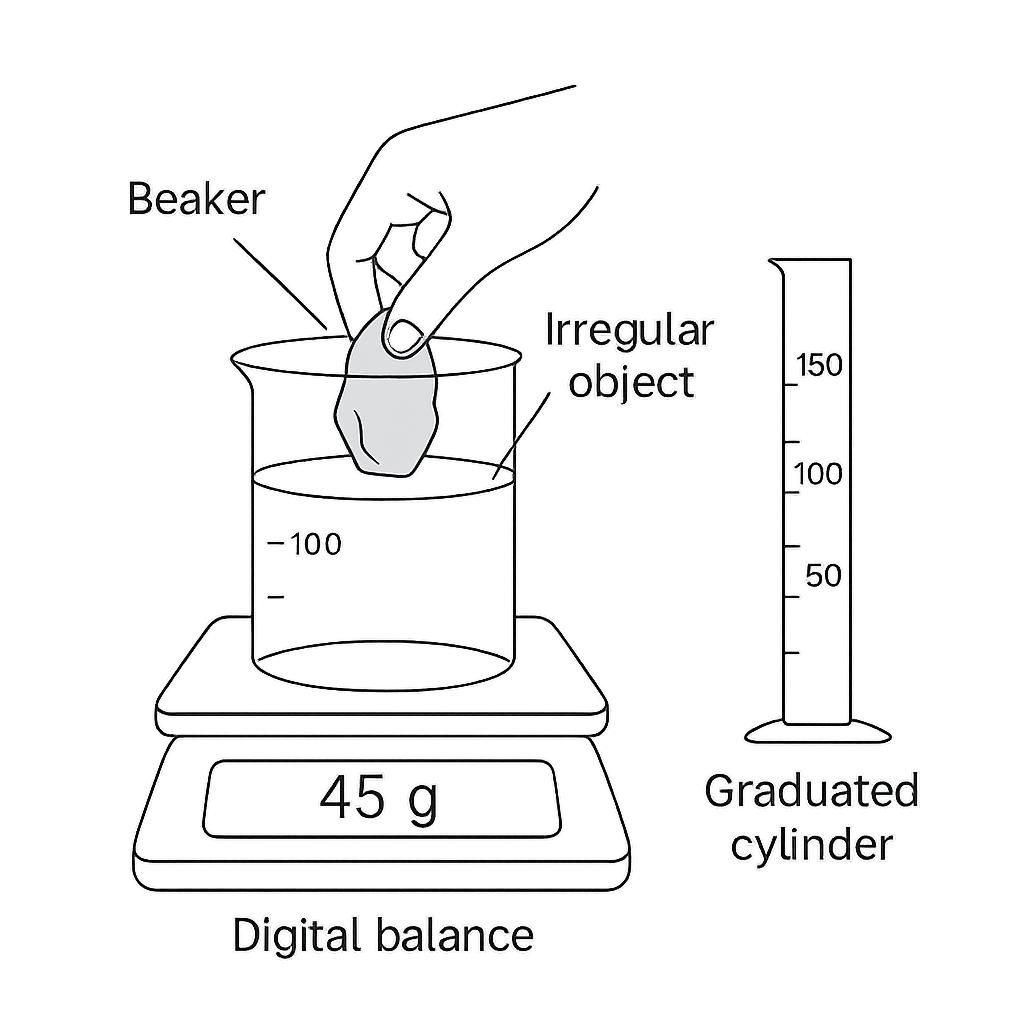
In the laboratory setup shown, a 250 mL beaker sits on a digital balance. Initially the beaker contains 100 mL of water and the combined mass (beaker + water) reads 150 g. An irregular solid object of mass 45 g is gently lowered into the water, causing 30 mL of water to overflow and be collected in a graduated cylinder. After the object is fully immersed, the balance reads 190 g (beaker + water + object). Using this information, determine the density of the solid object in \(\text{g\,cm}^{-3}\).
A. 1.8 g·cm⁻³
Correct B. 1.5 g·cm⁻³
C. 2.0 g·cm⁻³
D. 1.2 g·cm⁻³

Correct Answer: B

Want to see the full step-by-step solution? Unlock AI Explanation & Analytics
Question 21 View Details
An ideal battery of emf \(E\) V and internal resistance \(r\) \(\Omega\) is connected to a load resistor \(R\) \(\Omega\). When \(R = 6\,\Omega\) the terminal voltage is \(12\,\text{V}\) and the efficiency of the circuit (ratio of power delivered to the load to the total chemical power) is \(60\%\). The battery is then re‑connected to a different load resistor \(R'\) \(\Omega\) such that the efficiency becomes \(80\%\). Find the value of \(R'\) in ohms.
A. 18
B. 24
C. 12
Correct D. 16

Correct Answer: D

Want to see the full step-by-step solution? Unlock AI Explanation & Analytics
Question 22 View Details
A frictionless piston of area \(A = 0.005\,\text{m}^2\) supports a mass of \(50\,\text{kg}\). Atmospheric pressure is \(1.0\times10^{5}\,\text{Pa}\). The gas trapped beneath the piston initially has pressure \(1.2\times10^{5}\,\text{Pa}\) and temperature \(300\,\text{K}\). The piston is slowly lowered until the gas volume is halved, the temperature remaining constant. Determine the additional upward force exerted by the gas after compression, the total upward pressure force (gas plus atmosphere), and the net upward force on the piston. Give the net upward force in newtons.
A. 1510
B. 1310
Correct C. 1210
D. 1010

Correct Answer: C

Want to see the full step-by-step solution? Unlock AI Explanation & Analytics
Question 23 View Details
In an experiment to determine the resistivity of a copper wire, a student measures the length \(L = 1.200\,\text{m}\) with a ruler (least count \(1\,\text{mm}\)), the diameter \(d = 0.500\,\text{mm}\) with a micrometer (least count \(0.01\,\text{mm}\)), and the resistance \(R = 2.50\,\Omega\) with a digital multimeter (±0.5\% reading error). Assuming independent random errors and taking the absolute uncertainty as half the least count for each instrument, calculate the combined percentage uncertainty in the resistivity \(\rho = RA/L\). Identify the dominant source of uncertainty and suggest two experimental precautions to reduce it.
Correct A. 2.1
B. 2.5
C. 3.0
D. 1.9

Correct Answer: A

Want to see the full step-by-step solution? Unlock AI Explanation & Analytics
Question 24 View Details
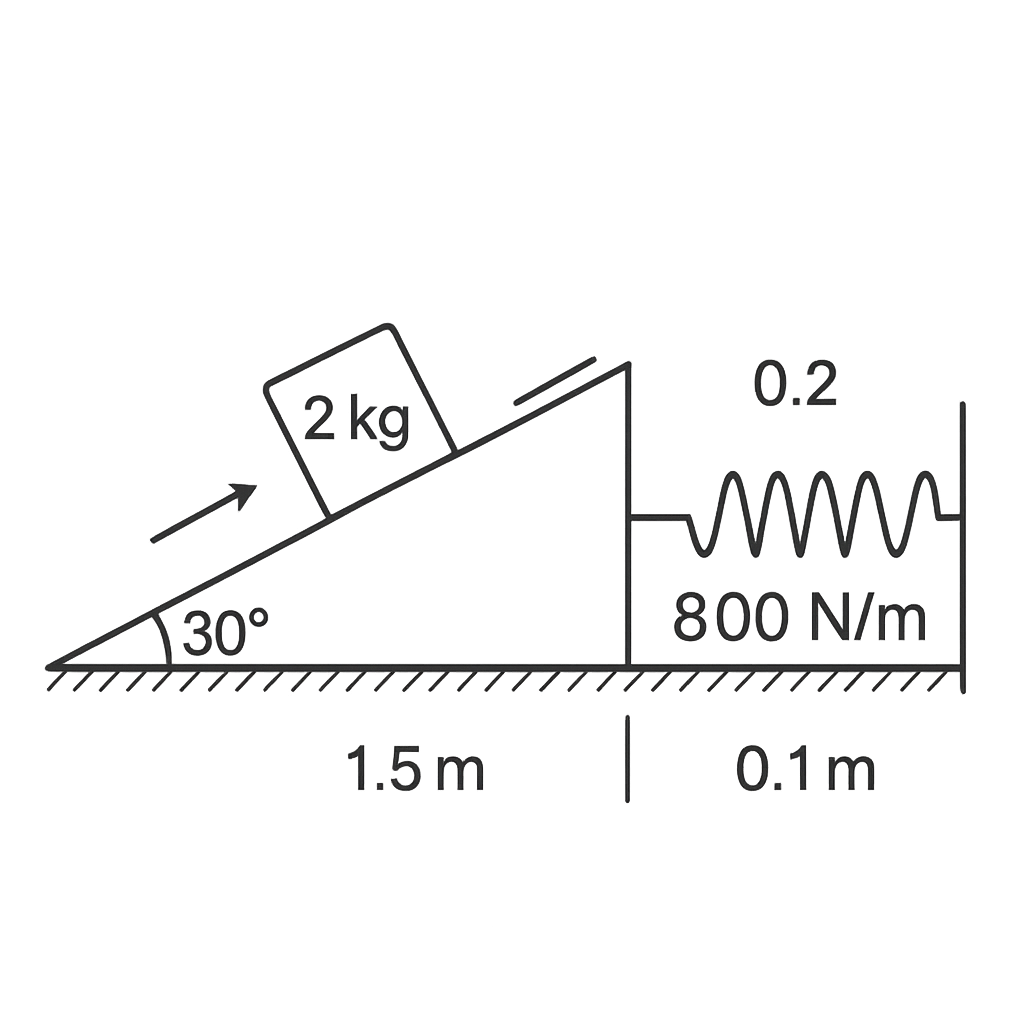
A \(2\,\text{kg}\) block starts from rest at the top of a frictionless incline that makes an angle of \(30^{\circ}\) with the horizontal. It slides down, reaches the bottom and then moves onto a horizontal rough surface of length \(1.5\,\text{m}\) where the coefficient of kinetic friction is \(\mu_{k}=0.2\). At the end of the rough surface the block compresses a spring of constant \(k=800\,\text{N\,m}^{-1}\) by \(0.10\,\text{m}\) and momentarily comes to rest. Assuming \(g=9.8\,\text{m\,s}^{-2}\), determine the minimum vertical height \(h\) of the incline required for the block to compress the spring by the given amount. (Use the diagram provided.)
Correct A. 0.50
B. 0.55
C. 0.60
D. 0.45

Correct Answer: A

Want to see the full step-by-step solution? Unlock AI Explanation & Analytics
Question 25 View Details
A \(150\,\text{g}\) piece of ice at \(-10^{\circ}\text{C}\) is placed in a well‑insulated container with \(200\,\text{g}\) of water at \(25^{\circ}\text{C}\). No heat is lost to the surroundings. The specific heat capacities are \(c_{ice}=2.1\,\text{J\,g}^{-1}\text{K}^{-1}\) and \(c_{water}=4.18\,\text{J\,g}^{-1}\text{K}^{-1}\); the latent heat of fusion of ice is \(L_f=334\,\text{J\,g}^{-1}\). Determine the final temperature of the mixture and the mass of ice that melts.
A. 45.0
B. 60.5
C. 30.1
Correct D. 53.2

Correct Answer: D

Want to see the full step-by-step solution? Unlock AI Explanation & Analytics

Master the Exam!

You've seen a preview, but there are thousands more questions plus AI tutor to break down complex solutions.

Unlock Full Access Available for Android & Windows
Help others prepare! Share this practice hub:
Chat with Support