neco 2020 physics | Essay

Prepare for your exams with neco questions? Reviewing past/model questions is one of the most effective ways to guarantee a high score. This practice hub features authentic 2020 physics (Essay) questions designed to simulate the real exam environment.

Practice these randomly selected questions to test your readiness.
Question 1 View Details
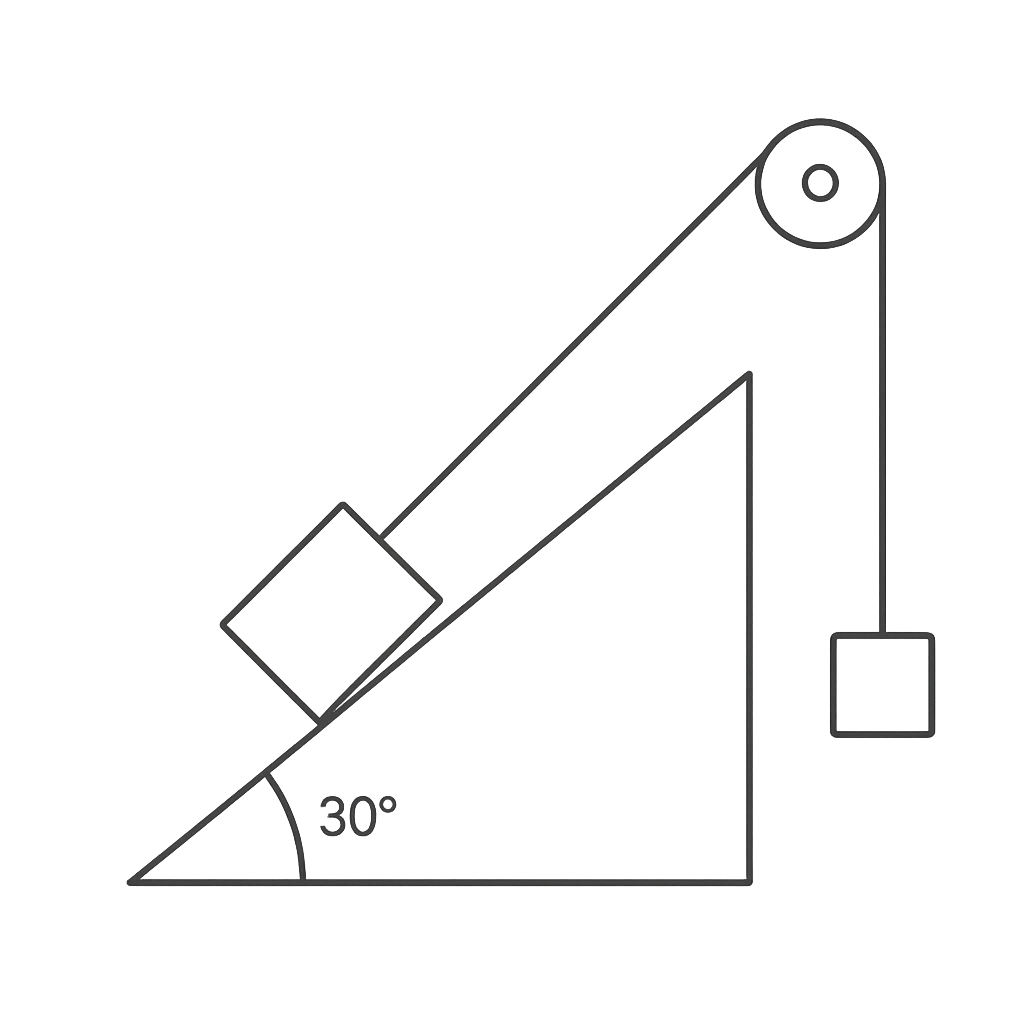
A laboratory experiment is to be carried out to determine the coefficient of kinetic friction (µk) between a wooden block and an inclined plane using a hanging mass and a protractor. The block has a mass of 0.50 kg and is placed on the plane. A string connects the block to a hanging mass of 0.20 kg that passes over a smooth pulley at the top of the plane. The angle of inclination of the plane is set to 30°. The system is allowed to move at constant speed when the hanging mass is released. Assume g = 9.8 m s⁻² and the pulley is frictionless.
Question Parts
(a)
State the purpose of the experiment.
(b)
List all the apparatus required for the experiment.
(c)
Describe briefly the procedure to be followed.
(d)
Using the data given, calculate the coefficient of kinetic friction (µk) between the block and the plane. Show all steps.
Detailed Essay Solution & Marking Scheme Available

Get the step-by-step mathematical proofs, key points required by examiners, and a comprehensive breakdown from our AI Tutor.
Question 2 View Details
A boat can travel at a speed of 5.0 m s⁻¹ relative to still water. It is attempting to cross a river that is 200 m wide and flows eastward at 3.0 m s⁻¹.
Question Parts
(a)
Determine the magnitude and the direction (as an angle east of north) of the resultant velocity of the boat relative to the ground when the boat heads directly north.
(b)
If the boat wishes to land directly opposite its starting point on the other bank, at what angle west of north must it head relative to the water? (Give the angle to one decimal place.)
Detailed Essay Solution & Marking Scheme Available

Get the step-by-step mathematical proofs, key points required by examiners, and a comprehensive breakdown from our AI Tutor.
Question 3 View Details
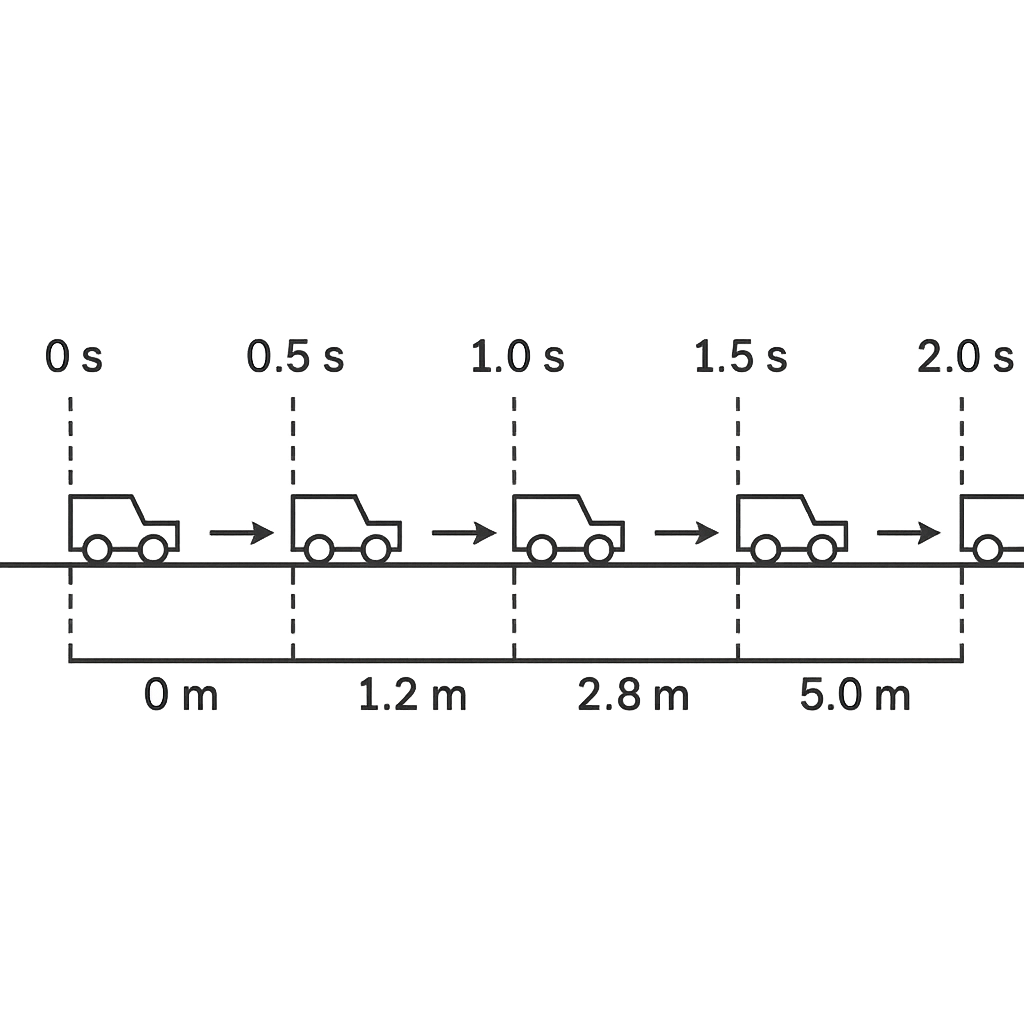
A toy car moves along a straight track. The motion diagram shows the positions of the car at successive 0.5 s intervals as given in the diagram.
Question Parts
(a)
Determine the average speed of the car over the whole 2.0 s interval.
(b)
Assuming the car started from rest and moved with constant acceleration, calculate the magnitude of the acceleration.
(c)
The car then continues to move with the same acceleration for another 1.0 s. Calculate the additional distance covered in that time.
(d)
Comment on whether the assumption of constant acceleration is consistent with the given positions in the motion diagram.
Detailed Essay Solution & Marking Scheme Available

Get the step-by-step mathematical proofs, key points required by examiners, and a comprehensive breakdown from our AI Tutor.
Question 4 View Details
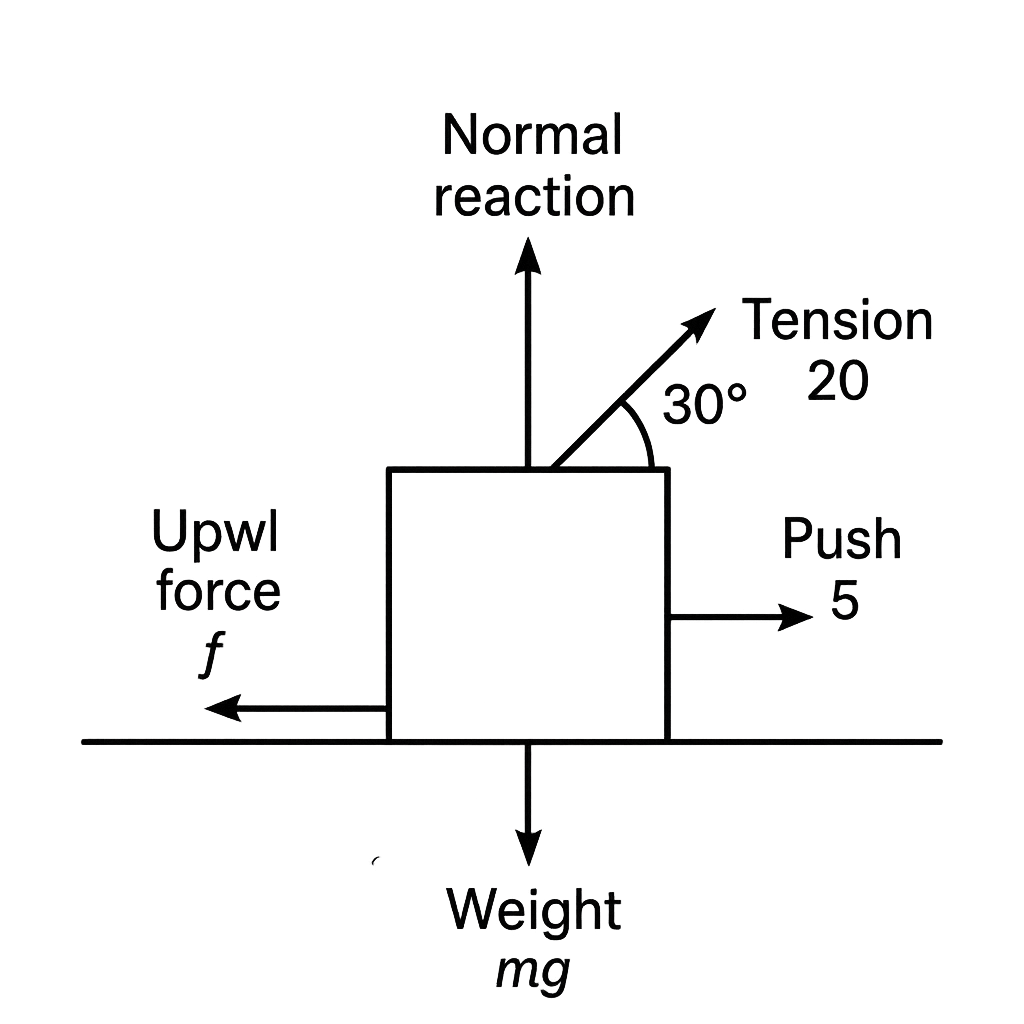
A 5.0 kg crate rests on a horizontal floor. The forces acting on the crate are shown in the force diagram. The tension in the rope is 20 N and makes an angle of 30° above the horizontal to the right. A horizontal push of 5 N acts to the right on the crate. An additional upward force of 5 N is applied vertically. The weight of the crate is due to gravity (g = 9.8 m s⁻²). The crate moves with constant speed under these conditions. The coefficient of kinetic friction between the crate and the floor is unknown. Answer the following:
Question Parts
(a)
Resolve the tension into its horizontal and vertical components (in newtons).
(b)
Using the fact that the crate moves with constant speed, determine the magnitude of the kinetic frictional force acting on the crate (in newtons).
(c)
Calculate the coefficient of kinetic friction (μ_k) between the crate and the floor.
(d)
If the tension in the rope is increased to 60 N (still at 30° above the horizontal) while all other forces remain unchanged, find the new acceleration of the crate (in m s⁻²).
Detailed Essay Solution & Marking Scheme Available

Get the step-by-step mathematical proofs, key points required by examiners, and a comprehensive breakdown from our AI Tutor.

Question 5 View Details
A 1500 kg car starts from rest at the bottom of a uniform hill that makes an angle of 5° with the horizontal and is 200 m long along the slope. The car's engine delivers a constant power of 30 kW. Air resistance and rolling resistance are negligible.
Question Parts
(a)
Calculate the total work done by the engine in moving the car from the bottom to the top of the hill.
(b)
Using the power supplied, find the speed of the car when it reaches the top of the hill.
(c)
If 10% of the engine's power is lost as heat, recalculate the speed of the car at the top of the hill.
Detailed Essay Solution & Marking Scheme Available

Get the step-by-step mathematical proofs, key points required by examiners, and a comprehensive breakdown from our AI Tutor.

Question 6 View Details
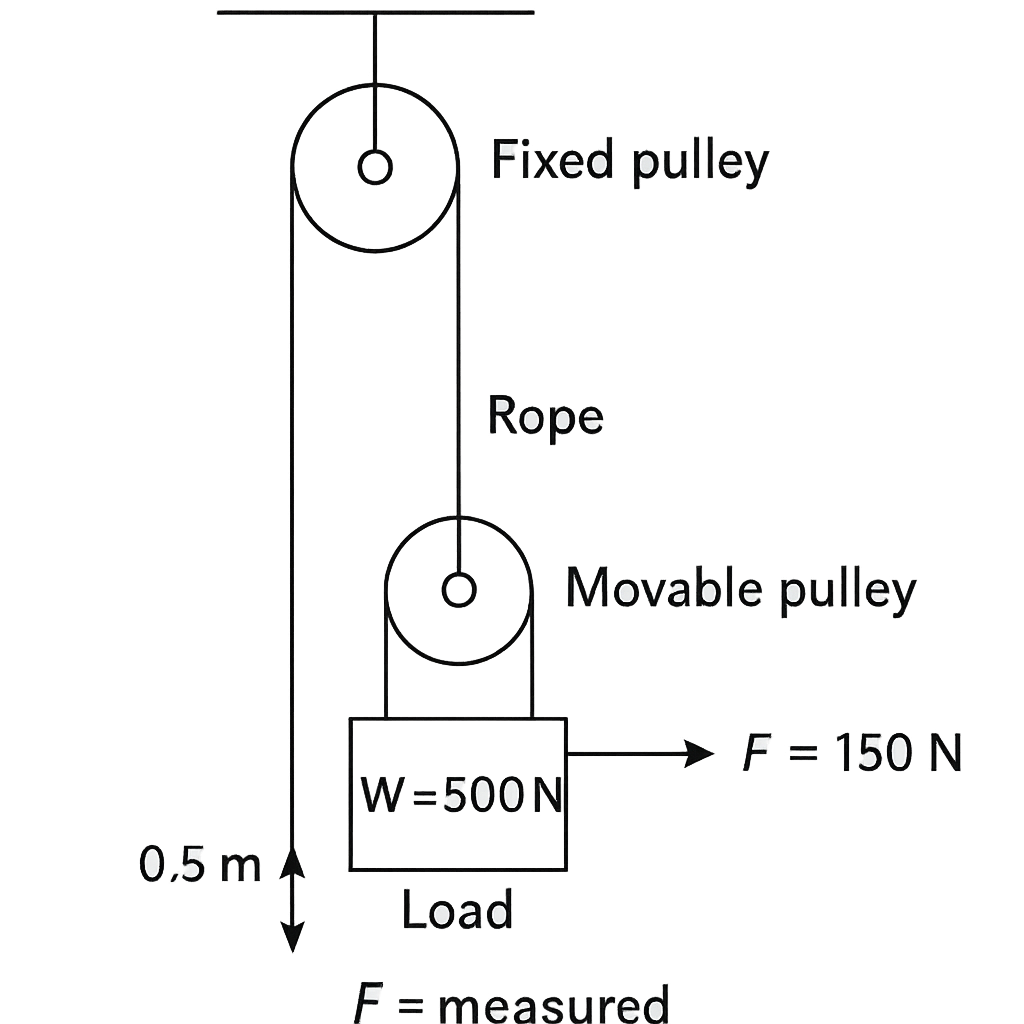
The diagram shows a system of two pulleys used to lift a load. The load (weight \(W = 500\,\text{N}\)) is attached to a movable pulley. The rope passes over a fixed pulley and the effort force \(F\) is applied to the free end of the rope. When the effort end of the rope moves a distance of \(2.0\,\text{m}\), the load rises a distance of \(0.5\,\text{m}\). In an experiment the effort required to raise the load at constant speed was measured as \(150\,\text{N}\). The load is raised through its total distance of \(0.5\,\text{m}\) in \(5\,\text{s}\).
Question Parts
(a)
Assuming the pulleys are ideal (no friction), determine the effort force that would be required to lift the load at constant speed.
(b)
Using the measured effort force of \(150\,\text{N}\), calculate the actual mechanical advantage (AMA) and the efficiency of the system.
(c)
State the ideal mechanical advantage (IMA) of the pulley system and explain how it is obtained from the distances shown in the diagram.
(d)
The load is raised through \(0.5\,\text{m}\) in \(5\,\text{s}\). Calculate:
() Power output.
() Power input.
(e)
Discuss two possible reasons why the efficiency of the pulley system is less than 100 %.
Detailed Essay Solution & Marking Scheme Available

Get the step-by-step mathematical proofs, key points required by examiners, and a comprehensive breakdown from our AI Tutor.

Question 7 View Details
A vertical rectangular dam is 30 m wide and 20 m high. The water level is 18 m above the base of the dam. The density of water is \(1000\,\text{kg m}^{-3}\) and \(g = 9.8\,\text{m s}^{-2}\).
Question Parts
(a)
Calculate the gauge pressure of the water at the bottom of the dam.
(b)
Determine the magnitude of the resultant hydrostatic force exerted on the dam.
(c)
Find the depth below the water surface at which the resultant force acts (centre of pressure).
(d)
If the water temperature rises, causing its density to decrease by 2 % while the water level remains unchanged, discuss qualitatively how the resultant hydrostatic force on the dam will be affected.
Detailed Essay Solution & Marking Scheme Available

Get the step-by-step mathematical proofs, key points required by examiners, and a comprehensive breakdown from our AI Tutor.

Question 8 View Details
A uniform metal rod 2.0 m long has a cross‑sectional area of \(1.5\times10^{-4}\,\text{m}^{2}\). One end of the rod is maintained at \(150^{\circ}\text{C}\) and the other at \(30^{\circ}\text{C}\). When the rod is allowed to reach steady‑state, the heat flow along it is measured to be \(45\,\text{W}\).
Question Parts
(a)
Calculate the thermal conductivity \(k\) of the material of the rod.
(b)
Assuming the rod is perfectly insulated along its length (heat loss only at the ends), determine the temperature at a point 0.8 m from the hot end.
(c)
If an identical second rod is placed in parallel with the first (both ends at the same temperatures), discuss qualitatively how the overall heat transfer and the temperature distribution along each rod are affected.
Detailed Essay Solution & Marking Scheme Available

Get the step-by-step mathematical proofs, key points required by examiners, and a comprehensive breakdown from our AI Tutor.

Master the Exam!

You've seen a preview, but there are thousands more questions plus AI tutor to break down complex solutions.

Unlock Full Access Available for Android & Windows
Help others prepare! Share this practice hub:
Chat with Support