neco 2020 mathematics | Essay

Prepare for your exams with neco questions? Reviewing past/model questions is one of the most effective ways to guarantee a high score. This practice hub features authentic 2020 mathematics (Essay) questions designed to simulate the real exam environment.

Practice these randomly selected questions to test your readiness.

Question 1 View Details
A positive integer N leaves a remainder of 3 when divided by 7 and a remainder of 5 when divided by 9. Determine the smallest such N.
Detailed Essay Solution & Marking Scheme Available

Get the step-by-step mathematical proofs, key points required by examiners, and a comprehensive breakdown from our AI Tutor.
Question 2 View Details
A shopkeeper purchased 150 kg of rice at a cost of \(\₦240\) per kilogram. He sold part of the rice at a 20% profit and the remaining part at a 10% loss. If his total revenue from the sale was \(\₦38,880\), how many kilograms were sold at a profit?
Detailed Essay Solution & Marking Scheme Available

Get the step-by-step mathematical proofs, key points required by examiners, and a comprehensive breakdown from our AI Tutor.
Question 3 View Details
Consider the expression \(E = \frac{(2^{3x} \cdot 5^{2x-1})}{(10^{x+2})} \times (\sqrt{125})^{\,x}\).
Question Parts
(a)
Simplify \(E\) and write it in the form \(2^{a}\,5^{b}\) where \(a\) and \(b\) are expressed in terms of \(x\).
(b)
Given that \(E = 1\), determine the value of \(x\). (Give your answer in exact form and to three decimal places.)
(c)
Using the value of \(x\) found in part (b), evaluate \(\log_{2}\bigl(2^{4x}\,5^{2x}\bigr)\). (Give your answer to two decimal places.)
Detailed Essay Solution & Marking Scheme Available

Get the step-by-step mathematical proofs, key points required by examiners, and a comprehensive breakdown from our AI Tutor.

Question 4 View Details
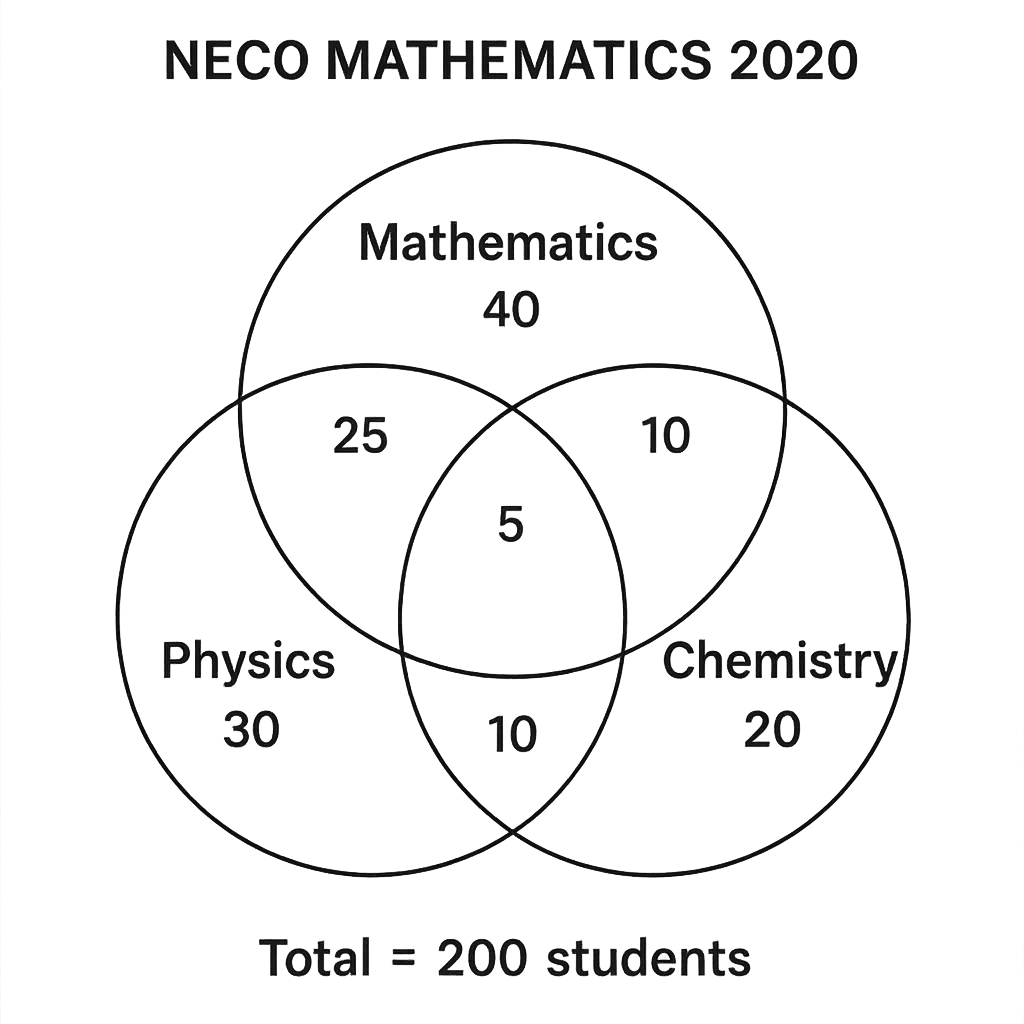
A survey was conducted among 200 senior secondary school students to find out which of the three science subjects they study: Mathematics (M), Physics (P) and Chemistry (C). The results are represented in the Venn diagram given.
Question Parts
(a)
Find the probability that a randomly selected student studies exactly two of the three subjects.
(b)
Find the probability that a randomly selected student studies at least one of the three subjects.
(c)
Given that a student studies Mathematics, find the probability that the same student also studies Chemistry.
(d)
Two students are selected at random without replacement. Find the probability that both students study none of the three subjects.
Detailed Essay Solution & Marking Scheme Available

Get the step-by-step mathematical proofs, key points required by examiners, and a comprehensive breakdown from our AI Tutor.

Question 5 View Details
A company produces two types of widgets, Type A and Type B. Let \(x\) be the number of Type A widgets produced and \(y\) be the number of Type B widgets produced. The profit \(P\) (in thousand Naira) obtained from producing \(x\) and \(y\) units is given by \[ P = 2x^{2}+4xy+2y^{2}-6x+8y+10. \] (a) Factor the quadratic part of the profit expression. (b) The company decides to produce a total of 10 widgets, i.e. \(x+y=10\). Determine the values of \(x\) and \(y\) that give the maximum profit. (c) Calculate the maximum profit (in thousand Naira).
Question Parts
(a)
Factor the quadratic part of the profit expression.
(b)
Using the condition \(x+y=10\), find the values of \(x\) and \(y\) that maximise the profit.
(c)
Calculate the maximum profit.
Detailed Essay Solution & Marking Scheme Available

Get the step-by-step mathematical proofs, key points required by examiners, and a comprehensive breakdown from our AI Tutor.

Question 6 View Details
A school purchases pens and notebooks. The total number of items bought is 45, and the number of pens bought is twice the number of notebooks bought. The total amount spent is \(\text{₦}5,400\). The cost of a pen is \(\text{₦}80\) more than twice the cost of a notebook. (a) Form a set of linear equations representing the information given. (b) Determine the cost of one pen and one notebook (in Naira). (c) Verify that the costs found satisfy the total expenditure of \(\text{₦}5,400\).
Question Parts
(a)
Form a set of linear equations representing the information given.
(b)
Determine the cost of one pen and one notebook (in Naira).
(c)
Verify that the costs found satisfy the total expenditure of \(\text{₦}5,400\).
Detailed Essay Solution & Marking Scheme Available

Get the step-by-step mathematical proofs, key points required by examiners, and a comprehensive breakdown from our AI Tutor.

Question 7 View Details
A rectangular garden has a length that is 5 metres more than its width. The area of the garden is 84 square metres. The garden is to be fenced with wire that costs \u20a6250 per metre. Answer the following:
Question Parts
(a)
Find the dimensions (length and width) of the garden.
(b)
Calculate the total length of wire required to fence the garden and the total cost of the wire.
(c)
If a fence parallel to the width is erected to divide the garden into two equal smaller rectangles, determine the additional length of wire needed and the new total cost.
Detailed Essay Solution & Marking Scheme Available

Get the step-by-step mathematical proofs, key points required by examiners, and a comprehensive breakdown from our AI Tutor.

Question 8 View Details
A company offers a discount \(d\)% on a product whose original price is \u20a62000. The discounted price \(P\) (in naira) is given by \(P = 2000\bigl(1 - \frac{d}{100}\bigr)\). The discount percentage must satisfy the inequality \(3d - 2 \le 4\sqrt{d+1}\) as well as the practical limits \(0 \le d \le 50\). Answer the following:
Question Parts
(a)
Solve the inequality \(3d - 2 \le 4\sqrt{d+1}\) for real values of \(d\).
(b)
Combine the result of part (a) with the condition \(0 \le d \le 50\) to give the final permissible range of the discount percentage.
(c)
Using the range obtained in part (b), calculate the minimum and maximum possible discounted prices of the product, rounding to the nearest naira.
Detailed Essay Solution & Marking Scheme Available

Get the step-by-step mathematical proofs, key points required by examiners, and a comprehensive breakdown from our AI Tutor.

Question 9 View Details
The sum of the first \(n\) terms of an arithmetic progression (AP) is given by \(S_n = 3n^{2}+2n\).
Question Parts
(a)
Find the 10th term of the AP and state its common difference \(d\).
(b)
A geometric progression (GP) is formed whose first term equals the 10th term of the AP and whose common ratio \(r\) is given by \(r = \dfrac{d}{a_{10}}\). Find the sum of the first 20 terms of this GP, giving your answer to the nearest integer.
(c)
State, with a brief justification, whether the sum of the first 20 terms of the GP will increase, decrease or remain the same if the common difference of the original AP were doubled while all other conditions stayed unchanged.
Detailed Essay Solution & Marking Scheme Available

Get the step-by-step mathematical proofs, key points required by examiners, and a comprehensive breakdown from our AI Tutor.

Question 10 View Details
In a manufacturing plant the daily energy consumption \(E\) (in kWh) varies jointly with the square of the production speed \(s\) (units per hour) and inversely with the efficiency factor \(\eta\) (a decimal between 0 and 1). In addition, a fixed base consumption of 50 kWh is incurred each day regardless of speed or efficiency.
Question Parts
(a)
When the plant operates at a speed of 120 units/hour with an efficiency of 0.8, the total daily consumption is 230 kWh. Determine the constant of proportionality \(k\) in the variation formula \(E = k\dfrac{s^{2}}{\eta}+50\).
(b)
Using the value of \(k\) found in part (a), calculate the total daily consumption when the speed is 180 units/hour and the efficiency is 0.75. Give your answer in kWh.
(c)
The plant wishes to keep the total daily consumption at or below 350 kWh. If the efficiency can be maintained at 0.9, what is the maximum speed (in whole units per hour) that can be used? State the speed to the nearest whole unit.
Detailed Essay Solution & Marking Scheme Available

Get the step-by-step mathematical proofs, key points required by examiners, and a comprehensive breakdown from our AI Tutor.

Question 11 View Details
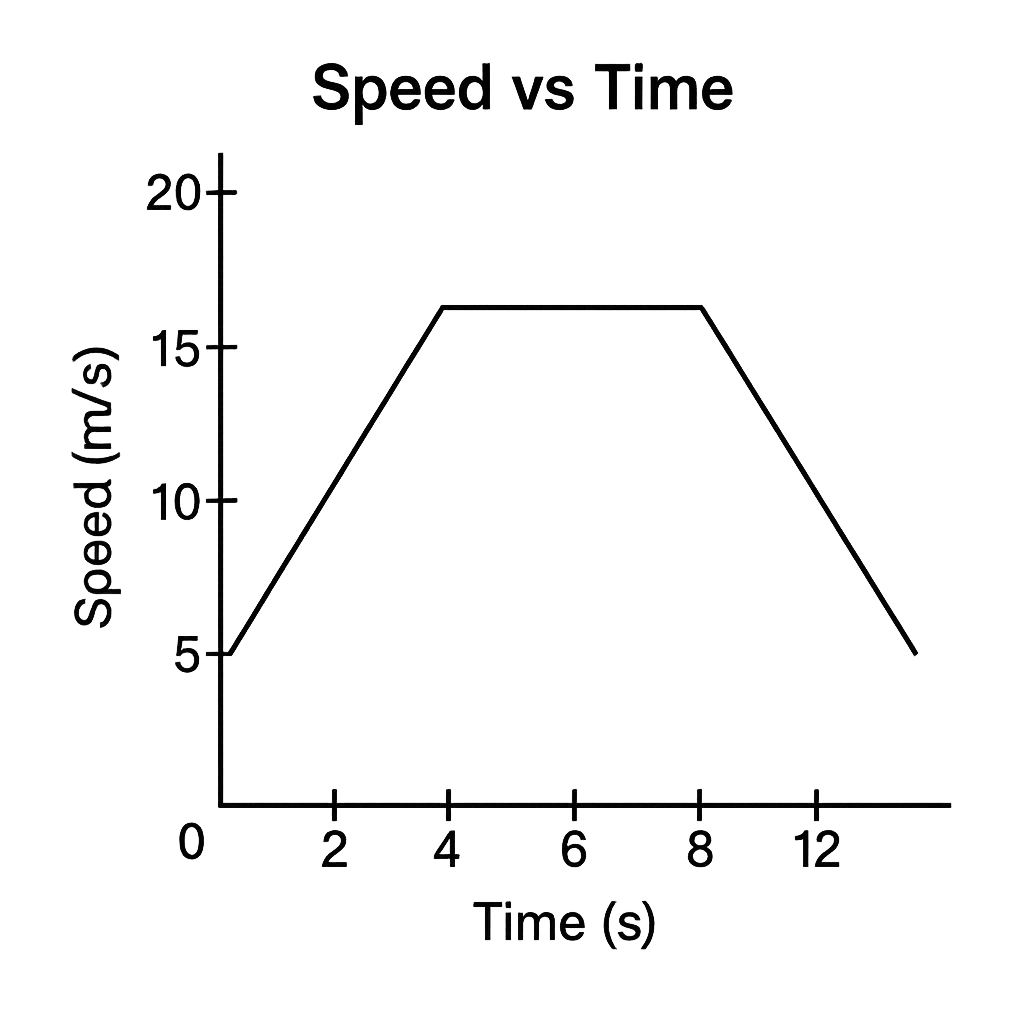
The graph below shows the variation of the speed (v) of a car in metres per second with respect to time (t) in seconds during a 12‑second interval.
Question Parts
(a)
Write the equation of the speed–time line for the interval 0 \le t \le 4 seconds.
(b)
Find the total distance travelled by the car during the whole 12‑second interval.
(c)
The car then accelerates uniformly from rest to 30 m/s in 5 seconds. Using the given graph as a reference, explain how the distance covered in this new acceleration compares with the distance covered in the first 5 seconds of the original motion.
Detailed Essay Solution & Marking Scheme Available

Get the step-by-step mathematical proofs, key points required by examiners, and a comprehensive breakdown from our AI Tutor.

Question 12 View Details
In the Cartesian plane, triangle \(ABC\) is positioned as follows: point \(A\) is at the origin \((0,0)\) and side \(AB\) lies on the positive x‑axis with length \(AB = 8\) cm. The interior angles at \(A\) and \(B\) are \(40^{\circ}\) and \(60^{\circ}\) respectively.
Question Parts
(a)
Determine the exact coordinates of point \(C\).
(b)
Write the equation of the line through \(C\) that is perpendicular to \(AB\).
(c)
Find the area of triangle \(ABC\) in square centimetres.
(d)
A point \(D\) lies on \(BC\) such that \(BD : DC = 1 : 2\). Determine the coordinates of \(D\) and the length \(AD\) (to two decimal places).
Detailed Essay Solution & Marking Scheme Available

Get the step-by-step mathematical proofs, key points required by examiners, and a comprehensive breakdown from our AI Tutor.

Question 13 View Details
In triangle \(ABC\), \(AB = 12\) cm, \(AC = 15\) cm and \(\angle BAC = 60^{\circ}\). The internal bisector of \(\angle BAC\) meets side \(BC\) at \(D\). From \(D\) a perpendicular is drawn to side \(AB\) meeting it at \(E\).
Question Parts
(a)
Find the length of side \(BC\).
(b)
Using the angle‑bisector theorem, determine the length of \(BD\).
(c)
Calculate the area of triangle \(ADE\).
(d)
Find the radius of the incircle of triangle \(ABC\).
Detailed Essay Solution & Marking Scheme Available

Get the step-by-step mathematical proofs, key points required by examiners, and a comprehensive breakdown from our AI Tutor.

Master the Exam!

You've seen a preview, but there are thousands more questions plus AI tutor to break down complex solutions.

Unlock Full Access Available for Android & Windows
Help others prepare! Share this practice hub:
Chat with Support