neco 2020 chemistry | Objective

Prepare for your exams with neco questions? Reviewing past/model questions is one of the most effective ways to guarantee a high score. This practice hub features authentic 2020 chemistry (Objective) questions designed to simulate the real exam environment.

Practice these randomly selected questions to test your readiness.

Question 1 View Details
A solution contains 0.010 M NaCl and 0.010 M NaBr. Silver nitrate solution is added slowly. Using the solubility‑product constants \(K_{sp}(AgCl)=1.8\times10^{-10}\) and \(K_{sp}(AgBr)=5.0\times10^{-13}\), determine which silver halide will precipitate first and calculate the concentration of \(Ag^{+}\) at which precipitation of that salt begins.
Correct A. AgBr precipitates first; precipitation begins at \([Ag^{+}]=5.0\times10^{-11}\,M
B. AgCl precipitates first; precipitation begins at \\([Ag^{+}]=1.8\\times10^{-9}\\,M
C. AgCl precipitates first; precipitation begins at \\([Ag^{+}]=5.0\\times10^{-11}\\,M
D. AgBr precipitates first; precipitation begins at \\([Ag^{+}]=2.5\\times10^{-11}\\,M

Correct Answer: A

Want to see the full step-by-step solution? Unlock AI Explanation & Analytics
Question 2 View Details
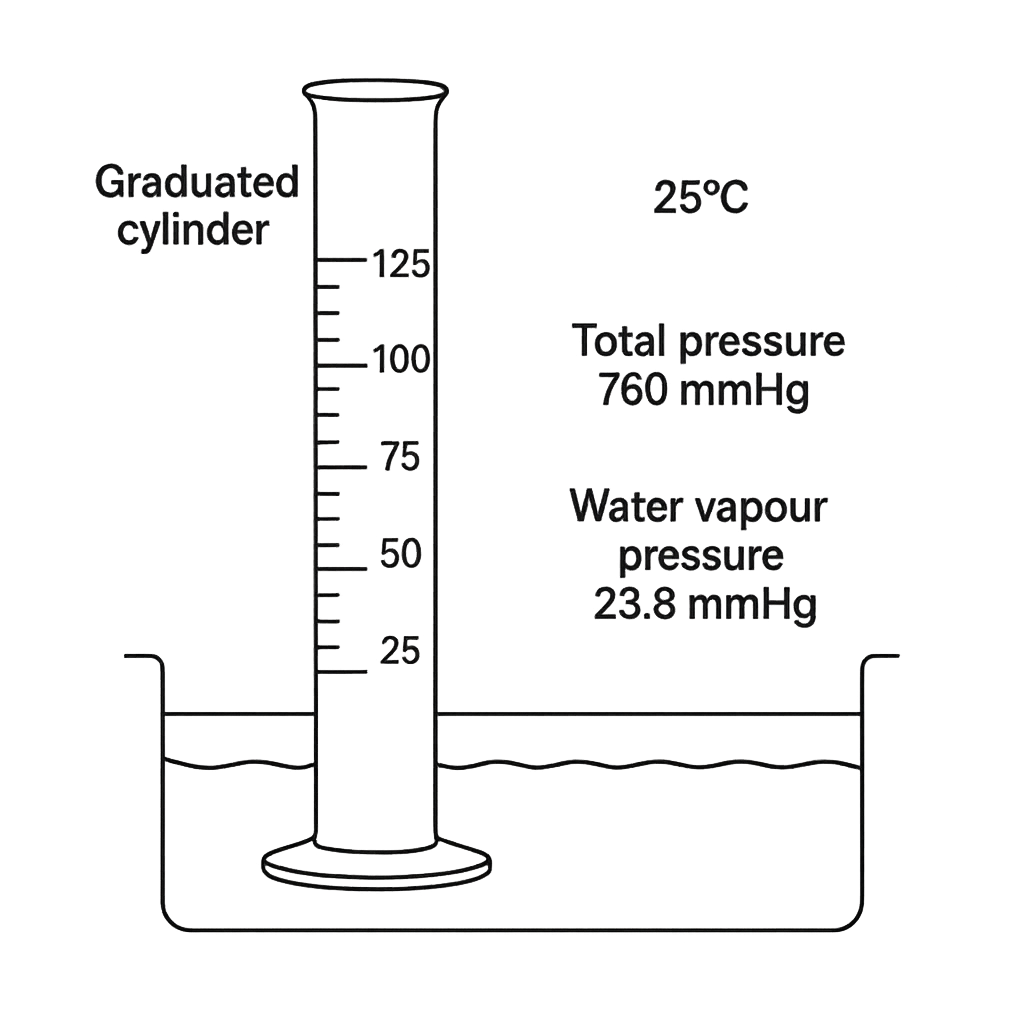
A 2.00 L container at 298 K holds a mixture of oxygen and nitrogen gases with a total pressure of 1.20 atm. The partial pressure of \(O_{2}\) is 0.45 atm. Calculate the mass of \(N_{2}\) present in the container.
A. 2.05 g
B. 1.10 g
C. 0.95 g
Correct D. 1.72 g

Correct Answer: D

Want to see the full step-by-step solution? Unlock AI Explanation & Analytics
Question 3 View Details
A solution is prepared by dissolving 0.500 mol of a non‑volatile solute in 1.00 kg of water at 25 °C. The vapour pressure of pure water at this temperature is 23.8 mmHg. Using Raoult's law, determine the vapour pressure of the solution. Then, calculate the boiling‑point elevation of the solution, given the ebullioscopic constant of water \(K_{b}=0.512\,^{\circ}C·kg·mol^{-1}\). Assume the normal boiling point of water is 100 °C.
Correct A. Vapour pressure = 23.6 mmHg; boiling point = 100.3 °C
B. Vapour pressure = 23.5 mmHg; boiling point = 100.1 °C
C. Vapour pressure = 23.4 mmHg; boiling point = 100.2 °C
D. Vapour pressure = 23.8 mmHg; boiling point = 100.0 °C

Correct Answer: A

Want to see the full step-by-step solution? Unlock AI Explanation & Analytics
Question 4 View Details
In acidic solution, potassium dichromate reacts with sodium sulfite according to the net ionic equation: \(Cr_{2}O_{7}^{2-} + 3SO_{3}^{2-} + 8H^{+} \rightarrow 2Cr^{3+} + 3SO_{4}^{2-} + 4H_{2}O\). If 25.0 mL of 0.150 M K₂Cr₂O₇ is mixed with excess Na₂SO₃, calculate the volume of 0.200 M H₂SO₄ required to provide the necessary \(H^{+}\) ions for complete reaction.
Correct A. 75.0 mL
B. 60.0 mL
C. 150.0 mL
D. 37.5 mL

Correct Answer: A

Want to see the full step-by-step solution? Unlock AI Explanation & Analytics
Question 5 View Details
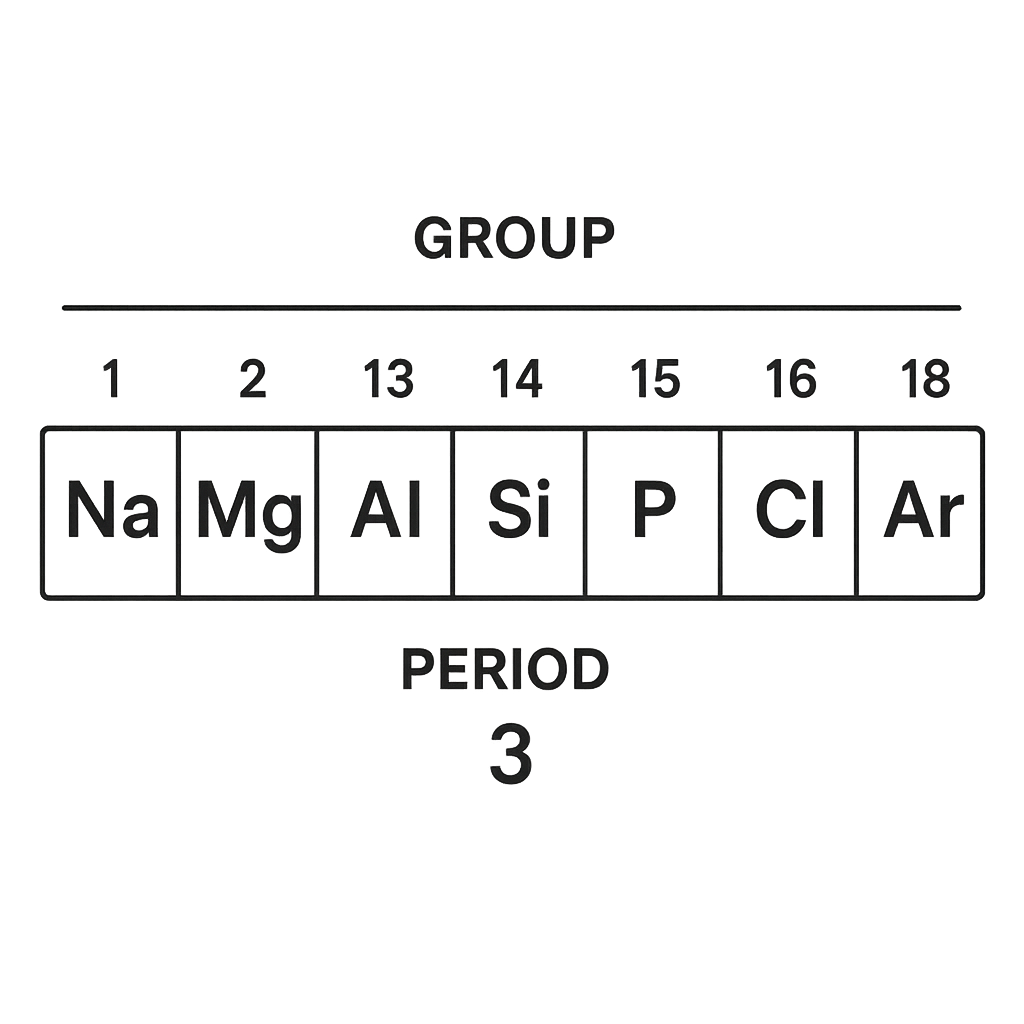
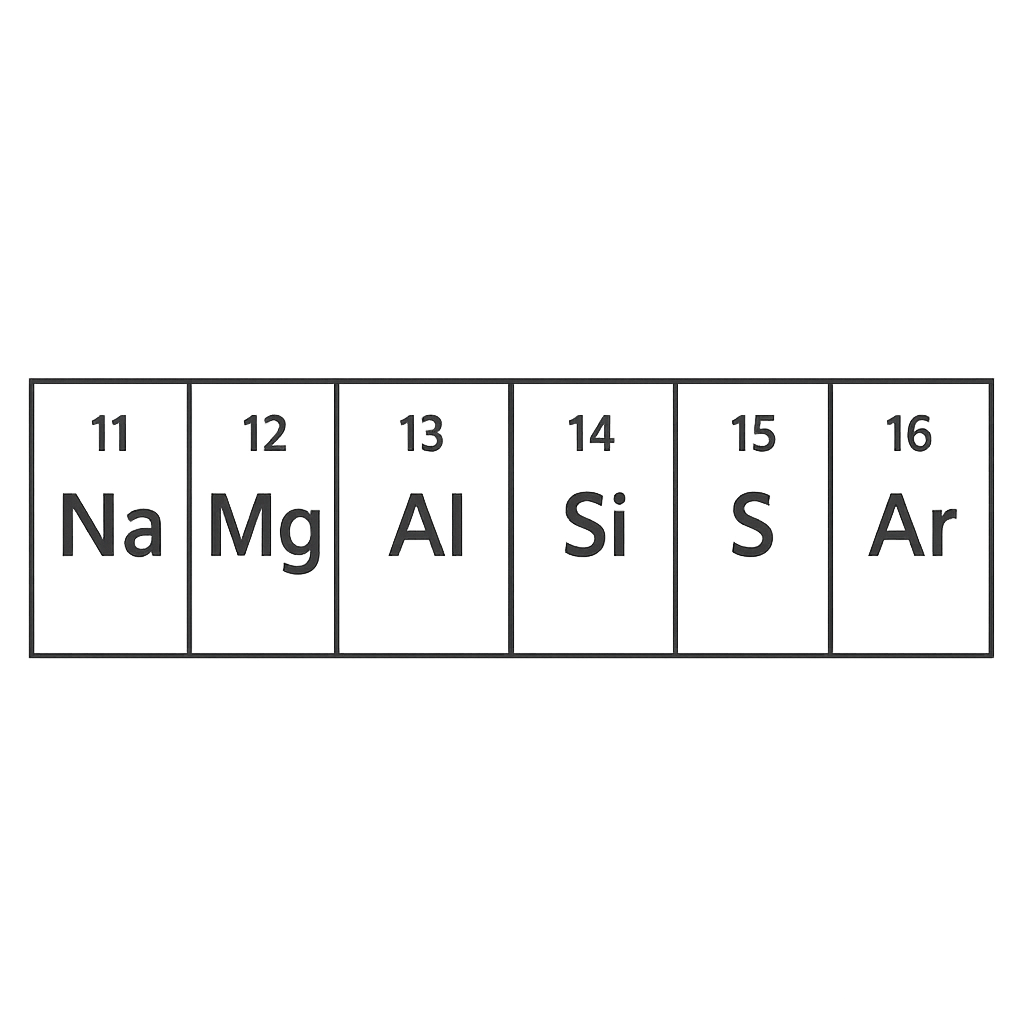
Refer to the diagram of the third period of the periodic table. Which element is positioned in group 16?
A. Phosphorus (P)
B. Chlorine (Cl)
C. Silicon (Si)
Correct D. Sulfur (S)

Correct Answer: D

Want to see the full step-by-step solution? Unlock AI Explanation & Analytics
Question 6 View Details
A 0.250 g sample containing a mixture of \(\mathrm{H_2SO_4}\) and \(\mathrm{HCl}\) is dissolved in water and titrated with 0.1000 M \(\mathrm{NaOH}\). Using phenolphthalein as the indicator, the first endpoint is reached after 23.45 mL of \(\mathrm{NaOH}\) has been added. Using methyl orange as the indicator, the second endpoint is reached after a total of 45.80 mL of \(\mathrm{NaOH}\) has been added. Assuming both acids are completely neutralised, calculate the mass percent of \(\mathrm{H_2SO_4}\) in the original sample.
A. 78.5%
Correct B. 87.7%
C. 92.3%
D. 84.1%

Correct Answer: B

Want to see the full step-by-step solution? Unlock AI Explanation & Analytics
Question 7 View Details
An aqueous solution of an unknown metal salt is subjected to the following qualitative tests:\n(i) Addition of dilute \(\mathrm{HCl}\) produces no visible precipitate.\n(ii) Addition of \(\mathrm{NaOH}\) yields a white precipitate which dissolves on the addition of excess \(\mathrm{NaOH}\).\n(iii) Addition of \(\mathrm{NH_4Cl}\) followed by excess \(\mathrm{NH_4OH}\) produces a deep‑blue solution with no further precipitate.\n(iv) Addition of \(\mathrm{K_2CrO_4}\) gives a yellow precipitate that is insoluble in dilute \(\mathrm{HNO_3}\). Identify all metal cations present in the solution.
A. zinc(II), copper(II) and cadmium(II) ions
Correct B. zinc(II), copper(II) and lead(II) ions
C. zinc(II), copper(II) and iron(III) ions
D. zinc(II), nickel(II) and lead(II) ions

Correct Answer: B

Want to see the full step-by-step solution? Unlock AI Explanation & Analytics
Question 8 View Details
Element X exists in two allotropes, A and B.\nAllotrope A is a yellow solid that sublimates at \(150^{\circ}\mathrm{C}\) and reacts with hot concentrated \(\mathrm{H_2SO_4}\) to evolve a colourless gas.\nAllotrope B is a colourless gas at room temperature, condenses to a colourless liquid at \(-10^{\circ}\mathrm{C}\), and reacts with aqueous \(\mathrm{NaOH}\) to give a colourless solution and a white precipitate that dissolves on heating.\n(a) Identify element X and its two allotropes.\n(b) Write the balanced chemical equation for the reaction of allotrope A with hot concentrated \(\mathrm{H_2SO_4}\).
A. Element X is sulphur; allotrope A = solid sulphur (S₈), allotrope B = hydrogen sulfide (H₂S). Balanced equation: \\ (\\mathrm{S + H_2SO_4 \\rightarrow SO_2 + H_2O}\\).
B. Element X is sulphur; allotrope A = solid sulphur (S₈), allotrope B = sulphur monoxide (SO). Balanced equation: \\ (\\mathrm{S + H_2SO_4 \\rightarrow SO + H_2O}\\).
C. Element X is sulphur; allotrope A = solid sulphur (S₈), allotrope B = sulphur trioxide (SO₃). Balanced equation: \\ (\\mathrm{S + 3\\,H_2SO_4 \\rightarrow 2\\,SO_3 + 3\\,H_2O}\\).
Correct D. Element X is sulphur; allotrope A = solid sulphur (S₈), allotrope B = sulphur dioxide (SO₂). Balanced equation: \(\mathrm{S + 2\,H_2SO_4 \rightarrow 3\,SO_2 + 2\,H_2O}\).

Correct Answer: D

Want to see the full step-by-step solution? Unlock AI Explanation & Analytics
Question 9 View Details
An unknown aqueous solution contains a single anion. The following observations are recorded:\n1. Adding dilute \(\mathrm{HCl}\) produces effervescence of a colourless gas.\n2. Adding \(\mathrm{BaCl_2}\) gives a white precipitate that does not dissolve in excess \(\mathrm{NH_4Cl}\).\n3. Adding \(\mathrm{AgNO_3}\) yields a white precipitate that is soluble in dilute \(\mathrm{NH_3}\). Identify the anion.
Correct A. carbonate ion (\(\mathrm{CO_3^{2-}}\))
B. phosphate ion (\(\mathrm{PO_4^{3-}}\))
C. sulfate ion (\(\mathrm{SO_4^{2-}}\))
D. chloride ion (\(\mathrm{Cl^-}\))

Correct Answer: A

Want to see the full step-by-step solution? Unlock AI Explanation & Analytics
Question 10 View Details
What is the atomic number of the element with the chemical symbol \(\mathrm{Sn}\)?
A. 52
B. 48
C. 51
Correct D. 50

Correct Answer: D

Want to see the full step-by-step solution? Unlock AI Explanation & Analytics
Question 11 View Details
A saturated solution of AgCl at 25 °C has a solubility product \(K_{sp}=1.8\times10^{-10}\). If 0.010 mol of NaCl is added to 1.0 L of this solution, calculate the new equilibrium concentration of \(Ag^{+}\) ions.
A. 2.0\times10^{-8}\,M
B. 1.8\times10^{-7}\,M
Correct C. 1.8\times10^{-8}\,M
D. 1.8\times10^{-9}\,M

Correct Answer: C

Want to see the full step-by-step solution? Unlock AI Explanation & Analytics
Question 12 View Details
A 5.00 g sample of a solid mixture containing calcium carbonate \(CaCO_{3}\) and sodium carbonate \(Na_{2}CO_{3}\) is strongly heated. The total mass of carbon dioxide gas collected over water is 2.10 g at 25 °C and 1 atm. Assuming complete decomposition of both carbonates, determine the mass percent of \(CaCO_{3}\) in the original mixture.
A. 25.0\%
B. 33.3\%
C. 15.0\%
Correct D. 19.8\%

Correct Answer: D

Want to see the full step-by-step solution? Unlock AI Explanation & Analytics
Question 13 View Details
0.250 M benzoic acid \(C_{6}H_{5}COOH\) (literature \(K_{a}=6.3\times10^{-5}\)) is partially neutralised with 0.050 mol NaOH in a total volume of 250.0 mL. The pH of the resulting solution is measured as 4.20. Using this data, calculate the experimental \(K_{a}\) value and the percentage error relative to the literature value.
A. 3.8\\times10^{-4}\\, (K_a), 500\\% error
Correct B. 2.5\times10^{-4}\, (K_a), 302\% error
C. 6.3\\times10^{-5}\\, (K_a), 0\\% error
D. 1.2\\times10^{-4}\\, (K_a), 90\\% error

Correct Answer: B

Want to see the full step-by-step solution? Unlock AI Explanation & Analytics
Question 14 View Details
5.00 g of a mixture of cyclohexanol \(C_{6}H_{12}O\) and 1‑hexanol \(C_{6}H_{14}O\) is oxidised with excess acidic \(K_{2}Cr_{2}O_{7}\) under reflux, converting each alcohol to the corresponding carbonyl compound (cyclohexanone and hexanal). After work‑up, 4.90 g of carbonyl products are obtained. Assuming 100 % yield for each oxidation, calculate the mass percent of cyclohexanol in the original mixture.
A. 73.4\%
B. 55.0\%
C. 61.2\%
Correct D. 68.5\%

Correct Answer: D

Want to see the full step-by-step solution? Unlock AI Explanation & Analytics
Question 15 View Details
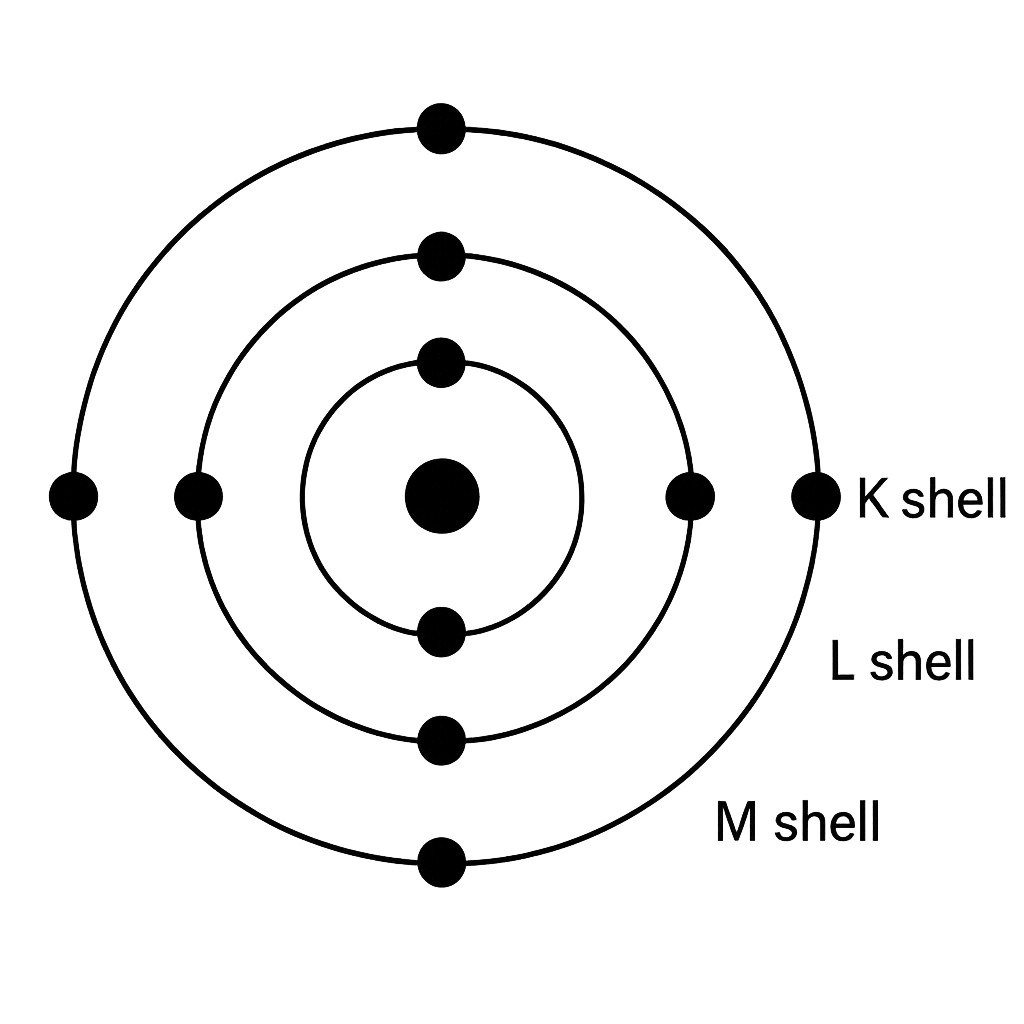
The diagram shows a neutral atom of element X with electrons distributed as follows: 2 electrons in the K shell, 8 electrons in the L shell and 7 electrons in the M shell. Determine the atomic number of X, identify the element, and write its ground‑state electron configuration.
Correct A. Z=17, element Cl, configuration 1s^{2} 2s^{2} 2p^{6} 3s^{2} 3p^{5}
B. Z=17, element Cl, configuration 1s^{2} 2s^{2} 2p^{6} 3s^{2} 3p^{6}
C. Z=16, element S, configuration 1s^{2} 2s^{2} 2p^{6} 3s^{2} 3p^{4}
D. Z=18, element Ar, configuration 1s^{2} 2s^{2} 2p^{6} 3s^{2} 3p^{6}

Correct Answer: A

Want to see the full step-by-step solution? Unlock AI Explanation & Analytics
Question 16 View Details
An electrochemical cell is constructed with the following half‑cells at 298\,K:\n\nAnode (oxidation): Fe(s) \| Fe^{2+} (0.020\,M)\n\nCathode (reduction): Ag^{+} (0.050\,M) \| Ag(s)\n\nStandard reduction potentials are E°(Ag^{+}/Ag)=+0.80\,V and E°(Fe^{2+}/Fe)=\-0.44\,V.\n\nThe measured cell potential under these conditions is 1.15\,V. Assuming ideal behaviour and unit activity coefficients, determine (a) the standard cell potential E°_{cell}, and (b) the equilibrium constant K for the overall cell reaction at 298\,K.
Correct A. E°_{cell}=1.18 V; K≈5.9×10^{39}
B. E°_{cell}=1.14 V; K≈1.1×10^{39}
C. E°_{cell}=1.18 V; K≈3.2×10^{38}
D. E°_{cell}=1.22 V; K≈2.3×10^{40}

Correct Answer: A

Want to see the full step-by-step solution? Unlock AI Explanation & Analytics
Question 17 View Details
Arrange the elements Na, Mg and Al in order of increasing first ionisation energy.
Correct A. Na < Al < Mg
B. Na < Mg < Al
C. Mg < Al < Na
D. Al < Na < Mg

Correct Answer: A

Want to see the full step-by-step solution? Unlock AI Explanation & Analytics
Question 18 View Details
Write the ground‑state electron configuration for a chlorine atom (Z=17) and give the set of quantum numbers (n, l, m_{l}, m_{s}) for the electron that occupies the highest‑energy 3p orbital.
A. (3, 1, +1, -½)
Correct B. (3, 1, +1, +½)
C. (3, 2, +1, +½)
D. (3, 1, -1, +½)

Correct Answer: B

Want to see the full step-by-step solution? Unlock AI Explanation & Analytics
Question 19 View Details
A factory discharges wastewater containing pollutant X at a concentration of 0.15\,mg\,L^{-1} with a flow rate of 5\,000\,L\,min^{-1}. The river into which it is released has a flow rate of 1.0\times10^{5}\,L\,min^{-1} and a background concentration of X equal to 0.005\,mg\,L^{-1}. Environmental regulations require that the concentration of X downstream of the mixing point must not exceed 0.010\,mg\,L^{-1}. The factory can install a treatment unit that reduces the concentration of X in its effluent by a percentage p (where 0\le p\le100). Assuming complete mixing and that the treatment does not change the effluent volume, calculate the minimum percentage removal p required to meet the regulatory limit.
Correct A. p_{min}=27\,\%
B. p_{min}=22\\,\\%
C. p_{min}=35\\,\\%
D. p_{min}=40\\,\\%

Correct Answer: A

Want to see the full step-by-step solution? Unlock AI Explanation & Analytics
Question 20 View Details
Two carboxylic acids, acetic acid (CH_{3}COOH) and benzoic acid (C_{6}H_{5}COOH), are each reacted separately with excess ethanol under identical acid‑catalysed conditions at 25\,°C to give the corresponding ethyl esters. The equilibrium constant for the esterification reaction, expressed as K_{eq}=\frac{[\text{ester}][\text{H_{2}O}]}{[\text{acid}][\text{EtOH}]}, is 4.0 for acetic acid and 0.5 for benzoic acid. Assuming the initial concentration of each acid is 0.10\,M, ethanol is present in large excess (its activity may be taken as 1), and the water concentration remains negligible, (a) calculate the equilibrium concentration of each ester, and (b) state which acid gives the higher percent conversion to ester.
Correct A. Acetic acid: [ester]=0.080\,M (80\% conversion); Benzoic acid: [ester]=0.033\,M (≈33\% conversion). Acetic acid gives the higher conversion.
B. Acetic acid: [ester]=0.050\\,M (50\\% conversion); Benzoic acid: [ester]=0.040\\,M (≈40\\% conversion). Benzoic acid gives the higher conversion.
C. Acetic acid: [ester]=0.067\\,M (≈67\\% conversion); Benzoic acid: [ester]=0.025\\,M (≈25\\% conversion). Acetic acid gives the higher conversion.
D. Acetic acid: [ester]=0.090\\,M (90\\% conversion); Benzoic acid: [ester]=0.045\\,M (≈45\\% conversion). Acetic acid gives the higher conversion.

Correct Answer: A

Want to see the full step-by-step solution? Unlock AI Explanation & Analytics
Question 21 View Details
A 1.15 g sample of an unknown organic compound is combusted completely. The combustion yields 0.050 mol of \( \mathrm{CO_2} \) and 0.075 mol of \( \mathrm{H_2O} \). Determine the empirical formula of the compound.
A. C2H4O
B. C2H5O
Correct C. C2H6O
D. C3H8O

Correct Answer: C

Want to see the full step-by-step solution? Unlock AI Explanation & Analytics
Question 22 View Details
An alloy is reported to contain 70.0\% copper by mass. A 10.0 g sample of the alloy is melted and cast into a rectangular bar measuring 2.0 cm × 1.0 cm × 0.5 cm. The measured density of the bar is 8.70 g cm\( ^{-3} \). Given densities \( \rho_{\text{Cu}} = 8.96 \) g cm\( ^{-3} \) and \( \rho_{\text{Zn}} = 7.14 \) g cm\( ^{-3} \), (a) calculate the density expected for a 70\% Cu-30\% Zn alloy using the rule of mixtures, and (b) determine the actual mass percent of copper in the alloy based on the measured density.
A. Expected density ≈8.20 g cm⁻³; actual Cu mass percent ≈80 %
Correct B. Expected density ≈8.32 g cm⁻³; actual Cu mass percent ≈88 %
C. Expected density ≈8.60 g cm⁻³; actual Cu mass percent ≈92 %
D. Expected density ≈8.45 g cm⁻³; actual Cu mass percent ≈85 %

Correct Answer: B

Want to see the full step-by-step solution? Unlock AI Explanation & Analytics
Question 23 View Details
A buffer solution is prepared by dissolving 0.250 mol of acetic acid (\( \mathrm{CH_3COOH} \), \( K_a = 1.8\times10^{-5} \)) and 0.150 mol of sodium acetate (\( \mathrm{CH_3COONa} \)) in 1.00 L of water. (a) Calculate the pH of the buffer. (b) Then 0.050 mol of \( \mathrm{HCl} \) is added to the solution. Calculate the new pH after the acid is added.
A. Initial pH = 4.70; after addition = 4.40
Correct B. Initial pH = 4.52; after addition = 4.27
C. Initial pH = 4.45; after addition = 4.20
D. Initial pH = 4.60; after addition = 4.35

Correct Answer: B

Want to see the full step-by-step solution? Unlock AI Explanation & Analytics
Question 24 View Details
State the type of hybridisation of the central carbon atom in methane (\( \mathrm{CH_4} \)) and give the approximate H-C-H bond angle.
A. sp² hybridisation; bond angle ≈120°
B. sp³ hybridisation; bond angle ≈90°
C. sp hybridisation; bond angle ≈180°
Correct D. sp³ hybridisation; bond angle ≈109.5°

Correct Answer: D

Want to see the full step-by-step solution? Unlock AI Explanation & Analytics
Question 25 View Details
Consider a galvanic cell: \( \mathrm{Zn|Zn^{2+}(0.010\;M) || Cu^{2+}(0.10\;M)|Cu} \). Standard electrode potentials are \( E^\circ_{\mathrm{Zn^{2+}/Zn}} = -0.76\;\text{V} \) and \( E^\circ_{\mathrm{Cu^{2+}/Cu}} = +0.34\;\text{V} \). (a) Calculate the cell potential at 25 °C. (b) If the concentrations are reversed (\( \mathrm{Zn^{2+}} = 0.10\;M, \mathrm{Cu^{2+}} = 0.010\;M \)), determine the cell potential and state whether the direction of the spontaneous reaction changes.
A. E = 0.98 V; with reversed concentrations E = 0.92 V and the reaction remains spontaneous but in the opposite direction (Cu oxidises, Zn²⁺ reduces).
Correct B. E = 1.13 V; with reversed concentrations E = 1.07 V and the reaction remains spontaneous in the same direction (Zn oxidises, Cu²⁺ reduces).
C. E = 1.10 V; with reversed concentrations E = 1.05 V and the reaction remains spontaneous in the same direction (Zn oxidises, Cu²⁺ reduces).
D. E = 1.13 V; with reversed concentrations E = 0.95 V and the reaction becomes non‑spontaneous (Cu oxidises, Zn²⁺ reduces).

Correct Answer: B

Want to see the full step-by-step solution? Unlock AI Explanation & Analytics

Master the Exam!

You've seen a preview, but there are thousands more questions plus AI tutor to break down complex solutions.

Unlock Full Access Available for Android & Windows
Help others prepare! Share this practice hub:
Chat with Support