neco 2020 biology | Objective

Prepare for your exams with neco questions? Reviewing past/model questions is one of the most effective ways to guarantee a high score. This practice hub features authentic 2020 biology (Objective) questions designed to simulate the real exam environment.

Practice these randomly selected questions to test your readiness.

Question 1 View Details
During a 28‑day menstrual cycle, progesterone is low \( <1 \) ng/mL during the follicular phase. After ovulation it rises linearly to a peak of 15 ng/mL on day\( 21 \) and then falls linearly back to 1 ng/mL on day\( 28 \). If a woman's serum progesterone measured on an unknown day is 5 ng/mL, on which day of the cycle is she most likely in?
A. 18
B. 20
C. 14
Correct D. 16

Correct Answer: D

Want to see the full step-by-step solution? Unlock AI Explanation & Analytics
Question 2 View Details
A researcher sampled a 2‑ha pond using five 1 m\(^2\) quadrats. The counts of algae (A), zooplankton (Z) and small fish (F) in each quadrat were: (2000,150,30), (1800,120,25), (2100,160,35), (1900,130,28), (2050,140,32). The average individual masses are: algae 0.001 mg, zooplankton 0.05 mg and fish 5 g.\n(a) Estimate the total biomass of each group in the pond and state the percentage of the total biomass contributed by fish.\n(b) Assuming a 10 % energy transfer efficiency between successive trophic levels, what is the overall energy transfer efficiency from algae (primary producers) to the fish (secondary consumers)?
Correct A. Fish contribute about 99.99\% of total biomass; overall energy transfer efficiency ≈1\%.
B. Fish contribute about 85\% of total biomass; overall energy transfer efficiency ≈0.5\%.
C. Fish contribute about 95\% of total biomass; overall energy transfer efficiency ≈2\%.
D. Fish contribute about 70\% of total biomass; overall energy transfer efficiency ≈3\%.

Correct Answer: A

Want to see the full step-by-step solution? Unlock AI Explanation & Analytics
Question 3 View Details
A subject has a plasma creatinine concentration of 0.9 mg/dL, a urine creatinine concentration of 120 mg/dL and a urine flow rate of 1.2 mL/min.\n(a) Estimate the glomerular filtration rate (GFR) using creatinine clearance.\n(b) If the tubular reabsorption of glucose is 90 % and the filtered load of glucose is 180 mg/min, how much glucose appears in the urine per minute?
A. GFR \\(\\approx 160\\) mL\/min; glucose excreted = 30 mg\/min
Correct B. GFR \(\approx 160\) mL/min; glucose excreted = 18 mg/min
C. GFR \\(\\approx 120\\) mL\/min; glucose excreted = 18 mg\/min
D. GFR \\(\\approx 200\\) mL\/min; glucose excreted = 10 mg\/min

Correct Answer: B

Want to see the full step-by-step solution? Unlock AI Explanation & Analytics
Question 4 View Details
A patient's arterial blood gas shows pH \(7.30\), PaCO\(_2\) \(30\) mmHg and HCO\(_3^-\) \(15\) mEq/L.\n(a) Identify the primary acid‑base disturbance and state whether the respiratory response is appropriate.\n(b) If the patient hyperventilates and reduces PaCO\(_2\) to \(25\) mmHg, what is the expected new pH? (Use the Henderson-Hasselbalch equation \(pH = pK_a + \log\frac{[HCO_3^-]}{0.03\times PaCO_2}\) with \(pK_a = 6.1\)).
A. Primary respiratory acidosis; respiratory compensation is inappropriate. New pH \\(\\approx 7.25\\).
B. Primary metabolic alkalosis; respiratory compensation is appropriate. New pH \\(\\approx 7.55\\).
C. Primary metabolic acidosis; respiratory compensation is inappropriate. New pH \\(\\approx 7.30\\).
Correct D. Primary metabolic acidosis; respiratory compensation is appropriate. New pH \(\approx 7.40\).

Correct Answer: D

Want to see the full step-by-step solution? Unlock AI Explanation & Analytics
Question 5 View Details
An experiment compared the height of seedlings grown with (treatment) and without (control) a fertilizer. Eight seedlings were used in each group. The control group had mean height \(12.3\) cm with standard deviation \(1.2\) cm; the treatment group had mean height \(14.1\) cm with standard deviation \(1.5\) cm. Assuming equal variances, test at the 5 % significance level (two‑tailed) whether the fertilizer produces a significant increase in height. Also state the percent increase in mean height due to the fertilizer.
A. Difference is statistically significant (p < 0.05); mean height increased by about 12.0\\%.
B. Difference is statistically significant (p < 0.01); mean height increased by about 14.6\\%.
C. Difference is not statistically significant (p > 0.05); mean height increased by about 14.6\\%.
Correct D. Difference is statistically significant (p < 0.05); mean height increased by about 14.6\%.

Correct Answer: D

Want to see the full step-by-step solution? Unlock AI Explanation & Analytics
Question 6 View Details
A single supramaximal electrical stimulus is applied to an isolated frog skeletal muscle fibre. The time from stimulus to the attainment of peak twitch tension is recorded under three conditions: (i) control (no drug) - 30 ms, (ii) after adding nifedipine, a blocker of voltage‑gated L‑type calcium channels - 55 ms, (iii) after adding cyclopiazonic acid, an inhibitor of the sarcoplasmic‑reticulum Ca²⁺‑ATPase (SERCA) - 70 ms. Using knowledge of excitation‑contraction coupling, indicate which physiological step is primarily responsible for the increased time in (ii) and (iii) and briefly explain the mechanism.
A. (ii) inhibition of voltage‑sensitive Na⁺ channels; (iii) blockage of Ca²⁺ release channels (ryanodine receptors) in the sarcoplasmic reticulum
B. (ii) impaired depolarization of the T‑tubule membrane; (iii) increased Ca²⁺ release from the sarcoplasmic reticulum
C. (ii) reduced Ca²⁺ influx through L‑type channels; (iii) accelerated Ca²⁺ re‑uptake into the sarcoplasmic reticulum
Correct D. (ii) delayed Ca²⁺ release from the sarcoplasmic reticulum; (iii) slowed Ca²⁺ re‑uptake into the sarcoplasmic reticulum

Correct Answer: D

Want to see the full step-by-step solution? Unlock AI Explanation & Analytics
Question 7 View Details
In a community, 60 % of individuals are vaccinated against disease Y. The vaccine reduces susceptibility to infection by 70 % and, if infection occurs, reduces the infectiousness of the host by 50 %. If the basic reproduction number of disease Y in a completely susceptible, unvaccinated population is \(R_{0}\), calculate the effective reproduction number \(R_{e}\) in the whole community. Express \(R_{e}\) as a multiple of \(R_{0}\).
Correct A. \(0.406\,R_{0}\)
B. \\(0.35\\,R_{0}\\)
C. \\(0.70\\,R_{0}\\)
D. \\(0.55\\,R_{0}\\)

Correct Answer: A

Want to see the full step-by-step solution? Unlock AI Explanation & Analytics
Question 8 View Details
Which organelle is directly responsible for the modification of carbohydrate side‑chains on a secretory protein that has entered the Golgi apparatus?
A. Endoplasmic reticulum
Correct B. Golgi apparatus
C. Peroxisome
D. Lysosome

Correct Answer: B

Want to see the full step-by-step solution? Unlock AI Explanation & Analytics
Question 9 View Details
A molecular phylogeny of three species A, B and C is given. The branch length from the most recent common ancestor to species A is 0.12 substitutions per site, to species B is 0.15, and the branch separating the common ancestor of B and C from C is 0.20 substitutions per site. Assuming a constant molecular clock of \(1\times10^{-8}\) substitutions per site per year, estimate the divergence time (in million years) between species B and C.
Correct A. 17.5 million years
B. 35 million years
C. 10 million years
D. 20 million years

Correct Answer: A

Want to see the full step-by-step solution? Unlock AI Explanation & Analytics
Question 10 View Details
A trained athlete has a maximal oxygen uptake (\(\dot V_{O_2\,max}\)) of 3.2 L min⁻¹. His haemoglobin concentration is 14 g dL⁻¹, arterial oxygen saturation is 97 %, arterial PaO₂ is 95 mmHg, venous oxygen saturation is 75 % and venous PvO₂ is 40 mmHg. The O₂‑binding capacity of haemoglobin is 1.34 mL O₂ g⁻¹ Hb and the solubility of O₂ in plasma is 0.0031 mL O₂ 100 mL⁻¹ mmHg⁻¹. Using the Fick principle, calculate the cardiac output (in L min⁻¹) at maximal exercise. Give your answer to the nearest whole litre per minute.
A. 82 L min⁻¹
B. 68 L min⁻¹
C. 90 L min⁻¹
Correct D. 74 L min⁻¹

Correct Answer: D

Want to see the full step-by-step solution? Unlock AI Explanation & Analytics
Question 11 View Details
A desert plant possesses two leaf adaptations: (i) a thick cuticle that reduces transpiration to 40% of that of a reference plant, and (ii) sunken stomata that (a) lower stomatal conductance by 30% and (b) increase leaf temperature by 10% of the reference temperature. Each 1 °C rise in leaf temperature raises transpiration by 15%. Assuming the reference leaf temperature is 30 °C, calculate the overall percentage reduction in transpiration of the desert plant relative to the reference plant when both adaptations are present.
A. 69.2% reduction
Correct B. 59.4% reduction
C. 72.0% reduction
D. 55.0% reduction

Correct Answer: B

Want to see the full step-by-step solution? Unlock AI Explanation & Analytics
Question 12 View Details
A spherical animal cell has a diameter of 20 µm. In a similar spherical plant cell of the same overall diameter, a central vacuole occupies 70 % of the total cell volume, leaving the cytoplasm as a thin spherical shell. Calculate the thickness of the cytoplasmic layer (in µm) to the nearest tenth.
Correct A. 1.1 µm
B. 2.3 µm
C. 4.0 µm
D. 0.9 µm

Correct Answer: A

Want to see the full step-by-step solution? Unlock AI Explanation & Analytics
Question 13 View Details
A bacterial culture at 30 °C starts with \(2\times10^{5}\) cells mL\(^{-1}\). After 4 hours the count is \(1.6\times10^{7}\) cells mL\(^{-1}\). Assuming exponential growth, (a) determine the generation time in minutes, and (b) if the temperature is raised to 37 °C causing the generation time to decrease by 20 %, calculate the expected cell count after the same 4‑hour period at 37 °C.
Correct A. Generation time ≈ 38 min; cell count ≈ 4.8×10⁷ cells mL⁻¹
B. Generation time ≈ 45 min; cell count ≈ 6.4×10⁷ cells mL⁻¹
C. Generation time ≈ 30 min; cell count ≈ 2.5×10⁷ cells mL⁻¹
D. Generation time ≈ 50 min; cell count ≈ 3.2×10⁷ cells mL⁻¹

Correct Answer: A

Want to see the full step-by-step solution? Unlock AI Explanation & Analytics
Question 14 View Details
The following dichotomous key is used to classify five groups of organisms.\n1a. Cells lack a nucleus … go to 2\n1b. Cells have a nucleus … go to 3\n2a. Cell wall contains peptidoglycan … Kingdom Monera (Bacteria)\n2b. Cell wall absent … Kingdom Archaea\n3a. Cells contain chloroplasts … go to 4\n3b. Cells lack chloroplasts … go to 5\n4a. Cell wall contains cellulose … Kingdom Plantae\n4b. No cell wall … Kingdom Protista\n5a. Extracellular matrix contains collagen … Kingdom Animalia\n5b. No collagen matrix … Kingdom Fungi\n\nAn unknown unicellular organism is observed to have a defined nucleus, no chloroplasts, a cell wall composed of chitin, and reproduces by budding. Using the key, determine the kingdom to which this organism belongs.
Correct A. Kingdom Fungi
B. Kingdom Plantae
C. Kingdom Protista
D. Kingdom Animalia

Correct Answer: A

Want to see the full step-by-step solution? Unlock AI Explanation & Analytics
Question 15 View Details
A daily diet provides 2500 kcal. Carbohydrates supply 55 % of the energy, proteins 15 % and fats the remainder. Because of a metabolic disorder the individual absorbs only 80 % of the dietary protein. (a) What is the effective caloric intake from protein (in kcal)? (b) After accounting for the reduced protein absorption, what percentage of the total effective calories is contributed by protein? Express your answer to one decimal place.
A. Effective protein calories = 375 kcal; percentage = 15.0 %
Correct B. Effective protein calories = 300 kcal; percentage = 12.4 %
C. Effective protein calories = 300 kcal; percentage = 12.0 %
D. Effective protein calories = 240 kcal; percentage = 9.9 %

Correct Answer: B

Want to see the full step-by-step solution? Unlock AI Explanation & Analytics
Question 16 View Details
A newly discovered unicellular organism exhibits the following characteristics: (i) possesses a true nucleus, (ii) reproduces by binary fission, (iii) stores food as starch granules, (iv) has cell walls composed of cellulose, (v) performs photosynthesis using chlorophyll a and b. Based on these traits, to which kingdom does the organism most likely belong?
Correct A. Plantae
B. Fungi
C. Protista
D. Animalia

Correct Answer: A

Want to see the full step-by-step solution? Unlock AI Explanation & Analytics
Question 17 View Details
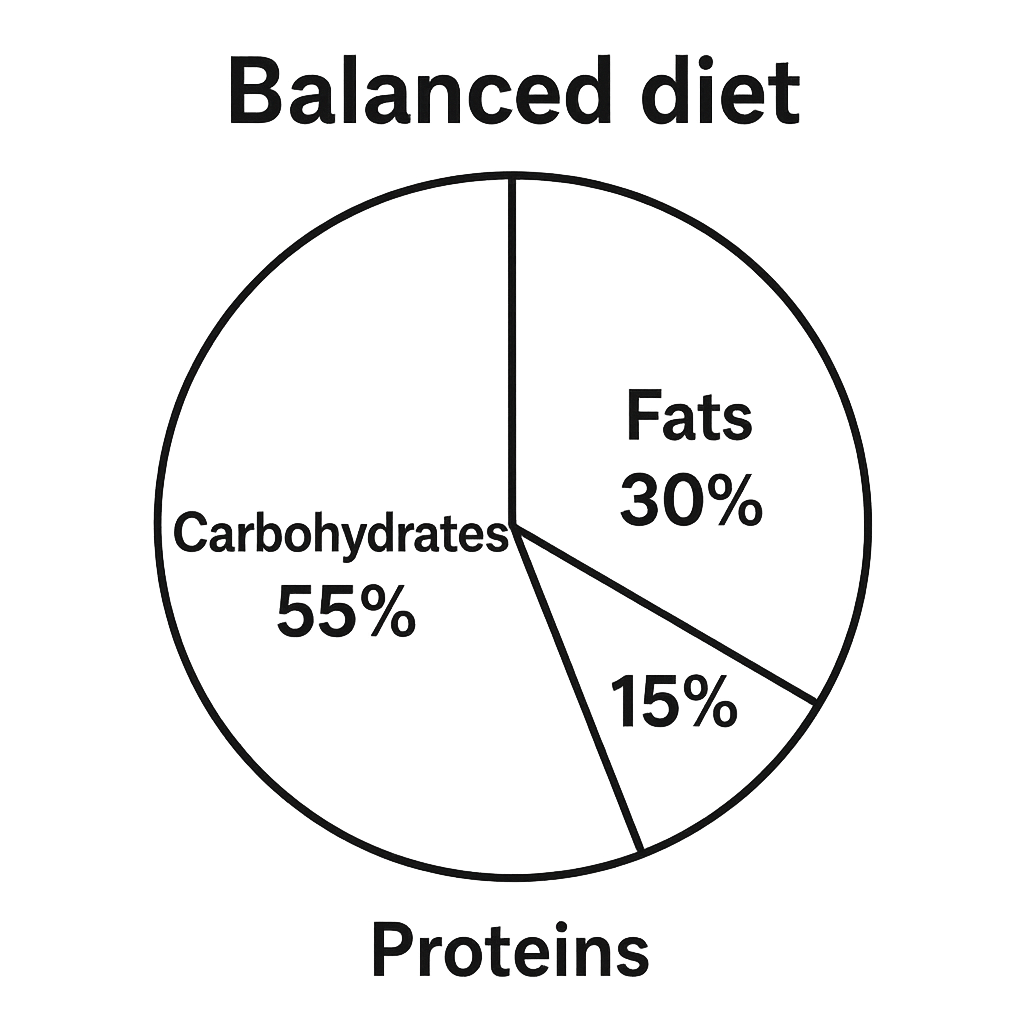
The diagram shows a balanced diet plate divided into three sections labelled as shown with their respective percentage contribution to total caloric intake. Which macronutrient provides the highest percentage of calories?
Correct A. Carbohydrates
B. Proteins
C. Fats
D. Alcohol

Correct Answer: A

Want to see the full step-by-step solution? Unlock AI Explanation & Analytics
Question 18 View Details
A leaf of a plant measures 12 cm in length and 4 cm in width. The thickness of the leaf is 0.2 mm. Microscopic examination shows that the lower epidermis contains stomata at a density of 150 stomata per mm\(^2\). Assuming stomata are present only on the lower surface, calculate the total number of stomata on the leaf.
A. 144000
Correct B. 720000
C. 1440000
D. 7200

Correct Answer: B

Want to see the full step-by-step solution? Unlock AI Explanation & Analytics
Question 19 View Details
A woman has a regular menstrual cycle lasting 28 days. The luteal phase (post‑ovulation) is known to last 14 days. If she has sexual intercourse on day 12 of her cycle, during which days of the cycle is she within the fertile window (the period when conception is most likely)?
A. days 12-17
Correct B. days 10-15
C. days 9-14
D. days 11-16

Correct Answer: B

Want to see the full step-by-step solution? Unlock AI Explanation & Analytics
Question 20 View Details
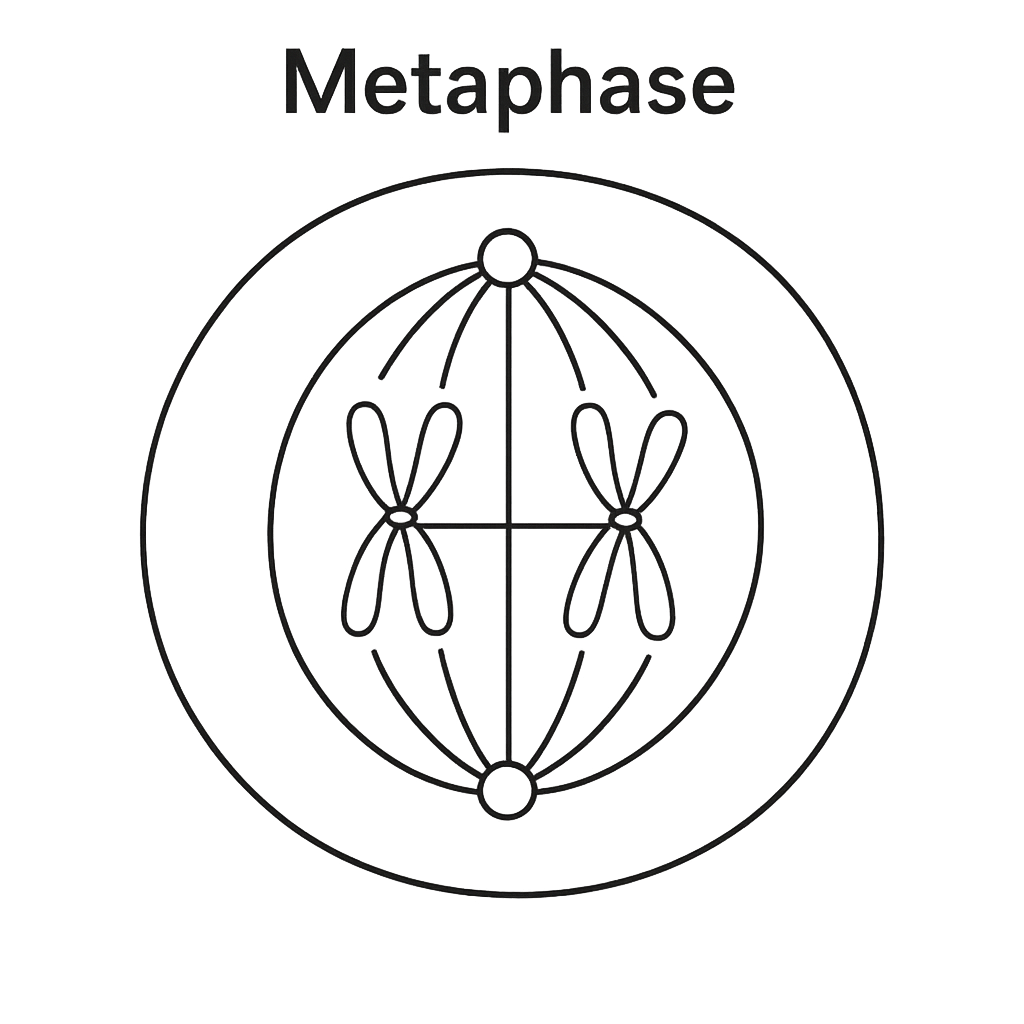
During which phase of mitosis do sister chromatids separate and move toward opposite poles?
Correct A. Anaphase
B. Telophase
C. Metaphase
D. Prophase

Correct Answer: A

Want to see the full step-by-step solution? Unlock AI Explanation & Analytics
Question 21 View Details
In a terrestrial ecosystem, the net primary productivity (NPP) is 1500 kcal·m⁻²·yr⁻¹. Only \(60\%\) of this NPP is actually assimilated by primary consumers because \(40\%\) is lost as uneaten material. Of the assimilated energy, \(15\%\) is used for respiration by the primary consumers. The remaining energy is transferred to secondary consumers with an ecological efficiency of \(12\%\). Secondary consumers in turn transfer energy to tertiary consumers with an efficiency of \(8\%\). Calculate the amount of energy (in kcal·m⁻²·yr⁻¹) available to tertiary consumers.
A. 4.90
B. 6.12
Correct C. 7.34
D. 8.64

Correct Answer: C

Want to see the full step-by-step solution? Unlock AI Explanation & Analytics
Question 22 View Details
An experiment was conducted to test the effect of a fertilizer on the height of a plant species. Five plants were grown without fertilizer (control) and their heights (cm) were: 12.1, 13.4, 11.8, 12.5, 13.0. Five plants received the fertilizer and their heights (cm) were: 14.2, 15.1, 13.9, 14.8, 15.3. Using a two‑sample t‑test assuming equal variances at the 5\% significance level, determine whether the fertilizer produces a statistically significant increase in plant height. State your conclusion.
Correct A. Yes, the fertilizer significantly increases plant height (t = 5.33 > 2.306, reject H0).
B. Yes, the fertilizer significantly increases plant height (t = 5.33 > 2.306, fail to reject H0).
C. No, the fertilizer does not significantly increase plant height (t = 1.87 < 2.306, fail to reject H0).
D. Yes, the fertilizer significantly increases plant height (t = 2.10 > 2.306, reject H0).

Correct Answer: A

Want to see the full step-by-step solution? Unlock AI Explanation & Analytics
Question 23 View Details
At rest a person's heart beats at \(70\) beats per minute (bpm). Sympathetic stimulation increases the heart rate by \(25\%\) of the resting rate, while parasympathetic stimulation decreases it by \(15\%\) of the resting rate. Under normal conditions both influences are present simultaneously. A drug is then administered that completely blocks the parasympathetic influence while leaving the sympathetic influence unchanged. What is the heart rate (in bpm) after the drug is given?
A. 98
Correct B. 87.5
C. 77
D. 90

Correct Answer: B

Want to see the full step-by-step solution? Unlock AI Explanation & Analytics
Question 24 View Details
In a dihybrid cross, two genes \(A/a\) and \(B/b\) are linked on the same chromosome with a recombination frequency of \(10\%\). One parent is heterozygous in coupling phase (\(AB/ab\)) and the other parent is homozygous recessive (\(ab/ab\)). What is the probability that an offspring will have the genotype \(A b / a b\) (i.e., receive the recombinant gamete \(Ab\) from the heterozygous parent)?
A. 0.025
Correct B. 0.05
C. 0.10
D. 0.15

Correct Answer: B

Want to see the full step-by-step solution? Unlock AI Explanation & Analytics
Question 25 View Details
A bacterial culture is monitored by measuring its optical density (OD). At time \(0\) h the OD is \(0.05\), which corresponds to a cell concentration of \(1\\times10^{6}\) cells·mL\(^{-1}\). At \(2\) h the OD is \(0.20\), at \(4\) h it is \(0.80\), and at \(6\) h it is \(3.20\). Assuming exponential growth during the first \(4\) h, (a) calculate the generation time in minutes, and (b) predict the cell concentration after \(8\) h if the same growth rate continues.
A. Generation time = 45 min; cell concentration after 8 h = 3.84 × 10⁸ cells·mL⁻¹
B. Generation time = 30 min; cell concentration after 8 h = 5.12 × 10⁸ cells·mL⁻¹
Correct C. Generation time = 60 min; cell concentration after 8 h = 2.56 × 10⁸ cells·mL⁻¹
D. Generation time = 120 min; cell concentration after 8 h = 1.28 × 10⁸ cells·mL⁻¹

Correct Answer: C

Want to see the full step-by-step solution? Unlock AI Explanation & Analytics

Master the Exam!

You've seen a preview, but there are thousands more questions plus AI tutor to break down complex solutions.

Unlock Full Access Available for Android & Windows
Help others prepare! Share this practice hub:
Chat with Support