neco 2019 physics | Essay

Prepare for your exams with neco questions? Reviewing past/model questions is one of the most effective ways to guarantee a high score. This practice hub features authentic 2019 physics (Essay) questions designed to simulate the real exam environment.

Practice these randomly selected questions to test your readiness.
Question 1 View Details
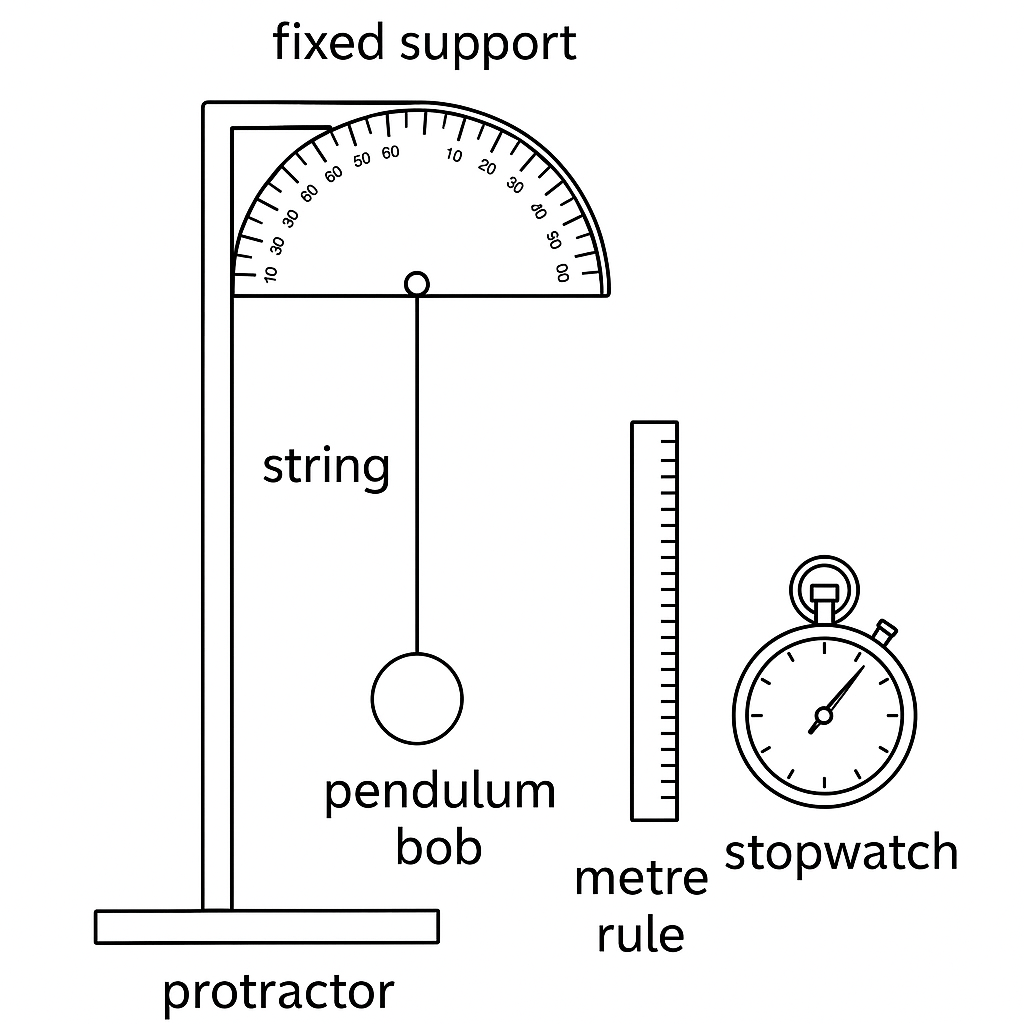
A simple pendulum is set up as shown in the illustration. The length of the string from the point of suspension to the centre of the bob is measured with a metre rule and recorded as \(L = 1.00\,\text{m}\) with an absolute uncertainty of \(\pm0.005\,\text{m}\). Using a stopwatch, the time for 20 complete oscillations is measured as \(t_{20}=40.2\,\text{s}\) with an absolute uncertainty of \(\pm0.2\,\text{s}\). The acceleration due to gravity is to be determined from these measurements. Answer the following:
Question Parts
(a)
Calculate the period \(T\) of the pendulum.
(b)
Using the relation \(T = 2\pi\sqrt{\frac{L}{g}}\), determine the value of \(g\). Show all steps.
(c)
Estimate the percentage uncertainty in the calculated value of \(g\) by propagating the uncertainties in \(L\) and \(T\). State the final result for \(g\) with its absolute uncertainty.
(d)
Suggest two practical measures that could be adopted to reduce the overall uncertainty in the determination of \(g\).
Detailed Essay Solution & Marking Scheme Available

Get the step-by-step mathematical proofs, key points required by examiners, and a comprehensive breakdown from our AI Tutor.
Question 2 View Details
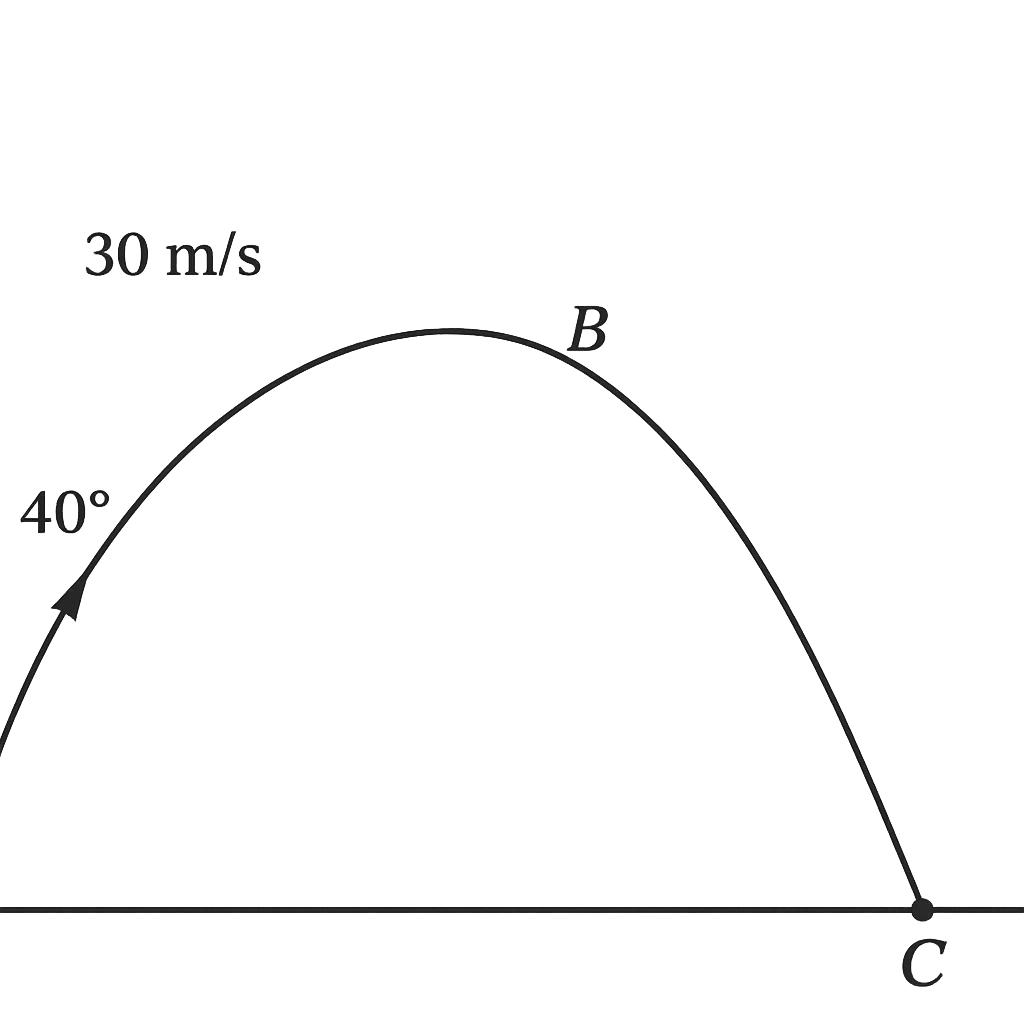
A projectile is launched from point O on level ground with an initial speed of 30 \(\text{m s}^{-1}\) making an angle of 40° above the horizontal. The motion diagram of the projectile is shown in the illustration. The diagram labels the launch point O, the point A which the projectile reaches after \(2.0\) s, the highest point B and the landing point C. Take \(g = 9.8\ \text{m s}^{-2}\).
Question Parts
(a)
Resolve the initial velocity into its horizontal (\(u_{x}\)) and vertical (\(u_{y}\)) components.
(b)
Determine (i) the time taken to reach the maximum height and (ii) the maximum height attained.
(c)
Using the motion diagram, calculate the horizontal distance of point A from the launch point O.
(d)
Find (i) the total time of flight and (ii) the horizontal range of the projectile.
(e)
At point A (t = 2.0 s) determine (i) the vertical component of velocity, (ii) the speed of the projectile and (iii) the angle the velocity makes with the horizontal (state whether it is above or below the horizontal).
Detailed Essay Solution & Marking Scheme Available

Get the step-by-step mathematical proofs, key points required by examiners, and a comprehensive breakdown from our AI Tutor.
Question 3 View Details
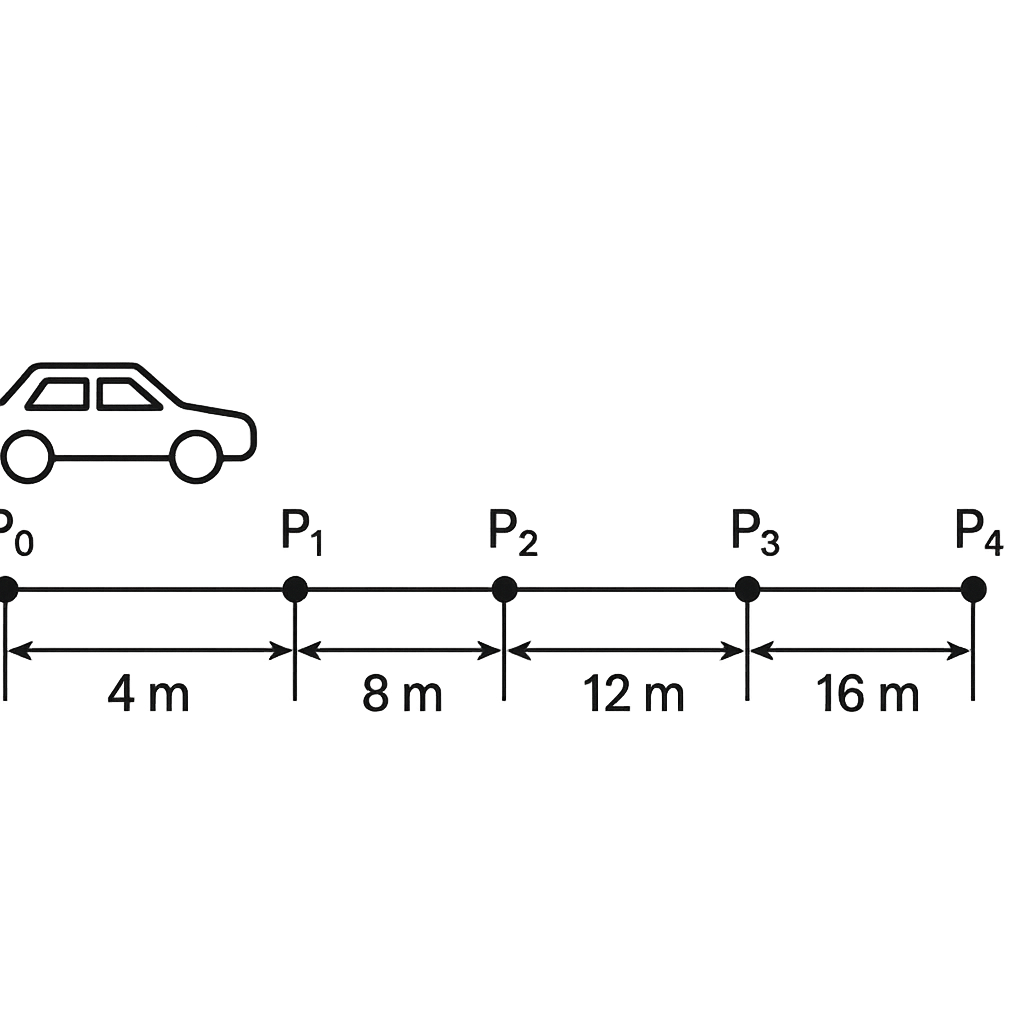
A car moves in a straight line. A motion diagram is drawn for equal time intervals of 2 s. The successive distances covered in each interval are 4 m, 8 m, 12 m and 16 m respectively.
Question Parts
(a)
Determine the initial speed of the car (in m s\(^{-1}\)).
(b)
Determine the constant acceleration of the car (in m s\(^{-2}\)).
(c)
Calculate the total distance travelled by the car in the first 8 s.
(d)
Using the information from the diagram, sketch and describe the shape of the velocity–time graph for the first 8 s.
Detailed Essay Solution & Marking Scheme Available

Get the step-by-step mathematical proofs, key points required by examiners, and a comprehensive breakdown from our AI Tutor.

Question 4 View Details
A block of mass 5.0 kg rests on a rough inclined plane that makes an angle of 30° with the horizontal. The block is held in equilibrium by a light rope attached to the block and passing over a smooth pulley at the top of the incline, as shown in the diagram. The tension in the rope is \(T\) and the coefficient of static friction between the block and the plane is \(\mu_s\). The rope makes an angle of 20° above the plane (i.e., it is inclined upward from the block towards the pulley).
Question Parts
(a)
List all the forces acting on the block and write the two equilibrium equations – one parallel to the plane and one perpendicular to the plane.
(b)
If the tension in the rope is measured to be 30 N, calculate the coefficient of static friction \(\mu_s\) that is just sufficient to keep the block at rest.
(c)
The rope is replaced by a second identical rope attached to the block and passing over a second smooth pulley on the opposite side of the incline, so that the two ropes are symmetric and each makes 20° above the plane. Determine the minimum tension in each rope required to start moving the block up the plane. Use the value of \(\mu_s\) obtained in part (b).
Detailed Essay Solution & Marking Scheme Available

Get the step-by-step mathematical proofs, key points required by examiners, and a comprehensive breakdown from our AI Tutor.

Question 5 View Details
A 12.0 kg block is released from rest at the top of an inclined plane that is 5.0 m long and makes an angle of 30° with the horizontal. The coefficient of kinetic friction between the block and the plane is \(\mu_k = 0.15\). After reaching the bottom, the block immediately compresses a spring of spring constant \(k = 800\,\text{N m}^{-1}\) that is fixed to the floor and comes to rest after compressing the spring by a distance \(x\). The block takes 0.40 s to travel the length of the plane.
Question Parts
(a)
Determine the work done by the frictional force on the block as it slides down the plane.
(b)
Using the work‑energy principle, calculate the speed of the block at the bottom of the plane just before it contacts the spring.
(c)
Find the maximum compression \(x\) of the spring.
(d)
If the block takes 0.40 s to travel the length of the plane, calculate the average power developed by the component of the block’s weight acting along the plane during the descent.
Detailed Essay Solution & Marking Scheme Available

Get the step-by-step mathematical proofs, key points required by examiners, and a comprehensive breakdown from our AI Tutor.

Question 6 View Details
A lifting system consists of a fixed pulley attached to the ceiling and a single movable pulley attached to a load of mass \(20\,\text{kg}\). The rope is massless and inextensible. The free end of the rope is pulled vertically upward with a constant effort force \(F\). The movable pulley has a radius of \(0.10\,\text{m}\) and the rope does not slip on it. The axle of the movable pulley is fixed to the load. The same effort force is applied by a class‑2 lever of total length \(0.8\,\text{m}\) in which the effort arm is \(0.20\,\text{m}\) and the resistance arm is \(0.60\,\text{m}\). The load is raised vertically through a distance of \(0.50\,\text{m}\).
Question Parts
(a)
Determine the ideal mechanical advantage (IMA) of the pulley arrangement alone, neglecting any friction.
(b)
Calculate (i) the tension in the rope required to lift the load at constant speed, and (ii) the effort force \(F\) that must be applied at the end of the lever to produce this rope tension.
Detailed Essay Solution & Marking Scheme Available

Get the step-by-step mathematical proofs, key points required by examiners, and a comprehensive breakdown from our AI Tutor.

Question 7 View Details
A sealed vertical cylinder of cross‑sectional area 0.020 m² contains 1.5 kg of air at 27 °C and a pressure of 1.2 atm. The cylinder is fitted with a frictionless piston and is placed in a room where the atmospheric pressure is 1.0 atm and the temperature remains constant at 27 °C. The piston is released and allowed to move until the pressure of the air inside the cylinder becomes equal to the atmospheric pressure.
Question Parts
(a)
Determine the initial volume of the air in the cylinder.
(b)
Find the final volume of the air after the piston has stopped moving.
(c)
Calculate:
() The distance the piston moves.
() The work done by the gas during the expansion.
Detailed Essay Solution & Marking Scheme Available

Get the step-by-step mathematical proofs, key points required by examiners, and a comprehensive breakdown from our AI Tutor.

Question 8 View Details
A solid metal block of mass 500 g is heated uniformly to 150 °C and then quickly transferred into a thin‑walled insulated container that initially holds 200 g of water at 25 °C. After the system reaches thermal equilibrium, the temperature of the water is 30 °C and the temperature of the metal block is 120 °C.
Question Parts
(a)
Determine the specific heat capacity of the metal (in J g⁻¹ °C⁻¹).
Detailed Essay Solution & Marking Scheme Available

Get the step-by-step mathematical proofs, key points required by examiners, and a comprehensive breakdown from our AI Tutor.

Master the Exam!

You've seen a preview, but there are thousands more questions plus AI tutor to break down complex solutions.

Unlock Full Access Available for Android & Windows
Help others prepare! Share this practice hub:
Chat with Support