neco 2019 biology | Objective

Prepare for your exams with neco questions? Reviewing past/model questions is one of the most effective ways to guarantee a high score. This practice hub features authentic 2019 biology (Objective) questions designed to simulate the real exam environment.

Practice these randomly selected questions to test your readiness.

Question 1 View Details
A person drinks 500\,mL of a solution containing 2\% (w/v) NaCl. Their plasma volume is 3\,L and the initial plasma Na\(^+\) concentration is 140\,mmol/L. The kidneys excrete Na\(^+\) at a constant rate of 150\,mmol per hour. After 2\,hours, what is the plasma Na\(^+\) concentration (in mmol/L)?
A. 102 mmol/L
B. 85 mmol/L
C. 110 mmol/L
Correct D. 97 mmol/L

Correct Answer: D

Want to see the full step-by-step solution? Unlock AI Explanation & Analytics
Question 2 View Details
In a stretch reflex, the afferent sensory neuron conducts at 80\,m/s, the efferent motor neuron at 60\,m/s, the synaptic delay is 0.5\,ms and the muscle contraction delay is 5\,ms. The total observed latency from stretch to contraction is 30\,ms. Assuming the afferent and efferent pathways are of equal length, what is the total length of the neural pathway (afferent plus efferent) in metres?
A. 1.71 m
B. 2.00 m
C. 1.55 m
Correct D. 1.68 m

Correct Answer: D

Want to see the full step-by-step solution? Unlock AI Explanation & Analytics
Question 3 View Details
In peas, gene A (tall \(T\) vs dwarf \(t\)) and gene B (yellow \(Y\) vs green \(y\)) are linked on the same chromosome with a recombination frequency of 20\%. A plant heterozygous for both genes in coupling phase (\(TY/ty\)) is crossed with a double‑recessive test plant (\(ty/ty\)). What is the expected phenotypic ratio of the offspring (tall yellow : tall green : dwarf yellow : dwarf green)?
A. 4:2:2:4
B. 5:5:0:0
Correct C. 4:4:1:1
D. 3:3:2:2

Correct Answer: C

Want to see the full step-by-step solution? Unlock AI Explanation & Analytics
Question 4 View Details
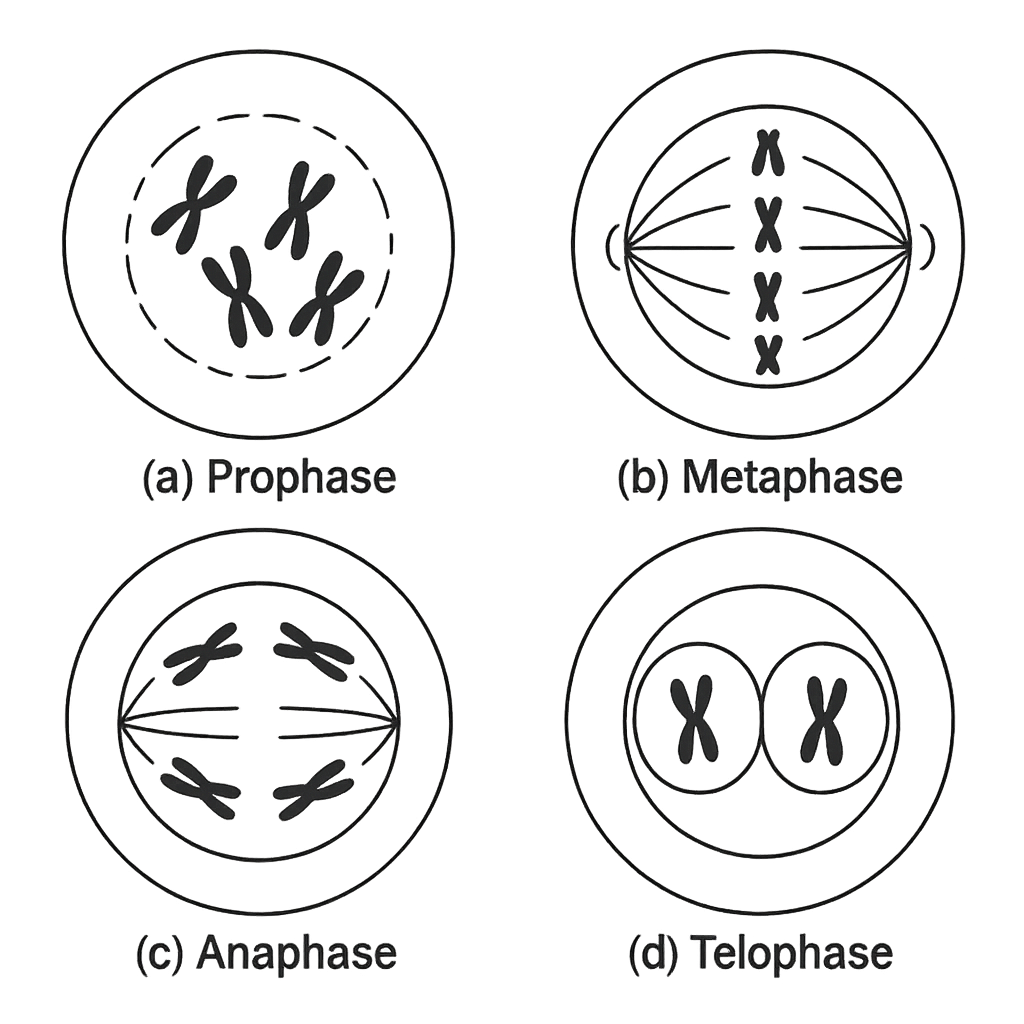
During which phase of mitosis are sister chromatids separated and move toward opposite poles?
A. Metaphase
Correct B. Anaphase
C. Telophase
D. Prophase

Correct Answer: B

Want to see the full step-by-step solution? Unlock AI Explanation & Analytics
Question 5 View Details
A diet provides 2500\,kcal per day. Carbohydrates supply 55\% of the energy, proteins 15\% and fats the remainder. If the recommended minimum protein intake is 130\,g per day, does this diet meet the protein requirement? Show your calculation.
A. No, it provides only about 110 g of protein (short by ~20 g)
B. No, it provides only about 80 g of protein (short by ~50 g)
Correct C. No, it provides only about 94 g of protein (short by ~36 g)
D. Yes, it provides about 130 g of protein, meeting the requirement

Correct Answer: C

Want to see the full step-by-step solution? Unlock AI Explanation & Analytics
Question 6 View Details
In a community of 10,000 people, a contagious disease has an unknown basic reproduction number \(R_0\). A vaccination programme immunises 60 % of the population with a vaccine whose efficacy is 80 %. After the programme the observed effective reproduction number is \(R_e = 1.2\). Assuming the vaccine reduces susceptibility proportionally, calculate the minimum possible value of \(R_0\) before vaccination. Give your answer to two decimal places.
Correct A. 2.31
B. 3.12
C. 2.05
D. 2.78

Correct Answer: A

Want to see the full step-by-step solution? Unlock AI Explanation & Analytics
Question 7 View Details
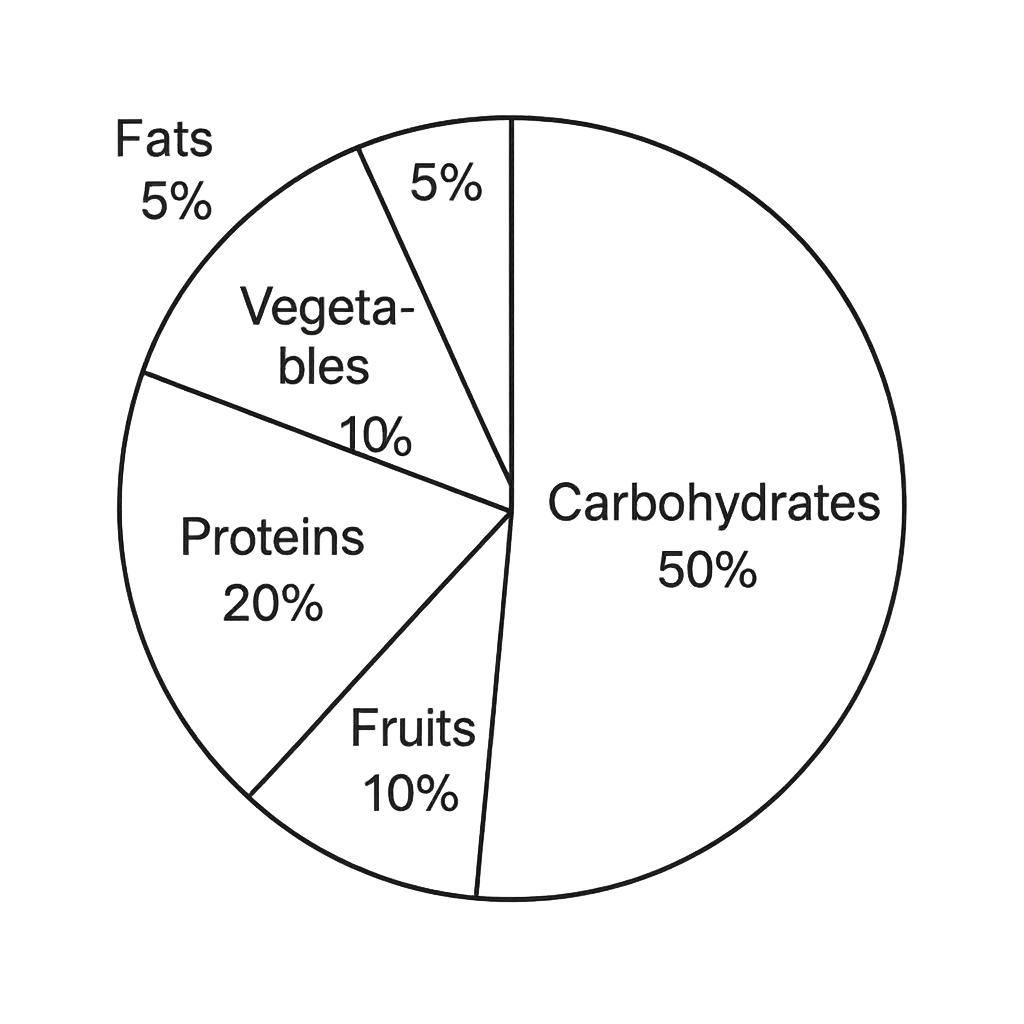
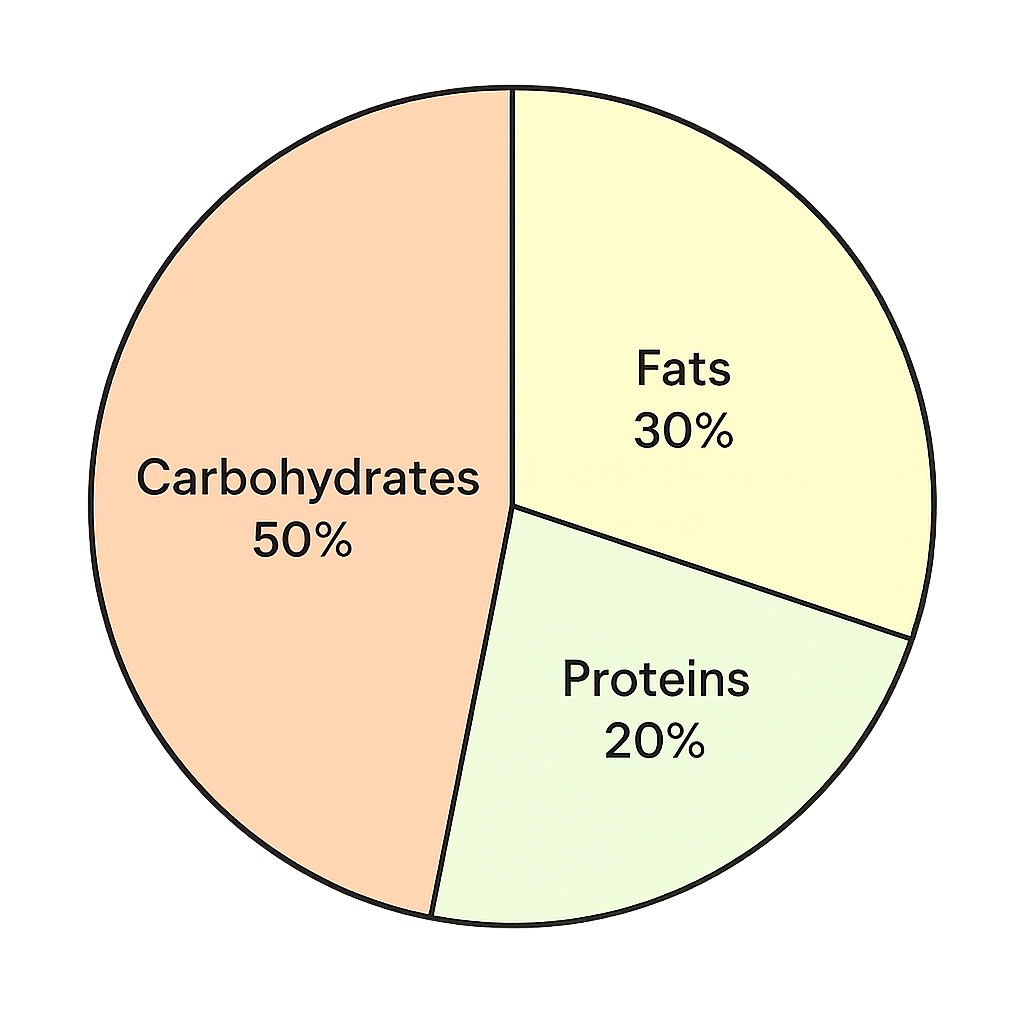
The diagram shows a balanced‑diet plate divided into five food groups with the percentages indicated. If a person consumes a total of 2000 kcal per day, calculate how many kilocalories are supplied by each food group and state which group provides the highest amount of energy.
Correct A. Carbohydrates
B. Fats
C. Proteins
D. Vegetables

Correct Answer: A

Want to see the full step-by-step solution? Unlock AI Explanation & Analytics
Question 8 View Details
A human somatic cell is diploid with a chromosome number of \(2n = 46\). During the early stage of mitosis (prophase) DNA has already been replicated. How many chromatids are present in the cell at this stage?
A. 94
B. 46
C. 48
Correct D. 92

Correct Answer: D

Want to see the full step-by-step solution? Unlock AI Explanation & Analytics
Question 9 View Details
In pea plants, gene \(A\) (yellow \(A\) vs green \(a\)) and gene \(B\) (round \(B\) vs wrinkled \(b\)) are linked on the same chromosome with a recombination frequency of 10 %. A plant heterozygous in coupling phase (\(A B / a b\)) is crossed with a homozygous recessive plant (\(a b / a b\)). Determine the expected phenotypic ratio among the offspring.
Correct A. 9:9:1:1
B. 10:10:0:0
C. 8:8:2:2
D. 9:9:2:2

Correct Answer: A

Want to see the full step-by-step solution? Unlock AI Explanation & Analytics
Question 10 View Details
A bacterial culture is monitored during its growth. The initial population at time \(t = 0\) h is \(N_0 = 5 \times 10^{2}\) cells. The culture shows a lag phase for the first 2 h, after which it enters exponential growth. At \(t = 2\) h the population is \(N_2 = 2 \times 10^{3}\) cells and at \(t = 6\) h it is \(N_6 = 1.28 \times 10^{5}\) cells. Assuming exponential growth follows \(N(t) = N_2 \; e^{\mu (t-2)}\) during the exponential phase, (i) calculate the specific growth rate \(\mu\) (h\(^{-1}\)), and (ii) determine the generation time \(g\) (in minutes) using \(g = \dfrac{\ln 2}{\mu}\). Give \(\mu\) to three decimal places and \(g\) to the nearest minute.
A. μ = 1.200 h⁻¹, generation time ≈ 35 min
B. μ = 0.924 h⁻¹, generation time ≈ 45 min
Correct C. μ = 1.039 h⁻¹, generation time ≈ 40 min
D. μ = 1.039 h⁻¹, generation time ≈ 45 min

Correct Answer: C

Want to see the full step-by-step solution? Unlock AI Explanation & Analytics
Question 11 View Details
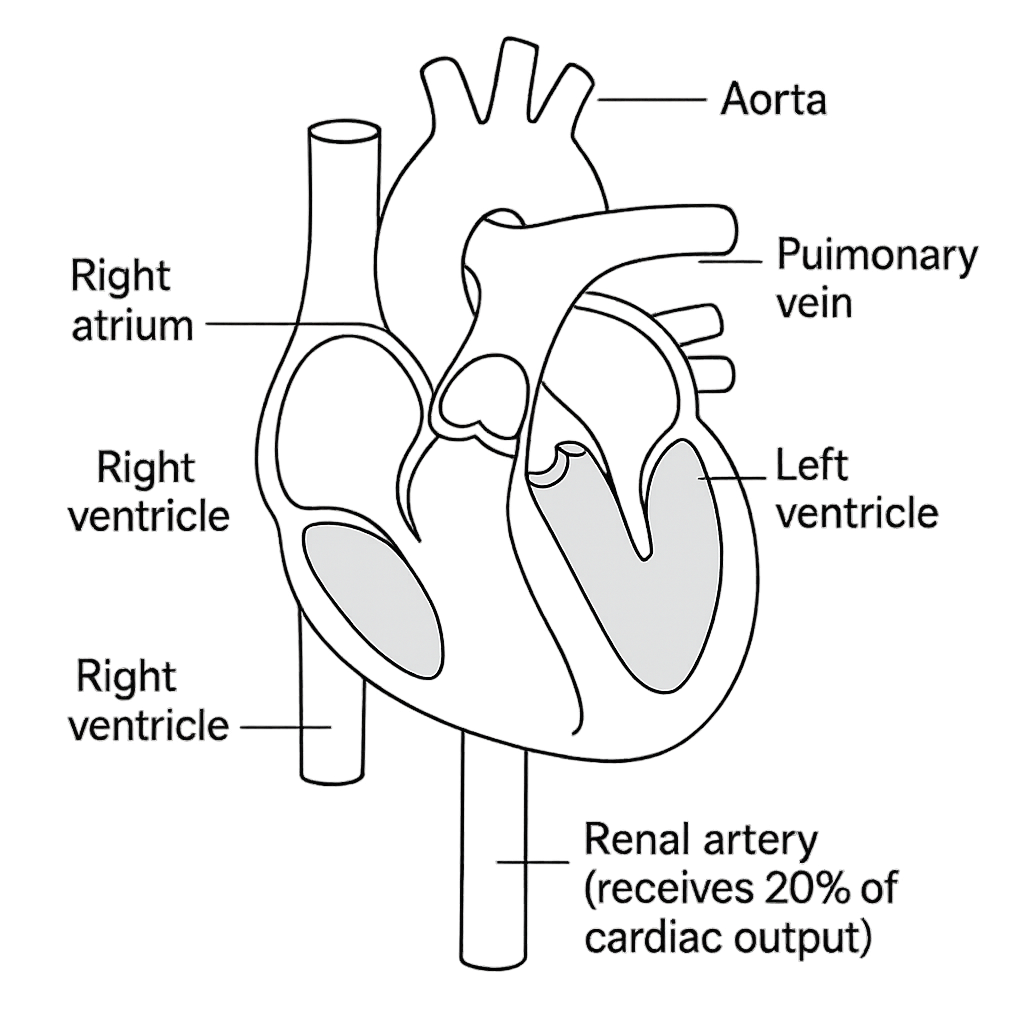
The labelled diagram shows the human heart and the renal artery branching from the abdominal aorta. The renal artery receives 20 % of the cardiac output. If the cardiac output is 5 L min\(^{-1}\), blood is 55 % plasma, and the arterial blood glucose concentration is 5 mmol L\(^{-1}\), what amount of glucose (in mmol) is re‑absorbed by the kidneys each minute, given that 80 % of the filtered glucose is re‑absorbed?
A. 4.0
B. 1.9
C. 2.75
Correct D. 2.2

Correct Answer: D

Want to see the full step-by-step solution? Unlock AI Explanation & Analytics
Question 12 View Details
A diet provides 2500 kJ from carbohydrates, 1500 kJ from proteins and 800 kJ from fats. If this represents 60 % of the recommended daily energy intake, what is the recommended daily energy intake in kilojoules?
Correct A. 8000
B. 9600
C. 6857
D. 2880

Correct Answer: A

Want to see the full step-by-step solution? Unlock AI Explanation & Analytics
Question 13 View Details
A person excretes 1.5 L of urine per day containing 0.3 g L\(^{-1}\) urea. The kidneys filter plasma at a rate of 180 L day\(^{-1}\) and re‑absorb 99 % of the filtered urea. Assuming the filtered urea concentration equals the plasma urea concentration, calculate the plasma urea concentration (in g L\(^{-1}\)).
Correct A. 0.25
B. 0.15
C. 0.20
D. 0.30

Correct Answer: A

Want to see the full step-by-step solution? Unlock AI Explanation & Analytics
Question 14 View Details
At sea level a person has a haemoglobin concentration of 150 g L\(^{-1}\); each gram of haemoglobin binds 1.34 mL O\(_2\). After acclimatisation to high altitude the haemoglobin concentration rises by 15 % and the arterial PO\(_2\) increases from 100 mmHg to 110 mmHg. Dissolved O\(_2\) in plasma changes by 0.003 mL O\(_2\) per mmHg per litre of blood. Calculate the increase in total O\(_2\) content (bound + dissolved) per litre of blood, in mL O\(_2\).
A. 31.0
B. 28.5
C. 33.2
Correct D. 30.2

Correct Answer: D

Want to see the full step-by-step solution? Unlock AI Explanation & Analytics
Question 15 View Details
In a eukaryotic cell there are 5 organelles that possess a double membrane and 12 organelles that possess a single membrane. How many membrane layers are present in total in the cell?
A. 34
B. 29
C. 17
Correct D. 22

Correct Answer: D

Want to see the full step-by-step solution? Unlock AI Explanation & Analytics
Question 16 View Details
In a plant, the water potential of the leaf cells is determined by their solute concentration. The leaf cells contain 0.15 mol\,L^{-1} of a non‑ionic solute at 25\,\degree C (298\,K). The universal gas constant is \(R = 0.008314\)\,MPa\,L\,mol^{-1}\,K^{-1}. The pressure potential of the leaf cells is negligible. The water potential of the xylem supplying the leaf is \(-0.30\)\,MPa. Calculate the osmotic potential of the leaf cells, the resulting leaf water potential, and state whether water will move into or out of the leaf cells from the xylem. Also give the magnitude of the water‑potential gradient (\(\Delta\Psi\)) between xylem and leaf.
A. Water moves into the leaf; \(\Delta\Psi = 0.10\)\,MPa
B. Water moves into the leaf; \(\Delta\Psi = 0.05\)\,MPa
Correct C. Water moves into the leaf; \(\Delta\Psi = 0.07\)\,MPa
D. Water moves out of the leaf; \(\Delta\Psi = 0.07\)\,MPa

Correct Answer: C

Want to see the full step-by-step solution? Unlock AI Explanation & Analytics
Question 17 View Details
An unlabeled diagram of a typical dicot leaf shows five numbered structures: 1 \u2013 palisade mesophyll, 2 \u2013 spongy mesophyll, 3 \u2013 stomata, 4 \u2013 guard cells, 5 \u2013 cuticle. Based on their functions, identify (i) the structure that is the primary site of photosynthesis, and (ii) the structure that primarily regulates transpiration. Give your answers as the corresponding numbers.
A. i) 1, ii) 3
Correct B. i) 1, ii) 4
C. i) 2, ii) 4
D. i) 2, ii) 3

Correct Answer: B

Want to see the full step-by-step solution? Unlock AI Explanation & Analytics
Question 18 View Details
A student touches a hot wire and the measured reaction time from stimulus to muscle contraction is \(0.250\)\,s. The sensory neuron conducts impulses from the receptor to the spinal cord at \(50\)\,m\,s^{-1} over a distance of \(0.80\)\,m. The motor neuron conducts impulses from the spinal cord to the effector muscle at \(40\)\,m\,s^{-1} over a distance of \(0.60\)\,m. Assuming a single synapse in the spinal cord, calculate the synaptic delay (in milliseconds) at the spinal cord.
A. 180 ms
B. 250 ms
Correct C. 219 ms
D. 200 ms

Correct Answer: C

Want to see the full step-by-step solution? Unlock AI Explanation & Analytics
Question 19 View Details
In a population of beetles, two alleles determine body colour: allele A (green) and allele a (brown). Before selection the population is in Hardy\u2013Weinberg equilibrium. After a selective event, 64\% of the surviving beetles are green and 36\% are brown. The selection acts only on the brown phenotype, reducing its survival to 75\% of the unselected brown beetles. Determine the original frequency of allele A (p) before selection. Give your answer to two decimal places.
A. 0.45
Correct B. 0.35
C. 0.40
D. 0.30

Correct Answer: B

Want to see the full step-by-step solution? Unlock AI Explanation & Analytics
Question 20 View Details
During an outbreak of a contagious disease in a community of 10\,000 people, 20 new cases are reported on day\,1. Each infected individual infects, on average, k others on the day they are infectious. Due to control measures, the effective transmission factor decreases by 20\% each subsequent day (i.e., on day\,2 the average number infected per case is 0.8k, on day\,3 it is 0.8^{2}k, etc.). Assuming the outbreak lasts exactly 5 days and the cumulative number of cases after day\,5 is 500, determine (i) the initial daily transmission factor k (to two decimal places) and (ii) the basic reproduction number R_{0}, defined as the total number of secondary cases generated by a typical case over the 5\-day infectious period (to one decimal place).
A. k = 2.50, R_{0}=8.2
B. k = 1.95, R_{0}=5.9
Correct C. k = 2.33, R_{0}=7.8
D. k = 2.10, R_{0}=6.5

Correct Answer: C

Want to see the full step-by-step solution? Unlock AI Explanation & Analytics
Question 21 View Details
Plant A opens its stomata for \(6\) h each night, losing water at a rate of \(0.5\) g h\(^{-1}\). It fixes carbon at \(2\) mg h\(^{-1}\). Plant B opens its stomata for \(4\) h at a rate of \(0.8\) g h\(^{-1}\) and fixes carbon at \(2.5\) mg h\(^{-1}\). Water‑use efficiency (WUE) is defined as total carbon fixed (mg) divided by total water lost (g). Which plant has the higher WUE and therefore a more effective drought‑avoidance adaptation?
Correct A. Plant A
B. Plant B
C. Neither plant has a measurable WUE
D. Both plants have equal WUE

Correct Answer: A

Want to see the full step-by-step solution? Unlock AI Explanation & Analytics
Question 22 View Details
A multicellular eukaryote possesses cell walls composed of cellulose, chloroplasts containing chlorophyll, and exhibits alternation of generations with a dominant sporophyte phase. Based on these characteristics, to which kingdom and phylum does the organism belong?
A. Kingdom Fungi, Phylum Basidiomycota
B. Kingdom Plantae, Phylum Anthophyta
C. Kingdom Plantae, Phylum Bryophyta
Correct D. Kingdom Plantae, Phylum Pteridophyta

Correct Answer: D

Want to see the full step-by-step solution? Unlock AI Explanation & Analytics
Question 23 View Details
An experiment measured the activity of a purified enzyme at different temperatures, yielding the following rates: \(10^{\\circ}C\): 20 units, \(20^{\\circ}C\): 45 units, \(30^{\\circ}C\): 70 units, \(40^{\\circ}C\): 55 units, \(50^{\\circ}C\): 30 units. Determine the optimum temperature for this enzyme, calculate the percentage decrease in activity at \(50^{\\circ}C\) relative to the optimum, and state the most likely biochemical reason for the decline at high temperature.
A. Optimum temperature = 20°C; activity at 50°C is 57.1% lower; decline due to product inhibition.
B. Optimum temperature = 30°C; activity at 50°C is 70.0% lower; decline due to pH shift.
Correct C. Optimum temperature = 30°C; activity at 50°C is 57.1% lower; decline due to enzyme denaturation.
D. Optimum temperature = 40°C; activity at 50°C is 45.5% lower; decline due to substrate inhibition.

Correct Answer: C

Want to see the full step-by-step solution? Unlock AI Explanation & Analytics
Question 24 View Details
During intense exercise a muscle cell obtains energy by both aerobic and anaerobic metabolism. Aerobic respiration yields \(36\) ATP per molecule of glucose, while anaerobic glycolysis yields \(2\) ATP per glucose. If the cell metabolises \(0.5\) mmol glucose min\(^{-1}\) aerobically and \(0.2\) mmol glucose min\(^{-1}\) anaerobically, calculate the total amount of ATP (in mmol) produced per minute.
Correct A. 18.4 mmol
B. 17.6 mmol
C. 19.2 mmol
D. 18.0 mmol

Correct Answer: A

Want to see the full step-by-step solution? Unlock AI Explanation & Analytics
Question 25 View Details
In a testcross, a plant heterozygous for two linked genes (genotype AaBb) produced the following progeny numbers: 40 AB, 40 ab, 10 Ab, and 10 aB. (AB and ab are parental types.) Calculate the recombination frequency between the two genes and give the map distance in centiMorgans (cM).
A. 25%
Correct B. 20%
C. 10%
D. 40%

Correct Answer: B

Want to see the full step-by-step solution? Unlock AI Explanation & Analytics

Master the Exam!

You've seen a preview, but there are thousands more questions plus AI tutor to break down complex solutions.

Unlock Full Access Available for Android & Windows
Help others prepare! Share this practice hub:
Chat with Support