neco 2018 physics | Essay

Prepare for your exams with neco questions? Reviewing past/model questions is one of the most effective ways to guarantee a high score. This practice hub features authentic 2018 physics (Essay) questions designed to simulate the real exam environment.

Practice these randomly selected questions to test your readiness.
Question 1 View Details
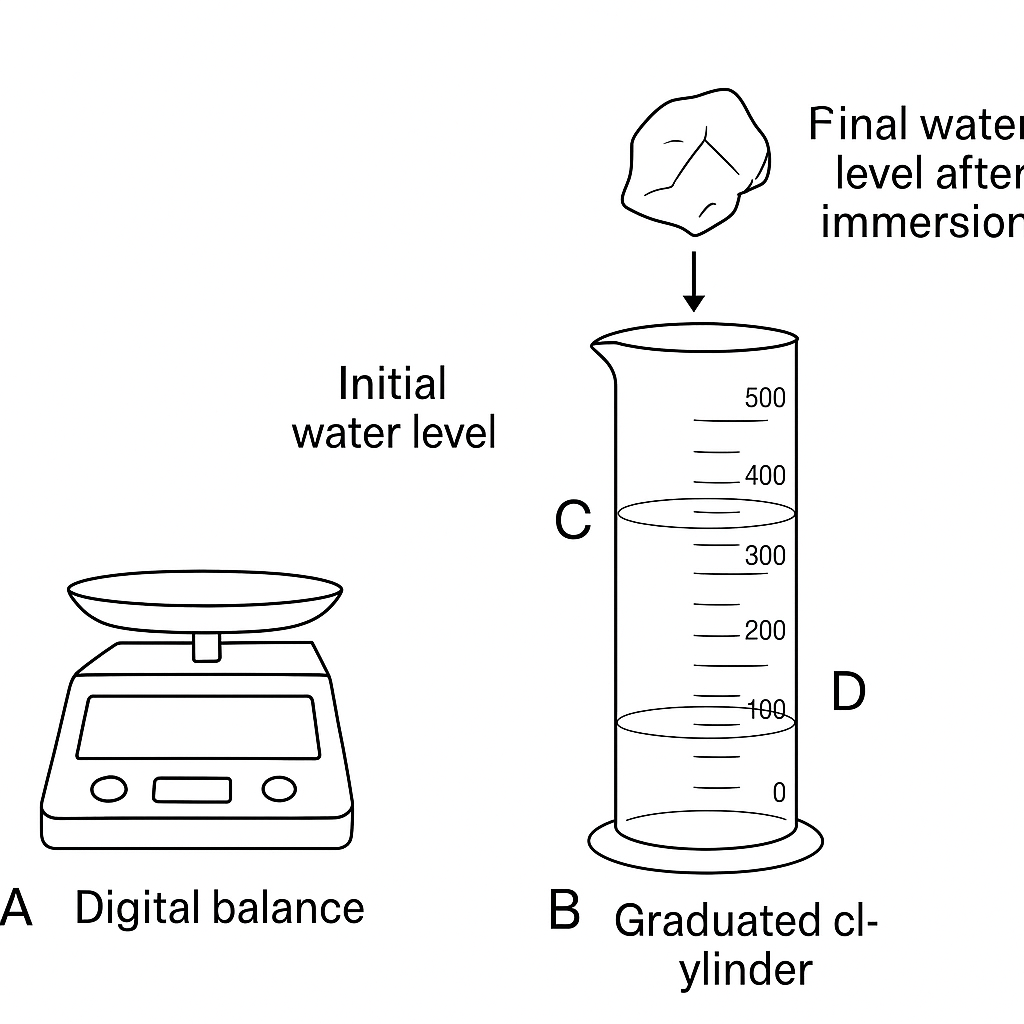
A student is required to determine the density of an irregularly shaped solid using the water‑displacement method in the school laboratory.
Question Parts
(a)
Describe, in clear steps, how the experiment should be set up and carried out to obtain the mass and volume of the solid.
(b)
The mass of the solid was measured as 150.0 g and the volume obtained from water displacement was 45.0 cm³. Calculate the density of the solid in \(\text{g cm}^{-3}\).
(c)
Identify two possible sources of systematic error in this experiment and suggest a method to reduce each error.
Detailed Essay Solution & Marking Scheme Available

Get the step-by-step mathematical proofs, key points required by examiners, and a comprehensive breakdown from our AI Tutor.
Question 2 View Details
A projectile is launched from ground level. The motion diagram of its flight is shown, with positions marked at each 1‑second interval. The horizontal distance between successive marks is uniform. The diagram indicates the vertical heights of the projectile at the marked instants as follows: at t = 0 s the projectile is at the launch point (height 0 m); at t = 1 s the height is 15 m; at t = 2 s the height is 20 m; at t = 3 s the height is 15 m; at t = 4 s the projectile returns to the ground (height 0 m). The total horizontal range measured from the diagram is 80 m. Using the information from the motion diagram, answer the following:
Question Parts
(a)
Determine the acceleration due to gravity (g) acting on the projectile.
(b)
Calculate the initial vertical component of the velocity (u_y).
(c)
Find the magnitude of the initial velocity and the angle of projection with the horizontal.
(d)
State the maximum height reached by the projectile and the time at which it occurs.
Detailed Essay Solution & Marking Scheme Available

Get the step-by-step mathematical proofs, key points required by examiners, and a comprehensive breakdown from our AI Tutor.
Question 3 View Details
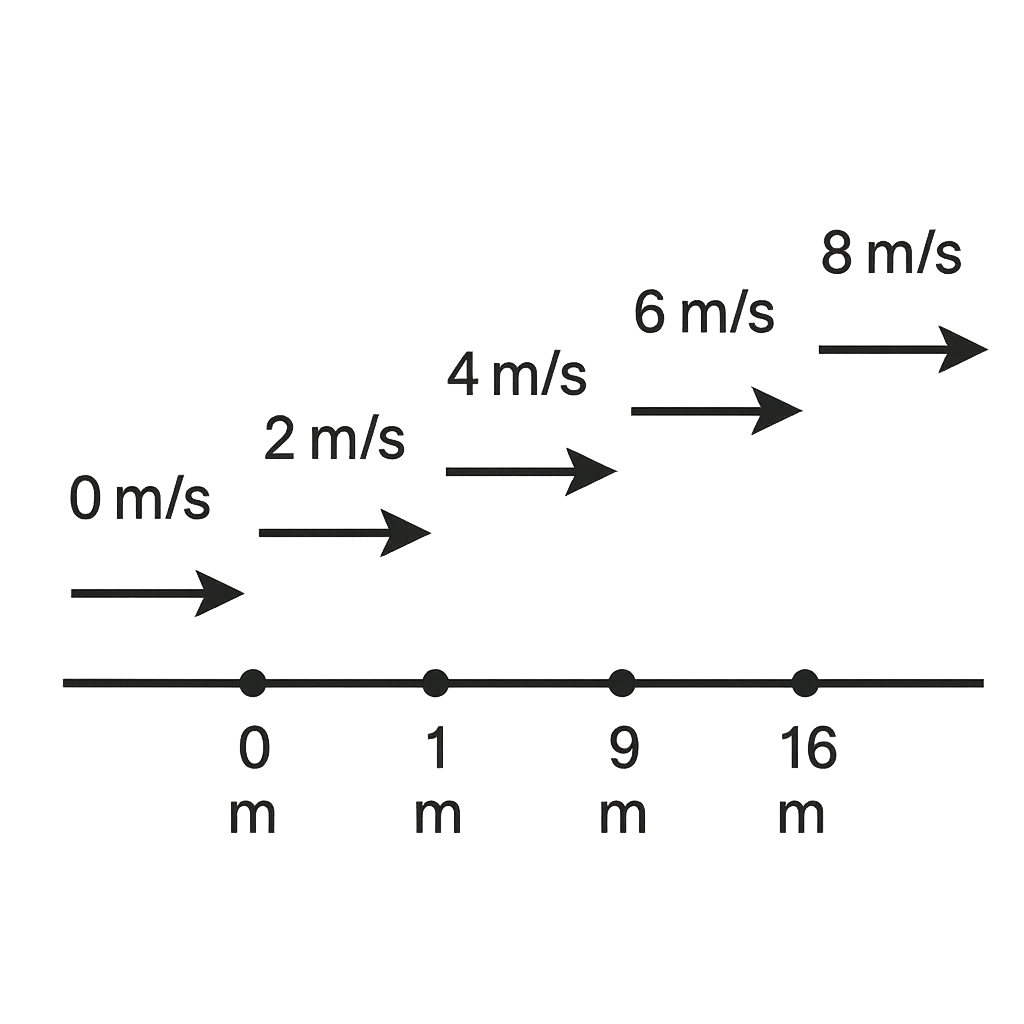
A particle moves in a straight line. The motion diagram records its position at successive 1 s intervals as shown in the diagram. The distances of the recorded positions from the starting point are 0 m, 1 m, 4 m, 9 m and 16 m respectively. The arrows on the diagram indicate the instantaneous velocity at each instant and increase in length from one instant to the next.
Question Parts
(a)
State the type of motion exhibited by the particle and justify your answer.
(b)
Calculate the average speed of the particle over the 4 s interval.
(c)
Assuming the particle started from rest, determine the magnitude of its constant acceleration.
(d)
Using the acceleration found in part (c), calculate the speed of the particle after 6 s from the start.
Detailed Essay Solution & Marking Scheme Available

Get the step-by-step mathematical proofs, key points required by examiners, and a comprehensive breakdown from our AI Tutor.

Question 4 View Details
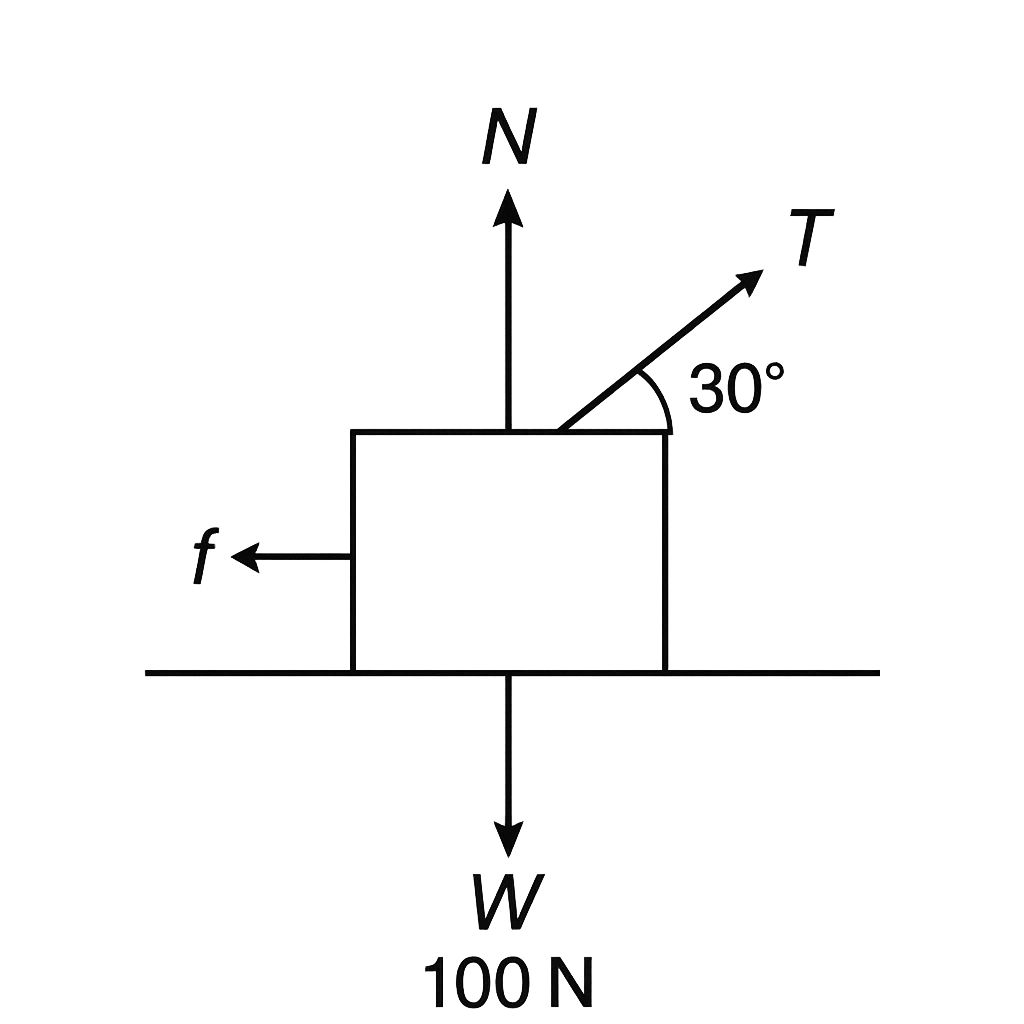
A 10 kg block rests on a rough horizontal floor. It is pulled by a rope that makes an angle of 30\(^\circ\) above the horizontal. The coefficient of kinetic friction between the block and the floor is 0.30. The block is required to accelerate horizontally at 2.0 m s\(^{-2}\). The rope tension is unknown. The block moves a horizontal distance of 5.0 m while the rope is pulling.
Question Parts
(a)
Determine the magnitude of the tension in the rope required to produce the stated acceleration.
(b)
Using the tension found in part (a), calculate the magnitude of the normal reaction exerted by the floor on the block.
(c)
Find the magnitude of the kinetic frictional force acting on the block.
(d)
If the block moves 5.0 m horizontally while the rope pulls, calculate the work done by the tension force.
Detailed Essay Solution & Marking Scheme Available

Get the step-by-step mathematical proofs, key points required by examiners, and a comprehensive breakdown from our AI Tutor.

Question 5 View Details
A 12 kg crate is pulled up a rough inclined plane that is 5.0 m long and makes an angle of 30° with the horizontal. The crate starts from rest at the bottom of the plane. A constant force of 80 N is applied parallel to the plane to pull the crate upward. The coefficient of kinetic friction between the crate and the plane is 0.20. The motion takes 4.5 s to reach the top of the incline.
Question Parts
(a)
Calculate the work done by the pulling force on the crate.
(b)
Determine the increase in kinetic energy of the crate when it reaches the top of the incline.
(c)
If the crate reaches the top in 4.5 s, calculate the average power delivered by the pulling force.
Detailed Essay Solution & Marking Scheme Available

Get the step-by-step mathematical proofs, key points required by examiners, and a comprehensive breakdown from our AI Tutor.

Question 6 View Details
A block‑and‑tackle system is used to lift a load weighing 150 N. The arrangement consists of three rope segments supporting the load (i.e., two movable pulleys and one fixed pulley). A constant effort of 60 N is applied to the free end of the rope. The rope is pulled by a hand pump that moves 0.25 m per complete stroke.
Question Parts
(a)
State the ideal mechanical advantage (IMA) of the system.
(b)
Calculate the actual mechanical advantage (AMA) and the efficiency of the system.
(c)
Using the ideal mechanical advantage, determine how far the load is lifted for each 0.25 m stroke of the hand pump.
(d)
Briefly discuss two practical factors that cause the efficiency of a block‑and‑tackle to be less than 100 %.
Detailed Essay Solution & Marking Scheme Available

Get the step-by-step mathematical proofs, key points required by examiners, and a comprehensive breakdown from our AI Tutor.

Question 7 View Details
A vertical rectangular gate 1.5 m wide and 4.0 m high is hinged at its top edge and holds back water in a reservoir. The water surface is level with the top of the gate. Assume the density of water is 1000 kg·m⁻³ and g = 9.8 m·s⁻². Answer the following:
Question Parts
(a)
Calculate the magnitude of the resultant hydrostatic force exerted on the gate.
(b)
Determine the depth below the water surface at which the resultant force acts (the centre of pressure).
(c)
If the hinge provides a resisting torque, calculate the magnitude of the torque that must be supplied to keep the gate in equilibrium (ignore friction).
Detailed Essay Solution & Marking Scheme Available

Get the step-by-step mathematical proofs, key points required by examiners, and a comprehensive breakdown from our AI Tutor.

Question 8 View Details
A solid brass rod 1.20 m long and of mass 2.5 kg is initially at 20°C. When it is heated uniformly to 120°C, its length increases by 1.44 mm. Answer the following:
Question Parts
(a)
Determine the coefficient of linear expansion (α) of the brass rod.
(b)
The specific heat capacity of brass is 380 J·kg⁻¹·K⁻¹. Calculate the amount of heat required to raise the temperature of the rod from 20°C to 120°C.
(c)
If the rod is used as a heating element and only 1500 J of heat is supplied, determine the temperature rise of the rod.
Detailed Essay Solution & Marking Scheme Available

Get the step-by-step mathematical proofs, key points required by examiners, and a comprehensive breakdown from our AI Tutor.

Master the Exam!

You've seen a preview, but there are thousands more questions plus AI tutor to break down complex solutions.

Unlock Full Access Available for Android & Windows
Help others prepare! Share this practice hub:
Chat with Support