neco 2018 chemistry | Objective

Prepare for your exams with neco questions? Reviewing past/model questions is one of the most effective ways to guarantee a high score. This practice hub features authentic 2018 chemistry (Objective) questions designed to simulate the real exam environment.

Practice these randomly selected questions to test your readiness.

Question 1 View Details
A saturated solution of silver chloride (AgCl) at 25\,°C contains \(1.33\times10^{-5}\) mol\,L\(^{-1}\) of Ag\(^+\). The solution is mixed with an equal volume of 0.10\,M NaCl solution. (a) Calculate the solubility product \(K_{sp}\) of AgCl from the given solubility. (b) After mixing, determine the mass of AgCl that precipitates (in mg) from the 0.50\,L mixture.
A. 0.75 mg
B. 1.05 mg
C. 0.85 mg
Correct D. 0.95 mg

Correct Answer: D

Want to see the full step-by-step solution? Unlock AI Explanation & Analytics
Question 2 View Details
A lake with a volume of \(2.0\times10^{6}\)\,L has a dissolved‑oxygen (DO) concentration of \(8\)\,mg\,L\(^{-1}\) at \(20\,°C\). At \(30\,°C\) the saturation concentration of oxygen is \(7.6\)\,mg\,L\(^{-1}\). (a) Calculate the percentage decrease in DO saturation when the temperature rises from \(20\,°C\) to \(30\,°C\). (b) Determine the additional amount of oxygen (in mg) that must be supplied per litre to maintain the original DO level of \(8\)\,mg\,L\(^{-1}\). (c) If each fish consumes \(0.5\)\,mg of O\(_2\) per hour, estimate the maximum number of fish that can be supported in the lake after the temperature rise, assuming the extra oxygen calculated in part (b) is supplied continuously for 24 h.
Correct A. 5 % decrease; 0.4 mg L⁻¹ extra O₂; about 6.7×10⁴ fish
B. 5 % decrease; 0.6 mg L⁻¹ extra O₂; about 5.0×10⁴ fish
C. 6 % decrease; 0.5 mg L⁻¹ extra O₂; about 5.5×10⁴ fish
D. 4 % decrease; 0.3 mg L⁻¹ extra O₂; about 7.9×10⁴ fish

Correct Answer: A

Want to see the full step-by-step solution? Unlock AI Explanation & Analytics
Question 3 View Details
A 1.250\,g sample of impure sodium carbonate (Na\(_2\)CO\(_3\)) is dissolved in water and 30.00\,mL of 0.100\,M HCl is added in excess. The excess acid is then back‑titrated with 0.0800\,M NaOH, requiring 15.00\,mL to reach the endpoint. (a) Determine the mass percent purity of Na\(_2\)CO\(_3\) in the sample. (b) How many millilitres of 0.0500\,M HCl are needed to completely neutralise 0.500\,g of pure Na\(_2\)CO\(_3\)?
Correct A. 7.63 % purity; 188.8 mL of 0.0500 M HCl
B. 6.45 % purity; 210.0 mL of 0.0500 M HCl
C. 8.12 % purity; 175.5 mL of 0.0500 M HCl
D. 7.63 % purity; 200.0 mL of 0.0500 M HCl

Correct Answer: A

Want to see the full step-by-step solution? Unlock AI Explanation & Analytics
Question 4 View Details
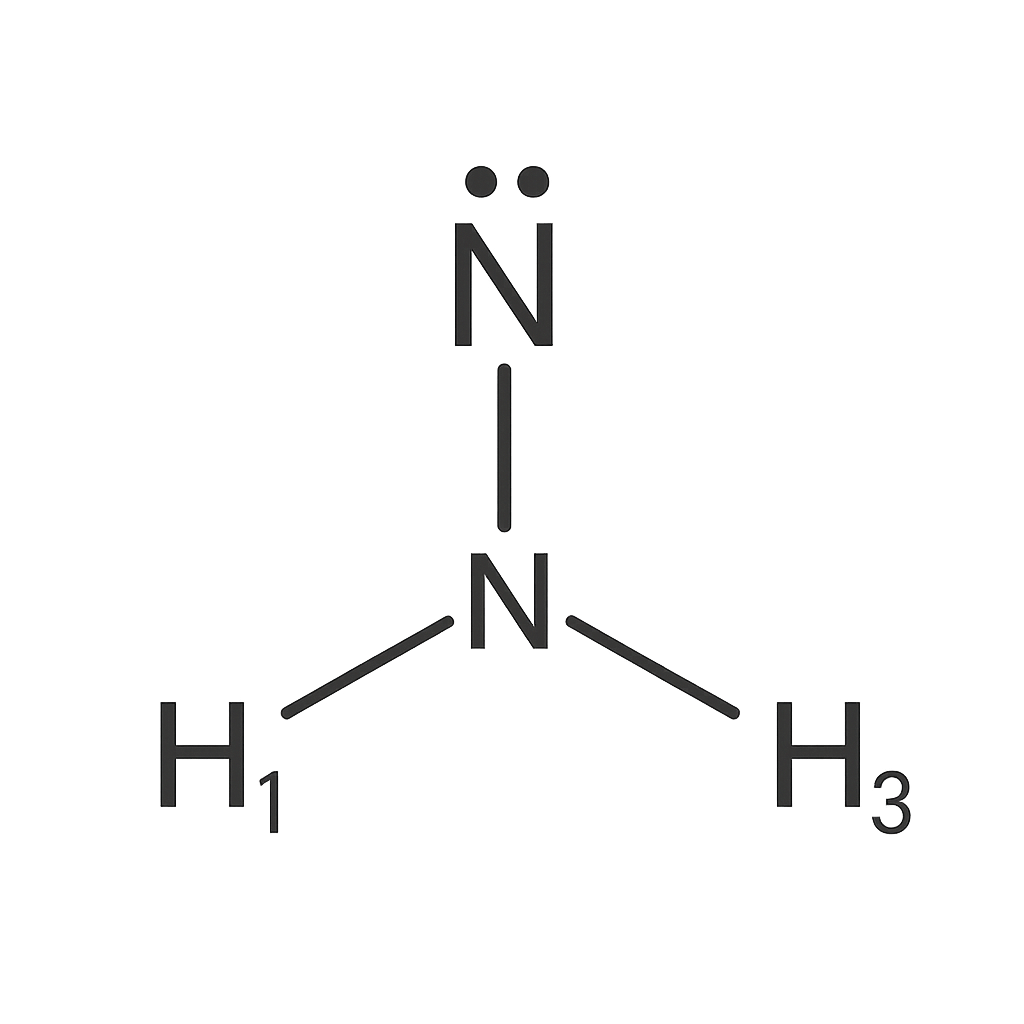
The diagram shows the Lewis structure of ammonia (NH\(_3\)). Based on the structure, state (a) the hybridisation of the nitrogen atom, (b) the approximate H-N-H bond angle, and (c) the type of covalent bonds between nitrogen and hydrogen.
A. a) sp²; b) ≈120°; c) pi (π) bonds
B. a) sp; b) ≈104.5°; c) delta (δ) bonds
Correct C. a) sp³; b) ≈107°; c) sigma (σ) bonds
D. a) sp³; b) ≈90°; c) pi (π) bonds

Correct Answer: C

Want to see the full step-by-step solution? Unlock AI Explanation & Analytics
Question 5 View Details
A steel pipe exposed to seawater experiences a corrosion current density of 2.5\,μA\,cm\(^{-2}\). The external surface area of the pipe is 1500\,cm\(^{2}\). (a) Calculate the corrosion rate in mm per year using the formula \(CR = \dfrac{0.00327\,I_{corr}\,EW}{\rho}\), where \(I_{corr}\) is in μA\,cm\(^{-2}\), \(EW\) (equivalent weight of Fe) = 27.9\,g\,eq\(^{-1}\), and \(\rho\) (density of Fe) = 7.87\,g\,cm\(^{-3}\). (b) If a zinc coating reduces the corrosion current density to 0.4\,μA\,cm\(^{-2}\), what is the new corrosion rate? (c) Determine the percentage reduction in mass loss per year due to the coating.
A. a) 0.035 mm/yr; b) 0.0058 mm/yr; c) ≈78 % reduction in mass loss
B. a) 0.025 mm/yr; b) 0.0039 mm/yr; c) ≈86 % reduction in mass loss
C. a) 0.031 mm/yr; b) 0.0042 mm/yr; c) ≈82 % reduction in mass loss
Correct D. a) 0.029 mm/yr; b) 0.0046 mm/yr; c) ≈84 % reduction in mass loss

Correct Answer: D

Want to see the full step-by-step solution? Unlock AI Explanation & Analytics
Question 6 View Details
A 2.00 g sample of an unknown metal oxide MO is reacted with excess hydrogen gas at 298 K and 1 atm. The reaction is \(\text{MO} + \text{H}_2 \rightarrow \text{M} + \text{H}_2\text{O}\). The volume of water vapour produced is measured to be 0.560 L. Given that the atomic mass of oxygen is 16.0 g·mol\(^{-1}\), determine the atomic mass of the metal M (in g·mol\(^{-1}\)).
A. 68.0
B. 73.0
C. 70.5
Correct D. 71.5

Correct Answer: D

Want to see the full step-by-step solution? Unlock AI Explanation & Analytics
Question 7 View Details
A polymer is dissolved in benzene (\(K_f = 5.12\) °C·kg·mol\(^{-1}\)). When 5.80 g of the polymer is added to 100 g of benzene, the freezing point of the solution is lowered by 0.512 °C. If the monomer unit has a molar mass of 58 g·mol\(^{-1}\), calculate the number‑average degree of polymerisation (DP\(_n\)).
A. 8
B. 15
Correct C. 10
D. 12

Correct Answer: C

Want to see the full step-by-step solution? Unlock AI Explanation & Analytics
Question 8 View Details
The normal boiling point of liquid A is 350 K and its molar enthalpy of vaporisation is \(\Delta H_{\text{vap}} = 30.0\) kJ·mol\(^{-1}\). Assuming the molar volume of the liquid is negligible compared with that of the vapour, estimate the vapour pressure of A at 300 K. Use \(R = 8.314\) J·mol\(^{-1}\)·K\(^{-1}\) and give your answer in kPa.
A. 15.2
B. 21.5
C. 12.8
Correct D. 18.1

Correct Answer: D

Want to see the full step-by-step solution? Unlock AI Explanation & Analytics
Question 9 View Details
A galvanic cell is constructed as \(\text{Zn(s)}|\text{Zn}^{2+}(0.010\ \text{M})||\text{Cu}^{2+}(x\ \text{M})|\text{Cu(s)}\). The standard reduction potentials are \(E^{\circ}_{\text{Cu}^{2+}/\text{Cu}} = +0.34\) V and \(E^{\circ}_{\text{Zn}^{2+}/\text{Zn}} = -0.76\) V. At 25 °C the cell emf is measured to be 1.05 V. Determine the concentration \(x\) of \(\text{Cu}^{2+}\) in the cathode compartment.
A. 1.0e-4
Correct B. 2.0e-4
C. 5.0e-4
D. 2.0e-3

Correct Answer: B

Want to see the full step-by-step solution? Unlock AI Explanation & Analytics
Question 10 View Details
An aqueous solution containing 0.500 mol of NaCl is electrolysed using a graphite anode and a platinum cathode. A constant current of 12.0 A is passed for 2.00 h. At the cathode the possible reductions are \(\text{Na}^{+} + e^{-} \rightarrow \text{Na(s)}\) \((E^{\circ} = -2.71\ \text{V})\) and \(2\text{H}_2\text{O} + 2e^{-} \rightarrow \text{H}_2 + 2\text{OH}^{-}\) \((E^{\circ} = -0.83\ \text{V})\). Assuming the more favourable reaction occurs, calculate (i) which product is formed at the cathode, (ii) the theoretical mass of \(\text{H}_2\) that could be produced, and (iii) the actual mass of \(\text{H}_2\) obtained if the current efficiency is 85 %. Express the actual mass in grams and the percentage of the theoretical maximum obtained.
Correct A. Hydrogen; 0.902 g; 0.767 g; 85%
B. Hydrogen; 0.902 g; 0.767 g; 90%
C. Hydrogen; 1.12 g; 0.952 g; 85%
D. Sodium; 0.902 g; 0.767 g; 85%

Correct Answer: A

Want to see the full step-by-step solution? Unlock AI Explanation & Analytics
Question 11 View Details
A mixture containing 10.0 g of \(\mathrm{Al}\) and 15.0 g of \(\mathrm{CuCl_2}\) is heated. The reaction is \(2\,\mathrm{Al} + 3\,\mathrm{CuCl_2} \rightarrow 2\,\mathrm{AlCl_3} + 3\,\mathrm{Cu}\). After the reaction, 4.5 g of copper metal is collected. Calculate the percent yield of copper.
A. 80%
B. 70%
C. 45%
Correct D. 63.5%

Correct Answer: D

Want to see the full step-by-step solution? Unlock AI Explanation & Analytics
Question 12 View Details
Which element has a higher first ionisation energy, \(\mathrm{Mg}\) or \(\mathrm{Na}\)?
A. Sodium
Correct B. Magnesium
C. Both elements have the same first ionisation energy
D. Magnesium has a lower first ionisation energy

Correct Answer: B

Want to see the full step-by-step solution? Unlock AI Explanation & Analytics
Question 13 View Details
The redox reaction between permanganate ion and ferrous ion in acidic medium is \(\mathrm{MnO_4^-} + \mathrm{Fe^{2+}} \rightarrow \mathrm{Mn^{2+}} + \mathrm{Fe^{3+}}\). (a) Balance the equation. (b) If 25.0\,mL of 0.150\,M \(\mathrm{KMnO_4}\) solution is used, what volume of 0.200\,M \(\mathrm{Fe^{2+}}\) solution is required for complete reaction?
A. 65.0 mL
B. 112.5 mL
C. 78.5 mL
Correct D. 93.8 mL

Correct Answer: D

Want to see the full step-by-step solution? Unlock AI Explanation & Analytics
Question 14 View Details
What is the most common oxidation state of chlorine in its compounds?
A. +1
B. +7
Correct C. -1
D. +5

Correct Answer: C

Want to see the full step-by-step solution? Unlock AI Explanation & Analytics
Question 15 View Details
How many neutrons are present in an atom of \(^{87}_{38}\mathrm{Sr}\)?
Correct A. 49
B. 38
C. 87
D. 51

Correct Answer: A

Want to see the full step-by-step solution? Unlock AI Explanation & Analytics
Question 16 View Details
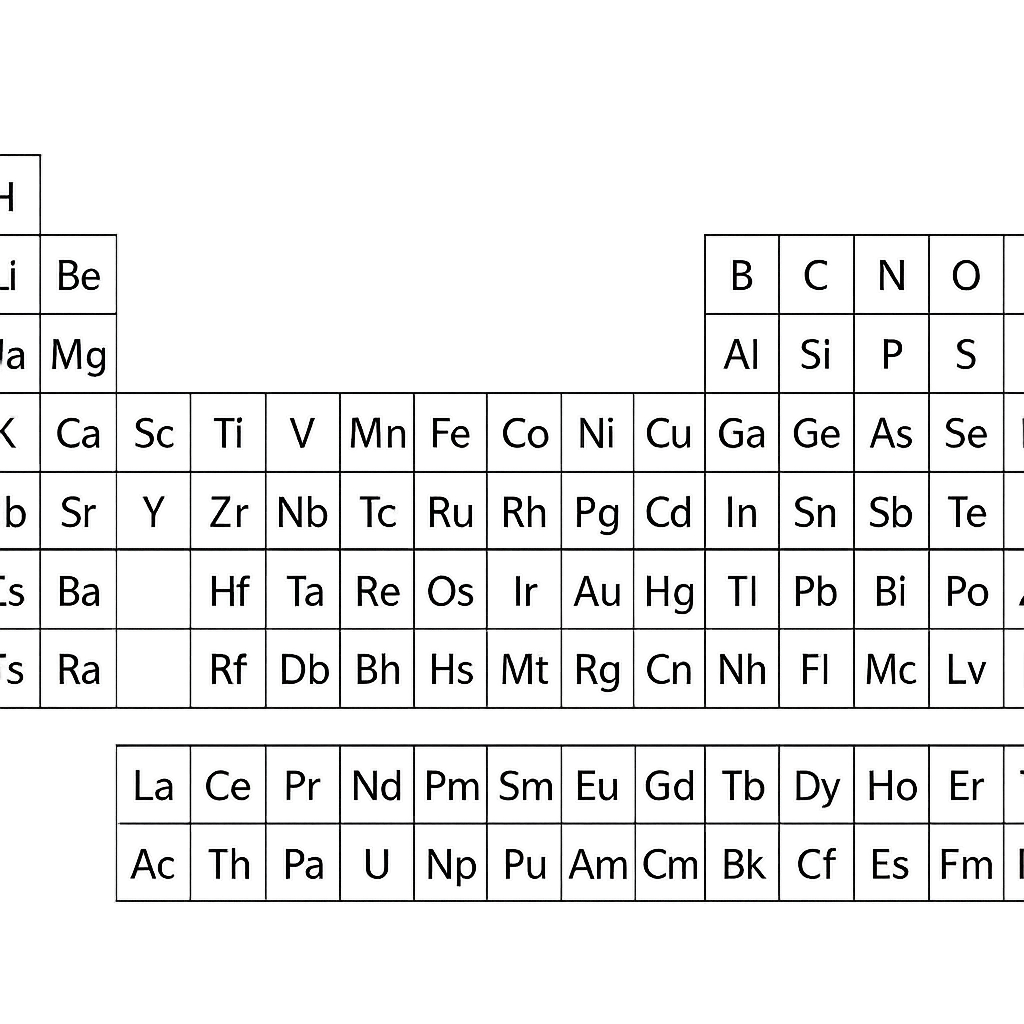
The diagram highlights a cell in the periodic table that lies in period \(3\) and group \(13\). Identify the element and state its atomic number.
Correct A. Aluminium, 13
B. Boron, 5
C. Gallium, 31
D. Silicon, 14

Correct Answer: A

Want to see the full step-by-step solution? Unlock AI Explanation & Analytics
Question 17 View Details
A rigid 2.00 L container initially contains 0.50 mol of dry air at 300 K. Then 10.0 g of liquid water is added and the container is heated to 350 K. At 350 K the vapor pressure of water is 0.56 kPa. Assuming ideal‑gas behaviour and that the water is in equilibrium with its vapour, calculate the total pressure in the container at 350 K.
A. 6.85×10^{2} kPa
Correct B. 7.28×10^{2} kPa
C. 7.28×10^{3} kPa
D. 7.95×10^{2} kPa

Correct Answer: B

Want to see the full step-by-step solution? Unlock AI Explanation & Analytics
Question 18 View Details
A 3.71 g sample of an unknown alcohol is dissolved in 100.0 g of water. The freezing point of the solution is lowered by 0.93°C. Given that the cryoscopic constant of water is \(K_{f}=1.86\;^{\circ}\text{C·kg·mol}^{-1}\), determine the molar mass of the alcohol and, from the list \{methanol, ethanol, propanol, butanol, pentanol\}, identify the most likely alcohol.
A. Molar mass ≈ 32 g·mol⁻¹; likely methanol (CH₄O)
Correct B. Molar mass ≈ 74 g·mol⁻¹; likely butanol (C₄H₁₀O)
C. Molar mass ≈ 46 g·mol⁻¹; likely ethanol (C₂H₆O)
D. Molar mass ≈ 88 g·mol⁻¹; likely pentanol (C₅H₁₂O)

Correct Answer: B

Want to see the full step-by-step solution? Unlock AI Explanation & Analytics
Question 19 View Details
Substance X has a triple point at (0.5 MPa, 250 K) and a critical point at (4.5 MPa, 560 K). At a pressure of 1.0 MPa it melts at 300 K and boils at 420 K. Two moles of X are initially in the liquid state at 280 K and 1.0 MPa. The system is heated at constant pressure to 500 K. Assuming the molar volumes of liquid and solid are negligible (0.001 L·mol⁻¹) and that of the vapour is 24.5 L·mol⁻¹ at 420 K, and neglecting volume change during melting, calculate the total work done by the system (in kJ).
Correct A. 5.83×10^{1} kJ
B. 6.20×10^{1} kJ
C. 5.83×10^{2} kJ
D. 4.75×10^{1} kJ

Correct Answer: A

Want to see the full step-by-step solution? Unlock AI Explanation & Analytics
Question 20 View Details
The solubility product of silver chloride at 25°C is \(K_{sp}=1.8\times10^{-10}\). In a solution that already contains 0.010 M NaCl, calculate the solubility of AgCl (in mol·L\(^{-1}\)). Then, if 0.20 g of solid AgCl is added to 250.0 mL of this solution, determine whether any solid remains undissolved.
A. Solubility = 1.8×10^{-6} mol·L^{-1}; excess solid remains
Correct B. Solubility = 1.8×10^{-8} mol·L^{-1}; excess solid remains
C. Solubility = 9.0×10^{-9} mol·L^{-1}; all solid dissolves
D. Solubility = 1.3×10^{-5} mol·L^{-1}; all solid dissolves

Correct Answer: B

Want to see the full step-by-step solution? Unlock AI Explanation & Analytics
Question 21 View Details
A 0.45 g sample of an unknown monohydric alcohol reacts with excess sodium metal to liberate \(0.00375\) mol of hydrogen gas. When the same alcohol is oxidised with acidic \(\mathrm{KMnO_4}\) it yields a carboxylic acid of molar mass \(74\ \mathrm{g\ mol^{-1}}\). The boiling point of the corresponding aldehyde (same carbon number) is \(49^{\circ}\mathrm{C}\). Determine the molecular formula of the alcohol and its boiling point.
A. C_3H_6O; 100°C
B. C_4H_10O; 150°C
C. C_2H_6O; 78°C
Correct D. C_3H_8O; 127°C

Correct Answer: D

Want to see the full step-by-step solution? Unlock AI Explanation & Analytics
Question 22 View Details
A 5.00 g sample of a solid mixture contains 40\% by mass of calcium chloride (\(\mathrm{CaCl_2}\)) and the remainder sodium chloride (\(\mathrm{NaCl}\)). The mixture is treated with excess sodium carbonate to precipitate calcium carbonate, which is then filtered, dried and heated to calcium oxide. If \(0.85\) g of \(\mathrm{CaO}\) is obtained, calculate the percent yield of \(\mathrm{CaO}\).
A. 78%
Correct B. 84%
C. 92%
D. 65%

Correct Answer: B

Want to see the full step-by-step solution? Unlock AI Explanation & Analytics
Question 23 View Details
The ground‑state electron configuration of a neutral atom is \(1s^{2}\,2s^{2}\,2p^{6}\,3s^{2}\,3p^{5}\). Identify the element and state the number of unpaired electrons in this configuration.
A. Argon; 0
Correct B. Chlorine; 1
C. Chlorine; 0
D. Sulfur; 2

Correct Answer: B

Want to see the full step-by-step solution? Unlock AI Explanation & Analytics
Question 24 View Details
A solution is prepared by dissolving \(0.20\) mol of acetic acid (\(K_a = 1.8 \times 10^{-5}\)) and \(0.10\) mol of sodium acetate in \(1.0\) L of water. (a) Calculate the pH of the solution. (b) If \(0.05\) mol of \(\mathrm{HCl}\) is added to the solution, what is the new pH? Give both pH values to two decimal places.
Correct A. pH₁ = 4.44; pH₂ = 4.04
B. pH₁ = 4.50; pH₂ = 4.00
C. pH₁ = 4.30; pH₂ = 3.90
D. pH₁ = 4.60; pH₂ = 4.20

Correct Answer: A

Want to see the full step-by-step solution? Unlock AI Explanation & Analytics
Question 25 View Details
A solution is made by dissolving \(0.50\) g of sodium chloride (\(\mathrm{NaCl}\)) in \(250.0\) mL of water. Excess solid silver nitrate (\(\mathrm{AgNO_3}\)) is then added until the solution becomes saturated with respect to silver chloride. At \(25^{\circ}\mathrm{C}\) the solubility product of silver chloride is \(K_{sp}=1.8 \times 10^{-10}\). (a) Calculate the equilibrium concentration of \(\mathrm{Ag^{+}}\) ions in the solution. (b) Determine the mass of silver chloride precipitated.
A. [Ag+] = 5.3×10⁻⁹ M; mass AgCl = 0.62 g
B. [Ag+] = 2.1×10⁻⁸ M; mass AgCl = 0.62 g
Correct C. [Ag+] = 5.3×10⁻⁹ M; mass AgCl = 1.23 g
D. [Ag+] = 1.0×10⁻⁸ M; mass AgCl = 1.23 g

Correct Answer: C

Want to see the full step-by-step solution? Unlock AI Explanation & Analytics

Master the Exam!

You've seen a preview, but there are thousands more questions plus AI tutor to break down complex solutions.

Unlock Full Access Available for Android & Windows
Help others prepare! Share this practice hub:
Chat with Support