igcse model questions vol1 2024 physics | Objective

Prepare for your exams with igcse model questions vol1 questions? Reviewing past/model questions is one of the most effective ways to guarantee a high score. This practice hub features authentic 2024 physics (Objective) questions designed to simulate the real exam environment.

Practice these randomly selected questions to test your readiness.
Question 1 View Details
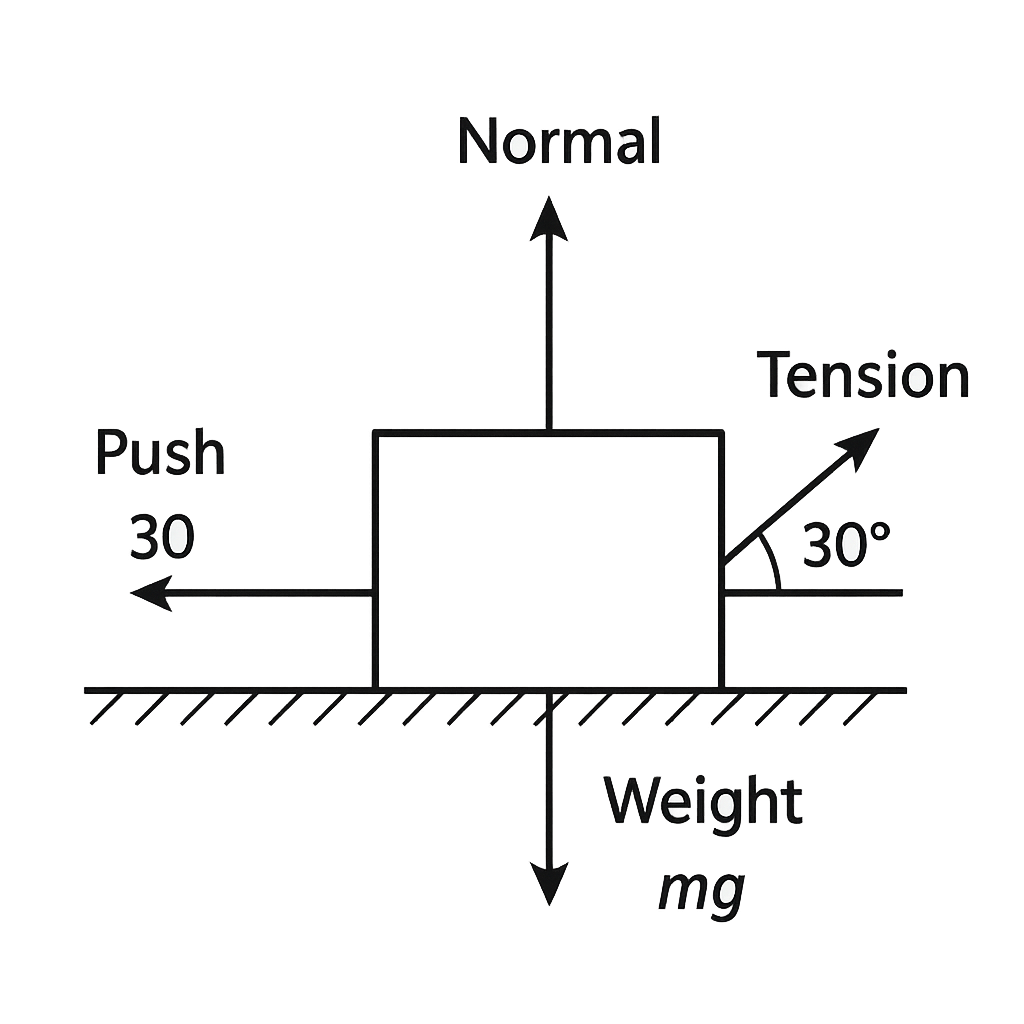
The diagram shows a 5.0 kg block resting on a rough horizontal surface. Three forces act on the block: a horizontal push of 30 N to the left, a tension \(T\) in a rope that makes an angle of 30° above the horizontal pulling to the right, and the weight \(mg\) acting downwards. The coefficient of kinetic friction between the block and the surface is 0.40. The block is in equilibrium (net force zero). Determine the magnitude of the tension \(T\) in newtons.
A. 61.0 N
B. 38.0 N
Correct C. 46.5 N
D. 52.3 N

Correct Answer: C

Want to see the full step-by-step solution? Unlock AI Explanation & Analytics
Question 2 View Details
A particle of charge \(q = 1.60 \times 10^{-19}\,\text{C}\) (an electron) is accelerated from rest through a potential difference of 500 V and then enters a uniform magnetic field of magnitude \(B = 0.005\ \text{T}\) directed into the page. The particle's velocity is perpendicular to the field. The magnetic field region is a rectangular slab 0.020 m wide in the direction of the particle's initial motion. (a) Calculate the radius of the particle's circular path inside the field. (b) Determine the time the particle spends within the field. (c) Find the vertical deflection of the particle from its original straight‑line trajectory after it leaves the field.
A. r = 1.70 cm; t = 1.55 ns; deflection = 3.2 mm
B. r = 1.23 cm; t = 1.80 ns; deflection = 4.2 mm
C. r = 1.40 cm; t = 1.70 ns; deflection = 4.5 mm
Correct D. r = 1.51 cm; t = 1.65 ns; deflection = 3.8 mm

Correct Answer: D

Want to see the full step-by-step solution? Unlock AI Explanation & Analytics
Question 3 View Details
A single‑turn rectangular coil of width \(L = 0.10\ \text{m}\) and length \(l = 0.15\ \text{m}\) (so the side that enters the field first has length \(l\)) is pulled at constant speed \(v\) into a region where a uniform magnetic field \(B = 0.60\ \text{T}\) points into the page. The coil has \(N = 50\) turns and resistance \(R = 2.0\ \Omega\). (a) While the coil is partially inside the field (i.e., \(0 < x < l\), where \(x\) is the distance the leading edge has entered), derive an expression for the induced emf \(\varepsilon\) as a function of \(x\). (b) Find the maximum speed \(v_{\max}\) that can be used so that the induced emf never exceeds \(5.0\ \text{V}\). (c) Using this speed, calculate the average electrical power dissipated in the coil while the coil is moving from \(x = 0\) to \(x = l\).
A. ε = N B L v; v_max = 2.00 m s⁻¹; average power = 12.5 W
B. ε = B L v; v_max = 1.67 m s⁻¹; average power = 12.5 W
C. ε = N B L v; v_max = 1.67 m s⁻¹; average power = 10.0 W
Correct D. ε = N B L v; v_max = 1.67 m s⁻¹; average power = 12.5 W

Correct Answer: D

Want to see the full step-by-step solution? Unlock AI Explanation & Analytics
Question 4 View Details
A 12.0 V battery has an internal resistance of \(r = 0.50\ \Omega\). It supplies power to a resistive heating element whose resistance at \(20^{\circ}\text{C}\) is \(R_{20} = 8.0\ \Omega\). The element's temperature coefficient of resistance is \(\alpha = 4.0 \times 10^{-3}\ \text{°C}^{-1}\). The element is allowed to heat until its temperature reaches \(120^{\circ}\text{C}\). (a) Calculate the current drawn from the battery and the power dissipated in the element at \(20^{\circ}\text{C}\). (b) Determine the resistance of the element at \(120^{\circ}\text{C}\). (c) Calculate the current and the power dissipated in the element at \(120^{\circ}\text{C}\). (d) Find the overall efficiency (useful heating power divided by total power supplied by the battery) when the element is at \(120^{\circ}\text{C}\).
A. I_{20}=1.41 A, P_{20}=15.9 W; R_{120}=11.2 Ω; I_{120}=1.03 A, P_{120}=11.8 W; efficiency=90.0 %
B. I_{20}=1.50 A, P_{20}=15.9 W; R_{120}=11.2 Ω; I_{120}=1.03 A, P_{120}=11.8 W; efficiency=95.7 %
C. I_{20}=1.41 A, P_{20}=15.9 W; R_{120}=10.0 Ω; I_{120}=1.03 A, P_{120}=11.8 W; efficiency=95.7 %
Correct D. I_{20}=1.41 A, P_{20}=15.9 W; R_{120}=11.2 Ω; I_{120}=1.03 A, P_{120}=11.8 W; efficiency=95.7 %

Correct Answer: D

Want to see the full step-by-step solution? Unlock AI Explanation & Analytics
Question 5 View Details
A hydrogen atom makes a transition from the \(n = 5\) level to the \(n = 2\) level, emitting a photon. The photon is incident on a diffraction grating that has \(5.8 \times 10^{5}\) lines per metre. A second‑order (\(m = 2\)) maximum is observed at an angle of \(30^{\circ}\) to the normal of the grating. (a) Calculate the wavelength of the emitted photon. (b) Determine the energy of the photon in joules and in electronvolts. (c) Find the grating spacing \(d\). (d) Verify that the observed angle is consistent with the second‑order diffraction condition using the wavelength obtained in part (a).
A. λ = 4.34×10⁻⁷ m (434 nm); E = 4.58×10⁻¹⁹ J = 2.86 eV; d = 1.45×10⁻⁶ m; predicted θ ≈ 30.2° confirming the observation
Correct B. λ = 4.34×10⁻⁷ m (434 nm); E = 4.58×10⁻¹⁹ J = 2.86 eV; d = 1.72×10⁻⁶ m; predicted θ ≈ 30.2° confirming the observation
C. λ = 5.12×10⁻⁷ m (512 nm); E = 3.88×10⁻¹⁹ J = 2.42 eV; d = 1.72×10⁻⁶ m; predicted θ ≈ 35.0° confirming the observation
D. λ = 3.90×10⁻⁷ m (390 nm); E = 5.10×10⁻¹⁹ J = 3.19 eV; d = 1.72×10⁻⁶ m; predicted θ ≈ 28.5° confirming the observation

Correct Answer: B

Want to see the full step-by-step solution? Unlock AI Explanation & Analytics
Question 6 View Details
A 5.0 kg crate is pulled up an incline that rises 3.0 m above the horizontal. The incline makes an angle of \(30^{\circ}\) with the horizontal. The crate is pulled by a constant horizontal force of \(60 \text{ N}\). The coefficient of kinetic friction between the crate and the incline is \(0.20\). The crate moves from the bottom to the top of the incline in \(4.0 \text{ s}\). Calculate the average power delivered by the horizontal pulling force during this motion.
A. 120 W
B. 90 W
Correct C. 78 W
D. 60 W

Correct Answer: C

Want to see the full step-by-step solution? Unlock AI Explanation & Analytics
Question 7 View Details
A length is measured as \(12.3 \text{ cm}\) using a ruler whose smallest division is \(0.1 \text{ cm}\). State the absolute uncertainty of the measurement and the relative uncertainty expressed as a percentage.
Correct A. ±0.05 cm; 0.41 %
B. ±0.02 cm; 0.16 %
C. ±0.05 cm; 0.5 %
D. ±0.1 cm; 0.81 %

Correct Answer: A

Want to see the full step-by-step solution? Unlock AI Explanation & Analytics
Question 8 View Details
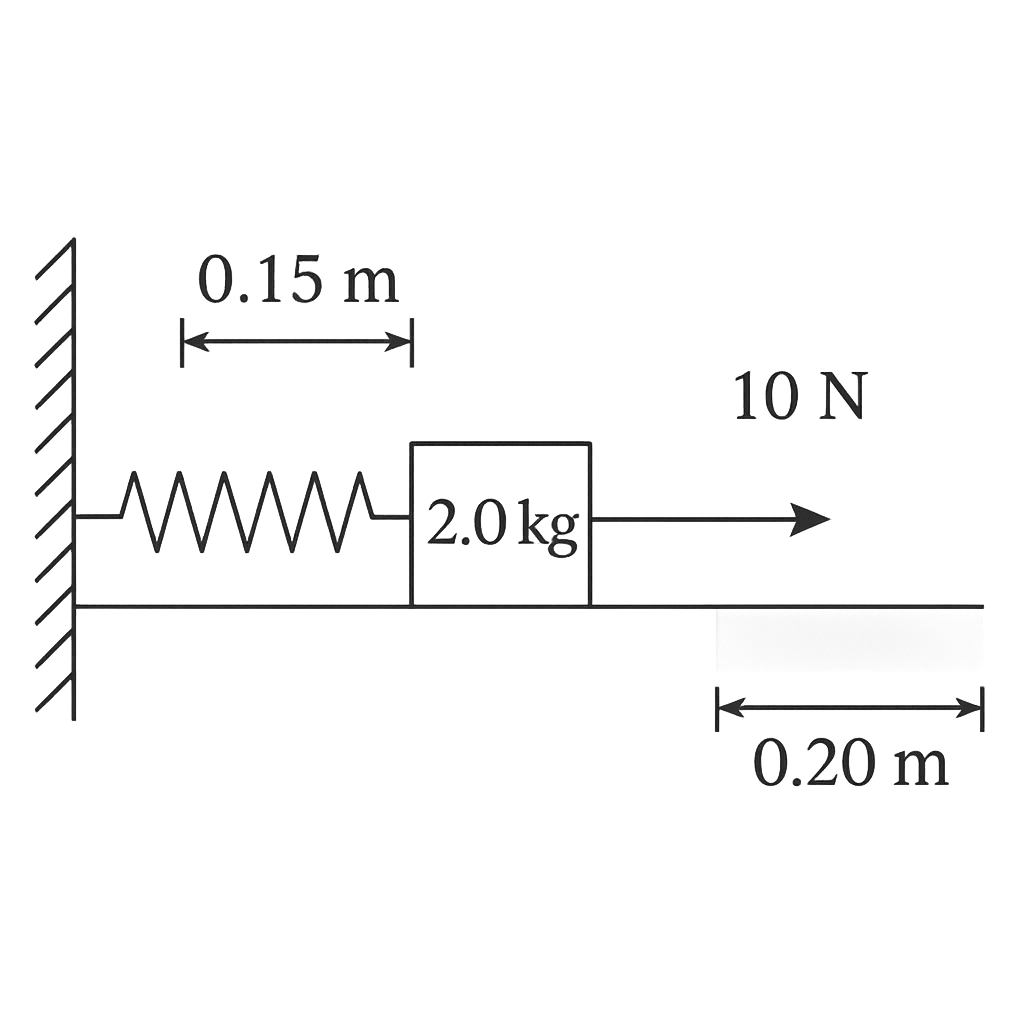
In the diagram, a \(2.0 \text{ kg}\) block is attached to a spring with spring constant \(k = 200 \text{ N m}^{-1}\) that is initially compressed \(0.15 \text{ m}\) from its natural length. The block is released on a frictionless horizontal surface. After traveling \(0.30 \text{ m}\) from the release point, it enters a region where a constant horizontal force of \(10 \text{ N}\) opposite to its motion acts over a distance of \(0.20 \text{ m}\). Determine the speed of the block as it exits the force region.
A. 0.30 m/s
Correct B. 0.50 m/s
C. 0.70 m/s
D. 0.90 m/s

Correct Answer: B

Want to see the full step-by-step solution? Unlock AI Explanation & Analytics
Question 9 View Details
Two identical strings each have a linear mass density of \(\mu = 0.020 \text{ kg m}^{-1}\) and the same length. String A is under a tension of \(80 \text{ N}\) and vibrates in its fundamental mode with a frequency of \(120 \text{ Hz}\). String B is under a tension of \(45 \text{ N}\) and also vibrates in its fundamental mode. Assuming the length of the strings is unchanged, calculate the fundamental frequency of String B.
Correct A. 90 Hz
B. 130 Hz
C. 70 Hz
D. 110 Hz

Correct Answer: A

Want to see the full step-by-step solution? Unlock AI Explanation & Analytics
Question 10 View Details
A car starts from rest and accelerates with a time‑dependent acceleration given by \(a = 2.0 t \; \text{m s}^{-2}\), where \(t\) is the time in seconds. After \(5.0 \text{ s}\) the car begins to decelerate uniformly and comes to rest exactly \(5.0 \text{ s}\) later. Determine the total distance travelled by the car during the whole \(10 \text{ s}\) interval.
A. 108 m
Correct B. 104 m
C. 95 m
D. 100 m

Correct Answer: B

Want to see the full step-by-step solution? Unlock AI Explanation & Analytics
Question 11 View Details
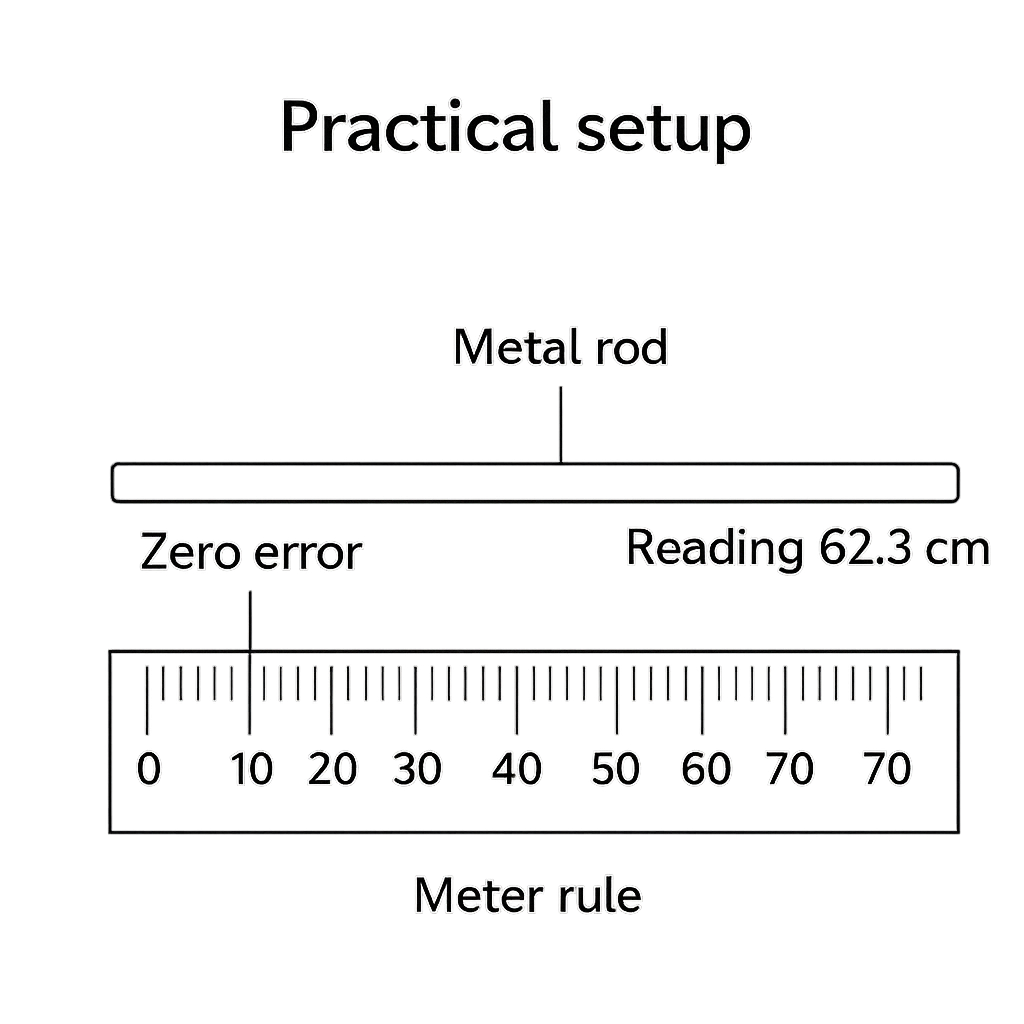
A metal rod is placed on a metre rule that has a zero error of +\(0.5\) cm. The reading at the far end of the rod is \(62.3\) cm. What is the actual length of the rod in centimetres?
A. 61.3 cm
B. 60.8 cm
C. 62.8 cm
Correct D. 61.8 cm

Correct Answer: D

Want to see the full step-by-step solution? Unlock AI Explanation & Analytics
Question 12 View Details
A frictionless piston of area \(0.02\) m\(^2\) seals a gas container. The piston has a mass of \(0.5\) kg. Initially the piston is \(0.15\) m above the base and the gas temperature is \(300\) K. Atmospheric pressure is \(1.0\times10^{5}\) Pa. The piston is pressed down until the height becomes \(0.10\) m and the gas temperature rises to \(350\) K. Assuming ideal‑gas behaviour, calculate the final absolute pressure of the gas (in Pa).
A. 1.70×10^5 Pa
B. 1.85×10^5 Pa
C. 1.65×10^5 Pa
Correct D. 1.75×10^5 Pa

Correct Answer: D

Want to see the full step-by-step solution? Unlock AI Explanation & Analytics
Question 13 View Details
A student walks \(5\) m east and then \(3\) m north. What is the magnitude of the resultant displacement in metres (to two decimal places)?
A. 8.00 m
B. 2.00 m
C. 6.00 m
Correct D. 5.83 m

Correct Answer: D

Want to see the full step-by-step solution? Unlock AI Explanation & Analytics
Question 14 View Details
Two point charges are placed on a straight line 0.12 m apart. The charge on the left is \(+Q\) and the charge on the right is \(-2Q\) where \(Q = 5\) µC. At what distance from the \(+Q\) charge (along the line between the charges) is the net electric field zero? Give your answer in centimetres (to one decimal place).
A. 3.0 cm
B. 10.0 cm
C. 7.5 cm
Correct D. 5.0 cm

Correct Answer: D

Want to see the full step-by-step solution? Unlock AI Explanation & Analytics
Question 15 View Details
A converging lens has a focal length of \(0.10\) m. An object (a street lamp) is \(30\) m away from the lens. A screen is currently placed \(0.25\) m behind the lens. Determine whether the screen is at the correct position for a sharp image. If not, calculate how far (in metres, to two decimal places) the screen must be moved towards the lens to obtain a sharp image.
Correct A. 0.15 m
B. 0.05 m
C. 0.25 m
D. 0.20 m

Correct Answer: A

Want to see the full step-by-step solution? Unlock AI Explanation & Analytics
Question 16 View Details
A sealed 2.00 L cylinder contains an ideal gas at 1.00 atm and 300 K. The gas is heated to 450 K, causing the pressure to rise. Then a valve is opened and gas is allowed to escape until the pressure returns to 1.00 atm while the temperature is kept at 450 K. What fraction of the original amount of gas remains in the cylinder after the valve is closed?
Correct A. 2/3
B. 1/3
C. 4/5
D. 3/4

Correct Answer: A

Want to see the full step-by-step solution? Unlock AI Explanation & Analytics
Question 17 View Details
A wheel‑and‑axle system consists of a large wheel of radius 0.20 m attached to a handle of radius 0.80 m. A belt runs from the rim of the large wheel to a small pulley of radius 0.10 m that is fixed to a 10.0 kg load, allowing the load to be lifted vertically. If a constant force of 30 N is applied tangentially to the handle, neglecting friction and assuming the belt does not slip, what is the upward acceleration of the load in \(\text{m s}^{-2}\)?
Correct A. 2.2
B. 2.8
C. 3.0
D. 1.8

Correct Answer: A

Want to see the full step-by-step solution? Unlock AI Explanation & Analytics
Question 18 View Details
A converging lens of focal length \(f = 12\) cm forms a real image of a candle on a screen 48 cm from the lens. The screen is then moved 10 cm farther away and the lens is shifted along the line to obtain a sharp image again. By how many centimetres was the lens moved towards the object? Give your answer to two significant figures.
A. 1.05
B. 0.78
C. 0.85
Correct D. 0.92

Correct Answer: D

Want to see the full step-by-step solution? Unlock AI Explanation & Analytics
Question 19 View Details
A car travels along a straight road. Its speed increases uniformly from 20 m s(^{-1}\) to 30 m s(^{-1}\) in 5.0 s. Immediately after this, the driver applies a constant brake force that brings the car to rest exactly 200 m after the brakes are applied. What is the magnitude of the deceleration in \(\text{m s}^{-2}\)?
Correct A. 6
B. 4
C. 8
D. 5.5

Correct Answer: A

Want to see the full step-by-step solution? Unlock AI Explanation & Analytics
Question 20 View Details
A sample contains 2.0 g of pure \(^{226}\text{Ra}\) (half‑life 1600 yr). It decays to \(^{222}\text{Rn}\) (half‑life 3.8 d) which quickly decays to stable \(^{206}\text{Pb}\), emitting an alpha particle of 4.78 MeV in the \(^{226}\text{Ra}\rightarrow^{222}\text{Rn}\) step. Assuming secular equilibrium has been reached, calculate (a) the activity of the \(^{222}\text{Rn}\) gas in becquerels, and (b) the total power (in watts) emitted as alpha particles from the original \(^{226}\text{Ra}\) sample at equilibrium. Give your answers to two significant figures.
A. 6.8×10^{10} Bq, 0.48 W
B. 7.3×10^{9} Bq, 0.056 W
Correct C. 7.3×10^{10} Bq, 0.56 W
D. 8.1×10^{10} Bq, 0.62 W

Correct Answer: C

Want to see the full step-by-step solution? Unlock AI Explanation & Analytics
Question 21 View Details
A string has a linear mass density of \(0.020\ \text{kg m}^{-1}\). When the tension in the string is \(80\ \text{N}\) it supports a standing wave of frequency \(5.0\ \text{Hz}\). If the tension is increased so that the wavelength of the same standing wave becomes \(20.0\ \text{m}\) (the frequency remains unchanged), what is the new tension in the string? Give your answer in newtons.
A. 160
B. 120
Correct C. 200
D. 240

Correct Answer: C

Want to see the full step-by-step solution? Unlock AI Explanation & Analytics
Question 22 View Details
A train sounding a horn of true frequency \(440\ \text{Hz}\) moves towards a stationary observer at speed \(v_s\). The observer hears a frequency of \(470\ \text{Hz}\) as the train approaches and \(410\ \text{Hz}\) as it recedes. Assuming the speed of sound in air is \(340\ \text{m s}^{-1}\), determine the speed of the train in metres per second (to two significant figures).
A. 20
B. 30
C. 25
Correct D. 23

Correct Answer: D

Want to see the full step-by-step solution? Unlock AI Explanation & Analytics
Question 23 View Details
A sealed container holds \(2.0\ \text{mol}\) of an ideal gas at a temperature of \(27^{\circ}\text{C}\) and a pressure of \(1.0\ \text{atm}\). The gas is heated until its pressure doubles. Then, while the gas is still at the higher temperature, \(0.5\ \text{mol}\) of gas is removed and the container is allowed to cool until the pressure returns to \(1.0\ \text{atm}\). What is the final temperature of the gas in degrees Celsius? Give your answer to the nearest degree.
Correct A. 127
B. 143
C. 112
D. 97

Correct Answer: A

Want to see the full step-by-step solution? Unlock AI Explanation & Analytics
Question 24 View Details
A rectangular loop of wire of resistance \(5.0\ \Omega\) has sides of length \(0.20\ \text{m}\) (parallel to the direction of motion) and \(0.10\ \text{m}\) (perpendicular to the direction of motion). The loop lies in a uniform magnetic field of magnitude \(0.80\ \text{T}\) that is directed into the page. Initially the loop is completely inside the field. The loop is pulled out of the field at a constant speed so that it leaves the field entirely in \(0.25\ \text{s}\). (a) Calculate the average magnitude of the induced emf in the loop during this interval. (b) Determine the average current flowing in the loop. (c) Find the magnitude of the magnetic force acting on the moving side of the loop while it is being pulled. (d) Compute the mechanical power required to pull the loop at constant speed. (e) Compare this mechanical power with the electrical power dissipated in the resistor and comment on any difference.
Correct A. 0.064 V; 0.0128 A; 2.0×10⁻³ N; 1.6×10⁻³ W; mechanical power ≈1.6×10⁻³ W, electrical power ≈8.2×10⁻⁴ W
B. 0.080 V; 0.0160 A; 2.5×10⁻³ N; 2.0×10⁻³ W; mechanical power ≈2.0×10⁻³ W, electrical power ≈1.0×10⁻³ W
C. 0.050 V; 0.0100 A; 1.5×10⁻³ N; 1.0×10⁻³ W; mechanical power ≈1.0×10⁻³ W, electrical power ≈5.0×10⁻⁴ W
D. 0.072 V; 0.0144 A; 2.2×10⁻³ N; 1.8×10⁻³ W; mechanical power ≈1.8×10⁻³ W, electrical power ≈9.0×10⁻⁴ W

Correct Answer: A

Want to see the full step-by-step solution? Unlock AI Explanation & Analytics
Question 25 View Details
A block of mass \(5.0\ \text{kg}\) rests on a rough inclined plane that makes an angle of \(30^{\circ}\) with the horizontal. The coefficients of static and kinetic friction between the block and the plane are \(\mu_s = 0.40\) and \(\mu_k = 0.30\) respectively. The block is attached by a light string over a smooth pulley at the top of the incline to a hanging mass \(M\). Determine the minimum value of \(M\) (in kilograms, to two significant figures) required to start moving the block up the incline.
A. 2.5
B. 5.0
Correct C. 4.2
D. 3.8

Correct Answer: C

Want to see the full step-by-step solution? Unlock AI Explanation & Analytics

Master the Exam!

You've seen a preview, but there are thousands more questions plus AI tutor to break down complex solutions.

Unlock Full Access Available for Android & Windows
Help others prepare! Share this practice hub:
Chat with Support