igcse model questions vol1 2023 biology | Objective

Prepare for your exams with igcse model questions vol1 questions? Reviewing past/model questions is one of the most effective ways to guarantee a high score. This practice hub features authentic 2023 biology (Objective) questions designed to simulate the real exam environment.

Practice these randomly selected questions to test your readiness.

Question 1 View Details
A meal contains 30 g of carbohydrate, 20 g of protein and an unknown amount of fat. The total energy provided by the meal is 2500 kJ. Carbohydrate and protein each supply 17 kJ per gram, while fat supplies 37 kJ per gram. (a) Calculate the mass of fat in the meal (to two decimal places). (b) Determine the percentage of the meal's total energy that comes from fat and state whether this exceeds the recommended maximum of 30 % of total energy.
A. Fat mass = 30.00 g; Energy from fat = 25 %; exceeds 30 %: No
B. Fat mass = 50.33 g; Energy from fat = 75 %; exceeds 30 %: Yes
C. Fat mass = 40.12 g; Energy from fat = 60 %; exceeds 30 %: Yes
Correct D. Fat mass = 44.59 g; Energy from fat = 66 %; exceeds 30 %: Yes

Correct Answer: D

Want to see the full step-by-step solution? Unlock AI Explanation & Analytics
Question 2 View Details
A person at sea level (atmospheric pressure 760 mm Hg) breathes a tidal volume of 500 mL at a rate of 12 breaths per minute. Anatomical dead space is 150 mL. The fraction of inspired oxygen is 0.21 and the water vapour pressure in the alveoli is 47 mm Hg. The metabolic carbon dioxide production is 200 mL min⁻¹ (STP). Using the conversion factor K = 0.863 and a respiratory quotient R = 0.8, calculate the alveolar partial pressure of oxygen \(P_{AO2}\) (in mm Hg).
Correct A. 98.4 mm Hg
B. 72.5 mm Hg
C. 85.0 mm Hg
D. 110.2 mm Hg

Correct Answer: A

Want to see the full step-by-step solution? Unlock AI Explanation & Analytics
Question 3 View Details
In a clinical trial of a new vaccine, 1000 participants received the vaccine and 1000 received a placebo. During the study period, 20 vaccinated participants and 80 placebo participants developed the disease. (a) Calculate the absolute risk reduction (ARR) and the relative risk reduction (RRR) provided by the vaccine. (b) Determine the number needed to treat (NNT) to prevent one case of disease, rounding up to the nearest whole person. (c) State whether the vaccine meets the WHO target of at least a 50 % relative risk reduction.
Correct A. ARR = 0.06 (6 %); RRR = 0.75 (75 %); NNT = 17; Meets WHO target: Yes
B. ARR = 0.05 (5 %); RRR = 0.70 (70 %); NNT = 20; Meets WHO target: Yes
C. ARR = 0.04 (4 %); RRR = 0.80 (80 %); NNT = 25; Meets WHO target: Yes
D. ARR = 0.08 (8 %); RRR = 0.60 (60 %); NNT = 13; Meets WHO target: No

Correct Answer: A

Want to see the full step-by-step solution? Unlock AI Explanation & Analytics
Question 4 View Details
A 25‑year‑old female weighs 60 kg and is 165 cm tall. Her basal metabolic rate (BMR) can be estimated using the Harris‑Benedict equation: \(BMR = 655 + 9.6\,W + 1.8\,H - 4.7\,A\), where \(W\) is weight in kg, \(H\) is height in cm and \(A\) is age in years. She has a moderate activity level with an activity factor of 1.55. (a) Calculate her total daily energy expenditure (TDEE). (b) If she consumes 200 kcal less than her TDEE each day, estimate how much weight she would lose after 30 days, assuming that a loss of 7700 kcal corresponds to 1 kg of body weight.
Correct A. TDEE ≈ 2186 kcal; Weight loss ≈ 0.78 kg after 30 days
B. TDEE ≈ 2000 kcal; Weight loss ≈ 0.52 kg after 30 days
C. TDEE ≈ 2250 kcal; Weight loss ≈ 0.90 kg after 30 days
D. TDEE ≈ 2100 kcal; Weight loss ≈ 0.65 kg after 30 days

Correct Answer: A

Want to see the full step-by-step solution? Unlock AI Explanation & Analytics
Question 5 View Details
Two desert plants employ different water‑storage adaptations. Plant A stores water in succulent leaves and has a fresh weight of 150 g and a dry weight of 30 g. Plant B stores water in a deep taproot and has a fresh weight of 200 g and a dry weight of 50 g. (a) Calculate the percentage of water content (by fresh weight) for each plant. (b) The annual rainfall in the region is 100 mm, and each plant occupies a ground area of 0.01 m². Assuming all rainfall is available to the plant, calculate the amount of water (in grams) that falls on each plant per year. (c) Compare the water stored in each plant to the water supplied by rainfall and discuss which adaptation provides a greater advantage under these conditions.
A. Plant A water content = 80 %; Plant B = 75 %; Rainfall per plant = 1000 g; Stored water: 100 g (A), 125 g (B); Adaptation advantage: Plant B provides a larger absolute reserve.
Correct B. Plant A water content = 80 %; Plant B = 75 %; Rainfall per plant = 1000 g; Stored water: 120 g (A), 150 g (B); Adaptation advantage: Plant B provides a larger absolute reserve.
C. Plant A water content = 80 %; Plant B = 75 %; Rainfall per plant = 500 g; Stored water: 120 g (A), 150 g (B); Adaptation advantage: Plant B provides a larger absolute reserve.
D. Plant A water content = 75 %; Plant B = 80 %; Rainfall per plant = 1000 g; Stored water: 120 g (A), 150 g (B); Adaptation advantage: Plant A provides a larger absolute reserve.

Correct Answer: B

Want to see the full step-by-step solution? Unlock AI Explanation & Analytics
Question 6 View Details
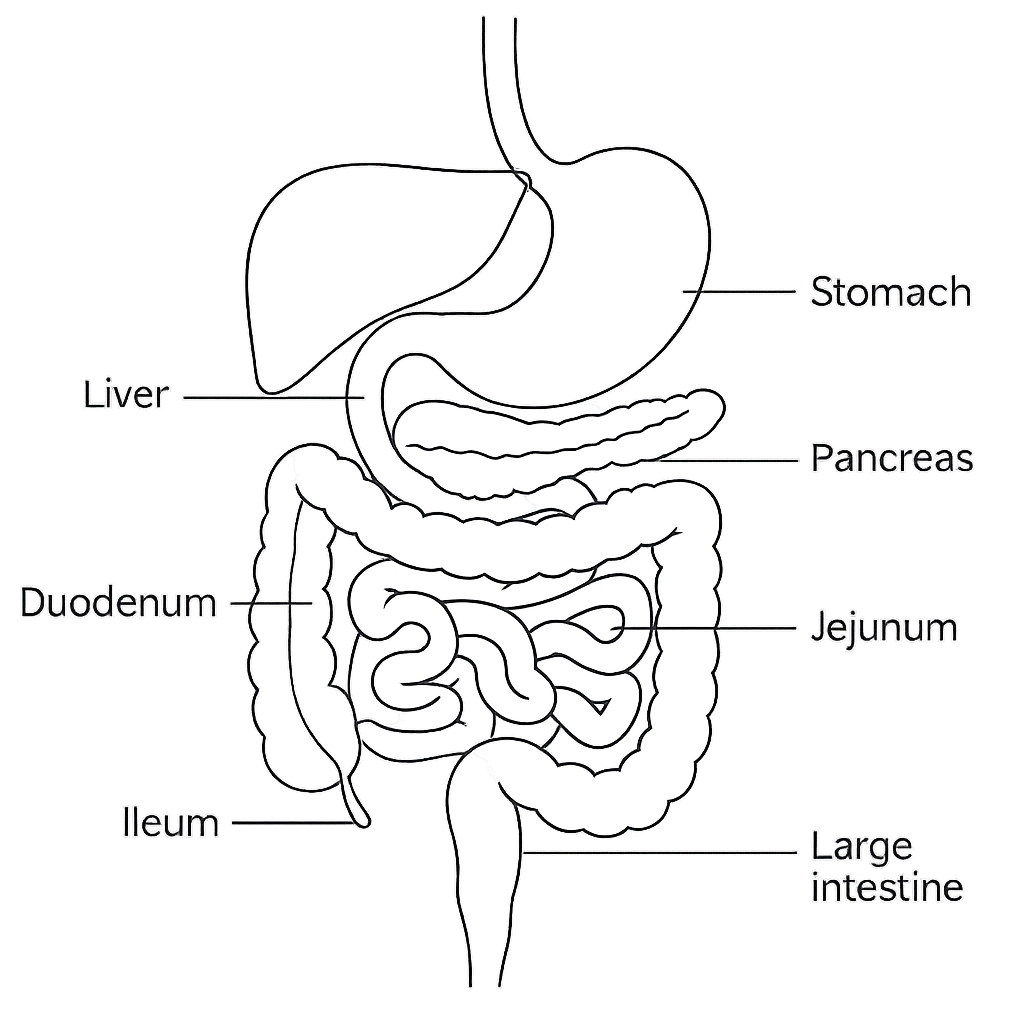
The diagram shows the human digestive system with the labelled sections of the small intestine: duodenum, jejunum and ileum. A particular nutrient is absorbed as follows: \(30\%\) of the nutrient present in the ingested food is absorbed in the duodenum; of the amount that remains, \(40\%\) is absorbed in the jejunum; and of the amount that still remains, \(50\%\) is absorbed in the ileum. If a meal contains \(100\) g of this nutrient, how many grams are absorbed in total?
A. 70 g
Correct B. 79 g
C. 81 g
D. 68 g

Correct Answer: B

Want to see the full step-by-step solution? Unlock AI Explanation & Analytics
Question 7 View Details
A bacterial culture at \(37\) °C doubles every \(20\) min. Starting with \(500\) cells, the culture is grown for \(2\) h at this temperature. Then the temperature is raised to \(45\) °C, which shortens the generation time by \(25\%\) (i.e., the new generation time is \(15\) min). However, at \(45\) °C each generation experiences a \(5\%\) loss of cells due to death. Assuming the culture continues for a further \(3\) h at \(45\) °C, how many viable cells are present at the end of the \(5\)-hour period?
A. 70826077411
B. 70826077400
C. 70826077420
Correct D. 70826077410

Correct Answer: D

Want to see the full step-by-step solution? Unlock AI Explanation & Analytics
Question 8 View Details
In a simple reflex arc, the sensory neuron is \(0.8\) m long and is myelinated, giving a conduction speed of \(120\) m s\(^{-1}\). The motor neuron is \(0.6\) m long and is unmyelinated, with a speed of \(30\) m s\(^{-1}\). Each of the two synapses in the arc introduces a delay of \(0.5\) ms. The total measured reaction time from stimulus to muscle contraction is \(35\) ms. What percentage of the total reaction time is accounted for by the nerve conduction (i.e., the time taken for the impulses to travel along the two neurons)?
A. 90 %
B. 70 %
C. 82 %
Correct D. 76 %

Correct Answer: D

Want to see the full step-by-step solution? Unlock AI Explanation & Analytics
Question 9 View Details
The glomerular filtration rate (GFR) in a kidney is \(120\) mL min\(^{-1}\). Of the filtrate, \(99\%\) of water, \(85\%\) of glucose and \(60\%\) of urea are re‑absorbed. The plasma concentrations of glucose and urea are \(0.9\) g L\(^{-1}\) and \(0.5\) g L\(^{-1}\) respectively. Assuming steady‑state conditions, calculate the concentrations of glucose and urea in the final urine, expressed in mg dL\(^{-1}\).
A. Glucose: 675 mg\/dL; Urea: 1000 mg\/dL
B. Glucose: 2700 mg\/dL; Urea: 4000 mg\/dL
C. Glucose: 1350 mg\/dL; Urea: 1000 mg\/dL
Correct D. Glucose: 1350 mg/dL; Urea: 2000 mg/dL

Correct Answer: D

Want to see the full step-by-step solution? Unlock AI Explanation & Analytics
Question 10 View Details
Estrogen is secreted by the ovarian follicle at a constant rate of \(25\) µg day\(^{-1}\). It is removed from the bloodstream with a first‑order rate constant of \(0.15\) day\(^{-1}\). An LH surge is triggered when the estrogen concentration reaches \(150\) µg. If the initial estrogen concentration is zero, after how many days will the concentration reach the threshold? (Use \(C(t)=\frac{R}{k}\bigl(1-e^{-kt}\bigr)\).)
A. 12.8 days
B. 17.9 days
C. 22.5 days
Correct D. 15.4 days

Correct Answer: D

Want to see the full step-by-step solution? Unlock AI Explanation & Analytics
Question 11 View Details
A cell contains 12 chromosomes. After it completes mitosis and cytokinesis, how many chromosomes are present in each daughter cell?
A. 8
B. 6
C. 24
Correct D. 12

Correct Answer: D

Want to see the full step-by-step solution? Unlock AI Explanation & Analytics
Question 12 View Details
A microscopic organism is described as follows: it is unicellular, possesses a true nucleus, stores excess food as starch, has a cell wall composed of cellulose, reproduces by binary fission, and contains chloroplasts. Identify the kingdom to which it belongs and name the phylum that best fits its characteristics.
A. Kingdom Protista, Phylum Chlorophyta
B. Kingdom Plantae, Phylum Bryophyta
Correct C. Kingdom Plantae, Phylum Chlorophyta
D. Kingdom Fungi, Phylum Ascomycota

Correct Answer: C

Want to see the full step-by-step solution? Unlock AI Explanation & Analytics
Question 13 View Details
An organism is described as follows: it is prokaryotic, its cell wall contains peptidoglycan, it reproduces by binary fission, it obtains carbon from organic compounds, and it has a single circular chromosome. Determine the kingdom to which it belongs and state whether it is an autotroph or a heterotroph.
A. Kingdom Archaea, Heterotroph
Correct B. Kingdom Monera, Heterotroph
C. Kingdom Protista, Heterotroph
D. Kingdom Monera, Autotroph

Correct Answer: B

Want to see the full step-by-step solution? Unlock AI Explanation & Analytics
Question 14 View Details
A cell is observed to have 46 chromosomes, each consisting of two sister chromatids. In which phase of mitosis is the cell most likely to be?
A. Metaphase
Correct B. Prophase
C. Telophase
D. Anaphase

Correct Answer: B

Want to see the full step-by-step solution? Unlock AI Explanation & Analytics
Question 15 View Details
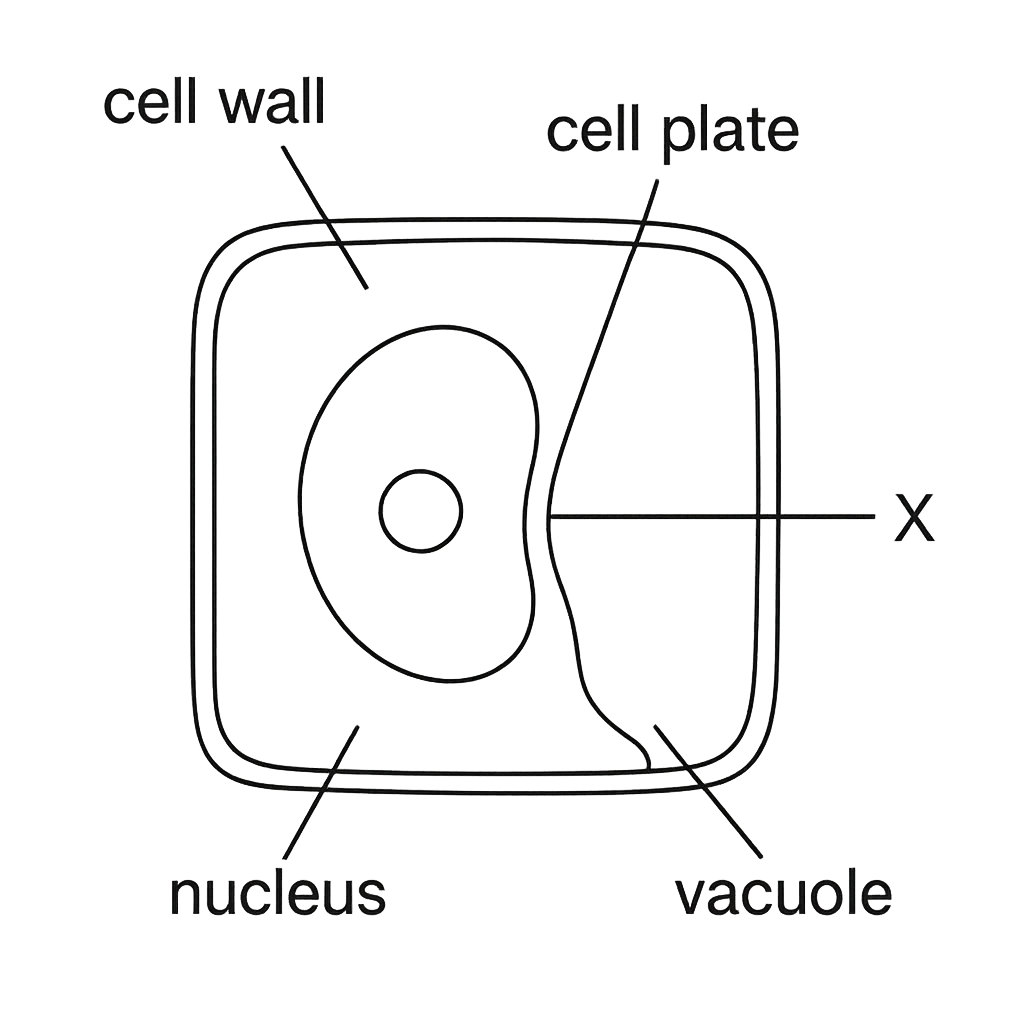
The diagram shows a plant cell undergoing cytokinesis. An arrow labelled X points to a structure that will develop into the new cell wall separating the two daughter cells. What is the structure indicated by X?
Correct A. Cell plate
B. Cell wall
C. Cleavage furrow
D. Phragmoplast

Correct Answer: A

Want to see the full step-by-step solution? Unlock AI Explanation & Analytics
Question 16 View Details
During moderate exercise, a runner's heart rate rises from \(72\) beats per minute to \(138\) beats per minute, and his stroke volume increases from \(68\) mL per beat to \(84\) mL per beat. By what percentage does his cardiac output increase? Give your answer to one decimal place.
A. 150.0
Correct B. 136.8
C. 124.5
D. 98.6

Correct Answer: B

Want to see the full step-by-step solution? Unlock AI Explanation & Analytics
Question 17 View Details
In Lake A, the net primary productivity of the phytoplankton is \(1200\ \text{g C m}^{-2}\text{yr}^{-1}\). Energy is transferred through five trophic levels (including the producers) with an ecological efficiency of 10 % between each successive level. (a) Calculate the total amount of carbon that reaches the top‑carnivore level per square metre per year. (b) If the top‑carnivore population consists of 200 individuals, what is the average carbon content per individual? (c) A second lake, Lake B, has the same primary productivity but an ecological efficiency of 15 % between levels. What is the ratio of carbon reaching the top‑carnivore level in Lake B to that in Lake A? Give your answer to two decimal places.
Correct A. 0.12 g m⁻² yr⁻¹; 0.0006 g per individual; 5.06
B. 1.2 g m⁻² yr⁻¹; 0.006 g per individual; 3.38
C. 0.12 g m⁻² yr⁻¹; 0.0012 g per individual; 5.06
D. 0.012 g m⁻² yr⁻¹; 0.00006 g per individual; 7.59

Correct Answer: A

Want to see the full step-by-step solution? Unlock AI Explanation & Analytics
Question 18 View Details
A population of beetles has two alleles at a locus: \(A\) (green) and \(a\) (brown). The initial allele frequencies are \(p = 0.6\) for \(A\) and \(q = 0.4\) for \(a\). The relative survival (fitness) of the three genotypes is: \(w_{AA}=0.9\), \(w_{Aa}=0.8\), \(w_{aa}=0.5\). After one generation of selection, what are the new allele frequencies \(p'\) and \(q'\)? Give your answers to three decimal places.
A. p' = 0.600, q' = 0.400
B. p' = 0.680, q' = 0.320
C. p' = 0.630, q' = 0.370
Correct D. p' = 0.655, q' = 0.345

Correct Answer: D

Want to see the full step-by-step solution? Unlock AI Explanation & Analytics
Question 19 View Details
A person has a blood sodium concentration of \(145\ \text{mmol L}^{-1}\) and a blood volume of \(5.0\ \text{L}\). They drink \(0.5\ \text{L}\) of pure water (containing no sodium), which mixes instantly with the blood. After 30 minutes, the kidneys excrete \(0.2\ \text{L}\) of urine whose sodium concentration is the same as the blood at that moment. What is the blood sodium concentration after the urine is excreted? Give your answer to one decimal place.
A. 124.5
B. 136.2
C. 130.0
Correct D. 131.8

Correct Answer: D

Want to see the full step-by-step solution? Unlock AI Explanation & Analytics
Question 20 View Details
A spherical animal cell has a diameter of \(20\ \mu\text{m}\). Calculate its surface‑area‑to‑volume ratio in \(\mu\text{m}^{-1}\). Give your answer to one decimal place.
A. 0.5
Correct B. 0.3
C. 0.2
D. 0.4

Correct Answer: B

Want to see the full step-by-step solution? Unlock AI Explanation & Analytics
Question 21 View Details
Mitochondrial DNA of two related bird species differs at 150 nucleotide sites within a 1500‑base‑pair gene. The mutation rate is estimated at \(2 \times 10^{-8}\) per site per generation, and each generation lasts 3 years. Assuming a constant molecular clock and that mutations accumulate independently in each lineage, estimate the number of years since the two species shared a common ancestor.
Correct A. 7.5 \times 10^{6} years (approximately 7.5 million years)
B. 9.0 \times 10^{6} years (approximately 9 million years)
C. 6.0 \times 10^{6} years (approximately 6 million years)
D. 1.5 \times 10^{7} years (approximately 15 million years)

Correct Answer: A

Want to see the full step-by-step solution? Unlock AI Explanation & Analytics
Question 22 View Details
A plant heterozygous for two linked genes A and B (genotype AaBb) in coupling phase (AB/ab) is test‑crossed with a plant homozygous recessive (aabb). Among 2000 offspring the following phenotypes are recorded: 820 tall green, 780 short yellow, 250 tall yellow, and 150 short green.\n\n(a) Calculate the recombination frequency between the two genes and give the map distance in centiMorgans.\n(b) If the recombination frequency were 12 %, what proportion of the offspring would be expected to be tall yellow?
A. (a) 30 % recombination frequency (30 cM); (b) 12 % of the offspring would be tall yellow.
B. (a) 25 % recombination frequency (25 cM); (b) 8 % of the offspring would be tall yellow.
Correct C. (a) 20 % recombination frequency (20 cM); (b) 6 % of the offspring would be tall yellow.
D. (a) 15 % recombination frequency (15 cM); (b) 5 % of the offspring would be tall yellow.

Correct Answer: C

Want to see the full step-by-step solution? Unlock AI Explanation & Analytics
Question 23 View Details
A person has a glomerular filtration rate (GFR) of 120 mL min\(^{-1}\) and a renal plasma flow (RPF) of 600 mL min\(^{-1}\). The hydrostatic pressure in the glomerular capillaries is 45 mmHg and the hydrostatic pressure in Bowman's capsule is 15 mmHg. Plasma protein concentration is 6 g dL\(^{-1}\); the oncotic pressure is directly proportional to protein concentration, with 7 g dL\(^{-1}\) giving 28 mmHg.\n\nCalculate (i) the filtration fraction, and (ii) the net filtration pressure (NFP) using the Starling equation \(\text{NFP}=P_{gc}-P_{bc}-\pi_{gc}\).
A. Filtration fraction = 0.30 (30 %); Net filtration pressure = 10 mmHg
B. Filtration fraction = 0.15 (15 %); Net filtration pressure = 4 mmHg
Correct C. Filtration fraction = 0.20 (20 %); Net filtration pressure = 6 mmHg
D. Filtration fraction = 0.25 (25 %); Net filtration pressure = 8 mmHg

Correct Answer: C

Want to see the full step-by-step solution? Unlock AI Explanation & Analytics
Question 24 View Details
In a grassland ecosystem primary production is 8000 kJ m\(^{-2}\) yr\(^{-1}\). Herbivores convert 10 % of the energy they ingest into biomass, and secondary consumers convert 15 % of the energy they ingest into biomass. The measured herbivore biomass is 150 kJ m\(^{-2}\).\n\n(a) Estimate the biomass of secondary consumers in the grassland.\n\nIn a forest ecosystem primary production is 6000 kJ m\(^{-2}\) yr\(^{-1}\). Herbivores convert 12 % of ingested energy into biomass and secondary consumers convert 20 % of ingested energy into biomass.\n\n(b) Calculate the ratio (as a percentage) of secondary‑consumer biomass to primary production for each ecosystem and state which ecosystem has the higher overall trophic efficiency.
A. (a) 27.0 kJ m^{-2}; (b) Grassland ≈0.35 %; Forest ≈3.0 %; Forest has the higher trophic efficiency.
B. (a) 20.0 kJ m^{-2}; (b) Grassland ≈0.30 %; Forest ≈2.2 %; Grassland has the higher trophic efficiency.
Correct C. (a) 22.5 kJ m^{-2}; (b) Grassland ≈0.28 %; Forest ≈2.4 %; Forest has the higher trophic efficiency.
D. (a) 18.0 kJ m^{-2}; (b) Grassland ≈0.22 %; Forest ≈2.0 %; Forest has the higher trophic efficiency.

Correct Answer: C

Want to see the full step-by-step solution? Unlock AI Explanation & Analytics
Question 25 View Details
Which membrane‑bound organelle is the main site of ATP production in eukaryotic cells through oxidative phosphorylation?
Correct A. Mitochondrion
B. Golgi apparatus
C. Endoplasmic reticulum
D. Chloroplast

Correct Answer: A

Want to see the full step-by-step solution? Unlock AI Explanation & Analytics

Master the Exam!

You've seen a preview, but there are thousands more questions plus AI tutor to break down complex solutions.

Unlock Full Access Available for Android & Windows
Help others prepare! Share this practice hub:
Chat with Support