igcse model questions vol1 2022 biology | Essay

Prepare for your exams with igcse model questions vol1 questions? Reviewing past/model questions is one of the most effective ways to guarantee a high score. This practice hub features authentic 2022 biology (Essay) questions designed to simulate the real exam environment.

Practice these randomly selected questions to test your readiness.
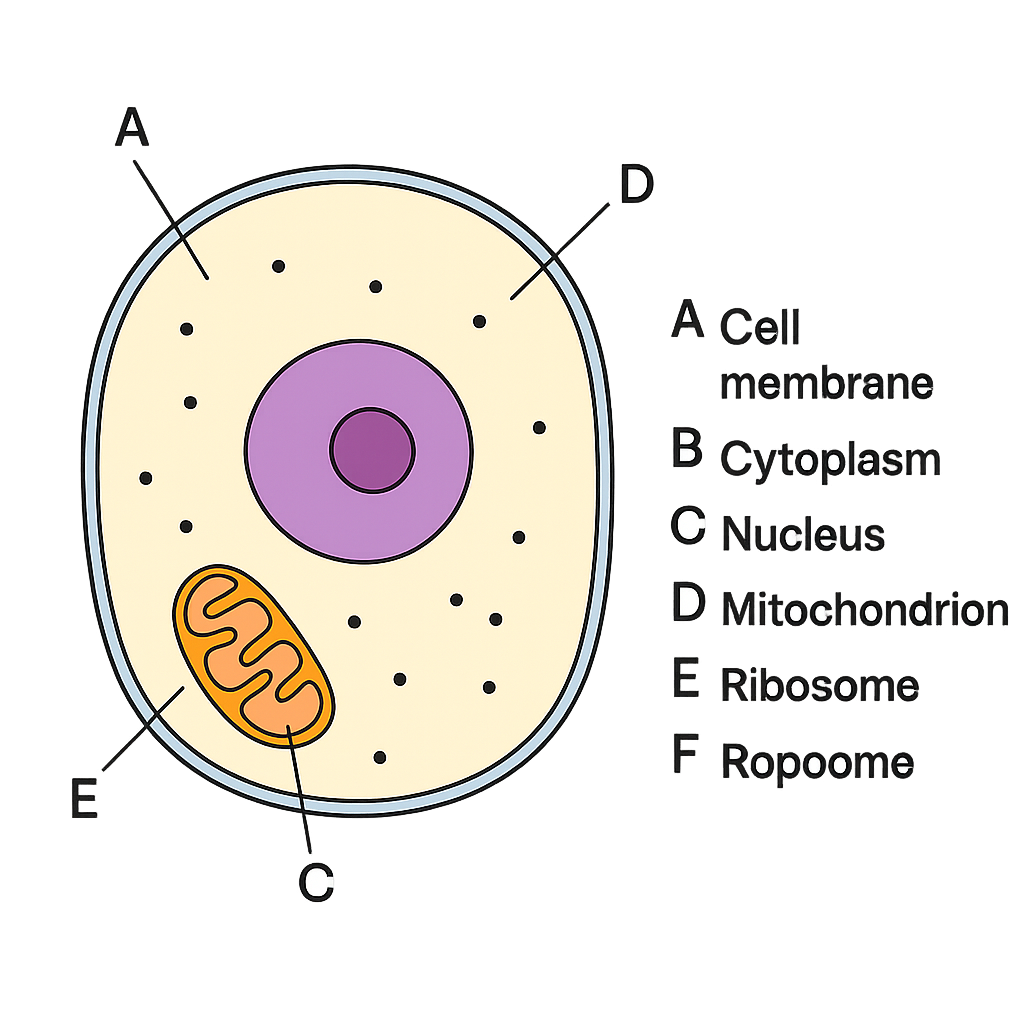
Question 1 View Details
The labelled diagram shows a typical eukaryotic animal cell.
Question Parts
(a)
List six structures that are labelled in the diagram.
(b)
State the main function of each structure you listed in part (a).
(c)
Mention three structural differences between the animal cell shown and a typical plant cell.
Detailed Essay Solution & Marking Scheme Available

Get the step-by-step mathematical proofs, key points required by examiners, and a comprehensive breakdown from our AI Tutor.
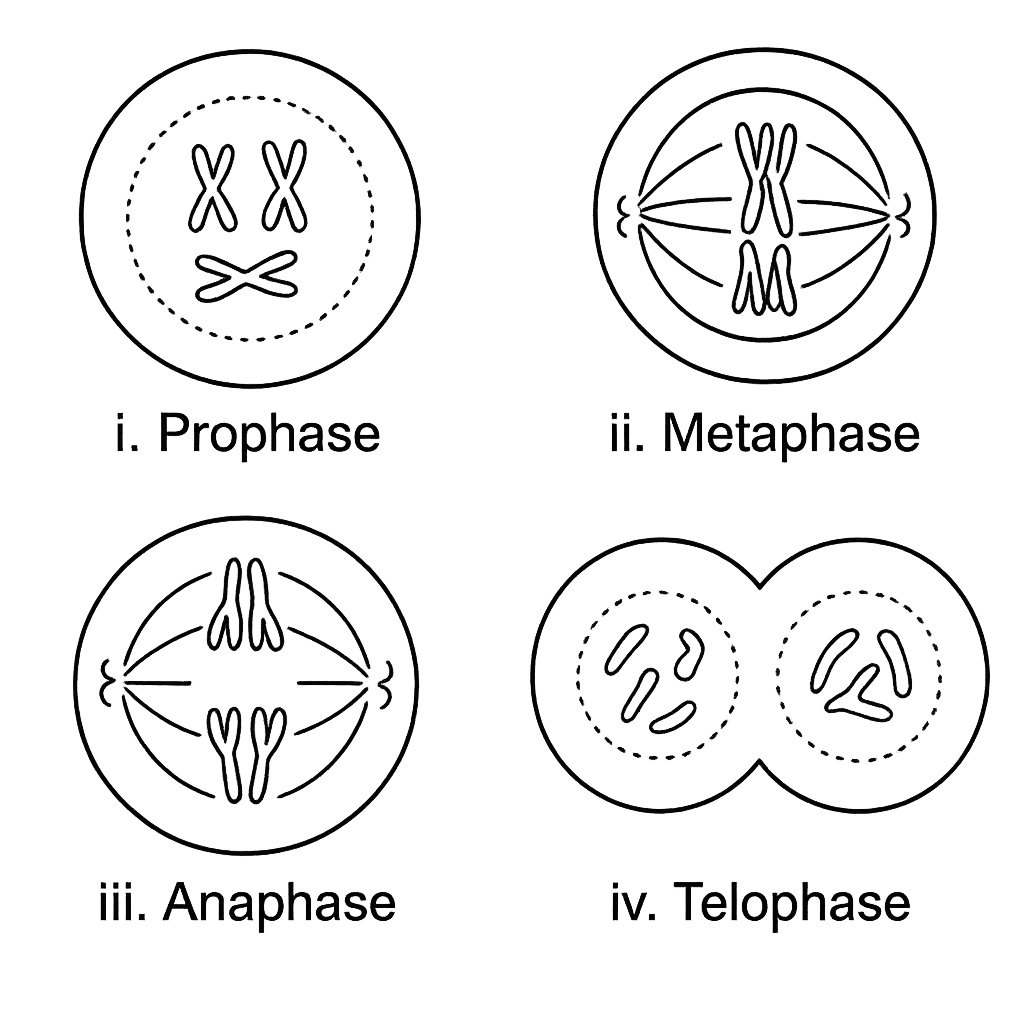
Question 2 View Details
The labelled diagram depicts the sequential stages of mitosis in a eukaryotic cell.
Question Parts
(a)
Identify the stage shown in each of the four labelled panels (i)–(iv).
(b)
For the stage identified in part (a)(i), describe the arrangement of chromosomes and the role of the spindle fibres.
(c)
Explain why accurate chromosome segregation during mitosis is essential for multicellular organisms.
Detailed Essay Solution & Marking Scheme Available

Get the step-by-step mathematical proofs, key points required by examiners, and a comprehensive breakdown from our AI Tutor.
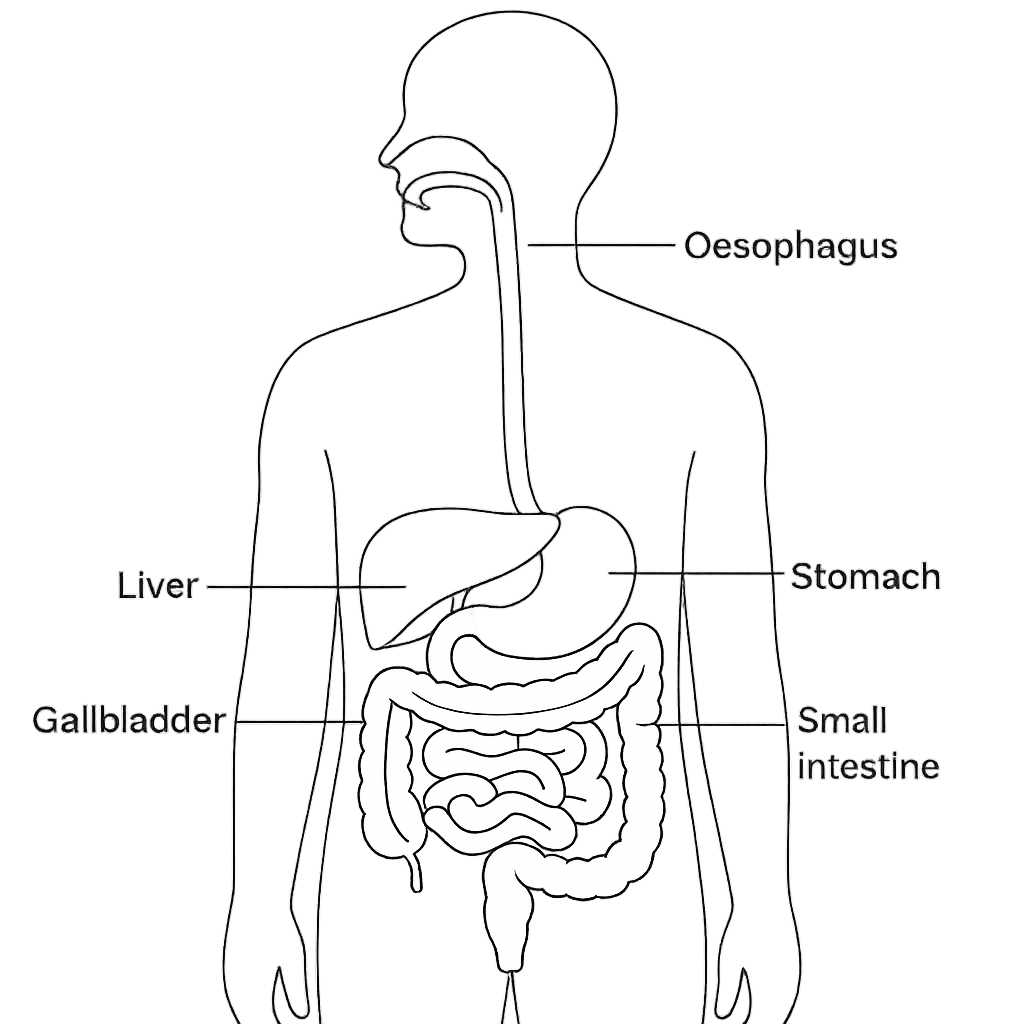
Question 3 View Details
The diagram shows the major parts of the human digestive system.
Question Parts
(a)
Label the following parts on the diagram: mouth, oesophagus, stomach, small intestine, large intestine, liver, pancreas and gallbladder.
(b)
Briefly describe the main function of each labelled part in the process of digestion.
(c)
Explain, in order, how a starch molecule is digested and absorbed, referring to the relevant organs and enzymes.
Detailed Essay Solution & Marking Scheme Available

Get the step-by-step mathematical proofs, key points required by examiners, and a comprehensive breakdown from our AI Tutor.
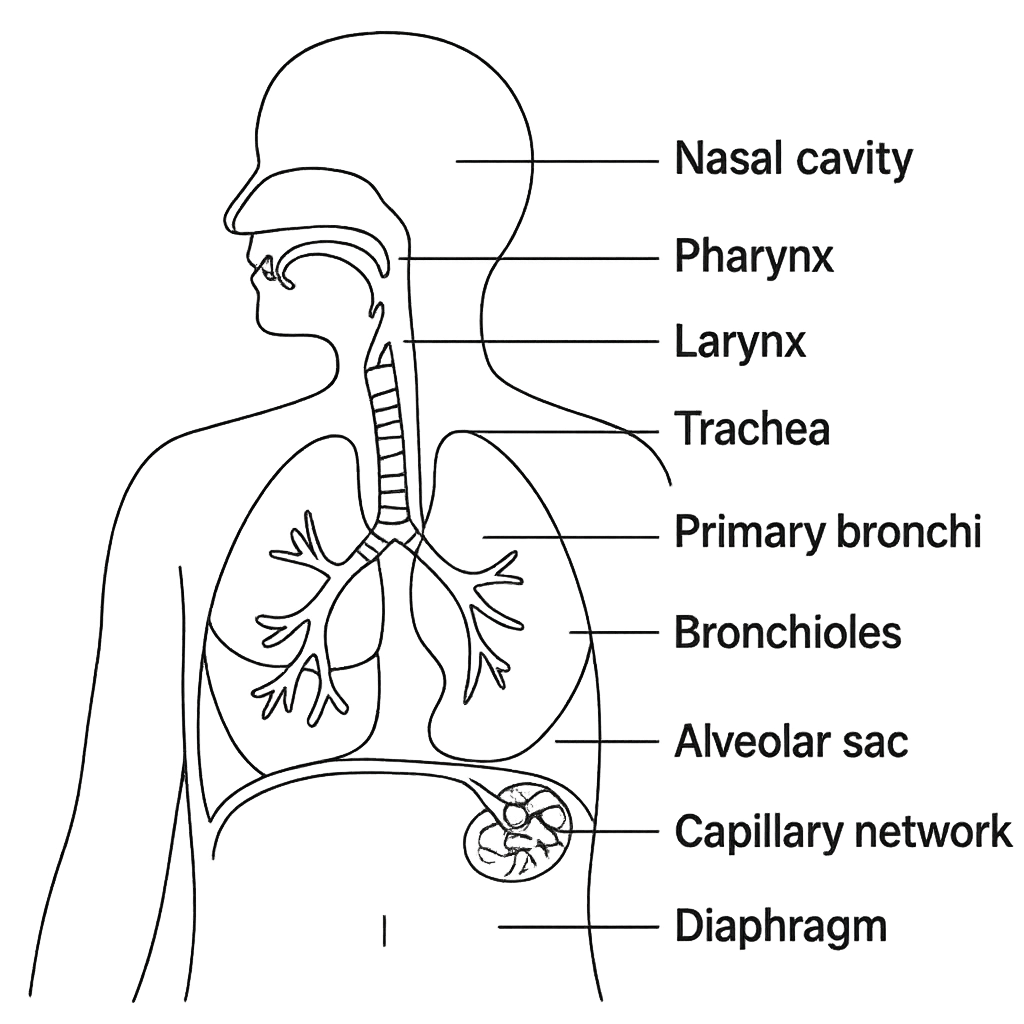
Question 4 View Details
The diagram shows the major structures of the human respiratory system, each labelled as indicated. Using the diagram, answer the following questions.
Question Parts
(a)
Describe the complete pathway that air follows from the external environment to the alveoli, naming each structure that is labelled in the diagram.
(b)
The tidal volume of a healthy adult at rest is 500 mL and the respiratory rate is 12 breaths per minute. The anatomical dead‑space volume is 150 mL. Calculate the alveolar ventilation per minute. Show all working.
(c)
During moderate exercise the tidal volume rises to 800 mL and the respiratory rate to 20 breaths per minute, while dead‑space remains 150 mL. (i) Calculate the new alveolar ventilation per minute. (ii) Explain how this increase in alveolar ventilation enhances the rate of oxygen uptake, referring to the principles of diffusion.
(d)
The diagram also shows the alveolar–capillary membrane. Explain how the structure of this membrane facilitates efficient gas exchange, and discuss two factors that could impair diffusion across it.
Detailed Essay Solution & Marking Scheme Available

Get the step-by-step mathematical proofs, key points required by examiners, and a comprehensive breakdown from our AI Tutor.

Question 5 View Details
A flowering plant is growing in a greenhouse where the temperature is 30 °C and the relative humidity is 40 %. The plant has broad leaves with a waxy cuticle and numerous stomata on the underside of the leaf. The soil water potential is –0.3 MPa and the atmospheric water potential is –1.5 MPa. Answer the following:
Question Parts
(a)
Explain, using the concept of water potential, how water moves from the soil to the leaf mesophyll cells.
(b)
Discuss two structural adaptations of the leaf that help to minimise water loss under the given conditions.
(c)
Predict how a sudden increase in temperature to 35 °C, while humidity remains at 40 %, would affect the rate of transpiration and explain the physiological consequence for the plant.
Detailed Essay Solution & Marking Scheme Available

Get the step-by-step mathematical proofs, key points required by examiners, and a comprehensive breakdown from our AI Tutor.

Question 6 View Details
A healthy adult human kidney filters about 180 L of plasma per day. The final urine volume is approximately 1.5 L per day. Answer the following:
Question Parts
(a)
Describe the three main processes that occur in the nephron to produce urine, indicating where each process takes place.
(b)
Calculate the average concentration factor (the ratio of the concentration of solutes in the final urine to that in the initial filtrate) for this kidney. Show your reasoning.
(c)
Explain how the hormone antidiuretic hormone (ADH) modifies the concentration factor and describe the structural change in the nephron that underlies this effect.
Detailed Essay Solution & Marking Scheme Available

Get the step-by-step mathematical proofs, key points required by examiners, and a comprehensive breakdown from our AI Tutor.

Question 7 View Details
A person has been walking in a hot, dry environment for several hours.
Question Parts
(a)
Explain how the body maintains its internal temperature in this situation. Include the role of the hypothalamus, sweat glands and cutaneous blood vessels.
(b)
Describe two ways in which the kidneys help to conserve water during dehydration.
(c)
The person begins to feel dizzy and faint. Explain the physiological mechanisms that lead to this symptom, linking it to homeostatic control of blood glucose and blood pressure.
Detailed Essay Solution & Marking Scheme Available

Get the step-by-step mathematical proofs, key points required by examiners, and a comprehensive breakdown from our AI Tutor.

Question 8 View Details
A 15‑year‑old student is training for a sprint race and is observed to have a sudden involuntary muscle twitch in the calf after a high‑intensity interval training session.
Question Parts
(a)
Identify the part of the nervous system responsible for rapid, voluntary movement of skeletal muscles and describe its pathway from the brain to the muscle.
(b)
The twitch is due to an accumulation of a particular ion in the extracellular fluid. Name the ion and explain how its concentration is normally regulated during intense exercise.
(c)
Discuss how the neuromuscular junction ensures precise timing of muscle contraction, including the role of neurotransmitter release, receptor activation, and removal.
(d)
The student’s coach wants to improve the student’s coordination. Propose two training methods that enhance neuromuscular coordination, explaining the physiological basis for their effectiveness.
Detailed Essay Solution & Marking Scheme Available

Get the step-by-step mathematical proofs, key points required by examiners, and a comprehensive breakdown from our AI Tutor.

Question 9 View Details
A 20‑year‑old university student, Ama, reports that she has not had a menstrual period for the past three months. She has never been pregnant. Her recent blood tests show the following hormone concentrations: estrogen 150 pg ml⁻¹ (normal luteal phase 200–400 pg ml⁻¹), progesterone 1 ng ml⁻¹ (normal luteal phase 5–20 ng ml⁻¹), FSH 5 IU ml⁻¹ (normal follicular phase 4–10 IU ml⁻¹), LH 2 IU ml⁻¹ (normal follicular phase 2–12 IU ml⁻¹).
Question Parts
(a)
Using the data provided, identify which phase of the menstrual cycle is most likely being disrupted and justify your answer.
(b)
Explain the normal hormonal feedback mechanism that controls the transition from the follicular phase to the luteal phase.
(c)
Based on the likely diagnosis, recommend two appropriate management strategies, explaining the principle behind each.
Detailed Essay Solution & Marking Scheme Available

Get the step-by-step mathematical proofs, key points required by examiners, and a comprehensive breakdown from our AI Tutor.

Question 10 View Details
In a large isolated village, a recessive allele ‘d’ causes a metabolic disorder that is clinically evident only in homozygotes (dd). A recent health survey of 10 000 villagers recorded 30 individuals with the disorder. Blood tests on a random sample of 200 unaffected villagers revealed that 38 of them are carriers (heterozygous, Dd).
Question Parts
(a)
Calculate the allele frequency of d in the population using the data from the random sample. Show all steps.
(b)
Using the Hardy–Weinberg principle, calculate the expected number of affected individuals (dd) and carriers (Dd) in the whole village. Compare these expected numbers with the observed data and discuss two possible reasons for any discrepancy.
Detailed Essay Solution & Marking Scheme Available

Get the step-by-step mathematical proofs, key points required by examiners, and a comprehensive breakdown from our AI Tutor.

Master the Exam!

You've seen a preview, but there are thousands more questions plus AI tutor to break down complex solutions.

Unlock Full Access Available for Android & Windows
Help others prepare! Share this practice hub:
Chat with Support