igcse model questions vol1 2019 biology | Objective

Prepare for your exams with igcse model questions vol1 questions? Reviewing past/model questions is one of the most effective ways to guarantee a high score. This practice hub features authentic 2019 biology (Objective) questions designed to simulate the real exam environment.

Practice these randomly selected questions to test your readiness.

Question 1 View Details
A person's blood glucose concentration falls linearly from 9 mmol L⁻¹ to 6 mmol L⁻¹ over 10 min after a meal. The pancreas secretes insulin at a rate of \(3\ \mu\text{U mL}^{-1}\) per minute for each mmol L⁻¹ that the glucose concentration exceeds 5 mmol L⁻¹. Insulin is removed from the bloodstream at a constant rate of \(5\ \mu\text{U mL}^{-1}\) per minute. Assuming the rates apply continuously, what is the net increase in insulin concentration in the blood after the first 5 minutes? Give your answer to two decimal places (µU mL⁻¹).
A. 30.00
B. 18.75
C. 26.25
Correct D. 23.75

Correct Answer: D

Want to see the full step-by-step solution? Unlock AI Explanation & Analytics
Question 2 View Details
In a population of beetles the allele \(A\) (dominant) confers resistance to a pesticide. The fitnesses of the three genotypes are: \(w_{AA}=1.0\), \(w_{Aa}=0.8\) and \(w_{aa}=0.2\). Initially the allele frequencies are \(p_{0}=0.4\) for \(A\) and \(q_{0}=0.6\) for \(a\). Assuming random mating and that the same fitness values apply each generation, calculate the frequency of allele \(A\) after two successive generations of selection. Give your answer as a decimal to three significant figures.
A. 0.640
Correct B. 0.692
C. 0.580
D. 0.720

Correct Answer: B

Want to see the full step-by-step solution? Unlock AI Explanation & Analytics
Question 3 View Details
A freshwater fish weighs 200 g. It loses water by osmosis at a rate of \(0.2\ \text{mL h}^{-1}\) per gram of body mass and simultaneously gains water through active ion uptake at a rate of \(0.05\ \text{mL h}^{-1}\) per gram. Over a period of 5 hours, what is the net change in the fish's water content (in millilitres)?
A. 170
B. 130
Correct C. 150
D. 200

Correct Answer: C

Want to see the full step-by-step solution? Unlock AI Explanation & Analytics
Question 4 View Details
Two closely related bird species differ in their mitochondrial DNA sequences at 12 % of nucleotide positions. Species A has a molecular‑clock rate of 2 % divergence per million years, whereas species B evolves twice as fast. Assuming the rates have been constant since the two species diverged, estimate the time (in million years) since their most recent common ancestor.
A. 1.5
B. 6
C. 4
Correct D. 2

Correct Answer: D

Want to see the full step-by-step solution? Unlock AI Explanation & Analytics
Question 5 View Details
Diffusion of a solute across a thin membrane follows Fick's first law: \(J = \dfrac{D A}{\Delta x}\,\Delta C\). Given a diffusion coefficient \(D = 1.2 \times 10^{-5}\ \text{cm}^2\text{s}^{-1}\), membrane area \(A = 2.5\ \text{cm}^2\), membrane thickness \(\Delta x = 0.01\ \text{cm}\), and a concentration difference \(\Delta C = 0.04\ \text{mol\,cm}^{-3}\), calculate the rate of diffusion \(J\) in mol s\(^{-1}\). Express your answer in scientific notation to two significant figures.
A. 1.5e-4
Correct B. 1.2e-4
C. 1.0e-4
D. 1.2e-3

Correct Answer: B

Want to see the full step-by-step solution? Unlock AI Explanation & Analytics
Question 6 View Details
A kidney filters (180\ \text{mL}\) of plasma each minute. 99\% of the filtered glucose is re‑absorbed. If the plasma glucose concentration is (5\ \text{mmol\ L}^{-1}\), how many millimoles of glucose are excreted in one hour? Express your answer to two decimal places.
A. 1.08
B. 5.40
C. 0.49
Correct D. 0.54

Correct Answer: D

Want to see the full step-by-step solution? Unlock AI Explanation & Analytics
Question 7 View Details
Organism A is a unicellular eukaryote that possesses chloroplasts, reproduces by binary fission and obtains energy through photosynthesis. Organism B is a multicellular heterotroph lacking cell walls, has specialised tissues and reproduces sexually. Identify the kingdom to which each organism belongs.
A. Organism A - Fungi; Organism B - Animalia
Correct B. Organism A - Plantae; Organism B - Animalia
C. Organism A - Plantae; Organism B - Fungi
D. Organism A - Protista; Organism B - Fungi

Correct Answer: B

Want to see the full step-by-step solution? Unlock AI Explanation & Analytics
Question 8 View Details
A person's urine has an osmolarity of \(800\ \text{mOsm\ L}^{-1}\) and a daily urine volume of \(1.5\ \text{L}\). The kidneys filter \(180\ \text{L}\) of plasma per day, and the plasma osmolarity is \(300\ \text{mOsm\ L}^{-1}\). What percentage of the filtered osmoles are excreted in the urine? Give your answer to one decimal place.
A. 1.9
Correct B. 2.2
C. 4.8
D. 3.1

Correct Answer: B

Want to see the full step-by-step solution? Unlock AI Explanation & Analytics
Question 9 View Details
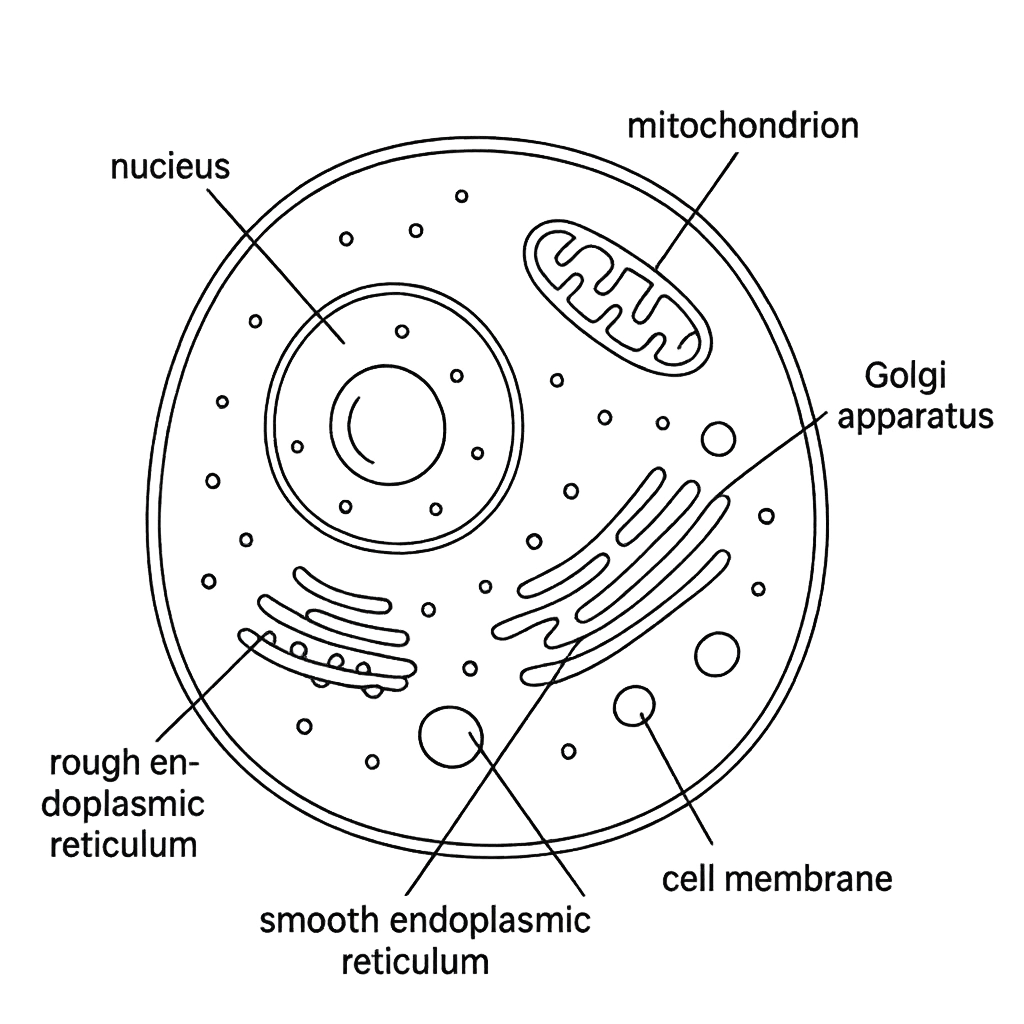
The diagram shows a labelled animal cell containing a nucleus, mitochondrion, ribosome, rough endoplasmic reticulum, Golgi apparatus, lysosome and cell membrane. Which organelle is primarily responsible for modifying proteins that are destined for export from the cell?
Correct A. Golgi apparatus
B. Rough endoplasmic reticulum
C. Lysosome
D. Mitochondrion

Correct Answer: A

Want to see the full step-by-step solution? Unlock AI Explanation & Analytics
Question 10 View Details
In a terrestrial ecosystem, primary producers fix \(12{,}000\ \text{MJ}\) of energy per year. Herbivores convert \(10\%\) of the energy they ingest into their own biomass, and carnivores convert \(20\%\) of the energy they ingest into biomass. If the total biomass of carnivores in the ecosystem is \(150\ \text{MJ}\), estimate the total biomass of herbivores (in MJ), assuming a steady state where all energy not converted is lost as heat.
A. 75
Correct B. 750
C. 1500
D. 600

Correct Answer: B

Want to see the full step-by-step solution? Unlock AI Explanation & Analytics
Question 11 View Details
A resting adult has an oxygen consumption of \(1400\) mL O\(_2\) per minute. Each litre of blood carries \(0.2\) L of O\(_2\). If the heart beats \(70\) times per minute, what stroke volume (in mL per beat) is required to meet the oxygen demand?
A. 70
B. 200
Correct C. 100
D. 140

Correct Answer: C

Want to see the full step-by-step solution? Unlock AI Explanation & Analytics
Question 12 View Details
An organism shows these characteristics: (i) eukaryotic cells with a true nucleus, (ii) cell walls containing chitin, (iii) obtains nutrients by absorption, (iv) reproduces both sexually and asexually, (v) produces basidiospores on club‑shaped structures, (vi) forms a fruiting body commonly known as a mushroom. Identify its kingdom, phylum and class.
A. Kingdom Fungi, Phylum Basidiomycota, Class Zygomycetes
B. Kingdom Fungi, Phylum Ascomycota, Class Agaricomycetes
C. Kingdom Plantae, Phylum Basidiomycota, Class Agaricomycetes
Correct D. Kingdom Fungi, Phylum Basidiomycota, Class Agaricomycetes

Correct Answer: D

Want to see the full step-by-step solution? Unlock AI Explanation & Analytics
Question 13 View Details
State the main function of the ribosome in a eukaryotic cell.
A. Lipid metabolism
B. RNA transcription
Correct C. Protein synthesis
D. DNA replication

Correct Answer: C

Want to see the full step-by-step solution? Unlock AI Explanation & Analytics
Question 14 View Details
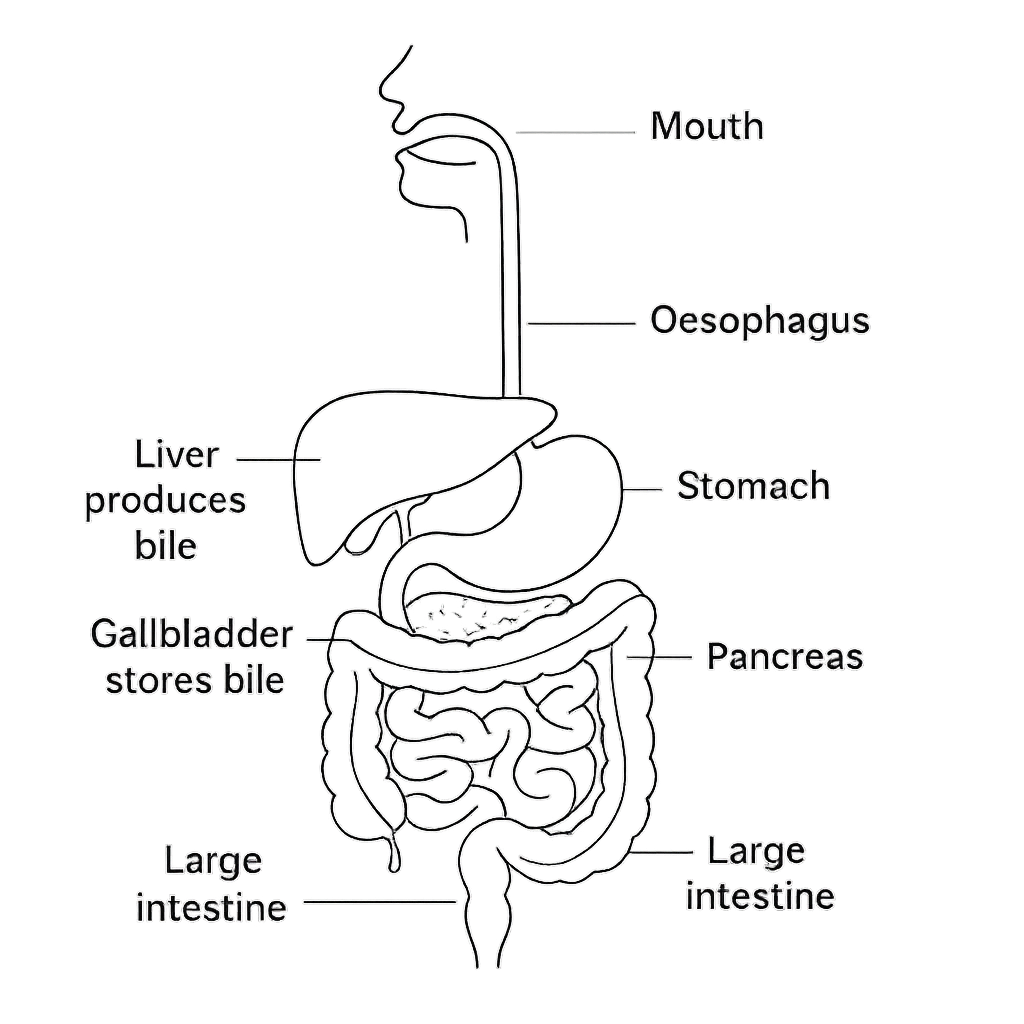
The diagram shows the major parts of the human digestive system. Identify the organ that produces bile and briefly describe its role in the digestion of fats. Then, using the lengths indicated in the diagram (small intestine \(6\) m, large intestine \(1.5\) m, stomach \(0.25\) m, oesophagus \(0.25\) m), calculate the percentage of the total length of the digestive tract that is represented by the small intestine, rounding to the nearest whole number.
A. Pancreas; it secretes enzymes for fat digestion. 65%
B. Gallbladder; it stores bile. 70%
Correct C. Liver; it emulsifies fats. 75%
D. Stomach; it begins protein digestion. 80%

Correct Answer: C

Want to see the full step-by-step solution? Unlock AI Explanation & Analytics
Question 15 View Details
A plant loses water through transpiration at a rate of \(5\) mL per hour per leaf. The plant has \(120\) leaves. The xylem can transport water at a maximum rate of \(0.8\) mL per minute per mm\(^2\) of cross‑sectional area. What is the minimum total cross‑sectional area of xylem (in mm\(^2\)) required to replace the water lost in one hour?
A. 15
Correct B. 12.5
C. 25
D. 750

Correct Answer: B

Want to see the full step-by-step solution? Unlock AI Explanation & Analytics
Question 16 View Details
A reflex arc consists of a sensory neuron (unmyelinated) and a motor neuron (myelinated). The total length of the two neurons combined is 0.30 m, with the sensory neuron being twice as long as the motor neuron. The conduction velocity in a myelinated axon is given by \(v = 5d\) (m s⁻¹) where \(d\) is the fibre diameter in µm, and in an unmyelinated axon \(v = 0.6d\). The motor neuron's fibre diameter is 8 µm. The measured total time for the reflex impulse to travel from the receptor to the effector is 5 ms. Determine the fibre diameter of the sensory neuron (in µm, to three significant figures).
A. 120 µm
B. 166 µm
Correct C. 133 µm
D. 150 µm

Correct Answer: C

Want to see the full step-by-step solution? Unlock AI Explanation & Analytics
Question 17 View Details
Two genes, \(A\) and \(B\), are linked on the same chromosome with a recombination frequency of 12 %. A plant heterozygous for both genes (genotype \(AaBb\)) is in the coupling phase (chromosomes \(AB\) and \(ab\)). The plant is self‑fertilised.\ (a) What percentage of the offspring are expected to show a recombinant phenotype (i.e. \(Ab\) or \(aB\))?\ (b) If 200 seeds are obtained, how many of them are expected to display a recombinant phenotype? Give your answer to the nearest whole seed.
A. ≈10.0 % (about 20 of 200 seeds)
B. ≈12.0 % (about 24 of 200 seeds)
C. ≈13.5 % (about 27 of 200 seeds)
Correct D. ≈11.3 % (about 23 of 200 seeds)

Correct Answer: D

Want to see the full step-by-step solution? Unlock AI Explanation & Analytics
Question 18 View Details
A plant cell diagram shows an organelle that (i) is bounded by a double membrane, (ii) contains its own circular DNA molecules, and (iii) houses pigment molecules that capture light energy for photosynthesis. Which organelle is being described?
A. mitochondrion
Correct B. chloroplast
C. nucleus
D. vacuole

Correct Answer: B

Want to see the full step-by-step solution? Unlock AI Explanation & Analytics
Question 19 View Details
At rest a student's cardiac output is 5.0 L min⁻¹ with a heart rate of 70 beats min⁻¹. During moderate exercise the heart rate rises to 110 beats min⁻¹ and the cardiac output increases to 9.0 L min⁻¹. Assuming the increase in stroke volume is the same for each beat, calculate the increase in stroke volume (in millilitres per beat) from rest to exercise.
Correct A. ≈10 ml
B. ≈15 ml
C. ≈20 ml
D. ≈5 ml

Correct Answer: A

Want to see the full step-by-step solution? Unlock AI Explanation & Analytics
Question 20 View Details
A simple reflex arc consists of a sensory neuron, a single interneuron and a motor neuron. The measured total response time from stimulus to muscle contraction is 12 ms. The conduction velocities are 50 m s⁻¹ for the sensory neuron (which travels 0.20 m) and 60 m s⁻¹ for the motor neuron (which travels 0.30 m). Each chemical synapse introduces a delay of 0.5 ms.\ (a) Is the measured time consistent with the given parameters?\ (b) If not, calculate the additional delay required and state how many extra synaptic delays (each 0.5 ms) this corresponds to.
A. No; an extra 3 ms delay is needed, equivalent to six additional synaptic delays.
Correct B. No; an extra 2 ms delay is needed, equivalent to four additional synaptic delays.
C. No; an extra 2 ms delay is needed, equivalent to three additional synaptic delays.
D. No; an extra 1 ms delay is needed, equivalent to two additional synaptic delays.

Correct Answer: B

Want to see the full step-by-step solution? Unlock AI Explanation & Analytics
Question 21 View Details
Grass in a savanna produces 20\,000\,kJ of chemical energy per day. Two herbivore species feed on the grass. Species A receives \(10\%\) of the grass energy and each individual of species A requires 150\,kJ per day. Species B receives \(6\%\) of the grass energy and each individual of species B requires 300\,kJ per day. The remaining herbivore energy that is actually consumed (i.e., after accounting for the integer numbers of individuals) is available to a carnivore species (hawks). Hawks obtain \(25\%\) of the total energy consumed by the two herbivore species and each hawk needs 600\,kJ per day. Assuming the herbivore populations are as large as possible given the energy they receive, what is the maximum number of hawks that can be sustained?
Correct A. 1
B. 3
C. 2
D. 0

Correct Answer: A

Want to see the full step-by-step solution? Unlock AI Explanation & Analytics
Question 22 View Details
Two genes, A (tall, dominant) and B (purple flowers, dominant), are located on the same chromosome with a recombination frequency of \(10\%\). A plant heterozygous for both genes (genotype AaBb) is crossed with a plant homozygous recessive (aabb). How many of the 2000 offspring are expected to be tall with white flowers?
A. 80
Correct B. 100
C. 120
D. 200

Correct Answer: B

Want to see the full step-by-step solution? Unlock AI Explanation & Analytics
Question 23 View Details
At rest a person produces metabolic heat at a rate of 100\,W. The ambient temperature is 35\,°C and the core body temperature is 37\,°C. Heat can be lost by radiation (\(5\ \text{W/°C}\) per degree difference), convection (\(3\ \text{W/°C}\) per degree difference) and evaporative cooling from sweating, which can remove up to 80\,W when sweating at its maximum rate. If the body uses radiation and convection together to dissipate exactly 60\,W, what fraction of the maximum sweating rate is required to maintain thermal balance?
A. 0.4
B. 0.6
C. 0.75
Correct D. 0.5

Correct Answer: D

Want to see the full step-by-step solution? Unlock AI Explanation & Analytics
Question 24 View Details
An \(E.\,coli\) culture grows exponentially at 37\,°C. During the exponential phase the population doubles every \(g\) minutes. After 2\,h of incubation the culture contains \(1.6 \times 10^{9}\) cells. At that moment an antibiotic is added that reduces the growth rate by 40\% (i.e., the effective generation time becomes \(g' = \frac{g}{0.6}\)). After a further 3\,h the population is measured at \(5.12 \times 10^{9}\) cells. Assuming exponential growth throughout, determine the original generation time \(g\) (in minutes) before the antibiotic was added. Give your answer rounded to the nearest whole minute.
A. 48
B. 80
C. 72
Correct D. 64

Correct Answer: D

Want to see the full step-by-step solution? Unlock AI Explanation & Analytics
Question 25 View Details
In a closed community of 5\,000 people an outbreak of a respiratory infection occurs. The first case appears on day 0. By day 7 there are 150 new cases, by day 14 there are 600 new cases and by day 21 there are 1\,800 new cases. Assume the infection follows a discrete generation model with a generation length of 7 days, so that the number of new cases in each generation follows \(C_{n+1}=R_{0}\,C_{n}\). Using the data from generations 1 to 3, estimate the basic reproduction number \(R_{0}\) (give your answer to two decimal places). Then, if a vaccination programme reduces the proportion of susceptibles to 30 % before the outbreak, would the outbreak be expected to grow? (Answer "yes" if the effective reproduction number \(R_{e}=R_{0}\times S\) is greater than 1, otherwise "no".) Provide the value of \(R_{0}\) and the yes/no answer.
A. R0 = 4.10; outbreak would grow: yes
B. R0 = 3.00; outbreak would grow: no
Correct C. R0 = 3.50; outbreak would grow: yes
D. R0 = 2.80; outbreak would grow: no

Correct Answer: C

Want to see the full step-by-step solution? Unlock AI Explanation & Analytics

Master the Exam!

You've seen a preview, but there are thousands more questions plus AI tutor to break down complex solutions.

Unlock Full Access Available for Android & Windows
Help others prepare! Share this practice hub:
Chat with Support