igcse model questions vol1 2017 biology | Objective

Prepare for your exams with igcse model questions vol1 questions? Reviewing past/model questions is one of the most effective ways to guarantee a high score. This practice hub features authentic 2017 biology (Objective) questions designed to simulate the real exam environment.

Practice these randomly selected questions to test your readiness.

Question 1 View Details
Plant A has leaves with a total surface area of \(150\ \text{cm}^2\) and an average leaf thickness of \(0.2\ \text{cm}\). Its roots extend to a depth of \(30\ \text{cm}\). Plant B has leaves with a total surface area of \(80\ \text{cm}^2\) and an average thickness of \(0.1\ \text{cm}\); its roots reach \(80\ \text{cm}\) depth. In a desert where rainfall infiltrates the soil to a depth of \(60\ \text{cm}\) and water is otherwise unavailable, which plant is more likely to survive? Explain your reasoning.
A. Plant A
B. Both plants equally likely
C. Neither plant
Correct D. Plant B

Correct Answer: D

Want to see the full step-by-step solution? Unlock AI Explanation & Analytics
Question 2 View Details
Three microorganisms are described as follows:\n\n- Organism X: cell wall contains peptidoglycan; membrane lipids are ester‑linked fatty acids; it metabolises glucose aerobically.\n- Organism Y: lacks a peptidoglycan cell wall; its membrane lipids are ether‑linked isoprenoids; it obtains energy by methanogenesis.\n- Organism Z: possesses a nucleus, membrane‑bound organelles and chloroplasts; it performs photosynthesis.\n\nClassify each organism into the correct domain (Bacteria, Archaea, or Eukarya). Then, considering that halophilic (high‑salt) environments favour organisms with ether‑linked membrane lipids, indicate which of the three is most likely to survive in a habitat containing \(15\%\) (w/v) NaCl.
A. X: Bacteria; Y: Eukarya; Z: Archaea; most likely to survive in 15% NaCl: Organism X
Correct B. X: Bacteria; Y: Archaea; Z: Eukarya; most likely to survive in 15% NaCl: Organism Y
C. X: Archaea; Y: Bacteria; Z: Eukarya; most likely to survive in 15% NaCl: Organism Z
D. X: Bacteria; Y: Archaea; Z: Eukarya; most likely to survive in 15% NaCl: Organism Z

Correct Answer: B

Want to see the full step-by-step solution? Unlock AI Explanation & Analytics
Question 3 View Details
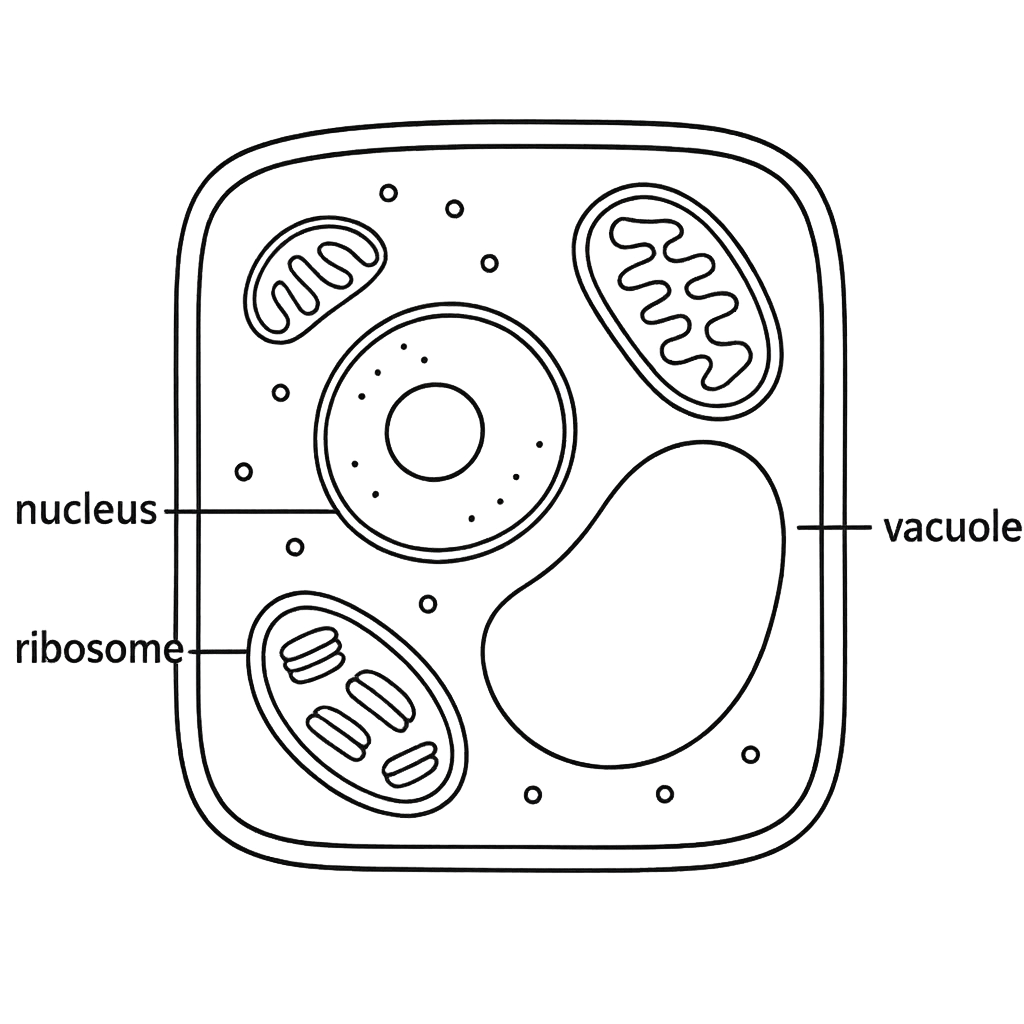
Refer to the labelled diagram of a plant cell. Which organelle shown is the site of photosynthesis?
Correct A. chloroplast
B. mitochondrion
C. ribosome
D. vacuole

Correct Answer: A

Want to see the full step-by-step solution? Unlock AI Explanation & Analytics
Question 4 View Details
The glomerular filtration rate in a human kidney is \(120\ \text{mL min}^{-1}\). Approximately \(99\%\) of the filtered water is re‑absorbed back into the bloodstream. Assuming no other losses, calculate the volume of urine produced in one hour.
A. 120
B. 60
C. 84
Correct D. 72

Correct Answer: D

Want to see the full step-by-step solution? Unlock AI Explanation & Analytics
Question 5 View Details
In a species with an X‑linked recessive disorder, a female carrier (genotype \(X^{N}X^{r}\)) mates with an unaffected male (\(X^{N}Y\)). What is the probability that a son will be affected by the disorder? What is the probability that a daughter will be a carrier? Express each probability as a fraction.
A. Son affected: 0; Daughter carrier: 1/2
B. Son affected: 1/4; Daughter carrier: 1/2
C. Son affected: 1/2; Daughter carrier: 1/4
Correct D. Son affected: 1/2; Daughter carrier: 1/2

Correct Answer: D

Want to see the full step-by-step solution? Unlock AI Explanation & Analytics
Question 6 View Details
A meal contains 250 g of food. Laboratory analysis shows that (40\%\) of the mass is carbohydrate, (25\%\) protein and (20\%\) fat, the remainder being water and fibre which provide no calories. Using the energy values 4 kcal g\(^{-1}\) for carbohydrate and protein and 9 kcal g\(^{-1}\) for fat, calculate the total energy supplied by the meal in kilocalories.
A. 950
B. 1150
Correct C. 1100
D. 1000

Correct Answer: C

Want to see the full step-by-step solution? Unlock AI Explanation & Analytics
Question 7 View Details
The body temperature \(T_b\) of a certain reptile varies linearly with the ambient temperature \(T_a\) according to the relation \(T_b = 0.6\,T_a + 5\) (°C). If the ambient temperature falls from \(30^{\circ}\text{C}\) to \(20^{\circ}\text{C}\), by how many degrees Celsius does the reptile's body temperature change?
Correct A. 6
B. 4
C. 5
D. 7

Correct Answer: A

Want to see the full step-by-step solution? Unlock AI Explanation & Analytics
Question 8 View Details
In a simple reflex arc, the sensory neuron conducts an impulse a distance of 0.8 m to the spinal cord at a speed of 50 m s\(^{-1}\). The motor neuron then conducts the impulse a further 0.5 m to the effector muscle at 60 m s\(^{-1}\). Each synapse in the pathway introduces a delay of 0.5 ms. Calculate the total time from the initial stimulus to the onset of muscle contraction, giving your answer in milliseconds to one decimal place.
A. 24.8
B. 26.3
Correct C. 25.3
D. 25.0

Correct Answer: C

Want to see the full step-by-step solution? Unlock AI Explanation & Analytics
Question 9 View Details
Diffusion of a solute across a capillary wall follows Fick's law: rate \(= \dfrac{D A \Delta C}{d}\). Given diffusion coefficient \(D = 1.0 \times 10^{-5}\,\text{cm}^2\text{s}^{-1}\), surface area \(A = 0.20\,\text{cm}^2\), concentration difference \(\Delta C = 0.5\,\text{mol cm}^{-3}\) and wall thickness \(d = 0.01\,\text{cm}\), calculate the percentage change in the diffusion rate if the wall thickness doubles.
Correct A. 50
B. 75
C. 25
D. 0

Correct Answer: A

Want to see the full step-by-step solution? Unlock AI Explanation & Analytics
Question 10 View Details
Two bacterial species, A and B, are cultured at \(37^{\circ}\text{C}\). Both start from an inoculum of \(2.0 \times 10^{5}\) cells. After 2 hours the populations are \(1.6 \times 10^{6}\) cells for species A and \(2.0 \times 10^{6}\) cells for species B. Assuming exponential growth, determine which species has the shorter generation time and calculate that generation time in minutes (round to the nearest whole minute). Give your answer in the form "Species X, Y minutes".
A. Species B, 48 minutes
Correct B. Species B, 36 minutes
C. Species A, 45 minutes
D. Species A, 30 minutes

Correct Answer: B

Want to see the full step-by-step solution? Unlock AI Explanation & Analytics
Question 11 View Details
At rest a person has a tidal volume of 500 mL and a respiratory rate of 20 breaths min⁻¹. The anatomical dead‑space volume is 150 mL. During moderate exercise the tidal volume increases by 20 % and the respiratory rate rises to 30 breaths min⁻¹, while the proportion of dead‑space to tidal volume remains unchanged. Calculate the percentage increase in alveolar ventilation from rest to exercise.
A. 40%
B. 100%
C. 60%
Correct D. 80%

Correct Answer: D

Want to see the full step-by-step solution? Unlock AI Explanation & Analytics
Question 12 View Details
Two beetle species have a 1500‑base‑pair mitochondrial DNA fragment. Sequencing shows 45 nucleotide differences between them. The mutation rate is 2 × 10⁻⁸ per site per generation. Species A has an average generation time of 0.5 years, while species B averages 1 year. Assuming mutations accumulate equally in both lineages, estimate the time since the two species diverged, expressed in millions of years (to two decimal places).
A. 0.78
Correct B. 0.56
C. 1.12
D. 0.45

Correct Answer: B

Want to see the full step-by-step solution? Unlock AI Explanation & Analytics
Question 13 View Details
In peas, gene A (tall T vs dwarf t) and gene B (green pod G vs yellow pod g) are linked on the same chromosome with a recombination frequency of 10 %. A plant heterozygous in coupling phase (genotype Tt Gg, gametes AB/ab) is crossed with a plant homozygous recessive (tt gg). What percentage of the offspring are expected to be tall with yellow pods?
A. 10%
Correct B. 5%
C. 2.5%
D. 15%

Correct Answer: B

Want to see the full step-by-step solution? Unlock AI Explanation & Analytics
Question 14 View Details
In a community 2000 people are vaccinated against disease X and 2000 are not. During one year 30 vaccinated individuals and 120 unvaccinated individuals develop the disease. (a) Calculate the relative risk (RR) of disease for the vaccinated group. (b) Using VE = (1 - RR) × 100 %, determine the vaccine efficacy. (c) If a new strain reduces the vaccine's efficacy by 25 % of the original efficacy, how many cases would be expected among 2000 vaccinated people, assuming the same exposure risk as before? Give the answer rounded to the nearest whole number.
A. 40
B. 75
C. 65
Correct D. 53

Correct Answer: D

Want to see the full step-by-step solution? Unlock AI Explanation & Analytics
Question 15 View Details
A daily diet supplies 2500 kJ and contains 60 g carbohydrate, 70 g protein and 80 g fat. The digestibility (absorption efficiency) is 95 % for carbohydrate, 90 % for protein and 98 % for fat. (a) Calculate the total usable energy (kJ) from the diet. (b) What percentage of the usable energy is supplied by protein? (c) The recommended protein energy percentage for an adult is 15 %. Does this diet meet the recommendation? Answer "yes" or "no".
A. maybe
B. unsure
Correct C. yes
D. no

Correct Answer: C

Want to see the full step-by-step solution? Unlock AI Explanation & Analytics
Question 16 View Details
A plant cell has a total volume of \(5000\ \mu\text{m}^3\). Its central vacuole occupies 60 % of the cell volume. What is the volume of the cytoplasm (in \(\mu\text{m}^3\))?
A. 3000 \(\mu\text{m}^3\)
Correct B. 2000 \(\mu\text{m}^3\)
C. 1500 \(\mu\text{m}^3\)
D. 2500 \(\mu\text{m}^3\)

Correct Answer: B

Want to see the full step-by-step solution? Unlock AI Explanation & Analytics
Question 17 View Details
A bacterial culture grows exponentially. After 2 h the population is \(5\times10^{6}\) cells and after 5 h it is \(4\times10^{7}\) cells. (a) Assuming a constant growth rate, calculate the doubling time in minutes. (b) If an antibiotic reduces the growth rate by 30 %, what is the population after 5 h under the antibiotic?
A. Doubling time = 60 minutes; population ≈ 9.0×10⁶ cells
Correct B. Doubling time = 60 minutes; population ≈ 1.4×10⁷ cells
C. Doubling time = 80 minutes; population ≈ 1.0×10⁷ cells
D. Doubling time = 45 minutes; population ≈ 2.0×10⁷ cells

Correct Answer: B

Want to see the full step-by-step solution? Unlock AI Explanation & Analytics
Question 18 View Details
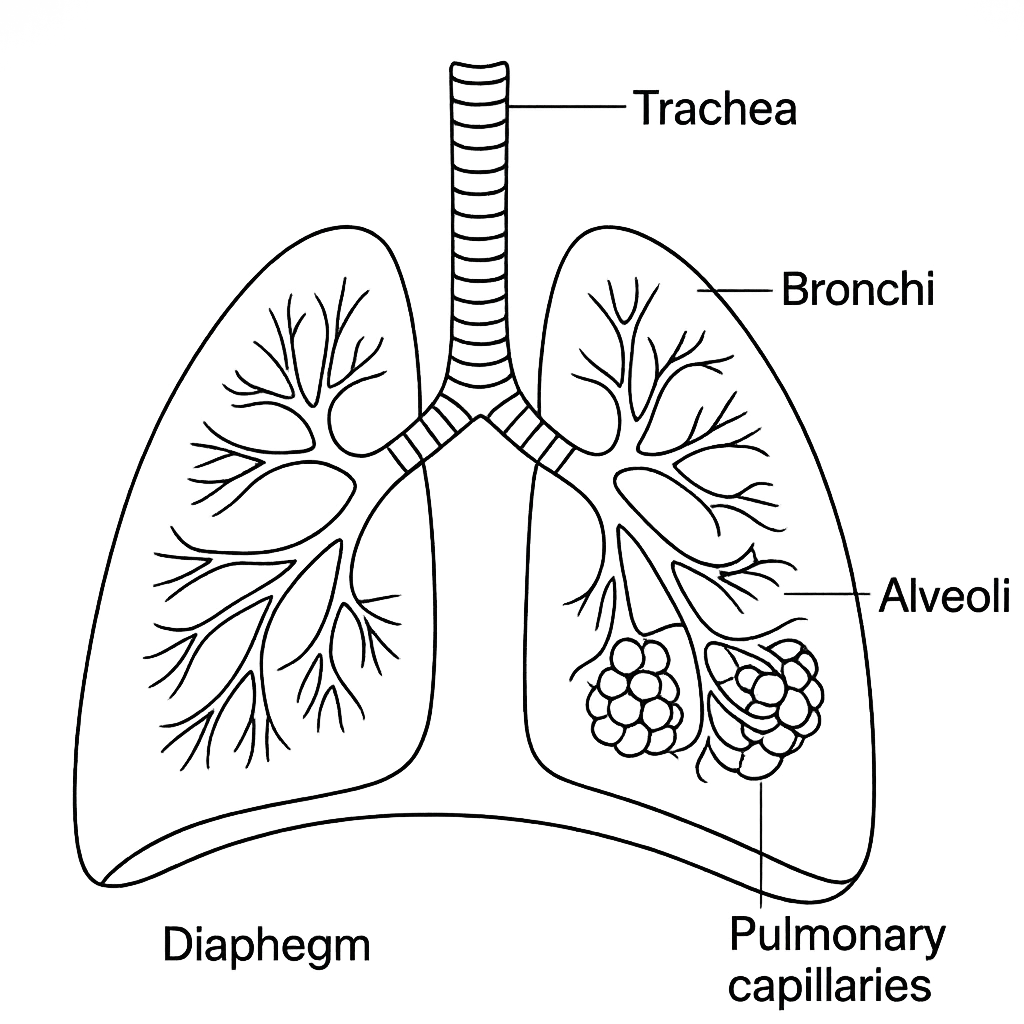
The labelled diagram shows the human respiratory system. In a healthy adult at rest the partial pressure difference for O₂ between alveolar air and pulmonary capillary blood is 60 mmHg. The rate of O₂ diffusion (\(R\)) is directly proportional to the alveolar surface area (\(A\)) and inversely proportional to the membrane thickness (\(T\)): \(R\propto \frac{A}{T}\). A disease reduces the alveolar surface area by 30 % and increases the membrane thickness by 20 % while the pressure difference remains unchanged. By what percentage does the rate of O₂ diffusion change compared with normal?
A. Increases by about 10 % (new rate ≈ 110 % of normal)
B. Decreases by about 30 % (new rate ≈ 70 % of normal)
C. Decreases by about 55 % (new rate ≈ 45 % of normal)
Correct D. Decreases by about 42 % (new rate ≈ 58 % of normal)

Correct Answer: D

Want to see the full step-by-step solution? Unlock AI Explanation & Analytics
Question 19 View Details
In a plant, the water potential of the soil is \(-0.2\) MPa. The root cells have a solute potential of \(-0.5\) MPa and generate a pressure potential of \(+0.3\) MPa. The leaf water potential is \(-0.8\) MPa. (a) Calculate the water potential of the root cells. (b) Determine the net driving force for water movement from the root to the leaf. (c) State the direction of water movement.
A. Root \(\Psi = -0.5\) MPa; driving force = 0.3 MPa; water moves upward from root to leaf.
Correct B. Root \(\Psi = -0.2\) MPa; driving force = 0.6 MPa; water moves upward from root to leaf.
C. Root \(\Psi = -0.2\) MPa; driving force = 0.6 MPa; water moves downward from leaf to root.
D. Root \(\Psi = -0.1\) MPa; driving force = 0.9 MPa; water moves upward from root to leaf.

Correct Answer: B

Want to see the full step-by-step solution? Unlock AI Explanation & Analytics
Question 20 View Details
A newly isolated microorganism shows the following characteristics: (i) cell wall composed of peptidoglycan, (ii) reproduces by binary fission, (iii) lacks membrane‑bound organelles, (iv) can grow in environments containing up to 15 % NaCl, (v) stains Gram‑positive. Using IGCSE classification criteria, give the most specific taxonomic hierarchy that can be assigned to this organism (Domain, Kingdom, Phylum, Class).
A. Domain Bacteria; Kingdom Monera; Phylum Firmicutes; Class Clostridia
Correct B. Domain Bacteria; Kingdom Monera; Phylum Firmicutes; Class Bacilli
C. Domain Archaea; Kingdom Archaea; Phylum Euryarchaeota; Class Halobacteria
D. Domain Bacteria; Kingdom Monera; Phylum Actinobacteria; Class Bacilli

Correct Answer: B

Want to see the full step-by-step solution? Unlock AI Explanation & Analytics
Question 21 View Details
Two rodent species live in different habitats. The desert species has a body approximated by a cylinder 12 cm long and 3 cm in diameter, and each ear is a thin disc of radius 2 cm and thickness 0.2 cm. The rainforest species has a body cylinder 10 cm long and 4 cm in diameter, and each ear is a disc of radius 1 cm and thickness 0.2 cm. Heat loss is proportional to the total ear surface area divided by body volume. Which species loses heat faster?
A. Both species lose heat at the same rate (identical ear‑surface‑area‑to‑body‑volume ratios).
Correct B. The desert rodent loses heat faster (higher ear‑surface‑area‑to‑body‑volume ratio).
C. The rainforest rodent loses heat faster (higher ear‑surface‑area‑to‑body‑volume ratio).
D. The desert rodent loses heat faster (greater body volume relative to ear surface area).

Correct Answer: B

Want to see the full step-by-step solution? Unlock AI Explanation & Analytics
Question 22 View Details
A plant cell contains a large central vacuole that occupies about 80 % of the cell's volume. Explain how this vacuole contributes to maintaining turgor pressure in the cell.
A. By secreting lignin into the cell wall, the vacuole reinforces structural rigidity, contributing to turgor pressure.
B. By producing ATP, the vacuole powers ion pumps that stiffen the cell wall, maintaining turgor pressure.
Correct C. By storing water and solutes, the vacuole creates an osmotic gradient that draws water in, expanding the vacuole and pressing against the cell wall; this outward force is the turgor pressure that keeps the cell rigid.
D. By generating heat through metabolic reactions, the vacuole raises internal temperature, which increases turgor pressure.

Correct Answer: C

Want to see the full step-by-step solution? Unlock AI Explanation & Analytics
Question 23 View Details
In a laboratory experiment a frog's blood plasma contains urea at a concentration of 5 mmol L⁻¹. The frog's glomerular filtration rate is 120 mL min⁻¹ and 50 % of the filtered urea is re‑absorbed by the kidneys. How many milligrams of urea are excreted each minute?
A. 12 mg per minute
Correct B. 18 mg per minute
C. 24 mg per minute
D. 30 mg per minute

Correct Answer: B

Want to see the full step-by-step solution? Unlock AI Explanation & Analytics
Question 24 View Details
Why does a cleavage furrow form during cytokinesis in animal cells, whereas plant cells form a cell plate instead?
Correct A. Because animal cells have no rigid cell wall, the actin‑myosin contractile ring can pull the membrane inward to make a cleavage furrow; plant cells have a rigid cell wall, so they build a new wall (cell plate) from vesicles instead.
B. Because plant cells have a rigid cell wall, they also use an actin‑myosin contractile ring like animal cells, but the wall simply stretches instead of forming a cell plate.
C. Because both animal and plant cells lack a cell wall, they both use a contractile actin‑myosin ring to divide, producing a cleavage furrow in each.
D. Because animal cells have a rigid cell wall, they cannot form a cleavage furrow; plant cells lack a cell wall, so they form a cleavage furrow instead.

Correct Answer: A

Want to see the full step-by-step solution? Unlock AI Explanation & Analytics
Question 25 View Details
In a certain flowering plant, flower colour (R = red, r = white, R dominant) and plant height (T = tall, t = short, T dominant) are linked on the same chromosome with a recombination frequency of 10 %. A heterozygous plant (RrTt) in coupling phase (RT / rt) is crossed with a homozygous recessive plant (rrtt). What proportion of the offspring are expected to be both red and tall?
A. 40 % (or 0.40) of the offspring will be red and tall.
B. 55 % (or 0.55) of the offspring will be red and tall.
C. 35 % (or 0.35) of the offspring will be red and tall.
Correct D. 45 % (or 0.45) of the offspring will be red and tall.

Correct Answer: D

Want to see the full step-by-step solution? Unlock AI Explanation & Analytics

Master the Exam!

You've seen a preview, but there are thousands more questions plus AI tutor to break down complex solutions.

Unlock Full Access Available for Android & Windows
Help others prepare! Share this practice hub:
Chat with Support