gce model questions vol1 2025 physics | Essay

Prepare for your exams with gce model questions vol1 questions? Reviewing past/model questions is one of the most effective ways to guarantee a high score. This practice hub features authentic 2025 physics (Essay) questions designed to simulate the real exam environment.

Practice these randomly selected questions to test your readiness.
Question 1 View Details
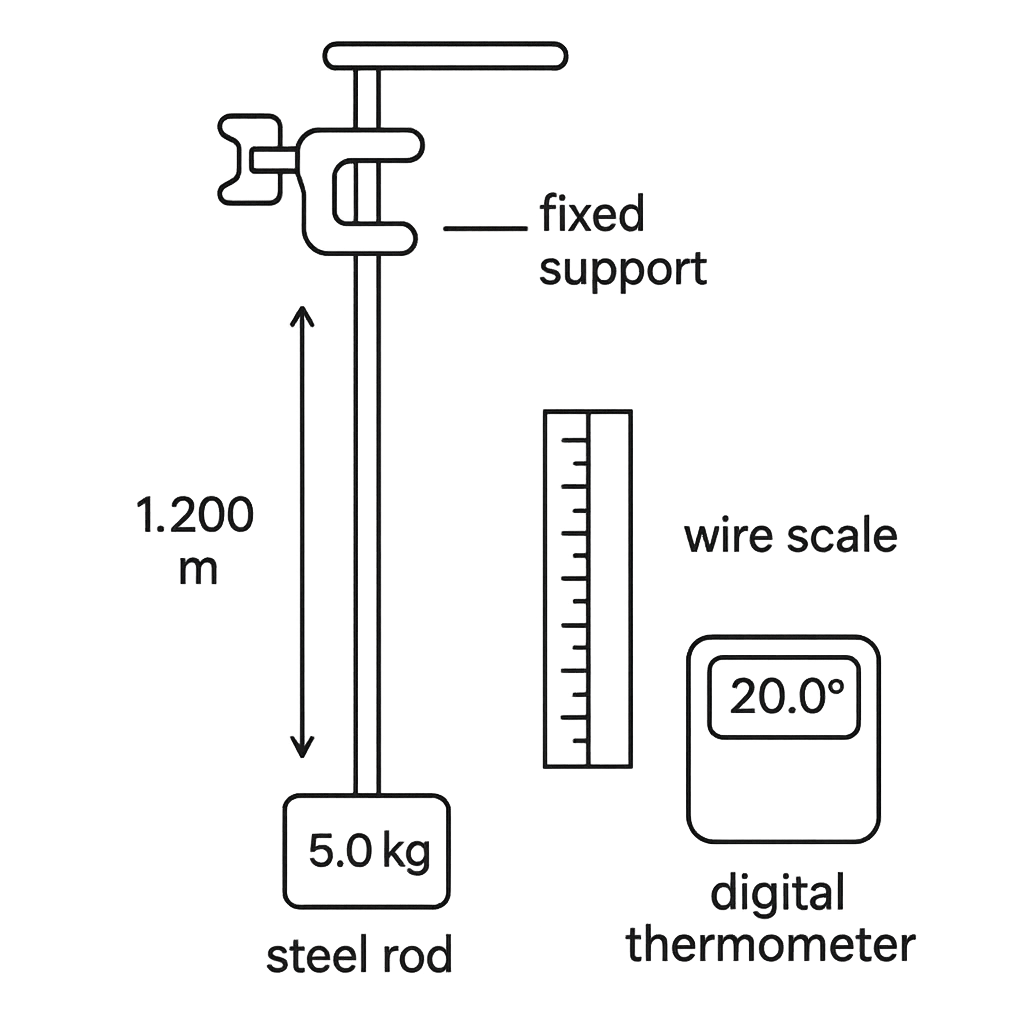
In a laboratory experiment to determine the coefficient of linear expansion (\(\alpha\)) of a steel rod, the following apparatus is used: a steel rod of length \(L_{0}=1.200\,\text{m}\) at \(20^{\circ}\text{C}\) suspended vertically from a fixed support, a set of calibrated weights totalling \(5.0\,\text{kg}\) attached to the lower end, a steel wire scale fixed at the base, and a digital thermometer reading temperature to the nearest \(0.1^{\circ}\text{C}\). The rod is allowed to reach thermal equilibrium at three different ambient temperatures: \(20^{\circ}\text{C}\), \(35^{\circ}\text{C}\) and \(50^{\circ}\text{C}\). The recorded extensions (increase in length) of the rod, measured from the scale, are \(0.0000\,\text{m}\), \(0.0018\,\text{m}\) and \(0.0036\,\text{m}\) respectively. The experiment is repeated with the same rod but with a different set of weights totalling \(2.0\,\text{kg}\), giving extensions of \(0.0000\,\text{m}\), \(0.0012\,\text{m}\) and \(0.0024\,\text{m}\) at the same temperatures.
Question Parts
(a)
Explain why the initial extension at \(20^{\circ}\text{C}\) is taken as zero for both weight sets.
(b)
Using the data for the 5.0 kg load, calculate the coefficient of linear expansion \(\alpha\) of the steel rod. Show all steps and state any assumptions made.
(c)
Discuss how changing the load from 5.0 kg to 2.0 kg could affect the measured value of \(\alpha\) and propose a method to minimise any systematic error arising from the load.
Detailed Essay Solution & Marking Scheme Available

Get the step-by-step mathematical proofs, key points required by examiners, and a comprehensive breakdown from our AI Tutor.
Question 2 View Details
A child throws a ball from the top of a 5.0 m high platform. The ball leaves the hand with a speed of 12.0 m s⁻¹ making an angle of 30° above the horizontal. Air resistance is negligible. The child then walks horizontally away from the platform at a constant speed of 2.0 m s⁻¹.
Question Parts
(a)
Resolve the initial velocity of the ball into horizontal and vertical components relative to the ground.
Detailed Essay Solution & Marking Scheme Available

Get the step-by-step mathematical proofs, key points required by examiners, and a comprehensive breakdown from our AI Tutor.

Question 3 View Details
A 0.250 kg aluminium block (specific heat capacity 900 J kg⁻¹ K⁻¹) at 150 °C is placed into 0.500 kg of water (specific heat capacity 4180 J kg⁻¹ K⁻¹) initially at 20 °C in an insulated container. No heat is lost to the surroundings.
Question Parts
(a)
Determine the final equilibrium temperature of the system.
(b)
Explain why the assumption of no heat loss is reasonable for this experiment.
Detailed Essay Solution & Marking Scheme Available

Get the step-by-step mathematical proofs, key points required by examiners, and a comprehensive breakdown from our AI Tutor.

Question 4 View Details
A string 1.20 m long is fixed at both ends and has a linear mass density of 2.5 × 10⁻³ kg m⁻¹. The string is under tension T and vibrates in its third harmonic.
Question Parts
(a)
Express the wavelength λ₃ of the third harmonic in terms of the string length L.
(b)
If the frequency of the third harmonic is 120 Hz, calculate the tension T in the string.
Detailed Essay Solution & Marking Scheme Available

Get the step-by-step mathematical proofs, key points required by examiners, and a comprehensive breakdown from our AI Tutor.

Question 5 View Details
A 12.0 kg block is released from rest at the top of a 5.0 m long incline that makes an angle of 20° with the horizontal. The first 3.0 m of the incline is smooth, after which the block encounters a rough section of length 2.0 m. The coefficient of kinetic friction on the rough section is unknown. The block just reaches the bottom of the incline with zero speed. The block is then pulled back up the same incline at constant speed by a horizontal force of 80 N applied via a light rope over a friction‑free pulley.
Question Parts
(a)
Determine the coefficient of kinetic friction on the rough section of the incline.
(b)
Calculate the work done by the horizontal pull force in pulling the block back up to its original position.
(c)
If the ascent takes 10.0 s, determine the average power supplied by the pull force.
Detailed Essay Solution & Marking Scheme Available

Get the step-by-step mathematical proofs, key points required by examiners, and a comprehensive breakdown from our AI Tutor.

Question 6 View Details
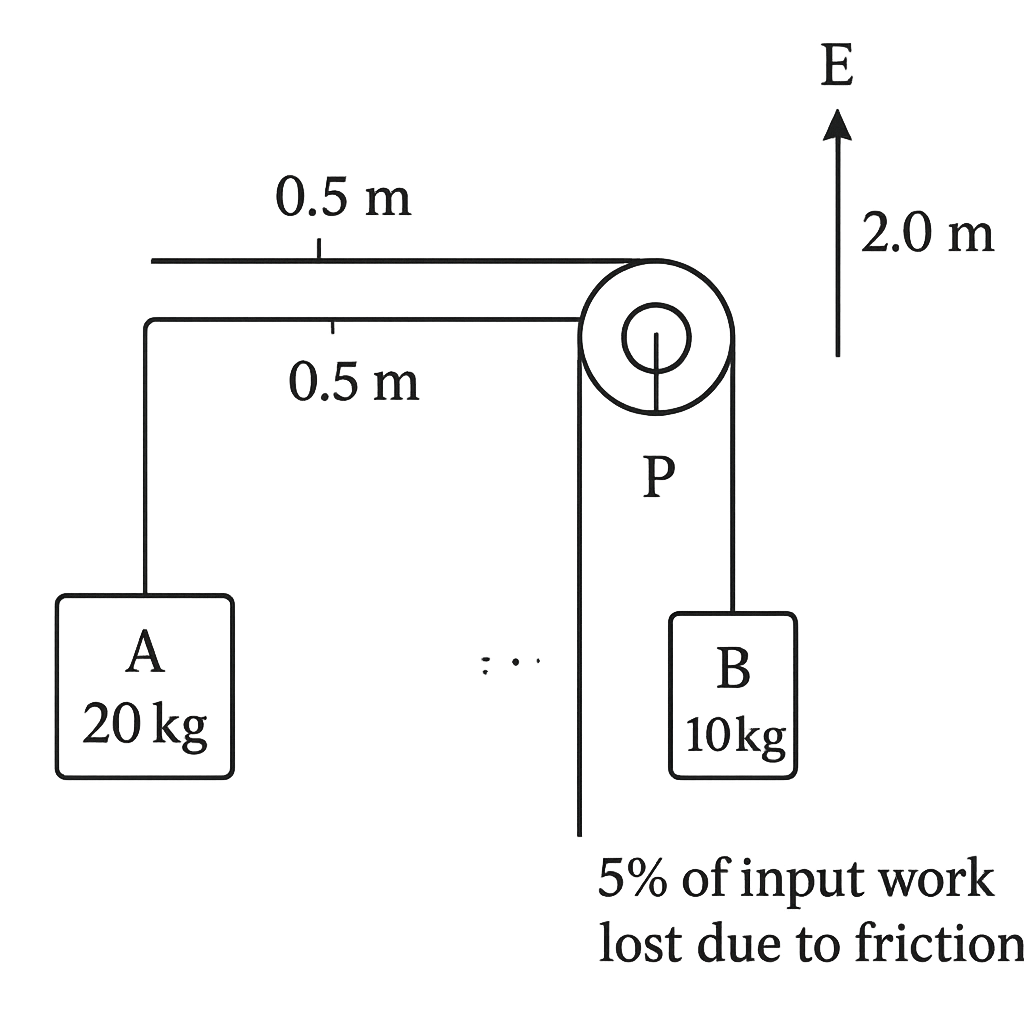
A compound pulley system is shown in the diagram. A 20 kg block (A) is attached to one end of a light, inextensible rope. The rope passes over a movable pulley (P) which is itself attached to a 10 kg block (B). The free end of the rope is pulled vertically upward by a person (the effort). The person pulls the rope through a distance of 2.0 m, causing the 20 kg block to rise a vertical distance of 0.5 m. The rope and pulleys are assumed massless. The system experiences friction in the pulley axle that dissipates 5 % of the total input work. Using g = 9.8 m s⁻², answer the following:
Question Parts
(a)
Determine the ideal mechanical advantage (IMA) of the system.
(b)
Calculate the actual mechanical advantage (AMA) of the system, taking the given friction loss into account.
(c)
Find the efficiency of the system expressed as a percentage.
(d)
Explain qualitatively how increasing the radius of the pulley wheel would affect the efficiency of the system, assuming that the frictional loss is proportional to the normal force exerted at the axle.
Detailed Essay Solution & Marking Scheme Available

Get the step-by-step mathematical proofs, key points required by examiners, and a comprehensive breakdown from our AI Tutor.

Question 7 View Details
A sealed cylindrical container of volume 2.0 L holds an unknown gas at 300 K. The container is connected at its base to a U‑tube manometer containing mercury (density = 13 600 kg m⁻³). The left leg of the manometer is open to the atmosphere (pressure = 101.3 kPa) and the right leg is connected to the container. The mercury levels differ by 15.0 cm, the mercury being higher in the leg attached to the container. Inside the container a vertical water column (density = 1000 kg m⁻³) of height 0.40 m rests on the bottom, so the gas occupies the space above the water. Using the diagram provided, answer the following:
Question Parts
(a)
Determine the absolute pressure of the gas in the container (in kPa, to one decimal place).
(b)
Assuming the gas behaves as an ideal gas, calculate the number of moles of gas present in the container (to three significant figures).
(c)
The temperature of the gas is raised to 350 K while the container volume and water column remain unchanged. (i) Calculate the new absolute pressure of the gas (kPa, to one decimal place). (ii) Determine the new height difference of the mercury columns in the manometer (cm, to one decimal place).
() Calculate the new absolute pressure of the gas.
() Determine the new mercury height difference in the manometer.
(d)
Explain qualitatively how the presence of the water column affects the pressure reading on the manometer compared with a direct connection to the gas (i.e., if the water column were absent).
Detailed Essay Solution & Marking Scheme Available

Get the step-by-step mathematical proofs, key points required by examiners, and a comprehensive breakdown from our AI Tutor.

Question 8 View Details
A 0.250 kg block of aluminium (specific heat capacity c₁ = 900 J kg⁻¹ K⁻¹) at 25 °C is placed in thermal contact with a 0.500 kg block of copper (c₂ = 385 J kg⁻¹ K⁻¹) initially at 80 °C. The two blocks are insulated from the surroundings and allowed to reach thermal equilibrium. Afterwards, the combined metal system is placed in a water bath containing 2.00 kg of water (c_w = 4186 J kg⁻¹ K⁻¹) at 20 °C, the whole arrangement being insulated from the environment. Specific heat capacities are taken as constant over the temperature range. The experiment is then repeated, but the aluminium block is coated with a thin layer of oil that provides a thermal resistance R_th = 0.02 K W⁻¹. The surface area of the aluminium block in contact with the water is 0.015 m². For steady‑state heat flow during equilibration with the water bath, the overall heat‑transfer coefficient can be approximated by h = 1 / R_th.
Question Parts
(a)
Determine the final equilibrium temperature of the aluminium–copper system before it is placed in the water bath.
(b)
After the metal system reaches the new equilibrium with the water bath, calculate the final temperature of the whole system.
Detailed Essay Solution & Marking Scheme Available

Get the step-by-step mathematical proofs, key points required by examiners, and a comprehensive breakdown from our AI Tutor.

Question 9 View Details
A sealed vertical cylinder contains 0.50 mol of an ideal diatomic gas at an initial temperature of 300 K and a pressure of 1.00 atm. The gas is first heated at constant volume until its temperature reaches 450 K. The cylinder then has a frictionless piston attached, and the gas is allowed to expand isothermally at 450 K until the pressure returns to 1.00 atm. (a) Calculate the amount of heat supplied to the gas during the constant‑volume heating. (b) Determine the work done by the gas during the subsequent isothermal expansion. (c) State the net change in internal energy of the gas for the whole two‑stage process. (d) If the heat added in part (a) is regarded as the energy input to a heat‑engine and the work obtained in part (b) is the useful output, evaluate the efficiency of this engine.
Question Parts
(a)
Calculate the amount of heat supplied to the gas during the constant‑volume heating.
(b)
Determine the work done by the gas during the subsequent isothermal expansion.
(c)
State the net change in internal energy of the gas for the whole two‑stage process.
(d)
If the heat added in part (a) is regarded as the energy input to a heat‑engine and the work obtained in part (b) is the useful output, evaluate the efficiency of this engine.
Detailed Essay Solution & Marking Scheme Available

Get the step-by-step mathematical proofs, key points required by examiners, and a comprehensive breakdown from our AI Tutor.

Question 10 View Details
A string of length L = 1.20 m is fixed at both ends. Its linear mass density is μ = 2.5×10⁻² kg m⁻¹. Initially the string is under a tension T₁ = 80 N, giving a fundamental frequency f₁. The tension is then increased to T₂ = 120 N, producing a new fundamental frequency f₂. (a) Determine f₁ and f₂. (b) The string at tension T₁ is plucked to vibrate in its fundamental mode. At the same time, a second identical string (same L and μ) is driven by an electronic oscillator at its fundamental frequency when the tension is 100 N. Find the beat frequency that would be heard. (c) When the string is kept at tension T₂, the amplitude of the standing wave decays with time according to A(t) = A₀ e^{‑t/τ}. If after 5.0 s the total mechanical energy of the standing wave is half its initial value, determine the decay constant τ. (d) Using the results obtained, discuss qualitatively how increasing the tension of a string influences (i) the speed of transverse waves on the string and (ii) the pitch of the musical note produced.
Question Parts
(a)
Determine the fundamental frequencies f₁ and f₂ for the two tensions.
(b)
Find the beat frequency produced when the two strings vibrate simultaneously as described.
(c)
Determine the decay constant τ given that the mechanical energy after 5.0 s is half the initial energy.
Detailed Essay Solution & Marking Scheme Available

Get the step-by-step mathematical proofs, key points required by examiners, and a comprehensive breakdown from our AI Tutor.

Master the Exam!

You've seen a preview, but there are thousands more questions plus AI tutor to break down complex solutions.

Unlock Full Access Available for Android & Windows
Help others prepare! Share this practice hub:
Chat with Support