gce model questions vol1 2025 chemistry | Objective

Prepare for your exams with gce model questions vol1 questions? Reviewing past/model questions is one of the most effective ways to guarantee a high score. This practice hub features authentic 2025 chemistry (Objective) questions designed to simulate the real exam environment.

Practice these randomly selected questions to test your readiness.
Question 1 View Details
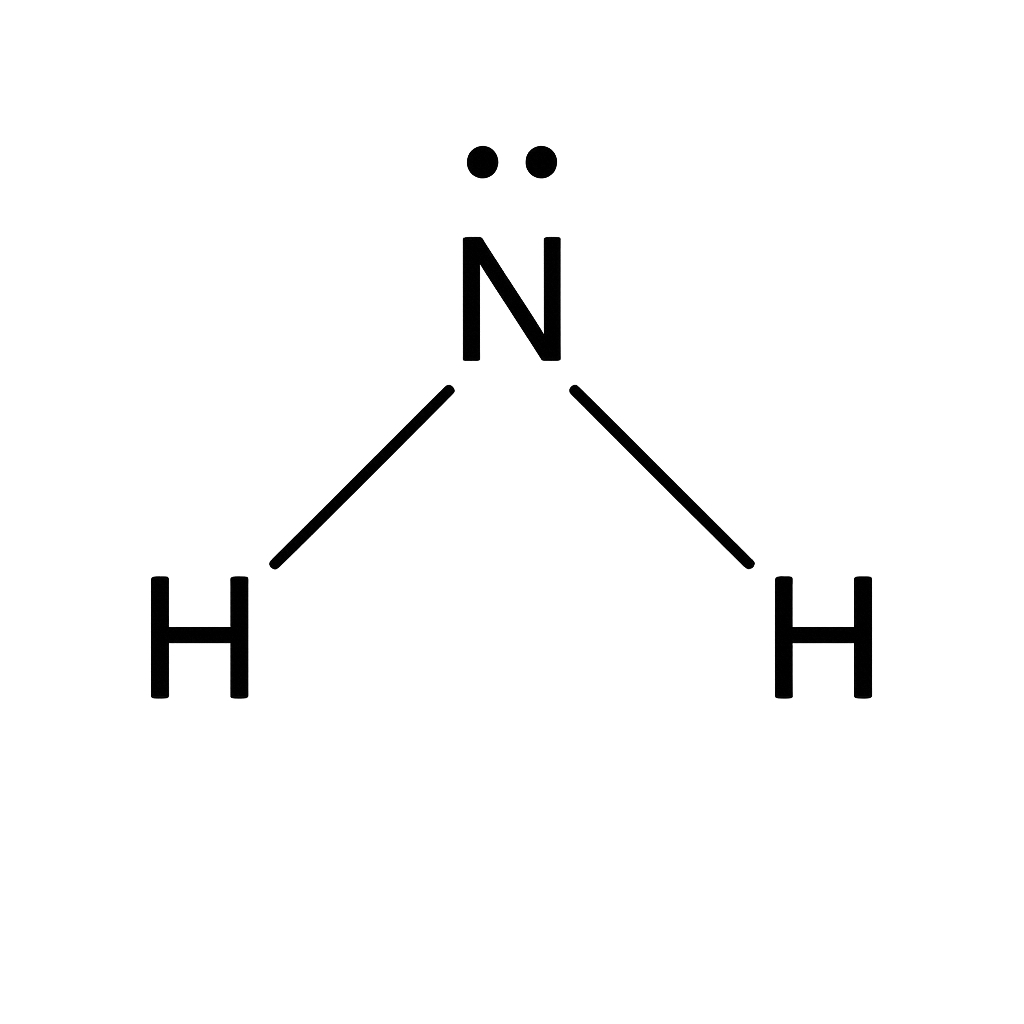
The diagram shows an ammonia (\( \mathrm{NH_3} \)) molecule with nitrogen as the central atom, three single bonds to hydrogen atoms and one lone pair on nitrogen. Identify the hybridisation of the nitrogen atom, state the molecular geometry, and give the approximate \( \angle \mathrm{H\!\!-\!N\!\!-\!H} \) bond angle.
A. sp hybridisation; linear geometry; bond angle ≈ 180°
B. sp² hybridisation; trigonal planar geometry; bond angle ≈ 120°
C. sp³ hybridisation; tetrahedral geometry; bond angle ≈ 109.5°
Correct D. sp³ hybridisation; trigonal pyramidal geometry; bond angle ≈ 107°

Correct Answer: D

Want to see the full step-by-step solution? Unlock AI Explanation & Analytics
Question 2 View Details
Ethyl acetate is formed by the esterification of acetic acid with ethanol: \( \mathrm{CH_3COOH + C_2H_5OH \rightleftharpoons CH_3COOC_2H_5 + H_2O} \). In a 1.0 L flask, 0.10 mol of acetic acid and 0.15 mol of ethanol are mixed. The equilibrium constant at 25 °C is \( K_c = 4.0 \). Assuming the volume remains 1.0 L and that water is initially absent, calculate the equilibrium concentrations of all species and the percentage of the initial acetic acid that has been converted to ester.
Correct A. [CH₃COOH] = 0.0215 M, [C₂H₅OH] = 0.0715 M, [CH₃COOC₂H₅] = 0.0785 M, [H₂O] = 0.0785 M; 78.5 % of the acid is converted.
B. [CH₃COOH] = 0.005 M, [C₂H₅OH] = 0.095 M, [CH₃COOC₂H₅] = 0.075 M, [H₂O] = 0.075 M; 95 % of the acid is converted.
C. [CH₃COOH] = 0.050 M, [C₂H₅OH] = 0.050 M, [CH₃COOC₂H₅] = 0.075 M, [H₂O] = 0.075 M; 50 % of the acid is converted.
D. [CH₃COOH] = 0.030 M, [C₂H₅OH] = 0.070 M, [CH₃COOC₂H₅] = 0.075 M, [H₂O] = 0.075 M; 75 % of the acid is converted.

Correct Answer: A

Want to see the full step-by-step solution? Unlock AI Explanation & Analytics
Question 3 View Details
Using bond enthalpies, calculate the standard enthalpy change for the reaction \( \mathrm{C(s,\,graphite) + 2\,H_2(g) \rightarrow CH_4(g)} \). Given: sublimation enthalpy of graphite \( \Delta H_{\text{sub}} = +716\ \text{kJ\,mol}^{-1} \); H-H bond enthalpy = 436 kJ mol⁻¹; C-H bond enthalpy = 413 kJ mol⁻¹. Show all steps.
A. -44 kJ mol⁻¹ (exothermic)
B. +64 kJ mol⁻¹ (endothermic)
C. -84 kJ mol⁻¹ (exothermic)
Correct D. -64 kJ mol⁻¹ (exothermic)

Correct Answer: D

Want to see the full step-by-step solution? Unlock AI Explanation & Analytics
Question 4 View Details
In acidic solution the following redox process occurs: \( \mathrm{MnO_4^- + C_2O_4^{2-} \rightarrow Mn^{2+} + CO_2} \). The standard reduction potentials are \( E^\circ(\mathrm{MnO_4^- / Mn^{2+}}) = +1.51\ \text{V} \) and \( E^\circ(\mathrm{C_2O_4^{2-} / CO_2}) = +0.49\ \text{V} \). (a) Balance the overall redox equation. (b) Calculate the standard cell potential \( E^\circ_{\text{cell}} \). (c) If the reaction is carried out at 25 °C with concentrations \([ \mathrm{MnO_4^-} ] = 0.010\ \text{M}\), \([ \mathrm{C_2O_4^{2-}} ] = 0.020\ \text{M}\), and \([ \mathrm{H^+} ] = 0.100\ \text{M}\), determine the cell potential using the Nernst equation (assume all other species have unit activity).
A. Balanced equation: 2 MnO₄⁻ + 5 C₂O₄²⁻ + 16 H⁺ → 2 Mn²⁺ + 10 CO₂ + 8 H₂O; E°cell = 1.12 V; E ≈ 0.95 V at the stated concentrations.
B. Balanced equation: 2 MnO₄⁻ + 3 C₂O₄²⁻ + 12 H⁺ → 2 Mn²⁺ + 6 CO₂ + 6 H₂O; E°cell = 0.92 V; E ≈ 0.78 V at the stated concentrations.
C. Balanced equation: 1 MnO₄⁻ + 5 C₂O₄²⁻ + 8 H⁺ → 1 Mn²⁺ + 10 CO₂ + 4 H₂O; E°cell = 1.02 V; E ≈ 0.90 V at the stated concentrations.
Correct D. Balanced equation: 2 MnO₄⁻ + 5 C₂O₄²⁻ + 16 H⁺ → 2 Mn²⁺ + 10 CO₂ + 8 H₂O; E°cell = 1.02 V; E ≈ 0.85 V at the stated concentrations.

Correct Answer: D

Want to see the full step-by-step solution? Unlock AI Explanation & Analytics
Question 5 View Details
A 2.00 g sample of an unknown hydrocarbon is combusted completely in excess oxygen, producing 5.60 g of carbon dioxide and 2.24 g of water. (a) Determine the empirical formula of the hydrocarbon. (b) Given that its molar mass is 56 g mol⁻¹, deduce its molecular formula.
A. Molecular formula C₃H₆
B. Molecular formula C₄H₁₀
Correct C. Molecular formula C₄H₈
D. Molecular formula C₅H₁₀

Correct Answer: C

Want to see the full step-by-step solution? Unlock AI Explanation & Analytics
Question 6 View Details
A 0.500 L solution contains 0.020 mol of the weak acid HA (Ka = 1.8×10⁻⁵) and its sodium salt NaA at 0.10 mol L⁻¹. 0.010 mol of HCl is added. Assuming the volume change is negligible, calculate the pH of the resulting solution.
A. 4.57
B. 4.02
C. 5.12
Correct D. 4.87

Correct Answer: D

Want to see the full step-by-step solution? Unlock AI Explanation & Analytics
Question 7 View Details
A galvanic cell consists of Zn|Zn²⁺ (0.010 M) || Cu²⁺ (0.10 M) |Cu at 298 K. Standard potentials are E°(Zn²⁺/Zn) = -0.76 V and E°(Cu²⁺/Cu) = +0.34 V. Calculate the cell potential when the temperature is raised to 310 K, using the Nernst equation (assume activities ≈ concentrations).
A. 0.97 V
Correct B. 1.13 V
C. 1.05 V
D. 1.20 V

Correct Answer: B

Want to see the full step-by-step solution? Unlock AI Explanation & Analytics
Question 8 View Details
For the molecule SF₄, determine the hybridisation of the central sulphur atom, give the approximate angle between an axial and an equatorial S-F bond, and state whether the molecule is polar.
A. sp²d; ≈102°; polar
B. sp³; ≈109.5°; nonpolar
Correct C. sp³d; ≈90°; polar
D. sp³d²; ≈90°; nonpolar

Correct Answer: C

Want to see the full step-by-step solution? Unlock AI Explanation & Analytics
Question 9 View Details
A sample of an unknown alkane CₙH₂ₙ₊₂ is combusted completely in excess O₂, producing 88.0 g of CO₂ and 54.1 g of H₂O. Determine the molecular formula of the alkane and calculate its standard enthalpy of combustion per mole, given ΔH_f°(CO₂) = -393.5 kJ mol⁻¹, ΔH_f°(H₂O, l) = -285.8 kJ mol⁻¹ and ΔH_f°(alkane) ≈ -(n·20) kJ mol⁻¹.
A. C₄H₁₀; -2.50×10³ kJ mol⁻¹
B. C₃H₈; -2.04×10³ kJ mol⁻¹
C. C₂H₆; -1.45×10³ kJ mol⁻¹
Correct D. C₂H₆; -1.60×10³ kJ mol⁻¹

Correct Answer: D

Want to see the full step-by-step solution? Unlock AI Explanation & Analytics
Question 10 View Details
In an electrolytic cell containing molten NaCl, a constant current of 2.00 A is passed for 30.0 min. The current efficiency for Na deposition is 85 %. (a) Calculate the theoretical mass of Na that would be deposited at 100 % efficiency. (b) Find the actual mass deposited. (c) If the remaining charge is used for water electrolysis (2 H₂O → O₂ + 4 H⁺ + 4 e⁻) with 100 % efficiency, determine the volume of H₂ gas produced at STP.
A. (a) 0.857 g; (b) 0.686 g; (c) 0.063 L
Correct B. (a) 0.857 g; (b) 0.728 g; (c) 0.063 L
C. (a) 0.857 g; (b) 0.728 g; (c) 0.067 L
D. (a) 0.900 g; (b) 0.765 g; (c) 0.070 L

Correct Answer: B

Want to see the full step-by-step solution? Unlock AI Explanation & Analytics
Question 11 View Details
A mixture containing 5.0 g of aluminium metal and 10.0 g of copper(II) sulfate \(\mathrm{CuSO_{4}}\) is heated according to the reaction \(2\,\mathrm{Al} + 3\,\mathrm{CuSO_{4}} \rightarrow \mathrm{Al_{2}(SO_{4})_{3}} + 3\,\mathrm{Cu}\). If the reaction proceeds with an 85 % yield of copper, calculate the mass of copper actually obtained.
A. 2.55 g
B. 3.98 g
Correct C. 3.39 g
D. 3.19 g

Correct Answer: C

Want to see the full step-by-step solution? Unlock AI Explanation & Analytics
Question 12 View Details
A buffer solution is prepared by dissolving 2.00 g of benzoic acid \(\mathrm{C_{6}H_{5}COOH}\) (\(pK_{a}=4.20\)) and 2.94 g of sodium benzoate \(\mathrm{NaC_{6}H_{5}COO}\) in 500 mL of water. Then 25.0 mL of 0.200 M NaOH is added. Assuming the volume change is negligible, calculate the pH of the solution after the addition of NaOH.
A. 5.00
B. 4.70
C. 4.30
Correct D. 4.55

Correct Answer: D

Want to see the full step-by-step solution? Unlock AI Explanation & Analytics
Question 13 View Details
For the molecule sulfur tetrafluoride \(\mathrm{SF_{4}}\), determine the hybridisation of the central sulfur atom and give the approximate bond angle between the two axial fluorine atoms.
A. sp²d hybridisation; axial F-S-F angle ≈ 150°
Correct B. sp³d hybridisation; axial F-S-F angle ≈ 173°
C. sp³ hybridisation; axial F-S-F angle ≈ 180°
D. sp³d² hybridisation; axial F-S-F angle ≈ 120°

Correct Answer: B

Want to see the full step-by-step solution? Unlock AI Explanation & Analytics
Question 14 View Details
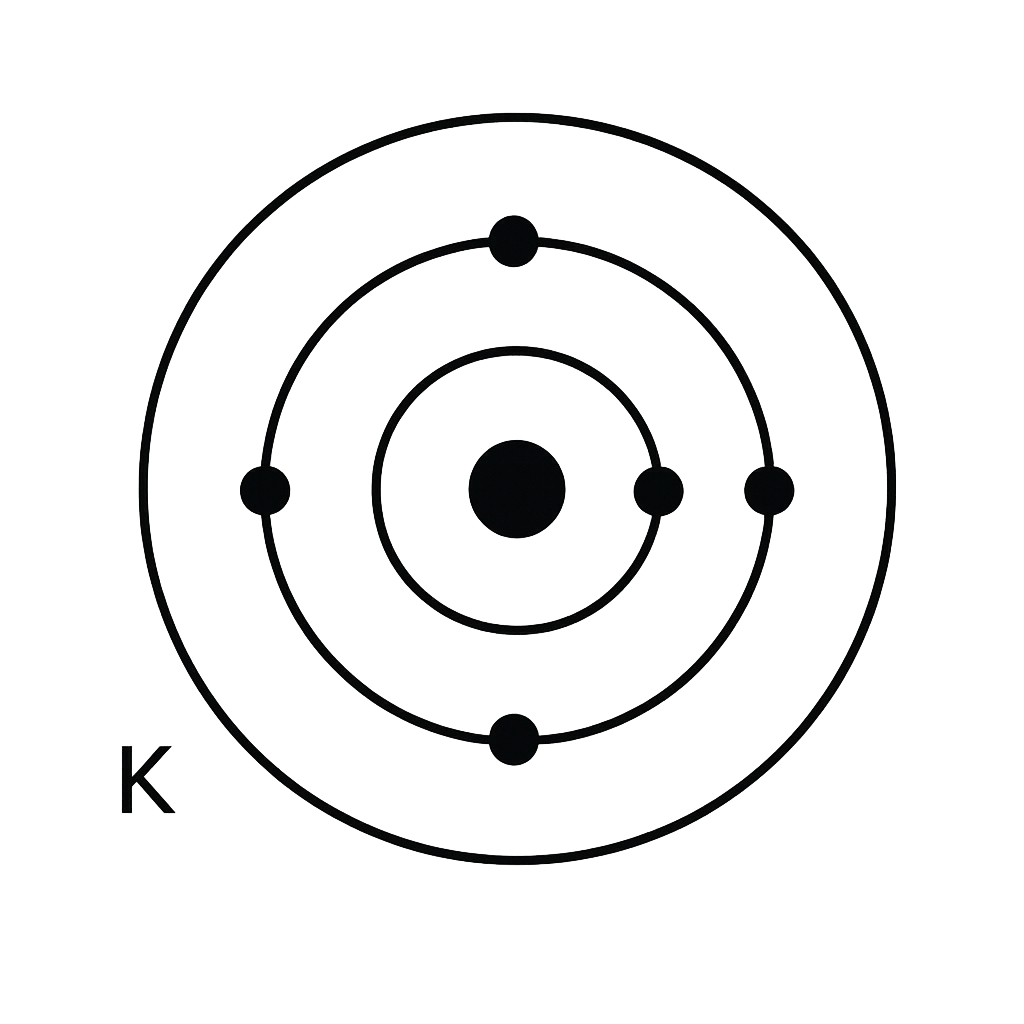
The diagram shows a Bohr model of a neutral atom of element X. The K shell contains 2 electrons and the L shell contains 5 electrons. Identify the element and write its ground‑state electron configuration in spectroscopic notation.
A. Carbon; 1s² 2s² 2p²
Correct B. Nitrogen; 1s² 2s² 2p³
C. Oxygen; 1s² 2s² 2p⁴
D. Boron; 1s² 2s² 2p¹

Correct Answer: B

Want to see the full step-by-step solution? Unlock AI Explanation & Analytics
Question 15 View Details
Calcium fluoride (\(\mathrm{CaF_{2}}\)) has a solubility in pure water of \(2.1\times10^{-4}\,\text{mol L}^{-1}\). (a) Calculate its solubility product \(K_{sp}\). (b) If the solution is saturated with \(0.010\;\text{M}\) sodium fluoride (\(\mathrm{NaF}\)), determine the new solubility of \(\mathrm{CaF_{2}}\) under these conditions.
A. Ksp = 1.2×10⁻⁹; solubility in 0.010 M NaF = 1.2×10⁻⁶ mol L⁻¹
B. Ksp = 2.5×10⁻¹⁰; solubility in 0.010 M NaF = 2.5×10⁻⁶ mol L⁻¹
Correct C. Ksp = 3.7×10⁻¹¹; solubility in 0.010 M NaF = 3.7×10⁻⁷ mol L⁻¹
D. Ksp = 5.0×10⁻¹²; solubility in 0.010 M NaF = 5.0×10⁻⁸ mol L⁻¹

Correct Answer: C

Want to see the full step-by-step solution? Unlock AI Explanation & Analytics
Question 16 View Details
The standard enthalpies of formation of nitrogen oxides are: \(\Delta_f H^\circ(\text{NO}) = +90.3\ \text{kJ mol}^{-1}\), \(\Delta_f H^\circ(\text{N}_2\text{O}) = +82.0\ \text{kJ mol}^{-1}\), and \(\Delta_f H^\circ(\text{NO}_2) = +33.2\ \text{kJ mol}^{-1}\). Using the bond dissociation energies \(D(\text{N}\equiv\text{N}) = 945\ \text{kJ mol}^{-1}\) and \(D(\text{O}=\text{O}) = 498\ \text{kJ mol}^{-1}\), determine the average N=O double‑bond enthalpy in \(\text{NO}_2\).
A. 280
B. 340
Correct C. 306
D. 250

Correct Answer: C

Want to see the full step-by-step solution? Unlock AI Explanation & Analytics
Question 17 View Details
A piece of zinc metal is placed in an aqueous solution containing \(0.10\ \text{mol}\) of \(\text{Fe}^{3+}\) and \(0.15\ \text{mol}\) of \(\text{Cu}^{2+}\). Standard reduction potentials are: \(\text{Zn}^{2+}/\text{Zn} = -0.76\ \text{V}\), \(\text{Fe}^{3+}/\text{Fe}^{2+} = +0.77\ \text{V}\), \(\text{Cu}^{2+}/\text{Cu} = +0.34\ \text{V}\). Assuming the reactions proceed spontaneously, which ion is reduced first? Then calculate the maximum mass of copper that can be deposited after all \(\text{Fe}^{3+}\) has been reduced.
A. 11.3
Correct B. 9.5
C. 6.4
D. 8.0

Correct Answer: B

Want to see the full step-by-step solution? Unlock AI Explanation & Analytics
Question 18 View Details
A polymer is prepared from a monomer of molar mass \(M_{\text{m}} = 100\ \text{g mol}^{-1}\). In a dilute solution its intrinsic viscosity is measured as \([\eta] = 0.85\ \text{dL g}^{-1}\). The Mark-Houwink relationship is \([\eta] = K\,M_n^{\,a}\) with \(K = 1.5\times10^{-4}\ \text{dL g}^{-1}\) and \(a = 0.75\). Calculate the number‑average molecular weight \(M_n\) of the polymer and the degree of polymerisation (DP).
A. 1.2e5 g mol^-1, DP ≈ 1.2e3
B. 9.2e4 g mol^-1, DP ≈ 9.2e2
C. 5.0e4 g mol^-1, DP ≈ 5.0e2
Correct D. 1.0e5 g mol^-1, DP ≈ 1.0e3

Correct Answer: D

Want to see the full step-by-step solution? Unlock AI Explanation & Analytics
Question 19 View Details
Twenty‑five point zero grams of 2‑butanol (\(\text{C}_4\text{H}_{10}\text{O}\)) are oxidised with excess potassium dichromate in acidic medium to give butan‑2‑one. The balanced redox equation is \(3\,\text{C}_4\text{H}_{10}\text{O} + \text{K}_2\text{Cr}_2\text{O}_7 + 4\,\text{H}_2\text{SO}_4 \rightarrow 3\,\text{C}_4\text{H}_8\text{O} + \text{K}_2\text{SO}_4 + \text{Cr}_2(\text{SO}_4)_3 + 7\,\text{H}_2\text{O}\). Determine the theoretical mass of butan‑2‑one produced and, if the actual yield is \(78\%\), the mass actually obtained.
A. 22.5 g (theoretical), 17.6 g (actual)
B. 20.0 g (theoretical), 15.6 g (actual)
Correct C. 24.3 g (theoretical), 18.9 g (actual)
D. 26.0 g (theoretical), 20.3 g (actual)

Correct Answer: C

Want to see the full step-by-step solution? Unlock AI Explanation & Analytics
Question 20 View Details
Using a Born-Haber cycle, calculate the lattice energy of magnesium oxide and calcium oxide. The data are: \(\Delta_f H^\circ(\text{MgO}) = -601.6\ \text{kJ mol}^{-1}\), \(\Delta_f H^\circ(\text{CaO}) = -635\ \text{kJ mol}^{-1}\); sublimation enthalpies \(\Delta_{\text{sub}}H(\text{Mg}) = 148\ \text{kJ mol}^{-1}\), \(\Delta_{\text{sub}}H(\text{Ca}) = 178\ \text{kJ mol}^{-1}\); first ionisation energies \(IE_1(\text{Mg}) = 738\ \text{kJ mol}^{-1}\), \(IE_1(\text{Ca}) = 590\ \text{kJ mol}^{-1}\); electron affinity of oxygen \(EA(\text{O}) = -141\ \text{kJ mol}^{-1}\); O-O bond dissociation energy \(D(\text{O}=\text{O}) = 498\ \text{kJ mol}^{-1}\). Assume the lattice energy \(U\) is the only unknown in each cycle and give its value (in kJ mol\(^{-1}\)).
A. MgO: -1.55e3 kJ mol^-1, CaO: -1.45e3 kJ mol^-1
Correct B. MgO: -1.60e3 kJ mol^-1, CaO: -1.51e3 kJ mol^-1
C. MgO: -1.45e3 kJ mol^-1, CaO: -1.40e3 kJ mol^-1
D. MgO: -1.75e3 kJ mol^-1, CaO: -1.60e3 kJ mol^-1

Correct Answer: B

Want to see the full step-by-step solution? Unlock AI Explanation & Analytics
Question 21 View Details
Two elements, X and Y, both belong to period 4 of the periodic table. The atomic radius of X is 150 pm and that of Y is 120 pm. Which element is positioned to the right of the other in the period?
A. Z
B. W
Correct C. Y
D. X

Correct Answer: C

Want to see the full step-by-step solution? Unlock AI Explanation & Analytics
Question 22 View Details
The solubility product of calcium fluoride at 25 °C is \(K_{sp}=1.5\times10^{-10}\). A 0.500 L saturated solution therefore contains a concentration \(s\) mol L\(^{-1}\) of \(\text{Ca}^{2+}\) and \(2s\) mol L\(^{-1}\) of \(\text{F}^{-}\). If 0.010 mol of NaF is added to this solution, calculate the mass of CaF\(_2\) that will precipitate (assume the volume remains 0.500 L).
A. 0.012 g
B. 0.020 g
Correct C. 0.013 g
D. 0.005 g

Correct Answer: C

Want to see the full step-by-step solution? Unlock AI Explanation & Analytics
Question 23 View Details
A molecule has the formula \(\mathrm{C}_5\mathrm{H}_8\mathrm{O}_2\). Its structure consists of a five‑carbon chain. At carbon 1 there is a carboxylic acid group (-COOH). Between carbon 3 and carbon 4 there is a carbon-carbon double bond, and carbon 3 also bears a methyl substituent. Write the IUPAC name of the compound.
Correct A. 3‑methylpent‑3‑enoic acid
B. 2‑methylpent‑3‑enoic acid
C. 3‑methylpent‑4‑enoic acid
D. 3‑methylpent‑2‑enoic acid

Correct Answer: A

Want to see the full step-by-step solution? Unlock AI Explanation & Analytics
Question 24 View Details
In the reaction \(\text{Fe}_2\text{O}_3 + 3\text{CO} \rightarrow 2\text{Fe} + 3\text{CO}_2\), 12.0 g of Fe\(_2\)O\(_3\) are mixed with 10.0 g of CO and heated until the reaction is complete. (a) Calculate the theoretical mass of iron produced. (b) If the actual mass of iron obtained is 5.0 g, determine the percent yield.
A. 7.12 g; 55 %
B. 9.85 g; 70 %
C. 8.39 g; 45 %
Correct D. 8.39 g; 60 %

Correct Answer: D

Want to see the full step-by-step solution? Unlock AI Explanation & Analytics
Question 25 View Details
The esterification of benzoic acid with ethanol follows the equilibrium\n\(\text{C}_6\text{H}_5\text{COOH} + \text{C}_2\text{H}_5\text{OH} \rightleftharpoons \text{C}_6\text{H}_5\text{COOC}_2\text{H}_5 + \text{H}_2\text{O}\)\nwith an equilibrium constant \(K = 4.0\times10^{-3}\) at 25 °C (activities of water are taken as unity). In a 1.00 L flask, 0.50 mol of benzoic acid and 0.80 mol of ethanol are placed. Calculate (a) the equilibrium concentration of ethyl benzoate, and (b) the percentage conversion of benzoic acid to ester.
A. 5.0×10⁻⁴ mol L⁻¹; 0.10 %
B. 1.0×10⁻³ mol L⁻¹; 0.20 %
Correct C. 1.3×10⁻³ mol L⁻¹; 0.25 %
D. 2.0×10⁻³ mol L⁻¹; 0.40 %

Correct Answer: C

Want to see the full step-by-step solution? Unlock AI Explanation & Analytics

Master the Exam!

You've seen a preview, but there are thousands more questions plus AI tutor to break down complex solutions.

Unlock Full Access Available for Android & Windows
Help others prepare! Share this practice hub:
Chat with Support